Protocol
Protocol is animportant part
of diplomatic practice linked
with history, royalty, religion,
culture and language.
3.
Protocol
Protocol involves etiquetteon
a local and international scale,
and the practice of good
manners on a daily basis. It
evolved as a result of old
traditions, when in the early
days of civilization hospitality
was extended to an arriving
guest.
4.
Protocol
• Today itis particularly
important because it not
only covers the ceremonial
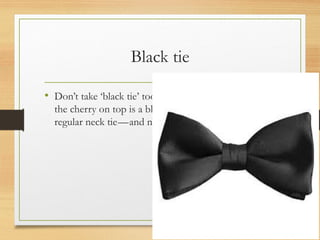
rules that are followed
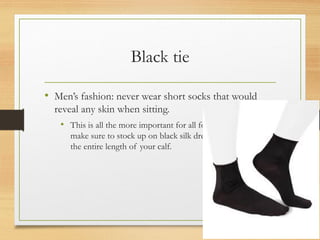
during official functions
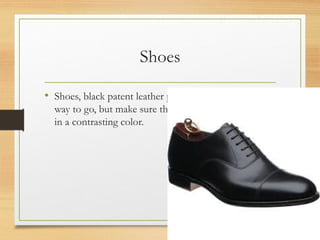
and how to behave on
these special occasions, but
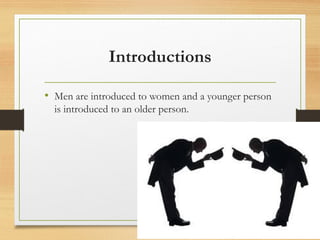
it also provides a set of
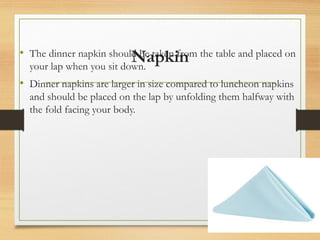
established rules of
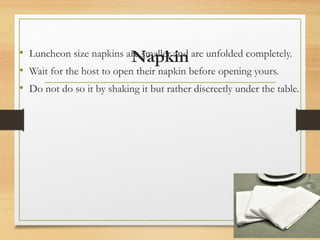
courteousness that are to
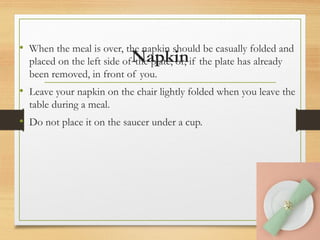
be respected in society.
5.
International politics
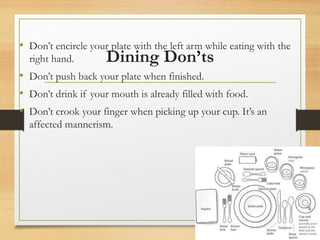
• Ininternational politics, protocol is the etiquette
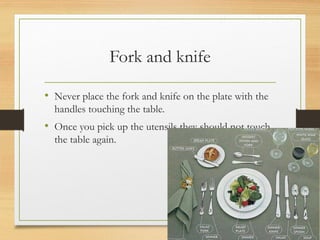
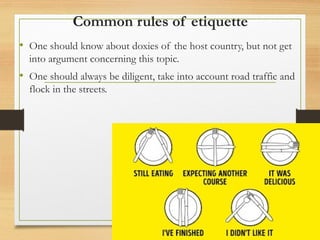
of diplomacy and affairs of state.
• It may also refer to an international agreement that
supplements or amends a treaty.
• A protocol is a rule which describes how an
activity should be performed, especially in the field
of diplomacy.
6.
Diplomatic services
• Indiplomatic services and governmental fields of
endeavor protocols are often unwritten guidelines.
• Protocols specify the proper and generally accepted
behavior in matters of state and diplomacy, such as
showing appropriate respect to a head of state,
ranking diplomats in chronological order of their
accreditation at court, and so on.
7.
Definitions
• There aretwo meanings of the
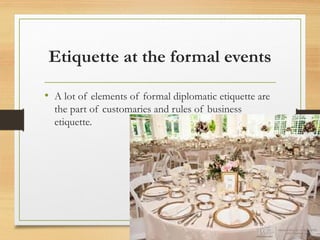
word "protocol".
• In the legal sense, it is defined as
an international agreement that
supplements or amends a treaty.
• In the diplomatic sense, the term
refers to the set of rules,
procedures, conventions and
ceremonies that relate to relations
between states.
• In general, protocol represents
the recognized and generally
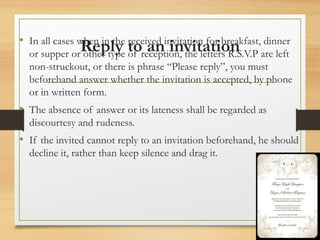
accepted system of international
courtesy.
8.
Definitions
• The termprotocol is derived, via French and Medieval
• Latin, from the Greek word πρωτόκολλον protokollon "first glued
sheet of or onto a papyrus-roll".
• This comes from the act of gluing a sheet of paper to the front
of a document to preserve it when it was sealed, which imparted
additional authenticity to it.
• In the beginning, the term protocol related to the various forms
of interaction observed in official correspondence between states,
which were often elaborate in nature. In course of time, however,
it has come to cover a much wider range of international
relations.
9.
Protocol and etiquette
•Protocol and etiquette are resources for proper
conduct in unfamiliar settings, toolkits to leave a
lasting good first impression, avoid giving offence,
and a hallmark of sophistication.
10.
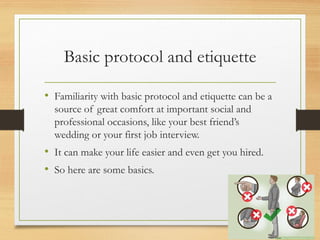
Basic protocol andetiquette
• Familiarity with basic protocol and etiquette can be a
source of great comfort at important social and
professional occasions, like your best friend’s
wedding or your first job interview.
• It can make your life easier and even get you hired.
• So here are some basics.
11.
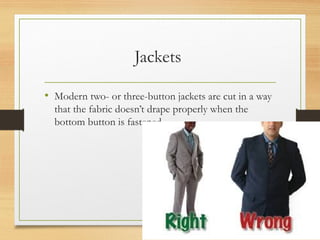
Jackets
• Modern two-or three-button jackets are cut in a way
that the fabric doesn’t drape properly when the
bottom button is fastened.
12.
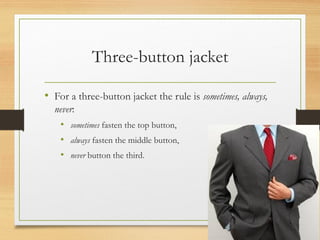
Three-button jacket
• Fora three-button jacket the rule is sometimes, always,
never:
• sometimes fasten the top button,
• always fasten the middle button,
• never button the third.
13.
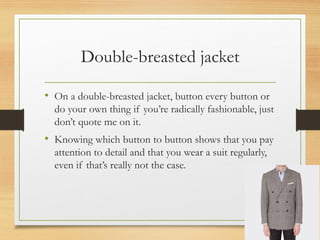
Double-breasted jacket
• Ona double-breasted jacket, button every button or
do your own thing if you’re radically fashionable, just
don’t quote me on it.
• Knowing which button to button shows that you pay
attention to detail and that you wear a suit regularly,
even if that’s really not the case.
14.
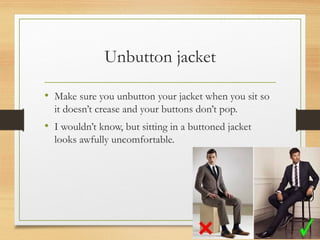
Unbutton jacket
• Makesure you unbutton your jacket when you sit so
it doesn’t crease and your buttons don’t pop.
• I wouldn’t know, but sitting in a buttoned jacket
looks awfully uncomfortable.
15.
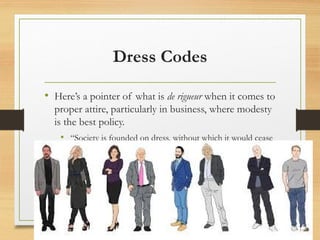
Dress Codes
• Here’sa pointer of what is de rigueur when it comes to
proper attire, particularly in business, where modesty
is the best policy.
• “Society is founded on dress, without which it would cease
to exist.”
16.
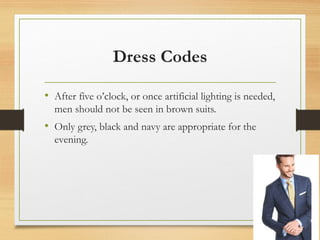
Dress Codes
• Afterfive o’clock, or once artificial lighting is needed,
men should not be seen in brown suits.
• Only grey, black and navy are appropriate for the
evening.
17.
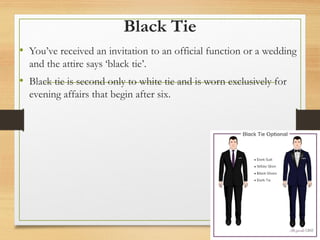
Black Tie
• You’vereceived an invitation to an official function or a wedding
and the attire says ‘black tie’.
• Black tie is second only to white tie and is worn exclusively for
evening affairs that begin after six.
18.
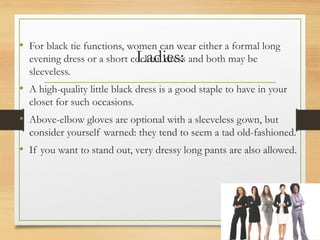
Ladies:
• For blacktie functions, women can wear either a formal long
evening dress or a short cocktail dress and both may be
sleeveless.
• A high-quality little black dress is a good staple to have in your
closet for such occasions.
• Above-elbow gloves are optional with a sleeveless gown, but
consider yourself warned: they tend to seem a tad old-fashioned.
• If you want to stand out, very dressy long pants are also allowed.
19.
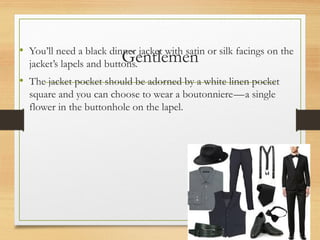
Gentlemen
• You’ll needa black dinner jacket with satin or silk facings on the
jacket’s lapels and buttons.
• The jacket pocket should be adorned by a white linen pocket
square and you can choose to wear a boutonniere—a single
flower in the buttonhole on the lapel.
20.
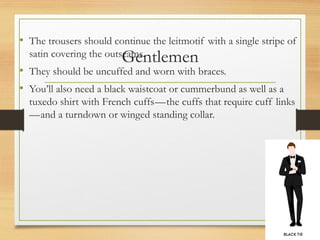
Gentlemen
• The trousersshould continue the leitmotif with a single stripe of
satin covering the outseams.
• They should be uncuffed and worn with braces.
• You’ll also need a black waistcoat or cummerbund as well as a
tuxedo shirt with French cuffs—the cuffs that require cuff links
—and a turndown or winged standing collar.
21.
Black tie
• Don’ttake ‘black tie’ too literary; what you’ll need as
the cherry on top is a black silk bow tie—not a
regular neck tie—and none of that clip-on nonsense.
22.
Black tie
• Men’sfashion: never wear short socks that would
reveal any skin when sitting.
• This is all the more important for all formal attires, so
make sure to stock up on black silk dress socks that cover
the entire length of your calf.
23.
Shoes
• Shoes, blackpatent leather pumps or oxfords are the
way to go, but make sure the soles aren’t too thick or
in a contrasting color.
24.
Introductions
• When makingintroductions, honor is recognized by
the name spoken first, meaning that the higher-
ranking person’s name should be mentioned first.
25.
Introductions
• Men areintroduced to women and a younger person
is introduced to an older person.
26.
Napkin
• The dinnernapkin should be taken from the table and placed on
your lap when you sit down.
• Dinner napkins are larger in size compared to luncheon napkins
and should be placed on the lap by unfolding them halfway with
the fold facing your body.
27.
Napkin
• Luncheon sizenapkins are smaller and are unfolded completely.
• Wait for the host to open their napkin before opening yours.
• Do not do so it by shaking it but rather discreetly under the table.
28.
Napkin
• When themeal is over, the napkin should be casually folded and
placed on the left side of the plate, or, if the plate has already
been removed, in front of you.
• Leave your napkin on the chair lightly folded when you leave the
table during a meal.
• Do not place it on the saucer under a cup.
29.
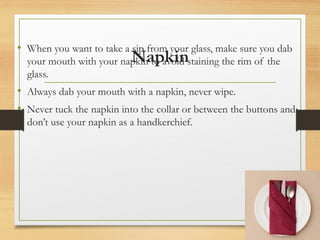
Napkin
• When youwant to take a sip from your glass, make sure you dab
your mouth with your napkin to avoid staining the rim of the
glass.
• Always dab your mouth with a napkin, never wipe.
• Never tuck the napkin into the collar or between the buttons and
don’t use your napkin as a handkerchief.
30.
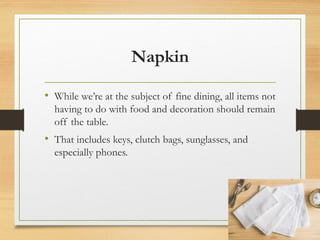
Napkin
• While we’reat the subject of fine dining, all items not
having to do with food and decoration should remain
off the table.
• That includes keys, clutch bags, sunglasses, and
especially phones.
31.
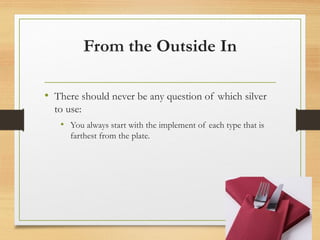
From the OutsideIn
• There should never be any question of which silver
to use:
• You always start with the implement of each type that is
farthest from the plate.
32.
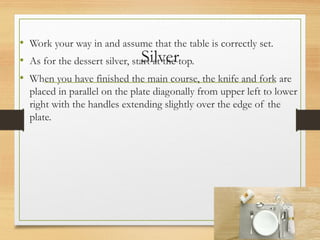
Silver
• Work yourway in and assume that the table is correctly set.
• As for the dessert silver, start at the top.
• When you have finished the main course, the knife and fork are
placed in parallel on the plate diagonally from upper left to lower
right with the handles extending slightly over the edge of the
plate.
33.
Fork and knife
•Never place the fork and knife on the plate with the
handles touching the table.
• Once you pick up the utensils they should not touch
the table again.
34.
Knife and fork
•There are two different styles of using a knife and a fork: the
American and the European style.
• The first implies changing the fork from left to right hand after
using the knife to cut food and, although uncommon in Europe,
is perfectly correct, but perhaps unnecessarily complicated.
• The European method of leaving the fork in your left hand after
using the knife with your right hand is much simpler.
35.
Knife and fork
•One of the most common, but less known, faux pas:
never place the fork and knife on the plate with the
handles touching the table.
• Once you pick up the utensils they should not touch
the table again.
36.
Dining Don’ts
• Don’tencircle your plate with the left arm while eating with the
right hand.
• Don’t push back your plate when finished.
• Don’t drink if your mouth is already filled with food.
• Don’t crook your finger when picking up your cup. It’s an
affected mannerism.
37.
Netiquette
• Avoid indulgingin arguments on social networks and
keep personal conversations private.
• Keep in mind how easily e-gossip can be forwarded
along to the wrong person.
• Posting photos of your friend’s babies or children on
your social media accounts without their knowledge
and permit can be a major breach of trust.
38.
Work Etiquette
• Example:
•when leaving a room in a business office, always step back to
allow your superior to go first if they are about to leave too.
• This one is important because it seems counter-intuitive
at first glance:
• when getting into a taxi with a superior, go first so she doesn’t
have to scooch across the seat.
• When entering the elevator, also go first.
• This is to allow the senior person to exit first.
39.
Do’s and Don’tsof Diplomatic
Etiquette
• Calling cards:
• a married women must never leave a card on a man
• Seat dinner guests:
• If you place official guests wrongly they may protest officially the
next day, or even leave your house after the soup.
• Dress:
• women is never formally dressed for daytime functions outside home
unless she is wearing a hat and gloves…women officers would be
well advised to keep a hat and glove in the office for such
emergencies.
40.
Do’s and Don’tsof Diplomatic
Etiquette
• Humour:
• Beware the temptations of wit and the dangers of humour.
• Failures in this line can lead to misunderstandings
• Dress:
• When deciding what to wear on an ordinary day remember that it may bring
unexpected demands.
• Public speaking:
• Do not speak for too long.
• Try not to use a text
• Your audience is more likely to stay awake.
41.
Principles of diplomatic
etiquette
•Diplomatic etiquette is the complex of customaries,
rules, habits, observed by government facilities,
organizations, authorities, businessmen and others,
who participate in external communication.
42.
Principles of diplomatic
etiquette
•Principles of diplomatic etiquette:
• Comity of nations
• International character of diplomatic etiquette
• Any foreign person, who in the host state, should be
respected on the part of official persons and government of
this country.
• Each foreigner should show respect to the government,
customs, traditions, lows of the host state.
3. Principle of mutuality
43.
Etiquette at theformal events
• To formal events one may refer different receptions and
ceremonies, held on the occasion of national holidays, historically
significant dates, arrival of foreign delegations, heads of state and
government, etc.
• Such receptions are navigated by heads of state, government,
ministers, and also embassies, consular agencies, trade delegations
of the state abroad.
44.
Etiquette at theformal events
• To formal events one may refer different receptions
and ceremonies, held on the occasion of national
holidays, historically significant dates, arrival of
foreign delegations, heads of state and government,
etc.
• Such receptions are navigated by heads of state,
government, ministers, and also embassies, consular
agencies, trade delegations of the state abroad.
45.
Etiquette at theformal events
• Military attaches, commanding officers, who have the
visit of friendship at foreign base, representatives of
local military command and civil authorities in
accordance with the procedure of solemnities
extension to military guests may also navigate
receptions.
46.
Etiquette at theformal events
• Diplomatic receptions are given independent from any
event in the procedure of daily diplomatic operation.
• For diplomatic mission such receptions are the most
common.
• Because of the fewness of guests, such events may be a
good possibility for conversational gambit, strengthening
and extension of contacts, getting of the necessary
information, influence on the local circles at the necessary
way, specification of external policy of the country.
47.
Etiquette at theformal events
• Independent from purpose, size and type, diplomatic
reception carries political character, as it provides
meeting of foreign representatives.
• Being abroad, the visitor should respect rules and
customs, accepted in this country.
48.
Etiquette at theformal events
• Inviting the foreigner to a formal event, one should
take care of not to put him into the state, abasing or
offending his national dignity, otherwise he may
estimate it as contempt to his state and nation.
• First of all one should strictly observe business
etiquette.
49.
Etiquette at theformal events
• While discharging of own functions, formal events
planning, participating in ceremonies and procedures,
diplomatists act in respect with business etiquette,
which suggests a complex of generally accepted
rules, traditions, conventionalities, observed by
governments, national representatives abroad
(embassies and consular agencies) in the process of
communication with each other.
50.
Etiquette at theformal events
• A lot of elements of formal diplomatic etiquette are
the part of customaries and rules of business
etiquette.
51.
Common rules ofetiquette
• Greeting in certain countries have national overtone.
• Handshake is the main form of greeting.
• But in some countries handshake with women is not customary.
• Kisses are typical for France and Mediterranean countries, hugs –
for Latin America.
• Two palms held together is national Indian greeting.
• In many countries religion influences business a lot.
52.
Common rules ofetiquette
• One should know about doxies of the host country, but not get
into argument concerning this topic.
• One should always be diligent, take into account road traffic and
flock in the streets.
53.
Common rules ofetiquette
• Clothes are an essential element, because it is a part of
appearance.
• It should be low-key, well-tailored and of high quality.
• White shirts and dark suits are the most common.
• Women in business travels should not wear trousers and too
short skirt or sleeveless dress as well.
54.
Common rules ofetiquette
• If one comes to the country not for the first time, he should care
for having on the back of the business card information in the
language of this country.
• In South-east Asia, Africa and Middle East business cards are
always offered with the right hand.
• In Japan it is offered with two hands with appropriate side to the
partner.
55.
Common rules ofetiquette
• One should respect national traditions in food, holidays and
nation's leadership of the country visited.
• To eat local food is considered good style in many countries.
• During meal, if it is unknown for a visitor, he should not ask
“what is this”, just eat what is offered.
• One should cut the portion small.
Do not criticize.
One should be acquainted with monetary system of country
visited.
Do not boast with big money.
Communication should be of strictly official character.
56.
Common rules ofetiquette
• If you do not know the language of the country visited, you
should have an interpreter during conversations.
• To know some general expressions is important.
• While conversation through an interpreter, the presence of a
person knowing both languages is desirable in order to control
the interpretation and correct mistakes.
57.
Common rules ofetiquette
• If the partners speak too quickly for you, you may ask them do it
more slowly explaining incompleteness of language proficiency.
• But never accuse them of speaking quick.
58.
Common rules ofetiquette
• If negotiations are held in your native language, you should
not accuse the partner for accent as well; you should speak
slowly and clean.
• Do not joke, because national humor is very specific, as well
as slang, which also should be avoided.
• One should show respect to elders everywhere.
• They are the ones, who should start the conversation first.
• When elder people are entering the room, one should stand
up.
59.
Keep in mindthe names
• One should keep in mind the names.
• If the name is complicated, you should train its
pronunciation.
• Note that names may point to social status and
family status.
• One should not mention people by name, if they do
not suggest that.
60.
• One shouldcertainly stand up when national anthem of the
country visited sounds.
• Observe and repeat the actions of the host.
• Not wear specific traditional costumes, like toga or sari, as it
may happen to be of religious character.
• Shoes must be left at the entry with toes to the door.
• To be careful with usage of habitual gestures.
• In different countries they have different meanings, not always
gentlemanlike.
61.
Reply to aninvitation
• In all cases when in the received invitation for breakfast, dinner
or supper or other type of reception, the letters R.S.V.P are left
non-struckout, or there is phrase “Please reply”, you must
beforehand answer whether the invitation is accepted, by phone
or in written form.
• The absence of answer or its lateness shall be regarded as
discourtesy and rudeness.
• If the invited cannot reply to an invitation beforehand, he should
decline it, rather than keep silence and drag it.
62.
Reply to aninvitation
• After affirmative reply, visit the reception is obligate.
• Only in extreme case, if there appeared any unforseen or exigent
circumstances that prevent from visiting, one may refuse to
accept, but with reasonable notice for the host.
• If in the invitation the letters R.S.V.P. are struckout or absent,
there is no need in reply.
63.
Arrival and departure
•For breakfast, dinner or supper or other type of reception, which
contains reply request, one should come at specified time sharp.
• Arriving late is considered to be breach of etiquette and may be
perceived negatively and even offendedly.
• If from one administration or institute several representatives are
invited and they come for reception together, then first come
those, who are junior by virtue of his position and then elder ones.
• If the reception without sitting at the table and in the invitation
there is time of its beginning and end (15.00-17.00; 19.00-20.00
etc.), then one may come and leave at any moment within specified
time.
64.
Arrival and departure
•There is no need to come to the beginning of reception and stay
till its end as well.
• Still, it is considered that coming at such reception in its
beginning and departure in its end speaks for respect to the
partner and friendly relations.
• And vice versa, if one wants show or emphasize chill or tension
in relations, he should stay at the reception for 15-20 minutes and
then take leave.
• Official person should not leave the reception before elder
visitors.
65.
Manners at diplomaticreceptions
• Any diplomatic reception is the meeting place for foreign
representatives, who in their relations with each other follow
common rules of politeness, kindness and touch.
• Foreign guests, come for the reception, pay honor the diplomatic
representative and his country that is why they must be taken
with honor and care.
66.
Manners at diplomaticreceptions
• Diplomatic representative and his colleagues take
care of the convenience, talk with guests and treat
them.
• It cannot be tolerated that diplomatic representatives
gathered in their own circle, forgetting about the
guests.
67.
Diplomatic receptions
• Atcocktail receptions that are standup, guests come up to
tables, take snacks in their plates and leave the tables in order
to allow others guests to come to table.
• This rule should not be ignored.
• One should not remain unnecessarily at the receptions, where
residence time is stated, as it may be burdensome for the host.
• Unfavorable impression may make the cases, when the guests
at the reception leave it just after leaving the main guest. It is
better to clear gradually.
68.
Diplomatic receptions
• Theyounger greet the elder first, men greet women, a woman greets a
man, who is much older than she is.
• An exception from this rule is a person, come into the room, whether
he is male or female, so he greets those there present, the leaving parts
with remaining.
• In case, when there are some people in the room, one should greet the
mistress, then other women, then the man of the house and other men.
• Greeting a man, a woman should offer her hand first. If she gives a
bow only, a man should not offer his hand. The same concerns the
elder and younger men.
69.
Diplomatic receptions
• Aman always stands up (except aged and ill, who cannot stand)
greeting both woman and man.
• A woman greeting a man does not stand up.
• A man greeting a woman stands up.
• The exception is a mistress; she always stands up, when takes in
guests, greets them.
• In official situation a man may not stand up when greeting a
woman.
• Women stand up greeting very aged men.
70.
Diplomatic receptions
• Havinggreeted your counterpart, a man may sit down.
• If he greets someone who is older than he, he may sit down
only after they do or with their allowance.
• If the mistress suggests to sit down and keep on standing, you
should not sit down.
• When greeting a woman, a man may kiss her hand.
• But this may be done only indoors.
• It is not customary to greet someone through the sill, table or
any other baffle.