Unit One: Prepare for Work
Subtitle:
Job Instructions, Safety, Materials, and Tools
UNIT OVERVIEW
Topics Covered:
 Job requirement work instructions
 OHS (Occupational Health and Safety) requirements
 Appropriate materials for work
 Safety equipment and tools
Learning Outcomes:
 Determine job requirement work instructions
 Understand OHS requirements for personal protection
 Select appropriate materials for work
 Identify and check safety equipment and tools
JOB REQUIREMENT WORK INSTRUCTIONS
Definition of a Job:
A specific task or duty
Employment (part-time/full-time)
Responsibility or obligation
Project, task, or matter being worked on
JOB BASICS – WHAT EVERY JOB REQUIRES
Regardless of the job type, these are essential:
 Discipline
 Enthusiasm
 Qualifications
Discipline
Key Point:
 Foundation of all job success
Why it's important:
 Enables consistency and commitment
 Applies to everyone, regardless of position
ENTHUSIASM
Key Point:
Job satisfaction fuels growth
Why it's important:
Leads to innovation, motivation, and success
Passion turns a job into a profession
QUALIFICATIONS
Key Point:
Beyond degrees—it's about desire to learn
Why it's important:
Learning from experience is vital
Real knowledge goes beyond formal education
SOFT SKILLS IN THE WORKPLACE
What are Soft Skills?
 Smooth communication
 Computer proficiency
 Language fluency
 Presentable appearance
 Crisis management skills
Why they're important:
Soft skills ensure not just job execution but also professional
behavior and interpersonal effectiveness.
GENERAL JOB REQUIREMENTS
 Jobs have specific requirements (skills, tasks, tools)
 But also include general expectations like discipline, enthusiasm, and soft skills
 These lead to better employees — and better individuals

Work Instruction – Definition
Work Instruction:
 Describes specific tasks and activities
 Provides detailed step-by-step guidance
 Supports smooth business operations
Example:
Exactly how to create a change request in software (much more detailed than a procedure)
WHAT’S INCLUDED IN WORK INSTRUCTIONS
Work Information: Task details
Job Functions: Responsibilities and roles
Key Activities: Actions required per task
Performance Indicators: Metrics for success
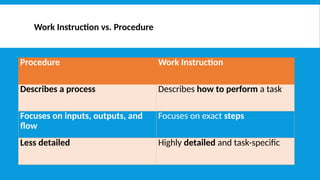
Work Instruction vs. Procedure
Procedure Work Instruction
Describes a process Describes how to perform a task
Focuses on inputs, outputs, and
flow
Focuses on exact steps
Less detailed Highly detailed and task-specific
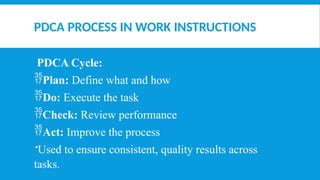
PDCA PROCESS IN WORK INSTRUCTIONS
PDCA Cycle:
Plan: Define what and how
Do: Execute the task
Check: Review performance
Act: Improve the process
Used to ensure consistent, quality results across
tasks.
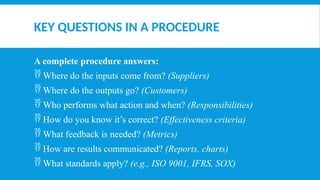
KEY QUESTIONS IN A PROCEDURE
A complete procedure answers:
 Where do the inputs come from? (Suppliers)
 Where do the outputs go? (Customers)
 Who performs what action and when? (Responsibilities)
 How do you know it’s correct? (Effectiveness criteria)
 What feedback is needed? (Metrics)
 How are results communicated? (Reports, charts)
 What standards apply? (e.g., ISO 9001, IFRS, SOX)
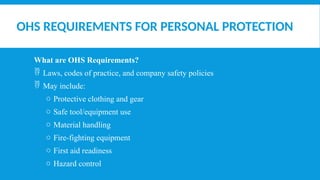
OHS REQUIREMENTS FOR PERSONAL PROTECTION
What are OHS Requirements?
 Laws, codes of practice, and company safety policies
 May include:
o Protective clothing and gear
o Safe tool/equipment use
o Material handling
o Fire-fighting equipment
o First aid readiness
o Hazard control
PERSONAL PROTECTIVE EQUIPMENT (PPE)
Examples include:
Helmets, gloves, goggles, and boots
Respirators and hearing protection
Protective clothing for hazardous tasks
Guided by:
Laws, standards, and workplace rules
SAFE OPERATING & EMERGENCY PROCEDURES
Safe Operating Procedures:
 Risk assessments
 Worksite organization
 Safe equipment handling
Emergency Procedures:
 Equipment shutdown
 Fire response
 First aid protocol
 Site evacuation plans
WHAT IS OHS/OSH/WHS?
Definitions:
 OSH / OHS / WHS: Concerned with worker safety, health, and
well-being
 Aims to protect:
o Workers
o Co-workers
o Employers
o Families and the public
OHS IMPORTANCE & WHO DEFINITION
Importance of OHS
Why OHS Matters:
 Moral: Duty of care toward employees
 Legal: Laws mandate safety measures
 Financial: Reduces costs (injuries, sick leave, healthcare, insurance)
In Common-Law Systems:
 Employers have a legal and moral responsibility to protect employees
 Statutory laws add specific regulations and enforcement mechanisms
WHO ON OCCUPATIONAL HEALTH
World Health Organization (WHO) Definition:
“Occupational health deals with all aspects of health and
safety in the workplace and has a strong focus on primary
prevention of hazards.”
Definition of Health (WHO):
“A state of complete physical, mental, and social well-
being—not merely the absence of disease.”
FOCUS OF OCCUPATIONAL HEALTH
Three Main Objectives (WHO):
1. Maintain and promote workers’ health and working capacity
2. Improve the work environment to support safety and well-
being
3. Develop work cultures that:
o Support health and safety
o Create positive social climate
o Improve organizational productivity
WHAT IS A “WORKING CULTURE”?
Definition:
 The values and attitudes reflected in:
o Management systems
o Personnel policies
o Participation practices
o Training and development
o Quality management
Goal:
A workplace culture that actively supports health, safety, and productivity.
JOINT ILO/WHO COMMITTEE ON OCCUPATIONAL HEALTH
Occupational Health Is Multidisciplinary:
 Professionals include:
o Physicians, psychologists
o Epidemiologists
o Physiotherapists & rehabilitation experts
o Human factors & ergonomics specialists
Areas of Advice:
 Adapting jobs to pre-existing conditions
 Proper posture and movement
 Appropriate rest breaks
 Preventive strategies for workplace hazards
AIMS OF OCCUPATIONAL HEALTH
Core Goals:
Promote and maintain physical, mental, and social well-
being
Prevent health issues caused by working conditions
Protect workers from health risks at work
Match jobs to the capabilities of each worker
Ensure mutual adaptation:
WORKPLACE HAZARDS
Workplace Hazards – An Overview
Workplaces Can Present Many Hazards:
 Chemical exposures
 Biological agents
 Physical dangers
 Ergonomic stressors
 Allergens
 Safety risks
 Psychosocial factors (e.g., stress, harassment)
While work offers benefits, it also comes with health and safety risks that must be
actively managed.
PHYSICAL & MECHANICAL HAZARDS
Physical Hazards:
 Common in industries like construction, mining, healthcare, and transportation
 Examples: Falls, loud noise, heat, vibration
 Child labor can introduce additional risks
Example: Fabrication & Welding Workshop
 Must follow PPE Regulations (1992)
 Required PPE includes:
o Eye and face protection
o Safety boots and clothing
o Protective overalls
MECHANICAL HAZARDS IN THE WORKPLACE
Machines May Cause:
 Crushing
 Burns
 Cuts, shears, or stabs
 Strikes or wounds
Industries Affected:
 Manufacturing
 Mining
 Agriculture
 Construction
Safety Measures:
 Lockout-tagout (LOTO) procedures
 Roll-over protection for vehicles
TRANSPORTATION SECTOR HAZARDS
Risks to commercial drivers:
o Vibration
o Prolonged sitting
o Work stress and exhaustion
 Additional risks worldwide:
o Vehicle security defects causing accidents
o Long border waiting times increasing time away from family
 Increased risk of diseases such as HIV due to delays
CONFINED SPACES HAZARD
 Defined by NIOSH as:
o Limited entry/exit points
o Poor ventilation
o Not meant for continuous occupancy
 Examples:
o Storage tanks
o Ship compartments
o Sewers
o Pipelines
 Hazards to workers and rescuers
NOISE & CHEMICAL HAZARDS
Occupational hearing loss:
oMost common work-related injury in the U.S.
o22 million workers exposed to hazardous noise
o$242 million annual compensation costs
Other causes of hearing loss:
oExposure to solvents and heavy metals (lead, arsenic,
mercury)
OTHER WORKPLACE HAZARDS
 Electricity risks:
o Fatal electrocution, shocks, burns, falls
 Vibrating machinery, lighting, air pressure hazards
 Asphyxiation risks in certain workplaces
 Musculoskeletal disorders prevented by good ergonomics
 Radiation hazards:
o Ionizing (alpha, beta, gamma, X-rays, neutrons)
o Non-ionizing (microwaves, IR, RF, UV, lasers)
 Regulatory example: Victoria’s workplace health & safety laws and
compliance codes
OCCUPATIONAL HEALTH AND SAFETY (OHS) ACT
 OHS Act 2004 (Victoria) is the cornerstone law
 Sets out key principles, duties, and rights for occupational health and safety
 Duties cover a wide variety of situations, offering flexibility to comply

OHS Regulations
 Occupational Health and Safety Regulations 2007 support the Act
 Specify how duties must be performed
 Include procedural and administrative requirements:
o Licensing
o Record keeping
o Reporting/notifying incidents
OHS GUIDANCE
WorkSafe Victoria provides guidance for compliance
 Tools include:
o Compliance Codes
o WorkSafe positions
o Non-statutory guidance documents
 All form part of the OHS compliance framework
OHS Policy
 Not all legislation terms are fully defined
 New work circumstances and industries bring new challenges
 WorkSafe develops policies to interpret legislation and clarify actions
 Policies ensure consistent understanding and enforcement
SUMMARY: OHS FRAMEWORK IN VICTORIA
Act sets duties and rights
Regulations detail performance and compliance
steps
Guidance ensures clear, accessible information
Policies address new issues and clarify
enforcement
SELECTING APPROPRIATE MATERIALS FOR WORK
 Tools and equipment to identify and measure waste (Muda) at
workstations:
o Tape (measuring device)
o Stopwatch
o Photo Camera
o Video Camera
 Calculator
IDENTIFYING AND CHECKING SAFETY EQUIPMENT
AND TOOLS
Tools used for Waste/Muda identification:
oTape/Meter
oStopwatch
oPhoto Camera
oVideo Camera
oCalculator
USE OF TOOLS AND EQUIPMENT
Tape/Meter: Measures distances or lengths
Stopwatch: Measures operation, processing, or waiting
times
Photo Camera: Captures images (e.g., shop layout for
analysis)
Video Camera: Records work elements to identify
wastes (motion, processing, waiting)
Calculator: Performs arithmetic calculations
TOOLS AND TECHNIQUES FOR WASTE ANALYSIS
 Plant Layout
 Process Flow
 Other Analysis Tools
 Time Study by Work Element
 Measuring Travel Distance
 Taking Photos of the Workplace
 Measuring Total Steps
END OF UNIT ONE
End of Unit ONE
UNIT TWO: IDENTIFYING MUDA AND
PLANNING FOR ELIMINATION
What is MUDA in HNS?
•MUDA ( 無駄 ): A Japanese term meaning waste — any
activity that does not add value to the cooperative or its
members.
•Objective: Improve efficiency in marketing, logistics,
procurement, promotion, and member services.
TYPES OF MUDA IN COOPERATIVES
•Overproduction
•Inventory
•Motion
•Transportation
•Over-processing
•Rework (Defects)
•Waiting (Time)
2.2 DISCUSSING CAUSES AND EFFECTS
OF MUDA IN COOPERATIVE MARKETING
Overproduction in Cooperatives
Causes:
• Producing or purchasing products beyond actual member demand
• Preparing large quantities “just in case”
• Using oversized machinery not suited for changing small demands
• Overstaffing due to inefficient planning
Effects:
• Overstocked goods in warehouses
• Increased storage cost
• Inflexibility in adjusting to real-time market trends
• Potential spoilage or expiration
• Blocked cash flow and resources
INVENTORY WASTE IN COOPERATIVES
Causes:
• Accepting excess inventory as “necessary”
• Poor warehouse layout
• Long supplier delivery or changeover times
• Ordering in bulk without real demand analysis
Effects:
• Waste of storage space
• Increase in inspection and handling cost
• Expired or spoiled stock (especially for perishables)
• Locked-up cash that could be used for other cooperative services
MOTION WASTE IN COOPERATIVE
MARKETING
Causes:
• Poorly designed office/market layouts
• Employees moving unnecessarily during sales or stock management
• Lack of training in efficient workflow
• Isolated operations without coordination
Effects:
• Employee fatigue
• Delays in serving customers/members
• Loss of productivity
• Higher labor costs
TRANSPORTATION WASTE
Causes:
• Poor layout of supply chain routes
• Sending goods long distances without consolidation
• Unskilled logistics handling
• Redundant movement of products between branches or stores
Effects:
• Wasted fuel and transportation cost
• Product damage during movement
• Delayed delivery to members/customers
• Increased CO emissions
₂
• Higher operational costs
OVER-PROCESSING IN COOPERATIVES
Causes:
• Doing extra steps that don’t add value (e.g., excessive packaging)
• Repeated approvals for simple tasks
• Duplicate data entry
Effects:
• Time loss
• Member dissatisfaction
• Higher processing costs
REWORK (DEFECTS)
Causes:
• Poor quality control
• Unclear responsibilities
• Incomplete member data or incorrect records
Effects:
• Redoing reports, reissuing invoices
• Member complaints
• Delayed payments
• Increased administrative workload
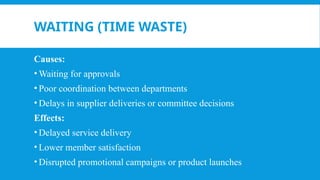
WAITING (TIME WASTE)
Causes:
• Waiting for approvals
• Poor coordination between departments
• Delays in supplier deliveries or committee decisions
Effects:
• Delayed service delivery
• Lower member satisfaction
• Disrupted promotional campaigns or product launches
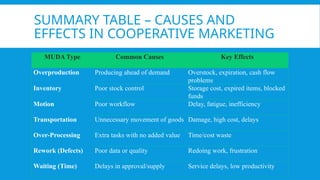
SUMMARY TABLE – CAUSES AND
EFFECTS IN COOPERATIVE MARKETING
MUDA Type Common Causes Key Effects
Overproduction Producing ahead of demand Overstock, expiration, cash flow
problems
Inventory Poor stock control Storage cost, expired items, blocked
funds
Motion Poor workflow Delay, fatigue, inefficiency
Transportation Unnecessary movement of goods Damage, high cost, delays
Over-Processing Extra tasks with no added value Time/cost waste
Rework (Defects) Poor data or quality Redoing work, frustration
Waiting (Time) Delays in approval/supply Service delays, low productivity
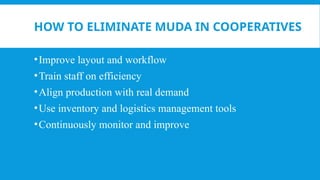
HOW TO ELIMINATE MUDA IN COOPERATIVES
•Improve layout and workflow
•Train staff on efficiency
•Align production with real demand
•Use inventory and logistics management tools
•Continuously monitor and improve
DISCUSSION AND REFLECTION
•Can you identify one MUDA from your cooperative’s
marketing process?
•What caused it?
•What can be improved?
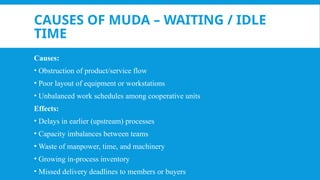
CAUSES OF MUDA – WAITING / IDLE
TIME
Causes:
• Obstruction of product/service flow
• Poor layout of equipment or workstations
• Unbalanced work schedules among cooperative units
Effects:
• Delays in earlier (upstream) processes
• Capacity imbalances between teams
• Waste of manpower, time, and machinery
• Growing in-process inventory
• Missed delivery deadlines to members or buyers
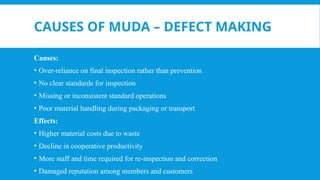
CAUSES OF MUDA – DEFECT MAKING
Causes:
• Over-reliance on final inspection rather than prevention
• No clear standards for inspection
• Missing or inconsistent standard operations
• Poor material handling during packaging or transport
Effects:
• Higher material costs due to waste
• Decline in cooperative productivity
• More staff and time required for re-inspection and correction
• Damaged reputation among members and customers
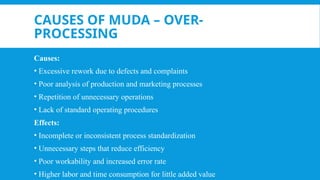
CAUSES OF MUDA – OVER-
PROCESSING
Causes:
• Excessive rework due to defects and complaints
• Poor analysis of production and marketing processes
• Repetition of unnecessary operations
• Lack of standard operating procedures
Effects:
• Incomplete or inconsistent process standardization
• Unnecessary steps that reduce efficiency
• Poor workability and increased error rate
• Higher labor and time consumption for little added value
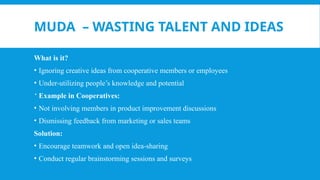
MUDA – WASTING TALENT AND IDEAS
What is it?
• Ignoring creative ideas from cooperative members or employees
• Under-utilizing people’s knowledge and potential
 Example in Cooperatives:
• Not involving members in product improvement discussions
• Dismissing feedback from marketing or sales teams
Solution:
• Encourage teamwork and open idea-sharing
• Conduct regular brainstorming sessions and surveys
MUDA – WASTING CASH
What is it?
• Spending money on items or services not used or not needed
• Lack of cost-benefit analysis in cooperative decisions
Examples:
• Buying marketing software that no one uses
• Stocking promotional items that remain unused
• Over-purchasing perishable stock
Solution:
• Educate staff and members on budgeting
• Always assess return on investment (ROI)
• Buy based on actual demand
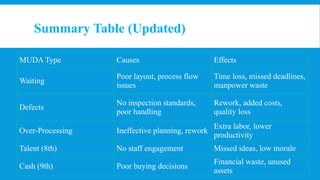
Summary Table (Updated)
MUDA Type Causes Effects
Waiting
Poor layout, process flow
issues
Time loss, missed deadlines,
manpower waste
Defects
No inspection standards,
poor handling
Rework, added costs,
quality loss
Over-Processing Ineffective planning, rework
Extra labor, lower
productivity
Talent (8th) No staff engagement Missed ideas, low morale
Cash (9th) Poor buying decisions
Financial waste, unused
assets
FINAL REFLECTION
• Which MUDA types exist in your cooperative today?
• What low-cost or no-cost changes can you start implementing?
• Are you using the talent and creativity of your cooperative
members?
Engage your members. Reduce your waste. Grow your
cooperative.
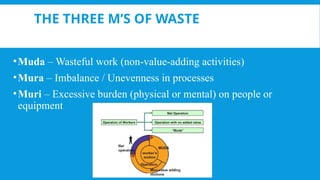
THE THREE M’S OF WASTE
•Muda – Wasteful work (non-value-adding activities)
•Mura – Imbalance / Unevenness in processes
•Muri – Excessive burden (physical or mental) on people or
equipment
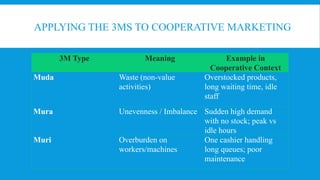
APPLYING THE 3MS TO COOPERATIVE MARKETING
3M Type Meaning Example in
Cooperative Context
Muda Waste (non-value
activities)
Overstocked products,
long waiting time, idle
staff
Mura Unevenness / Imbalance Sudden high demand
with no stock; peak vs
idle hours
Muri Overburden on
workers/machines
One cashier handling
long queues; poor
maintenance
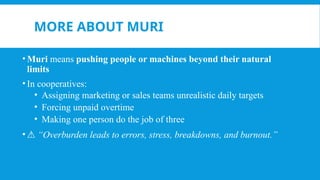
MORE ABOUT MURI
• Muri means pushing people or machines beyond their natural
limits
• In cooperatives:
• Assigning marketing or sales teams unrealistic daily targets
• Forcing unpaid overtime
• Making one person do the job of three
• ⚠️“Overburden leads to errors, stress, breakdowns, and burnout.”
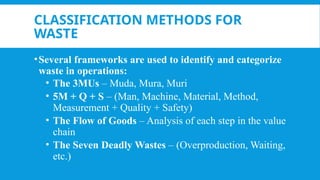
CLASSIFICATION METHODS FOR
WASTE
•Several frameworks are used to identify and categorize
waste in operations:
• The 3MUs – Muda, Mura, Muri
• 5M + Q + S – (Man, Machine, Material, Method,
Measurement + Quality + Safety)
• The Flow of Goods – Analysis of each step in the value
chain
• The Seven Deadly Wastes – (Overproduction, Waiting,
etc.)
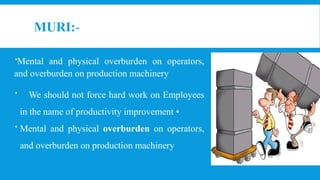
MURI:-
Mental and physical overburden on operators,
and overburden on production machinery
 We should not force hard work on Employees
in the name of productivity improvement •
 Mental and physical overburden on operators,
and overburden on production machinery
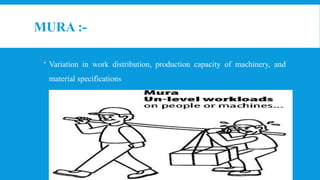
MURA :-
 Variation in work distribution, production capacity of machinery, and
material specifications
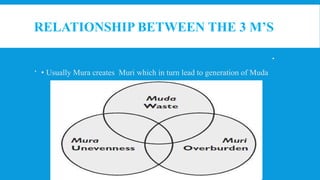
RELATIONSHIP BETWEEN THE 3 M’S

 • Usually Mura creates Muri which in turn lead to generation of Muda
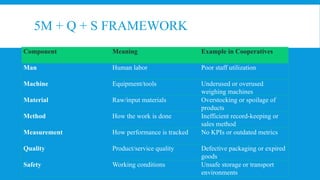
5M + Q + S FRAMEWORK
Component Meaning Example in Cooperatives
Man Human labor Poor staff utilization
Machine Equipment/tools Underused or overused
weighing machines
Material Raw/input materials Overstocking or spoilage of
products
Method How the work is done Inefficient record-keeping or
sales method
Measurement How performance is tracked No KPIs or outdated metrics
Quality Product/service quality Defective packaging or expired
goods
Safety Working conditions Unsafe storage or transport
environments
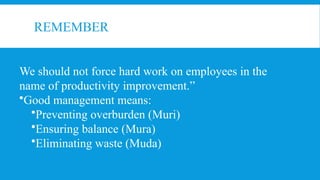
REMEMBER
We should not force hard work on employees in the
name of productivity improvement.”
•Good management means:
•Preventing overburden (Muri)
•Ensuring balance (Mura)
•Eliminating waste (Muda)
FINAL DISCUSSION QUESTIONS
• Are there signs of Muda, Mura, or Muri in your cooperative?
• How can we apply the 5M+Q+S model to improve our processes?
• What actions will we take today to reduce overburden and
imbalance?
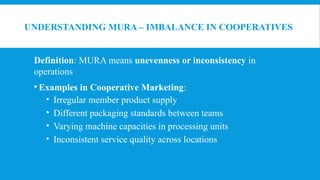
UNDERSTANDING MURA – IMBALANCE IN COOPERATIVES
Definition: MURA means unevenness or inconsistency in
operations
• Examples in Cooperative Marketing:
• Irregular member product supply
• Different packaging standards between teams
• Varying machine capacities in processing units
• Inconsistent service quality across locations
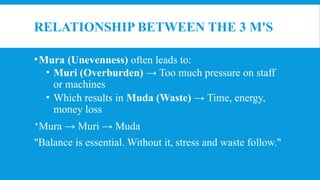
RELATIONSHIP BETWEEN THE 3 M'S
•Mura (Unevenness) often leads to:
• Muri (Overburden) → Too much pressure on staff
or machines
• Which results in Muda (Waste) → Time, energy,
money loss
Mura → Muri → Muda
"Balance is essential. Without it, stress and waste follow."
INTRODUCTION TO KAIZEN
•Kaizen = Continuous Improvement
•Focus: Small, consistent improvements in all business
processes
•Objective: Eliminate waste and maximize value in
cooperative operations
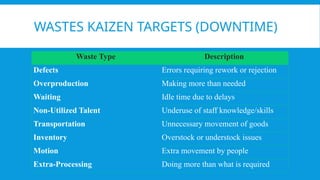
WASTES KAIZEN TARGETS (DOWNTIME)
Waste Type Description
Defects Errors requiring rework or rejection
Overproduction Making more than needed
Waiting Idle time due to delays
Non-Utilized Talent Underuse of staff knowledge/skills
Transportation Unnecessary movement of goods
Inventory Overstock or understock issues
Motion Extra movement by people
Extra-Processing Doing more than what is required
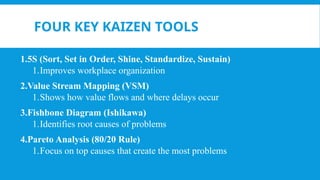
FOUR KEY KAIZEN TOOLS
1.5S (Sort, Set in Order, Shine, Standardize, Sustain)
1.Improves workplace organization
2.Value Stream Mapping (VSM)
1.Shows how value flows and where delays occur
3.Fishbone Diagram (Ishikawa)
1.Identifies root causes of problems
4.Pareto Analysis (80/20 Rule)
1.Focus on top causes that create the most problems
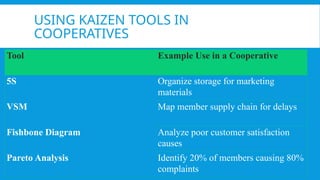
USING KAIZEN TOOLS IN
COOPERATIVES
Tool Example Use in a Cooperative
5S Organize storage for marketing
materials
VSM Map member supply chain for delays
Fishbone Diagram Analyze poor customer satisfaction
causes
Pareto Analysis Identify 20% of members causing 80%
complaints
SAMPLE PROBLEMS IDENTIFIED IN COOPERATIVES
•Long delays in packaging or delivery
•Overstocking unsold products
•Staff not using their full skill potential
•Excessive steps in customer registration
•Uneven workload between departments
•Quality defects in member-supplied goods
SUMMARY
•Recognize how Mura, Muri, and Muda are connected
•Apply Kaizen tools to continuously improve cooperative
systems
•Engage cooperative members and staff to identify and solve
problems
KAIZEN PROBLEM IDENTIFICATION
TECHNIQUES
•Kaizen relies on practical tools to identify and solve
workplace inefficiencies.
•These techniques help cooperatives improve marketing,
distribution, and internal workflow.
PDCA CYCLE (PLAN – DO – CHECK –
ACT)
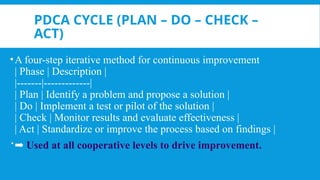
•A four-step iterative method for continuous improvement
| Phase | Description |
|-------|-------------|
| Plan | Identify a problem and propose a solution |
| Do | Implement a test or pilot of the solution |
| Check | Monitor results and evaluate effectiveness |
| Act | Standardize or improve the process based on findings |
➡ Used at all cooperative levels to drive improvement.
GEMBA – “THE REAL PLACE”
•Gemba means going to where the work actually happens
•In a cooperative, this means:
• Visiting storage areas
• Observing product marketing and sales
• Talking with frontline workers and members
🔍 Managers gain real-time insight to support
problem-solving.
JISHUKEN – SELF-DIRECTED STUDY
GROUPS
Jishuken = Self-learning & team learning
•In a cooperative:
• Marketing staff form teams to review promotional processes
• Management studies member delivery schedules and quality
control
✅ Encourages accountability and continuous improvement from
within
WHYS TECHNIQUE
Ask “Why?” five times to find the root cause of a problem
• Example:
• Why are sales dropping? → Products are not reaching
customers on time
• Why? → Delays in transportation
• Why? → Poor route planning
• Why? → No clear schedule
• Why? → Lack of communication protocol
🎯 Helps identify root causes, not just symptoms
VALUE STREAM MAPPING (VSM)
•A visual tool for mapping out how a product or service flows
•Includes every stage from:
• Raw material → Storage → Packaging → Distribution →
Customer
•In a cooperative:
• Maps how products move from members to buyers
• Reveals bottlenecks or delays
📈 Supports data-based improvement decisions
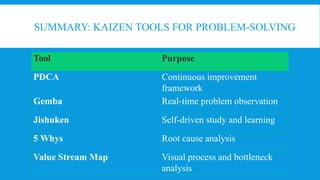
SUMMARY: KAIZEN TOOLS FOR PROBLEM-SOLVING
Tool Purpose
PDCA Continuous improvement
framework
Gemba Real-time problem observation
Jishuken Self-driven study and learning
5 Whys Root cause analysis
Value Stream Map Visual process and bottleneck
analysis
2.4 ANALYZING LIST AND POSTING ON
KAIZEN BOARD
What is Process Kaizen?
•Process Kaizen = Small, continuous improvements at individual or
team level
•Goal: Increase efficiency, reduce waste, and improve communication
in cooperative operations
💡 Applies even when the organization isn’t doing full Lean
transformation
EXAMPLES OF PROCESS KAIZEN IN A
COOPERATIVE
📉 Reducing the number of steps in a product packaging process
🔄 Limiting simultaneous marketing campaigns to maintain focus
📊 Reviewing weekly sales trends as a team using a tracking board
📦 Organizing supply areas to minimize movement
THE KAIZEN BOARD – TURNING IDEAS INTO ACTIONS
• A visual tool to manage and track continuous improvement ideas
• Helps teams implement ideas instead of forgetting them
 🧩 Especially helpful when meetings produce good suggestions—
but no follow-up!
STRUCTURE OF A KAIZEN BOARD
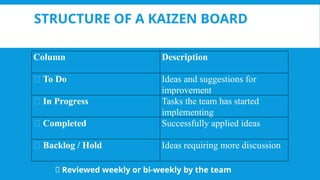
Column Description
📌 To Do Ideas and suggestions for
improvement
🚧 In Progress Tasks the team has started
implementing
✅ Completed Successfully applied ideas
🧠 Backlog / Hold Ideas requiring more discussion
🔁 Reviewed weekly or bi-weekly by the team
BENEFITS OF USING A KAIZEN BOARD IN COOPERATIVES
👥 Encourages team ownership of ideas
✅ Tracks which ideas are acted upon
🗓 Builds habit of review and structured improvement
📈 Improves efficiency and transparency of
cooperative workflows
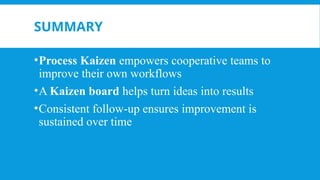
SUMMARY
•Process Kaizen empowers cooperative teams to
improve their own workflows
•A Kaizen board helps turn ideas into results
•Consistent follow-up ensures improvement is
sustained over time
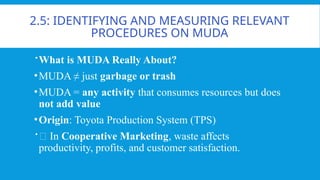
2.5: IDENTIFYING AND MEASURING RELEVANT
PROCEDURES ON MUDA
What is MUDA Really About?
•MUDA ≠ just garbage or trash
•MUDA = any activity that consumes resources but does
not add value
•Origin: Toyota Production System (TPS)
🔎 In Cooperative Marketing, waste affects
productivity, profits, and customer satisfaction.
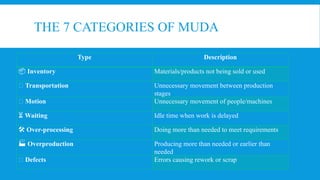
THE 7 CATEGORIES OF MUDA
Type Description
📦 Inventory Materials/products not being sold or used
🚛 Transportation Unnecessary movement between production
stages
🤸 Motion Unnecessary movement of people/machines
⏳ Waiting Idle time when work is delayed
🛠 Over-processing Doing more than needed to meet requirements
🏭 Overproduction Producing more than needed or earlier than
needed
❌ Defects Errors causing rework or scrap
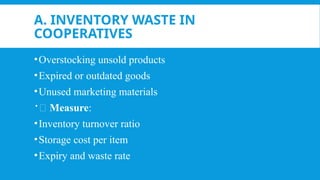
A. INVENTORY WASTE IN
COOPERATIVES
•Overstocking unsold products
•Expired or outdated goods
•Unused marketing materials
📏 Measure:
•Inventory turnover ratio
•Storage cost per item
•Expiry and waste rate
B. TRANSPORTATION WASTE
•Repetitive or long-distance movement of goods
•Underutilized delivery capacity
📏 Measure:
•Transport cost per item
•Distance moved per transaction
•Load efficiency rate
C. Motion Waste
•Unnecessary walking/searching in stockrooms
•Frequent manual adjustments
📏 Measure:
•Time spent on non-value activities
•Number of repetitive body movements
•Equipment uptime vs. downtime
D. WAITING WASTE
•Idle workers during delivery delays
•Waiting for marketing approval or stock availability
📏 Measure:
•Idle time per shift
•Process cycle time
•Delay logs
E. OVER-PROCESSING WASTE
•Re-entering data already available
•Unneeded packaging or labeling
📏 Measure:
•Number of steps per process
•Redundancy index
•Cost of extra processing tasks
F. OVERPRODUCTION WASTE
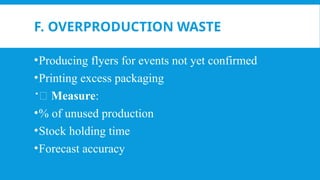
•Producing flyers for events not yet confirmed
•Printing excess packaging
📏 Measure:
•% of unused production
•Stock holding time
•Forecast accuracy
G. DEFECT WASTE
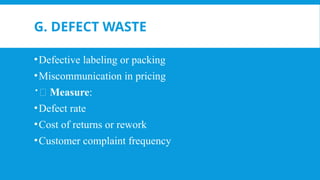
•Defective labeling or packing
•Miscommunication in pricing
📏 Measure:
•Defect rate
•Cost of returns or rework
•Customer complaint frequency
SUMMARY OF MUDA MEASUREMENT IN
COOPERATIVES
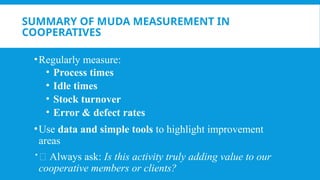
•Regularly measure:
• Process times
• Idle times
• Stock turnover
• Error & defect rates
•Use data and simple tools to highlight improvement
areas
📌 Always ask: Is this activity truly adding value to our
cooperative members or clients?
End of Unit TWO

HNS Preventing and Eliminating MUDA.pptx

  • 1.
    Unit One: Preparefor Work Subtitle: Job Instructions, Safety, Materials, and Tools
  • 2.
    UNIT OVERVIEW Topics Covered: Job requirement work instructions  OHS (Occupational Health and Safety) requirements  Appropriate materials for work  Safety equipment and tools Learning Outcomes:  Determine job requirement work instructions  Understand OHS requirements for personal protection  Select appropriate materials for work  Identify and check safety equipment and tools
  • 3.
    JOB REQUIREMENT WORKINSTRUCTIONS Definition of a Job: A specific task or duty Employment (part-time/full-time) Responsibility or obligation Project, task, or matter being worked on
  • 4.
    JOB BASICS –WHAT EVERY JOB REQUIRES Regardless of the job type, these are essential:  Discipline  Enthusiasm  Qualifications Discipline Key Point:  Foundation of all job success Why it's important:  Enables consistency and commitment  Applies to everyone, regardless of position
  • 5.
    ENTHUSIASM Key Point: Job satisfactionfuels growth Why it's important: Leads to innovation, motivation, and success Passion turns a job into a profession
  • 6.
    QUALIFICATIONS Key Point: Beyond degrees—it'sabout desire to learn Why it's important: Learning from experience is vital Real knowledge goes beyond formal education
  • 7.
    SOFT SKILLS INTHE WORKPLACE What are Soft Skills?  Smooth communication  Computer proficiency  Language fluency  Presentable appearance  Crisis management skills Why they're important: Soft skills ensure not just job execution but also professional behavior and interpersonal effectiveness.
  • 8.
    GENERAL JOB REQUIREMENTS Jobs have specific requirements (skills, tasks, tools)  But also include general expectations like discipline, enthusiasm, and soft skills  These lead to better employees — and better individuals  Work Instruction – Definition Work Instruction:  Describes specific tasks and activities  Provides detailed step-by-step guidance  Supports smooth business operations Example: Exactly how to create a change request in software (much more detailed than a procedure)
  • 9.
    WHAT’S INCLUDED INWORK INSTRUCTIONS Work Information: Task details Job Functions: Responsibilities and roles Key Activities: Actions required per task Performance Indicators: Metrics for success
  • 10.
    Work Instruction vs.Procedure Procedure Work Instruction Describes a process Describes how to perform a task Focuses on inputs, outputs, and flow Focuses on exact steps Less detailed Highly detailed and task-specific
  • 11.
    PDCA PROCESS INWORK INSTRUCTIONS PDCA Cycle: Plan: Define what and how Do: Execute the task Check: Review performance Act: Improve the process Used to ensure consistent, quality results across tasks.
  • 12.
    KEY QUESTIONS INA PROCEDURE A complete procedure answers:  Where do the inputs come from? (Suppliers)  Where do the outputs go? (Customers)  Who performs what action and when? (Responsibilities)  How do you know it’s correct? (Effectiveness criteria)  What feedback is needed? (Metrics)  How are results communicated? (Reports, charts)  What standards apply? (e.g., ISO 9001, IFRS, SOX)
  • 13.
    OHS REQUIREMENTS FORPERSONAL PROTECTION What are OHS Requirements?  Laws, codes of practice, and company safety policies  May include: o Protective clothing and gear o Safe tool/equipment use o Material handling o Fire-fighting equipment o First aid readiness o Hazard control
  • 14.
    PERSONAL PROTECTIVE EQUIPMENT(PPE) Examples include: Helmets, gloves, goggles, and boots Respirators and hearing protection Protective clothing for hazardous tasks Guided by: Laws, standards, and workplace rules
  • 15.
    SAFE OPERATING &EMERGENCY PROCEDURES Safe Operating Procedures:  Risk assessments  Worksite organization  Safe equipment handling Emergency Procedures:  Equipment shutdown  Fire response  First aid protocol  Site evacuation plans
  • 16.
    WHAT IS OHS/OSH/WHS? Definitions: OSH / OHS / WHS: Concerned with worker safety, health, and well-being  Aims to protect: o Workers o Co-workers o Employers o Families and the public
  • 17.
    OHS IMPORTANCE &WHO DEFINITION Importance of OHS Why OHS Matters:  Moral: Duty of care toward employees  Legal: Laws mandate safety measures  Financial: Reduces costs (injuries, sick leave, healthcare, insurance) In Common-Law Systems:  Employers have a legal and moral responsibility to protect employees  Statutory laws add specific regulations and enforcement mechanisms
  • 18.
    WHO ON OCCUPATIONALHEALTH World Health Organization (WHO) Definition: “Occupational health deals with all aspects of health and safety in the workplace and has a strong focus on primary prevention of hazards.” Definition of Health (WHO): “A state of complete physical, mental, and social well- being—not merely the absence of disease.”
  • 19.
    FOCUS OF OCCUPATIONALHEALTH Three Main Objectives (WHO): 1. Maintain and promote workers’ health and working capacity 2. Improve the work environment to support safety and well- being 3. Develop work cultures that: o Support health and safety o Create positive social climate o Improve organizational productivity
  • 20.
    WHAT IS A“WORKING CULTURE”? Definition:  The values and attitudes reflected in: o Management systems o Personnel policies o Participation practices o Training and development o Quality management Goal: A workplace culture that actively supports health, safety, and productivity.
  • 21.
    JOINT ILO/WHO COMMITTEEON OCCUPATIONAL HEALTH Occupational Health Is Multidisciplinary:  Professionals include: o Physicians, psychologists o Epidemiologists o Physiotherapists & rehabilitation experts o Human factors & ergonomics specialists Areas of Advice:  Adapting jobs to pre-existing conditions  Proper posture and movement  Appropriate rest breaks  Preventive strategies for workplace hazards
  • 22.
    AIMS OF OCCUPATIONALHEALTH Core Goals: Promote and maintain physical, mental, and social well- being Prevent health issues caused by working conditions Protect workers from health risks at work Match jobs to the capabilities of each worker Ensure mutual adaptation:
  • 23.
    WORKPLACE HAZARDS Workplace Hazards– An Overview Workplaces Can Present Many Hazards:  Chemical exposures  Biological agents  Physical dangers  Ergonomic stressors  Allergens  Safety risks  Psychosocial factors (e.g., stress, harassment) While work offers benefits, it also comes with health and safety risks that must be actively managed.
  • 24.
    PHYSICAL & MECHANICALHAZARDS Physical Hazards:  Common in industries like construction, mining, healthcare, and transportation  Examples: Falls, loud noise, heat, vibration  Child labor can introduce additional risks Example: Fabrication & Welding Workshop  Must follow PPE Regulations (1992)  Required PPE includes: o Eye and face protection o Safety boots and clothing o Protective overalls
  • 25.
    MECHANICAL HAZARDS INTHE WORKPLACE Machines May Cause:  Crushing  Burns  Cuts, shears, or stabs  Strikes or wounds Industries Affected:  Manufacturing  Mining  Agriculture  Construction Safety Measures:  Lockout-tagout (LOTO) procedures  Roll-over protection for vehicles
  • 26.
    TRANSPORTATION SECTOR HAZARDS Risksto commercial drivers: o Vibration o Prolonged sitting o Work stress and exhaustion  Additional risks worldwide: o Vehicle security defects causing accidents o Long border waiting times increasing time away from family  Increased risk of diseases such as HIV due to delays
  • 27.
    CONFINED SPACES HAZARD Defined by NIOSH as: o Limited entry/exit points o Poor ventilation o Not meant for continuous occupancy  Examples: o Storage tanks o Ship compartments o Sewers o Pipelines  Hazards to workers and rescuers
  • 28.
    NOISE & CHEMICALHAZARDS Occupational hearing loss: oMost common work-related injury in the U.S. o22 million workers exposed to hazardous noise o$242 million annual compensation costs Other causes of hearing loss: oExposure to solvents and heavy metals (lead, arsenic, mercury)
  • 29.
    OTHER WORKPLACE HAZARDS Electricity risks: o Fatal electrocution, shocks, burns, falls  Vibrating machinery, lighting, air pressure hazards  Asphyxiation risks in certain workplaces  Musculoskeletal disorders prevented by good ergonomics  Radiation hazards: o Ionizing (alpha, beta, gamma, X-rays, neutrons) o Non-ionizing (microwaves, IR, RF, UV, lasers)  Regulatory example: Victoria’s workplace health & safety laws and compliance codes
  • 30.
    OCCUPATIONAL HEALTH ANDSAFETY (OHS) ACT  OHS Act 2004 (Victoria) is the cornerstone law  Sets out key principles, duties, and rights for occupational health and safety  Duties cover a wide variety of situations, offering flexibility to comply  OHS Regulations  Occupational Health and Safety Regulations 2007 support the Act  Specify how duties must be performed  Include procedural and administrative requirements: o Licensing o Record keeping o Reporting/notifying incidents
  • 31.
    OHS GUIDANCE WorkSafe Victoriaprovides guidance for compliance  Tools include: o Compliance Codes o WorkSafe positions o Non-statutory guidance documents  All form part of the OHS compliance framework OHS Policy  Not all legislation terms are fully defined  New work circumstances and industries bring new challenges  WorkSafe develops policies to interpret legislation and clarify actions  Policies ensure consistent understanding and enforcement
  • 32.
    SUMMARY: OHS FRAMEWORKIN VICTORIA Act sets duties and rights Regulations detail performance and compliance steps Guidance ensures clear, accessible information Policies address new issues and clarify enforcement
  • 33.
    SELECTING APPROPRIATE MATERIALSFOR WORK  Tools and equipment to identify and measure waste (Muda) at workstations: o Tape (measuring device) o Stopwatch o Photo Camera o Video Camera  Calculator
  • 34.
    IDENTIFYING AND CHECKINGSAFETY EQUIPMENT AND TOOLS Tools used for Waste/Muda identification: oTape/Meter oStopwatch oPhoto Camera oVideo Camera oCalculator
  • 35.
    USE OF TOOLSAND EQUIPMENT Tape/Meter: Measures distances or lengths Stopwatch: Measures operation, processing, or waiting times Photo Camera: Captures images (e.g., shop layout for analysis) Video Camera: Records work elements to identify wastes (motion, processing, waiting) Calculator: Performs arithmetic calculations
  • 36.
    TOOLS AND TECHNIQUESFOR WASTE ANALYSIS  Plant Layout  Process Flow  Other Analysis Tools  Time Study by Work Element  Measuring Travel Distance  Taking Photos of the Workplace  Measuring Total Steps
  • 37.
    END OF UNITONE End of Unit ONE
  • 38.
    UNIT TWO: IDENTIFYINGMUDA AND PLANNING FOR ELIMINATION What is MUDA in HNS? •MUDA ( 無駄 ): A Japanese term meaning waste — any activity that does not add value to the cooperative or its members. •Objective: Improve efficiency in marketing, logistics, procurement, promotion, and member services.
  • 39.
    TYPES OF MUDAIN COOPERATIVES •Overproduction •Inventory •Motion •Transportation •Over-processing •Rework (Defects) •Waiting (Time)
  • 40.
    2.2 DISCUSSING CAUSESAND EFFECTS OF MUDA IN COOPERATIVE MARKETING Overproduction in Cooperatives Causes: • Producing or purchasing products beyond actual member demand • Preparing large quantities “just in case” • Using oversized machinery not suited for changing small demands • Overstaffing due to inefficient planning Effects: • Overstocked goods in warehouses • Increased storage cost • Inflexibility in adjusting to real-time market trends • Potential spoilage or expiration • Blocked cash flow and resources
  • 41.
    INVENTORY WASTE INCOOPERATIVES Causes: • Accepting excess inventory as “necessary” • Poor warehouse layout • Long supplier delivery or changeover times • Ordering in bulk without real demand analysis Effects: • Waste of storage space • Increase in inspection and handling cost • Expired or spoiled stock (especially for perishables) • Locked-up cash that could be used for other cooperative services
  • 42.
    MOTION WASTE INCOOPERATIVE MARKETING Causes: • Poorly designed office/market layouts • Employees moving unnecessarily during sales or stock management • Lack of training in efficient workflow • Isolated operations without coordination Effects: • Employee fatigue • Delays in serving customers/members • Loss of productivity • Higher labor costs
  • 43.
    TRANSPORTATION WASTE Causes: • Poorlayout of supply chain routes • Sending goods long distances without consolidation • Unskilled logistics handling • Redundant movement of products between branches or stores Effects: • Wasted fuel and transportation cost • Product damage during movement • Delayed delivery to members/customers • Increased CO emissions ₂ • Higher operational costs
  • 44.
    OVER-PROCESSING IN COOPERATIVES Causes: •Doing extra steps that don’t add value (e.g., excessive packaging) • Repeated approvals for simple tasks • Duplicate data entry Effects: • Time loss • Member dissatisfaction • Higher processing costs
  • 45.
    REWORK (DEFECTS) Causes: • Poorquality control • Unclear responsibilities • Incomplete member data or incorrect records Effects: • Redoing reports, reissuing invoices • Member complaints • Delayed payments • Increased administrative workload
  • 46.
    WAITING (TIME WASTE) Causes: •Waiting for approvals • Poor coordination between departments • Delays in supplier deliveries or committee decisions Effects: • Delayed service delivery • Lower member satisfaction • Disrupted promotional campaigns or product launches
  • 47.
    SUMMARY TABLE –CAUSES AND EFFECTS IN COOPERATIVE MARKETING MUDA Type Common Causes Key Effects Overproduction Producing ahead of demand Overstock, expiration, cash flow problems Inventory Poor stock control Storage cost, expired items, blocked funds Motion Poor workflow Delay, fatigue, inefficiency Transportation Unnecessary movement of goods Damage, high cost, delays Over-Processing Extra tasks with no added value Time/cost waste Rework (Defects) Poor data or quality Redoing work, frustration Waiting (Time) Delays in approval/supply Service delays, low productivity
  • 48.
    HOW TO ELIMINATEMUDA IN COOPERATIVES •Improve layout and workflow •Train staff on efficiency •Align production with real demand •Use inventory and logistics management tools •Continuously monitor and improve
  • 49.
    DISCUSSION AND REFLECTION •Canyou identify one MUDA from your cooperative’s marketing process? •What caused it? •What can be improved?
  • 50.
    CAUSES OF MUDA– WAITING / IDLE TIME Causes: • Obstruction of product/service flow • Poor layout of equipment or workstations • Unbalanced work schedules among cooperative units Effects: • Delays in earlier (upstream) processes • Capacity imbalances between teams • Waste of manpower, time, and machinery • Growing in-process inventory • Missed delivery deadlines to members or buyers
  • 51.
    CAUSES OF MUDA– DEFECT MAKING Causes: • Over-reliance on final inspection rather than prevention • No clear standards for inspection • Missing or inconsistent standard operations • Poor material handling during packaging or transport Effects: • Higher material costs due to waste • Decline in cooperative productivity • More staff and time required for re-inspection and correction • Damaged reputation among members and customers
  • 52.
    CAUSES OF MUDA– OVER- PROCESSING Causes: • Excessive rework due to defects and complaints • Poor analysis of production and marketing processes • Repetition of unnecessary operations • Lack of standard operating procedures Effects: • Incomplete or inconsistent process standardization • Unnecessary steps that reduce efficiency • Poor workability and increased error rate • Higher labor and time consumption for little added value
  • 53.
    MUDA – WASTINGTALENT AND IDEAS What is it? • Ignoring creative ideas from cooperative members or employees • Under-utilizing people’s knowledge and potential  Example in Cooperatives: • Not involving members in product improvement discussions • Dismissing feedback from marketing or sales teams Solution: • Encourage teamwork and open idea-sharing • Conduct regular brainstorming sessions and surveys
  • 54.
    MUDA – WASTINGCASH What is it? • Spending money on items or services not used or not needed • Lack of cost-benefit analysis in cooperative decisions Examples: • Buying marketing software that no one uses • Stocking promotional items that remain unused • Over-purchasing perishable stock Solution: • Educate staff and members on budgeting • Always assess return on investment (ROI) • Buy based on actual demand
  • 55.
    Summary Table (Updated) MUDAType Causes Effects Waiting Poor layout, process flow issues Time loss, missed deadlines, manpower waste Defects No inspection standards, poor handling Rework, added costs, quality loss Over-Processing Ineffective planning, rework Extra labor, lower productivity Talent (8th) No staff engagement Missed ideas, low morale Cash (9th) Poor buying decisions Financial waste, unused assets
  • 56.
    FINAL REFLECTION • WhichMUDA types exist in your cooperative today? • What low-cost or no-cost changes can you start implementing? • Are you using the talent and creativity of your cooperative members? Engage your members. Reduce your waste. Grow your cooperative.
  • 57.
    THE THREE M’SOF WASTE •Muda – Wasteful work (non-value-adding activities) •Mura – Imbalance / Unevenness in processes •Muri – Excessive burden (physical or mental) on people or equipment
  • 58.
    APPLYING THE 3MSTO COOPERATIVE MARKETING 3M Type Meaning Example in Cooperative Context Muda Waste (non-value activities) Overstocked products, long waiting time, idle staff Mura Unevenness / Imbalance Sudden high demand with no stock; peak vs idle hours Muri Overburden on workers/machines One cashier handling long queues; poor maintenance
  • 59.
    MORE ABOUT MURI •Muri means pushing people or machines beyond their natural limits • In cooperatives: • Assigning marketing or sales teams unrealistic daily targets • Forcing unpaid overtime • Making one person do the job of three • ⚠️“Overburden leads to errors, stress, breakdowns, and burnout.”
  • 60.
    CLASSIFICATION METHODS FOR WASTE •Severalframeworks are used to identify and categorize waste in operations: • The 3MUs – Muda, Mura, Muri • 5M + Q + S – (Man, Machine, Material, Method, Measurement + Quality + Safety) • The Flow of Goods – Analysis of each step in the value chain • The Seven Deadly Wastes – (Overproduction, Waiting, etc.)
  • 61.
    MURI:- Mental and physicaloverburden on operators, and overburden on production machinery  We should not force hard work on Employees in the name of productivity improvement •  Mental and physical overburden on operators, and overburden on production machinery
  • 62.
    MURA :-  Variationin work distribution, production capacity of machinery, and material specifications
  • 63.
    RELATIONSHIP BETWEEN THE3 M’S   • Usually Mura creates Muri which in turn lead to generation of Muda
  • 64.
    5M + Q+ S FRAMEWORK Component Meaning Example in Cooperatives Man Human labor Poor staff utilization Machine Equipment/tools Underused or overused weighing machines Material Raw/input materials Overstocking or spoilage of products Method How the work is done Inefficient record-keeping or sales method Measurement How performance is tracked No KPIs or outdated metrics Quality Product/service quality Defective packaging or expired goods Safety Working conditions Unsafe storage or transport environments
  • 65.
    REMEMBER We should notforce hard work on employees in the name of productivity improvement.” •Good management means: •Preventing overburden (Muri) •Ensuring balance (Mura) •Eliminating waste (Muda)
  • 66.
    FINAL DISCUSSION QUESTIONS •Are there signs of Muda, Mura, or Muri in your cooperative? • How can we apply the 5M+Q+S model to improve our processes? • What actions will we take today to reduce overburden and imbalance?
  • 67.
    UNDERSTANDING MURA –IMBALANCE IN COOPERATIVES Definition: MURA means unevenness or inconsistency in operations • Examples in Cooperative Marketing: • Irregular member product supply • Different packaging standards between teams • Varying machine capacities in processing units • Inconsistent service quality across locations
  • 68.
    RELATIONSHIP BETWEEN THE3 M'S •Mura (Unevenness) often leads to: • Muri (Overburden) → Too much pressure on staff or machines • Which results in Muda (Waste) → Time, energy, money loss Mura → Muri → Muda "Balance is essential. Without it, stress and waste follow."
  • 69.
    INTRODUCTION TO KAIZEN •Kaizen= Continuous Improvement •Focus: Small, consistent improvements in all business processes •Objective: Eliminate waste and maximize value in cooperative operations
  • 70.
    WASTES KAIZEN TARGETS(DOWNTIME) Waste Type Description Defects Errors requiring rework or rejection Overproduction Making more than needed Waiting Idle time due to delays Non-Utilized Talent Underuse of staff knowledge/skills Transportation Unnecessary movement of goods Inventory Overstock or understock issues Motion Extra movement by people Extra-Processing Doing more than what is required
  • 71.
    FOUR KEY KAIZENTOOLS 1.5S (Sort, Set in Order, Shine, Standardize, Sustain) 1.Improves workplace organization 2.Value Stream Mapping (VSM) 1.Shows how value flows and where delays occur 3.Fishbone Diagram (Ishikawa) 1.Identifies root causes of problems 4.Pareto Analysis (80/20 Rule) 1.Focus on top causes that create the most problems
  • 72.
    USING KAIZEN TOOLSIN COOPERATIVES Tool Example Use in a Cooperative 5S Organize storage for marketing materials VSM Map member supply chain for delays Fishbone Diagram Analyze poor customer satisfaction causes Pareto Analysis Identify 20% of members causing 80% complaints
  • 73.
    SAMPLE PROBLEMS IDENTIFIEDIN COOPERATIVES •Long delays in packaging or delivery •Overstocking unsold products •Staff not using their full skill potential •Excessive steps in customer registration •Uneven workload between departments •Quality defects in member-supplied goods
  • 74.
    SUMMARY •Recognize how Mura,Muri, and Muda are connected •Apply Kaizen tools to continuously improve cooperative systems •Engage cooperative members and staff to identify and solve problems
  • 75.
    KAIZEN PROBLEM IDENTIFICATION TECHNIQUES •Kaizenrelies on practical tools to identify and solve workplace inefficiencies. •These techniques help cooperatives improve marketing, distribution, and internal workflow.
  • 76.
    PDCA CYCLE (PLAN– DO – CHECK – ACT) •A four-step iterative method for continuous improvement | Phase | Description | |-------|-------------| | Plan | Identify a problem and propose a solution | | Do | Implement a test or pilot of the solution | | Check | Monitor results and evaluate effectiveness | | Act | Standardize or improve the process based on findings | ➡ Used at all cooperative levels to drive improvement.
  • 77.
    GEMBA – “THEREAL PLACE” •Gemba means going to where the work actually happens •In a cooperative, this means: • Visiting storage areas • Observing product marketing and sales • Talking with frontline workers and members 🔍 Managers gain real-time insight to support problem-solving.
  • 78.
    JISHUKEN – SELF-DIRECTEDSTUDY GROUPS Jishuken = Self-learning & team learning •In a cooperative: • Marketing staff form teams to review promotional processes • Management studies member delivery schedules and quality control ✅ Encourages accountability and continuous improvement from within
  • 79.
    WHYS TECHNIQUE Ask “Why?”five times to find the root cause of a problem • Example: • Why are sales dropping? → Products are not reaching customers on time • Why? → Delays in transportation • Why? → Poor route planning • Why? → No clear schedule • Why? → Lack of communication protocol 🎯 Helps identify root causes, not just symptoms
  • 80.
    VALUE STREAM MAPPING(VSM) •A visual tool for mapping out how a product or service flows •Includes every stage from: • Raw material → Storage → Packaging → Distribution → Customer •In a cooperative: • Maps how products move from members to buyers • Reveals bottlenecks or delays 📈 Supports data-based improvement decisions
  • 81.
    SUMMARY: KAIZEN TOOLSFOR PROBLEM-SOLVING Tool Purpose PDCA Continuous improvement framework Gemba Real-time problem observation Jishuken Self-driven study and learning 5 Whys Root cause analysis Value Stream Map Visual process and bottleneck analysis
  • 82.
    2.4 ANALYZING LISTAND POSTING ON KAIZEN BOARD What is Process Kaizen? •Process Kaizen = Small, continuous improvements at individual or team level •Goal: Increase efficiency, reduce waste, and improve communication in cooperative operations 💡 Applies even when the organization isn’t doing full Lean transformation
  • 83.
    EXAMPLES OF PROCESSKAIZEN IN A COOPERATIVE 📉 Reducing the number of steps in a product packaging process 🔄 Limiting simultaneous marketing campaigns to maintain focus 📊 Reviewing weekly sales trends as a team using a tracking board 📦 Organizing supply areas to minimize movement
  • 84.
    THE KAIZEN BOARD– TURNING IDEAS INTO ACTIONS • A visual tool to manage and track continuous improvement ideas • Helps teams implement ideas instead of forgetting them  🧩 Especially helpful when meetings produce good suggestions— but no follow-up!
  • 85.
    STRUCTURE OF AKAIZEN BOARD Column Description 📌 To Do Ideas and suggestions for improvement 🚧 In Progress Tasks the team has started implementing ✅ Completed Successfully applied ideas 🧠 Backlog / Hold Ideas requiring more discussion 🔁 Reviewed weekly or bi-weekly by the team
  • 86.
    BENEFITS OF USINGA KAIZEN BOARD IN COOPERATIVES 👥 Encourages team ownership of ideas ✅ Tracks which ideas are acted upon 🗓 Builds habit of review and structured improvement 📈 Improves efficiency and transparency of cooperative workflows
  • 87.
    SUMMARY •Process Kaizen empowerscooperative teams to improve their own workflows •A Kaizen board helps turn ideas into results •Consistent follow-up ensures improvement is sustained over time
  • 88.
    2.5: IDENTIFYING ANDMEASURING RELEVANT PROCEDURES ON MUDA What is MUDA Really About? •MUDA ≠ just garbage or trash •MUDA = any activity that consumes resources but does not add value •Origin: Toyota Production System (TPS) 🔎 In Cooperative Marketing, waste affects productivity, profits, and customer satisfaction.
  • 89.
    THE 7 CATEGORIESOF MUDA Type Description 📦 Inventory Materials/products not being sold or used 🚛 Transportation Unnecessary movement between production stages 🤸 Motion Unnecessary movement of people/machines ⏳ Waiting Idle time when work is delayed 🛠 Over-processing Doing more than needed to meet requirements 🏭 Overproduction Producing more than needed or earlier than needed ❌ Defects Errors causing rework or scrap
  • 90.
    A. INVENTORY WASTEIN COOPERATIVES •Overstocking unsold products •Expired or outdated goods •Unused marketing materials 📏 Measure: •Inventory turnover ratio •Storage cost per item •Expiry and waste rate
  • 91.
    B. TRANSPORTATION WASTE •Repetitiveor long-distance movement of goods •Underutilized delivery capacity 📏 Measure: •Transport cost per item •Distance moved per transaction •Load efficiency rate
  • 92.
    C. Motion Waste •Unnecessarywalking/searching in stockrooms •Frequent manual adjustments 📏 Measure: •Time spent on non-value activities •Number of repetitive body movements •Equipment uptime vs. downtime
  • 93.
    D. WAITING WASTE •Idleworkers during delivery delays •Waiting for marketing approval or stock availability 📏 Measure: •Idle time per shift •Process cycle time •Delay logs
  • 94.
    E. OVER-PROCESSING WASTE •Re-enteringdata already available •Unneeded packaging or labeling 📏 Measure: •Number of steps per process •Redundancy index •Cost of extra processing tasks
  • 95.
    F. OVERPRODUCTION WASTE •Producingflyers for events not yet confirmed •Printing excess packaging 📏 Measure: •% of unused production •Stock holding time •Forecast accuracy
  • 96.
    G. DEFECT WASTE •Defectivelabeling or packing •Miscommunication in pricing 📏 Measure: •Defect rate •Cost of returns or rework •Customer complaint frequency
  • 97.
    SUMMARY OF MUDAMEASUREMENT IN COOPERATIVES •Regularly measure: • Process times • Idle times • Stock turnover • Error & defect rates •Use data and simple tools to highlight improvement areas 📌 Always ask: Is this activity truly adding value to our cooperative members or clients?

  • 98.