Protecting workers on road and
highway construction sites
Presented by:
The Windsor Consulting Group, Inc.
Road Construction Work
Zone Safety
WCG
Copyright © 2014 The Windsor Consulting Group, Inc.
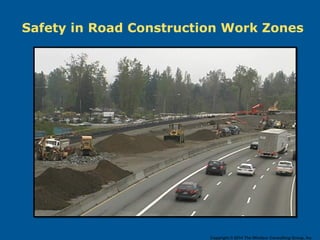
Safety in Road Construction Work Zones
Copyright © 2014 The Windsor Consulting Group, Inc.
What this presentation covers
 Road construction hazards
 Roadway worker fatalities
 Traffic control measures
 Construction vehicle blind spots
 How to protect roadway workers
 Resources
Copyright © 2014 The Windsor Consulting Group, Inc.
Introduction
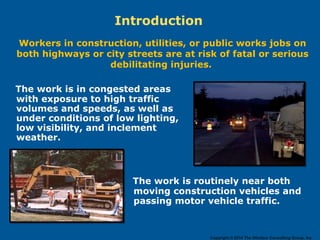
Workers in construction, utilities, or public works jobs on
both highways or city streets are at risk of fatal or serious
debilitating injuries.
The work is in congested areas
with exposure to high traffic
volumes and speeds, as well as
under conditions of low lighting,
low visibility, and inclement
weather.
The work is routinely near both
moving construction vehicles and
passing motor vehicle traffic.
Copyright © 2014 The Windsor Consulting Group, Inc.
Are roadway workers exposed or at risk?
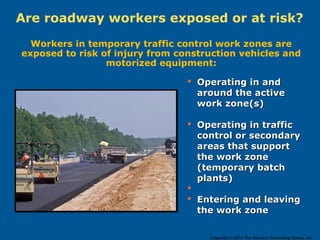
Workers in temporary traffic control work zones are
exposed to risk of injury from construction vehicles and
motorized equipment:
 Operating in andOperating in and
around the activearound the active
work zone(s)work zone(s)
 Operating in trafficOperating in traffic
control or secondarycontrol or secondary
areas that supportareas that support
the work zonethe work zone
(temporary batch(temporary batch
plants)plants)

 Entering and leavingEntering and leaving
the work zonethe work zone
Copyright © 2014 The Windsor Consulting Group, Inc.
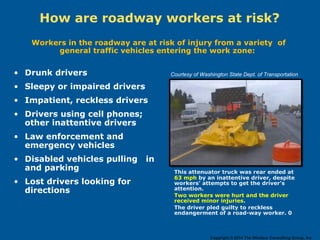
This attenuator truck was rear ended at
63 mph by an inattentive driver, despite
workers’ attempts to get the driver’s
attention.
Two workers were hurt and the driver
received minor injuries.
The driver pled guilty to reckless
endangerment of a road-way worker. 0
How are roadway workers at risk?
Workers in the roadway are at risk of injury from a variety of
general traffic vehicles entering the work zone:
• Drunk drivers
• Sleepy or impaired drivers
• Impatient, reckless drivers
• Drivers using cell phones;
other inattentive drivers
• Law enforcement and
emergency vehicles
• Disabled vehicles pulling in
and parking
• Lost drivers looking for
directions
Courtesy of Washington State Dept. of Transportation
Copyright © 2014 The Windsor Consulting Group, Inc.
How are workers on foot at risk?
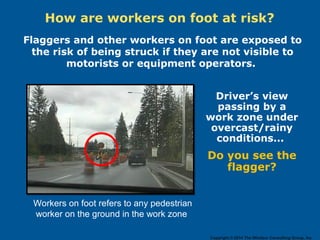
Flaggers and other workers on foot are exposed to
the risk of being struck if they are not visible to
motorists or equipment operators.
Workers on foot refers to any pedestrian
worker on the ground in the work zone
Driver’s view
passing by a
work zone under
overcast/rainy
conditions...
Do you see the
flagger?
Copyright © 2014 The Windsor Consulting Group, Inc.
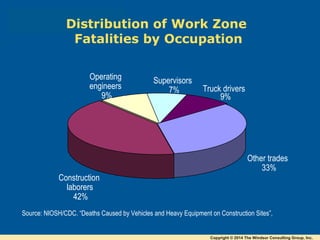
Source: NIOSH/CDC. “Deaths Caused by Vehicles and Heavy Equipment on Construction Sites”,
Other trades
33%
Truck drivers
9%
Construction
laborers
42%
Operating
engineers
9%
Supervisors
7%
Distribution of Work Zone
Fatalities by Occupation
Copyright © 2014 The Windsor Consulting Group, Inc.
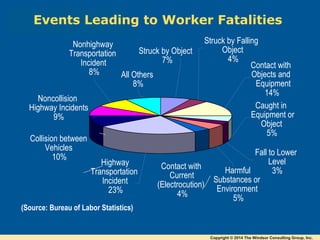
Collision between
Vehicles
10%
Noncollision
Highway Incidents
9%
Nonhighway
Transportation
Incident
8%
Highway
Transportation
Incident
23%
Caught in
Equipment or
Object
5%
Struck by Object
7%
Struck by Falling
Object
4%
Contact with
Objects and
Equipment
14%
Fall to Lower
Level
3%Harmful
Substances or
Environment
5%
Contact with
Current
(Electrocution)
4%
All Others
8%
(Source: Bureau of Labor Statistics)
Events Leading to Worker Fatalities
Copyright © 2014 The Windsor Consulting Group, Inc.
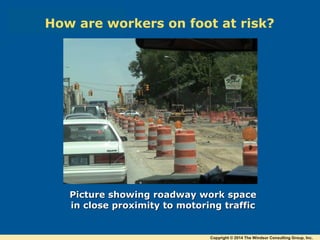
Picture showing roadway work spacePicture showing roadway work space
in close proximity to motoring trafficin close proximity to motoring traffic
How are workers on foot at risk?
Copyright © 2014 The Windsor Consulting Group, Inc.
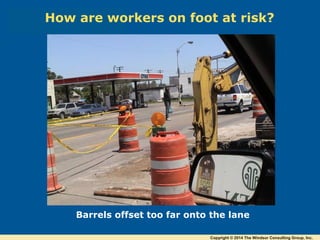
Barrels offset too far onto the lane
How are workers on foot at risk?
Copyright © 2014 The Windsor Consulting Group, Inc.
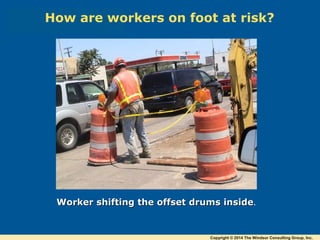
Worker shifting the offset drums insideWorker shifting the offset drums inside.
How are workers on foot at risk?
Copyright © 2014 The Windsor Consulting Group, Inc.
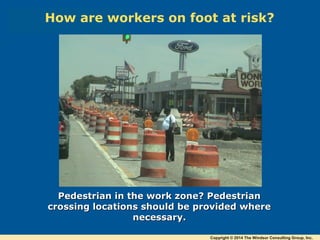
Pedestrian in the work zone? PedestrianPedestrian in the work zone? Pedestrian
crossing locations should be provided wherecrossing locations should be provided where
necessary.necessary.
How are workers on foot at risk?
Copyright © 2014 The Windsor Consulting Group, Inc.
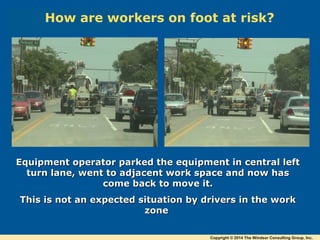
Equipment operator parked the equipment in central leftEquipment operator parked the equipment in central left
turn lane, went to adjacent work space and now hasturn lane, went to adjacent work space and now has
come back to move it.come back to move it.
This is not an expected situation by drivers in the workThis is not an expected situation by drivers in the work
zonezone
How are workers on foot at risk?
Copyright © 2014 The Windsor Consulting Group, Inc.
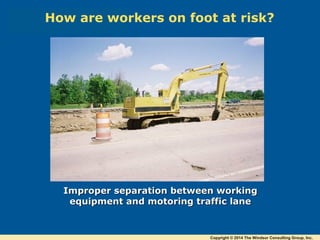
Improper separation between workingImproper separation between working
equipment and motoring traffic laneequipment and motoring traffic lane
How are workers on foot at risk?
Copyright © 2014 The Windsor Consulting Group, Inc.
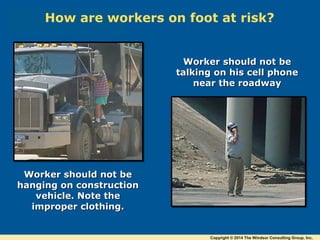
Worker should not beWorker should not be
hanging on constructionhanging on construction
vehicle. Note thevehicle. Note the
improper clothing.improper clothing.
Worker should not beWorker should not be
talking on his cell phonetalking on his cell phone
near the roadwaynear the roadway
How are workers on foot at risk?
Copyright © 2014 The Windsor Consulting Group, Inc.
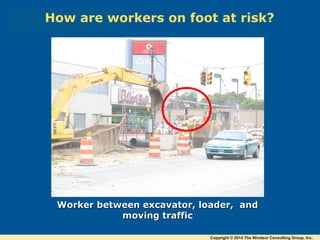
Worker between excavator, loader, andWorker between excavator, loader, and
moving trafficmoving traffic
How are workers on foot at risk?
Copyright © 2014 The Windsor Consulting Group, Inc.
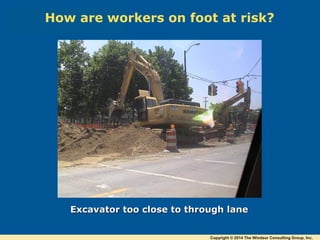
Excavator too close to through laneExcavator too close to through lane
How are workers on foot at risk?
Copyright © 2014 The Windsor Consulting Group, Inc.
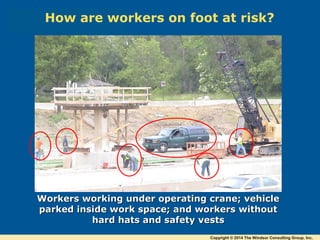
Workers working under operating crane; vehicleWorkers working under operating crane; vehicle
parked inside work space; and workers withoutparked inside work space; and workers without
hard hats and safety vestshard hats and safety vests
How are workers on foot at risk?
Copyright © 2014 The Windsor Consulting Group, Inc.
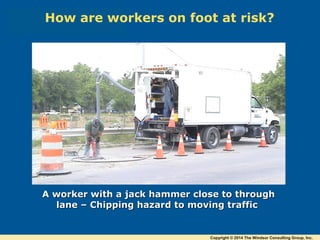
A worker with a jack hammer close to throughA worker with a jack hammer close to through
lane – Chipping hazard to moving trafficlane – Chipping hazard to moving traffic
How are workers on foot at risk?
Copyright © 2014 The Windsor Consulting Group, Inc.
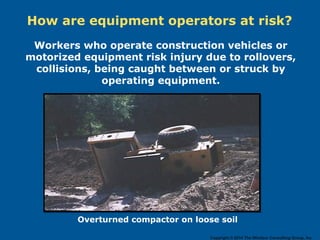
How are equipment operators at risk?
Workers who operate construction vehicles or
motorized equipment risk injury due to rollovers,
collisions, being caught between or struck by
operating equipment.
Overturned compactor on loose soil
Copyright © 2014 The Windsor Consulting Group, Inc.
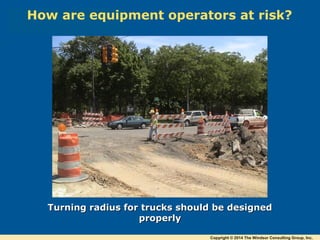
Turning radius for trucks should be designedTurning radius for trucks should be designed
properlyproperly
How are equipment operators at risk?
Copyright © 2014 The Windsor Consulting Group, Inc.
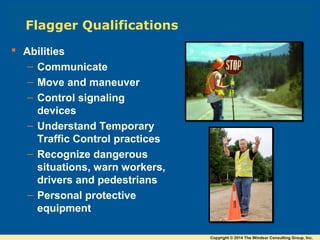
 Abilities
– Communicate
– Move and maneuver
– Control signaling
devices
– Understand Temporary
Traffic Control practices
– Recognize dangerous
situations, warn workers,
drivers and pedestrians
– Personal protective
equipment
Flagger Qualifications
Copyright © 2014 The Windsor Consulting Group, Inc.
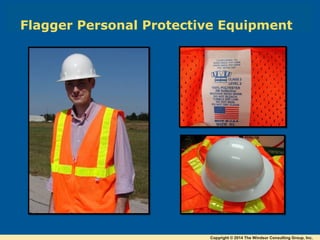
Flagger Personal Protective Equipment
Copyright © 2014 The Windsor Consulting Group, Inc.
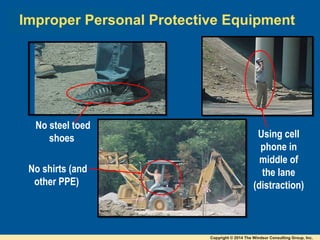
Using cell
phone in
middle of
the lane
(distraction)
Improper Personal Protective Equipment
No shirts (and
other PPE)
No steel toed
shoes
Copyright © 2014 The Windsor Consulting Group, Inc.
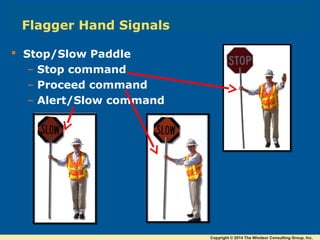
Flagger Hand Signals
 Stop/Slow Paddle
– Stop command
– Proceed command
– Alert/Slow command
Copyright © 2014 The Windsor Consulting Group, Inc.
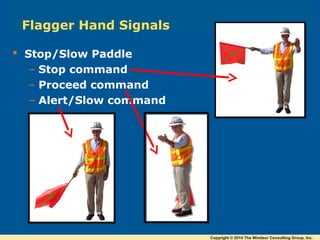
Flagger Hand Signals
 Stop/Slow Paddle
– Stop command
– Proceed command
– Alert/Slow command
Copyright © 2014 The Windsor Consulting Group, Inc.
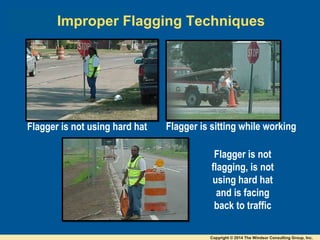
Flagger is not using hard hat
Improper Flagging Techniques
Flagger is sitting while working
Flagger is not
flagging, is not
using hard hat
and is facing
back to traffic
Copyright © 2014 The Windsor Consulting Group, Inc.
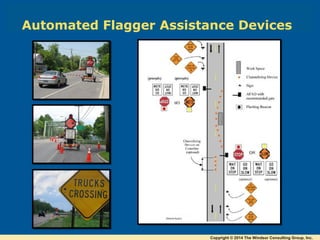
Automated Flagger Assistance Devices
Copyright © 2014 The Windsor Consulting Group, Inc.
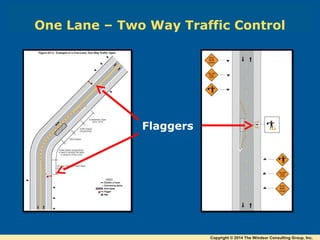
One Lane – Two Way Traffic Control
Flaggers
Copyright © 2014 The Windsor Consulting Group, Inc.
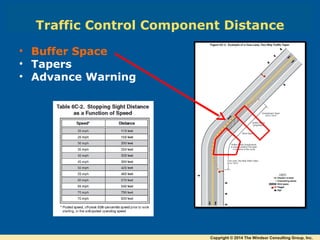
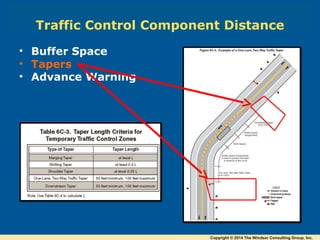
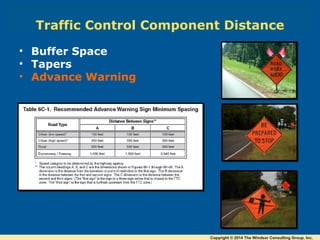
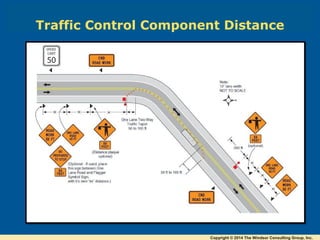
Traffic Control Component Distance
• Buffer Space
• Tapers
• Advance Warning
Copyright © 2014 The Windsor Consulting Group, Inc.
Traffic Control Component Distance
• Buffer Space
• Tapers
• Advance Warning
Copyright © 2014 The Windsor Consulting Group, Inc.
Traffic Control Component Distance
• Buffer Space
• Tapers
• Advance Warning
Copyright © 2014 The Windsor Consulting Group, Inc.
Traffic Control Component Distance
Copyright © 2014 The Windsor Consulting Group, Inc.
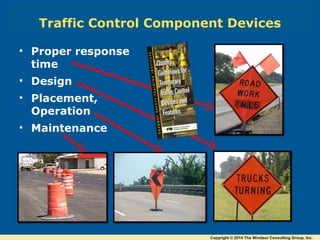
Traffic Control Component Devices
• Proper response
time
• Design
• Placement,
Operation
• Maintenance
Copyright © 2014 The Windsor Consulting Group, Inc.
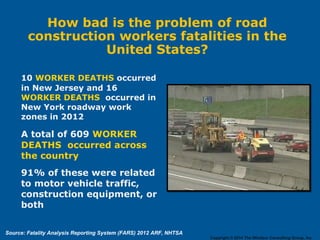
10 WORKER DEATHS occurred
in New Jersey and 16
WORKER DEATHS occurred in
New York roadway work
zones in 2012
A total of 609 WORKER
DEATHS occurred across
the country
91% of these were related
to motor vehicle traffic,
construction equipment, or
both
Source: Fatality Analysis Reporting System (FARS) 2012 ARF, NHTSA
How bad is the problem of road
construction workers fatalities in the
United States?
Copyright © 2014 The Windsor Consulting Group, Inc.
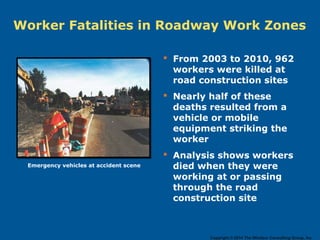
 From 2003 to 2010, 962
workers were killed at
road construction sites
 Nearly half of these
deaths resulted from a
vehicle or mobile
equipment striking the
worker
 Analysis shows workers
died when they were
working at or passing
through the road
construction site
Worker Fatalities in Roadway Work Zones
Emergency vehicles at accident scene
Copyright © 2014 The Windsor Consulting Group, Inc.
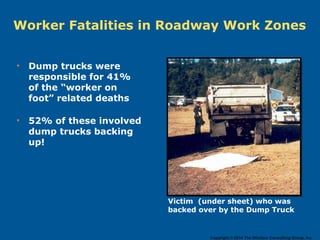
• Dump trucks were
responsible for 41%
of the “worker on
foot” related deaths
• 52% of these involved
dump trucks backing
up!
Worker Fatalities in Roadway Work Zones
Victim (under sheet) who was
backed over by the Dump Truck
Copyright © 2014 The Windsor Consulting Group, Inc.
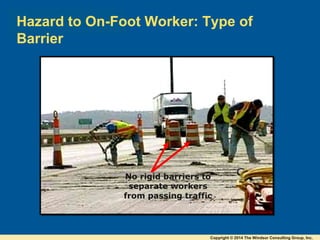
No rigid barriers to
separate workers
from passing traffic
Hazard to On-Foot Worker: Type of
Barrier
Copyright © 2014 The Windsor Consulting Group, Inc.
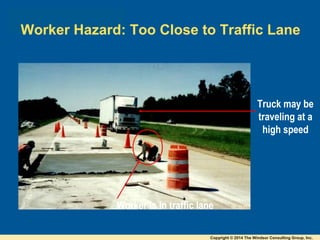
Truck may be
traveling at a
high speed
Worker is in traffic lane
Worker Hazard: Too Close to Traffic Lane
Copyright © 2014 The Windsor Consulting Group, Inc.
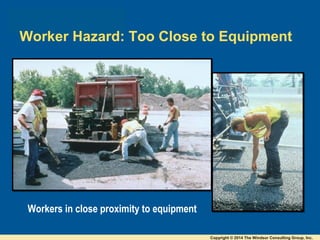
Workers in close proximity to equipment
Worker Hazard: Too Close to Equipment
Copyright © 2014 The Windsor Consulting Group, Inc.
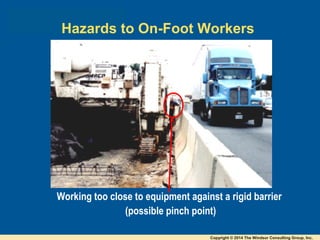
Working too close to equipment against a rigid barrier
(possible pinch point)
Hazards to On-Foot Workers
Copyright © 2014 The Windsor Consulting Group, Inc.
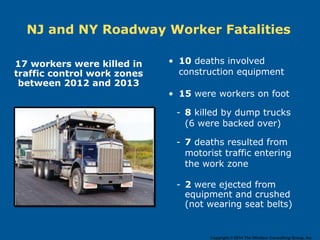
NJ and NY Roadway Worker Fatalities
17 workers were killed in
traffic control work zones
between 2012 and 2013
• 10 deaths involved
construction equipment
• 15 were workers on foot
- 8 killed by dump trucks
(6 were backed over)
- 7 deaths resulted from
motorist traffic entering
the work zone
- 2 were ejected from
equipment and crushed
(not wearing seat belts)
Copyright © 2014 The Windsor Consulting Group, Inc.
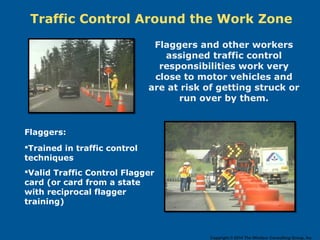
Traffic Control Around the Work Zone
Flaggers and other workers
assigned traffic control
responsibilities work very
close to motor vehicles and
are at risk of getting struck or
run over by them.
Flaggers:
Trained in traffic control
techniques
Valid Traffic Control Flagger
card (or card from a state
with reciprocal flagger
training)
Copyright © 2014 The Windsor Consulting Group, Inc.
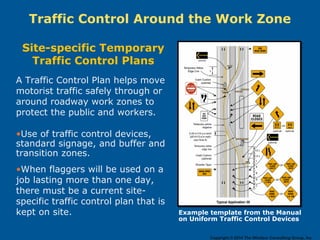
A Traffic Control Plan helps move
motorist traffic safely through or
around roadway work zones to
protect the public and workers.
•Use of traffic control devices,
standard signage, and buffer and
transition zones.
•When flaggers will be used on a
job lasting more than one day,
there must be a current site-
specific traffic control plan that is
kept on site.
Traffic Control Around the Work Zone
Example template from the Manual
on Uniform Traffic Control Devices
Site-specific Temporary
Traffic Control Plans
Copyright © 2014 The Windsor Consulting Group, Inc.
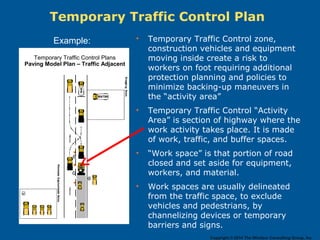
• Temporary Traffic Control zone,
construction vehicles and equipment
moving inside create a risk to
workers on foot requiring additional
protection planning and policies to
minimize backing-up maneuvers in
the “activity area”
• Temporary Traffic Control “Activity
Area” is section of highway where the
work activity takes place. It is made
of work, traffic, and buffer spaces.
• “Work space” is that portion of road
closed and set aside for equipment,
workers, and material.
• Work spaces are usually delineated
from the traffic space, to exclude
vehicles and pedestrians, by
channelizing devices or temporary
barriers and signs.
Temporary Traffic Control Plan
Temporary Traffic Control Plans
Paving Model Plan – Traffic Adjacent
Example:
Copyright © 2014 The Windsor Consulting Group, Inc.
Temporary Traffic Control Plan
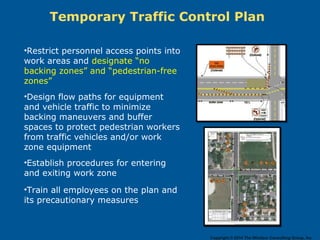
•Restrict personnel access points into
work areas and designate “no
backing zones” and “pedestrian-free
zones”
•Design flow paths for equipment
and vehicle traffic to minimize
backing maneuvers and buffer
spaces to protect pedestrian workers
from traffic vehicles and/or work
zone equipment
•Establish procedures for entering
and exiting work zone
•Train all employees on the plan and
its precautionary measures
Copyright © 2014 The Windsor Consulting Group, Inc.
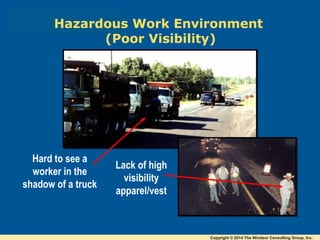
Hazardous Work Environment
(Poor Visibility)
Hard to see a
worker in the
shadow of a truck
Lack of high
visibility
apparel/vest
Copyright © 2014 The Windsor Consulting Group, Inc.
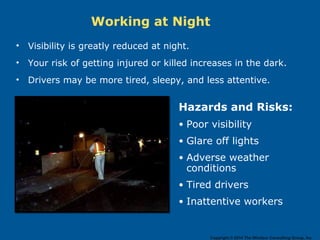
Working at Night
• Visibility is greatly reduced at night.
• Your risk of getting injured or killed increases in the dark.
• Drivers may be more tired, sleepy, and less attentive.
Hazards and Risks:
• Poor visibility
• Glare off lights
• Adverse weather
conditions
• Tired drivers
• Inattentive workers
Copyright © 2014 The Windsor Consulting Group, Inc.
Working at Night
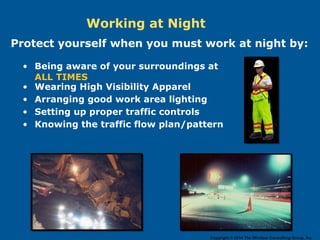
• Being aware of your surroundings at
ALL TIMES
• Wearing High Visibility Apparel
• Arranging good work area lighting
• Setting up proper traffic controls
• Knowing the traffic flow plan/pattern
Protect yourself when you must work at night by:
Copyright © 2014 The Windsor Consulting Group, Inc.
Working Around Vehicles/Heavy Equipment
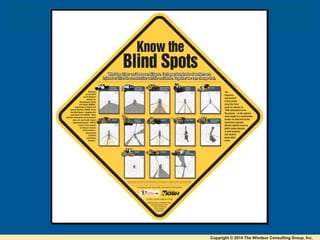
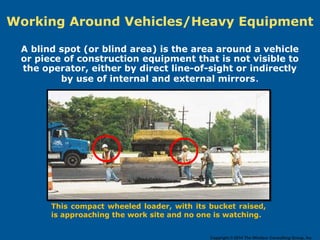
A blind spot (or blind area) is the area around a vehicle
or piece of construction equipment that is not visible to
the operator, either by direct line-of-sight or indirectly
by use of internal and external mirrors.
This compact wheeled loader, with its bucket raised,
is approaching the work site and no one is watching.
Copyright © 2014 The Windsor Consulting Group, Inc.
Blind Spots or Areas
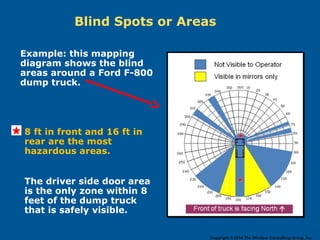
Example: this mapping
diagram shows the blind
areas around a Ford F-800
dump truck.
8 ft in front and 16 ft in
rear are the most
hazardous areas.
The driver side door area
is the only zone within 8
feet of the dump truck
that is safely visible.
Copyright © 2014 The Windsor Consulting Group, Inc.
Blind Areas: Struck-By or Run Over
DRIVER’S and OPERATORS
What happens when you can’t see around you?
HAZARDS:
● Running over or
striking pedestrians
● Smashing site
materials and tools
● Striking other
equipment or vehicles
● Rollover on steep
slopes
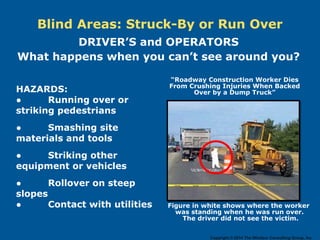
● Contact with utilities Figure in white shows where the worker
was standing when he was run over.
The driver did not see the victim.
“Roadway Construction Worker Dies
From Crushing Injuries When Backed
Over by a Dump Truck”
Copyright © 2014 The Windsor Consulting Group, Inc.
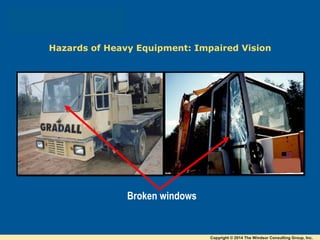
Broken windows
Hazards of Heavy Equipment: Impaired Vision
Copyright © 2014 The Windsor Consulting Group, Inc.
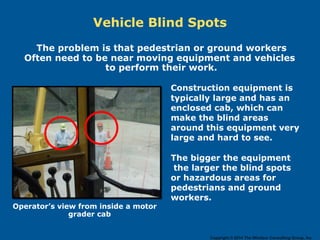
Vehicle Blind Spots
Construction equipment is
typically large and has an
enclosed cab, which can
make the blind areas
around this equipment very
large and hard to see.
The bigger the equipment
the larger the blind spots
or hazardous areas for
pedestrians and ground
workers.
The problem is that pedestrian or ground workers
Often need to be near moving equipment and vehicles
to perform their work.
Operator’s view from inside a motor
grader cab
Copyright © 2014 The Windsor Consulting Group, Inc.
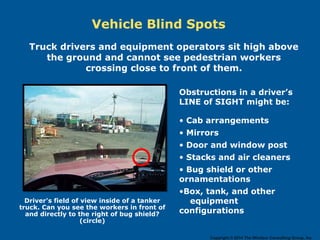
Vehicle Blind Spots
Driver's field of view inside of a tanker
truck. Can you see the workers in front of
and directly to the right of bug shield?
(circle)
Truck drivers and equipment operators sit high above
the ground and cannot see pedestrian workers
crossing close to front of them.
Obstructions in a driver’s
LINE of SIGHT might be:
• Cab arrangements
• Mirrors
• Door and window post
• Stacks and air cleaners
• Bug shield or other
ornamentations
•Box, tank, and other
equipment
configurations
Copyright © 2014 The Windsor Consulting Group, Inc.
Vehicle Blind Spots
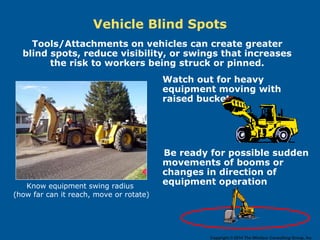
Tools/Attachments on vehicles can create greater
blind spots, reduce visibility, or swings that increases
the risk to workers being struck or pinned.
Watch out for heavy
equipment moving with
raised buckets
Be ready for possible sudden
movements of booms or
changes in direction of
equipment operationKnow equipment swing radius
(how far can it reach, move or rotate)
Copyright © 2014 The Windsor Consulting Group, Inc.
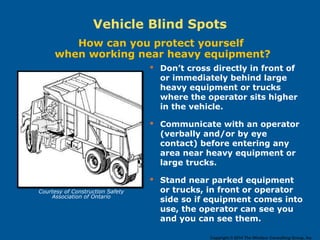
 Don’t cross directly in front of
or immediately behind large
heavy equipment or trucks
where the operator sits higher
in the vehicle.
 Communicate with an operator
(verbally and/or by eye
contact) before entering any
area near heavy equipment or
large trucks.
 Stand near parked equipment
or trucks, in front or operator
side so if equipment comes into
use, the operator can see you
and you can see them.
How can you protect yourself
when working near heavy equipment?
Vehicle Blind Spots
Courtesy of Construction Safety
Association of Ontario
Copyright © 2014 The Windsor Consulting Group, Inc.
Operating Dump Trucks in Reverse
Before backing a dump truck the
driver must determine that no one is
currently in the backing zone and it
is reasonable to expect that no
employee will enter the backing
zone while operating the dump truck
in reverse.
If employees are in the backing
zone or it is reasonable to expect
that an employee will enter the
backing zone, you must make sure
the truck is backed up only when:
- An observer signals that it is safe to
back; or
- An operable mechanical device that
provides the driver a full view behind
the dump truck is used, such as a
video camera.
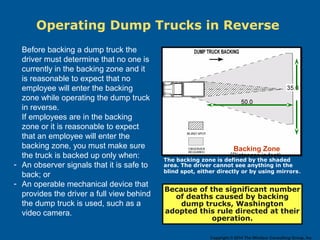
Backing Zone
(Distances in feet)
The backing zone is defined by the shaded
area. The driver cannot see anything in the
blind spot, either directly or by using mirrors.
Because of the significant number
of deaths caused by backing
dump trucks, Washington
adopted this rule directed at their
operation.
Copyright © 2014 The Windsor Consulting Group, Inc.
Operating Dump Trucks in Reverse
If employees are in the backing zone or it is reasonable to expect that
employees will enter the backing zone behind a dump truck, then ensure that:
AND
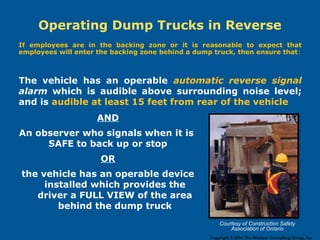
An observer who signals when it is
SAFE to back up or stop
OR
the vehicle has an operable device
installed which provides the
driver a FULL VIEW of the area
behind the dump truck
The vehicle has an operable automatic reverse signal
alarm which is audible above surrounding noise level;
and is audible at least 15 feet from rear of the vehicle
Courtesy of Construction Safety
Association of Ontario
Copyright © 2014 The Windsor Consulting Group, Inc.
Operating Dump Trucks in Reverse
Exemption to Rule
Workers are considered protected when they are on the opposite
side of a fixed barrier such as a jersey barrier or a six-inch concrete
curb or heavy equipment like a paving machine.
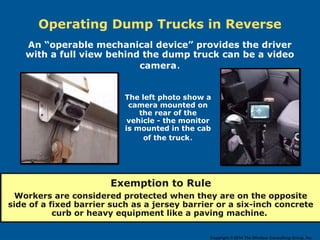
The left photo show a
camera mounted on
the rear of the
vehicle - the monitor
is mounted in the cab
of the truck.
An “operable mechanical device” provides the driver
with a full view behind the dump truck can be a video
camera.
Copyright © 2014 The Windsor Consulting Group, Inc.
How Do You Protect Workers in
Roadway Work Zones?
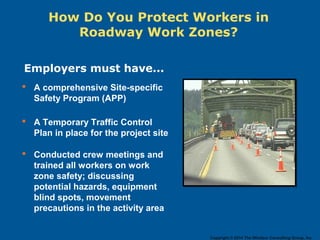
 A comprehensive Site-specific
Safety Program (APP)
 A Temporary Traffic Control
Plan in place for the project site
 Conducted crew meetings and
trained all workers on work
zone safety; discussing
potential hazards, equipment
blind spots, movement
precautions in the activity area
Employers must have...
Copyright © 2014 The Windsor Consulting Group, Inc.
How Do You Protect Workers in
Roadway Work Zones?
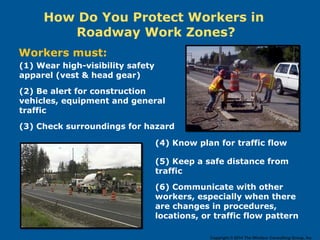
Workers must:
(1) Wear high-visibility safety
apparel (vest & head gear)
(2) Be alert for construction
vehicles, equipment and general
traffic
(3) Check surroundings for hazard
(4) Know plan for traffic flow
(5) Keep a safe distance from
traffic
(6) Communicate with other
workers, especially when there
are changes in procedures,
locations, or traffic flow pattern
Copyright © 2014 The Windsor Consulting Group, Inc.
Pedestrians and Workers
 Keep in eye contact with
operators when working
near moving equipment
 Remember equipment blind
spots and limited visual
areas
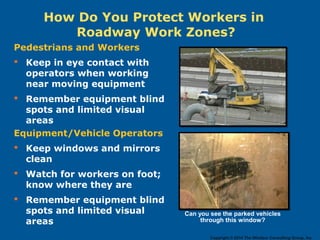
Equipment/Vehicle Operators
 Keep windows and mirrors
clean
 Watch for workers on foot;
know where they are
 Remember equipment blind
spots and limited visual
areas
Can you see the parked vehicles
through this window?
How Do You Protect Workers in
Roadway Work Zones?
Copyright © 2014 The Windsor Consulting Group, Inc.
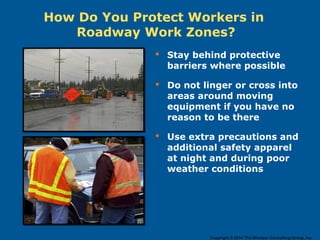
 Stay behind protective
barriers where possible
 Do not linger or cross into
areas around moving
equipment if you have no
reason to be there
 Use extra precautions and
additional safety apparel
at night and during poor
weather conditions
How Do You Protect Workers in
Roadway Work Zones?
Copyright © 2014 The Windsor Consulting Group, Inc.
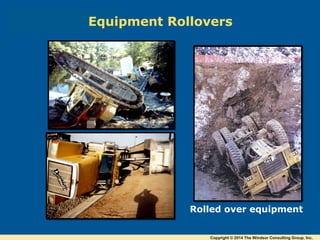
Rolled over equipment
Equipment Rollovers
Copyright © 2014 The Windsor Consulting Group, Inc.
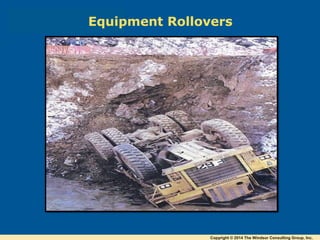
Equipment Rollovers
Copyright © 2014 The Windsor Consulting Group, Inc.
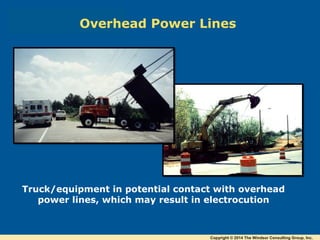
Truck/equipment in potential contact with overhead
power lines, which may result in electrocution
Overhead Power Lines
Copyright © 2014 The Windsor Consulting Group, Inc.
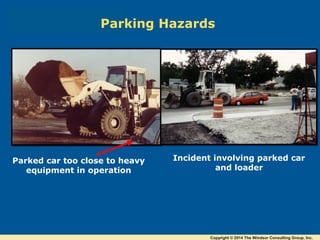
Parked car too close to heavy
equipment in operation
Incident involving parked car
and loader
Parking Hazards
Copyright © 2014 The Windsor Consulting Group, Inc.
More Information and Resources
 DOSH – Noise in Road Construction:
http://www.lni.wa.gov/Safety/TrainTools/Online/Cours
 Federal Highway Administration – work zone
mobility & safety program: FHWA Work Zone
 OSHA – Compactor Rollover Hazard -
Compactor Rollover Hazard
 NIOSH – Highway Work Zone Safety:
NIOSH Topic: Highway Work Zone Safety | CDC/NIOSH
Copyright © 2014 The Windsor Consulting Group, Inc.

Work Zone Safety in Construction

  • 1.
    Protecting workers onroad and highway construction sites Presented by: The Windsor Consulting Group, Inc. Road Construction Work Zone Safety WCG Copyright © 2014 The Windsor Consulting Group, Inc.
  • 2.
    Safety in RoadConstruction Work Zones Copyright © 2014 The Windsor Consulting Group, Inc.
  • 3.
    What this presentationcovers  Road construction hazards  Roadway worker fatalities  Traffic control measures  Construction vehicle blind spots  How to protect roadway workers  Resources Copyright © 2014 The Windsor Consulting Group, Inc.
  • 4.
    Introduction Workers in construction,utilities, or public works jobs on both highways or city streets are at risk of fatal or serious debilitating injuries. The work is in congested areas with exposure to high traffic volumes and speeds, as well as under conditions of low lighting, low visibility, and inclement weather. The work is routinely near both moving construction vehicles and passing motor vehicle traffic. Copyright © 2014 The Windsor Consulting Group, Inc.
  • 5.
    Are roadway workersexposed or at risk? Workers in temporary traffic control work zones are exposed to risk of injury from construction vehicles and motorized equipment:  Operating in andOperating in and around the activearound the active work zone(s)work zone(s)  Operating in trafficOperating in traffic control or secondarycontrol or secondary areas that supportareas that support the work zonethe work zone (temporary batch(temporary batch plants)plants)   Entering and leavingEntering and leaving the work zonethe work zone Copyright © 2014 The Windsor Consulting Group, Inc.
  • 6.
    This attenuator truckwas rear ended at 63 mph by an inattentive driver, despite workers’ attempts to get the driver’s attention. Two workers were hurt and the driver received minor injuries. The driver pled guilty to reckless endangerment of a road-way worker. 0 How are roadway workers at risk? Workers in the roadway are at risk of injury from a variety of general traffic vehicles entering the work zone: • Drunk drivers • Sleepy or impaired drivers • Impatient, reckless drivers • Drivers using cell phones; other inattentive drivers • Law enforcement and emergency vehicles • Disabled vehicles pulling in and parking • Lost drivers looking for directions Courtesy of Washington State Dept. of Transportation Copyright © 2014 The Windsor Consulting Group, Inc.
  • 7.
    How are workerson foot at risk? Flaggers and other workers on foot are exposed to the risk of being struck if they are not visible to motorists or equipment operators. Workers on foot refers to any pedestrian worker on the ground in the work zone Driver’s view passing by a work zone under overcast/rainy conditions... Do you see the flagger? Copyright © 2014 The Windsor Consulting Group, Inc.
  • 8.
    Source: NIOSH/CDC. “DeathsCaused by Vehicles and Heavy Equipment on Construction Sites”, Other trades 33% Truck drivers 9% Construction laborers 42% Operating engineers 9% Supervisors 7% Distribution of Work Zone Fatalities by Occupation Copyright © 2014 The Windsor Consulting Group, Inc.
  • 9.
    Collision between Vehicles 10% Noncollision Highway Incidents 9% Nonhighway Transportation Incident 8% Highway Transportation Incident 23% Caughtin Equipment or Object 5% Struck by Object 7% Struck by Falling Object 4% Contact with Objects and Equipment 14% Fall to Lower Level 3%Harmful Substances or Environment 5% Contact with Current (Electrocution) 4% All Others 8% (Source: Bureau of Labor Statistics) Events Leading to Worker Fatalities Copyright © 2014 The Windsor Consulting Group, Inc.
  • 10.
    Picture showing roadwaywork spacePicture showing roadway work space in close proximity to motoring trafficin close proximity to motoring traffic How are workers on foot at risk? Copyright © 2014 The Windsor Consulting Group, Inc.
  • 11.
    Barrels offset toofar onto the lane How are workers on foot at risk? Copyright © 2014 The Windsor Consulting Group, Inc.
  • 12.
    Worker shifting theoffset drums insideWorker shifting the offset drums inside. How are workers on foot at risk? Copyright © 2014 The Windsor Consulting Group, Inc.
  • 13.
    Pedestrian in thework zone? PedestrianPedestrian in the work zone? Pedestrian crossing locations should be provided wherecrossing locations should be provided where necessary.necessary. How are workers on foot at risk? Copyright © 2014 The Windsor Consulting Group, Inc.
  • 14.
    Equipment operator parkedthe equipment in central leftEquipment operator parked the equipment in central left turn lane, went to adjacent work space and now hasturn lane, went to adjacent work space and now has come back to move it.come back to move it. This is not an expected situation by drivers in the workThis is not an expected situation by drivers in the work zonezone How are workers on foot at risk? Copyright © 2014 The Windsor Consulting Group, Inc.
  • 15.
    Improper separation betweenworkingImproper separation between working equipment and motoring traffic laneequipment and motoring traffic lane How are workers on foot at risk? Copyright © 2014 The Windsor Consulting Group, Inc.
  • 16.
    Worker should notbeWorker should not be hanging on constructionhanging on construction vehicle. Note thevehicle. Note the improper clothing.improper clothing. Worker should not beWorker should not be talking on his cell phonetalking on his cell phone near the roadwaynear the roadway How are workers on foot at risk? Copyright © 2014 The Windsor Consulting Group, Inc.
  • 17.
    Worker between excavator,loader, andWorker between excavator, loader, and moving trafficmoving traffic How are workers on foot at risk? Copyright © 2014 The Windsor Consulting Group, Inc.
  • 18.
    Excavator too closeto through laneExcavator too close to through lane How are workers on foot at risk? Copyright © 2014 The Windsor Consulting Group, Inc.
  • 19.
    Workers working underoperating crane; vehicleWorkers working under operating crane; vehicle parked inside work space; and workers withoutparked inside work space; and workers without hard hats and safety vestshard hats and safety vests How are workers on foot at risk? Copyright © 2014 The Windsor Consulting Group, Inc.
  • 20.
    A worker witha jack hammer close to throughA worker with a jack hammer close to through lane – Chipping hazard to moving trafficlane – Chipping hazard to moving traffic How are workers on foot at risk? Copyright © 2014 The Windsor Consulting Group, Inc.
  • 21.
    Copyright © 2014The Windsor Consulting Group, Inc.
  • 22.
    How are equipmentoperators at risk? Workers who operate construction vehicles or motorized equipment risk injury due to rollovers, collisions, being caught between or struck by operating equipment. Overturned compactor on loose soil Copyright © 2014 The Windsor Consulting Group, Inc.
  • 23.
    Turning radius fortrucks should be designedTurning radius for trucks should be designed properlyproperly How are equipment operators at risk? Copyright © 2014 The Windsor Consulting Group, Inc.
  • 24.
    Copyright © 2014The Windsor Consulting Group, Inc.
  • 25.
     Abilities – Communicate –Move and maneuver – Control signaling devices – Understand Temporary Traffic Control practices – Recognize dangerous situations, warn workers, drivers and pedestrians – Personal protective equipment Flagger Qualifications Copyright © 2014 The Windsor Consulting Group, Inc.
  • 26.
    Flagger Personal ProtectiveEquipment Copyright © 2014 The Windsor Consulting Group, Inc.
  • 27.
    Using cell phone in middleof the lane (distraction) Improper Personal Protective Equipment No shirts (and other PPE) No steel toed shoes Copyright © 2014 The Windsor Consulting Group, Inc.
  • 28.
    Flagger Hand Signals Stop/Slow Paddle – Stop command – Proceed command – Alert/Slow command Copyright © 2014 The Windsor Consulting Group, Inc.
  • 29.
    Flagger Hand Signals Stop/Slow Paddle – Stop command – Proceed command – Alert/Slow command Copyright © 2014 The Windsor Consulting Group, Inc.
  • 30.
    Flagger is notusing hard hat Improper Flagging Techniques Flagger is sitting while working Flagger is not flagging, is not using hard hat and is facing back to traffic Copyright © 2014 The Windsor Consulting Group, Inc.
  • 31.
    Copyright © 2014The Windsor Consulting Group, Inc.
  • 32.
    Automated Flagger AssistanceDevices Copyright © 2014 The Windsor Consulting Group, Inc.
  • 33.
    One Lane –Two Way Traffic Control Flaggers Copyright © 2014 The Windsor Consulting Group, Inc.
  • 34.
    Traffic Control ComponentDistance • Buffer Space • Tapers • Advance Warning Copyright © 2014 The Windsor Consulting Group, Inc.
  • 35.
    Traffic Control ComponentDistance • Buffer Space • Tapers • Advance Warning Copyright © 2014 The Windsor Consulting Group, Inc.
  • 36.
    Traffic Control ComponentDistance • Buffer Space • Tapers • Advance Warning Copyright © 2014 The Windsor Consulting Group, Inc.
  • 37.
    Traffic Control ComponentDistance Copyright © 2014 The Windsor Consulting Group, Inc.
  • 38.
    Traffic Control ComponentDevices • Proper response time • Design • Placement, Operation • Maintenance Copyright © 2014 The Windsor Consulting Group, Inc.
  • 39.
    10 WORKER DEATHSoccurred in New Jersey and 16 WORKER DEATHS occurred in New York roadway work zones in 2012 A total of 609 WORKER DEATHS occurred across the country 91% of these were related to motor vehicle traffic, construction equipment, or both Source: Fatality Analysis Reporting System (FARS) 2012 ARF, NHTSA How bad is the problem of road construction workers fatalities in the United States? Copyright © 2014 The Windsor Consulting Group, Inc.
  • 40.
     From 2003to 2010, 962 workers were killed at road construction sites  Nearly half of these deaths resulted from a vehicle or mobile equipment striking the worker  Analysis shows workers died when they were working at or passing through the road construction site Worker Fatalities in Roadway Work Zones Emergency vehicles at accident scene Copyright © 2014 The Windsor Consulting Group, Inc.
  • 41.
    • Dump truckswere responsible for 41% of the “worker on foot” related deaths • 52% of these involved dump trucks backing up! Worker Fatalities in Roadway Work Zones Victim (under sheet) who was backed over by the Dump Truck Copyright © 2014 The Windsor Consulting Group, Inc.
  • 42.
    No rigid barriersto separate workers from passing traffic Hazard to On-Foot Worker: Type of Barrier Copyright © 2014 The Windsor Consulting Group, Inc.
  • 43.
    Truck may be travelingat a high speed Worker is in traffic lane Worker Hazard: Too Close to Traffic Lane Copyright © 2014 The Windsor Consulting Group, Inc.
  • 44.
    Workers in closeproximity to equipment Worker Hazard: Too Close to Equipment Copyright © 2014 The Windsor Consulting Group, Inc.
  • 45.
    Working too closeto equipment against a rigid barrier (possible pinch point) Hazards to On-Foot Workers Copyright © 2014 The Windsor Consulting Group, Inc.
  • 46.
    NJ and NYRoadway Worker Fatalities 17 workers were killed in traffic control work zones between 2012 and 2013 • 10 deaths involved construction equipment • 15 were workers on foot - 8 killed by dump trucks (6 were backed over) - 7 deaths resulted from motorist traffic entering the work zone - 2 were ejected from equipment and crushed (not wearing seat belts) Copyright © 2014 The Windsor Consulting Group, Inc.
  • 47.
    Traffic Control Aroundthe Work Zone Flaggers and other workers assigned traffic control responsibilities work very close to motor vehicles and are at risk of getting struck or run over by them. Flaggers: Trained in traffic control techniques Valid Traffic Control Flagger card (or card from a state with reciprocal flagger training) Copyright © 2014 The Windsor Consulting Group, Inc.
  • 48.
    A Traffic ControlPlan helps move motorist traffic safely through or around roadway work zones to protect the public and workers. •Use of traffic control devices, standard signage, and buffer and transition zones. •When flaggers will be used on a job lasting more than one day, there must be a current site- specific traffic control plan that is kept on site. Traffic Control Around the Work Zone Example template from the Manual on Uniform Traffic Control Devices Site-specific Temporary Traffic Control Plans Copyright © 2014 The Windsor Consulting Group, Inc.
  • 49.
    • Temporary TrafficControl zone, construction vehicles and equipment moving inside create a risk to workers on foot requiring additional protection planning and policies to minimize backing-up maneuvers in the “activity area” • Temporary Traffic Control “Activity Area” is section of highway where the work activity takes place. It is made of work, traffic, and buffer spaces. • “Work space” is that portion of road closed and set aside for equipment, workers, and material. • Work spaces are usually delineated from the traffic space, to exclude vehicles and pedestrians, by channelizing devices or temporary barriers and signs. Temporary Traffic Control Plan Temporary Traffic Control Plans Paving Model Plan – Traffic Adjacent Example: Copyright © 2014 The Windsor Consulting Group, Inc.
  • 50.
    Temporary Traffic ControlPlan •Restrict personnel access points into work areas and designate “no backing zones” and “pedestrian-free zones” •Design flow paths for equipment and vehicle traffic to minimize backing maneuvers and buffer spaces to protect pedestrian workers from traffic vehicles and/or work zone equipment •Establish procedures for entering and exiting work zone •Train all employees on the plan and its precautionary measures Copyright © 2014 The Windsor Consulting Group, Inc.
  • 51.
    Copyright © 2014The Windsor Consulting Group, Inc.
  • 52.
    Hazardous Work Environment (PoorVisibility) Hard to see a worker in the shadow of a truck Lack of high visibility apparel/vest Copyright © 2014 The Windsor Consulting Group, Inc.
  • 53.
    Working at Night •Visibility is greatly reduced at night. • Your risk of getting injured or killed increases in the dark. • Drivers may be more tired, sleepy, and less attentive. Hazards and Risks: • Poor visibility • Glare off lights • Adverse weather conditions • Tired drivers • Inattentive workers Copyright © 2014 The Windsor Consulting Group, Inc.
  • 54.
    Working at Night •Being aware of your surroundings at ALL TIMES • Wearing High Visibility Apparel • Arranging good work area lighting • Setting up proper traffic controls • Knowing the traffic flow plan/pattern Protect yourself when you must work at night by: Copyright © 2014 The Windsor Consulting Group, Inc.
  • 55.
    Working Around Vehicles/HeavyEquipment A blind spot (or blind area) is the area around a vehicle or piece of construction equipment that is not visible to the operator, either by direct line-of-sight or indirectly by use of internal and external mirrors. This compact wheeled loader, with its bucket raised, is approaching the work site and no one is watching. Copyright © 2014 The Windsor Consulting Group, Inc.
  • 56.
    Blind Spots orAreas Example: this mapping diagram shows the blind areas around a Ford F-800 dump truck. 8 ft in front and 16 ft in rear are the most hazardous areas. The driver side door area is the only zone within 8 feet of the dump truck that is safely visible. Copyright © 2014 The Windsor Consulting Group, Inc.
  • 57.
    Blind Areas: Struck-Byor Run Over DRIVER’S and OPERATORS What happens when you can’t see around you? HAZARDS: ● Running over or striking pedestrians ● Smashing site materials and tools ● Striking other equipment or vehicles ● Rollover on steep slopes ● Contact with utilities Figure in white shows where the worker was standing when he was run over. The driver did not see the victim. “Roadway Construction Worker Dies From Crushing Injuries When Backed Over by a Dump Truck” Copyright © 2014 The Windsor Consulting Group, Inc.
  • 58.
    Broken windows Hazards ofHeavy Equipment: Impaired Vision Copyright © 2014 The Windsor Consulting Group, Inc.
  • 59.
    Vehicle Blind Spots Constructionequipment is typically large and has an enclosed cab, which can make the blind areas around this equipment very large and hard to see. The bigger the equipment the larger the blind spots or hazardous areas for pedestrians and ground workers. The problem is that pedestrian or ground workers Often need to be near moving equipment and vehicles to perform their work. Operator’s view from inside a motor grader cab Copyright © 2014 The Windsor Consulting Group, Inc.
  • 60.
    Vehicle Blind Spots Driver'sfield of view inside of a tanker truck. Can you see the workers in front of and directly to the right of bug shield? (circle) Truck drivers and equipment operators sit high above the ground and cannot see pedestrian workers crossing close to front of them. Obstructions in a driver’s LINE of SIGHT might be: • Cab arrangements • Mirrors • Door and window post • Stacks and air cleaners • Bug shield or other ornamentations •Box, tank, and other equipment configurations Copyright © 2014 The Windsor Consulting Group, Inc.
  • 61.
    Vehicle Blind Spots Tools/Attachmentson vehicles can create greater blind spots, reduce visibility, or swings that increases the risk to workers being struck or pinned. Watch out for heavy equipment moving with raised buckets Be ready for possible sudden movements of booms or changes in direction of equipment operationKnow equipment swing radius (how far can it reach, move or rotate) Copyright © 2014 The Windsor Consulting Group, Inc.
  • 62.
     Don’t crossdirectly in front of or immediately behind large heavy equipment or trucks where the operator sits higher in the vehicle.  Communicate with an operator (verbally and/or by eye contact) before entering any area near heavy equipment or large trucks.  Stand near parked equipment or trucks, in front or operator side so if equipment comes into use, the operator can see you and you can see them. How can you protect yourself when working near heavy equipment? Vehicle Blind Spots Courtesy of Construction Safety Association of Ontario Copyright © 2014 The Windsor Consulting Group, Inc.
  • 63.
    Operating Dump Trucksin Reverse Before backing a dump truck the driver must determine that no one is currently in the backing zone and it is reasonable to expect that no employee will enter the backing zone while operating the dump truck in reverse. If employees are in the backing zone or it is reasonable to expect that an employee will enter the backing zone, you must make sure the truck is backed up only when: - An observer signals that it is safe to back; or - An operable mechanical device that provides the driver a full view behind the dump truck is used, such as a video camera. Backing Zone (Distances in feet) The backing zone is defined by the shaded area. The driver cannot see anything in the blind spot, either directly or by using mirrors. Because of the significant number of deaths caused by backing dump trucks, Washington adopted this rule directed at their operation. Copyright © 2014 The Windsor Consulting Group, Inc.
  • 64.
    Operating Dump Trucksin Reverse If employees are in the backing zone or it is reasonable to expect that employees will enter the backing zone behind a dump truck, then ensure that: AND An observer who signals when it is SAFE to back up or stop OR the vehicle has an operable device installed which provides the driver a FULL VIEW of the area behind the dump truck The vehicle has an operable automatic reverse signal alarm which is audible above surrounding noise level; and is audible at least 15 feet from rear of the vehicle Courtesy of Construction Safety Association of Ontario Copyright © 2014 The Windsor Consulting Group, Inc.
  • 65.
    Operating Dump Trucksin Reverse Exemption to Rule Workers are considered protected when they are on the opposite side of a fixed barrier such as a jersey barrier or a six-inch concrete curb or heavy equipment like a paving machine. The left photo show a camera mounted on the rear of the vehicle - the monitor is mounted in the cab of the truck. An “operable mechanical device” provides the driver with a full view behind the dump truck can be a video camera. Copyright © 2014 The Windsor Consulting Group, Inc.
  • 66.
    How Do YouProtect Workers in Roadway Work Zones?  A comprehensive Site-specific Safety Program (APP)  A Temporary Traffic Control Plan in place for the project site  Conducted crew meetings and trained all workers on work zone safety; discussing potential hazards, equipment blind spots, movement precautions in the activity area Employers must have... Copyright © 2014 The Windsor Consulting Group, Inc.
  • 67.
    How Do YouProtect Workers in Roadway Work Zones? Workers must: (1) Wear high-visibility safety apparel (vest & head gear) (2) Be alert for construction vehicles, equipment and general traffic (3) Check surroundings for hazard (4) Know plan for traffic flow (5) Keep a safe distance from traffic (6) Communicate with other workers, especially when there are changes in procedures, locations, or traffic flow pattern Copyright © 2014 The Windsor Consulting Group, Inc.
  • 68.
    Pedestrians and Workers Keep in eye contact with operators when working near moving equipment  Remember equipment blind spots and limited visual areas Equipment/Vehicle Operators  Keep windows and mirrors clean  Watch for workers on foot; know where they are  Remember equipment blind spots and limited visual areas Can you see the parked vehicles through this window? How Do You Protect Workers in Roadway Work Zones? Copyright © 2014 The Windsor Consulting Group, Inc.
  • 69.
     Stay behindprotective barriers where possible  Do not linger or cross into areas around moving equipment if you have no reason to be there  Use extra precautions and additional safety apparel at night and during poor weather conditions How Do You Protect Workers in Roadway Work Zones? Copyright © 2014 The Windsor Consulting Group, Inc.
  • 70.
    Rolled over equipment EquipmentRollovers Copyright © 2014 The Windsor Consulting Group, Inc.
  • 71.
    Equipment Rollovers Copyright ©2014 The Windsor Consulting Group, Inc.
  • 72.
    Truck/equipment in potentialcontact with overhead power lines, which may result in electrocution Overhead Power Lines Copyright © 2014 The Windsor Consulting Group, Inc.
  • 73.
    Parked car tooclose to heavy equipment in operation Incident involving parked car and loader Parking Hazards Copyright © 2014 The Windsor Consulting Group, Inc.
  • 74.
    More Information andResources  DOSH – Noise in Road Construction: http://www.lni.wa.gov/Safety/TrainTools/Online/Cours  Federal Highway Administration – work zone mobility & safety program: FHWA Work Zone  OSHA – Compactor Rollover Hazard - Compactor Rollover Hazard  NIOSH – Highway Work Zone Safety: NIOSH Topic: Highway Work Zone Safety | CDC/NIOSH Copyright © 2014 The Windsor Consulting Group, Inc.

Editor's Notes

  • #9 The distribution of work zone deaths by occupation, based on data published by the National Institute of Occupational Safety and Health/Center for Disease Control and Prevention (NIOSH/CDC) from 1992 to 1999 indicates that the employee classifications with the largest portions of deaths involved construction laborers and trades persons. This may be attributed to their type of work activities, as well as the location and environment in which they work.
  • #10 A review of historic data from 1992 to 2002 indicate that some events are associated with higher incidence of H&SC worker fatalities, based on the 1992 to 2002 data published by the Bureau of Labor Statistics. The higher risk activities include highway transportation incidents, contacts with objects and equipment and collisions between vehicles. The remaining factors account for 5 percent or less of the highway and street construction worker fatalities and are not associated with high risk.
  • #28 This illustration demonstrates various improper attire and lack of personal protective equipment of highway workers on the job sites including: (1) lack of steel-toed boots as shown in the upper left photograph, (2) lack of safety vest and standing inattentively in a traffic lanes as shown in the upper right photograph and (3) lack of proper clothing (shirts) in addition to other PPEs such as hard hats, etc., as shown in the bottom photograph.
  • #31 This illustration demonstrates various improper flagging techniques including: (1) flagger not holding the sign so that the message can be read by the motorists (sign turned to the side) and is also standing unnecessarily in the travel lanes, as shown in the upper left photograph, (2) flagger is directing traffic improperly by sitting in the back of a pick-up truck, as shown in the upper right photograph, and (3) flagger has his back toward traffic, as shown in the bottom center photograph. Additionally, in all of the photographs, the flaggers are not wearing hard hats.
  • #44 This slide illustrates a situation where a worker is partially located in the traffic lane, in a kneeling position that does not allow him to respond quickly in an emergency situation. Additionally, the worker does not seem to be aware that a large truck is approaching most likely at a high speed, which puts him at very high risk. The truck already appears to be traveling on the shoulder to avoid hitting the worker. This example demonstrates a very high risk situation.
  • #45 This slide illustrates situations where workers must perform their work activities in close proximity to heavy equipment, which may be moving or stationary. Workers must be aware of potential hazards when working near heavy equipment. Loose clothing/jewelry may get stuck in the equipment, workers may get caught in the equipment if not paying full attention, or a slip/fall may result in a severe injury while working near to such heavy equipment. Thus caution must be exercised to prevent such incidents from occurring.
  • #46 This slide illustrates a situation where a worker is located in an extremely confined space, a possible pinch point, between large equipment and a barrier wall. In such a situation, the worker should perform the specific duty promptly, and coordinate and stay in constant communication with the equipment operator until he is out of the pinch point. Any unexpected movement of the equipment could cause the worker his life, since he does not have any place to escape to.
  • #53 This illustrates hazards related to visibility issues within a work zone. The top photograph demonstrates that workers may not be visible when working in the shadow of a truck, even during the day time. If workers cannot be seen by the truck drivers, they may be at risk of being struck. A high visibility vest would improve the visibility of this worker. Additionally, the worker should stay in communication with the vehicle operators to further ensure his safety. The bottom photograph shows night work being conducted, where a group of workers are wearing reflectorized safety vests and are clearly visible to the oncoming trucks. However, one of the workers is not wearing high visibility clothing and may not be visible. Additionally, the workers at this job site are not wearing hard hats, which is not a safe practice.
  • #59 This illustrates hazards associated with impaired vision of trucks and equipment. If the windshield is broken, the operator may not be able to see other workers in the area and other hazardous situations, and may put many people in unnecessary danger. The equipment should be inspected for damages, before it is used. If damages are detected, the equipment should not be used until it is repaired.
  • #71 This illustrates various equipment rollovers and the inherent danger to the operators within the cabs, as well as any workers nearby. These rollover accidents may be related to unstable soils/surfaces, uneven loads in dump trucks, equipment being operated at excessive speeds, and other improper operation.
  • #73 This illustrates hazards with trucks and other equipment coming in contact with overhead power lines, which is an extremely dangerous situation. The truck/equipment run the risk of being electrocuted, as well as any workers nearby. All workers should know the proper actions to take if a power line is hit, else they may be fatally electrocuted.
  • #74 This illustrates how problems may arise due to undesignated parking areas for workers personal vehicles. In the planning stages, areas for parking should be identified and all workers should be instructed to use only those areas to park. Undesignated parking may create unnecessary conflicts within the work areas.