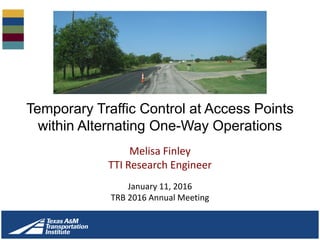
Temporary Traffic Control at Access Points
within Alternating One-Way Operations
Melisa Finley
TTI Research Engineer
January 11, 2016
TRB 2016 Annual Meeting
The Problem
 Lane closures on two-lane, two-way roads
• Control one-way operation at each end
• What about low-volume access points?
 Existing methods are not always feasible
• Work duration
• Traffic volume
• Time of day
• Cost
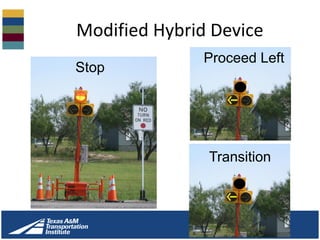
Modified Hybrid Device
Stop
Proceed Left
Transition
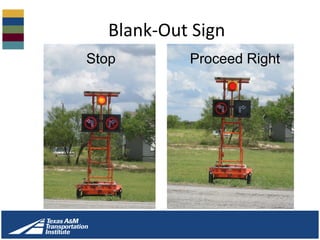
Blank-Out Sign
Stop Proceed Right
Evaluation
 Surveys to determine driver understanding
 Field studies to assess operational and
safety effectiveness
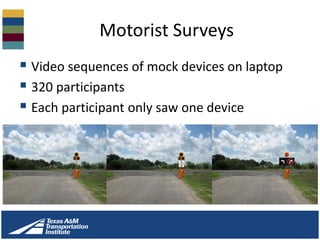
Motorist Surveys
 Video sequences of mock devices on laptop
 320 participants
 Each participant only saw one device
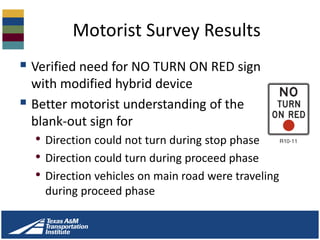
Motorist Survey Results
 Verified need for NO TURN ON RED sign
with modified hybrid device
 Better motorist understanding of the
blank-out sign for
• Direction could not turn during stop phase
• Direction could turn during proceed phase
• Direction vehicles on main road were traveling
during proceed phase
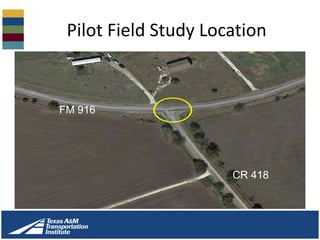
Pilot Field Study Location
CR 418
FM 916
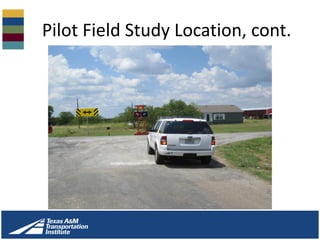
Pilot Field Study Location, cont.
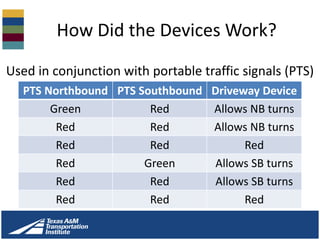
How Did the Devices Work?
Used in conjunction with portable traffic signals (PTS)
PTS Northbound PTS Southbound Driveway Device
Green Red Allows NB turns
Red Red Allows NB turns
Red Red Red
Red Green Allows SB turns
Red Red Allows SB turns
Red Red Red
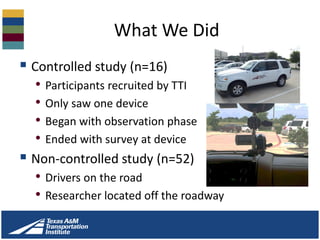
What We Did
 Controlled study (n=16)
• Participants recruited by TTI
• Only saw one device
• Began with observation phase
• Ended with survey at device
 Non-controlled study (n=52)
• Drivers on the road
• Researcher located off the roadway
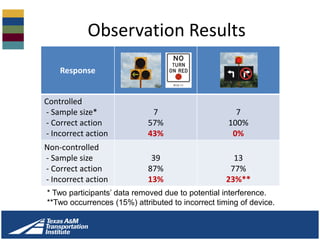
Response
Controlled
- Sample size*
- Correct action
- Incorrect action
7
57%
43%
7
100%
0%
Non-controlled
- Sample size
- Correct action
- Incorrect action
39
87%
13%
13
77%
23%**
Observation Results
* Two participants’ data removed due to potential interference.
**Two occurrences (15%) attributed to incorrect timing of device.
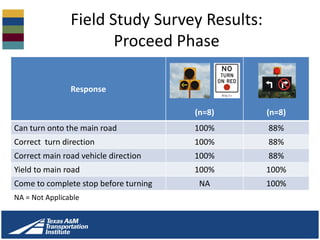
Response
(n=8) (n=8)
Can turn onto the main road 100% 88%
Correct turn direction 100% 88%
Correct main road vehicle direction 100% 88%
Yield to main road 100% 100%
Come to complete stop before turning NA 100%
Field Study Survey Results:
Proceed Phase
NA = Not Applicable
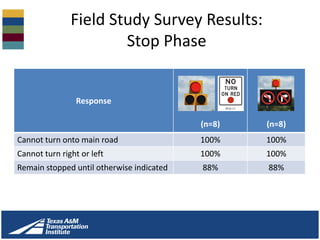
Field Study Survey Results:
Stop Phase
Response
(n=8) (n=8)
Cannot turn onto main road 100% 100%
Cannot turn right or left 100% 100%
Remain stopped until otherwise indicated 88% 88%
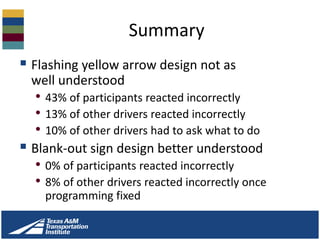
Summary
 Flashing yellow arrow design not as
well understood
• 43% of participants reacted incorrectly
• 13% of other drivers reacted incorrectly
• 10% of other drivers had to ask what to do
 Blank-out sign design better understood
• 0% of participants reacted incorrectly
• 8% of other drivers reacted incorrectly once
programming fixed
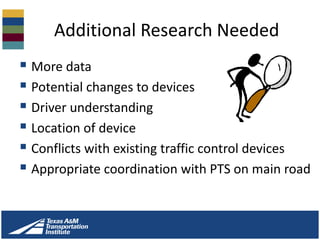
Additional Research Needed
 More data
 Potential changes to devices
 Driver understanding
 Location of device
 Conflicts with existing traffic control devices
 Appropriate coordination with PTS on main road
Contact Information
 Melisa D. Finley, P.E.
979-845-7596
m-finley@tti.tamu.edu
 Research report available at
http://tti.tamu.edu/documents/
0-6708-1.pdf
 TRB paper 16-0682

Temporary Traffic Control at Access Points within Alternating One-Way Operations

  • 1.
    Temporary Traffic Controlat Access Points within Alternating One-Way Operations Melisa Finley TTI Research Engineer January 11, 2016 TRB 2016 Annual Meeting
  • 2.
    The Problem  Laneclosures on two-lane, two-way roads • Control one-way operation at each end • What about low-volume access points?  Existing methods are not always feasible • Work duration • Traffic volume • Time of day • Cost
  • 3.
  • 4.
  • 5.
    Evaluation  Surveys todetermine driver understanding  Field studies to assess operational and safety effectiveness
  • 6.
    Motorist Surveys  Videosequences of mock devices on laptop  320 participants  Each participant only saw one device
  • 7.
    Motorist Survey Results Verified need for NO TURN ON RED sign with modified hybrid device  Better motorist understanding of the blank-out sign for • Direction could not turn during stop phase • Direction could turn during proceed phase • Direction vehicles on main road were traveling during proceed phase
  • 8.
    Pilot Field StudyLocation CR 418 FM 916
  • 9.
    Pilot Field StudyLocation, cont.
  • 10.
    How Did theDevices Work? Used in conjunction with portable traffic signals (PTS) PTS Northbound PTS Southbound Driveway Device Green Red Allows NB turns Red Red Allows NB turns Red Red Red Red Green Allows SB turns Red Red Allows SB turns Red Red Red
  • 11.
    What We Did Controlled study (n=16) • Participants recruited by TTI • Only saw one device • Began with observation phase • Ended with survey at device  Non-controlled study (n=52) • Drivers on the road • Researcher located off the roadway
  • 12.
    Response Controlled - Sample size* -Correct action - Incorrect action 7 57% 43% 7 100% 0% Non-controlled - Sample size - Correct action - Incorrect action 39 87% 13% 13 77% 23%** Observation Results * Two participants’ data removed due to potential interference. **Two occurrences (15%) attributed to incorrect timing of device.
  • 13.
    Response (n=8) (n=8) Can turnonto the main road 100% 88% Correct turn direction 100% 88% Correct main road vehicle direction 100% 88% Yield to main road 100% 100% Come to complete stop before turning NA 100% Field Study Survey Results: Proceed Phase NA = Not Applicable
  • 14.
    Field Study SurveyResults: Stop Phase Response (n=8) (n=8) Cannot turn onto main road 100% 100% Cannot turn right or left 100% 100% Remain stopped until otherwise indicated 88% 88%
  • 15.
    Summary  Flashing yellowarrow design not as well understood • 43% of participants reacted incorrectly • 13% of other drivers reacted incorrectly • 10% of other drivers had to ask what to do  Blank-out sign design better understood • 0% of participants reacted incorrectly • 8% of other drivers reacted incorrectly once programming fixed
  • 16.
    Additional Research Needed More data  Potential changes to devices  Driver understanding  Location of device  Conflicts with existing traffic control devices  Appropriate coordination with PTS on main road
  • 17.
    Contact Information  MelisaD. Finley, P.E. 979-845-7596 m-finley@tti.tamu.edu  Research report available at http://tti.tamu.edu/documents/ 0-6708-1.pdf  TRB paper 16-0682