Work co-operatively
and communicate with
others about work
matters Recap Week 9 10/09/2013
Communication styles
When we think about communication
styles the 3 most common we refer to
include:
Passive
Assertive
Aggressive
WORKING TOGETHER
Week 10 17/9/2013
Assessment Task 2 –
The follow up report
due today Week 10
(17/9/013). Remember
cover sheets.
Strategies staff use to communicate
effectively with one another
Staff meetings
Regular opportunities for staff to attend staff
and team meetings will support staff to
develop and maintain a strong team work
relationship
Staff communicate effectively by actively
listening to colleagues and striving to
understand their colleagues perspectives.
Staff meetings
The way staff relate to each other will influence
the atmosphere created in the service
Staff meetings:
Allow staff to have input into decisions being
made
Act as a means of receiving and discussing
information
Provide an avenue to air grievances, and
discuss any concerns
You can help make the meetings more
successful by doing the following:
Preparing for a meeting beforehand by
thinking about what you would like to
discuss, what you would like to achieve,
and how you’ll approach the rest of the
team.
If there is an agenda outlined
beforehand, familiarise yourself with
the topics to be discussed.
Sharing your ideas freely with your
team in a logical genuine way.
Asking questions when you don’t
understand other’s suggestions and
discussions
Listening carefully to what others have
to say and clarifying anything that you’re
unsure of
Trying to encourage those who are quiet
to participate.
Clarifying who is responsible for the
outcomes of the meeting and
summarising any future tasks which you
understand are your responsibility
Communication strategies
An important element of effective team
work is the ability of staff to empathise
with and support their colleagues. This
assists staff to appreciate each other’s
feelings, views, needs and interests and
respect the knowledge and skills that
each staff member brings to work
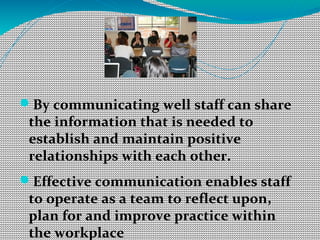
By communicating well staff can share
the information that is needed to
establish and maintain positive
relationships with each other.
Effective communication enables staff
to operate as a team to reflect upon,
plan for and improve practice within
the workplace
Working Cooperatively
Working cooperatively requires team
members to complete their individual
responsibilities and duties, but to also
use their initiative and assist and
support the other team members within
the workplace
These behaviours are highly regarded within
community services organisations and
demonstrate an individual’s ability to be an
effective team member
Behaviours that promote cooperation in the
work place include:
Effective and ethical communication with team
members.
Ensuring decisions and practices are fair and
equitable.
Discussing issues and concerns openly.
TODAYS SESSION YOU WILL BE
WORKING TOGETHER AS A WHOLE
GROUP TO BOTH ORGANISE AND
CONDUCT A STAFF MEETING
In a staff meeting the same rules apply as per last week...
Demonstrating an ability to listen appropriately to
the opinions and suggestions of others;
Communicating clearly, concisely and with a focus on
the issue (task);
Using questions to clarify instructions or
responsibilities;
Displaying a helpful and courteous manner at all
times;
Using effective conflict resolution skills.
BEFORE YOU COMMENCE ...
Remember -
• Code of conduct;
• The ability to pick on non-verbal
cues of your peers;
• To work positively and together
as a team;
• Actively listen to each other;
• Respect each others efforts.
HOW DO WE ORGANISE THIS?
WHAT ROLES DO WE PLAY?
WHAT TOPICS DO WE CHOOSE?
HOW DO WE ORGANISE THIS?
Group 1
1. Plan an agenda. This can be typed up and
sent as an email that I will print out.
2. Think of the roles that need to be played –
director, teachers/room leaders, early
childhood educators, office staff (minute
taker), cook etc.
WHAT ROLES DO WE PLAY?
WHAT TOPICS DO WE CHOOSE?
Group 2
Think of some topics that would be relevant to
discuss i.e.
1. A child with behavioural problems;
2. A parent who becomes upset if her child is not attended to when she
leaves;
3. Staff ensuring that all work is completed if on late shift (what do you
need to refer to here)?
4. Fathers day – how are we going to celebrate this? Etc etc
Remember you will also need to make a list of any possible previous issues
raised at the last meeting.
Lillypilly Children's Centre Staff Meeting   
*Date of meeting
* Facilitator – who is running it?
* Attendees – who is present
* Start Time of Meeting
* Venue
Its body will mainly consist of:
* Issues raised from the previous meeting.
* Agenda
* Apologies
* Closing time of meeting.
UPON COMPLETING THE MEETING
Did it go well?
Did all the issues get raised?
Was the communication (both
verbal and non-verbal) professional
and in keeping with what we have
learnt in class?

Work with others week 10

  • 1.
    Work co-operatively and communicatewith others about work matters Recap Week 9 10/09/2013
  • 2.
    Communication styles When wethink about communication styles the 3 most common we refer to include: Passive Assertive Aggressive
  • 3.
  • 4.
    Assessment Task 2– The follow up report due today Week 10 (17/9/013). Remember cover sheets.
  • 5.
    Strategies staff useto communicate effectively with one another Staff meetings Regular opportunities for staff to attend staff and team meetings will support staff to develop and maintain a strong team work relationship Staff communicate effectively by actively listening to colleagues and striving to understand their colleagues perspectives.
  • 6.
    Staff meetings The waystaff relate to each other will influence the atmosphere created in the service Staff meetings: Allow staff to have input into decisions being made Act as a means of receiving and discussing information Provide an avenue to air grievances, and discuss any concerns
  • 7.
    You can helpmake the meetings more successful by doing the following: Preparing for a meeting beforehand by thinking about what you would like to discuss, what you would like to achieve, and how you’ll approach the rest of the team. If there is an agenda outlined beforehand, familiarise yourself with the topics to be discussed. Sharing your ideas freely with your team in a logical genuine way.
  • 8.
    Asking questions whenyou don’t understand other’s suggestions and discussions Listening carefully to what others have to say and clarifying anything that you’re unsure of
  • 9.
    Trying to encouragethose who are quiet to participate. Clarifying who is responsible for the outcomes of the meeting and summarising any future tasks which you understand are your responsibility
  • 10.
    Communication strategies An importantelement of effective team work is the ability of staff to empathise with and support their colleagues. This assists staff to appreciate each other’s feelings, views, needs and interests and respect the knowledge and skills that each staff member brings to work
  • 11.
    By communicating wellstaff can share the information that is needed to establish and maintain positive relationships with each other. Effective communication enables staff to operate as a team to reflect upon, plan for and improve practice within the workplace
  • 12.
    Working Cooperatively Working cooperativelyrequires team members to complete their individual responsibilities and duties, but to also use their initiative and assist and support the other team members within the workplace
  • 13.
    These behaviours arehighly regarded within community services organisations and demonstrate an individual’s ability to be an effective team member Behaviours that promote cooperation in the work place include: Effective and ethical communication with team members. Ensuring decisions and practices are fair and equitable. Discussing issues and concerns openly.
  • 14.
    TODAYS SESSION YOUWILL BE WORKING TOGETHER AS A WHOLE GROUP TO BOTH ORGANISE AND CONDUCT A STAFF MEETING
  • 15.
    In a staffmeeting the same rules apply as per last week... Demonstrating an ability to listen appropriately to the opinions and suggestions of others; Communicating clearly, concisely and with a focus on the issue (task); Using questions to clarify instructions or responsibilities; Displaying a helpful and courteous manner at all times; Using effective conflict resolution skills.
  • 16.
    BEFORE YOU COMMENCE... Remember - • Code of conduct; • The ability to pick on non-verbal cues of your peers; • To work positively and together as a team; • Actively listen to each other; • Respect each others efforts.
  • 17.
    HOW DO WEORGANISE THIS? WHAT ROLES DO WE PLAY? WHAT TOPICS DO WE CHOOSE?
  • 18.
    HOW DO WEORGANISE THIS? Group 1 1. Plan an agenda. This can be typed up and sent as an email that I will print out. 2. Think of the roles that need to be played – director, teachers/room leaders, early childhood educators, office staff (minute taker), cook etc. WHAT ROLES DO WE PLAY?
  • 19.
    WHAT TOPICS DOWE CHOOSE? Group 2 Think of some topics that would be relevant to discuss i.e. 1. A child with behavioural problems; 2. A parent who becomes upset if her child is not attended to when she leaves; 3. Staff ensuring that all work is completed if on late shift (what do you need to refer to here)? 4. Fathers day – how are we going to celebrate this? Etc etc Remember you will also need to make a list of any possible previous issues raised at the last meeting.
  • 20.
    Lillypilly Children's CentreStaff Meeting    *Date of meeting * Facilitator – who is running it? * Attendees – who is present * Start Time of Meeting * Venue Its body will mainly consist of: * Issues raised from the previous meeting. * Agenda * Apologies * Closing time of meeting.
  • 21.
    UPON COMPLETING THEMEETING Did it go well? Did all the issues get raised? Was the communication (both verbal and non-verbal) professional and in keeping with what we have learnt in class?