Prepare for work in the
community Sector
The Community Service Industry
Recap Week 4 6/8/2013

* Target groups
* Different models of work in the CSI
* Stakeholders
Target groups
• In the Community Service Industry many services or
organisations work with particular groups of people
called target groups
• A target group is a client group with a particular defining
characteristic such as gender, age, sexual orientation,
disability or cultural background.
• Services are often funded to work with specific target
groups such as a women’s health program, a youth
recreation service or a child care service.
Major target groups within CSI
• Children
• Women
• People with a disability
• Older mature people
• Young people
• Aboriginal and Torres Strait Islanders
• People from culturally and linguistically
• People with HIV/AIDS related illnesses
• Gay and lesbian communities
• People who are sick
• People who have a mental illness
• People who are in receipt of welfare benefits
• People with alcohol and other drug related
problems
• Some people may fit into a number of target
groups while others will belong to just one.
• Some organisations will work with just one
target group and are called specialist
organisations (such as a child care service or
alcohol and other drug service).
• Others work with a range of target groups and
are called generalist services (such as a
neighbourhood service).
Different models of work in the CSI
• Services work in different ways to meet their
target group. These include:-

• Prevention: Service works to prevent
problems from occurring

– For example education programs aimed at
reducing child abuse or domestic violence
• Crisis Intervention: these services work
at supporting and helping people in
crisis.

– For example, people who have lost their homes
through fire or financial hardship

• Direct service: these services provide
support and assistance directly to the
target group.

– For example, meals on wheels, counselling and
alcohol and other drug rehabilitation
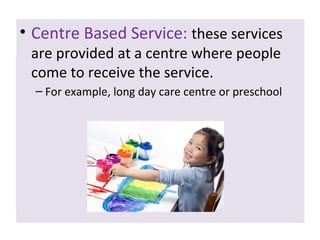
• Centre Based Service: these services

are provided at a centre where people
• Centre Based Service: these services
come to receive the service.
– For example, at day care centre or people
are providedlonga centre wherepreschool
come to receive the service.
• For example, long day care centre or
preschool.
• A Client-centred Approach: with a

client-centred approach it’s important to see the client
as the central part of a situation or issue, rather than as
being the end result of a problem to be solved.

• Clients may have needs that relate to health care, diet
and nutrition, safe housing, personal safety and security,
general welfare or the early diagnosis and assessment of
problems.
• By ensuring that a range of basic needs are being
considered and met, a client is better able to focus upon
resolving other pressing issues.
For example, Community health – disability & aged care...
• Participatory: is an active involvement of

people in making decisions about
implementation of processes, programs and
projects which affect them.

• A participatory approach can be used in
facilitating community development.
• Projects where stakeholders are able to
participate in the process tend to have a
higher success rate than top-down structures.
– For example, Byron Youth Service
• Community education: is defined as

learning and social development work with
individuals and groups in their communities
using a range of formal and informal methods.

• A common defining feature is that
programmes and activities are developed in
dialogue with communities and participants.
• The purpose of community learning and
development is to improve quality of life.
– For example, ACE, the Black Dog Institute (deliver
education seminars on mood disorders and
wellbeing), North Coast Area Health Service
• Case Management: is a strategy that

actively mobilises, coordinates and maintains
a diversity of services for the individual and
their family (Stroul & Friedman, 1986).

• It has been described as the ‘glue that holds
the system together’, or the ‘lynchpin for an
effective interagency system’
• It has been used in the health and aged care
sectors as a means of improving efficiency in
resource allocation to clients with complex
(health) care needs that could not be met
through existing services (Fisher & Fine, 2002).
• Outreach services: these services go

into the community to work with people
in their homes or local area.
– For example, mobile child care service or home
visiting program
• Advocacy: these services advocate (stand

up) for the rights of particular target groups:
– For example, Intellectual Disability Rights Service
and Welfare Rights Services
• Community development: these

services work to identify unmet needs of the
community and then plan and develop new
services to meet those needs.
– For example most local councils have community
development workers
• Peak bodies: these services provide

support, training and policy development for
non-government services.
– For example, the NSW Council of Social Services
(NCOSS) and KU Children’s Services (NSW)
Stakeholders
• Stakeholders describe the key people
associated with an organisation or client the
stakeholders of a service may include clients,
workers (staff), funding bodies, families or the
community in which the service is based
Who is a stakeholder in a
children's service or preschool?
Stakeholders in a preschool
• Could include:– Children families using the centre
– Staff
– Department of Education and Communities
– The Family Assistance Office
– Groups that manage the centre like a parent committee
– The community in which the
centre is based
Week 5 13/8/2013

Careers in the CSI
Industrial Relations
The Role of Unions
Careers in the CSI
• The CSI is a dynamic, flexible workplace where individuals
can give back to their local communities while achieving
their personal career goals.
• Employment prospects in the CSI are above average.
• Demographic changes predict increasing demand for CS.
• It’s expected maternal health, childcare & aged care
services will continue to rise.
• Fastest growing occupations: personal care & nursing
assistants, nurse managers, childcare workers, welfare &
community workers.
Careers in the CSI
• Based on statistics from the ABS 2011, the following link
provides information in relation to the 1) growth of
employees in the children's services industry in recent years
2) the difference between male and female workers and 3)
the age of workers in the industry.

•

http://www.abs.gov.au/AUSSTATS/abs@.nsf/Lookup/4102.0Main+Features30Sep+2011
Careers in the CSI
• ACTIVITY 1

Using the Breakdown of the the CSI printout from week 3 (p18
training package), students are the break into pairs.
With the butcher paper provided, you are to choose 2 of the areas
within the breakdown and list all the occupations you can find for
these areas i.e.
1. Indigenous services and centrelink;
2. Youth services and legal/corrective services;
3. Alcohol and other drugs/ health services;
4. Aged services and family services;
5. Children's services and generalist community services
6. Culturally and linguistically diverse services.
Industrial Relations
• 'Industrial relations' refers to laws dealing with the

arrangements that are made between workers and
employers.

• These laws are developed by Federal & State
Governments
• Other key players:
Employers: focus on goods, services & profits
Unions: focus on fair conditions for workers
Industrial Relations
• Activity 2
• Students are to use their iPads to find out about NSW
industrial relations using the following link -

http://www.industrialrelations.nsw.gov.au/
• The laws cover different aspects of
work including:
• Setting conditions about workers rights, such
as pay rates, leave entitlements and dismissal
rules.
• Guidelines and rules in relation to Workplace
Health and Safety (WH&S) issues.
• Handling workplace disputes or infringements
of the Industrial Relations Law
The Fair Work System
• Fair work system started on the 1st July 2009.
• It’s Australia’s new national (Federal)
workplace relations system.
• The Fair Work Act 2009 covers a majority of
workplaces in Australia
The Fair Work System
• There are now 2 new organisations that
regulate the system • FAIR WORK AUSTRALIA and
• FAIR WORK OMBUDSMAN
Key elements of the fair work
system

• A legislated safety net of 10 National Employment Standards
that apply to all employees within the federal system
– Includes: maximum weekly hours, requests for flexible
working arrangements, parental leave and related
entitlements, annual leave, personal/carer's leave and
compassionate leave, community service leave, long
service leave, public holidays, notice of termination and
redundancy pay.
• New modern awards
• Enterprise bargaining arrangements
• Protection against discrimination and unfair dismissal
Unfair dismissal
• Activity 3 Read the fact sheet in your
handouts
• In what instances is immediate dismissal
permissible?
• In a process that may lead to dismissal, what
must an employer ensure happens?
• In discussions where dismissal is possible, who
should an employee take to the meeting?
Unions
• Unions can help employees in many ways:
– Training about industrial issues
– Preserving & improving wages & conditions
– Better health & safety at work
– Job security
– Workers compensation help
– Protection from discrimination
– Lobbying governments on workers’ behalf
Unions
Activity 4
• As per activity 2, using their iPads, students are to
locate the union that is relevant for their industry -

Prepare for work week 5 1 33

  • 1.
    Prepare for workin the community Sector
  • 2.
    The Community ServiceIndustry Recap Week 4 6/8/2013 * Target groups * Different models of work in the CSI * Stakeholders
  • 3.
    Target groups • Inthe Community Service Industry many services or organisations work with particular groups of people called target groups • A target group is a client group with a particular defining characteristic such as gender, age, sexual orientation, disability or cultural background. • Services are often funded to work with specific target groups such as a women’s health program, a youth recreation service or a child care service.
  • 4.
    Major target groupswithin CSI • Children • Women • People with a disability • Older mature people • Young people • Aboriginal and Torres Strait Islanders • People from culturally and linguistically
  • 5.
    • People withHIV/AIDS related illnesses • Gay and lesbian communities • People who are sick • People who have a mental illness • People who are in receipt of welfare benefits • People with alcohol and other drug related problems
  • 6.
    • Some peoplemay fit into a number of target groups while others will belong to just one. • Some organisations will work with just one target group and are called specialist organisations (such as a child care service or alcohol and other drug service). • Others work with a range of target groups and are called generalist services (such as a neighbourhood service).
  • 7.
    Different models ofwork in the CSI • Services work in different ways to meet their target group. These include:- • Prevention: Service works to prevent problems from occurring – For example education programs aimed at reducing child abuse or domestic violence
  • 8.
    • Crisis Intervention:these services work at supporting and helping people in crisis. – For example, people who have lost their homes through fire or financial hardship • Direct service: these services provide support and assistance directly to the target group. – For example, meals on wheels, counselling and alcohol and other drug rehabilitation
  • 9.
    • Centre BasedService: these services are provided at a centre where people • Centre Based Service: these services come to receive the service. – For example, at day care centre or people are providedlonga centre wherepreschool come to receive the service. • For example, long day care centre or preschool.
  • 10.
    • A Client-centredApproach: with a client-centred approach it’s important to see the client as the central part of a situation or issue, rather than as being the end result of a problem to be solved. • Clients may have needs that relate to health care, diet and nutrition, safe housing, personal safety and security, general welfare or the early diagnosis and assessment of problems. • By ensuring that a range of basic needs are being considered and met, a client is better able to focus upon resolving other pressing issues. For example, Community health – disability & aged care...
  • 11.
    • Participatory: isan active involvement of people in making decisions about implementation of processes, programs and projects which affect them. • A participatory approach can be used in facilitating community development. • Projects where stakeholders are able to participate in the process tend to have a higher success rate than top-down structures. – For example, Byron Youth Service
  • 12.
    • Community education:is defined as learning and social development work with individuals and groups in their communities using a range of formal and informal methods. • A common defining feature is that programmes and activities are developed in dialogue with communities and participants. • The purpose of community learning and development is to improve quality of life. – For example, ACE, the Black Dog Institute (deliver education seminars on mood disorders and wellbeing), North Coast Area Health Service
  • 13.
    • Case Management:is a strategy that actively mobilises, coordinates and maintains a diversity of services for the individual and their family (Stroul & Friedman, 1986). • It has been described as the ‘glue that holds the system together’, or the ‘lynchpin for an effective interagency system’ • It has been used in the health and aged care sectors as a means of improving efficiency in resource allocation to clients with complex (health) care needs that could not be met through existing services (Fisher & Fine, 2002).
  • 14.
    • Outreach services:these services go into the community to work with people in their homes or local area. – For example, mobile child care service or home visiting program
  • 15.
    • Advocacy: theseservices advocate (stand up) for the rights of particular target groups: – For example, Intellectual Disability Rights Service and Welfare Rights Services
  • 16.
    • Community development:these services work to identify unmet needs of the community and then plan and develop new services to meet those needs. – For example most local councils have community development workers
  • 17.
    • Peak bodies:these services provide support, training and policy development for non-government services. – For example, the NSW Council of Social Services (NCOSS) and KU Children’s Services (NSW)
  • 18.
    Stakeholders • Stakeholders describethe key people associated with an organisation or client the stakeholders of a service may include clients, workers (staff), funding bodies, families or the community in which the service is based
  • 19.
    Who is astakeholder in a children's service or preschool?
  • 20.
    Stakeholders in apreschool • Could include:– Children families using the centre – Staff – Department of Education and Communities – The Family Assistance Office – Groups that manage the centre like a parent committee – The community in which the centre is based
  • 21.
    Week 5 13/8/2013 Careersin the CSI Industrial Relations The Role of Unions
  • 22.
    Careers in theCSI • The CSI is a dynamic, flexible workplace where individuals can give back to their local communities while achieving their personal career goals. • Employment prospects in the CSI are above average. • Demographic changes predict increasing demand for CS. • It’s expected maternal health, childcare & aged care services will continue to rise. • Fastest growing occupations: personal care & nursing assistants, nurse managers, childcare workers, welfare & community workers.
  • 23.
    Careers in theCSI • Based on statistics from the ABS 2011, the following link provides information in relation to the 1) growth of employees in the children's services industry in recent years 2) the difference between male and female workers and 3) the age of workers in the industry. • http://www.abs.gov.au/AUSSTATS/abs@.nsf/Lookup/4102.0Main+Features30Sep+2011
  • 24.
    Careers in theCSI • ACTIVITY 1 Using the Breakdown of the the CSI printout from week 3 (p18 training package), students are the break into pairs. With the butcher paper provided, you are to choose 2 of the areas within the breakdown and list all the occupations you can find for these areas i.e. 1. Indigenous services and centrelink; 2. Youth services and legal/corrective services; 3. Alcohol and other drugs/ health services; 4. Aged services and family services; 5. Children's services and generalist community services 6. Culturally and linguistically diverse services.
  • 25.
    Industrial Relations • 'Industrialrelations' refers to laws dealing with the arrangements that are made between workers and employers. • These laws are developed by Federal & State Governments • Other key players: Employers: focus on goods, services & profits Unions: focus on fair conditions for workers
  • 26.
    Industrial Relations • Activity2 • Students are to use their iPads to find out about NSW industrial relations using the following link - http://www.industrialrelations.nsw.gov.au/
  • 27.
    • The lawscover different aspects of work including: • Setting conditions about workers rights, such as pay rates, leave entitlements and dismissal rules. • Guidelines and rules in relation to Workplace Health and Safety (WH&S) issues. • Handling workplace disputes or infringements of the Industrial Relations Law
  • 28.
    The Fair WorkSystem • Fair work system started on the 1st July 2009. • It’s Australia’s new national (Federal) workplace relations system. • The Fair Work Act 2009 covers a majority of workplaces in Australia
  • 29.
    The Fair WorkSystem • There are now 2 new organisations that regulate the system • FAIR WORK AUSTRALIA and • FAIR WORK OMBUDSMAN
  • 30.
    Key elements ofthe fair work system • A legislated safety net of 10 National Employment Standards that apply to all employees within the federal system – Includes: maximum weekly hours, requests for flexible working arrangements, parental leave and related entitlements, annual leave, personal/carer's leave and compassionate leave, community service leave, long service leave, public holidays, notice of termination and redundancy pay. • New modern awards • Enterprise bargaining arrangements • Protection against discrimination and unfair dismissal
  • 31.
    Unfair dismissal • Activity3 Read the fact sheet in your handouts • In what instances is immediate dismissal permissible? • In a process that may lead to dismissal, what must an employer ensure happens? • In discussions where dismissal is possible, who should an employee take to the meeting?
  • 32.
    Unions • Unions canhelp employees in many ways: – Training about industrial issues – Preserving & improving wages & conditions – Better health & safety at work – Job security – Workers compensation help – Protection from discrimination – Lobbying governments on workers’ behalf
  • 33.
    Unions Activity 4 • Asper activity 2, using their iPads, students are to locate the union that is relevant for their industry -

Editor's Notes

  • #2 {"25":"Independent Education Union (IEU)United Voice (formerly LHMU)\n","26":"Independent Education Union (IEU)United Voice (formerly LHMU)\n"}