Daniela Naranjo
December 13, 2021
edX - Tecnológico de Monterrey
Project: My Interpersonal Communication
Objective: To classify how I communicate through a self-diagnosis, with the objective of designing an
action plan to improve some of the areas that could be improved.
I. SELF-DIAGNOSIS
Self-Diagnosis Table:
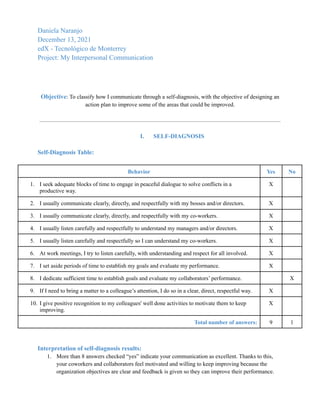
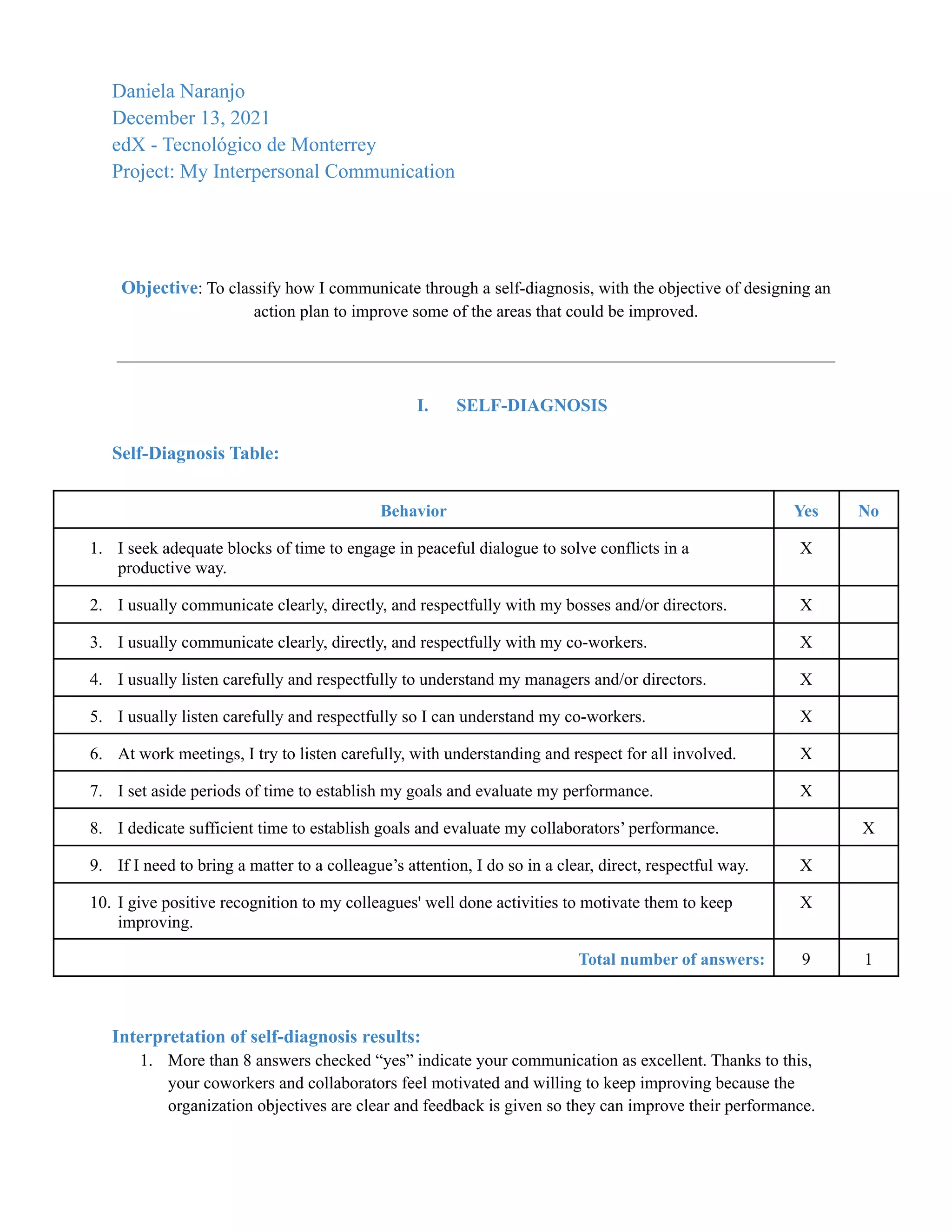
Behavior Yes No
1. I seek adequate blocks of time to engage in peaceful dialogue to solve conflicts in a
productive way.
X
2. I usually communicate clearly, directly, and respectfully with my bosses and/or directors. X
3. I usually communicate clearly, directly, and respectfully with my co-workers. X
4. I usually listen carefully and respectfully to understand my managers and/or directors. X
5. I usually listen carefully and respectfully so I can understand my co-workers. X
6. At work meetings, I try to listen carefully, with understanding and respect for all involved. X
7. I set aside periods of time to establish my goals and evaluate my performance. X
8. I dedicate sufficient time to establish goals and evaluate my collaborators’ performance. X
9. If I need to bring a matter to a colleague’s attention, I do so in a clear, direct, respectful way. X
10. I give positive recognition to my colleagues' well done activities to motivate them to keep
improving.
X
Total number of answers: 9 1
Interpretation of self-diagnosis results:
1. More than 8 answers checked “yes” indicate your communication as excellent. Thanks to this,
your coworkers and collaborators feel motivated and willing to keep improving because the
organization objectives are clear and feedback is given so they can improve their performance.
II. REFLECTIONS
Questions for reflection:
1. What positive behaviors could you identify in the way you communicate? The positive
behaviors that I could identify in the way that I communicate is that I am an empathetic
communicator. I am assertive and kind in my communication, and I always try my best to
keep my communication as professional, direct and positive as possible even if there is
discussion on something challenging or difficult.
2. What behaviors of yours do you feel need improving? A behavior I know I need
improving in is dedicating more time to develop and carry out my goals. It is easy for me
to set goals, but I realized I get so caught away in the productivity of my days that I leave
my goals up until the last minute, or sometimes unfinished. I noticed that a lot of my
colleagues also function like this - setting goals and struggling to find the balance of time,
juggling our workloads and completing goals. I think it’s important that I complete my
goals to motivate my colleagues, and the culture at work, to complete a successful work
goal.
3. How do you think your way of communicating affects people and results? The way I
communicate is keeping everything professionally polite, never taking anything personal,
and always striving to be positive (even when I have a bad day). You can still be an
assertive, respectful and strong leader when having difficult conversations because the
tonality and gravity of delivery really makes a difference. That is where empathy comes
in. It is checking in with the other person, listening and understanding where they may be
at for the day, and providing whatever necessary feedback or information I may need to
give them. When a leader aggressively gives tasks, the person is not as likely to feel as
motivated or excited to complete the tasks. Being on that side of the pipeline, I felt that
my work was not appreciated and a lot of my hard work wasn’t viewed as a success but
more of an expected measurement on my value as an employee.
4. What factors do you think influence the way you communicate with others? Factors that
may influence communication may be stressors, poor communication, distractions,
positive/negative body language, aggressive/authoritative vs. assertive communication, or
sometimes simply the things we carry in our life outside of work (frantic that your bus
was late, annoyed that you spilled coffee, cheerful from a text message, etc.)
5. What conclusions can you make based on these observations that will allow you to
improve your communication as a leader, both in the work environment and in your
personal environment? One major improvement that strikes me is putting action to
complete my goals. I am a dreamer, and it comes very naturally for me to set goals. It is
also easy for me to dream and begin the process of a goal. It’s where the completion of
the goal makes me drag a little. For example, this task and completing this course. I was
leaving the last major tasks to the end, and the day is here where I revisit the motivation
and putting into practice the act of completing my goals.
III. BEHAVIORAL IMPROVEMENT
One behavior to improve: Putting into practice completing my goals.
IV. ACTIONS FOR BEHAVIORAL IMPROVEMENT
Three actions to improve behavior:
1. Time-Management. Block out a specific routine and time in my day to dedicate time
into my goal. That way I don’t try to complete my goal in one go, and take my time and
truly digest my goal.
2. Prep. Don’t be afraid to mentally prepare and have fun learning something new. Failing
to prepare is preparation for failure.
3. Commitment. Be committed to my word, and be committed to the very end. Keep
motivation and stamina with a strong vision and beginning, and uphold my self to
continue to the very end.
Checklist to evaluate your project:
Criteria Yes, it
complies
No, it doesn’t
comply
a. Includes a self-diagnosis table with the total number of responses and
correct interpretation of the results.
X
b. Answers the 5 reflection questions. X
c. Identifies the behavior chosen to improve. X
d. Describes at least 3 actions to improve the chosen behavior. X
e. The actions described are concrete and can be evaluated within a
specific period of time.
X

Effective communication for today's leader exercise 2

  • 1.
    Daniela Naranjo December 13,2021 edX - Tecnológico de Monterrey Project: My Interpersonal Communication Objective: To classify how I communicate through a self-diagnosis, with the objective of designing an action plan to improve some of the areas that could be improved. I. SELF-DIAGNOSIS Self-Diagnosis Table: Behavior Yes No 1. I seek adequate blocks of time to engage in peaceful dialogue to solve conflicts in a productive way. X 2. I usually communicate clearly, directly, and respectfully with my bosses and/or directors. X 3. I usually communicate clearly, directly, and respectfully with my co-workers. X 4. I usually listen carefully and respectfully to understand my managers and/or directors. X 5. I usually listen carefully and respectfully so I can understand my co-workers. X 6. At work meetings, I try to listen carefully, with understanding and respect for all involved. X 7. I set aside periods of time to establish my goals and evaluate my performance. X 8. I dedicate sufficient time to establish goals and evaluate my collaborators’ performance. X 9. If I need to bring a matter to a colleague’s attention, I do so in a clear, direct, respectful way. X 10. I give positive recognition to my colleagues' well done activities to motivate them to keep improving. X Total number of answers: 9 1 Interpretation of self-diagnosis results: 1. More than 8 answers checked “yes” indicate your communication as excellent. Thanks to this, your coworkers and collaborators feel motivated and willing to keep improving because the organization objectives are clear and feedback is given so they can improve their performance.
  • 2.
    II. REFLECTIONS Questions forreflection: 1. What positive behaviors could you identify in the way you communicate? The positive behaviors that I could identify in the way that I communicate is that I am an empathetic communicator. I am assertive and kind in my communication, and I always try my best to keep my communication as professional, direct and positive as possible even if there is discussion on something challenging or difficult. 2. What behaviors of yours do you feel need improving? A behavior I know I need improving in is dedicating more time to develop and carry out my goals. It is easy for me to set goals, but I realized I get so caught away in the productivity of my days that I leave my goals up until the last minute, or sometimes unfinished. I noticed that a lot of my colleagues also function like this - setting goals and struggling to find the balance of time, juggling our workloads and completing goals. I think it’s important that I complete my goals to motivate my colleagues, and the culture at work, to complete a successful work goal. 3. How do you think your way of communicating affects people and results? The way I communicate is keeping everything professionally polite, never taking anything personal, and always striving to be positive (even when I have a bad day). You can still be an assertive, respectful and strong leader when having difficult conversations because the tonality and gravity of delivery really makes a difference. That is where empathy comes in. It is checking in with the other person, listening and understanding where they may be at for the day, and providing whatever necessary feedback or information I may need to give them. When a leader aggressively gives tasks, the person is not as likely to feel as motivated or excited to complete the tasks. Being on that side of the pipeline, I felt that my work was not appreciated and a lot of my hard work wasn’t viewed as a success but more of an expected measurement on my value as an employee. 4. What factors do you think influence the way you communicate with others? Factors that may influence communication may be stressors, poor communication, distractions, positive/negative body language, aggressive/authoritative vs. assertive communication, or sometimes simply the things we carry in our life outside of work (frantic that your bus was late, annoyed that you spilled coffee, cheerful from a text message, etc.) 5. What conclusions can you make based on these observations that will allow you to improve your communication as a leader, both in the work environment and in your personal environment? One major improvement that strikes me is putting action to complete my goals. I am a dreamer, and it comes very naturally for me to set goals. It is also easy for me to dream and begin the process of a goal. It’s where the completion of the goal makes me drag a little. For example, this task and completing this course. I was leaving the last major tasks to the end, and the day is here where I revisit the motivation and putting into practice the act of completing my goals.
  • 3.
    III. BEHAVIORAL IMPROVEMENT Onebehavior to improve: Putting into practice completing my goals. IV. ACTIONS FOR BEHAVIORAL IMPROVEMENT Three actions to improve behavior: 1. Time-Management. Block out a specific routine and time in my day to dedicate time into my goal. That way I don’t try to complete my goal in one go, and take my time and truly digest my goal. 2. Prep. Don’t be afraid to mentally prepare and have fun learning something new. Failing to prepare is preparation for failure. 3. Commitment. Be committed to my word, and be committed to the very end. Keep motivation and stamina with a strong vision and beginning, and uphold my self to continue to the very end. Checklist to evaluate your project: Criteria Yes, it complies No, it doesn’t comply a. Includes a self-diagnosis table with the total number of responses and correct interpretation of the results. X b. Answers the 5 reflection questions. X c. Identifies the behavior chosen to improve. X d. Describes at least 3 actions to improve the chosen behavior. X e. The actions described are concrete and can be evaluated within a specific period of time. X