MOTIVATION
SCIENCE, PRACTICE AND
PHILOSOPHY
Padmakumar Nair
MOTIVATING
SELF AND
OTHERS…
4
5
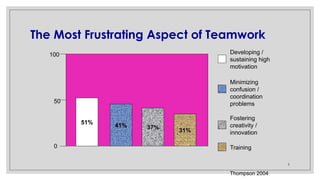
The Most Frustrating Aspect of Teamwork
0
50
100
51% 41% 37% 31%
Thompson 2004
Developing /
sustaining high
motivation
Minimizing
confusion /
coordination
problems
Fostering
creativity /
innovation
Training
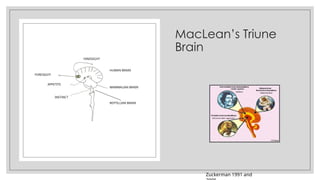
MacLean’s Triune
Brain
Zuckerman 1991 and
REPTILLIAN BRAIN
MAMMALIAN BRAIN
HUMAN BRAIN
INSTINCT
HINDSIGHT
FORESIGHT
APPETITE
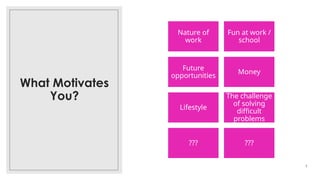
What Motivates
You?
7
Nature of
work
Fun at work /
school
Future
opportunities
Money
Lifestyle
The challenge
of solving
difficult
problems
??? ???
8
Group Activity: What Motivates
You? / How Do You Motivate Others?
Can Pay be an
Absolute Motivator?
◦ What else do you think which can
motivate you and others?
9
GE’S
PERFORMANCE
MANAGEMENT
SYSTEM
10
20
70
10
Group Activity:
How Good is
GE’s
Performance
Management
System?
11
Discuss in your table
groups
What are the potential
problems with this pay-
for-performance system?
What changes would you
suggest to improve this
system?
12
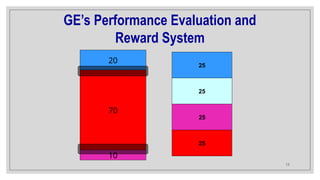
20
70
10
GE’s Performance Evaluation and
Reward System
25
25
25
25
WORK MOTIVATION
Why are you
here today ?
What Motivates You?
What drives you to want to learn OML or Business
Administration ?
The reason why you chose a particular career ?
Your partner?
What needs drive you to live in a particular area ?
Are your drives different from other people or do we all share the
same goals in life?
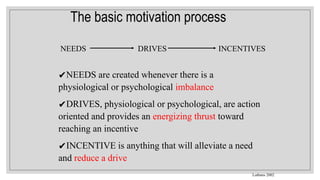
The basic motivation process
NEEDS DRIVES INCENTIVES
Luthans 2002
✔NEEDS are created whenever there is a
physiological or psychological imbalance
✔DRIVES, physiological or psychological, are action
oriented and provides an energizing thrust toward
reaching an incentive
✔INCENTIVE is anything that will alleviate a need
and reduce a drive
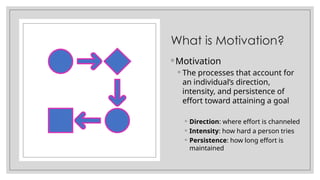
What is Motivation?
◦ Motivation
◦ The processes that account for
an individual’s direction,
intensity, and persistence of
effort toward attaining a goal
◦ Direction: where effort is channeled
◦ Intensity: how hard a person tries
◦ Persistence: how long effort is
maintained
Sources of
Motivation
◦Extrinsic motivation
◦ Occurs when the person
does something to earn
external reward
◦Intrinsic motivation
◦ Occurs when the person
does something to
experience inherently
satisfying results
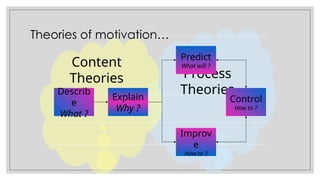
Process
Theories
Content
Theories
Describ
e
What ?
Explain
Why ?
Predict
What will ?
Improv
e
How to ?
Control
How to ?
Theories of motivation…
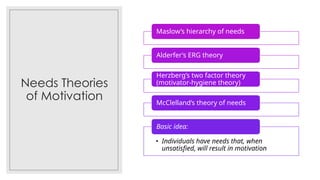
Needs Theories
of Motivation
Maslow’s hierarchy of needs
Alderfer’s ERG theory
Herzberg’s two factor theory
(motivator-hygiene theory)
McClelland’s theory of needs
• Individuals have needs that, when
unsatisfied, will result in motivation
Basic idea:
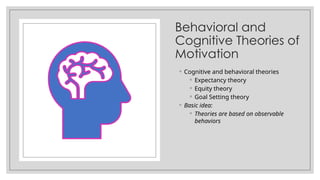
Behavioral and
Cognitive Theories of
Motivation
◦ Cognitive and behavioral theories
◦ Expectancy theory
◦ Equity theory
◦ Goal Setting theory
◦ Basic idea:
◦ Theories are based on observable
behaviors
21
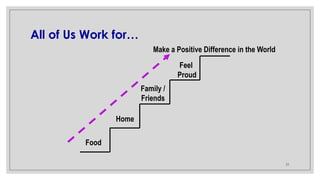
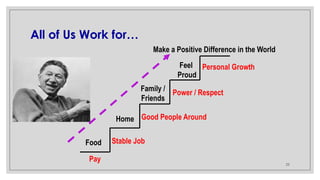
All of Us Work for…
Make a Positive Difference in the World
Food
Home
Family /
Friends
Feel
Proud
22
All of Us Work for…
Make a Positive Difference in the World
Food
Home
Family /
Friends
Feel
Proud
Pay
Stable Job
Good People Around
Power / Respect
Personal Growth
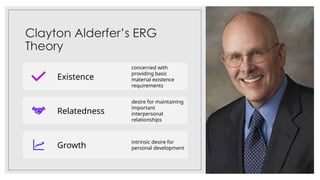
Clayton Alderfer’s ERG
Theory
Existence
concerned with
providing basic
material existence
requirements
Relatedness
desire for maintaining
important
interpersonal
relationships
Growth
intrinsic desire for
personal development
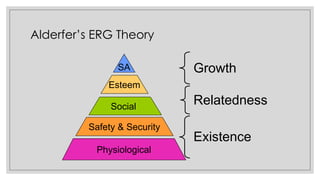
Alderfer’s ERG Theory
Physiological
Safety & Security
Social
Esteem
SA
Existence
Relatedness
Growth
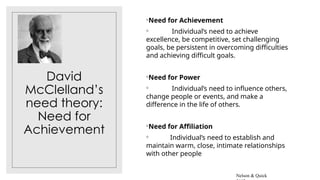
David
McClelland’s
need theory:
Need for
Achievement
◦Need for Achievement
◦ Individual’s need to achieve
excellence, be competitive, set challenging
goals, be persistent in overcoming difficulties
and achieving difficult goals.
◦Need for Power
◦ Individual’s need to influence others,
change people or events, and make a
difference in the life of others.
◦Need for Affiliation
◦ Individual’s need to establish and
maintain warm, close, intimate relationships
with other people
Nelson & Quick
Will More of
Everything
Motivate Us?
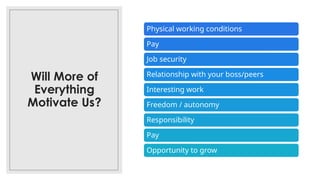
Physical working conditions
Pay
Job security
Relationship with your boss/peers
Interesting work
Freedom / autonomy
Responsibility
Pay
Opportunity to grow
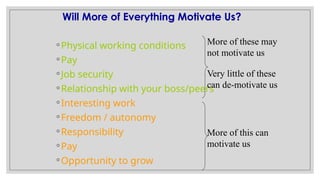
Will More of Everything Motivate Us?
◦Physical working conditions
◦Pay
◦Job security
◦Relationship with your boss/peers
◦Interesting work
◦Freedom / autonomy
◦Responsibility
◦Pay
◦Opportunity to grow
More of these may
not motivate us
Very little of these
can de-motivate us
More of this can
motivate us
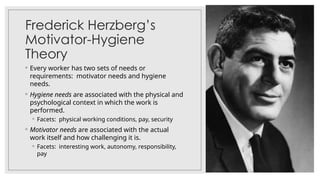
Frederick Herzberg’s
Motivator-Hygiene
Theory
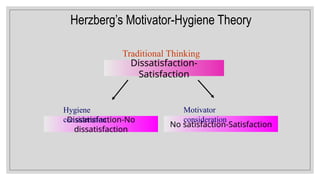
◦ Every worker has two sets of needs or
requirements: motivator needs and hygiene
needs.
◦ Hygiene needs are associated with the physical and
psychological context in which the work is
performed.
◦ Facets: physical working conditions, pay, security
◦ Motivator needs are associated with the actual
work itself and how challenging it is.
◦ Facets: interesting work, autonomy, responsibility,
pay
Herzberg’s
Motivator-
Hygiene
Theory
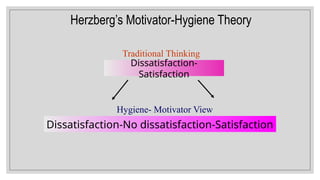
◦ Hypothesized relationships
between motivator needs, hygiene
needs, and job satisfaction:
◦ When hygiene needs are met,
workers will not be dissatisfied;
when these needs are not met,
workers will be dissatisfied
◦ When motivator needs are met,
workers will be satisfied and
motivated; when these needs are
not met, workers will not be
satisfied
Dissatisfaction-
Satisfaction
Traditional Thinking
Dissatisfaction-No
dissatisfaction
Hygiene
consideration
No satisfaction-Satisfaction
Motivator
consideration
Herzberg’s Motivator-Hygiene Theory
Dissatisfaction-
Satisfaction
Traditional Thinking
Dissatisfaction-No dissatisfaction-Satisfaction
Hygiene- Motivator View
Herzberg’s Motivator-Hygiene Theory
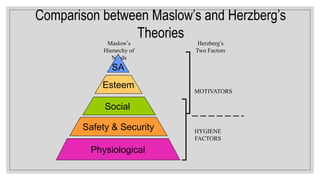
Comparison between Maslow’s and Herzberg’s
Theories
Maslow’s
Hierarchy of
Needs
Herzberg’s
Two Factors
MOTIVATORS
HYGIENE
FACTORS
Physiological
Safety & Security
Social
Esteem
SA
Behavioral
and
Cognitive
Theories of
Motivation
◦Cognitive and behavioral
theories
◦Expectancy theory
◦Equity theory
◦Goal Setting theory
◦Basic idea:
◦Theories are based on
observable behaviors
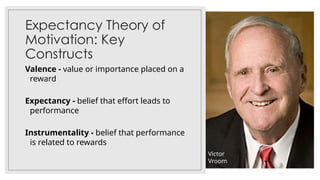
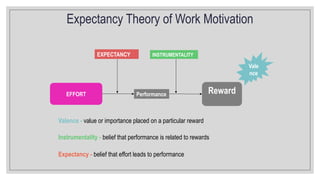
Expectancy Theory of
Motivation: Key
Constructs
Valence - value or importance placed on a
reward
Expectancy - belief that effort leads to
performance
Instrumentality - belief that performance
is related to rewards
Victor
Vroom
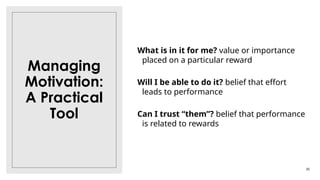
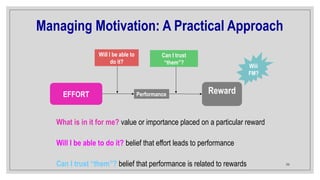
Managing
Motivation:
A Practical
Tool
What is in it for me? value or importance
placed on a particular reward
Will I be able to do it? belief that effort
leads to performance
Can I trust “them”? belief that performance
is related to rewards
35
36
Performance
EFFORT Reward
Managing Motivation: A Practical Approach
Wiii
FM?
Will I be able to
do it?
Can I trust
“them”?
What is in it for me? value or importance placed on a particular reward
Will I be able to do it? belief that effort leads to performance
Can I trust “them”? belief that performance is related to rewards
Performance
EXPECTANCY
EFFORT Reward
INSTRUMENTALITY
Expectancy Theory of Work Motivation
Vale
nce
Valence - value or importance placed on a particular reward
Instrumentality - belief that performance is related to rewards
Expectancy - belief that effort leads to performance
38
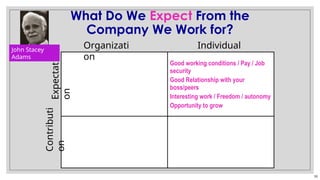
What Do We Expect From the
Company We Work for?
Good working conditions / Pay / Job
security
Good Relationship with your
boss/peers
Interesting work / Freedom / autonomy
Opportunity to grow
Individual
Organizati
on
Expectati
on
Contributi
on
John Stacey
Adams
39
Good working conditions / Pay / Job
security
Good Relationship with your
boss/peers
Interesting work / Freedom /
autonomy
Opportunity to grow
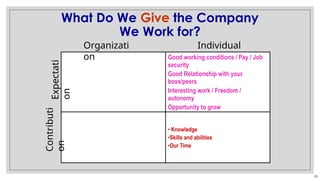
• Knowledge
•Skills and abilities
•Our Time
Individual
Organizati
on
Expectati
on
Contributi
on
What Do We Give the Company
We Work for?
40
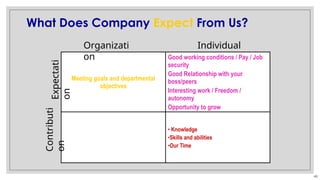
What Does Company Expect From Us?
Meeting goals and departmental
objectives
Good working conditions / Pay / Job
security
Good Relationship with your
boss/peers
Interesting work / Freedom /
autonomy
Opportunity to grow
• Knowledge
•Skills and abilities
•Our Time
Individual
Organizati
on
Expectati
on
Contributi
on
41
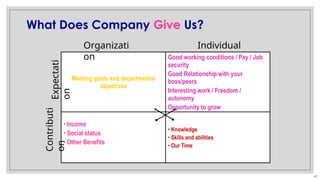
What Does Company Give Us?
Meeting goals and departmental
objectives
Good working conditions / Pay / Job
security
Good Relationship with your
boss/peers
Interesting work / Freedom /
autonomy
Opportunity to grow
• Income
• Social status
• Other Benefits
• Knowledge
• Skills and abilities
• Our Time
Individual
Organizati
on
Expectati
on
Contributi
on
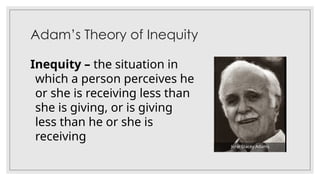
Adam’s Theory of Inequity
Inequity – the situation in
which a person perceives he
or she is receiving less than
she is giving, or is giving
less than he or she is
receiving
John Stacey Adams
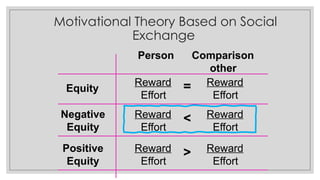
Motivational Theory Based on Social
Exchange
Equity
Person Comparison
other
Reward
Effort
Reward
Effort
=
Negative
Equity
Reward
Effort
Reward
Effort
<
Positive
Equity
Reward
Effort
Reward
Effort
>
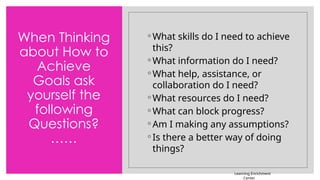
When Thinking
about How to
Achieve
Goals ask
yourself the
following
Questions?
……
◦ What skills do I need to achieve
this?
◦ What information do I need?
◦ What help, assistance, or
collaboration do I need?
◦ What resources do I need?
◦ What can block progress?
◦ Am I making any assumptions?
◦ Is there a better way of doing
things?
Learning Enrichment
Center
45
Integrating All: Theory of Life, Personality
and Motivation
Intention Motivation Action
•Autonomy / feedback
•Value attached to Internal / external reward
•Ability to do the job (self efficacy)
•Trust / Belief in the system /
•Culture / conformity
•Personality
•Situation [micro and macro]
Is it the right
thing to do?
(Theory of Life)
Self-Determination Theory
46
(RE-)
DESIGNING
JOBS
47
Greg R. Oldham
Job Characteristic Model
(JCM)
(RE-) DESIGNING
JOB
4
8
What is a
good job ?
Individual
Activity: My
Best Job
49
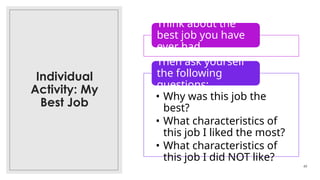
Think about the
best job you have
ever had
• Why was this job the
best?
• What characteristics of
this job I liked the most?
• What characteristics of
this job I did NOT like?
Then ask yourself
the following
questions:
50
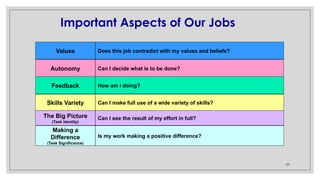
Can I make full use of a wide variety of skills?
Can I see the result of my effort in full?
Is my work making a positive difference?
Can I decide what is to be done?
How am I doing?
Important Aspects of Our Jobs
Skills Variety
The Big Picture
(Task Identity)
Making a
Difference
(Task Significance)
Autonomy
Feedback
Does this job contradict with my values and beliefs?
Values
51
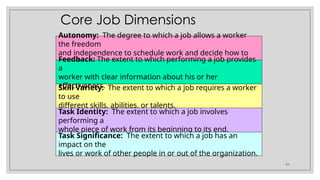
Skill Variety: The extent to which a job requires a worker
to use
different skills, abilities, or talents.
Task Identity: The extent to which a job involves
performing a
whole piece of work from its beginning to its end.
Task Significance: The extent to which a job has an
impact on the
lives or work of other people in or out of the organization.
Core Job Dimensions
Autonomy: The degree to which a job allows a worker
the freedom
and independence to schedule work and decide how to
carry it out.
Feedback: The extent to which performing a job provides
a
worker with clear information about his or her
effectiveness.
52
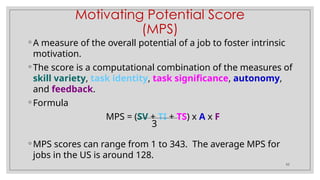
Motivating Potential Score
(MPS)
◦ A measure of the overall potential of a job to foster intrinsic
motivation.
◦ The score is a computational combination of the measures of
skill variety, task identity, task significance, autonomy,
and feedback.
◦ Formula
MPS = (SV + TI + TS) x A x F
◦ MPS scores can range from 1 to 343. The average MPS for
jobs in the US is around 128.
3
53
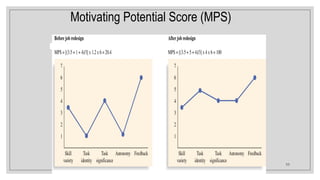
Insert Figure 7.3
here
Motivating Potential Score (MPS)
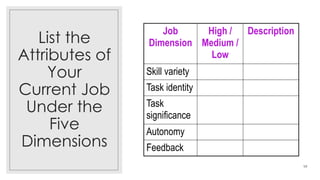
List the
Attributes of
Your
Current Job
Under the
Five
Dimensions
54
Job
Dimension
High /
Medium /
Low
Description
Skill variety
Task identity
Task
significance
Autonomy
Feedback
55
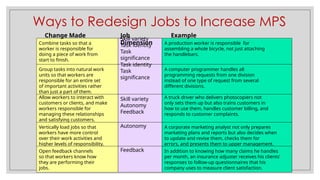
Ways to Redesign Jobs to Increase MPS
Combine tasks so that a
worker is responsible for
doing a piece of work from
start to finish.
Skill variety
Task identity
Task
significance
A production worker is responsible for
assembling a whole bicycle, not just attaching
the handlebars.
Group tasks into natural work
units so that workers are
responsible for an entire set
of important activities rather
than just a part of them.
Task identity
Task
significance
A computer programmer handles all
programming requests from one division
instead of one type of request from several
different divisions.
Allow workers to interact with
customers or clients, and make
workers responsible for
managing these relationships
and satisfying customers.
Skill variety
Autonomy
Feedback
A truck driver who delivers photocopiers not
only sets them up but also trains customers in
how to use them, handles customer billing, and
responds to customer complaints.
Vertically load jobs so that
workers have more control
over their work activities and
higher levels of responsibility.
Autonomy A corporate marketing analyst not only prepares
marketing plans and reports but also decides when
to update and revise them, checks them for
errors, and presents them to upper management.
Open feedback channels
so that workers know how
they are performing their
jobs.
Feedback In addition to knowing how many claims he handles
per month, an insurance adjuster receives his clients’
responses to follow-up questionnaires that his
company uses to measure client satisfaction.
Change Made Job
Dimension
Example
GROUP ACTIVITY: JOB
RE-DESIGN
56
57
Job (Re-)Design: Group Exercise
◦Revisit your jobs
◦Discuss, by applying the concepts
discussed in the class, how you or
your manager can redesign the job
to increase its motivation potential
Padmakumar.nair@thapar.ed
u
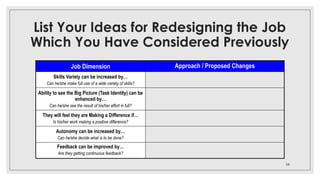
List Your Ideas for Redesigning the Job
Which You Have Considered Previously
58
Job Dimension Approach / Proposed Changes
Skills Variety can be increased by…
Can he/she make full use of a wide variety of skills?
Ability to see the Big Picture (Task Identity) can be
enhanced by…
Can he/she see the result of his/her effort in full?
They will feel they are Making a Difference if…
Is his/her work making a positive difference?
Autonomy can be increased by…
Can he/she decide what is to be done?
Feedback can be improved by…
Are they getting continuous feedback?
GOAL
SETTING
59
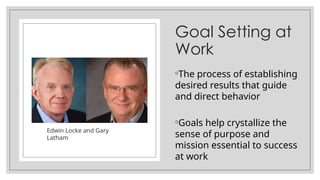
Goal Setting at
Work
◦The process of establishing
desired results that guide
and direct behavior
◦Goals help crystallize the
sense of purpose and
mission essential to success
at work
Edwin Locke and Gary
Latham
Characterist
ics of
Effective
Goals
◦Set SMART goals…
◦Specific
◦Measurable
◦Achievable and
Realistic
◦Time-phased
61
Effective
GOALS
setting
◦Set Performance Goals, Not
Outcome Goals
◦Express Goals Positively.
◦Be Precise
◦Set measurable dates, times,
and amounts.
◦Set Priorities.
◦Write Goals Down.
62
When Thinking
about How to
Achieve Goals
ask yourself
the following
Questions?
……
◦ What skills do I need to achieve
this?
◦ What information do I need?
◦ What help, assistance, or
collaboration do I need?
◦ What resources do I need?
◦ What can block progress?
◦ Am I making any assumptions?
◦ Is there a better way of doing
things?
63
Learning Enrichment
Center
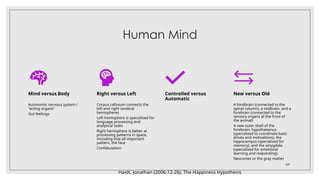
Human Mind
64
Haidt, Jonathan (2006-12-26). The Happiness Hypothesis
Mind versus Body
Autonomic nervous system /
“acting organs”
Gut feelings
Right versus Left
Corpus callosum connects the
left and right cerebral
hemispheres
Left hemisphere is specialized for
language processing and
analytical tasks
Right hemisphere is better at
processing patterns in space,
including that all-important
pattern, the face
Confabulation
Controlled versus
Automatic
New versus Old
A hindbrain (connected to the
spinal column), a midbrain, and a
forebrain (connected to the
sensory organs at the front of
the animal)
A new outer shell of the
forebrain: hypothalamus
(specialized to coordinate basic
drives and motivations), the
hippocampus (specialized for
memory), and the amygdala
(specialized for emotional
learning and responding).
Neocortex or the gray matter

Motivation and Performance Excellence Fall 2022.pptx

  • 1.
  • 4.
  • 5.
    5 The Most FrustratingAspect of Teamwork 0 50 100 51% 41% 37% 31% Thompson 2004 Developing / sustaining high motivation Minimizing confusion / coordination problems Fostering creativity / innovation Training
  • 6.
    MacLean’s Triune Brain Zuckerman 1991and REPTILLIAN BRAIN MAMMALIAN BRAIN HUMAN BRAIN INSTINCT HINDSIGHT FORESIGHT APPETITE
  • 7.
    What Motivates You? 7 Nature of work Funat work / school Future opportunities Money Lifestyle The challenge of solving difficult problems ??? ???
  • 8.
    8 Group Activity: WhatMotivates You? / How Do You Motivate Others?
  • 9.
    Can Pay bean Absolute Motivator? ◦ What else do you think which can motivate you and others? 9
  • 10.
  • 11.
    Group Activity: How Goodis GE’s Performance Management System? 11 Discuss in your table groups What are the potential problems with this pay- for-performance system? What changes would you suggest to improve this system?
  • 12.
    12 20 70 10 GE’s Performance Evaluationand Reward System 25 25 25 25
  • 13.
    WORK MOTIVATION Why areyou here today ?
  • 14.
    What Motivates You? Whatdrives you to want to learn OML or Business Administration ? The reason why you chose a particular career ? Your partner? What needs drive you to live in a particular area ? Are your drives different from other people or do we all share the same goals in life?
  • 15.
    The basic motivationprocess NEEDS DRIVES INCENTIVES Luthans 2002 ✔NEEDS are created whenever there is a physiological or psychological imbalance ✔DRIVES, physiological or psychological, are action oriented and provides an energizing thrust toward reaching an incentive ✔INCENTIVE is anything that will alleviate a need and reduce a drive
  • 16.
    What is Motivation? ◦Motivation ◦ The processes that account for an individual’s direction, intensity, and persistence of effort toward attaining a goal ◦ Direction: where effort is channeled ◦ Intensity: how hard a person tries ◦ Persistence: how long effort is maintained
  • 17.
    Sources of Motivation ◦Extrinsic motivation ◦Occurs when the person does something to earn external reward ◦Intrinsic motivation ◦ Occurs when the person does something to experience inherently satisfying results
  • 18.
    Process Theories Content Theories Describ e What ? Explain Why ? Predict Whatwill ? Improv e How to ? Control How to ? Theories of motivation…
  • 19.
    Needs Theories of Motivation Maslow’shierarchy of needs Alderfer’s ERG theory Herzberg’s two factor theory (motivator-hygiene theory) McClelland’s theory of needs • Individuals have needs that, when unsatisfied, will result in motivation Basic idea:
  • 20.
    Behavioral and Cognitive Theoriesof Motivation ◦ Cognitive and behavioral theories ◦ Expectancy theory ◦ Equity theory ◦ Goal Setting theory ◦ Basic idea: ◦ Theories are based on observable behaviors
  • 21.
    21 All of UsWork for… Make a Positive Difference in the World Food Home Family / Friends Feel Proud
  • 22.
    22 All of UsWork for… Make a Positive Difference in the World Food Home Family / Friends Feel Proud Pay Stable Job Good People Around Power / Respect Personal Growth
  • 23.
    Clayton Alderfer’s ERG Theory Existence concernedwith providing basic material existence requirements Relatedness desire for maintaining important interpersonal relationships Growth intrinsic desire for personal development
  • 24.
    Alderfer’s ERG Theory Physiological Safety& Security Social Esteem SA Existence Relatedness Growth
  • 25.
    David McClelland’s need theory: Need for Achievement ◦Needfor Achievement ◦ Individual’s need to achieve excellence, be competitive, set challenging goals, be persistent in overcoming difficulties and achieving difficult goals. ◦Need for Power ◦ Individual’s need to influence others, change people or events, and make a difference in the life of others. ◦Need for Affiliation ◦ Individual’s need to establish and maintain warm, close, intimate relationships with other people Nelson & Quick
  • 26.
    Will More of Everything MotivateUs? Physical working conditions Pay Job security Relationship with your boss/peers Interesting work Freedom / autonomy Responsibility Pay Opportunity to grow
  • 27.
    Will More ofEverything Motivate Us? ◦Physical working conditions ◦Pay ◦Job security ◦Relationship with your boss/peers ◦Interesting work ◦Freedom / autonomy ◦Responsibility ◦Pay ◦Opportunity to grow More of these may not motivate us Very little of these can de-motivate us More of this can motivate us
  • 28.
    Frederick Herzberg’s Motivator-Hygiene Theory ◦ Everyworker has two sets of needs or requirements: motivator needs and hygiene needs. ◦ Hygiene needs are associated with the physical and psychological context in which the work is performed. ◦ Facets: physical working conditions, pay, security ◦ Motivator needs are associated with the actual work itself and how challenging it is. ◦ Facets: interesting work, autonomy, responsibility, pay
  • 29.
    Herzberg’s Motivator- Hygiene Theory ◦ Hypothesized relationships betweenmotivator needs, hygiene needs, and job satisfaction: ◦ When hygiene needs are met, workers will not be dissatisfied; when these needs are not met, workers will be dissatisfied ◦ When motivator needs are met, workers will be satisfied and motivated; when these needs are not met, workers will not be satisfied
  • 30.
  • 31.
  • 32.
    Comparison between Maslow’sand Herzberg’s Theories Maslow’s Hierarchy of Needs Herzberg’s Two Factors MOTIVATORS HYGIENE FACTORS Physiological Safety & Security Social Esteem SA
  • 33.
    Behavioral and Cognitive Theories of Motivation ◦Cognitive andbehavioral theories ◦Expectancy theory ◦Equity theory ◦Goal Setting theory ◦Basic idea: ◦Theories are based on observable behaviors
  • 34.
    Expectancy Theory of Motivation:Key Constructs Valence - value or importance placed on a reward Expectancy - belief that effort leads to performance Instrumentality - belief that performance is related to rewards Victor Vroom
  • 35.
    Managing Motivation: A Practical Tool What isin it for me? value or importance placed on a particular reward Will I be able to do it? belief that effort leads to performance Can I trust “them”? belief that performance is related to rewards 35
  • 36.
    36 Performance EFFORT Reward Managing Motivation:A Practical Approach Wiii FM? Will I be able to do it? Can I trust “them”? What is in it for me? value or importance placed on a particular reward Will I be able to do it? belief that effort leads to performance Can I trust “them”? belief that performance is related to rewards
  • 37.
    Performance EXPECTANCY EFFORT Reward INSTRUMENTALITY Expectancy Theoryof Work Motivation Vale nce Valence - value or importance placed on a particular reward Instrumentality - belief that performance is related to rewards Expectancy - belief that effort leads to performance
  • 38.
    38 What Do WeExpect From the Company We Work for? Good working conditions / Pay / Job security Good Relationship with your boss/peers Interesting work / Freedom / autonomy Opportunity to grow Individual Organizati on Expectati on Contributi on John Stacey Adams
  • 39.
    39 Good working conditions/ Pay / Job security Good Relationship with your boss/peers Interesting work / Freedom / autonomy Opportunity to grow • Knowledge •Skills and abilities •Our Time Individual Organizati on Expectati on Contributi on What Do We Give the Company We Work for?
  • 40.
    40 What Does CompanyExpect From Us? Meeting goals and departmental objectives Good working conditions / Pay / Job security Good Relationship with your boss/peers Interesting work / Freedom / autonomy Opportunity to grow • Knowledge •Skills and abilities •Our Time Individual Organizati on Expectati on Contributi on
  • 41.
    41 What Does CompanyGive Us? Meeting goals and departmental objectives Good working conditions / Pay / Job security Good Relationship with your boss/peers Interesting work / Freedom / autonomy Opportunity to grow • Income • Social status • Other Benefits • Knowledge • Skills and abilities • Our Time Individual Organizati on Expectati on Contributi on
  • 42.
    Adam’s Theory ofInequity Inequity – the situation in which a person perceives he or she is receiving less than she is giving, or is giving less than he or she is receiving John Stacey Adams
  • 43.
    Motivational Theory Basedon Social Exchange Equity Person Comparison other Reward Effort Reward Effort = Negative Equity Reward Effort Reward Effort < Positive Equity Reward Effort Reward Effort >
  • 44.
    When Thinking about Howto Achieve Goals ask yourself the following Questions? …… ◦ What skills do I need to achieve this? ◦ What information do I need? ◦ What help, assistance, or collaboration do I need? ◦ What resources do I need? ◦ What can block progress? ◦ Am I making any assumptions? ◦ Is there a better way of doing things? Learning Enrichment Center
  • 45.
    45 Integrating All: Theoryof Life, Personality and Motivation Intention Motivation Action •Autonomy / feedback •Value attached to Internal / external reward •Ability to do the job (self efficacy) •Trust / Belief in the system / •Culture / conformity •Personality •Situation [micro and macro] Is it the right thing to do? (Theory of Life)
  • 46.
  • 47.
  • 48.
  • 49.
    Individual Activity: My Best Job 49 Thinkabout the best job you have ever had • Why was this job the best? • What characteristics of this job I liked the most? • What characteristics of this job I did NOT like? Then ask yourself the following questions:
  • 50.
    50 Can I makefull use of a wide variety of skills? Can I see the result of my effort in full? Is my work making a positive difference? Can I decide what is to be done? How am I doing? Important Aspects of Our Jobs Skills Variety The Big Picture (Task Identity) Making a Difference (Task Significance) Autonomy Feedback Does this job contradict with my values and beliefs? Values
  • 51.
    51 Skill Variety: Theextent to which a job requires a worker to use different skills, abilities, or talents. Task Identity: The extent to which a job involves performing a whole piece of work from its beginning to its end. Task Significance: The extent to which a job has an impact on the lives or work of other people in or out of the organization. Core Job Dimensions Autonomy: The degree to which a job allows a worker the freedom and independence to schedule work and decide how to carry it out. Feedback: The extent to which performing a job provides a worker with clear information about his or her effectiveness.
  • 52.
    52 Motivating Potential Score (MPS) ◦A measure of the overall potential of a job to foster intrinsic motivation. ◦ The score is a computational combination of the measures of skill variety, task identity, task significance, autonomy, and feedback. ◦ Formula MPS = (SV + TI + TS) x A x F ◦ MPS scores can range from 1 to 343. The average MPS for jobs in the US is around 128. 3
  • 53.
  • 54.
    List the Attributes of Your CurrentJob Under the Five Dimensions 54 Job Dimension High / Medium / Low Description Skill variety Task identity Task significance Autonomy Feedback
  • 55.
    55 Ways to RedesignJobs to Increase MPS Combine tasks so that a worker is responsible for doing a piece of work from start to finish. Skill variety Task identity Task significance A production worker is responsible for assembling a whole bicycle, not just attaching the handlebars. Group tasks into natural work units so that workers are responsible for an entire set of important activities rather than just a part of them. Task identity Task significance A computer programmer handles all programming requests from one division instead of one type of request from several different divisions. Allow workers to interact with customers or clients, and make workers responsible for managing these relationships and satisfying customers. Skill variety Autonomy Feedback A truck driver who delivers photocopiers not only sets them up but also trains customers in how to use them, handles customer billing, and responds to customer complaints. Vertically load jobs so that workers have more control over their work activities and higher levels of responsibility. Autonomy A corporate marketing analyst not only prepares marketing plans and reports but also decides when to update and revise them, checks them for errors, and presents them to upper management. Open feedback channels so that workers know how they are performing their jobs. Feedback In addition to knowing how many claims he handles per month, an insurance adjuster receives his clients’ responses to follow-up questionnaires that his company uses to measure client satisfaction. Change Made Job Dimension Example
  • 56.
  • 57.
    57 Job (Re-)Design: GroupExercise ◦Revisit your jobs ◦Discuss, by applying the concepts discussed in the class, how you or your manager can redesign the job to increase its motivation potential Padmakumar.nair@thapar.ed u
  • 58.
    List Your Ideasfor Redesigning the Job Which You Have Considered Previously 58 Job Dimension Approach / Proposed Changes Skills Variety can be increased by… Can he/she make full use of a wide variety of skills? Ability to see the Big Picture (Task Identity) can be enhanced by… Can he/she see the result of his/her effort in full? They will feel they are Making a Difference if… Is his/her work making a positive difference? Autonomy can be increased by… Can he/she decide what is to be done? Feedback can be improved by… Are they getting continuous feedback?
  • 59.
  • 60.
    Goal Setting at Work ◦Theprocess of establishing desired results that guide and direct behavior ◦Goals help crystallize the sense of purpose and mission essential to success at work Edwin Locke and Gary Latham
  • 61.
    Characterist ics of Effective Goals ◦Set SMARTgoals… ◦Specific ◦Measurable ◦Achievable and Realistic ◦Time-phased 61
  • 62.
    Effective GOALS setting ◦Set Performance Goals,Not Outcome Goals ◦Express Goals Positively. ◦Be Precise ◦Set measurable dates, times, and amounts. ◦Set Priorities. ◦Write Goals Down. 62
  • 63.
    When Thinking about Howto Achieve Goals ask yourself the following Questions? …… ◦ What skills do I need to achieve this? ◦ What information do I need? ◦ What help, assistance, or collaboration do I need? ◦ What resources do I need? ◦ What can block progress? ◦ Am I making any assumptions? ◦ Is there a better way of doing things? 63 Learning Enrichment Center
  • 64.
    Human Mind 64 Haidt, Jonathan(2006-12-26). The Happiness Hypothesis Mind versus Body Autonomic nervous system / “acting organs” Gut feelings Right versus Left Corpus callosum connects the left and right cerebral hemispheres Left hemisphere is specialized for language processing and analytical tasks Right hemisphere is better at processing patterns in space, including that all-important pattern, the face Confabulation Controlled versus Automatic New versus Old A hindbrain (connected to the spinal column), a midbrain, and a forebrain (connected to the sensory organs at the front of the animal) A new outer shell of the forebrain: hypothalamus (specialized to coordinate basic drives and motivations), the hippocampus (specialized for memory), and the amygdala (specialized for emotional learning and responding). Neocortex or the gray matter

Editor's Notes

  • #16 This material is found on page 116-117.
  • #19 This material is found on page 117-121.
  • #20 This material is found on page 117-121.
  • #23 This material is found on page 120-121.
  • #33 This material is found on page 117-121.
  • #47 Leadership is all about organizing for results ! Getting others to work for the “common” goal !It about seeing / defining where we need to go, defining the possible ways to go and taking everybody to the destination through most effective means.
  • #59 Leadership is all about organizing for results ! Getting others to work for the “common” goal !It about seeing / defining where we need to go, defining the possible ways to go and taking everybody to the destination through most effective means.