American Management’s Greatest Opportunity …
is where they’ve missed the mark, and that’s with Pay Systems:
1. Frederick Taylor’s scientific approach to incentives has been attacked by those who see
incentives as a cost and not an investment.
2. In the last 20 years many managers believed that “money doesn’t motivate” and sought
to enrich each job with inherently interesting work.

There is a solution:
1. Taylor’s scientific approach to incentives, with each human time studied as just another
machine, does not work. Work Focused Improvement’s Socio-Technical design adjusts
design factors according to the culture rating of the socio-technical work system.
2. Pay Systems must be designed so that if things stay the same, there is no bonus.
3. The notion that “money doesn’t motivate” springs from a corruption of Frederick
Herberg’s writings. There are many linear jobs (comprised of mostly repetitive tasks)
that cannot be significantly enriched.
4. The number 1 motive for murder is money. Here is a point that has somehow been
missed. If people are willing to kill for money and risk their lives, it is likely that they
will work harder during their 8 hours at work for more money.
5. Even Nexters and X Y Generation People who sometimes adopt the Hollywood motto
of “take this job and shove it” respond to properly designed Pay Systems
Management Approaches
• The Control Model

Based on the military model, it is
the fastest in terms of decision making, but does not foster
commitment and does not work with today’s workers

• The Commitment Model

Most management gurus
endorse some variation of the Commitment (Team) model which
does not move individuals out of the Entertainment / Entitlement
Zone

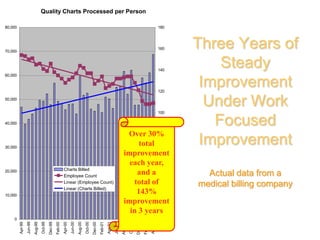
• Work Focused Improvement®
• Linear & Nonlinear work is uniquely managed in
consideration of profound differences
• Pay Systems offer real rewards for advancing the
organization’s bottomline
• People choose to excel and move the organization into the
Performance Zone
• Everyone thinks and acts like an owner
© 1997-2013 Samuel H. Pratt / SHP Consulting Limited
Work Focused Improvement
... in a nutshell
l

l

l

Endorse & understand the underlying premise: When a
group of people work in concert to advance the business, a
by-product of the effort is a better functioning social unit
Distinguish between the two basic types of work: linear
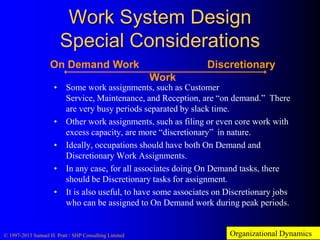
and non-linear and design all business mechanisms to
match the work
Focus on the work, performance and results, not on …
– Hygiene: company policy, wages, working conditions, security,
status, supervision, and interpersonal relationships
– Feelings & Emotions
– Turf, politics, personality, or blame

l

Be a student of management and build a profound
understanding of all leadership and management
mechanisms, tactics, and concepts

© 1997-2013 Samuel H. Pratt / SHP Consulting Limited

People
Two Theories
• If you make people happy they will work
hard
• If people choose to work hard, they will be
happy
• Work hard because the work is inherently
interesting and stimulating
• Work hard because in the process of
doing so there is recognition and reward
© 1997-2013 Samuel H. Pratt / SHP Consulting Limited

Work & Jobs
Pay System Gems
• If excellent work is not meaningfully rewarded, there
will be no healthy and open competition. This is
because people who work very hard for no extra
money are under attack ... from other people, and
even from themselves. The notion is: “Why am I
busting my ass to make some owner richer when I
could coast like Bobby, have some fun, and take
home the same pay.”
• Most management gurus today focus on nonrepetitive work. As for repetitive linear work, they
either pretend it doesn't exist, tell you how to get rid
of it, or camouflage it with things like vertical job
enrichment.
© 1997-2013 Samuel H. Pratt / SHP Consulting Limited
Incentive Overview
l

l

Gain Share pays bonuses to individuals for
improvements in bottomline performance of an
organization or team. Gains are generally idea
based and as such are cumulative over time and
tend to be in the nature of two steps forward and
one step back.
Direct Incentive pays bonuses to Individuals or
small teams for improved performance on
measurable tasks and quality. While on Direct
Incentive, people also get a 20% share of the
applicable Gain Share. Gains are usually
immediate and large.

© 1997-2013 Samuel H. Pratt / SHP Consulting Limited
Incentive Imperatives
(applies to both Gain Share & Direct Incentive)
l
l

When individuals receive bonuses, the
organization experiences a commensurate gain.
Before individuals receive a bonus, their (or
their team’s) performance must exceed:
–
–
–

l

the stretch
the baseline
the cost of their earlier bonuses

If the above imperatives are not realized in a
way that is fair to the organization and fair to
individuals, the design must be adjusted.

© 1997-2013 Samuel H. Pratt / SHP Consulting Limited
Pay Systems
Futuristic Non-linear Work
Visioning

Gain
Share

Organization

Pay for Periodic
Bottom-line
Results
Gain
Share

Executives

Coordinating
Collaborating

Team
Direct
Incentive
Direct
Incentives

Planning

Pay for
Immediate
Work
Performed

Individual

Concentrated Linear Work
© 1997-2013 Samuel H. Pratt / SHP Consulting Limited

Managers

Coaching
Supervisors

Repetitive

Core Workers

Measurable elements
Pay Systems
WFI Pay Systems
Core Steps (Items 1 to 6 are essential and occur naturally
while 7 is situational)
1. Perform Organizational / Environmental Analysis
2. Develop Key Performance Indicator Matrix and Graphs
3. Follow Work Essentials Process leading to Advancement List
4. Design Pay System
5. Use Scoreboards to make performance visible & elevate its impact
6. Design Communications Program
7. Conduct Leadership Training

© 1997-2013 Samuel H. Pratt / SHP Consulting Limited
Environmental Analysis
• Streamlined process
• A carefully sequenced questionnaire includes both
standard and custom questions to dissect an organization
and provide:
• Objective scores for culture & business mechanisms
• Insights on consistency & flexibility
• Knowledge of “if and how” Work Focused
Improvement® can make a difference
• The process
• Is interactive … everyone participates and benefits
• Provides information used to design socio-technically
correct Incentive Baselines & Sculpted Pay Curves

© 1997-2013 Samuel H. Pratt / SHP Consulting Limited
Key Performance Indicators
• Streamlined Process to identify & organize KPIs
• KPIs are measures of performance in all areas of
the organization critical to bottomline results
• To be useful the indicators must be
simple, visible, accurate, meaningful, timely, and
objective
• Some KPIs are measures of individual and team
performance
• In Work Focused Improvement®, standardized
graphs are used in various ways to intensify gains
© 1997-2013 Samuel H. Pratt / SHP Consulting Limited

Pay Systems
Hygiene then Motivators & Movers
“… the factors involved in producing job
satisfaction (and motivation) are separate and
distinct from the factors that lead to job
dissatisfaction.”

“… The opposite of job satisfaction is not job
dissatisfaction but, rather, no job satisfaction;
and similarly, the opposite of job dissatisfaction
is not job satisfaction, but no job dissatisfaction.”
Frederick Herzberg
© 1997-2013 Samuel H. Pratt / SHP Consulting Limited

People
WFI Pay Systems
Core Steps (Items 1 to 6 are essential and occur naturally
while 7 is situational)
1. Perform Environmental Analysis
2. Develop Key Performance Indicator Matrix and Graphs
3. Follow Work Essentials Process leading to Advancement List
4. Design Pay System
5. Use Scoreboards to make performance visible & elevate its impact
6. Design Communications Program
7. Conduct Leadership Training

© 1997-2013 Samuel H. Pratt / SHP Consulting Limited
10+ Pay System Design Steps
(Captured in Workbook)

Select Design Team – match personnel with roles
1) The Group – who is covered by the plan
2) The Formula – measures that define the gain
3) The Baseline – value of formula that must be exceeded
4) Smoothing Mechanisms – control volatility of payout
5) The Curve – match the pay curve, culture, and stage
6) The Share – how much goes to organization & team
7) Payout Frequency – how often is bonus paid
8) The Split – how are the gains distributed within the team
9) Continuous Improvement Adjustment – keep opportunity fair
10) Capital Investment Adjustment – re-engineering recognition
0)

© 1997-2013 Samuel H. Pratt / SHP Consulting Limited

Pay Systems
Direct Incentive Opportunity

130%
120%




100%

The sweet spot (best overall result) is when
there is 130% actual opportunity (earnings as
compared to guaranteed base rate)
As opportunity drops below 130%, increasing
numbers of linear workers lose interest
The only benefits to the company for
opportunities above 130%:
 Stabilize the work force
 Preserve trust by only taking the specified annual
Continuous Improvement Adjustment



Very loose incentives have the potential to be
counterproductive when workers restrict output
to hide the easy opportunity

© 1986-20010 Samuel H. Pratt / SHP Consulting Limited

Key Systems & Mechanisms
Work Essentials
• Streamlined process
• One page form is simultaneously completed by all
members of a Work Group to capture
• Tasks of Occupations & Work Assignments
• Relative importance / impact of tasks
• Time requirements of work
• Data used to
• Assess Work System Design and Flow
• Eliminate Non Value Adding Work
• Identify On Demand and Discretionary Work
• Plan Focus Studies of key linear work
© 1997-2013 Samuel H. Pratt / SHP Consulting Limited
Considerations When Setting Baselines
Socio-technical Design
• Technical capabilities of the team (as determined
by studies, data analysis, correction factors)
• Culture of the Work Group
• Size of the gap between where the team is today
and where it technically could be
• Volatility of historic performance coupled to an
assessment of the reasons for peaks, valleys, and
current direction
• Opinions and mindset of the team as it relates to
the incentive design
• Recent initiatives and structural changes
© 1997-2013 Samuel H. Pratt / SHP Consulting Limited

Pay Systems
These are examples many available
Pay Curves.
Actual Pay Curves extend below
100% for rating purposes.

©

1986-2012 Samuel H. Pratt / SHP Consulting Limited
Core Logic and Mechanisms for Optimizing Work Focused Improvement®

The power of Work Focused Improvement® is captured in tables, lists, and algorithms that use
Culture Rating and Stage of WFI to optimize the Pay System with an ongoing process. Examples
of design factors that are calibrated include:
1.
2.
3.
4.
5.
6.
7.

Workable Stretch range
Slope or slopes of low section of pay curve
Slope of middle section of pay curve
Slope of high section or sections of pay curve
Intersection point at bottom and top of middle section
Ratios of opportunities between Direct Incentive and Gain Share
Culture Rating coupled to the Stage of Work Focused Improvement® (refer to “The 3
Stages of Work Focused Improvement®”)

Calibration is verified and ownership transferred by visuals and a list of questions for each
design element / decision. There is a narrative outlining the process. Many of the adjustments
are counter-intuitive.
Those using these tools need high levels of WFI experience and advanced Excel skills. These
tools are continuously improved. For example, if an organization has deviated from the
© 1997-2013 Samuel H. Pratt / SHP Consulting Limited
Examples When GS is 25% and Direct Incentive is 30%
160.0%
When on Direct Incentive, an
individual also gets a 20% Share
of The Gain Share Bonus.

140.0%
5.0%

120.0%

2.5%
12.5%

30.0%

25.0%

15.0%

100.0%
GS while on DI
GS Bonus
DI Bonus
Base Pay

An associate will not earn less than his or her base
rate. Poor Direct Incentive performance will subtract
from Gain Share Bonus, but Gain Share Performance
never subtracts from Direct Incentive

80.0%
60.0%
100.0%

100.0%

100.0%

Person on Direct
Incentive Only

Person on Gain Share
Only

Person with 1/2 of Hours
on Each

40.0%
20.0%
0.0%

© 1997-2013 Samuel H. Pratt / SHP Consulting Limited

Pay Systems
Virtual Performance Company™
• Company within a Company – consider outsourcing, but do it to
your own encapsulated company

• Compartmentalized and Team Controllable Revenue &
Expense measures determine Virtual Profit
• Outputs or outcomes are the actual or virtual product that
energizes the effort
• Step by step analysis and graphs are used to set targets and
incentive baselines
• Gains beyond baseline are shared with team members per
Sculpted Pay Curves and other design criteria

© 1997-2013 Samuel H. Pratt / SHP Consulting Limited
Virtual Performance Company™
One design option for Gain Share is the Virtual Performance Company™. The idea is to build an
organization within an organization. Anything from a small Work Group to a large division
could be a virtual company. Virtual Revenue and Virtual Expenses are used to calculate Virtual
Profit or Gain.
To get the right VPC mindset, ask yourself this series of questions:
1. If you were going to outsource a functional area of your organization, such as billing or
transcription, would you compare your costs and value or product / service to the costs
and value of the outsourced work?
2. If you were going to double the size of a functional area and sell your services or product
in the open market, would you first estimate expenses and revenue of the new enterprise?
3. Can any company perform well or poorly?
4. Would it help if employees in any enterprise were motivated, and also thought and acted
like owners?
5. If you do neither 1 or 2 above, would it still make sense to create formulas for Revenue
and Expenses to be used to calculate Virtual Profit to gauge performance?
6. Would it then make sense to share exceptional gains in Virtual Profit with associates
thereby transforming everyone into an owner?

© 1997-2013 Samuel H. Pratt / SHP Consulting Limited
Virtual Performance Company™
Design Criteria
A.
B.
C.
D.
E.
F.
G.
H.
I.
J.
K.
L.
M.
N.

Is simple to understand the pay system via words, numbers, and graphs
Insures that bonuses are truly earned by associates
Protects against staff bonuses caused by Corporate effort, investment, or
initiative
Assures that historic trend, stretch target, and budget are exceeded before
bonus is paid
Uses virtual outputs & outcomes that are balanced by quality measures
Perfect quality is rewarded, and poor quality is penalized
Compartmentalizes Virtual Performance Company™ gain
Focuses on VPC controllable gain on both the revenue and cost sides
Energizes linear work with Direct Incentives
Incorporates organizational objectives and criteria into the design
Assures if bonuses are earned by individuals, a commensurate gain goes to
organization
Embodies the message: “Fair to Individuals & Fair to the Organization”
Utilizes regular, brief, and graphic update meetings to assure alignment
Includes Continuous Improvement & Redesign Criteria

© 1997-2013 Samuel H. Pratt / SHP Consulting Limited
The American Workforce
In the Entertainment / Entitlement Zone
– Tend to identify more with their own objectives than
those of the organization
– Are comfortable saying “My new dog has to get his
shots today, so I have to leave at 2:45,” [assume the
individual is behind on critical work]
– Perform at about 33% to 45% of potential (from
various studies)
– Focus on personal entitlements regardless of the
organization’s performance
– Spend a disproportionate amount of time on social and
entertainment factors as compared to performance
factors and the core work
– Especially struggle with linear work
© 1997-2013 Samuel H. Pratt / SHP Consulting Limited
The Performance Organization










Key Performance Indicators (KPIs) are visible and important to
everyone
The organization as a whole is focused more on facts and less
on opinion
There is high flexibility, and people move to where they are
needed most
All business mechanisms are geared to performance
Personnel assessment, recognition, and reward are all tied
directly to actual measured results
Individuals act as positive forces
Associates are aligned with organizational goals, and at the
same time, the organization supports individual objectives

© 1997-2013 Samuel H. Pratt / SHP Consulting Limited

Organizational Dynamics
Gain Share After Design & Kickoff



A Gain Share System is not crock pot chili that you can make
and then walk away
It requires stirring, tasting, seasoning, and Personal Attention
– Use walkabouts to send the message you care about performance
– Post KPIs on Scoreboards to share information and create the Hawthorne
Effect [Individual, Team & Organization Performance over time]
– Use Work Sampling as an enabling tool
– Focus on facts while giving Personal Attention
– Lead by example and be a visible, positive force
– Give Associates frequent performance data
– Pass the message “We can do it!”
– Secure all gains of the Advancement Process
– Instill everyone with a Continuous Improvement Mindset
– Listen, look, and Over-communicate
– Track Inventory
– Track Direct Incentive to Total Work Hour Ratio
– Monitor Tasks to Date Chart

© 1986-2007 Samuel H. Pratt / SHP Consulting Limited

Pay Systems
Direct Incentive Annual Continuous Improvement Adjustment
Continuous Improvement Pay Curve Adjustment
300%

250%

200%

% Performance

The Annual Year-end Continuous
Adjustment is calculated by reducing
the opportunity in excess of 130%
by 1/3. Example: If the average
opportunity is 160% for 2001, it will
be reduced to 150% for 2002. The
10% reduction is 1/3 of the 30%
excess over 130%. So if it took 22
Quality Widgets per hour in 2001 for
160%, it will take 23.47 in 2002. It
is expected that performance
improvements would continue so
that actual bonuses remain at the
higher level. In the process of
reviewing all rates, some may
actually be increased.

150%

100%

2001 Pay Curve
2002 Pay Curve

50%

Average 2001
Adjusted Average Opportunity Start 2002
0%
0

50

100

150

200

250

300

Widgets Per Hour

© 1986-2007 Samuel H. Pratt / SHP Consulting Limited

Pay Systems
Pragmatism, Culture, Reality, Etceteras
Summary











Don’t expect rapid changes of culture or values.
Never give up on changing culture over the long haul
Recognize that attempts to transform the culture overnight can
be counterproductive due to reality / perception / expectation
gaps [management can look incredibly naive]
Use multi-factored pay systems to change short-term conduct
and long-term culture
Use a wide variety of management tools & techniques to bring
about change
Manage with facts
Push for rapid changes in technology and conduct
Assure that culture is moving in the right direction, and worry
less about the rate of change

© 1997-2013 Samuel H. Pratt / SHP Consulting Limited

Organizational Dynamics
Over 30%
total
improvement
each year,
and a
total of
143%
improvement
in 3 years
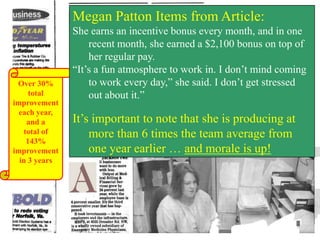
Megan Patton Items from Article:

Over 30%
total
improvement
each year,
and a
total of
143%
improvement
in 3 years

She earns an incentive bonus every month, and in one
recent month, she earned a $2,100 bonus on top of
her regular pay.
“It’s a fun atmosphere to work in. I don’t mind coming
to work every day,” she said. I don’t get stressed
out about it.”

It’s important to note that she is producing at
more than 6 times the team average from
one year earlier … and morale is up!
Quality Charts Processed per Person
80,000

180

160

70,000

140
60,000

120
50,000
100
40,000
80
Over 30%
total
improvement
60
each year,
and a 40
total of
143%
20
improvement
in 3 years

30,000

Charts Billed
Employee Count
Linear (Employee Count)
Linear (Charts Billed)

20,000

10,000

Apr-02

Feb-02

Dec-01

Oct-01

Aug-01

Jun-01

Apr-01

Feb-01

Dec-00

Oct-00

Aug-00

Jun-00

Apr-00

Feb-00

Dec-99

Oct-99

Aug-99

Jun-99

0
Apr-99

0

Three Years of
Steady
Improvement
Under Work
Focused
Improvement
Actual data from a
medical billing company
Three More
Incentive Start-up Examples
Next 3 Slides
This is actual data without
real names of participants
Long Term Care Division

Close Files [inclusive]
Post EOBs [inclusive]
Issue Bill ( invoice) [inclusive]
Issue PO [inclusive]
Verify Order (Order Intake)
Verify Medicare #

450.00

400.00

40% Reduction In
Force after 9 work days
on Pay System

350.00

300.00

250.00

200.00

150.00

100.00

50.00

3/31/2004

3/30/2004

3/29/2004

3/28/2004

3/27/2004

3/26/2004

3/25/2004

3/24/2004

3/23/2004

3/22/2004

3/21/2004

3/20/2004

3/19/2004

3/18/2004

3/17/2004

3/16/2004

3/15/2004

3/14/2004

3/13/2004

3/12/2004

3/11/2004

3/10/2004

3/9/2004

3/8/2004

3/7/2004

3/6/2004

3/5/2004

3/4/2004

3/3/2004

3/2/2004

3/1/2004

0.00
Direct Incentive Startup
160%

140%

120%

100%

80%

60%

40%
Pre Incentive Average
20%

Nov-03

Oct-03

Sep-03

Aug-03

Jul-03

Jun-03

May-03

0%

Gayle T
Laura K
Nicole W.
Lena F.
Christine Z.
Val C.
Michelle W.
Melissa F.
Nina B.
Kelli V.
Erica U.
Debbie S.
Deanna W.
Lisa E.
Connie L.
Casey E.
Hollie T.
Susan M.
Melissa C.
Misty S.
Nikki T.
Val B.
Pre Incentive Avg
Linear (Casey E.)
Linear (Nicole W.)
Linear (Gayle T)
Fundamentals

Management
By
Wishful
Thinking

Today’s
Management
Panaceas

© 1997-2013 Samuel H. Pratt / SHP Consulting Limited

Work
Focused
Improvement®

Business
tested
mechanisms
that work in
concert
The Norm

Work Focused Improvement®

“Money Doesn’t Motivate”

Money creates movement & over time
changes culture

Incentives are viewed as a cost

Incentives are designed as a no lose
investment

No recognition of distinct needs to manage
linear work

Linear work is elevated and energized with
unique mechanisms

Hourly workers tend to increasingly act like
hourly workers – not owners

Everyone is an “owner” with the real
opportunity to succeed … or fail

If used, incentives are either Taylor
(scientific) or Wishful Thinking (low
opportunity)

Incentive design is socio-technical with
culture-corrected baselines and sculpted pay
curves

Grading or keeping score dehumanizes
people

Keep score and make it visible, timely, and
helpful

Use “feel good” management programs
rather than focus on results

Pragmatic leadership, systems, and
mechanism move the organization into the
performance zone

© 1986-2007 Samuel H. Pratt / SHP Consulting Limited
What do all these People Concepts
Suggest about Leadership?
1.
2.
3.
4.

People are complex
Managing people is more complex
All of the preceding concepts have value but none is
predominate
To lead, you must treat each person as a unique
individual
a)
b)
c)
d)
e)
f)

Know the likes, dislikes, strengths, weaknesses
Learn what triggers positive responses from individuals
Ask and listen
Try different approaches, tactics and mechanisms
Focus on what works!
Remember that Trust is always an issue

© 1997-2013 Samuel H. Pratt / SHP Consulting Limited

People
Building
Blocks

Mission
Objectives
ISO 9000

Re-engineering
Pay Systems

Mechanisms

Communications

Training
Process design
Conduct
Values
Culture
© 1997-2013 Samuel H. Pratt / SHP Consulting Limited
Perfect Alignment
Mission
Objectives
ISO 9000
Re-engineering
Pay Systems
Mechanisms
Communications
Training
Process Design
Conduct
Values
Culture
© 1997-2013 Samuel H. Pratt / SHP Consulting Limited
Define objective in terms
of KPIs, outputs, and
other measures or results

Follow-up as
promised (lead by
example)

5 Step
Closed Loop System
A. If project or task,
repeat until
complete
B. If process, repeat
on ongoing basis

Document
discussions, agendas, ac
tions, issues, performan
ce over time

©

1986-2012 Samuel H. Pratt / SHP Consulting Limited

Communicate
clearly with the
objective of two
way understanding

Build natural follow-up
points for feed back such
as month-end reports, and
Performance Reviews
Gain Share / Direct Incentive Realities











The new Pay System is not an effort to give money to employees
It is a system to share gains of the organization with employees
In a significant way, the Pay System makes employees “owners”
The system is a carrot, not a stick
Unlike some organizations, this organization does not take money
away from employees for poor performance
It is all on the plus side
If nothing changes, pay to individuals will not change
The expectation is for large gains and large bonuses
If you prove yourself to the Pay System, it will prove itself to you
… give it your best shot!
Again, the ultimate goal is to become a Performance Organization
that is profitable each month … resulting in a win-win

© 1997-2013 Samuel H. Pratt / SHP Consulting Limited

Pay Systems
Focus on
The work
Performance
Results

Do NOT focus on
Hygiene: company
policy, wages, working
conditions, security, status, supervision, a
nd interpersonal relationships
Feelings & Emotions
Turf, politics, personality, or blame
© 1997-2013 Samuel H. Pratt / SHP Consulting Limited
Quality
Throughput without World Class Quality
will put you out of business
During the 1980s the United States awakened to the fact that
poor quality was the path to disaster. The Japanese, with
world class quality, led the way to quality focused
organizations. Two of the key players in the Japanese quality
transformation were Edwards Deming (an American) and
Genichi Taguchi. From a quality leadership perspective,
Taguchi provided the quote that is most instructive:

"Whatever an executive thinks are the losses of
poor quality, they are actually six times greater"
© 1997-2013 Samuel H. Pratt / SHP Consulting Limited

Quality
Work System Design Checklist
1.
2.
3.
4.
5.
6.
7.

8.
9.
10.
11.
12.
13.
14.
15.

Design as a collaborative effort among Work Groups
Eliminate non-value adding work, streamline, simplify, automate, reconfigure
Design so that people rely on their strengths and develop their weaknesses
Design so that people are equally challenged, but recognize the mastery verses variety
dynamic
Incorporate vision that there will be greater cooperation and more cross functional
Advancement Teams
Include mechanisms to insure design refinement and reconfiguration in an ongoing way
Consider how all associates will be more integrated into the information and decision
making system
Support the concept of "boundaryless" and protect against turf battles
Develop multiple work assignment groupings to show occupation options
Develop multiple organizations that include various diagonal groupings
Don’t avoid past adversarial relationships but consider both healing and synergy
Include discretionary and non-discretionary work in each team if possible
Include repetitive and creative tasks in occupations and teams where possible
Design from a organization perspective first, and consider specific personalities second
Push the limits … don’t be afraid to combine or change teams, jobs, processes, etc.

© 1997-2013 Samuel H. Pratt / SHP Consulting Limited

Organizational Dynamics
Work System Design
Special Considerations
On Demand Work

Discretionary

Work

• Some work assignments, such as Customer
Service, Maintenance, and Reception, are “on demand.” There
are very busy periods separated by slack time.
• Other work assignments, such as filing or even core work with
excess capacity, are more “discretionary” in nature.
• Ideally, occupations should have both On Demand and
Discretionary Work Assignments.
• In any case, for all associates doing On Demand tasks, there
should be Discretionary tasks for assignment.
• It is also useful, to have some associates on Discretionary jobs
who can be assigned to On Demand work during peak periods.

© 1997-2013 Samuel H. Pratt / SHP Consulting Limited

Organizational Dynamics
Work System Design
Special Considerations
Mastery

Choose or Combine

Variety

• Professionals and specialists
• From Managing People is Like
increase expertise throughout
Herding Cats: “Rotate your key
their careers as the expand
assistants every two years. They
knowledge and skills diagonally
may become too complacent.”
in the organization
• From The Boundaryless
• Rely on strengths and develop
Organization: “In many
weaknesses
organizations, professionals, speciali
sts, and other functional experts find
comfort in their long-standing
functional identities. They wrap
themselves in their function like a
child with a comfort blanket.”
• From Who Moved My Cheese:
“The quicker you let go of the old
cheese, the sooner you can enjoy the
new cheese.”
© 1997-2013 Samuel H. Pratt / SHP Consulting Limited

Organizational Dynamics
Calibration
Technical
Focus / Expertise
Leadership & Management
Focus / Expertise
1

2

3

4

5

6

7

1

2

3

4

5

6

7

Strict
Values Consistency

Lenient
Values goodwill of individuals
People & Leadership
Advantages of Inclusive Rates
•

•

•

•

•

Key Performance Indicators (KPIs)
zero in on measures that flow directly
to the bottomline. KPIs make
excellent Inclusive Rates
If the number of precollect call
completed is more important than the
number of wrong numbers reached in
the effort, then focus on and track the
precollect calls completed (the
Inclusive Rate which is also a KPI …
not a sub-task).
Inclusive Rates encourage process
improvement and elimination of nonvalue adding tasks. Tracking sub-tasks
does the opposite.
Inclusive rates reduce
bureaucracy, complexity, and
frustration.
Inclusive rates eliminate (or greatly
reduce) the need to track ancillary
work, delays, interruptions, dwell, sub
ordinate work, and minutia.
Concept of Inclusive Rates
• The Work Essentials process identifies the Key Core work of an
organization.
• If Issuing a bill is the fundamental work of a Work Group, then all
ancillary work associated with this Core Task can be considered as
integral to it.
• Sub-tasks that may or may not be required in issuing a bill for an
encounter:
1. Verify address and personal information
2. Send email(s) and / or make call(s)
3. Review account
4. Verify codes and procedures
5. Etc.
• Rather than record all the subtasks associated with an account, it is
more efficient and direct to record just the inclusive rate.
• For an Inclusive Rate to be fair to the organization and to
individuals, it is imperative that it includes sufficient time for an
effectively working individual to earn a bonus of 30% … on the
average.

© 1997-2013 Samuel H. Pratt / SHP Consulting Limited
Personal Attention
Enabling / Coaching / Counseling
Enabling Scale
Normal & Frequent

Last Chance or Never

Fact based

Characteristic based

Unemotional

Emotional

Focused on future opportunity

Focused on past conduct

Optimistic and caring

Noting imminent peril

“You can do it”

“I’m fed up”

© 1986, 1986-2012 Samuel H. Pratt

Supervising People
Think in Thirds
• It is useful to picture
performance in thirds
• The thirds relate to
performance and value
of the people – not
literally the top 33.3%
• It is also useful to
think of the Groups as
A, B, and C
© 1986, 1986-2012 Samuel H. Pratt

A = Superior

B = Good

C = Struggling

Supervising People
Women in the Springfield Armory
World War I and II
• Women joined the workforce during World Wars I and II
as a necessary measure to win the wars
• At the Springfield Armory during WWII, faster and better
training methods were developed to get women into the
workforce quickly.
• With women composing as much as 43% of the
workforce, productivity reached all-time records.
• This workforce was focused on winning the war by
supplying as much quality armaments as possible …

which just might be a lesson … maybe several!
© 1997-2013 Samuel H. Pratt / SHP Consulting Limited
Work Focused Improvement
Underlying Assumptions / Environment
• Managers / Leaders know their areas
• In an area at any given time, there are far more known
improvements to make than resources to make them
• A Manager / Leader’s day is fragmented
• Only large cost / risk ideas require detailed justifications
and return on investment calculations
• Most local improvements go unreported
• Reporting, tracking, energizing, and analysis
mechanisms should be simple
• Trust is always an issue
© 1997-2013 Samuel H. Pratt / SHP Consulting Limited

Pay Systems
WFI Socio-technical Design
Traditional

Socio-technical Design

Less of this

More of this

•
•
•
•
•
•
•
•

•
•
•
•
•
•
•
•

Controlled compartmentalized units
Ambiguous requirements
Technical system dominance
Limited information flow
Narrowly defined jobs
Errors reworked downstream
Controlling structure & culture
Static design by top management

© 1997-2013 Samuel H. Pratt / SHP Consulting Limited

Empowered autonomous units
Clear direction and goals
Socio-technical integration
Accessible information flow
Diagonally enriched jobs
Control of variance at source
Empowering structure & culture
Capacity to reconfigure built in

Organization
Important
Introducing Work Focused Improvement®
1. WFI is a streamlined process that uses fully designed modules
powered by templates, workbooks, slide shows, etc.
2. WFI is learned by participating in the process which is
carefully sequenced.
3. At times, describing a module prior to doing the work is
counterproductive. Example: describing the Focus Study
process before the hour of the Focus Study.
4. WFI slides are often not self explanatory.
Context, derivation, examples, and issues must be added by
presenter.
5. Introductory Meetings should not become
“ready, aim, aim, aim …” when the process is ready to “fire”.
6. The roll out process and the final selected slides should be
reviewed with Sam Pratt before presenting.
© 1986-2012 Samuel H. Pratt / SHP Consulting Limited

Work Focused Improvement®

  • 1.
    American Management’s GreatestOpportunity … is where they’ve missed the mark, and that’s with Pay Systems: 1. Frederick Taylor’s scientific approach to incentives has been attacked by those who see incentives as a cost and not an investment. 2. In the last 20 years many managers believed that “money doesn’t motivate” and sought to enrich each job with inherently interesting work. There is a solution: 1. Taylor’s scientific approach to incentives, with each human time studied as just another machine, does not work. Work Focused Improvement’s Socio-Technical design adjusts design factors according to the culture rating of the socio-technical work system. 2. Pay Systems must be designed so that if things stay the same, there is no bonus. 3. The notion that “money doesn’t motivate” springs from a corruption of Frederick Herberg’s writings. There are many linear jobs (comprised of mostly repetitive tasks) that cannot be significantly enriched. 4. The number 1 motive for murder is money. Here is a point that has somehow been missed. If people are willing to kill for money and risk their lives, it is likely that they will work harder during their 8 hours at work for more money. 5. Even Nexters and X Y Generation People who sometimes adopt the Hollywood motto of “take this job and shove it” respond to properly designed Pay Systems
  • 2.
    Management Approaches • TheControl Model Based on the military model, it is the fastest in terms of decision making, but does not foster commitment and does not work with today’s workers • The Commitment Model Most management gurus endorse some variation of the Commitment (Team) model which does not move individuals out of the Entertainment / Entitlement Zone • Work Focused Improvement® • Linear & Nonlinear work is uniquely managed in consideration of profound differences • Pay Systems offer real rewards for advancing the organization’s bottomline • People choose to excel and move the organization into the Performance Zone • Everyone thinks and acts like an owner © 1997-2013 Samuel H. Pratt / SHP Consulting Limited
  • 3.
    Work Focused Improvement ...in a nutshell l l l Endorse & understand the underlying premise: When a group of people work in concert to advance the business, a by-product of the effort is a better functioning social unit Distinguish between the two basic types of work: linear and non-linear and design all business mechanisms to match the work Focus on the work, performance and results, not on … – Hygiene: company policy, wages, working conditions, security, status, supervision, and interpersonal relationships – Feelings & Emotions – Turf, politics, personality, or blame l Be a student of management and build a profound understanding of all leadership and management mechanisms, tactics, and concepts © 1997-2013 Samuel H. Pratt / SHP Consulting Limited People
  • 4.
    Two Theories • Ifyou make people happy they will work hard • If people choose to work hard, they will be happy • Work hard because the work is inherently interesting and stimulating • Work hard because in the process of doing so there is recognition and reward © 1997-2013 Samuel H. Pratt / SHP Consulting Limited Work & Jobs
  • 5.
    Pay System Gems •If excellent work is not meaningfully rewarded, there will be no healthy and open competition. This is because people who work very hard for no extra money are under attack ... from other people, and even from themselves. The notion is: “Why am I busting my ass to make some owner richer when I could coast like Bobby, have some fun, and take home the same pay.” • Most management gurus today focus on nonrepetitive work. As for repetitive linear work, they either pretend it doesn't exist, tell you how to get rid of it, or camouflage it with things like vertical job enrichment. © 1997-2013 Samuel H. Pratt / SHP Consulting Limited
  • 6.
    Incentive Overview l l Gain Sharepays bonuses to individuals for improvements in bottomline performance of an organization or team. Gains are generally idea based and as such are cumulative over time and tend to be in the nature of two steps forward and one step back. Direct Incentive pays bonuses to Individuals or small teams for improved performance on measurable tasks and quality. While on Direct Incentive, people also get a 20% share of the applicable Gain Share. Gains are usually immediate and large. © 1997-2013 Samuel H. Pratt / SHP Consulting Limited
  • 7.
    Incentive Imperatives (applies toboth Gain Share & Direct Incentive) l l When individuals receive bonuses, the organization experiences a commensurate gain. Before individuals receive a bonus, their (or their team’s) performance must exceed: – – – l the stretch the baseline the cost of their earlier bonuses If the above imperatives are not realized in a way that is fair to the organization and fair to individuals, the design must be adjusted. © 1997-2013 Samuel H. Pratt / SHP Consulting Limited
  • 8.
    Pay Systems Futuristic Non-linearWork Visioning Gain Share Organization Pay for Periodic Bottom-line Results Gain Share Executives Coordinating Collaborating Team Direct Incentive Direct Incentives Planning Pay for Immediate Work Performed Individual Concentrated Linear Work © 1997-2013 Samuel H. Pratt / SHP Consulting Limited Managers Coaching Supervisors Repetitive Core Workers Measurable elements Pay Systems
  • 9.
    WFI Pay Systems CoreSteps (Items 1 to 6 are essential and occur naturally while 7 is situational) 1. Perform Organizational / Environmental Analysis 2. Develop Key Performance Indicator Matrix and Graphs 3. Follow Work Essentials Process leading to Advancement List 4. Design Pay System 5. Use Scoreboards to make performance visible & elevate its impact 6. Design Communications Program 7. Conduct Leadership Training © 1997-2013 Samuel H. Pratt / SHP Consulting Limited
  • 10.
    Environmental Analysis • Streamlinedprocess • A carefully sequenced questionnaire includes both standard and custom questions to dissect an organization and provide: • Objective scores for culture & business mechanisms • Insights on consistency & flexibility • Knowledge of “if and how” Work Focused Improvement® can make a difference • The process • Is interactive … everyone participates and benefits • Provides information used to design socio-technically correct Incentive Baselines & Sculpted Pay Curves © 1997-2013 Samuel H. Pratt / SHP Consulting Limited
  • 11.
    Key Performance Indicators •Streamlined Process to identify & organize KPIs • KPIs are measures of performance in all areas of the organization critical to bottomline results • To be useful the indicators must be simple, visible, accurate, meaningful, timely, and objective • Some KPIs are measures of individual and team performance • In Work Focused Improvement®, standardized graphs are used in various ways to intensify gains © 1997-2013 Samuel H. Pratt / SHP Consulting Limited Pay Systems
  • 12.
    Hygiene then Motivators& Movers “… the factors involved in producing job satisfaction (and motivation) are separate and distinct from the factors that lead to job dissatisfaction.” “… The opposite of job satisfaction is not job dissatisfaction but, rather, no job satisfaction; and similarly, the opposite of job dissatisfaction is not job satisfaction, but no job dissatisfaction.” Frederick Herzberg © 1997-2013 Samuel H. Pratt / SHP Consulting Limited People
  • 13.
    WFI Pay Systems CoreSteps (Items 1 to 6 are essential and occur naturally while 7 is situational) 1. Perform Environmental Analysis 2. Develop Key Performance Indicator Matrix and Graphs 3. Follow Work Essentials Process leading to Advancement List 4. Design Pay System 5. Use Scoreboards to make performance visible & elevate its impact 6. Design Communications Program 7. Conduct Leadership Training © 1997-2013 Samuel H. Pratt / SHP Consulting Limited
  • 14.
    10+ Pay SystemDesign Steps (Captured in Workbook) Select Design Team – match personnel with roles 1) The Group – who is covered by the plan 2) The Formula – measures that define the gain 3) The Baseline – value of formula that must be exceeded 4) Smoothing Mechanisms – control volatility of payout 5) The Curve – match the pay curve, culture, and stage 6) The Share – how much goes to organization & team 7) Payout Frequency – how often is bonus paid 8) The Split – how are the gains distributed within the team 9) Continuous Improvement Adjustment – keep opportunity fair 10) Capital Investment Adjustment – re-engineering recognition 0) © 1997-2013 Samuel H. Pratt / SHP Consulting Limited Pay Systems
  • 15.
    Direct Incentive Opportunity 130% 120%   100% Thesweet spot (best overall result) is when there is 130% actual opportunity (earnings as compared to guaranteed base rate) As opportunity drops below 130%, increasing numbers of linear workers lose interest The only benefits to the company for opportunities above 130%:  Stabilize the work force  Preserve trust by only taking the specified annual Continuous Improvement Adjustment  Very loose incentives have the potential to be counterproductive when workers restrict output to hide the easy opportunity © 1986-20010 Samuel H. Pratt / SHP Consulting Limited Key Systems & Mechanisms
  • 16.
    Work Essentials • Streamlinedprocess • One page form is simultaneously completed by all members of a Work Group to capture • Tasks of Occupations & Work Assignments • Relative importance / impact of tasks • Time requirements of work • Data used to • Assess Work System Design and Flow • Eliminate Non Value Adding Work • Identify On Demand and Discretionary Work • Plan Focus Studies of key linear work © 1997-2013 Samuel H. Pratt / SHP Consulting Limited
  • 17.
    Considerations When SettingBaselines Socio-technical Design • Technical capabilities of the team (as determined by studies, data analysis, correction factors) • Culture of the Work Group • Size of the gap between where the team is today and where it technically could be • Volatility of historic performance coupled to an assessment of the reasons for peaks, valleys, and current direction • Opinions and mindset of the team as it relates to the incentive design • Recent initiatives and structural changes © 1997-2013 Samuel H. Pratt / SHP Consulting Limited Pay Systems
  • 18.
    These are examplesmany available Pay Curves. Actual Pay Curves extend below 100% for rating purposes. © 1986-2012 Samuel H. Pratt / SHP Consulting Limited
  • 19.
    Core Logic andMechanisms for Optimizing Work Focused Improvement® The power of Work Focused Improvement® is captured in tables, lists, and algorithms that use Culture Rating and Stage of WFI to optimize the Pay System with an ongoing process. Examples of design factors that are calibrated include: 1. 2. 3. 4. 5. 6. 7. Workable Stretch range Slope or slopes of low section of pay curve Slope of middle section of pay curve Slope of high section or sections of pay curve Intersection point at bottom and top of middle section Ratios of opportunities between Direct Incentive and Gain Share Culture Rating coupled to the Stage of Work Focused Improvement® (refer to “The 3 Stages of Work Focused Improvement®”) Calibration is verified and ownership transferred by visuals and a list of questions for each design element / decision. There is a narrative outlining the process. Many of the adjustments are counter-intuitive. Those using these tools need high levels of WFI experience and advanced Excel skills. These tools are continuously improved. For example, if an organization has deviated from the © 1997-2013 Samuel H. Pratt / SHP Consulting Limited
  • 20.
    Examples When GSis 25% and Direct Incentive is 30% 160.0% When on Direct Incentive, an individual also gets a 20% Share of The Gain Share Bonus. 140.0% 5.0% 120.0% 2.5% 12.5% 30.0% 25.0% 15.0% 100.0% GS while on DI GS Bonus DI Bonus Base Pay An associate will not earn less than his or her base rate. Poor Direct Incentive performance will subtract from Gain Share Bonus, but Gain Share Performance never subtracts from Direct Incentive 80.0% 60.0% 100.0% 100.0% 100.0% Person on Direct Incentive Only Person on Gain Share Only Person with 1/2 of Hours on Each 40.0% 20.0% 0.0% © 1997-2013 Samuel H. Pratt / SHP Consulting Limited Pay Systems
  • 21.
    Virtual Performance Company™ •Company within a Company – consider outsourcing, but do it to your own encapsulated company • Compartmentalized and Team Controllable Revenue & Expense measures determine Virtual Profit • Outputs or outcomes are the actual or virtual product that energizes the effort • Step by step analysis and graphs are used to set targets and incentive baselines • Gains beyond baseline are shared with team members per Sculpted Pay Curves and other design criteria © 1997-2013 Samuel H. Pratt / SHP Consulting Limited
  • 22.
    Virtual Performance Company™ Onedesign option for Gain Share is the Virtual Performance Company™. The idea is to build an organization within an organization. Anything from a small Work Group to a large division could be a virtual company. Virtual Revenue and Virtual Expenses are used to calculate Virtual Profit or Gain. To get the right VPC mindset, ask yourself this series of questions: 1. If you were going to outsource a functional area of your organization, such as billing or transcription, would you compare your costs and value or product / service to the costs and value of the outsourced work? 2. If you were going to double the size of a functional area and sell your services or product in the open market, would you first estimate expenses and revenue of the new enterprise? 3. Can any company perform well or poorly? 4. Would it help if employees in any enterprise were motivated, and also thought and acted like owners? 5. If you do neither 1 or 2 above, would it still make sense to create formulas for Revenue and Expenses to be used to calculate Virtual Profit to gauge performance? 6. Would it then make sense to share exceptional gains in Virtual Profit with associates thereby transforming everyone into an owner? © 1997-2013 Samuel H. Pratt / SHP Consulting Limited
  • 23.
    Virtual Performance Company™ DesignCriteria A. B. C. D. E. F. G. H. I. J. K. L. M. N. Is simple to understand the pay system via words, numbers, and graphs Insures that bonuses are truly earned by associates Protects against staff bonuses caused by Corporate effort, investment, or initiative Assures that historic trend, stretch target, and budget are exceeded before bonus is paid Uses virtual outputs & outcomes that are balanced by quality measures Perfect quality is rewarded, and poor quality is penalized Compartmentalizes Virtual Performance Company™ gain Focuses on VPC controllable gain on both the revenue and cost sides Energizes linear work with Direct Incentives Incorporates organizational objectives and criteria into the design Assures if bonuses are earned by individuals, a commensurate gain goes to organization Embodies the message: “Fair to Individuals & Fair to the Organization” Utilizes regular, brief, and graphic update meetings to assure alignment Includes Continuous Improvement & Redesign Criteria © 1997-2013 Samuel H. Pratt / SHP Consulting Limited
  • 24.
    The American Workforce Inthe Entertainment / Entitlement Zone – Tend to identify more with their own objectives than those of the organization – Are comfortable saying “My new dog has to get his shots today, so I have to leave at 2:45,” [assume the individual is behind on critical work] – Perform at about 33% to 45% of potential (from various studies) – Focus on personal entitlements regardless of the organization’s performance – Spend a disproportionate amount of time on social and entertainment factors as compared to performance factors and the core work – Especially struggle with linear work © 1997-2013 Samuel H. Pratt / SHP Consulting Limited
  • 25.
    The Performance Organization        KeyPerformance Indicators (KPIs) are visible and important to everyone The organization as a whole is focused more on facts and less on opinion There is high flexibility, and people move to where they are needed most All business mechanisms are geared to performance Personnel assessment, recognition, and reward are all tied directly to actual measured results Individuals act as positive forces Associates are aligned with organizational goals, and at the same time, the organization supports individual objectives © 1997-2013 Samuel H. Pratt / SHP Consulting Limited Organizational Dynamics
  • 26.
    Gain Share AfterDesign & Kickoff   A Gain Share System is not crock pot chili that you can make and then walk away It requires stirring, tasting, seasoning, and Personal Attention – Use walkabouts to send the message you care about performance – Post KPIs on Scoreboards to share information and create the Hawthorne Effect [Individual, Team & Organization Performance over time] – Use Work Sampling as an enabling tool – Focus on facts while giving Personal Attention – Lead by example and be a visible, positive force – Give Associates frequent performance data – Pass the message “We can do it!” – Secure all gains of the Advancement Process – Instill everyone with a Continuous Improvement Mindset – Listen, look, and Over-communicate – Track Inventory – Track Direct Incentive to Total Work Hour Ratio – Monitor Tasks to Date Chart © 1986-2007 Samuel H. Pratt / SHP Consulting Limited Pay Systems
  • 27.
    Direct Incentive AnnualContinuous Improvement Adjustment Continuous Improvement Pay Curve Adjustment 300% 250% 200% % Performance The Annual Year-end Continuous Adjustment is calculated by reducing the opportunity in excess of 130% by 1/3. Example: If the average opportunity is 160% for 2001, it will be reduced to 150% for 2002. The 10% reduction is 1/3 of the 30% excess over 130%. So if it took 22 Quality Widgets per hour in 2001 for 160%, it will take 23.47 in 2002. It is expected that performance improvements would continue so that actual bonuses remain at the higher level. In the process of reviewing all rates, some may actually be increased. 150% 100% 2001 Pay Curve 2002 Pay Curve 50% Average 2001 Adjusted Average Opportunity Start 2002 0% 0 50 100 150 200 250 300 Widgets Per Hour © 1986-2007 Samuel H. Pratt / SHP Consulting Limited Pay Systems
  • 28.
    Pragmatism, Culture, Reality,Etceteras Summary         Don’t expect rapid changes of culture or values. Never give up on changing culture over the long haul Recognize that attempts to transform the culture overnight can be counterproductive due to reality / perception / expectation gaps [management can look incredibly naive] Use multi-factored pay systems to change short-term conduct and long-term culture Use a wide variety of management tools & techniques to bring about change Manage with facts Push for rapid changes in technology and conduct Assure that culture is moving in the right direction, and worry less about the rate of change © 1997-2013 Samuel H. Pratt / SHP Consulting Limited Organizational Dynamics
  • 29.
    Over 30% total improvement each year, anda total of 143% improvement in 3 years
  • 30.
    Megan Patton Itemsfrom Article: Over 30% total improvement each year, and a total of 143% improvement in 3 years She earns an incentive bonus every month, and in one recent month, she earned a $2,100 bonus on top of her regular pay. “It’s a fun atmosphere to work in. I don’t mind coming to work every day,” she said. I don’t get stressed out about it.” It’s important to note that she is producing at more than 6 times the team average from one year earlier … and morale is up!
  • 31.
    Quality Charts Processedper Person 80,000 180 160 70,000 140 60,000 120 50,000 100 40,000 80 Over 30% total improvement 60 each year, and a 40 total of 143% 20 improvement in 3 years 30,000 Charts Billed Employee Count Linear (Employee Count) Linear (Charts Billed) 20,000 10,000 Apr-02 Feb-02 Dec-01 Oct-01 Aug-01 Jun-01 Apr-01 Feb-01 Dec-00 Oct-00 Aug-00 Jun-00 Apr-00 Feb-00 Dec-99 Oct-99 Aug-99 Jun-99 0 Apr-99 0 Three Years of Steady Improvement Under Work Focused Improvement Actual data from a medical billing company
  • 32.
    Three More Incentive Start-upExamples Next 3 Slides
  • 34.
    This is actualdata without real names of participants
  • 35.
    Long Term CareDivision Close Files [inclusive] Post EOBs [inclusive] Issue Bill ( invoice) [inclusive] Issue PO [inclusive] Verify Order (Order Intake) Verify Medicare # 450.00 400.00 40% Reduction In Force after 9 work days on Pay System 350.00 300.00 250.00 200.00 150.00 100.00 50.00 3/31/2004 3/30/2004 3/29/2004 3/28/2004 3/27/2004 3/26/2004 3/25/2004 3/24/2004 3/23/2004 3/22/2004 3/21/2004 3/20/2004 3/19/2004 3/18/2004 3/17/2004 3/16/2004 3/15/2004 3/14/2004 3/13/2004 3/12/2004 3/11/2004 3/10/2004 3/9/2004 3/8/2004 3/7/2004 3/6/2004 3/5/2004 3/4/2004 3/3/2004 3/2/2004 3/1/2004 0.00
  • 36.
    Direct Incentive Startup 160% 140% 120% 100% 80% 60% 40% PreIncentive Average 20% Nov-03 Oct-03 Sep-03 Aug-03 Jul-03 Jun-03 May-03 0% Gayle T Laura K Nicole W. Lena F. Christine Z. Val C. Michelle W. Melissa F. Nina B. Kelli V. Erica U. Debbie S. Deanna W. Lisa E. Connie L. Casey E. Hollie T. Susan M. Melissa C. Misty S. Nikki T. Val B. Pre Incentive Avg Linear (Casey E.) Linear (Nicole W.) Linear (Gayle T)
  • 37.
    Fundamentals Management By Wishful Thinking Today’s Management Panaceas © 1997-2013 SamuelH. Pratt / SHP Consulting Limited Work Focused Improvement® Business tested mechanisms that work in concert
  • 38.
    The Norm Work FocusedImprovement® “Money Doesn’t Motivate” Money creates movement & over time changes culture Incentives are viewed as a cost Incentives are designed as a no lose investment No recognition of distinct needs to manage linear work Linear work is elevated and energized with unique mechanisms Hourly workers tend to increasingly act like hourly workers – not owners Everyone is an “owner” with the real opportunity to succeed … or fail If used, incentives are either Taylor (scientific) or Wishful Thinking (low opportunity) Incentive design is socio-technical with culture-corrected baselines and sculpted pay curves Grading or keeping score dehumanizes people Keep score and make it visible, timely, and helpful Use “feel good” management programs rather than focus on results Pragmatic leadership, systems, and mechanism move the organization into the performance zone © 1986-2007 Samuel H. Pratt / SHP Consulting Limited
  • 39.
    What do allthese People Concepts Suggest about Leadership? 1. 2. 3. 4. People are complex Managing people is more complex All of the preceding concepts have value but none is predominate To lead, you must treat each person as a unique individual a) b) c) d) e) f) Know the likes, dislikes, strengths, weaknesses Learn what triggers positive responses from individuals Ask and listen Try different approaches, tactics and mechanisms Focus on what works! Remember that Trust is always an issue © 1997-2013 Samuel H. Pratt / SHP Consulting Limited People
  • 40.
    Building Blocks Mission Objectives ISO 9000 Re-engineering Pay Systems Mechanisms Communications Training Processdesign Conduct Values Culture © 1997-2013 Samuel H. Pratt / SHP Consulting Limited
  • 41.
    Perfect Alignment Mission Objectives ISO 9000 Re-engineering PaySystems Mechanisms Communications Training Process Design Conduct Values Culture © 1997-2013 Samuel H. Pratt / SHP Consulting Limited
  • 42.
    Define objective interms of KPIs, outputs, and other measures or results Follow-up as promised (lead by example) 5 Step Closed Loop System A. If project or task, repeat until complete B. If process, repeat on ongoing basis Document discussions, agendas, ac tions, issues, performan ce over time © 1986-2012 Samuel H. Pratt / SHP Consulting Limited Communicate clearly with the objective of two way understanding Build natural follow-up points for feed back such as month-end reports, and Performance Reviews
  • 43.
    Gain Share /Direct Incentive Realities           The new Pay System is not an effort to give money to employees It is a system to share gains of the organization with employees In a significant way, the Pay System makes employees “owners” The system is a carrot, not a stick Unlike some organizations, this organization does not take money away from employees for poor performance It is all on the plus side If nothing changes, pay to individuals will not change The expectation is for large gains and large bonuses If you prove yourself to the Pay System, it will prove itself to you … give it your best shot! Again, the ultimate goal is to become a Performance Organization that is profitable each month … resulting in a win-win © 1997-2013 Samuel H. Pratt / SHP Consulting Limited Pay Systems
  • 44.
    Focus on The work Performance Results DoNOT focus on Hygiene: company policy, wages, working conditions, security, status, supervision, a nd interpersonal relationships Feelings & Emotions Turf, politics, personality, or blame © 1997-2013 Samuel H. Pratt / SHP Consulting Limited
  • 45.
    Quality Throughput without WorldClass Quality will put you out of business During the 1980s the United States awakened to the fact that poor quality was the path to disaster. The Japanese, with world class quality, led the way to quality focused organizations. Two of the key players in the Japanese quality transformation were Edwards Deming (an American) and Genichi Taguchi. From a quality leadership perspective, Taguchi provided the quote that is most instructive: "Whatever an executive thinks are the losses of poor quality, they are actually six times greater" © 1997-2013 Samuel H. Pratt / SHP Consulting Limited Quality
  • 46.
    Work System DesignChecklist 1. 2. 3. 4. 5. 6. 7. 8. 9. 10. 11. 12. 13. 14. 15. Design as a collaborative effort among Work Groups Eliminate non-value adding work, streamline, simplify, automate, reconfigure Design so that people rely on their strengths and develop their weaknesses Design so that people are equally challenged, but recognize the mastery verses variety dynamic Incorporate vision that there will be greater cooperation and more cross functional Advancement Teams Include mechanisms to insure design refinement and reconfiguration in an ongoing way Consider how all associates will be more integrated into the information and decision making system Support the concept of "boundaryless" and protect against turf battles Develop multiple work assignment groupings to show occupation options Develop multiple organizations that include various diagonal groupings Don’t avoid past adversarial relationships but consider both healing and synergy Include discretionary and non-discretionary work in each team if possible Include repetitive and creative tasks in occupations and teams where possible Design from a organization perspective first, and consider specific personalities second Push the limits … don’t be afraid to combine or change teams, jobs, processes, etc. © 1997-2013 Samuel H. Pratt / SHP Consulting Limited Organizational Dynamics
  • 47.
    Work System Design SpecialConsiderations On Demand Work Discretionary Work • Some work assignments, such as Customer Service, Maintenance, and Reception, are “on demand.” There are very busy periods separated by slack time. • Other work assignments, such as filing or even core work with excess capacity, are more “discretionary” in nature. • Ideally, occupations should have both On Demand and Discretionary Work Assignments. • In any case, for all associates doing On Demand tasks, there should be Discretionary tasks for assignment. • It is also useful, to have some associates on Discretionary jobs who can be assigned to On Demand work during peak periods. © 1997-2013 Samuel H. Pratt / SHP Consulting Limited Organizational Dynamics
  • 48.
    Work System Design SpecialConsiderations Mastery Choose or Combine Variety • Professionals and specialists • From Managing People is Like increase expertise throughout Herding Cats: “Rotate your key their careers as the expand assistants every two years. They knowledge and skills diagonally may become too complacent.” in the organization • From The Boundaryless • Rely on strengths and develop Organization: “In many weaknesses organizations, professionals, speciali sts, and other functional experts find comfort in their long-standing functional identities. They wrap themselves in their function like a child with a comfort blanket.” • From Who Moved My Cheese: “The quicker you let go of the old cheese, the sooner you can enjoy the new cheese.” © 1997-2013 Samuel H. Pratt / SHP Consulting Limited Organizational Dynamics
  • 49.
    Calibration Technical Focus / Expertise Leadership& Management Focus / Expertise 1 2 3 4 5 6 7 1 2 3 4 5 6 7 Strict Values Consistency Lenient Values goodwill of individuals People & Leadership
  • 50.
    Advantages of InclusiveRates • • • • • Key Performance Indicators (KPIs) zero in on measures that flow directly to the bottomline. KPIs make excellent Inclusive Rates If the number of precollect call completed is more important than the number of wrong numbers reached in the effort, then focus on and track the precollect calls completed (the Inclusive Rate which is also a KPI … not a sub-task). Inclusive Rates encourage process improvement and elimination of nonvalue adding tasks. Tracking sub-tasks does the opposite. Inclusive rates reduce bureaucracy, complexity, and frustration. Inclusive rates eliminate (or greatly reduce) the need to track ancillary work, delays, interruptions, dwell, sub ordinate work, and minutia.
  • 51.
    Concept of InclusiveRates • The Work Essentials process identifies the Key Core work of an organization. • If Issuing a bill is the fundamental work of a Work Group, then all ancillary work associated with this Core Task can be considered as integral to it. • Sub-tasks that may or may not be required in issuing a bill for an encounter: 1. Verify address and personal information 2. Send email(s) and / or make call(s) 3. Review account 4. Verify codes and procedures 5. Etc. • Rather than record all the subtasks associated with an account, it is more efficient and direct to record just the inclusive rate. • For an Inclusive Rate to be fair to the organization and to individuals, it is imperative that it includes sufficient time for an effectively working individual to earn a bonus of 30% … on the average. © 1997-2013 Samuel H. Pratt / SHP Consulting Limited
  • 52.
    Personal Attention Enabling /Coaching / Counseling Enabling Scale Normal & Frequent Last Chance or Never Fact based Characteristic based Unemotional Emotional Focused on future opportunity Focused on past conduct Optimistic and caring Noting imminent peril “You can do it” “I’m fed up” © 1986, 1986-2012 Samuel H. Pratt Supervising People
  • 53.
    Think in Thirds •It is useful to picture performance in thirds • The thirds relate to performance and value of the people – not literally the top 33.3% • It is also useful to think of the Groups as A, B, and C © 1986, 1986-2012 Samuel H. Pratt A = Superior B = Good C = Struggling Supervising People
  • 54.
    Women in theSpringfield Armory World War I and II • Women joined the workforce during World Wars I and II as a necessary measure to win the wars • At the Springfield Armory during WWII, faster and better training methods were developed to get women into the workforce quickly. • With women composing as much as 43% of the workforce, productivity reached all-time records. • This workforce was focused on winning the war by supplying as much quality armaments as possible … which just might be a lesson … maybe several! © 1997-2013 Samuel H. Pratt / SHP Consulting Limited
  • 55.
    Work Focused Improvement UnderlyingAssumptions / Environment • Managers / Leaders know their areas • In an area at any given time, there are far more known improvements to make than resources to make them • A Manager / Leader’s day is fragmented • Only large cost / risk ideas require detailed justifications and return on investment calculations • Most local improvements go unreported • Reporting, tracking, energizing, and analysis mechanisms should be simple • Trust is always an issue © 1997-2013 Samuel H. Pratt / SHP Consulting Limited Pay Systems
  • 56.
    WFI Socio-technical Design Traditional Socio-technicalDesign Less of this More of this • • • • • • • • • • • • • • • • Controlled compartmentalized units Ambiguous requirements Technical system dominance Limited information flow Narrowly defined jobs Errors reworked downstream Controlling structure & culture Static design by top management © 1997-2013 Samuel H. Pratt / SHP Consulting Limited Empowered autonomous units Clear direction and goals Socio-technical integration Accessible information flow Diagonally enriched jobs Control of variance at source Empowering structure & culture Capacity to reconfigure built in Organization
  • 57.
    Important Introducing Work FocusedImprovement® 1. WFI is a streamlined process that uses fully designed modules powered by templates, workbooks, slide shows, etc. 2. WFI is learned by participating in the process which is carefully sequenced. 3. At times, describing a module prior to doing the work is counterproductive. Example: describing the Focus Study process before the hour of the Focus Study. 4. WFI slides are often not self explanatory. Context, derivation, examples, and issues must be added by presenter. 5. Introductory Meetings should not become “ready, aim, aim, aim …” when the process is ready to “fire”. 6. The roll out process and the final selected slides should be reviewed with Sam Pratt before presenting. © 1986-2012 Samuel H. Pratt / SHP Consulting Limited

Editor's Notes

  • #55 “The Springfield Armory through the women of the World War I era made many strides to improve safety within the workplace, which had a direct result on the efficiency and manufacturing capabilities of the armory itself. Productivity increased, the overall working conditions in the armory increased, and although after the end of the war many of the non-essential women who were not the sole financial support of their families were laid off, they laid the groundwork for the next generation of women some thirty years later in 1941.” “The Springfield Armory experienced a boom in women workers and through their dedication and patriotism to the job that they had to fill pushed forward not only the issues of equality for women, but proved the phrase “anything you can do I can do better” for women across the country.” By Paul Anthony