Be Prepare for…
www.humanikaconsulting.com
Seta A. Wicaksana
0811 19 53 43
wicaksana@humanikaconsulting.com
• Managing Director of Humanika Amanah Indonesia –
Humanika Consulting
• Managing Director of Humanika Bisnis Digital –
hipotest.com
• Ahli Senior di Komite Kebijakan Pengelolaan Kinerja
Organisasi dan SDM (KPKOS) Dewan Pengawas BPJS
Ketenagakerjaan
• Dosen Tetap Fakultas Psikologi Universitas Pancasila
• Pembina Yayasan Humanika Edukasi Indonesia
• Penulis Buku “SOBAT” Elexmedia Gramedia 2016
• Organizational Development Expertise
• Pengembang Alat Tes minat bakat BRIGHT dan Sistem Tes
Psikologi berbasis aplikasi di hipotest.com
• Sedang mengikuti tugas belajar Doktoral (S3) di Fakultas
Ilmu Ekonomi dan Bisnis Universitas Pancasila Bidang
MSDM
• Fakultas Psikologi S1 dan S2 Universitas Indonesia
• Mathematics: Cryptology sekolah ikatan dinas Sandi Negara
“Knowing is not understanding. There is a great
difference between knowing and understanding: you
can know a lot about something and not really
understand it.”
- Charles Kettering
NORMAL
NORMAL+ TECHNOLOGY=DISRUPTION
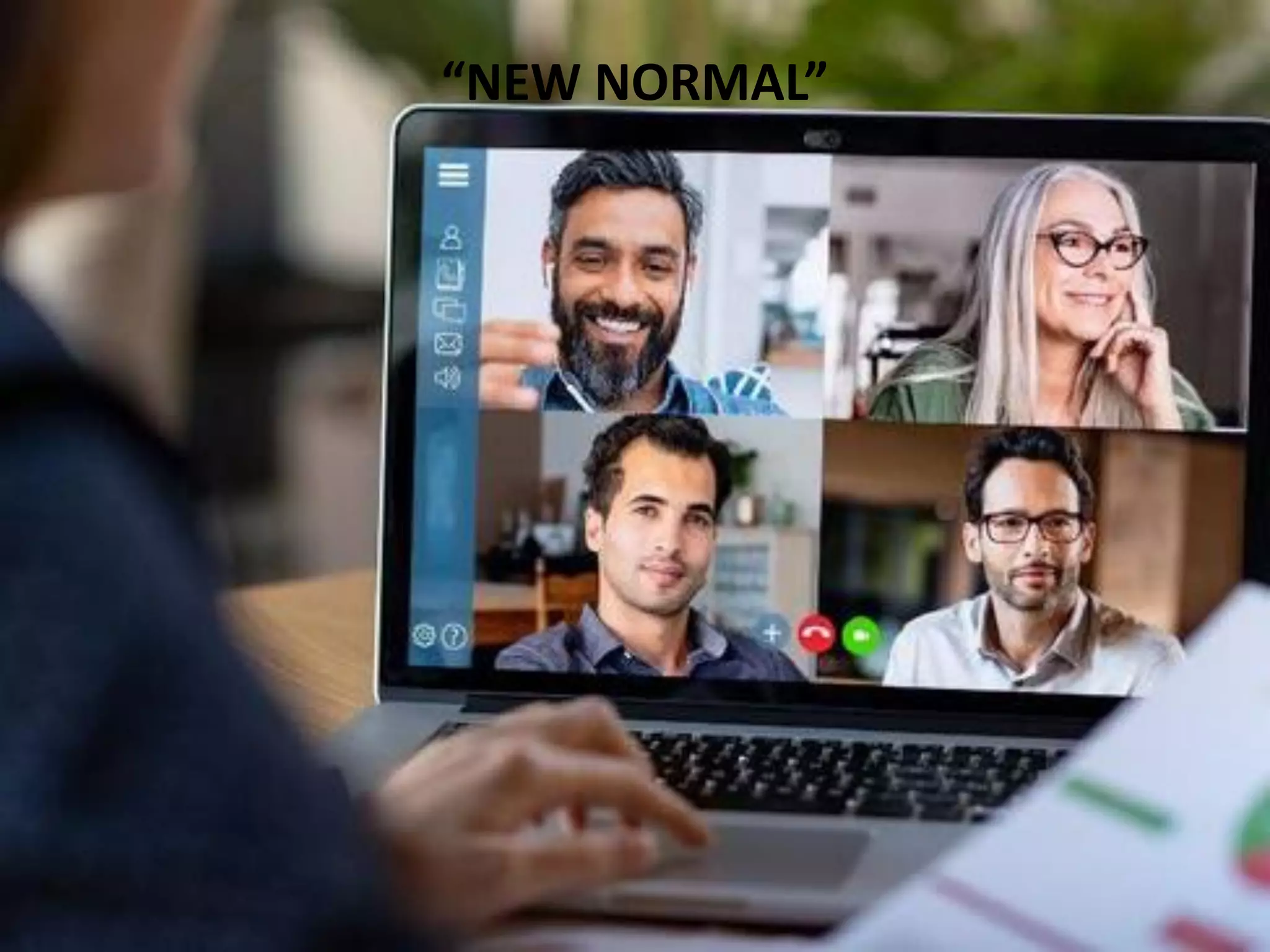
“NEW NORMAL”
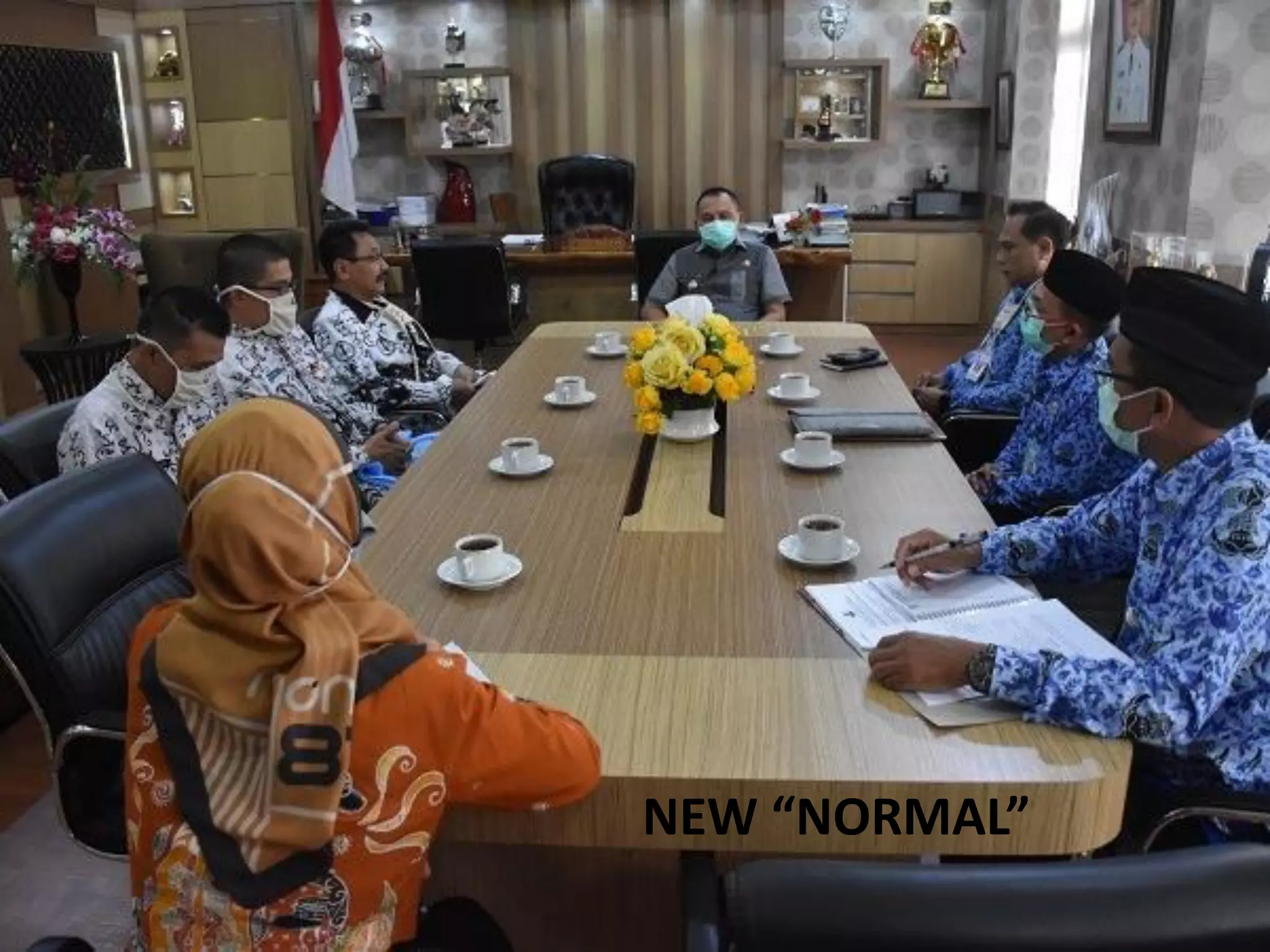
NEW “NORMAL”
Source: https://www.softwareone.com/-/media/global/insights/free-content/infographic-swo-embrace-the-power-of-video-collaboration-
en.pdf?rev=3ff4330471574071ac22b05f856502fd
“Insanity: doing the same thing
over and over again and expecting
different results” – Albert Einstein
• “We need special measures to protect the
millions of health care workers and other
workers who risk their own health for us
every day.”
• “Teleworking offers new opportunities for
workers to keep working... However, workers
must be able to negotiate these
arrangements so that they retain balance
with other responsibilities, such as caring for
children, the sick or the elderly, and of course
themselves.”
- ILO Director-General, Guy Ryder
Work Life Balance = Working from Home ?
Crosbie, T., & Moore, J., (2004), Work–life Balance and Working from Home, Social Policy & Society 3:3, 223–233
Printed in the United Kingdom, Cambridge University Press DOI:10.1017/S1474746404001733
Personal Time
The indication from the current study
is that because men define
themselves primarily as wage earners,
they have fewer personal conflicts
when combining home and work than
women.
Care Time
• They could manage more easily included the
care of spouses, children, older people or
disabled relatives as well household tasks, such
as cleaning, washing, shopping, gardening and
paying bills.
• Those with children over the age of 12 gave very
positive accounts of how working at home
improved their relationships with their children
and their ability to care for them. One of the
professional mothers interviewed said that
despite working longer hours she spent more
time with her children. ‘I tend to play more with
the kids, whether it’s because I’m here and
they’re in the house, and I feel guilty because I’m
not with them. So I do think although I work
longer hours I spend more time with them’
“These problems included working longer hours than they are paid for and
working longer hours than someone who did a similar job to them outside of
the home.”
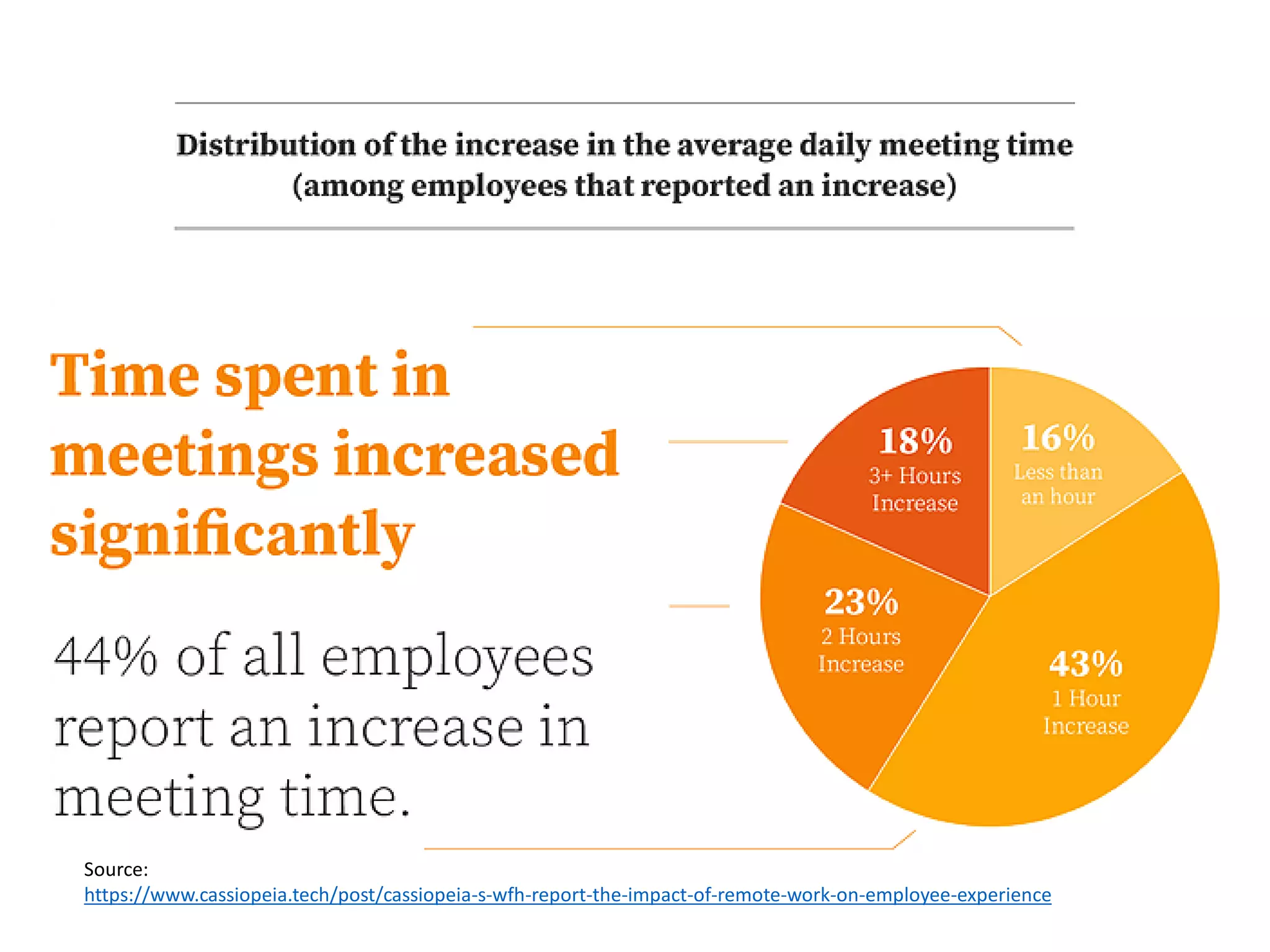
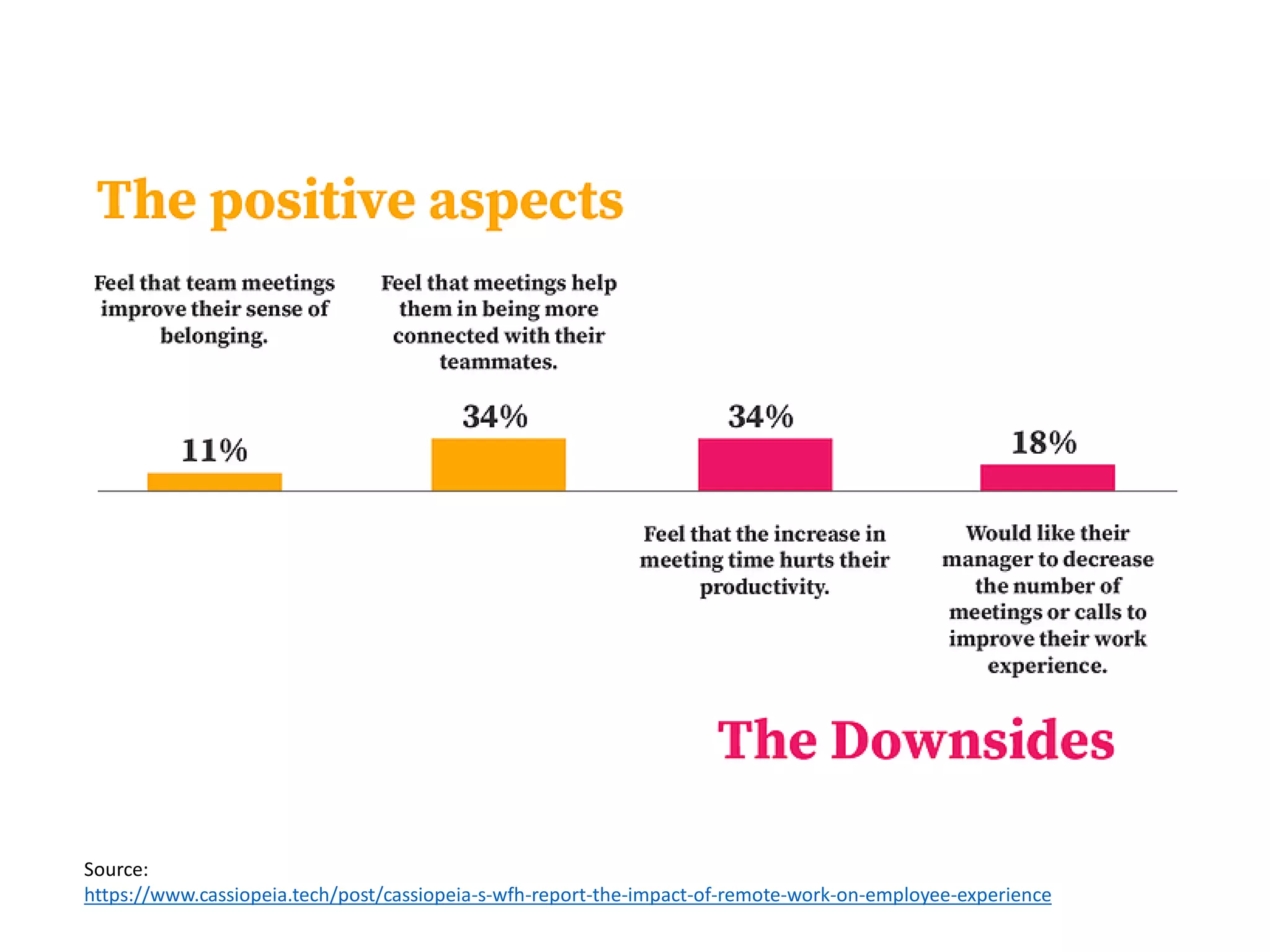
Source:
https://www.cassiopeia.tech/post/cassiopeia-s-wfh-report-the-impact-of-remote-work-on-employee-experience
Source:
https://www.cassiopeia.tech/post/cassiopeia-s-wfh-report-the-impact-of-remote-work-on-employee-experience
Source:
https://www.cassiopeia.tech/post/cassiopeia-s-wfh-report-the-impact-of-remote-work-on-employee-experience
Space of
Work: the
homeworking
experience
were related
to a lack of
space
Source: https://www.softwareone.com/-/media/global/insights/free-content/infographic-swo-work-from-home-
en.pdf?rev=28b9e4d2fb964b448bbaff347634ce6f
Health and Wealth
• …that biggest concern was the health and
wellbeing of our staff and their families, in
relation to COVID-19 and didn't want people
back at work until he could guarantee this.
• Other CEOs and business leaders, We need to be
able to work to sustain a business, and for many,
this will require a return to the workplace.
However, before going back we need to consider
managing risk, uncertainty and ensure a safe and
healthy environment.
• Each business will need to consider how they will
return to work and we should consider the
following model to help us manage uncertainty
and minimise harm.
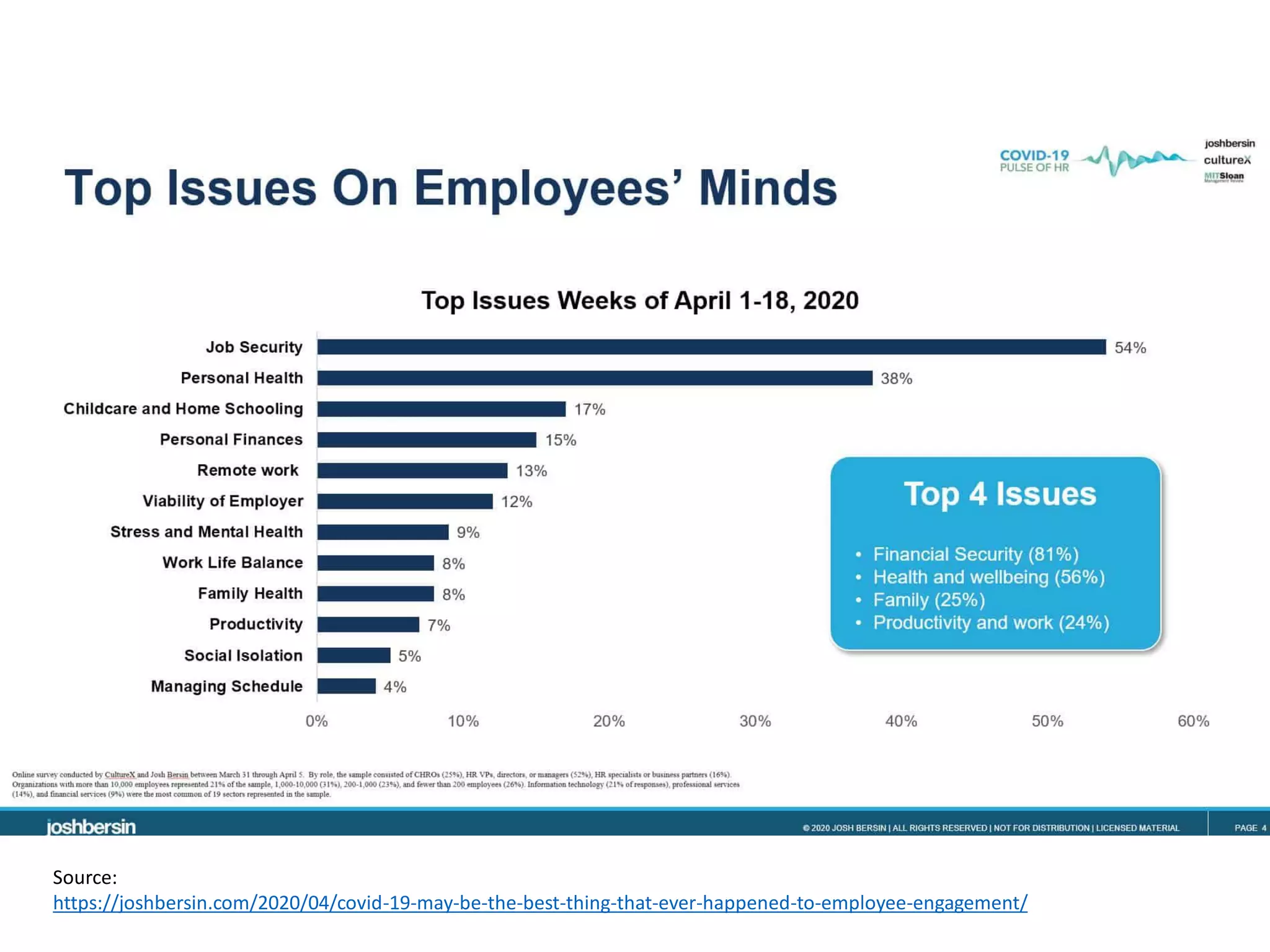
Source:
https://joshbersin.com/2020/04/covid-19-may-be-the-best-thing-that-ever-happened-to-employee-engagement/
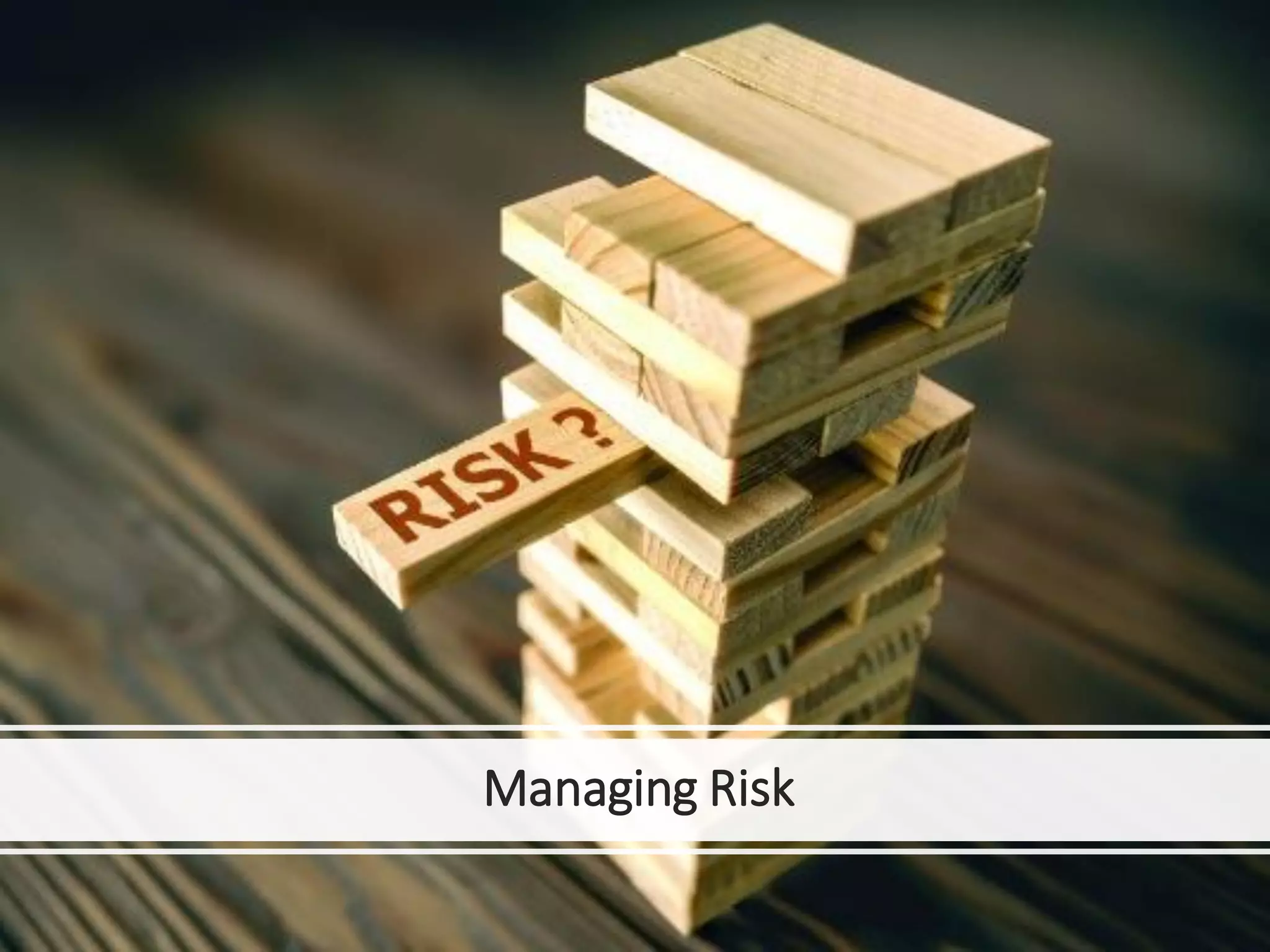
Managing Risk
How Can We Start
Returning to Work?
• You have carried out a COVID-19 Risk
Assessment and have shared the results
with the people who work in your
organisation
• You have cleaning, handwashing and
hygiene procedures in line with
government guidance
• You have taken all reasonable steps to help
people work from home
• You have taken all reasonable steps to
maintain a 2m distance in the workplace
• Where people cannot be 2m apart, you
have done everything practical to manage
the transmission risk
Sources: https://www.cardinus.com/insights/covid-19-hs-response/returning-to-work-after-lockdown/
1. Prepare:
• Leadership team discuss and agree the
business return to work programme
• Plan to prepare your building for
occupancy
• Arrange to conduct a preoccupancy
inspection and arrange a pre-occupancy
deep cleaning programme
• Train your people and cleaning teams on
good hygiene matters and establish a daily
cleaning schedule
• Review any service which may present a
health issue and establish how you can
minimise risk
• Test all emergency and life safety systems
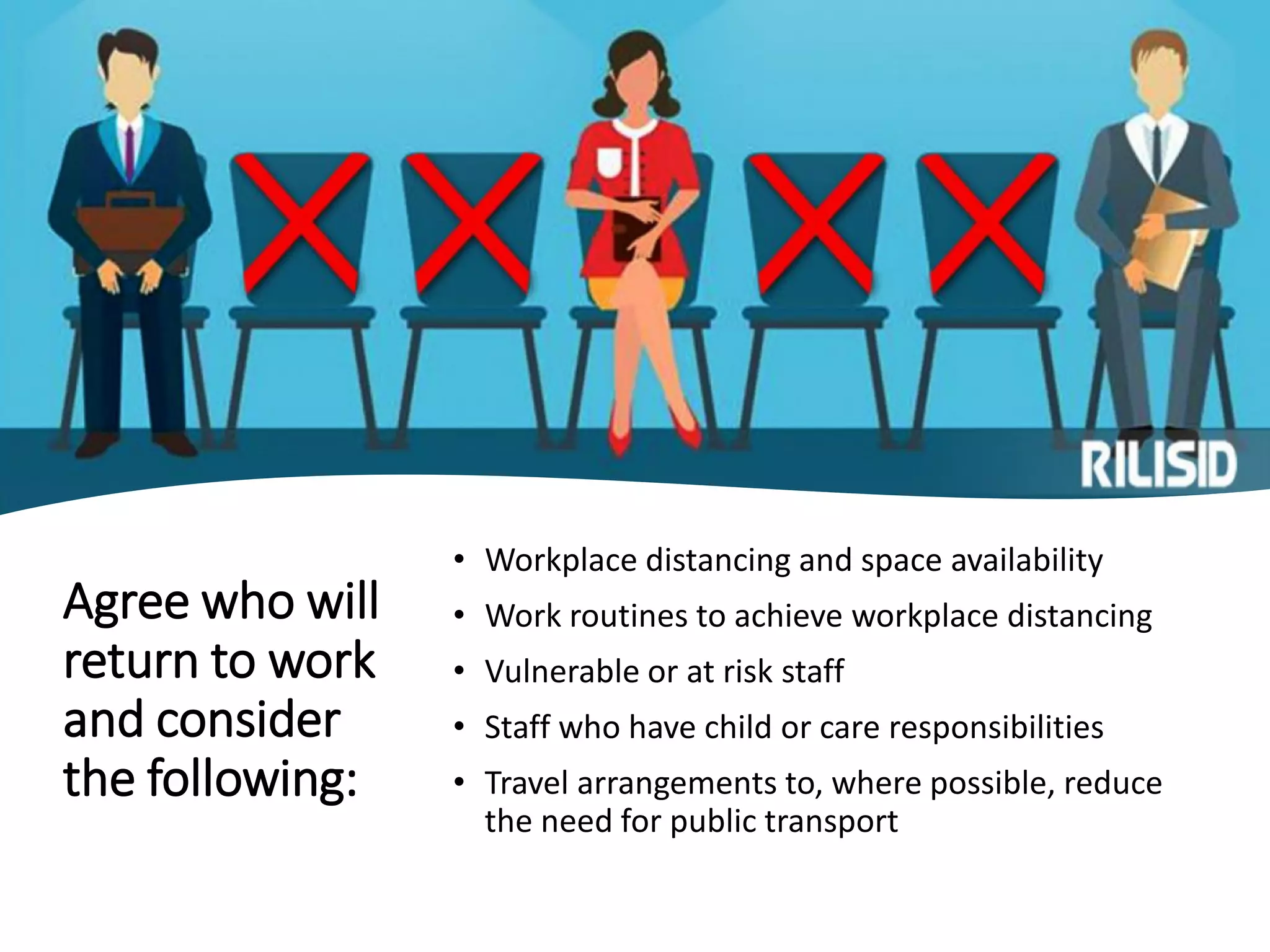
Agree who will
return to work
and consider
the following:
• Workplace distancing and space availability
• Work routines to achieve workplace distancing
• Vulnerable or at risk staff
• Staff who have child or care responsibilities
• Travel arrangements to, where possible, reduce
the need for public transport
Establish workspace
distancing protocols
• Staggered arrival and departure
• Building entrance and/or exit
protocols
• Workspace
• Pantries and any space where
food is prepared and eaten
• Meetings internal
• Meetings with clients
• Security and Emergency
arrangements
2. Inform
Source:
https://www.gotomyerp.com/blog/soci
al-distancing-at-work/
3. Prevent:
• Identifying key touch points in the workplace and providing
appropriate sanitation stations to allow hands to be cleaned
• Washroom cleanliness
• Determining cleaning frequencies which need to consider an initial
clean of surfaces and HVAC system
• Cleaning to consider core activities and staff provided with appropriate
PPE and be visible to staff during the working day
• PPE is recommended for psychological control, rather than a
safety measure
• Ensuring statutory testing is undertaken safely
• Reviewing:
• Food preparation and server areas to ensure workspace
distancing can be maintained
• Deliveries
• Waste Arrangements included specific arrangements for PPE
worn by cleaners and FM Staff
• Cycle to work arrangements and changing facilities where
provided
• Reinforcement of workplace distancing protocols
4. Recover
• Leaders should monitor the effectiveness of the return to work
program to ensure that it remains effective and is supporting those
who have returned to work. It can also be used to restore confidence in
the business.
• Review lessons learnt from the outbreak and ask for feedback.
Critique what you've learnt and use this to improve.
• Review and update your Business Continuity Plan. Most organisations
will have had their plan activated by the outbreak so we would
encourage you to learn from this.
• Finally, review what you've learnt from the period of time people have
been working from home. Are there positives to be had? We believe
that lockdown has reconnected families and given people time look at
what's important to them, so it might be time to look at how teams
work in a different way!
Further Reading:
• Employee Health and Safety Is Our Priority:
Workplace Guidance for COVID-19
https://humanresources.umn.edu/home/hr-
and-covid
• World Day for Safety and Health at Work
2020 - Stop the pandemic: Safety and health
at work can save lives
https://www.ilo.org/global/topics/safety-and-
health-at-work/events-training/events-
meetings/world-day-safety-health-at-
work/WCMS_739669/lang--en/index.htm
Learning and Giving for Better Indonesia
www.humanikaconsulting.com

Be Prepare for Work in New normal

  • 1.
  • 2.
    Seta A. Wicaksana 081119 53 43 wicaksana@humanikaconsulting.com • Managing Director of Humanika Amanah Indonesia – Humanika Consulting • Managing Director of Humanika Bisnis Digital – hipotest.com • Ahli Senior di Komite Kebijakan Pengelolaan Kinerja Organisasi dan SDM (KPKOS) Dewan Pengawas BPJS Ketenagakerjaan • Dosen Tetap Fakultas Psikologi Universitas Pancasila • Pembina Yayasan Humanika Edukasi Indonesia • Penulis Buku “SOBAT” Elexmedia Gramedia 2016 • Organizational Development Expertise • Pengembang Alat Tes minat bakat BRIGHT dan Sistem Tes Psikologi berbasis aplikasi di hipotest.com • Sedang mengikuti tugas belajar Doktoral (S3) di Fakultas Ilmu Ekonomi dan Bisnis Universitas Pancasila Bidang MSDM • Fakultas Psikologi S1 dan S2 Universitas Indonesia • Mathematics: Cryptology sekolah ikatan dinas Sandi Negara
  • 3.
    “Knowing is notunderstanding. There is a great difference between knowing and understanding: you can know a lot about something and not really understand it.” - Charles Kettering
  • 4.
  • 5.
  • 6.
  • 7.
  • 8.
  • 9.
    “Insanity: doing thesame thing over and over again and expecting different results” – Albert Einstein
  • 10.
    • “We needspecial measures to protect the millions of health care workers and other workers who risk their own health for us every day.” • “Teleworking offers new opportunities for workers to keep working... However, workers must be able to negotiate these arrangements so that they retain balance with other responsibilities, such as caring for children, the sick or the elderly, and of course themselves.” - ILO Director-General, Guy Ryder
  • 11.
    Work Life Balance= Working from Home ? Crosbie, T., & Moore, J., (2004), Work–life Balance and Working from Home, Social Policy & Society 3:3, 223–233 Printed in the United Kingdom, Cambridge University Press DOI:10.1017/S1474746404001733
  • 14.
    Personal Time The indicationfrom the current study is that because men define themselves primarily as wage earners, they have fewer personal conflicts when combining home and work than women.
  • 15.
    Care Time • Theycould manage more easily included the care of spouses, children, older people or disabled relatives as well household tasks, such as cleaning, washing, shopping, gardening and paying bills. • Those with children over the age of 12 gave very positive accounts of how working at home improved their relationships with their children and their ability to care for them. One of the professional mothers interviewed said that despite working longer hours she spent more time with her children. ‘I tend to play more with the kids, whether it’s because I’m here and they’re in the house, and I feel guilty because I’m not with them. So I do think although I work longer hours I spend more time with them’
  • 16.
    “These problems includedworking longer hours than they are paid for and working longer hours than someone who did a similar job to them outside of the home.” Source: https://www.cassiopeia.tech/post/cassiopeia-s-wfh-report-the-impact-of-remote-work-on-employee-experience
  • 17.
  • 18.
  • 19.
  • 20.
  • 21.
    Health and Wealth •…that biggest concern was the health and wellbeing of our staff and their families, in relation to COVID-19 and didn't want people back at work until he could guarantee this. • Other CEOs and business leaders, We need to be able to work to sustain a business, and for many, this will require a return to the workplace. However, before going back we need to consider managing risk, uncertainty and ensure a safe and healthy environment. • Each business will need to consider how they will return to work and we should consider the following model to help us manage uncertainty and minimise harm.
  • 22.
  • 23.
  • 25.
    How Can WeStart Returning to Work? • You have carried out a COVID-19 Risk Assessment and have shared the results with the people who work in your organisation • You have cleaning, handwashing and hygiene procedures in line with government guidance • You have taken all reasonable steps to help people work from home • You have taken all reasonable steps to maintain a 2m distance in the workplace • Where people cannot be 2m apart, you have done everything practical to manage the transmission risk
  • 26.
  • 27.
    1. Prepare: • Leadershipteam discuss and agree the business return to work programme • Plan to prepare your building for occupancy • Arrange to conduct a preoccupancy inspection and arrange a pre-occupancy deep cleaning programme • Train your people and cleaning teams on good hygiene matters and establish a daily cleaning schedule • Review any service which may present a health issue and establish how you can minimise risk • Test all emergency and life safety systems
  • 28.
    Agree who will returnto work and consider the following: • Workplace distancing and space availability • Work routines to achieve workplace distancing • Vulnerable or at risk staff • Staff who have child or care responsibilities • Travel arrangements to, where possible, reduce the need for public transport
  • 30.
    Establish workspace distancing protocols •Staggered arrival and departure • Building entrance and/or exit protocols • Workspace • Pantries and any space where food is prepared and eaten • Meetings internal • Meetings with clients • Security and Emergency arrangements
  • 32.
  • 33.
    3. Prevent: • Identifyingkey touch points in the workplace and providing appropriate sanitation stations to allow hands to be cleaned • Washroom cleanliness • Determining cleaning frequencies which need to consider an initial clean of surfaces and HVAC system • Cleaning to consider core activities and staff provided with appropriate PPE and be visible to staff during the working day • PPE is recommended for psychological control, rather than a safety measure • Ensuring statutory testing is undertaken safely • Reviewing: • Food preparation and server areas to ensure workspace distancing can be maintained • Deliveries • Waste Arrangements included specific arrangements for PPE worn by cleaners and FM Staff • Cycle to work arrangements and changing facilities where provided • Reinforcement of workplace distancing protocols
  • 34.
    4. Recover • Leadersshould monitor the effectiveness of the return to work program to ensure that it remains effective and is supporting those who have returned to work. It can also be used to restore confidence in the business. • Review lessons learnt from the outbreak and ask for feedback. Critique what you've learnt and use this to improve. • Review and update your Business Continuity Plan. Most organisations will have had their plan activated by the outbreak so we would encourage you to learn from this. • Finally, review what you've learnt from the period of time people have been working from home. Are there positives to be had? We believe that lockdown has reconnected families and given people time look at what's important to them, so it might be time to look at how teams work in a different way!
  • 36.
    Further Reading: • EmployeeHealth and Safety Is Our Priority: Workplace Guidance for COVID-19 https://humanresources.umn.edu/home/hr- and-covid • World Day for Safety and Health at Work 2020 - Stop the pandemic: Safety and health at work can save lives https://www.ilo.org/global/topics/safety-and- health-at-work/events-training/events- meetings/world-day-safety-health-at- work/WCMS_739669/lang--en/index.htm
  • 37.
    Learning and Givingfor Better Indonesia www.humanikaconsulting.com