INTRODUCTION TO SETS
Content Standards:
The learner demonstrates understanding of key concepts of sets and
the real number system.
Performance Standards:
The learner is able to formulate challenging situations involving sets and
real numbers and solve these in a variety of strategies.
Most Essential Learning competencies
Week 1
The learner illustrates well-defined sets, subsets, universal sets, null
set, cardinality of sets, union and intersection of sets and the
difference of two sets.
Week 2
The learner solves problems involving sets with the use of Venn
Diagram.
HISTORY OF SETS
SETS- is a well-defined group of objects, called elements
that share a common characteristic.
H = {ladies hat, baseball cap, hard hat}
A = {a, b, c, d, e, f, g, h, i, j}
U = {0, 1, 2, 3, 4, 5, 6, 7, 8, 9},
R = {x| x is a factor of 24}
S = { }
EQUIVALENT SETS- SETS HAVE THE
SAME NUMBER OF ELEMETS.
Cardinality of a set is a measure of the number of
elements in the set.
A= { a, b , c , d } A(n)= 4
B= { 1,2,3,4,5,6 } B(n) = 6
C= { } C(n) = 0
Empty set
Notations and Symbols
Subsets
A= { 1, 2 } S(A) = { (1,2), (1), (2), ()}
A(n) = 2 n² = 2² = 4
E= { m, a, t, h }
4² = 16
Union of Sets
1. A = { 1,2,3 } and B = { 1,2,4,5,6}
A U B = { 1,2,3,4,5,6}
2. M = { a, b, c } , N = { c, d, e, f } and P = { b, d, g }
M U N U P = { a, b, c, d, e, f, g }
Intersection of Sets
1. A = { 1,2,3} and B = { 1, 2, 4, 5, 6 }
A∩B = { 1, 2 }
2. C = { a, b, c, d }, D = { b, a, l , k } and E = { a, b, e, d, }
C∩D∩E = { a, b }
Complement of a Set
U = { 0,1,2,3,4,5,6,7,8,9 }
A= { 0,1,2,3 }
B= { 3,4,5,6,7}
C= {0,2,4,6,8 }
A’ = { 4,5,6,7,8,9 }
B’ = { 0,1,2,8,9 }
C’ = { 1,3,5,7,9 }
(A∩B)’
Find
Remember A∩B = { 3 }
Then, (A∩B)’ = { 0,1,2,4,5,6,7,8,9}
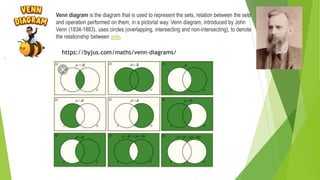
Venn diagram is the diagram that is used to represent the sets, relation between the sets
and operation performed on them, in a pictorial way. Venn diagram, introduced by John
Venn (1834-1883), uses circles (overlapping, intersecting and non-intersecting), to denote
the relationship between sets.
https://byjus.com/maths/venn-diagrams/
U = { 1,2,3,4,5,6,7,8} A { 1, 2, 3, 4} and B = { 3,4,5,6,7 }
Use Venn diagram to represent the elements
Use Venn diagram to represent the location of the sets
3, 4
1, 2 5,6,7
8
Use Venn diagram to represent the location of the elements
U = { a, b, c, d, e, f, g, h }
A = { a, b, c, d, e }, B = { c, d, e, f,} and C = { a, d, e , f, h}
d, e
c
b
f
a
h
1. Let A and B be two finite sets such that n(A) = 20, n(B) = 28
and n(A ∪ B) = 36, find n(A ∩ B).
Solution:
Using the formula n(A ∪ B) = n(A) + n(B) - n(A ∩ B).
then n(A ∩ B) = n(A) + n(B) - n(A ∪ B)
= 20 + 28 - 36
= 48 - 36
= 12
Problems involving Sets
In a survey of university students, 64 had taken
mathematics course, 94 had taken chemistry course,
58 had taken physics course, 28 had taken
mathematics and physics, 26 had taken mathematics
and chemistry, 22 had taken chemistry and physics
course, and 14 had taken all the three courses. Find
how many had taken one course only
M(n) = 64
C(n) = 94
P(n)= 58
M∩P(n)=28
M∩C(n) = 26
C∩P(n) = 22
M ∩C ∩P (n) = 14
Solution:
14
8
12
14
24 60
22
Answers:
Mathematics = 24
Chemistry = 60
Physics = 22
WEEK 1 -2.pptx

WEEK 1 -2.pptx

  • 1.
    INTRODUCTION TO SETS ContentStandards: The learner demonstrates understanding of key concepts of sets and the real number system. Performance Standards: The learner is able to formulate challenging situations involving sets and real numbers and solve these in a variety of strategies.
  • 2.
    Most Essential Learningcompetencies Week 1 The learner illustrates well-defined sets, subsets, universal sets, null set, cardinality of sets, union and intersection of sets and the difference of two sets. Week 2 The learner solves problems involving sets with the use of Venn Diagram.
  • 3.
  • 4.
    SETS- is awell-defined group of objects, called elements that share a common characteristic.
  • 5.
    H = {ladieshat, baseball cap, hard hat} A = {a, b, c, d, e, f, g, h, i, j} U = {0, 1, 2, 3, 4, 5, 6, 7, 8, 9}, R = {x| x is a factor of 24} S = { }
  • 14.
    EQUIVALENT SETS- SETSHAVE THE SAME NUMBER OF ELEMETS.
  • 18.
    Cardinality of aset is a measure of the number of elements in the set. A= { a, b , c , d } A(n)= 4 B= { 1,2,3,4,5,6 } B(n) = 6 C= { } C(n) = 0 Empty set
  • 19.
  • 20.
    Subsets A= { 1,2 } S(A) = { (1,2), (1), (2), ()} A(n) = 2 n² = 2² = 4 E= { m, a, t, h } 4² = 16
  • 21.
    Union of Sets 1.A = { 1,2,3 } and B = { 1,2,4,5,6} A U B = { 1,2,3,4,5,6} 2. M = { a, b, c } , N = { c, d, e, f } and P = { b, d, g } M U N U P = { a, b, c, d, e, f, g } Intersection of Sets 1. A = { 1,2,3} and B = { 1, 2, 4, 5, 6 } A∩B = { 1, 2 } 2. C = { a, b, c, d }, D = { b, a, l , k } and E = { a, b, e, d, } C∩D∩E = { a, b }
  • 22.
    Complement of aSet U = { 0,1,2,3,4,5,6,7,8,9 } A= { 0,1,2,3 } B= { 3,4,5,6,7} C= {0,2,4,6,8 } A’ = { 4,5,6,7,8,9 } B’ = { 0,1,2,8,9 } C’ = { 1,3,5,7,9 } (A∩B)’ Find Remember A∩B = { 3 } Then, (A∩B)’ = { 0,1,2,4,5,6,7,8,9}
  • 23.
    Venn diagram isthe diagram that is used to represent the sets, relation between the sets and operation performed on them, in a pictorial way. Venn diagram, introduced by John Venn (1834-1883), uses circles (overlapping, intersecting and non-intersecting), to denote the relationship between sets. https://byjus.com/maths/venn-diagrams/
  • 24.
    U = {1,2,3,4,5,6,7,8} A { 1, 2, 3, 4} and B = { 3,4,5,6,7 } Use Venn diagram to represent the elements Use Venn diagram to represent the location of the sets 3, 4 1, 2 5,6,7 8
  • 25.
    Use Venn diagramto represent the location of the elements U = { a, b, c, d, e, f, g, h } A = { a, b, c, d, e }, B = { c, d, e, f,} and C = { a, d, e , f, h} d, e c b f a h
  • 26.
    1. Let Aand B be two finite sets such that n(A) = 20, n(B) = 28 and n(A ∪ B) = 36, find n(A ∩ B). Solution: Using the formula n(A ∪ B) = n(A) + n(B) - n(A ∩ B). then n(A ∩ B) = n(A) + n(B) - n(A ∪ B) = 20 + 28 - 36 = 48 - 36 = 12 Problems involving Sets
  • 27.
    In a surveyof university students, 64 had taken mathematics course, 94 had taken chemistry course, 58 had taken physics course, 28 had taken mathematics and physics, 26 had taken mathematics and chemistry, 22 had taken chemistry and physics course, and 14 had taken all the three courses. Find how many had taken one course only M(n) = 64 C(n) = 94 P(n)= 58 M∩P(n)=28 M∩C(n) = 26 C∩P(n) = 22 M ∩C ∩P (n) = 14 Solution: 14 8 12 14 24 60 22 Answers: Mathematics = 24 Chemistry = 60 Physics = 22