DEBATE PRESENTATION
PREP
CLU 3MO
OBJECTIVES
 SWBAT construct an argument using evidence
and provide reasoning for a claim
 SWBAT participate in a debate about a
contemporary issue.
THE GREAT DEBATERS
 Who has seen “The Great Debaters”?
 A quick overview of what a debate looks and
sounds like.
 Click Here
OUR DEBATE
 Our debate will use our knowledge of predator
and prey relationships as well as food chains and
food webs.
 We will be debating the claim that wolves should
be hunted in Michigan.
 You must provide evidence and reasoning.
 The next slides will provide an example how you
should prepare to debate.
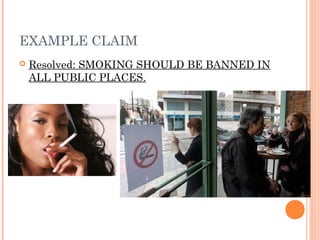
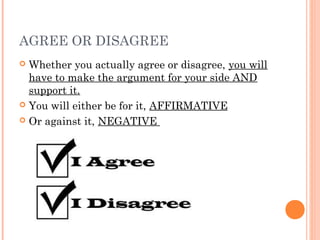
EXAMPLE CLAIM
 Resolved: SMOKING SHOULD BE BANNED IN
ALL PUBLIC PLACES.
AGREE OR DISAGREE
 Whether you actually agree or disagree, you will
have to make the argument for your side AND
support it.
 You will either be for it, AFFIRMATIVE
 Or against it, NEGATIVE
Giving Support for
Your Reasons
Support consists of evidence. The four kinds of evidence:
1. Example: from your own experience or from
what you heard or read.
2. Common Sense: things that you believe
everybody knows.
3. Expert Opinion: the opinions of experts -- this
comes from research.
4. Statistics: numbers -- this also comes from
research.
SMOKING SHOULD BE BANNED IN
ALL PUBLIC PLACES.
Example: For example / for instance / let me
give an example
 Whenever I go to a restaurant and there are
people smoking near me, I feel that I am
breathing their smoke. This makes me a smoker
even though I don't want to be.
Common Sense: Everyone knows / if...then /
it's common knowledge that
 Secondhand smoke is very unhealthy for
nonsmokers.
Statistics:
 Secondhand smoke causes about 250,000 respiratory
infections in infants and children every year, resulting
in about 15,000 hospitalizations each year.
Expert Opinion: According to.../ to quote.../ the
book _____ says...
 According to the Environmental Protection Agency,
"secondhand smoke causes approximately 3,000 lung
cancer deaths in nonsmokers each year."
 Debate and Persuasive Writing Ruth Sunda, Gifted
Resource Teacher
 May 2006 Brisas Elementary School, Chandler, AZ
Your Opinions, Preferences: I think..., In my
opinion..., I'd like to..., I'd rather..., I'd prefer...,
The way I see it..., As far as I'm concerned..., If it
were up to me..., I suppose..., I suspect that..., I'm
pretty sure that..., It is fairly certain that..., I'm
convinced that..., I honestly feel that, I strongly
believe that..., Without a doubt,...,
5. Disagreeing:
 I don't think that..., Don't you think it would be
better..., I don't agree, I'd prefer..., Shouldn't we
consider..., But what about..., I'm afraid I don't
agree..., Frankly, I doubt if..., Let's face it, The truth of
the matter is..., The problem with your point of view is
that…
6. Giving Reasons and offering explanations:
 To start with, The reason why..., That's why..., For this
reason..., That's the reason why..., Many people
think...., Considering..., Allowing for the fact that...,
When you consider that...
REBUTTAL
 A rebuttal is the “no, you're wrong and this is
why" argument.
 Also known as “you boostin’ because..”
 Please note –DO NOT use you boostin’ if you
want to be taken seriously in this debate!!!!
REBUTTAL
STEP 1: "They say ..."
 State the argument that you are about to refute
so that the we can follow easily. Take notes
during your opponent's speeches so you will be
clear about what they argued.
 "The other team said that smoking is
harmful for nonsmokers."
STEP 2: "But I disagree..." Or "That may be
true, but..."
 "That may be true, but I think that if
nonsmokers want to avoid cigarette smoke,
they can walk away from it."
REBUTTAL
STEP 3: "Because ..."
 "Because nonsmokers should look out for
their own health."
STEP 4: "Therefore..."
 "Therefore it is not the responsibility of
smokers to protect nonsmokers."
STRATEGIES
1. If you don't want to debate a point, don't bring it
up.
2. Don't get mad—get even through use of logic.
3. Negative body language (like rolling the eyes)
does not serve to give the judge/audience a
positive impression of you.
4. Listen!—then get the other side with logical
attack (not physical).
5. Use formal language. Slang, name-calling or
cursing makes you appear unintelligent and ill
prepared.
6. Loud is not logic. A quiet voice can command the most
attention. An old trick of politicians is to lower the
voice so that everyone listens more closely.
7. Choose your experts and sources wisely. One person
who has been roller skating once is not an expert on
the subject.
8. Know the position of the other side as well as you
know your own. This way you won't be surprised.
9. Save your best quote, strongest point and highest-
impact emotional appeal for summation and final
statement.
ASSIGNMENT
 You will work in teams to construct an argument
for a debate. The debate will happen tomorrow.
 Each team will be broken into 5 smaller groups
 (2-3 people per small group)
 Groups 1 and 2 work together (opening statement)
 Forming an opinion and making the argument
 Finding evidence to support your argument
 Visual aids (charts, graphs, pictures, etc) are optional
 Groups 3 and 4 work together (rebuttal)
 Figuring out what the other team might say
 Finding evidence that goes against what you think the other
team might say
 Visual aids (charts, graphs, pictures, etc) are optional
 Group 5 –Summery and Powerful Conclusion (most
important points)
THE CLAIM
 The State of Michigan should allow wolf hunting.
RESOURCES
 This PowerPoint is available on the class website
if you need to review it
 I have linked 4 resources with data and possible
arguments to the website
(look for the charts and graphs)
 Use the templates provided to help your group
layout your argument.
 Feel free to research more if you want.
GRADING
 1. Participation: I want to see you actively participating
in the debate--proposing and refuting arguments (25%)
 2. Delivery: Effective use of public speaking skills to
communicate your message. I will also judge your ability
to have a controlled debate. In other words, the way that
you handle yourself in the debate will impact upon your
delivery grade (15%)
 3. Logic: Use of well supported arguments (20%)
 4. Support Material: This can mean informal, personal
examples, hypothetical examples, statistics, testimony,
etc. While I do want to see that you researched the topic,
not all support material has to come from an outside
source (30%)
 5. Refutation: Direct responses to the opposite side’s
arguments (10%)
GO! (CONVINCE ME) . . .

Wolf hunting debate presentation prep

  • 1.
  • 2.
    OBJECTIVES  SWBAT constructan argument using evidence and provide reasoning for a claim  SWBAT participate in a debate about a contemporary issue.
  • 3.
    THE GREAT DEBATERS Who has seen “The Great Debaters”?  A quick overview of what a debate looks and sounds like.  Click Here
  • 4.
    OUR DEBATE  Ourdebate will use our knowledge of predator and prey relationships as well as food chains and food webs.  We will be debating the claim that wolves should be hunted in Michigan.  You must provide evidence and reasoning.  The next slides will provide an example how you should prepare to debate.
  • 5.
    EXAMPLE CLAIM  Resolved:SMOKING SHOULD BE BANNED IN ALL PUBLIC PLACES.
  • 6.
    AGREE OR DISAGREE Whether you actually agree or disagree, you will have to make the argument for your side AND support it.  You will either be for it, AFFIRMATIVE  Or against it, NEGATIVE
  • 7.
    Giving Support for YourReasons Support consists of evidence. The four kinds of evidence: 1. Example: from your own experience or from what you heard or read. 2. Common Sense: things that you believe everybody knows. 3. Expert Opinion: the opinions of experts -- this comes from research. 4. Statistics: numbers -- this also comes from research.
  • 8.
    SMOKING SHOULD BEBANNED IN ALL PUBLIC PLACES. Example: For example / for instance / let me give an example  Whenever I go to a restaurant and there are people smoking near me, I feel that I am breathing their smoke. This makes me a smoker even though I don't want to be. Common Sense: Everyone knows / if...then / it's common knowledge that  Secondhand smoke is very unhealthy for nonsmokers.
  • 9.
    Statistics:  Secondhand smokecauses about 250,000 respiratory infections in infants and children every year, resulting in about 15,000 hospitalizations each year. Expert Opinion: According to.../ to quote.../ the book _____ says...  According to the Environmental Protection Agency, "secondhand smoke causes approximately 3,000 lung cancer deaths in nonsmokers each year."  Debate and Persuasive Writing Ruth Sunda, Gifted Resource Teacher  May 2006 Brisas Elementary School, Chandler, AZ
  • 10.
    Your Opinions, Preferences:I think..., In my opinion..., I'd like to..., I'd rather..., I'd prefer..., The way I see it..., As far as I'm concerned..., If it were up to me..., I suppose..., I suspect that..., I'm pretty sure that..., It is fairly certain that..., I'm convinced that..., I honestly feel that, I strongly believe that..., Without a doubt,...,
  • 11.
    5. Disagreeing:  Idon't think that..., Don't you think it would be better..., I don't agree, I'd prefer..., Shouldn't we consider..., But what about..., I'm afraid I don't agree..., Frankly, I doubt if..., Let's face it, The truth of the matter is..., The problem with your point of view is that… 6. Giving Reasons and offering explanations:  To start with, The reason why..., That's why..., For this reason..., That's the reason why..., Many people think...., Considering..., Allowing for the fact that..., When you consider that...
  • 12.
    REBUTTAL  A rebuttalis the “no, you're wrong and this is why" argument.  Also known as “you boostin’ because..”  Please note –DO NOT use you boostin’ if you want to be taken seriously in this debate!!!!
  • 13.
    REBUTTAL STEP 1: "Theysay ..."  State the argument that you are about to refute so that the we can follow easily. Take notes during your opponent's speeches so you will be clear about what they argued.  "The other team said that smoking is harmful for nonsmokers." STEP 2: "But I disagree..." Or "That may be true, but..."  "That may be true, but I think that if nonsmokers want to avoid cigarette smoke, they can walk away from it."
  • 14.
    REBUTTAL STEP 3: "Because..."  "Because nonsmokers should look out for their own health." STEP 4: "Therefore..."  "Therefore it is not the responsibility of smokers to protect nonsmokers."
  • 15.
    STRATEGIES 1. If youdon't want to debate a point, don't bring it up. 2. Don't get mad—get even through use of logic. 3. Negative body language (like rolling the eyes) does not serve to give the judge/audience a positive impression of you. 4. Listen!—then get the other side with logical attack (not physical). 5. Use formal language. Slang, name-calling or cursing makes you appear unintelligent and ill prepared.
  • 16.
    6. Loud isnot logic. A quiet voice can command the most attention. An old trick of politicians is to lower the voice so that everyone listens more closely. 7. Choose your experts and sources wisely. One person who has been roller skating once is not an expert on the subject. 8. Know the position of the other side as well as you know your own. This way you won't be surprised. 9. Save your best quote, strongest point and highest- impact emotional appeal for summation and final statement.
  • 17.
    ASSIGNMENT  You willwork in teams to construct an argument for a debate. The debate will happen tomorrow.  Each team will be broken into 5 smaller groups  (2-3 people per small group)  Groups 1 and 2 work together (opening statement)  Forming an opinion and making the argument  Finding evidence to support your argument  Visual aids (charts, graphs, pictures, etc) are optional  Groups 3 and 4 work together (rebuttal)  Figuring out what the other team might say  Finding evidence that goes against what you think the other team might say  Visual aids (charts, graphs, pictures, etc) are optional  Group 5 –Summery and Powerful Conclusion (most important points)
  • 18.
    THE CLAIM  TheState of Michigan should allow wolf hunting.
  • 19.
    RESOURCES  This PowerPointis available on the class website if you need to review it  I have linked 4 resources with data and possible arguments to the website (look for the charts and graphs)  Use the templates provided to help your group layout your argument.  Feel free to research more if you want.
  • 20.
    GRADING  1. Participation:I want to see you actively participating in the debate--proposing and refuting arguments (25%)  2. Delivery: Effective use of public speaking skills to communicate your message. I will also judge your ability to have a controlled debate. In other words, the way that you handle yourself in the debate will impact upon your delivery grade (15%)  3. Logic: Use of well supported arguments (20%)  4. Support Material: This can mean informal, personal examples, hypothetical examples, statistics, testimony, etc. While I do want to see that you researched the topic, not all support material has to come from an outside source (30%)  5. Refutation: Direct responses to the opposite side’s arguments (10%)
  • 21.

Editor's Notes

  • #4 Take show of hands and see if one person can give a summery if not… A professor coaches the debate team to a nearly-undefeated season that sees the first debate between U.S. students from white and Negro colleges and ends with an invitation to face Harvard University's national champions. The team of four, which includes a female student and a very young James Farmer, is tested in a crucible heated by Jim Crow, sexism, a lynch mob, an arrest and near riot, a love affair, jealousy, and a national radio audience
  • #9 Just talk about these, students can read them if you want.