WK8 Agenda
• Project 8 per group: members by Jan 18, 2010
• Pick one topic for multiple comparisons
  project topics: religion, music, art, language
  and literature
• European Middle Ages Lecture
• Homework (-2 per week for late work)
• Exam Result
Western Europe (Middle Ages)

• Got influence from Greek and Roman Classics,
  Germanic tribes and Christianity
• Peak at 1200-1300 AD. (Christianity and
  Feudalism)
• Focus on the new world and prepare for the
  judgment day
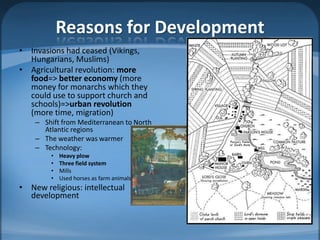
Reasons for Development
• Invasions had ceased (Vikings,
  Hungarians, Muslims)
• Agricultural revolution: more
  food=> better economy (more
  money for monarchs which they
  could use to support church and
  schools)=>urban revolution
  (more time, migration)
    – Shift from Mediterranean to North
      Atlantic regions
    – The weather was warmer
    – Technology:
        •   Heavy plow
        •   Three field system
        •   Mills
        •   Used horses as farm animals
• New religious: intellectual
  development
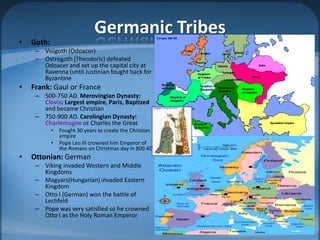
Germanic Tribes
•   Goth:
     – Visigoth (Odoacer)
     – Ostrogoth (Theodoric) defeated
       Odoacer and set up the capital city at
       Ravenna (until Justinian fought back for
       Byzantine
•   Frank: Gaul or France
     – 500-750 AD. Merovingian Dynasty:
       Clovis: Largest empire, Paris, Baptized
       and became Christian
     – 750-900 AD. Carolingian Dynasty:
       Charlemagne or Charles the Great
            •   Fought 30 years to create the Christian
                empire
            •   Pope Leo III crowned him Emperor of
                the Romans on Christmas day in 800 AD
•   Ottonian: German
     – Viking invaded Western and Middle
       Kingdoms
     – Magyars(Hungarian) invaded Eastern
       Kingdom
     – Otto I (German) won the battle of
       Lechfeld
     – Pope was very satisfied so he crowned
       Otto I as the Holy Roman Emperor
Germanic Tribes
• Comitatus: relationship between leaders and knights
    – Leaders gave: Food, weapon, and shelter
    – Knights returned: Loyalty and military service
    – Foundation of feudalism in EU
• Polytheist
• Christianity: Age of Faith during the dark age
• Christian influenced: politic, economic, society, and tradition from
  birth to death
    – Canon Law: punished those who deceitfully swear, insulted Christian,
      practiced magic
    – Excommunication: those who got excommunicated couldn’t
      participate in the religious activity
    – Interdiction: punished the whole community or country, no religious
      practice at all
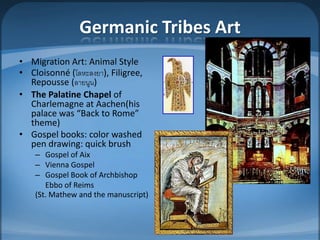
Germanic Tribes Art
• Migration Art: Animal Style
• Cloisonné (โลหะลงยา), Filigree,
  Repousse (ลายนูน)
• The Palatine Chapel of
  Charlemagne at Aachen(his
  palace was “Back to Rome”
  theme)
• Gospel books: color washed
  pen drawing: quick brush
    – Gospel of Aix
    – Vienna Gospel
    – Gospel Book of Archbishop
       Ebbo of Reims
    (St. Mathew and the manuscript)
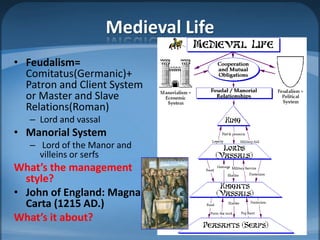
Medieval Life
• Feudalism=
  Comitatus(Germanic)+
  Patron and Client System
  or Master and Slave
  Relations(Roman)
   – Lord and vassal
• Manorial System
   – Lord of the Manor and
     villeins or serfs
What’s the management
  style?
• John of England: Magna
  Carta (1215 AD.)
What’s it about?
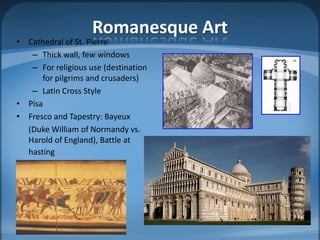
Romanesque Art
• Cathedral of St. Pierre
   – Thick wall, few windows
   – For religious use (destination
      for pilgrims and crusaders)
   – Latin Cross Style
• Pisa
• Fresco and Tapestry: Bayeux
  (Duke William of Normandy vs.
  Harold of England), Battle at
  hasting
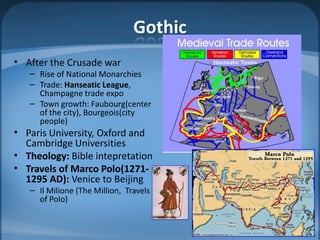
Gothic
• After the Crusade war
   – Rise of National Monarchies
   – Trade: Hanseatic League,
     Champagne trade expo
   – Town growth: Faubourg(center
     of the city), Bourgeois(city
     people)
• Paris University, Oxford and
  Cambridge Universities
• Theology: Bible intepretation
• Travels of Marco Polo(1271-
  1295 AD): Venice to Beijing
   – Il Milione (The Million, Travels
     of Polo)
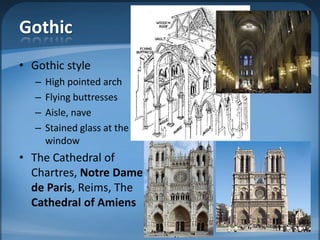
Gothic
• Gothic style
   –   High pointed arch
   –   Flying buttresses
   –   Aisle, nave
   –   Stained glass at the
       window
• The Cathedral of
  Chartres, Notre Dame
  de Paris, Reims, The
  Cathedral of Amiens
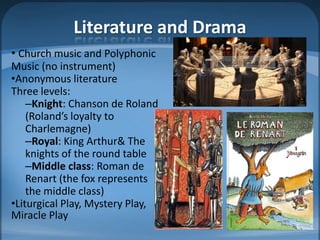
Literature and Drama
• Church music and Polyphonic
Music (no instrument)
•Anonymous literature
Three levels:
    –Knight: Chanson de Roland
    (Roland’s loyalty to
    Charlemagne)
    –Royal: King Arthur& The
    knights of the round table
    –Middle class: Roman de
    Renart (the fox represents
    the middle class)
•Liturgical Play, Mystery Play,
Miracle Play
Italian Renaissance
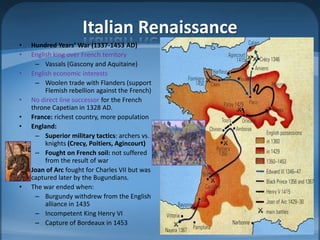
•   Hundred Years’ War (1337-1453 AD)
•   English king over French territory
     – Vassals (Gascony and Aquitaine)
•   English economic interests
     – Woolen trade with Flanders (support
         Flemish rebellion against the French)
•   No direct line successor for the French
    throne Capetian in 1328 AD.
•   France: richest country, more population
•   England:
     – Superior military tactics: archers vs.
         knights (Crecy, Poitiers, Agincourt)
     – Fought on French soil: not suffered
         from the result of war
•   Joan of Arc fought for Charles VII but was
    captured later by the Bugundians.
•   The war ended when:
     – Burgundy withdrew from the English
         alliance in 1435
     – Incompetent King Henry VI
     – Capture of Bordeaux in 1453
Italian Renaissance
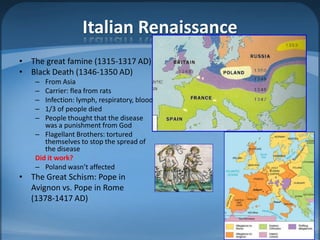
• The great famine (1315-1317 AD)
• Black Death (1346-1350 AD)
    –  From Asia
    –  Carrier: flea from rats
    –  Infection: lymph, respiratory, blood
    –  1/3 of people died
    –  People thought that the disease
       was a punishment from God
    – Flagellant Brothers: tortured
       themselves to stop the spread of
       the disease
    Did it work?
    – Poland wasn’t affected
• The Great Schism: Pope in
  Avignon vs. Pope in Rome
  (1378-1417 AD)
Italian Renaissance
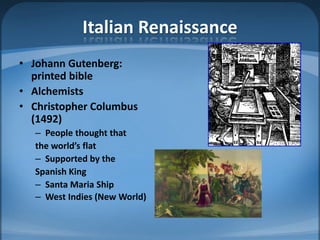
• Johann Gutenberg:
  printed bible
• Alchemists
• Christopher Columbus
  (1492)
  – People thought that
  the world’s flat
  – Supported by the
  Spanish King
  – Santa Maria Ship
  – West Indies (New World)
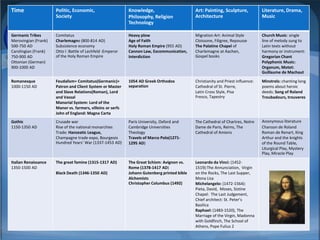
Time                  Politic, Economic,                     Knowledge,                       Art: Painting, Sculpture,            Literature, Drama,
                      Society                                Philosophy, Religion             Architecture                         Music


Germanic Tribes
Merovingian (Frank)
                      Comitatus
                      Charlemagne (800-814 AD)
                                                            EU Medieval
                                                             Technology

                                                             Heavy plow
                                                             Age of Faith
                                                                                              Migration Art: Animal Style
                                                                                              Cloissone, Filigree, Repousse
                                                                                                                                   Church Music: single
                                                                                                                                   line of melody sung to
500-750 AD            Subsistence economy                    Holy Roman Empire (955 AD)       The Palatine Chapel of               Latin texts without
Carolingian (Frank)   Otto I :Battle of Lechfeld :Emperor    Cannon Law, Excommunication,     Charlemagne at Aachen,               harmony or instrument:
750-900 AD            of the Holy Roman Empire               Interdiction                     Gospel books                         Gregorian Chant
Ottonian (German)                                                                                                                  Polyphonic Music:
900-1000 AD                                                                                                                        Organum, Motet:
                                                                                                                                   Guillaume de Machaut

Romanesque            Feudalism= Comitatus(Germanic)+        1054 AD Greek Orthodox           Christianity and Priest influence:   Minstrels: chanting long
1000-1150 AD          Patron and Client System or Master     separation                       Cathedral of St. Pierre,             poems about heroic
                      and Slave Relations(Roman), Lord                                        Latin Cross Style, Pisa              deeds: Song of Roland
                      and Vassal                                                              Fresco, Tapestry                     Troubadours, trouveres
                      Manorial System: Lord of the
                      Manor vs. farmers, villeins or serfs
                      John of England: Magna Carta
Gothic                Crusade war                            Paris University, Oxford and     The Cathedral of Chartres, Notre     Anonymous literature
1150-1350 AD          Rise of the national monarchies        Cambridge Universities           Dame de Paris, Reims, The            Chanson de Roland
                      Trade: Hanseatic League,               Theology                         Cathedral of Amiens                  Roman de Renart, King
                      Champagne trade expo, Bourgeois        Travels of Marco Polo(1271-                                           Arthur and the knights
                      Hundred Years’ War (1337-1453 AD)      1295 AD)                                                              of the Round Table,
                                                                                                                                   Liturgical Play, Mystery
                                                                                                                                   Play, Miracle Play

Italian Renaissance   The great famine (1315-1317 AD)        The Great Schism: Avignon vs.    Leonardo da Vinci: (1452-
1350-1500 AD                                                 Rome (1378-1417 AD)              1519):The Annunciation, Virgin
                      Black Death (1346-1350 AD)             Johann Gutenberg printed bible   on the Rocks, The Last Supper,
                                                             Alchemists                       Mona Lisa
                                                             Christopher Columbus (1492)      Michelangelo: (1472-1564):
                                                                                              Pieta, David, Moses, Sistine
                                                                                              Chapel: The Last Judgement,
                                                                                              Chief architect: St. Peter’s
                                                                                              Basilica
                                                                                              Raphael: (1483-1520), The
                                                                                              Marriage of the Virgin, Madonna
                                                                                              with Goldfinch, The School of
                                                                                              Athens, Pope Fulius 2
Homework

• Art work for Leonardo da Vinci and Michael
  Angelo
• Table for 1500-1900 AD.
• Late homework -2 per week.
• Medieval Exam on January 25, 2010.

WK10EUMedieval

  • 1.
    WK8 Agenda • Project8 per group: members by Jan 18, 2010 • Pick one topic for multiple comparisons project topics: religion, music, art, language and literature • European Middle Ages Lecture • Homework (-2 per week for late work) • Exam Result
  • 2.
    Western Europe (MiddleAges) • Got influence from Greek and Roman Classics, Germanic tribes and Christianity • Peak at 1200-1300 AD. (Christianity and Feudalism) • Focus on the new world and prepare for the judgment day
  • 3.
    Reasons for Development •Invasions had ceased (Vikings, Hungarians, Muslims) • Agricultural revolution: more food=> better economy (more money for monarchs which they could use to support church and schools)=>urban revolution (more time, migration) – Shift from Mediterranean to North Atlantic regions – The weather was warmer – Technology: • Heavy plow • Three field system • Mills • Used horses as farm animals • New religious: intellectual development
  • 4.
    Germanic Tribes • Goth: – Visigoth (Odoacer) – Ostrogoth (Theodoric) defeated Odoacer and set up the capital city at Ravenna (until Justinian fought back for Byzantine • Frank: Gaul or France – 500-750 AD. Merovingian Dynasty: Clovis: Largest empire, Paris, Baptized and became Christian – 750-900 AD. Carolingian Dynasty: Charlemagne or Charles the Great • Fought 30 years to create the Christian empire • Pope Leo III crowned him Emperor of the Romans on Christmas day in 800 AD • Ottonian: German – Viking invaded Western and Middle Kingdoms – Magyars(Hungarian) invaded Eastern Kingdom – Otto I (German) won the battle of Lechfeld – Pope was very satisfied so he crowned Otto I as the Holy Roman Emperor
  • 5.
    Germanic Tribes • Comitatus:relationship between leaders and knights – Leaders gave: Food, weapon, and shelter – Knights returned: Loyalty and military service – Foundation of feudalism in EU • Polytheist • Christianity: Age of Faith during the dark age • Christian influenced: politic, economic, society, and tradition from birth to death – Canon Law: punished those who deceitfully swear, insulted Christian, practiced magic – Excommunication: those who got excommunicated couldn’t participate in the religious activity – Interdiction: punished the whole community or country, no religious practice at all
  • 6.
    Germanic Tribes Art •Migration Art: Animal Style • Cloisonné (โลหะลงยา), Filigree, Repousse (ลายนูน) • The Palatine Chapel of Charlemagne at Aachen(his palace was “Back to Rome” theme) • Gospel books: color washed pen drawing: quick brush – Gospel of Aix – Vienna Gospel – Gospel Book of Archbishop Ebbo of Reims (St. Mathew and the manuscript)
  • 7.
    Medieval Life • Feudalism= Comitatus(Germanic)+ Patron and Client System or Master and Slave Relations(Roman) – Lord and vassal • Manorial System – Lord of the Manor and villeins or serfs What’s the management style? • John of England: Magna Carta (1215 AD.) What’s it about?
  • 8.
    Romanesque Art • Cathedralof St. Pierre – Thick wall, few windows – For religious use (destination for pilgrims and crusaders) – Latin Cross Style • Pisa • Fresco and Tapestry: Bayeux (Duke William of Normandy vs. Harold of England), Battle at hasting
  • 9.
    Gothic • After theCrusade war – Rise of National Monarchies – Trade: Hanseatic League, Champagne trade expo – Town growth: Faubourg(center of the city), Bourgeois(city people) • Paris University, Oxford and Cambridge Universities • Theology: Bible intepretation • Travels of Marco Polo(1271- 1295 AD): Venice to Beijing – Il Milione (The Million, Travels of Polo)
  • 10.
    Gothic • Gothic style – High pointed arch – Flying buttresses – Aisle, nave – Stained glass at the window • The Cathedral of Chartres, Notre Dame de Paris, Reims, The Cathedral of Amiens
  • 11.
    Literature and Drama •Church music and Polyphonic Music (no instrument) •Anonymous literature Three levels: –Knight: Chanson de Roland (Roland’s loyalty to Charlemagne) –Royal: King Arthur& The knights of the round table –Middle class: Roman de Renart (the fox represents the middle class) •Liturgical Play, Mystery Play, Miracle Play
  • 12.
    Italian Renaissance • Hundred Years’ War (1337-1453 AD) • English king over French territory – Vassals (Gascony and Aquitaine) • English economic interests – Woolen trade with Flanders (support Flemish rebellion against the French) • No direct line successor for the French throne Capetian in 1328 AD. • France: richest country, more population • England: – Superior military tactics: archers vs. knights (Crecy, Poitiers, Agincourt) – Fought on French soil: not suffered from the result of war • Joan of Arc fought for Charles VII but was captured later by the Bugundians. • The war ended when: – Burgundy withdrew from the English alliance in 1435 – Incompetent King Henry VI – Capture of Bordeaux in 1453
  • 13.
    Italian Renaissance • Thegreat famine (1315-1317 AD) • Black Death (1346-1350 AD) – From Asia – Carrier: flea from rats – Infection: lymph, respiratory, blood – 1/3 of people died – People thought that the disease was a punishment from God – Flagellant Brothers: tortured themselves to stop the spread of the disease Did it work? – Poland wasn’t affected • The Great Schism: Pope in Avignon vs. Pope in Rome (1378-1417 AD)
  • 14.
    Italian Renaissance • JohannGutenberg: printed bible • Alchemists • Christopher Columbus (1492) – People thought that the world’s flat – Supported by the Spanish King – Santa Maria Ship – West Indies (New World)
  • 15.
    Time Politic, Economic, Knowledge, Art: Painting, Sculpture, Literature, Drama, Society Philosophy, Religion Architecture Music Germanic Tribes Merovingian (Frank) Comitatus Charlemagne (800-814 AD) EU Medieval Technology Heavy plow Age of Faith Migration Art: Animal Style Cloissone, Filigree, Repousse Church Music: single line of melody sung to 500-750 AD Subsistence economy Holy Roman Empire (955 AD) The Palatine Chapel of Latin texts without Carolingian (Frank) Otto I :Battle of Lechfeld :Emperor Cannon Law, Excommunication, Charlemagne at Aachen, harmony or instrument: 750-900 AD of the Holy Roman Empire Interdiction Gospel books Gregorian Chant Ottonian (German) Polyphonic Music: 900-1000 AD Organum, Motet: Guillaume de Machaut Romanesque Feudalism= Comitatus(Germanic)+ 1054 AD Greek Orthodox Christianity and Priest influence: Minstrels: chanting long 1000-1150 AD Patron and Client System or Master separation Cathedral of St. Pierre, poems about heroic and Slave Relations(Roman), Lord Latin Cross Style, Pisa deeds: Song of Roland and Vassal Fresco, Tapestry Troubadours, trouveres Manorial System: Lord of the Manor vs. farmers, villeins or serfs John of England: Magna Carta Gothic Crusade war Paris University, Oxford and The Cathedral of Chartres, Notre Anonymous literature 1150-1350 AD Rise of the national monarchies Cambridge Universities Dame de Paris, Reims, The Chanson de Roland Trade: Hanseatic League, Theology Cathedral of Amiens Roman de Renart, King Champagne trade expo, Bourgeois Travels of Marco Polo(1271- Arthur and the knights Hundred Years’ War (1337-1453 AD) 1295 AD) of the Round Table, Liturgical Play, Mystery Play, Miracle Play Italian Renaissance The great famine (1315-1317 AD) The Great Schism: Avignon vs. Leonardo da Vinci: (1452- 1350-1500 AD Rome (1378-1417 AD) 1519):The Annunciation, Virgin Black Death (1346-1350 AD) Johann Gutenberg printed bible on the Rocks, The Last Supper, Alchemists Mona Lisa Christopher Columbus (1492) Michelangelo: (1472-1564): Pieta, David, Moses, Sistine Chapel: The Last Judgement, Chief architect: St. Peter’s Basilica Raphael: (1483-1520), The Marriage of the Virgin, Madonna with Goldfinch, The School of Athens, Pope Fulius 2
  • 16.
    Homework • Art workfor Leonardo da Vinci and Michael Angelo • Table for 1500-1900 AD. • Late homework -2 per week. • Medieval Exam on January 25, 2010.