WK2 AgendaHot topic: News?FacebookCompanion websitesNo class last week of JulyMIB Student surveyIndia vs. ChinaReading DiscoveryNonverbal CommunicationFDIMini FDI Decision Homework1MIB, BBA 2010

India vs. ChinaBBC video clips, Fed ArticleWhat is the focus of each country?Why China and India walk different path?What kind of business that you will prefer India over China?Apply the concepts you’ve learned to compare China and India for the overall attractiveness of the country.What other information would be helpful for your reasoning? Where can you get it?BBA, MIB 20102
Reading DiscoveryRead the following articles.What’s the main theme of those stories?Why is it important?How do we learn other cultures?What are the determinants of culture?Fill up this table.3MIB, BBA 2010
Nonverbal CommunicationNeed two volunteers.Act from the following list of body language.Ask your classmates: What does it mean?MIB, BBA 20104
Foreign Direct InvestmentWatch the video clips from PBSHanes brand relocates to Vietnam, Thailand, and ChinaFDI in EthiopiaWhat makes Vietnam and Ethiopia attractive for FDI?What are the issues in these stories?What can the companies do to help improve the situation?What are the advantages and disadvantages of FDI?MIB, BBA 20105
Homework for FridayIn a group of 4-5, select a particular business.Your goal is to decide on the best country for your business.Create a list of criteria (4-6).Weight each criteria against each other.Create the country options(3-4) and compare all options according to each criteria.Compare each option based on all criteria combined. Compare the option score.Detail instruction example is in the sheet provided.Where can you get the data for this exercise?MIB, BBA 20106
WK2.2 AgendaHot topics: World Cup? This time for?Review: Monday discoveryExchange students FDI interviewing exerciseLectureMind mapHomework MIB, BBA 20107
Exchange students interview(FDI analogy)In a group of 4-5, interview your friends from abroad(anywhere outside Ubon)Reasons for coming here. How long have they studied here? Did they start from high-school?What are the advantages and disadvantages of both sides(local students and exchange students)? What did you gain? What did you loose?Any investment? Expense?How can we encourage more exchange students to come here?How can we decrease the number of exchange students to come here?MIB, BBA 20108
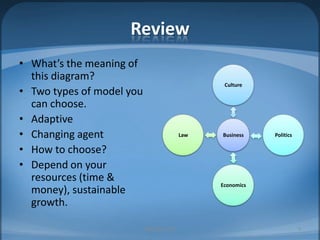
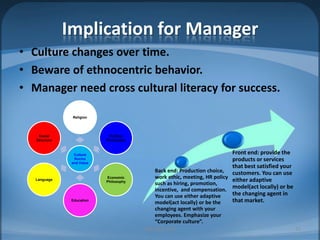
ReviewWhat’s the meaning of this diagram?Two types of model you can choose.AdaptiveChanging agentHow to choose?Depend on your resources (time & money), sustainable growth.MIB, BBA 20109
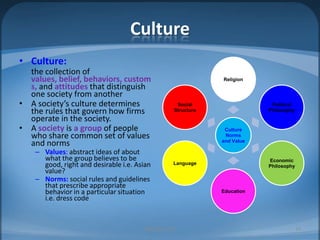
CultureCulture: 	the collection of values, belief, behaviors, customs, and attitudesthat distinguish one society from anotherA society’s culture determines the rules that govern how firms operate in the society.A societyis a group of people who share common set of values and normsValues: abstract ideas of about what the group believes to be good, right and desirable i.e. Asian value?Norms: social rules and guidelines that prescribe appropriate behavior in a particular situation i.e. dress codeMIB, BBA 201010
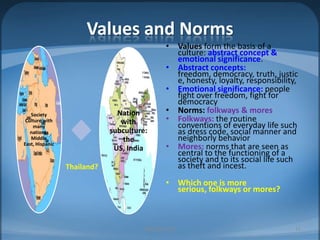
Values and NormsValues form the basis of a culture: abstract concept & emotional significance.Abstract concepts: freedom, democracy, truth, justice, honesty, loyalty, responsibility, Emotional significance: people fight over freedom, fight for democracyNorms: folkways & moresFolkways: the routine conventions of everyday life such as dress code, social manner and neighborly behaviorMores: norms that are seen as central to the functioning of a society and to its social life such as theft and incest.Which one is more serious, folkways or mores?MIB, BBA 201011Thailand?
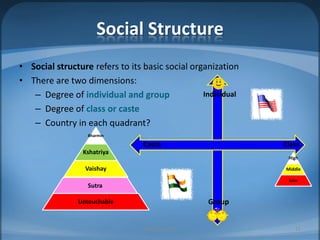
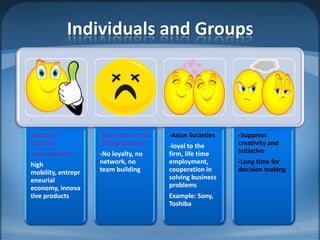
Social StructureSocial structure refers to its basic social organizationThere are two dimensions:Degree of individualandgroupDegree of class or casteCountry in each quadrant?MIB, BBA 201012IndividualClassCasteGroup
Individuals and GroupsMIB, BBA 201013
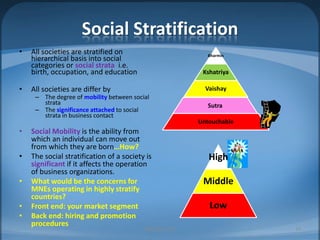
Social StratificationAll societies are stratified on hierarchical basis into social categories or social stratai.e. birth, occupation, and educationAll societies are differ byThe degree of mobility between social strataThe significanceattached to social strata in business contactSocial Mobilityis the ability from which an individual can move out from which they are born…How?The social stratification of a society is significant if it affects the operation of business organizations.What would be the concerns for MNEs operating in highly stratify countries?Front end: your market segmentBack end: hiring and promotion proceduresMIB, BBA 201014
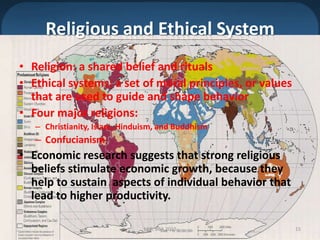
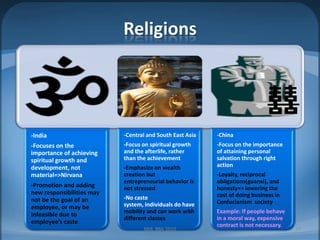
Religious and Ethical SystemReligion: a shared belief and ritualsEthical systems: a set of moral principles, or values that are used to guide and shape behaviorFour major religions: Christianity, Islam, Hinduism, and BuddhismConfucianismEconomic research suggests that strong religious beliefs stimulate economic growth, because they help to sustain  aspects of individual behavior that lead to higher productivity.MIB, BBA 201015
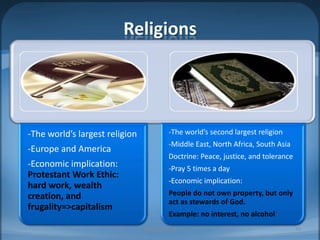
ReligionsMIB, BBA 201016
ReligionsMIB, BBA 201017
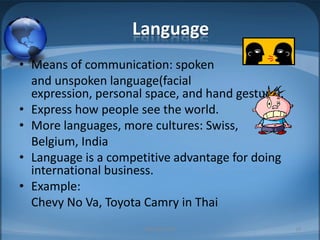
LanguageMeans of communication: spoken 	and unspoken language(facial expression, personal space, and hand gesture).Express how people see the world.More languages, more cultures: Swiss, 	Belgium, IndiaLanguage is a competitive advantage for doing international business.Example: 	Chevy No Va, Toyota Camry in ThaiMIB, BBA 201018
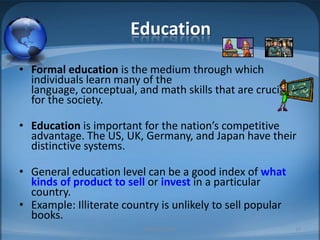
EducationFormal education is the medium through which individuals learn many of the language, conceptual, and math skills that are crucial for the society.Education is important for the nation’s competitive advantage. The US, UK, Germany, and Japan have their distinctive systems.General education level can be a good index of what kinds of product to sell or invest in a particular country. Example: Illiterate country is unlikely to sell popular books.MIB, BBA 201019
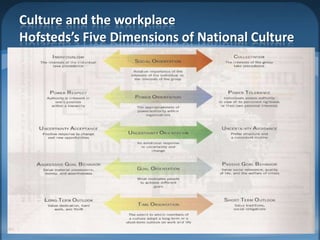
Culture and the workplaceHofsteds’sFive Dimensions of National CultureMIB, BBA 201020
Research and our resultCollectivism: relationship over task, learn how to do things not learn how to learnTransition state: lecture vs. activities, Power tolerance: need resourceful democrat teacher, but also Power respect: Parental teacher: tell you what to do in every situationUncertainty avoidance: like structure and objective, teacher must know all, dislike rules(uncertainty acceptance because you’re still young)Passive goal: use intuition, emphasize on life qualityLong term: but no goal???MIB, BBA 201021
Implication for ManagerCulture changes over time.Beware of ethnocentric behavior.Manager need cross cultural literacy for success.MIB, BBA 201022
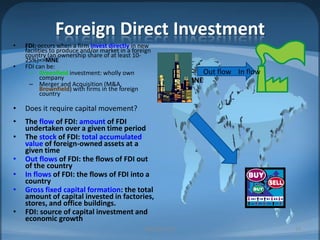
Foreign Direct InvestmentFDI: occurs when a firminvest directly in new facilities to produce and/or market in a foreign country (an ownership share of at least 10-25%)=>MNEFDI can be:Greenfieldinvestment: wholly own companyMerger and Acquisition (M&A, Brownfield) with firms in the foreign countryDoes it require capital movement?The flow of FDI: amount of FDI undertaken over a given time periodThe stock of FDI: total accumulatedvalue of foreign-owned assets at a given timeOut flows of FDI: the flows of FDI out of the country In flows of FDI: the flows of FDI into a countryGross fixed capital formation: the total amount of capital invested in factories, stores, and office buildings.FDI: source of capital investment and economic growthMNEMIB, BBA 201023Out flowIn flow
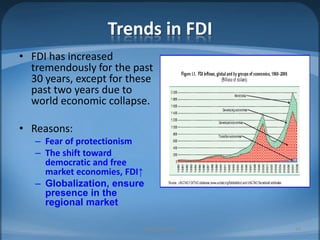
Trends in FDIFDI has increased tremendously for the past 30 years, except for these past two years due to world economic collapse.Reasons:Fear of protectionismThe shift toward democratic and free market economies, FDI↑Globalization, ensure presence in the regional marketMIB, BBA 201024
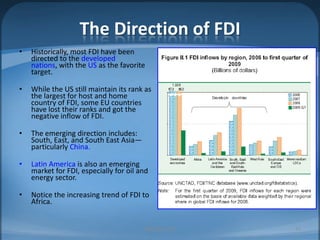
The Direction of FDIHistorically, most FDI have been directed to the developed nations, with the US as the favorite target. While the US still maintain its rank as the largest for host and home country of FDI, some EU countries have lost their ranks and got the negative inflow of FDI.The emerging direction includes: South, East, and South East Asia—particularly China.Latin America is also an emerging market for FDI, especially for oil and energy sector.Notice the increasing trend of FDI to Africa.MIB, BBA 201025
The Forms of FDI Acquisition vs. Greenfield InvestmentsMost cross border investment are in the form of M&Arather than GreenfieldinvestmentFirms prefer to acquire existing asset because:M&A are quicker to execute than Greenfield investmentsM&A are easier and less risky than to build from the ground upFirms believe that they can increase the efficiency of an acquired unit by transferring capital, technology or management skillsMIB, BBA 201026
The Shift to ServicesFDI is shifting away from extractive industries and manufacturing, and towards services.The shift to service is driven by:General move in developed nations toward servicesThe fact that many services need to be produced where they are consumedi.e. Starbucks, cementA liberalization of policies governing FDI in services i.e. banking, insuranceThe rise of Internet-based global telecommunication networksMIB, BBA 201027
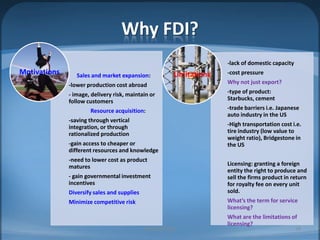
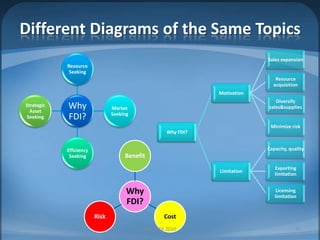
Why FDI?MIB, BBA 201028
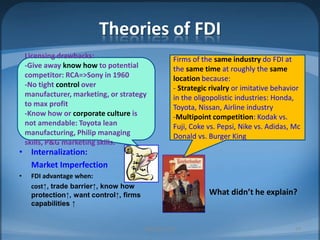
Theories of FDIInternalization:	Market ImperfectionFDI advantage when:	cost↑, trade barrier↑, know how protection↑, want control↑, firms capabilities ↑What didn’t he explain?MIB, BBA 201029Firms of the same industry do FDI at the same time at roughly the same location because: - Strategic rivalry or imitative behavior in the oligopolistic industries: Honda, Toyota, Nissan, Airline industry-Multipoint competition: Kodak vs. Fuji, Coke vs. Pepsi, Nike vs. Adidas, Mc Donald vs. Burger KingLicensing drawbacks:-Give away know how to potential competitor: RCA=>Sony in 1960-No tight control over manufacturer, marketing, or strategy to max profit-Know how or corporate culture is not amendable: Toyota lean manufacturing, Philip managing skills, P&G marketing skills.
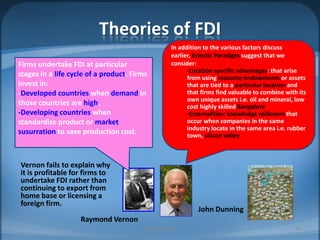
Theories of FDIMIB, BBA 201030In addition to the various factors discuss earlier, Eclectic Paradigm suggest that we consider:-Location specific advantages: that arise from using resource endowments or assets that are tied to a particular location and that firms find valuable to combine with its own unique assets i.e. oil and mineral, low cost highly skilled Bangalore-Externalities: knowledge spillovers that occur when companies in the same industry locate in the same area i.e. rubber town, silicon valleyFirms undertake FDI at particular stages in a life cycle of a product. Firms invest in:-Developed countries when demand in those countries are high.-Developing countries when standardize product or market susurration to save production cost.Vernon fails to explain why it is profitable for firms to undertake FDI rather than continuing to export from home base or licensing a foreign firm.John DunningRaymond Vernon
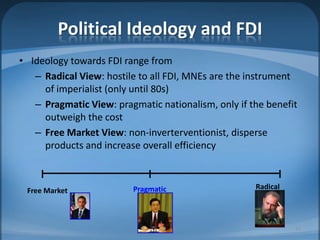
Political Ideology and FDIIdeology towards FDI range fromRadical View: hostile to all FDI, MNEs are the instrument of imperialist (only until 80s)Pragmatic View: pragmatic nationalism, only if the benefit outweigh the costFree Market View: non-inverterventionist, disperse products and increase overall efficiencyMIB, BBA 201031RadicalPragmaticFree Market
Benefits and Costs of FDI for Host CountryBenefitResource transfer effect: capital, technology, management resourceEmployment effect: bring jobsBalance of payment effect: receive from other countries, FDI can help achieve a current account surplusEffect on competition and economic growth: more green field investment~moresuppliers~competition~price	consumer welfare ↑Increase competition:productivity↑,innovation↑, economy↑CostPossible adverse effect on competition (MNE might do better due to larger support)Adverse effect on the BOPs:repatriate earnings to the parent country, MNE still import parts from abroadLoss of national sovereignty and autonomy: no commitment from MNE, host country government has no real controlMIB, BBA 201032
Benefits and Costs of FDI for Home CountryBenefitPositive effect on BOP: from the repatriate moneyEmployment effect: Toyota supplier in Japan, Thai companies still order the machines for operating from abroadGain from learning new skills that can transfer back to the home countryCostInitial capital outflow to finance FDIJob loss: Serve home market from the low cost labor, FDI is a substitute for direct exportMIB, BBA 201033
International Trade Theory and FDIInternational trade theory suggested that the home country concern about the negative economic effects of offshore production may not be valid because of the following reasons: Free up resource in the home country to concentrate on comparative advantageConsumers benefit if the price of the products falls as a result of offshore productionNot worth losing market share to international competitorTherefore, the long run economic effect of FDI, outweigh the minor BOP and employment effects. MIB, BBA 201034
Government Policy on FDI for Home CountryEncouraging Outward FDIGovernment backed insurance to cover major types of foreign investment risk, special loan, tax incentive, eliminate double tax, encourage host country to open market: US, JapanRestrictingOutward FDIMost countries limit capital outflows, manipulate tax rules, or outright prohibitFDI (Cuba, Iran)MIB, BBA 201035
Government Policy on FDI for Host CountryEncouraging Inward FDIOffer incentive to foreign firms such as tax concessions, low interest loan, grants or subsidies, improve infrastructure and educationWhy should we encourage inward FDI?Restricting Inward FDIGovernment can use ownership restraint and performance requirement To protect national security and competition:Sweden excludes foreign ownership in tobacco and mining industry, US government rejected DP United Arab Emirates, Malaysia protects its infant auto businessMax the benefit of resource transfer and employment: Japan during the 80s allowed JV with valuable technology onlyMIB, BBA 201036
Implications for Manager Decision factors to undertake FDISupply factors=>CostProduction costs: better location, tax rate, laborLogistics: transportation costResource availability: oil, gas, tuna etc.Access to key technology: faster than developing by itself i.e. Swiss PharmaceuticalDemand factors=>BenefitSales expansion: market size, market growthCustomer access: require presence i.e. fast food chainMarketing advantageExploiting competitive advantage: brand, trade mark, technologyCustomer mobility: to continue to supply the customer i.e. Japanese auto supplierPolitical Factors=>RiskAvoidance of trade barriers i.e. FujiEconomic development incentive, BOI, Chinese governmentShare the risk: not depend only on home country marketMIB, BBA 201037
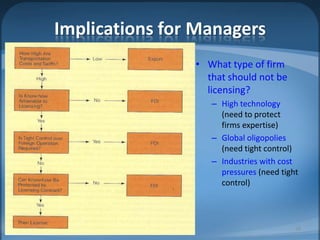
Implications for ManagersWhat type of firm that should not be licensing?High technology (need to protect firms expertise)Global oligopolies (need tight control)Industries with costpressures (need tight control)MIB, BBA 201038
Mind Map & HomeworkSummarize this lecture through your mind map.Any question for Friday homework?MIB, BBA 201039
Different Diagrams of the Same TopicsMIB, BBA 201040
WK2.3 AgendaDiscussion: news? CCTV?ChinaMind map all elements? How can we have all elements? Do we need all elements?Facebook, PPT, notebookThe good, the bad, and the ugly mind maps.FDI Decision HomeworkBusiness?Criteria?Options?Result of option score?BOI target countries:Africa: Nigeria, MoroccoMiddle East: Iran, Qatar, Dubai, Oman, JordanSouth Asia: India, PakistanLatin America: Brazil, Chile, CaribbeanNeighboring countries: Lao, Cambodia, Myanmar, Vietnam, ChinaBusiness:	Construction, Energy, Petrochemical, Food, Automotive parts, Textile, Shoes, Tourism and servicesMIB, BBA 201041
FDI Decision HomeworkThe order of creating criteria vs. options, will lead you to different result or different path of doing business. It doesn’t mean that you won’t be success. You’ll have to use different strategy.Creating the criteria first will lead you to try to find all of your options. Creating options first, will make you think of how to compare them.If you have more than 6 criteria, you should not use this method because you might end up having very little importance(weight) to all those criteria.MIB, BBA 201042

WK2 Cultural Differences and FDI

  • 1.
    WK2 AgendaHot topic:News?FacebookCompanion websitesNo class last week of JulyMIB Student surveyIndia vs. ChinaReading DiscoveryNonverbal CommunicationFDIMini FDI Decision Homework1MIB, BBA 2010
  • 2.
    India vs. ChinaBBCvideo clips, Fed ArticleWhat is the focus of each country?Why China and India walk different path?What kind of business that you will prefer India over China?Apply the concepts you’ve learned to compare China and India for the overall attractiveness of the country.What other information would be helpful for your reasoning? Where can you get it?BBA, MIB 20102
  • 3.
    Reading DiscoveryRead thefollowing articles.What’s the main theme of those stories?Why is it important?How do we learn other cultures?What are the determinants of culture?Fill up this table.3MIB, BBA 2010
  • 4.
    Nonverbal CommunicationNeed twovolunteers.Act from the following list of body language.Ask your classmates: What does it mean?MIB, BBA 20104
  • 5.
    Foreign Direct InvestmentWatchthe video clips from PBSHanes brand relocates to Vietnam, Thailand, and ChinaFDI in EthiopiaWhat makes Vietnam and Ethiopia attractive for FDI?What are the issues in these stories?What can the companies do to help improve the situation?What are the advantages and disadvantages of FDI?MIB, BBA 20105
  • 6.
    Homework for FridayIna group of 4-5, select a particular business.Your goal is to decide on the best country for your business.Create a list of criteria (4-6).Weight each criteria against each other.Create the country options(3-4) and compare all options according to each criteria.Compare each option based on all criteria combined. Compare the option score.Detail instruction example is in the sheet provided.Where can you get the data for this exercise?MIB, BBA 20106
  • 7.
    WK2.2 AgendaHot topics:World Cup? This time for?Review: Monday discoveryExchange students FDI interviewing exerciseLectureMind mapHomework MIB, BBA 20107
  • 8.
    Exchange students interview(FDIanalogy)In a group of 4-5, interview your friends from abroad(anywhere outside Ubon)Reasons for coming here. How long have they studied here? Did they start from high-school?What are the advantages and disadvantages of both sides(local students and exchange students)? What did you gain? What did you loose?Any investment? Expense?How can we encourage more exchange students to come here?How can we decrease the number of exchange students to come here?MIB, BBA 20108
  • 9.
    ReviewWhat’s the meaningof this diagram?Two types of model you can choose.AdaptiveChanging agentHow to choose?Depend on your resources (time & money), sustainable growth.MIB, BBA 20109
  • 10.
    CultureCulture: the collectionof values, belief, behaviors, customs, and attitudesthat distinguish one society from anotherA society’s culture determines the rules that govern how firms operate in the society.A societyis a group of people who share common set of values and normsValues: abstract ideas of about what the group believes to be good, right and desirable i.e. Asian value?Norms: social rules and guidelines that prescribe appropriate behavior in a particular situation i.e. dress codeMIB, BBA 201010
  • 11.
    Values and NormsValuesform the basis of a culture: abstract concept & emotional significance.Abstract concepts: freedom, democracy, truth, justice, honesty, loyalty, responsibility, Emotional significance: people fight over freedom, fight for democracyNorms: folkways & moresFolkways: the routine conventions of everyday life such as dress code, social manner and neighborly behaviorMores: norms that are seen as central to the functioning of a society and to its social life such as theft and incest.Which one is more serious, folkways or mores?MIB, BBA 201011Thailand?
  • 12.
    Social StructureSocial structurerefers to its basic social organizationThere are two dimensions:Degree of individualandgroupDegree of class or casteCountry in each quadrant?MIB, BBA 201012IndividualClassCasteGroup
  • 13.
  • 14.
    Social StratificationAll societiesare stratified on hierarchical basis into social categories or social stratai.e. birth, occupation, and educationAll societies are differ byThe degree of mobility between social strataThe significanceattached to social strata in business contactSocial Mobilityis the ability from which an individual can move out from which they are born…How?The social stratification of a society is significant if it affects the operation of business organizations.What would be the concerns for MNEs operating in highly stratify countries?Front end: your market segmentBack end: hiring and promotion proceduresMIB, BBA 201014
  • 15.
    Religious and EthicalSystemReligion: a shared belief and ritualsEthical systems: a set of moral principles, or values that are used to guide and shape behaviorFour major religions: Christianity, Islam, Hinduism, and BuddhismConfucianismEconomic research suggests that strong religious beliefs stimulate economic growth, because they help to sustain aspects of individual behavior that lead to higher productivity.MIB, BBA 201015
  • 16.
  • 17.
  • 18.
    LanguageMeans of communication:spoken and unspoken language(facial expression, personal space, and hand gesture).Express how people see the world.More languages, more cultures: Swiss, Belgium, IndiaLanguage is a competitive advantage for doing international business.Example: Chevy No Va, Toyota Camry in ThaiMIB, BBA 201018
  • 19.
    EducationFormal education isthe medium through which individuals learn many of the language, conceptual, and math skills that are crucial for the society.Education is important for the nation’s competitive advantage. The US, UK, Germany, and Japan have their distinctive systems.General education level can be a good index of what kinds of product to sell or invest in a particular country. Example: Illiterate country is unlikely to sell popular books.MIB, BBA 201019
  • 20.
    Culture and theworkplaceHofsteds’sFive Dimensions of National CultureMIB, BBA 201020
  • 21.
    Research and ourresultCollectivism: relationship over task, learn how to do things not learn how to learnTransition state: lecture vs. activities, Power tolerance: need resourceful democrat teacher, but also Power respect: Parental teacher: tell you what to do in every situationUncertainty avoidance: like structure and objective, teacher must know all, dislike rules(uncertainty acceptance because you’re still young)Passive goal: use intuition, emphasize on life qualityLong term: but no goal???MIB, BBA 201021
  • 22.
    Implication for ManagerCulturechanges over time.Beware of ethnocentric behavior.Manager need cross cultural literacy for success.MIB, BBA 201022
  • 23.
    Foreign Direct InvestmentFDI:occurs when a firminvest directly in new facilities to produce and/or market in a foreign country (an ownership share of at least 10-25%)=>MNEFDI can be:Greenfieldinvestment: wholly own companyMerger and Acquisition (M&A, Brownfield) with firms in the foreign countryDoes it require capital movement?The flow of FDI: amount of FDI undertaken over a given time periodThe stock of FDI: total accumulatedvalue of foreign-owned assets at a given timeOut flows of FDI: the flows of FDI out of the country In flows of FDI: the flows of FDI into a countryGross fixed capital formation: the total amount of capital invested in factories, stores, and office buildings.FDI: source of capital investment and economic growthMNEMIB, BBA 201023Out flowIn flow
  • 24.
    Trends in FDIFDIhas increased tremendously for the past 30 years, except for these past two years due to world economic collapse.Reasons:Fear of protectionismThe shift toward democratic and free market economies, FDI↑Globalization, ensure presence in the regional marketMIB, BBA 201024
  • 25.
    The Direction ofFDIHistorically, most FDI have been directed to the developed nations, with the US as the favorite target. While the US still maintain its rank as the largest for host and home country of FDI, some EU countries have lost their ranks and got the negative inflow of FDI.The emerging direction includes: South, East, and South East Asia—particularly China.Latin America is also an emerging market for FDI, especially for oil and energy sector.Notice the increasing trend of FDI to Africa.MIB, BBA 201025
  • 26.
    The Forms ofFDI Acquisition vs. Greenfield InvestmentsMost cross border investment are in the form of M&Arather than GreenfieldinvestmentFirms prefer to acquire existing asset because:M&A are quicker to execute than Greenfield investmentsM&A are easier and less risky than to build from the ground upFirms believe that they can increase the efficiency of an acquired unit by transferring capital, technology or management skillsMIB, BBA 201026
  • 27.
    The Shift toServicesFDI is shifting away from extractive industries and manufacturing, and towards services.The shift to service is driven by:General move in developed nations toward servicesThe fact that many services need to be produced where they are consumedi.e. Starbucks, cementA liberalization of policies governing FDI in services i.e. banking, insuranceThe rise of Internet-based global telecommunication networksMIB, BBA 201027
  • 28.
  • 29.
    Theories of FDIInternalization: MarketImperfectionFDI advantage when: cost↑, trade barrier↑, know how protection↑, want control↑, firms capabilities ↑What didn’t he explain?MIB, BBA 201029Firms of the same industry do FDI at the same time at roughly the same location because: - Strategic rivalry or imitative behavior in the oligopolistic industries: Honda, Toyota, Nissan, Airline industry-Multipoint competition: Kodak vs. Fuji, Coke vs. Pepsi, Nike vs. Adidas, Mc Donald vs. Burger KingLicensing drawbacks:-Give away know how to potential competitor: RCA=>Sony in 1960-No tight control over manufacturer, marketing, or strategy to max profit-Know how or corporate culture is not amendable: Toyota lean manufacturing, Philip managing skills, P&G marketing skills.
  • 30.
    Theories of FDIMIB,BBA 201030In addition to the various factors discuss earlier, Eclectic Paradigm suggest that we consider:-Location specific advantages: that arise from using resource endowments or assets that are tied to a particular location and that firms find valuable to combine with its own unique assets i.e. oil and mineral, low cost highly skilled Bangalore-Externalities: knowledge spillovers that occur when companies in the same industry locate in the same area i.e. rubber town, silicon valleyFirms undertake FDI at particular stages in a life cycle of a product. Firms invest in:-Developed countries when demand in those countries are high.-Developing countries when standardize product or market susurration to save production cost.Vernon fails to explain why it is profitable for firms to undertake FDI rather than continuing to export from home base or licensing a foreign firm.John DunningRaymond Vernon
  • 31.
    Political Ideology andFDIIdeology towards FDI range fromRadical View: hostile to all FDI, MNEs are the instrument of imperialist (only until 80s)Pragmatic View: pragmatic nationalism, only if the benefit outweigh the costFree Market View: non-inverterventionist, disperse products and increase overall efficiencyMIB, BBA 201031RadicalPragmaticFree Market
  • 32.
    Benefits and Costsof FDI for Host CountryBenefitResource transfer effect: capital, technology, management resourceEmployment effect: bring jobsBalance of payment effect: receive from other countries, FDI can help achieve a current account surplusEffect on competition and economic growth: more green field investment~moresuppliers~competition~price consumer welfare ↑Increase competition:productivity↑,innovation↑, economy↑CostPossible adverse effect on competition (MNE might do better due to larger support)Adverse effect on the BOPs:repatriate earnings to the parent country, MNE still import parts from abroadLoss of national sovereignty and autonomy: no commitment from MNE, host country government has no real controlMIB, BBA 201032
  • 33.
    Benefits and Costsof FDI for Home CountryBenefitPositive effect on BOP: from the repatriate moneyEmployment effect: Toyota supplier in Japan, Thai companies still order the machines for operating from abroadGain from learning new skills that can transfer back to the home countryCostInitial capital outflow to finance FDIJob loss: Serve home market from the low cost labor, FDI is a substitute for direct exportMIB, BBA 201033
  • 34.
    International Trade Theoryand FDIInternational trade theory suggested that the home country concern about the negative economic effects of offshore production may not be valid because of the following reasons: Free up resource in the home country to concentrate on comparative advantageConsumers benefit if the price of the products falls as a result of offshore productionNot worth losing market share to international competitorTherefore, the long run economic effect of FDI, outweigh the minor BOP and employment effects. MIB, BBA 201034
  • 35.
    Government Policy onFDI for Home CountryEncouraging Outward FDIGovernment backed insurance to cover major types of foreign investment risk, special loan, tax incentive, eliminate double tax, encourage host country to open market: US, JapanRestrictingOutward FDIMost countries limit capital outflows, manipulate tax rules, or outright prohibitFDI (Cuba, Iran)MIB, BBA 201035
  • 36.
    Government Policy onFDI for Host CountryEncouraging Inward FDIOffer incentive to foreign firms such as tax concessions, low interest loan, grants or subsidies, improve infrastructure and educationWhy should we encourage inward FDI?Restricting Inward FDIGovernment can use ownership restraint and performance requirement To protect national security and competition:Sweden excludes foreign ownership in tobacco and mining industry, US government rejected DP United Arab Emirates, Malaysia protects its infant auto businessMax the benefit of resource transfer and employment: Japan during the 80s allowed JV with valuable technology onlyMIB, BBA 201036
  • 37.
    Implications for ManagerDecision factors to undertake FDISupply factors=>CostProduction costs: better location, tax rate, laborLogistics: transportation costResource availability: oil, gas, tuna etc.Access to key technology: faster than developing by itself i.e. Swiss PharmaceuticalDemand factors=>BenefitSales expansion: market size, market growthCustomer access: require presence i.e. fast food chainMarketing advantageExploiting competitive advantage: brand, trade mark, technologyCustomer mobility: to continue to supply the customer i.e. Japanese auto supplierPolitical Factors=>RiskAvoidance of trade barriers i.e. FujiEconomic development incentive, BOI, Chinese governmentShare the risk: not depend only on home country marketMIB, BBA 201037
  • 38.
    Implications for ManagersWhattype of firm that should not be licensing?High technology (need to protect firms expertise)Global oligopolies (need tight control)Industries with costpressures (need tight control)MIB, BBA 201038
  • 39.
    Mind Map &HomeworkSummarize this lecture through your mind map.Any question for Friday homework?MIB, BBA 201039
  • 40.
    Different Diagrams ofthe Same TopicsMIB, BBA 201040
  • 41.
    WK2.3 AgendaDiscussion: news?CCTV?ChinaMind map all elements? How can we have all elements? Do we need all elements?Facebook, PPT, notebookThe good, the bad, and the ugly mind maps.FDI Decision HomeworkBusiness?Criteria?Options?Result of option score?BOI target countries:Africa: Nigeria, MoroccoMiddle East: Iran, Qatar, Dubai, Oman, JordanSouth Asia: India, PakistanLatin America: Brazil, Chile, CaribbeanNeighboring countries: Lao, Cambodia, Myanmar, Vietnam, ChinaBusiness: Construction, Energy, Petrochemical, Food, Automotive parts, Textile, Shoes, Tourism and servicesMIB, BBA 201041
  • 42.
    FDI Decision HomeworkTheorder of creating criteria vs. options, will lead you to different result or different path of doing business. It doesn’t mean that you won’t be success. You’ll have to use different strategy.Creating the criteria first will lead you to try to find all of your options. Creating options first, will make you think of how to compare them.If you have more than 6 criteria, you should not use this method because you might end up having very little importance(weight) to all those criteria.MIB, BBA 201042