Submitted by:
Soumyodeep Karmakar
Department: Computer Science Engineering (CSE)
Roll No: 09182001011
Year: 4th year, 7th Semester
College Name: Institute of Science & Technology
Wireless USB Overview
Reasons for Wireless USB
Advantages
Vision
Features
Security Design
Problems/Issues
Implementations
Future Scope
Concluding Thoughts
References
Based on Ultra-Wideband
(UWB) RF technology
USB is a technology for
transmitting data over a
large bandwidth (>500 MHz)
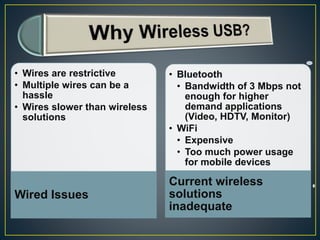
• Wires are restrictive
• Multiple wires can be a
hassle
• Wires slower than wireless
solutions
Wired Issues
• Bluetooth
• Bandwidth of 3 Mbps not
enough for higher
demand applications
(Video, HDTV, Monitor)
• WiFi
• Expensive
• Too much power usage
for mobile devices
Current wireless
solutions
inadequate
Wireless version of USB; same features but high speeds
Interoperable across three major platforms
• Consumer Electronic devices (digital video/audio)
• Mobile devices (cellular phones, PDA)
• Personal Computing (laptop, PC, printer, peripherals)
High bandwidth to support demanding data transfer (High Definition,
Monitors)
Mobile friendly
• Low power usage
• Inexpensive costs
• Small physical implementation
High level of security
Speed/Range
• Currently 480 Mbps at 3 m; 110 Mbps at 10 m
Frequency: 3.1
GHz to 10.6
GHz
• Divided into 14 bands; 5 groups
• Each band is 528 MHz wide
• OFDM symbols are interleaved across all bands
• Provides protection against multi-
path/interference
Same level of
security as
wired USB
Wireless
interconnect
is easy to
install and
use
Wired
connections
provide the
user with
implied
expectations
Two major
components:
Association
and
Encryption
Interference Issues
• Potential conflict to
devices on same
frequencies
• Switches to
frequencies not
being used
• Conflict issues are
more when
overpowered
Competing
Standards
• Cable-Free USB
• USB-Implementers
Forum (Intel, HP,
Microsoft)
Belkin Cable
Free Hub
• Released Dec, 2006
• Dongle attaches to PC
• Retail price of $199.00
• Speeds up to 480
Mbps
GeFen HMDI
Extender
• Based on WiMedia Alliance
specification
• Retail price of $699.00
• Range of 20 meters
• data rates up to 480 Mbps
• Frequency band: 3.1 - 4.8 GHz
• Resolution support : 480i, 480p,
720p, and 1080i
Seagate
Wireless USB
Hard Drive
• Coming soon…
• 2.5 inches wide
• Speeds up to 480
Mbps
Early
2007
Initial devices
being produced
Late
2007
Expect wUSB
being built into
laptops, PCs,
multimedia
devices
2008
Visiongain
research firm
predicts
increase of
wUSB by 400
percent
2009-
2010
Wide scale
interoperability?
Appears well
designed; good
support
Slow start of
products
Promises a lot; Will it
deliver?
Security is very
important
• Will it really catch on?
• More products need
to be developed
Web Sites:
• www.wikipedia.com
• www.google.com
• www.usb.com
Newspapers:
• The Telegraph
• Times of India
Wireless USB
Wireless USB

Wireless USB

  • 1.
    Submitted by: Soumyodeep Karmakar Department:Computer Science Engineering (CSE) Roll No: 09182001011 Year: 4th year, 7th Semester College Name: Institute of Science & Technology
  • 2.
    Wireless USB Overview Reasonsfor Wireless USB Advantages Vision Features Security Design Problems/Issues Implementations Future Scope Concluding Thoughts References
  • 3.
    Based on Ultra-Wideband (UWB)RF technology USB is a technology for transmitting data over a large bandwidth (>500 MHz)
  • 4.
    • Wires arerestrictive • Multiple wires can be a hassle • Wires slower than wireless solutions Wired Issues • Bluetooth • Bandwidth of 3 Mbps not enough for higher demand applications (Video, HDTV, Monitor) • WiFi • Expensive • Too much power usage for mobile devices Current wireless solutions inadequate
  • 5.
    Wireless version ofUSB; same features but high speeds Interoperable across three major platforms • Consumer Electronic devices (digital video/audio) • Mobile devices (cellular phones, PDA) • Personal Computing (laptop, PC, printer, peripherals) High bandwidth to support demanding data transfer (High Definition, Monitors) Mobile friendly • Low power usage • Inexpensive costs • Small physical implementation High level of security
  • 7.
    Speed/Range • Currently 480Mbps at 3 m; 110 Mbps at 10 m Frequency: 3.1 GHz to 10.6 GHz • Divided into 14 bands; 5 groups • Each band is 528 MHz wide • OFDM symbols are interleaved across all bands • Provides protection against multi- path/interference
  • 8.
    Same level of securityas wired USB Wireless interconnect is easy to install and use Wired connections provide the user with implied expectations Two major components: Association and Encryption
  • 9.
    Interference Issues • Potentialconflict to devices on same frequencies • Switches to frequencies not being used • Conflict issues are more when overpowered Competing Standards • Cable-Free USB • USB-Implementers Forum (Intel, HP, Microsoft)
  • 10.
    Belkin Cable Free Hub •Released Dec, 2006 • Dongle attaches to PC • Retail price of $199.00 • Speeds up to 480 Mbps
  • 11.
    GeFen HMDI Extender • Basedon WiMedia Alliance specification • Retail price of $699.00 • Range of 20 meters • data rates up to 480 Mbps • Frequency band: 3.1 - 4.8 GHz • Resolution support : 480i, 480p, 720p, and 1080i
  • 12.
    Seagate Wireless USB Hard Drive •Coming soon… • 2.5 inches wide • Speeds up to 480 Mbps
  • 13.
    Early 2007 Initial devices being produced Late 2007 ExpectwUSB being built into laptops, PCs, multimedia devices 2008 Visiongain research firm predicts increase of wUSB by 400 percent 2009- 2010 Wide scale interoperability?
  • 14.
    Appears well designed; good support Slowstart of products Promises a lot; Will it deliver? Security is very important • Will it really catch on? • More products need to be developed
  • 15.
    Web Sites: • www.wikipedia.com •www.google.com • www.usb.com Newspapers: • The Telegraph • Times of India