LI-FI TECHNOLOGY
BY
SRICHARAN RAVI
AJITH KUMAR RAVI
CONTENTS
• PREFACE
• LI-FI WHAT AND WHY ?
• HISTORY OF LI-FI
• WORKING TECHNOLOGY
• THE ABODE FOR INTERNET
• SECURITY
• WIRELESS TECHNOLOGIES
• COMPARISON BETWEEN LI-FI
& WI-FI
• GAINS
• LOSES
• APPLICATIONS
• CONCLUSIONS
• CREDITS AND SOURCE
PREFACE
This presentation is delivered to you for improving the
knowledge about LI-FI technology which is going to
produce a revolution in the network world .we would
like to convey our gratitude to our Principal, Head of
Dept., our beloved staffs(Comp.Engg.) ,all our
friends and parents for encouraging us.
LI-FI WHAT AND WHY?
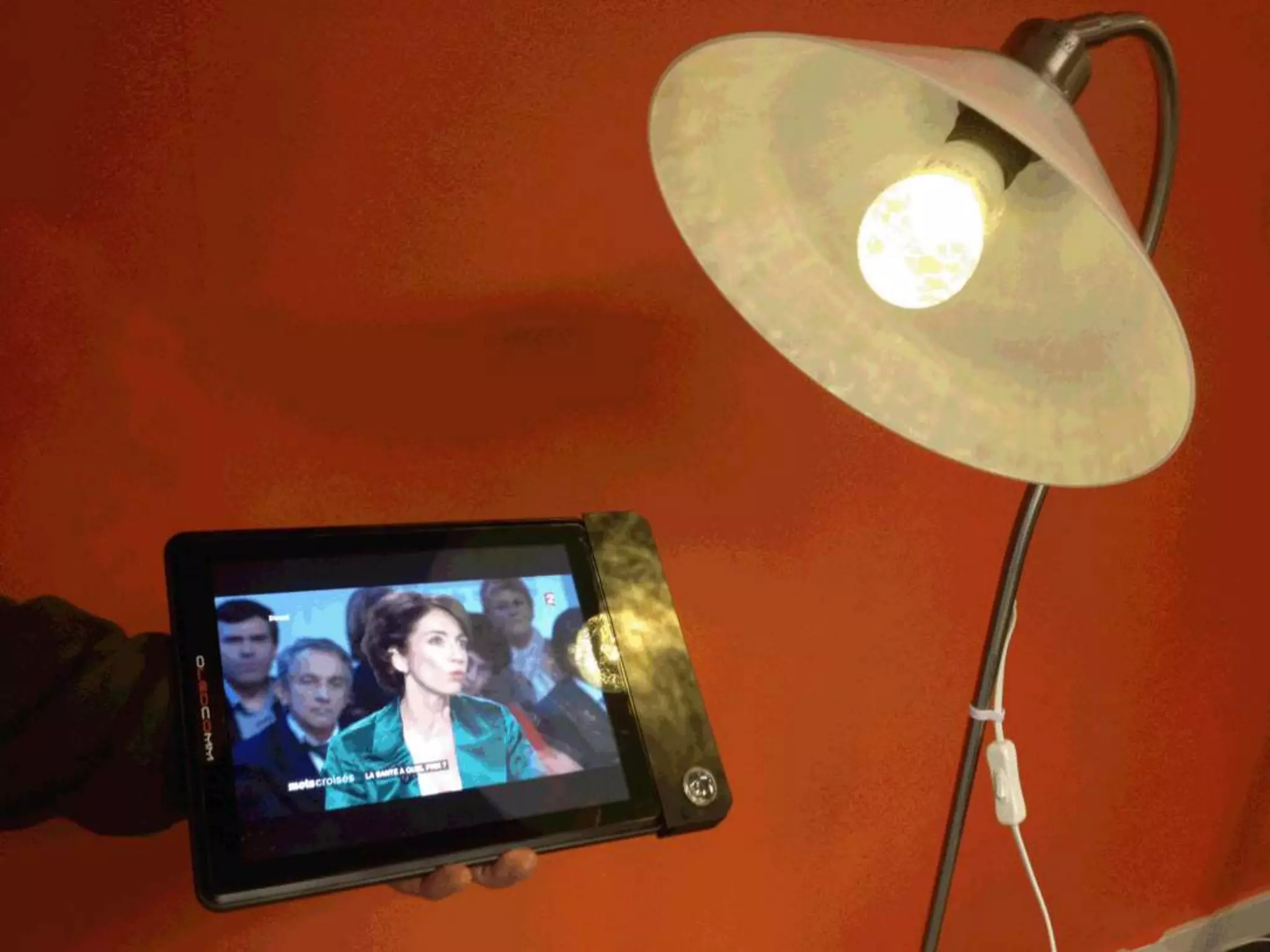
• LI-FI, or "light fidelity", refers to wireless communication systems.
• LI-FI is expected to be ten times cheaper than Wi-Fi.
• It is used in electromagnetic sensitive areas.
• The system relies on light to send and receive data wirelessly.
• LI-FI is ten times faster than Wi-Fi.
Harald Haas of University of Edinburgh-Founder of LI-FI
HISTORY
• The founder of LI-FI was Harald Haas of University of Edinburgh.
• They set up a company named Visible Light Communication(VLC) to explore the
technologies using light in 2011.
• LI-FI promises to be cheaper and more energy-efficient than existing wireless
radio systems.
• The bandwidth of Visible light is 10,000 times bigger than the radio frequency.
• Prof. Haas Harald quotes that evenly spaced LED transmitters could provide
consistent internet connectivity.
THE ABODE FOR INTERNET
• LI-FI technology transmits data wirelessly at high speeds with the use of light
emitting diodes.
• With the invention of new LI-FI technology, we will soon find light bulbs of a car,
light lamps in our rooms, lights in subway, flashlight of our mobiles and any other
light source are providing internet access at very high speed.
SECURITY
• Secure data transmission is a critical and increasingly challenging issue.
• Today’s wireless technology uses common radio waves to carry sensitive and
private data from one source to another.
• Radio waves easily transmit through solid objects such as walls, leaving wireless
data vulnerable to collection by unauthorized entities.
• Light transmission does not penetrate solid objects and can be contained within a
given area, adding an additional layer of security and protection.
WIRELESS TECHNOLOGIES
Wireless(current) Speed Density
• Wi-Fi – IEEE 802.11n 150 Mbps *
• Bluetooth 3 Mbps **
• IrDA 4 Mbps ***
Wireless(future)
• WiGig 2 Gbps **
• Giga-IR 1 Gbps ***
• LI-FI <10Gbps ****
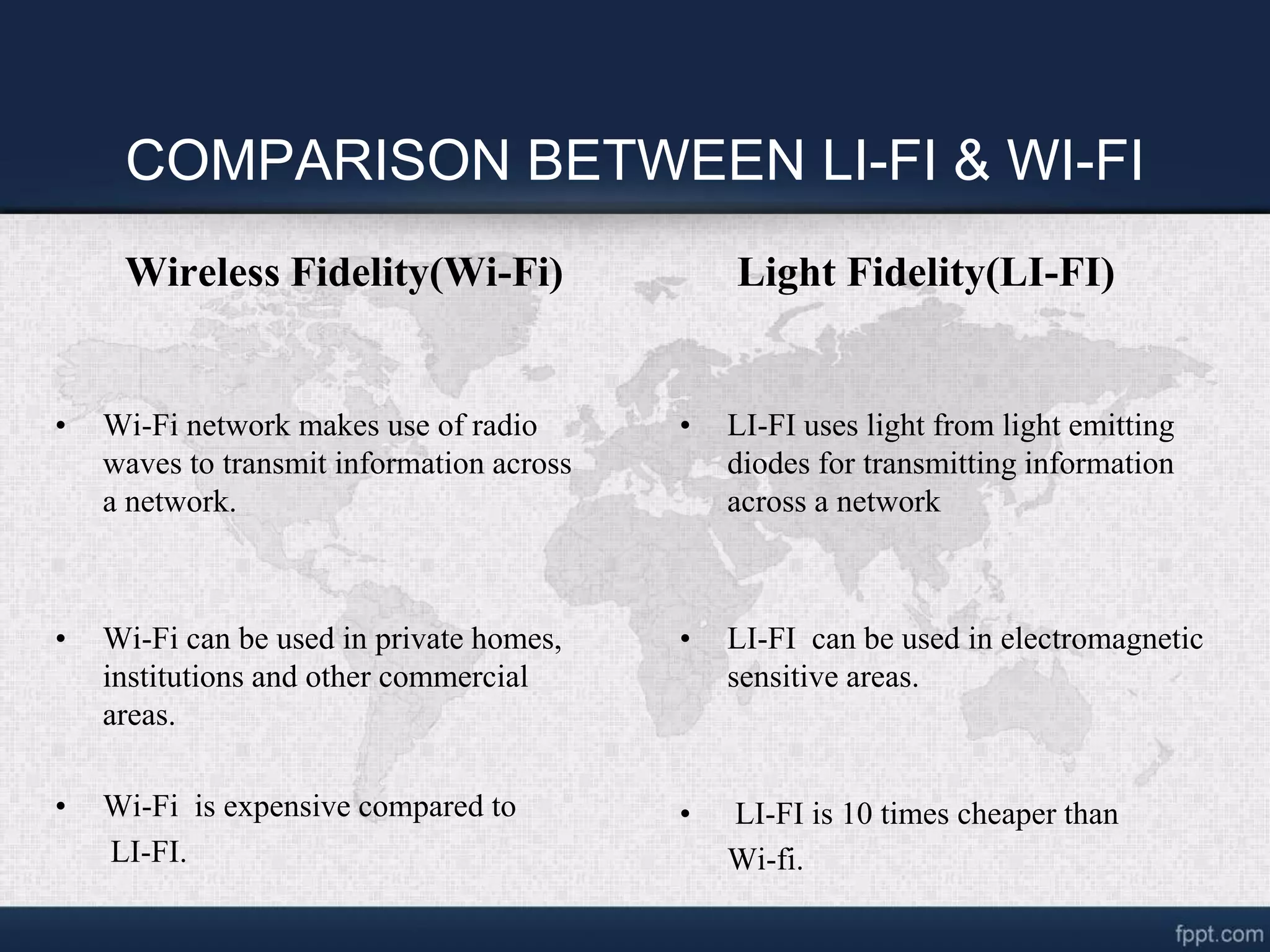
COMPARISON BETWEEN LI-FI & WI-FI
Wireless Fidelity(Wi-Fi)
• Wi-Fi network makes use of radio
waves to transmit information across
a network.
• Wi-Fi can be used in private homes,
institutions and other commercial
areas.
• Wi-Fi is expensive compared to
LI-FI.
Light Fidelity(LI-FI)
• LI-FI uses light from light emitting
diodes for transmitting information
across a network
• LI-FI can be used in electromagnetic
sensitive areas.
• LI-FI is 10 times cheaper than
Wi-fi.
APPLICATIONS
SMARTER POWER PLANTS
• Wi-Fi and many other radiation types are bad for sensitive areas.
• Power plants need fast, inter-connected data systems to monitor.
• LI-FI could offer safe, abundant connectivity for all areas of these sensitive
locations.
GAINS
• Best advantage of LI-FI Technology will be accessing internet at high speed in
those areas where optical fires are not easy to install.
• LI-FI technology can also be used to extend wireless networks at your home, office
or university.
• LI-FI Technology can also be used to control traffic conditions by placing this new
technology into the LEDs of cars.
• LI-FI can be used in electromagnetic sensitive areas such as in aircraft or nuclear
power plants, without causing interference.
CHALLENGES
• LI-FI technology is requires a prefect line-of-sight to transmit data.
• Other major challenge which probably could be faced by this new
LI-FI technology is, how optimally data can be transferred back to the transmitter.
• LI-FI cannot penetrate through solid objects .
• This provides data security . But apart from this this also proves as a difficulty for
data transmission.
COMMON USES
• Can be used in the places where it is difficult to lay the optical fiber like
hospitals. Used in operation theatres
• In traffic signals LI-FI can be used which will communicate with the LED
lights of the cars and accident numbers can be decreased.
• Thousand and millions of street lamps can be transferred to LI-FI lamps to
transfer data.
• Can be used for data transmission in aircrafts.
CONCLUSION
• If this technology can be put into practical use, every bulb can be used something
like a Wi-Fi hotspot to transmit wireless data.
• We will proceed towards a cleaner, greener, safer and brighter future.
• This allow internet where traditional radio based wireless isn’t allowed such as
aircraft or hospitals.
CREDITS & SOURCE
• The Principal (Mr.V.Dattatreya) Sriram Polytechnic College
• HOD Computer Engg. department Mr.Suresh.A.
• All the Staffs of Computer Engg. Department.
SOURCE:
• www.wikipedia.com
• www.google.com
• www.googleimages.com
• www.bbc.com
ANY QUERIES

Li-Fi (Light - Fedility) Technology New Version 2017

  • 1.
  • 2.
    CONTENTS • PREFACE • LI-FIWHAT AND WHY ? • HISTORY OF LI-FI • WORKING TECHNOLOGY • THE ABODE FOR INTERNET • SECURITY • WIRELESS TECHNOLOGIES • COMPARISON BETWEEN LI-FI & WI-FI • GAINS • LOSES • APPLICATIONS • CONCLUSIONS • CREDITS AND SOURCE
  • 3.
    PREFACE This presentation isdelivered to you for improving the knowledge about LI-FI technology which is going to produce a revolution in the network world .we would like to convey our gratitude to our Principal, Head of Dept., our beloved staffs(Comp.Engg.) ,all our friends and parents for encouraging us.
  • 4.
    LI-FI WHAT ANDWHY? • LI-FI, or "light fidelity", refers to wireless communication systems. • LI-FI is expected to be ten times cheaper than Wi-Fi. • It is used in electromagnetic sensitive areas. • The system relies on light to send and receive data wirelessly. • LI-FI is ten times faster than Wi-Fi.
  • 6.
    Harald Haas ofUniversity of Edinburgh-Founder of LI-FI
  • 7.
    HISTORY • The founderof LI-FI was Harald Haas of University of Edinburgh. • They set up a company named Visible Light Communication(VLC) to explore the technologies using light in 2011. • LI-FI promises to be cheaper and more energy-efficient than existing wireless radio systems. • The bandwidth of Visible light is 10,000 times bigger than the radio frequency. • Prof. Haas Harald quotes that evenly spaced LED transmitters could provide consistent internet connectivity.
  • 10.
    THE ABODE FORINTERNET • LI-FI technology transmits data wirelessly at high speeds with the use of light emitting diodes. • With the invention of new LI-FI technology, we will soon find light bulbs of a car, light lamps in our rooms, lights in subway, flashlight of our mobiles and any other light source are providing internet access at very high speed.
  • 11.
    SECURITY • Secure datatransmission is a critical and increasingly challenging issue. • Today’s wireless technology uses common radio waves to carry sensitive and private data from one source to another. • Radio waves easily transmit through solid objects such as walls, leaving wireless data vulnerable to collection by unauthorized entities. • Light transmission does not penetrate solid objects and can be contained within a given area, adding an additional layer of security and protection.
  • 13.
    WIRELESS TECHNOLOGIES Wireless(current) SpeedDensity • Wi-Fi – IEEE 802.11n 150 Mbps * • Bluetooth 3 Mbps ** • IrDA 4 Mbps *** Wireless(future) • WiGig 2 Gbps ** • Giga-IR 1 Gbps *** • LI-FI <10Gbps ****
  • 14.
    COMPARISON BETWEEN LI-FI& WI-FI Wireless Fidelity(Wi-Fi) • Wi-Fi network makes use of radio waves to transmit information across a network. • Wi-Fi can be used in private homes, institutions and other commercial areas. • Wi-Fi is expensive compared to LI-FI. Light Fidelity(LI-FI) • LI-FI uses light from light emitting diodes for transmitting information across a network • LI-FI can be used in electromagnetic sensitive areas. • LI-FI is 10 times cheaper than Wi-fi.
  • 15.
    APPLICATIONS SMARTER POWER PLANTS •Wi-Fi and many other radiation types are bad for sensitive areas. • Power plants need fast, inter-connected data systems to monitor. • LI-FI could offer safe, abundant connectivity for all areas of these sensitive locations.
  • 16.
    GAINS • Best advantageof LI-FI Technology will be accessing internet at high speed in those areas where optical fires are not easy to install. • LI-FI technology can also be used to extend wireless networks at your home, office or university. • LI-FI Technology can also be used to control traffic conditions by placing this new technology into the LEDs of cars. • LI-FI can be used in electromagnetic sensitive areas such as in aircraft or nuclear power plants, without causing interference.
  • 17.
    CHALLENGES • LI-FI technologyis requires a prefect line-of-sight to transmit data. • Other major challenge which probably could be faced by this new LI-FI technology is, how optimally data can be transferred back to the transmitter. • LI-FI cannot penetrate through solid objects . • This provides data security . But apart from this this also proves as a difficulty for data transmission.
  • 18.
    COMMON USES • Canbe used in the places where it is difficult to lay the optical fiber like hospitals. Used in operation theatres • In traffic signals LI-FI can be used which will communicate with the LED lights of the cars and accident numbers can be decreased. • Thousand and millions of street lamps can be transferred to LI-FI lamps to transfer data. • Can be used for data transmission in aircrafts.
  • 19.
    CONCLUSION • If thistechnology can be put into practical use, every bulb can be used something like a Wi-Fi hotspot to transmit wireless data. • We will proceed towards a cleaner, greener, safer and brighter future. • This allow internet where traditional radio based wireless isn’t allowed such as aircraft or hospitals.
  • 20.
    CREDITS & SOURCE •The Principal (Mr.V.Dattatreya) Sriram Polytechnic College • HOD Computer Engg. department Mr.Suresh.A. • All the Staffs of Computer Engg. Department. SOURCE: • www.wikipedia.com • www.google.com • www.googleimages.com • www.bbc.com
  • 22.