Wireless Payment System
Tang Ha Anh Duy
CS2014
Instructor : Dr.Philip
Outline
• Introduction
• Wireless payment systems and underlying technology
1. Mobile Web Payment system (WAP)
2. SMS/USSD Payment System
3. Contactless Payment System (NFC)
• Practical Issues
• Conclusion
Introduction
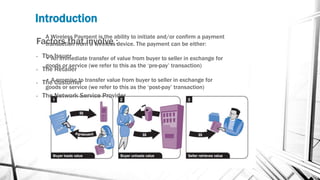
A Wireless Payment is the ability to initiate and/or confirm a payment
transaction from a wireless device. The payment can be either:
• An immediate transfer of value from buyer to seller in exchange for
goods or service (we refer to this as the ‘pre-pay’ transaction)
• A promise to transfer value from buyer to seller in exchange for
goods or service (we refer to this as the ‘post-pay’ transaction)
Factors that involve :
- The Issuer
- The Retailer
- The Customer
- The Network Service Provider
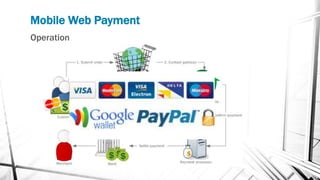
Mobile Web Payment
Operation
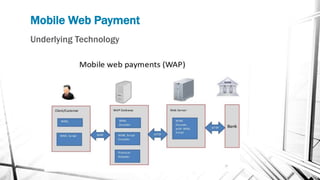
Mobile Web Payment
Underlying Technology
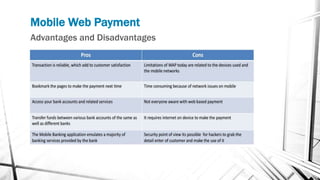
Mobile Web Payment
Advantages and Disadvantages
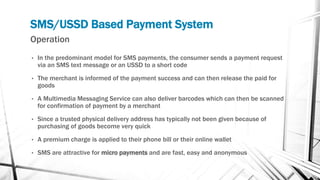
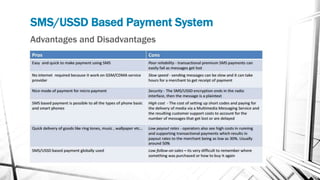
SMS/USSD Based Payment System
• In the predominant model for SMS payments, the consumer sends a payment request
via an SMS text message or an USSD to a short code
• The merchant is informed of the payment success and can then release the paid for
goods
• A Multimedia Messaging Service can also deliver barcodes which can then be scanned
for confirmation of payment by a merchant
• Since a trusted physical delivery address has typically not been given because of
purchasing of goods become very quick
• A premium charge is applied to their phone bill or their online wallet
• SMS are attractive for micro payments and are fast, easy and anonymous
Operation
SMS/USSD Based Payment System
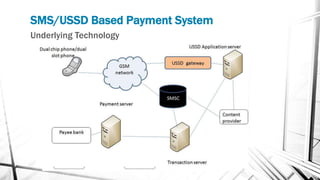
Underlying Technology
SMS/USSD Based Payment System
Advantages and Disadvantages
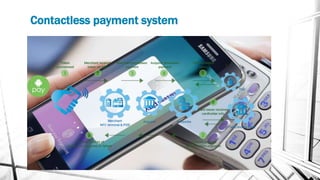
Contactless payment system
• Contactless payment uses a short range wireless system called
Near Field Communications (NFC) or radio-frequency identification (RFID)
for making secure payments.
• Debit and credit chip cards are fitted with an antenna that enable them to
communicate with devices at a radius of up to five centimeters.
• Contactless payments are made in close physical proximity, unlike mobile
payments which use broad-area cellular or Wifi networks and do not involve
close physical proximity.
• It is used for small amount transaction. For example, if spending more than
20$ , buyer has to input PIN numbers.
Contactless payment system
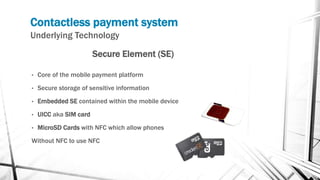
• Core of the mobile payment platform
• Secure storage of sensitive information
• Embedded SE contained within the mobile device
• UICC aka SIM card
• MicroSD Cards with NFC which allow phones
Without NFC to use NFC
Underlying Technology
Secure Element (SE)
Contactless payment system
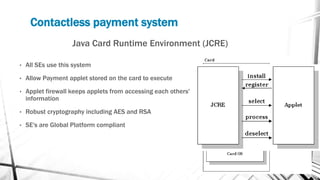
• All SEs use this system
• Allow Payment applet stored on the card to execute
• Applet firewall keeps applets from accessing each others'
information
• Robust cryptography including AES and RSA
• SE's are Global Platform compliant
Java Card Runtime Environment (JCRE)
Contactless payment system
Proximity Payment System Environment (PPSE)
• Registry of all payment apps in the SE
• App names and standard Application Identifier
• Tells the payment terminal what apps are available
• Allows terminal to select which app it wants to use
Contactless payment system
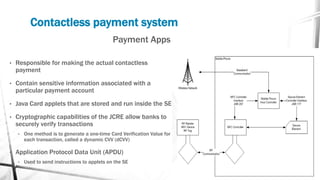
Payment Apps
• Responsible for making the actual contactless
payment
• Contain sensitive information associated with a
particular payment account
• Java Card applets that are stored and run inside the SE
• Cryptographic capabilities of the JCRE allow banks to
securely verify transactions
• One method is to generate a one-time Card Verification Value for
each transaction, called a dynamic CVV (dCVV)
• Application Protocol Data Unit (APDU)
• Used to send instructions to applets on the SE
Contactless payment system
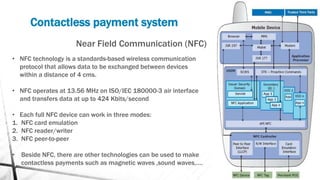
Near Field Communication (NFC)
• NFC technology is a standards-based wireless communication
protocol that allows data to be exchanged between devices
within a distance of 4 cms.
• NFC operates at 13.56 MHz on ISO/IEC 180000-3 air interface
and transfers data at up to 424 Kbits/second
• Each full NFC device can work in three modes:
1. NFC card emulation
2. NFC reader/writer
3. NFC peer-to-peer
• Beside NFC, there are other technologies can be used to make
contactless payments such as magnetic waves ,sound waves,….
Contactless payment system
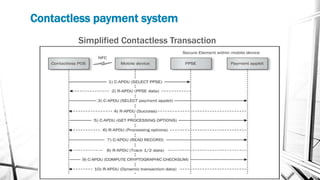
Simplified Contactless Transaction
Contactless payment system
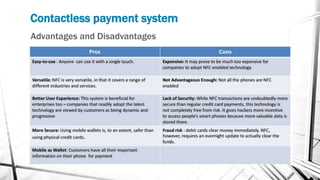
Advantages and Disadvantages
Practical Issues
Challenges
• Hardware Incompatibility
• Cost
• Device Failure
• Not so many accepts retailer
accept wireless payments
• Cybercrime
Opportunities
• Business owners love it because it speeds up transaction times, cuts down
on queues and reduces sales lost with people deciding they’re ‘too busy to
wait.
• Businesses won’t be exposed to any greater risk of fraud as contactless
cards use the same high level technology that’s behind chip and PIN.
• According to Financial Fraud Action UK, the total amount of UK fraud
reported from contactless cards in 2012 was £13,700. To put this into
context, £216million of fraud was reported on debit and credit cards in the
UK
• Mr .Hasan Akis, of Tarves Food and Wine in south east London said that
“We went contactless about six months ago and we wouldn’t be without it
now .Being able to take payments this way has benefited our business
dramatically with payments of £20 or less taking less than a second. ”
• Increase Sales with Business on Go, Track customer trends and develop
customer loyalty program.
Practical Issues
Future Development
• It’s not just about cards, there are a range of future developments using the same technology
to facilitate payment transactions , including contactless enabled smartphones, wrist bands
and watches all supporting e-wallets containing a customer’s virtual card.
• The £20 transaction limit is also being reviewed and the industry is developing contactless
‘higher value payments’ which will enable payments of more than £20 to be made.
• Further anti-fraud measures will go hand in hand with such developments to safeguard the
integrity of contactless.
Conclusion
• Mobile web payment is suitable for online shopping , convenient checking out
wherever in Wifi or Cellular Network range.
• SMS payment is convenient for small transactions especially digital goods without
Wifi network.
• Contactless payment helps to cut down waiting time , fasten up check out process for
in - store payments.
• Wireless payment system has opened an new era of payment – No Wallet , No
Problem.

Wireless Payment System

  • 1.
    Wireless Payment System TangHa Anh Duy CS2014 Instructor : Dr.Philip
  • 2.
    Outline • Introduction • Wirelesspayment systems and underlying technology 1. Mobile Web Payment system (WAP) 2. SMS/USSD Payment System 3. Contactless Payment System (NFC) • Practical Issues • Conclusion
  • 3.
    Introduction A Wireless Paymentis the ability to initiate and/or confirm a payment transaction from a wireless device. The payment can be either: • An immediate transfer of value from buyer to seller in exchange for goods or service (we refer to this as the ‘pre-pay’ transaction) • A promise to transfer value from buyer to seller in exchange for goods or service (we refer to this as the ‘post-pay’ transaction) Factors that involve : - The Issuer - The Retailer - The Customer - The Network Service Provider
  • 4.
  • 5.
  • 6.
  • 7.
    SMS/USSD Based PaymentSystem • In the predominant model for SMS payments, the consumer sends a payment request via an SMS text message or an USSD to a short code • The merchant is informed of the payment success and can then release the paid for goods • A Multimedia Messaging Service can also deliver barcodes which can then be scanned for confirmation of payment by a merchant • Since a trusted physical delivery address has typically not been given because of purchasing of goods become very quick • A premium charge is applied to their phone bill or their online wallet • SMS are attractive for micro payments and are fast, easy and anonymous Operation
  • 8.
    SMS/USSD Based PaymentSystem Underlying Technology
  • 9.
    SMS/USSD Based PaymentSystem Advantages and Disadvantages
  • 10.
    Contactless payment system •Contactless payment uses a short range wireless system called Near Field Communications (NFC) or radio-frequency identification (RFID) for making secure payments. • Debit and credit chip cards are fitted with an antenna that enable them to communicate with devices at a radius of up to five centimeters. • Contactless payments are made in close physical proximity, unlike mobile payments which use broad-area cellular or Wifi networks and do not involve close physical proximity. • It is used for small amount transaction. For example, if spending more than 20$ , buyer has to input PIN numbers.
  • 11.
    Contactless payment system •Core of the mobile payment platform • Secure storage of sensitive information • Embedded SE contained within the mobile device • UICC aka SIM card • MicroSD Cards with NFC which allow phones Without NFC to use NFC Underlying Technology Secure Element (SE)
  • 12.
    Contactless payment system •All SEs use this system • Allow Payment applet stored on the card to execute • Applet firewall keeps applets from accessing each others' information • Robust cryptography including AES and RSA • SE's are Global Platform compliant Java Card Runtime Environment (JCRE)
  • 13.
    Contactless payment system ProximityPayment System Environment (PPSE) • Registry of all payment apps in the SE • App names and standard Application Identifier • Tells the payment terminal what apps are available • Allows terminal to select which app it wants to use
  • 14.
    Contactless payment system PaymentApps • Responsible for making the actual contactless payment • Contain sensitive information associated with a particular payment account • Java Card applets that are stored and run inside the SE • Cryptographic capabilities of the JCRE allow banks to securely verify transactions • One method is to generate a one-time Card Verification Value for each transaction, called a dynamic CVV (dCVV) • Application Protocol Data Unit (APDU) • Used to send instructions to applets on the SE
  • 15.
    Contactless payment system NearField Communication (NFC) • NFC technology is a standards-based wireless communication protocol that allows data to be exchanged between devices within a distance of 4 cms. • NFC operates at 13.56 MHz on ISO/IEC 180000-3 air interface and transfers data at up to 424 Kbits/second • Each full NFC device can work in three modes: 1. NFC card emulation 2. NFC reader/writer 3. NFC peer-to-peer • Beside NFC, there are other technologies can be used to make contactless payments such as magnetic waves ,sound waves,….
  • 16.
  • 17.
  • 18.
    Practical Issues Challenges • HardwareIncompatibility • Cost • Device Failure • Not so many accepts retailer accept wireless payments • Cybercrime Opportunities • Business owners love it because it speeds up transaction times, cuts down on queues and reduces sales lost with people deciding they’re ‘too busy to wait. • Businesses won’t be exposed to any greater risk of fraud as contactless cards use the same high level technology that’s behind chip and PIN. • According to Financial Fraud Action UK, the total amount of UK fraud reported from contactless cards in 2012 was £13,700. To put this into context, £216million of fraud was reported on debit and credit cards in the UK • Mr .Hasan Akis, of Tarves Food and Wine in south east London said that “We went contactless about six months ago and we wouldn’t be without it now .Being able to take payments this way has benefited our business dramatically with payments of £20 or less taking less than a second. ” • Increase Sales with Business on Go, Track customer trends and develop customer loyalty program.
  • 19.
    Practical Issues Future Development •It’s not just about cards, there are a range of future developments using the same technology to facilitate payment transactions , including contactless enabled smartphones, wrist bands and watches all supporting e-wallets containing a customer’s virtual card. • The £20 transaction limit is also being reviewed and the industry is developing contactless ‘higher value payments’ which will enable payments of more than £20 to be made. • Further anti-fraud measures will go hand in hand with such developments to safeguard the integrity of contactless.
  • 20.
    Conclusion • Mobile webpayment is suitable for online shopping , convenient checking out wherever in Wifi or Cellular Network range. • SMS payment is convenient for small transactions especially digital goods without Wifi network. • Contactless payment helps to cut down waiting time , fasten up check out process for in - store payments. • Wireless payment system has opened an new era of payment – No Wallet , No Problem.