By
Sai Shunmuga

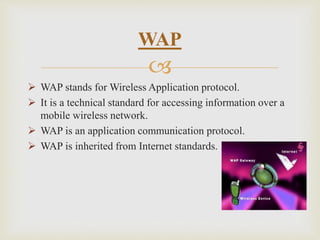
 WAP stands for Wireless Application protocol.
 It is a technical standard for accessing information over a
mobile wireless network.
 WAP is an application communication protocol.
 WAP is inherited from Internet standards.
WAP

To enable easy, fast delivery of relevant information
and services to mobile users.
Type of devices that use WAP
Handheld digital wireless devices such as mobile
phones, pagers, two-way radios, smart phones and
communicators -- from low-end to high-end.
Purpose of WAP

• WAP is independent of OS that means WAP can
be implemented on any OS.
• It can be built on any operating system including
Palm OS, EPOC 32, Windows CE, FLEXOS,
OS/9, Java OS, etc. It provides service
interoperability even between different device
families.
Operating systems that are compatible
with WAP

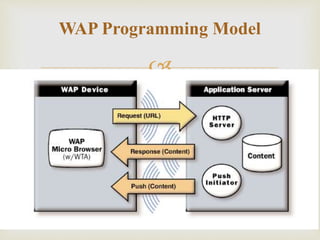
WAP Programming Model

WAP Optional Proxy Model

• open standard, vendor independent
• network-standard independent
• transport mechanism–optimized for wireless
data bearers
• application downloaded from the server,
enabling fast service creation and introduction,
as opposed to embedded software
ADVANTAGES

• Small screens
• Speed of access
• Limited or fragmented availability
• Price
• Lack of user habit
DISADVANTAGES of WAP

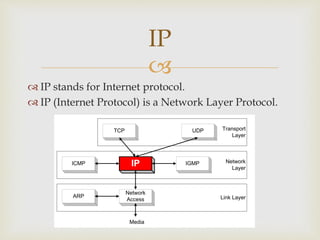
 IP stands for Internet protocol.
 IP (Internet Protocol) is a Network Layer Protocol.
IP
Network
Layer
Link Layer
IP
ARP
Network
Access
Media
ICMP IGMP
Transport
Layer
TCP UDP

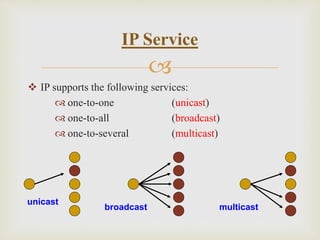
 IP supports the following services:
 one-to-one (unicast)
 one-to-all (broadcast)
 one-to-several (multicast)
IP Service
unicast
broadcast multicast

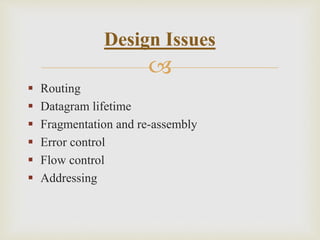
 Routing
 Datagram lifetime
 Fragmentation and re-assembly
 Error control
 Flow control
 Addressing
Design Issues

Internet protocol Wireless Application
protocol
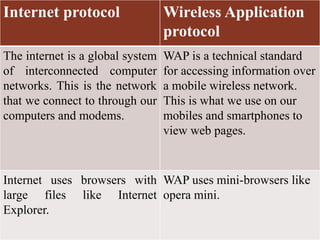
The internet is a global system
of interconnected computer
networks. This is the network
that we connect to through our
computers and modems.
WAP is a technical standard
for accessing information over
a mobile wireless network.
This is what we use on our
mobiles and smartphones to
view web pages.
Internet uses browsers with
large files like Internet
Explorer.
WAP uses mini-browsers like
opera mini.

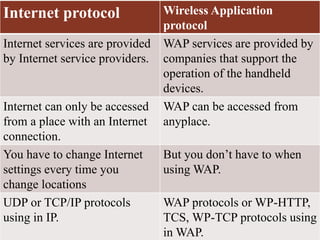
Internet protocol Wireless Application
protocol
Internet services are provided
by Internet service providers.
WAP services are provided by
companies that support the
operation of the handheld
devices.
Internet can only be accessed
from a place with an Internet
connection.
WAP can be accessed from
anyplace.
You have to change Internet
settings every time you
change locations
But you don’t have to when
using WAP.
UDP or TCP/IP protocols
using in IP.
WAP protocols or WP-HTTP,
TCS, WP-TCP protocols using
in WAP.


Wireless Application protocol VS Internet Protocol (WAP VS IP)

  • 1.
  • 2.
      WAP standsfor Wireless Application protocol.  It is a technical standard for accessing information over a mobile wireless network.  WAP is an application communication protocol.  WAP is inherited from Internet standards. WAP
  • 3.
     To enable easy,fast delivery of relevant information and services to mobile users. Type of devices that use WAP Handheld digital wireless devices such as mobile phones, pagers, two-way radios, smart phones and communicators -- from low-end to high-end. Purpose of WAP
  • 4.
     • WAP isindependent of OS that means WAP can be implemented on any OS. • It can be built on any operating system including Palm OS, EPOC 32, Windows CE, FLEXOS, OS/9, Java OS, etc. It provides service interoperability even between different device families. Operating systems that are compatible with WAP
  • 5.
  • 6.
  • 7.
     • open standard,vendor independent • network-standard independent • transport mechanism–optimized for wireless data bearers • application downloaded from the server, enabling fast service creation and introduction, as opposed to embedded software ADVANTAGES
  • 8.
     • Small screens •Speed of access • Limited or fragmented availability • Price • Lack of user habit DISADVANTAGES of WAP
  • 9.
      IP standsfor Internet protocol.  IP (Internet Protocol) is a Network Layer Protocol. IP Network Layer Link Layer IP ARP Network Access Media ICMP IGMP Transport Layer TCP UDP
  • 10.
      IP supportsthe following services:  one-to-one (unicast)  one-to-all (broadcast)  one-to-several (multicast) IP Service unicast broadcast multicast
  • 11.
      Routing  Datagramlifetime  Fragmentation and re-assembly  Error control  Flow control  Addressing Design Issues
  • 12.
     Internet protocol WirelessApplication protocol The internet is a global system of interconnected computer networks. This is the network that we connect to through our computers and modems. WAP is a technical standard for accessing information over a mobile wireless network. This is what we use on our mobiles and smartphones to view web pages. Internet uses browsers with large files like Internet Explorer. WAP uses mini-browsers like opera mini.
  • 13.
     Internet protocol WirelessApplication protocol Internet services are provided by Internet service providers. WAP services are provided by companies that support the operation of the handheld devices. Internet can only be accessed from a place with an Internet connection. WAP can be accessed from anyplace. You have to change Internet settings every time you change locations But you don’t have to when using WAP. UDP or TCP/IP protocols using in IP. WAP protocols or WP-HTTP, TCS, WP-TCP protocols using in WAP.
  • 14.