CONVEYO
R BELT
Presented by
Fahima Nuri. A
B tech 3rd year
What is conveyor belt?
•
•
•
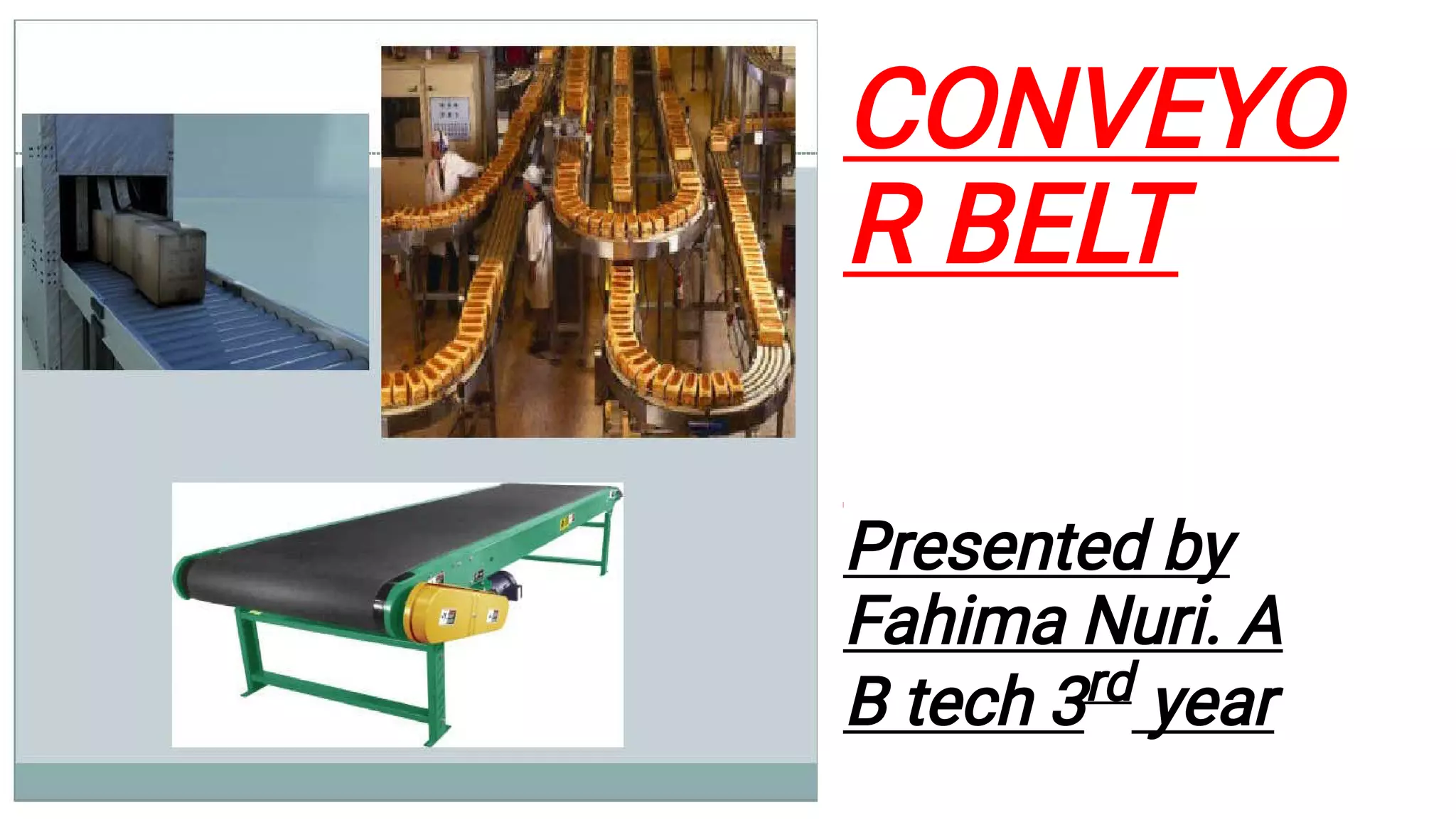
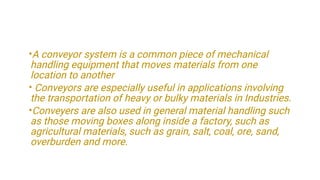
Belt conveyor is an endless belt operating between
two or more pulleys with its load supported on idlers.
A belt conveyor is rubber or textile structure with a
belt shape closed ring, with a vulcanized or metallic
joint, used for material transportation.
Belt conveyors are the most used for transport of
solid objects and bulk materials at great speed,
covering great distances (up to 30 km ) .
•
•
•
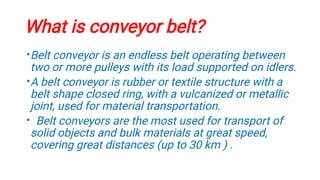
A conveyor system is a common piece of mechanical
handling equipment that moves materials from one
location to another
Conveyors are especially useful in applications involving
the transportation of heavy or bulky materials in Industries.
Conveyers are also used in general material handling such
as those moving boxes along inside a factory, such as
agricultural materials, such as grain, salt, coal, ore, sand,
overburden and more.
Classification
1.
2.
1.
According to design & application
General purpose conveyor
Special purpose conveyor
According to profile path
Horizontal type
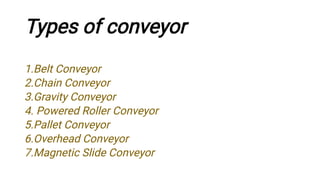
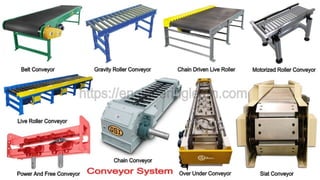
Types of conveyor
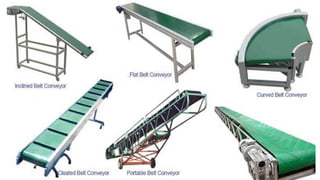
1.Belt Conveyor
2.Chain Conveyor
3.Gravity Conveyor
4. Powered Roller Conveyor
5.Pallet Conveyor
6.Overhead Conveyor
7.Magnetic Slide Conveyor
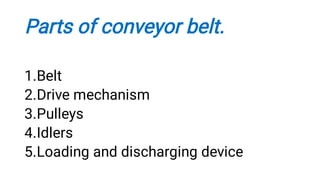
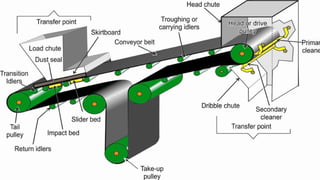
Parts of conveyor belt.
1.Belt
2.Drive mechanism
3.Pulleys
4.Idlers
5.Loading and discharging device
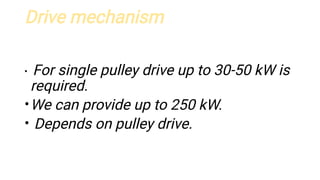
Drive mechanism
•
•
•
For single pulley drive up to 30-50 kW is
required.
We can provide up to 250 kW.
Depends on pulley drive.
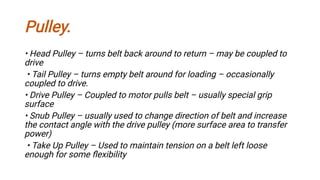
Pulley.
• Head Pulley – turns belt back around to return – may be coupled to
drive
• Tail Pulley – turns empty belt around for loading – occasionally
coupled to drive.
• Drive Pulley – Coupled to motor pulls belt – usually special grip
surface
• Snub Pulley – usually used to change direction of belt and increase
the contact angle with the drive pulley (more surface area to transfer
power)
• Take Up Pulley – Used to maintain tension on a belt left loose
enough for some flexibility
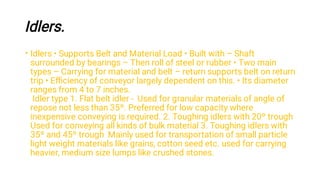
Idlers.
• Idlers • Supports Belt and Material Load • Built with – Shaft
surrounded by bearings – Then roll of steel or rubber • Two main
types – Carrying for material and belt – return supports belt on return
trip • Efficiency of conveyor largely dependent on this. • Its diameter
ranges from 4 to 7 inches.
Idler type 1. Flat belt idler - Used for granular materials of angle of
repose not less than 35º. Preferred for low capacity where
inexpensive conveying is required. 2. Toughing idlers with 20º trough
Used for conveying all kinds of bulk material 3. Toughing idlers with
35º and 45º trough Mainly used for transportation of small particle
light weight materials like grains, cotton seed etc. used for carrying
heavier, medium size lumps like crushed stones.
Working of belt
•
•
•
The Belt is provided with two rollers .
One is the Drive and other is the Tension
Roller.
Drive roller is driven mechanically by a
motor Tension roller can be moved forward
and backward directions to release or tight
the belt with our requirement.
•
•
•
•
•
High strength
Low relative elongation
High elasticity longitudinally and crosswise
Low hygroscopicity
High wear resistance Characteristics
Belt characteristics.
Belt Materials.
A.
•
•
Rubber
used for bulk material
Made up of carcass
B. Woven cloth
• Light weight material
C. Steel
• For metal industries
Belt material
Belts are typically made from cotton,
canvas, Kevlar, nitrile, nylon, polyester,
polyurethane/urethane, PVC, rubber,
silicone, steel cord, Teflon, wire mesh or
weave.
Design of belt
The Belt consists of one or more layers
of material.Generally contains two layers.
1.) An under layer-to provide linear
strength and shape called a
carcass(polyester, nylon and cotton)
2.) An over layer called the cover. (rubber
or plastic compounds)
Belt construction
1.
2.
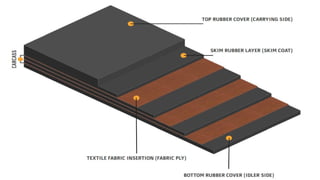
Conveyor belts generally are composed of three main
components:
1. Carcass
2. Skims
3. Covers
There are two types of belt available:
Rubber belt
Steel Cord
Carcass
•
1.
2.
3.
The reinforcement usually found on the inside of a conveyor belt is
normally referred to as the “carcass.”
In a sense, the carcass is in the conveyor belt since it must:
Provide the tensile strength necessary to move the loaded belt.
Absorb the impact of the impinging material being loaded
onto the conveyor belt.
Provide the bulk and lateral stiffness required for the load
support.
•
•
•
The most common carcass design is made up of layers or “plies” of woven
fabrics bonded together.
This “conventional plied” belt construction, generally employs a plain weave or
twill weave carcass which is built up into as many layers as is required to provide
the necessary belt strength…usually bound together with rubber.
Conventional plied belting constructions, employing all synthetic carcasses and
elastomer covers appropriate to the end use, are particularly recommended for:
I. Hard Rock Mining (A) Aggregate, sand and ore
II. General purpose applications
III. Forest products
IV. Soft Minerals (A) Coal (B) Potash, Phosphates (C) Grain
V. Unit Handling (A) Parcels (B) Baggage (C) Mail
•
•
•
•
•
The strength of fabric and the number of plies in the carcass of
the belt may be varied together to suit the strength requirement.
However if the belt is too tough, troughing of the belt and bending
it round the terminal pulleys will be very difficult.
Therefore the belt with lesser number of plies with stronger fabric
is generally preferred because it is more flexible.
Steel cord belting is used when good trough ability, small specific
elongation and higher operating tensile forces are required.
PVC belting is generally selected for underground mining
applications where fire hazard exists.
Skims
•
•
•
The rubber, PVC or urethane between plies is called a
“skim.”
Skims are important contributors to internal belt
adhesions, impact resistance, and play a significant
role in determining belt “load support” and
“troughability.”
Improper or marginal “skims” can adversely affect
belt performance in general and can lead to ply
separation and/or idler junction failure.
Covers
•
•
•
•
•
•
•
•
•
•
Covers are used in conveyor belt constructions in order to protect the base
conveyor belt carcass and, if possible, to extend its service life.
In addition, covers do provide the finished belt with a wide variety of desirable
properties, including the following:
A. Textures To increase friction To increase inclination To control product
B. Cleanability
C. A specific coefficient of friction
D. A specific color
E. Cut resistance
F. Enhanced impact resistance, etc.
G. Hardness
H. Fire Resistance, Oil & Chemical Resistance
•
•
•
•
•
In addition to selecting proper compounds for cover material, it is also
necessary to determine the proper cover thickness.
The thickness of a cover is influenced by the amount of abuse and wear
the belt will receive.
The cover is usually the lowest cost component of the belt. The severity of
the wear depends on the nature of the material and on the size, weight,
shape and trip rate of the Material conveyed.
Sharp edges, particularly on large pieces, can quickly cut a cover badly.
On the other hand, if loading conditions are ideal, with the material being
loaded in the direction of travel of the belt, and with only a slight impact
onto the belt, even very sharp material may not seriously cut or wear the
belt surface.
Fabric Construction for Conveyor Belt
There are four basic types of construction for
reinforcing
i. High strength belts- cord fabrics,
ii. Straight warp fabrics,
iii. Solid woven fabric and
iv. Cabled cords.
Cord fabrics
•
•
Filaments of Kevlar yarns have only 1.5
denier linear density.
The cord constructions use Kevlar yarns
as the strength member laid in warp
direction, usually with a light weft of nylon
or polyester to hold the cords together.
Straight warp fabrics
•In the preferred straight-warp the Kevlar warp cords are place by
a series of binder V (of nylon) and weft yarns. This ensures that
the straight-warp weave has minimum crimp and, hence,
obtains 90% of the strength of the fibres in warp direction.
Using a “stacked” or double warp construction the elongation
goes maximum 5%. Using straight-warp weaves; it is possible to
achieve breaking strength of up to 150 kN/m. This construction
offers the cost-saving benefits of a single ply plain woven fabric
and, also, provides high transverse impact and penetration
resistance, thus eliminating the need for breakers.
Solid woven construction
•
•
•
•
•
Kevlar fibres have disadvantage of being brittle, and they can be
damaged by lateral pressure and friction.
This demerit of Kevlar fibre can be overcome by solid woven
construction.
The solid woven construction causes the kevlar warp to go through
crimp, resulting in a higher elongation break. Because of the heavier
construction, belt breaking strengths of up to 4000 kN/m are achievable.
These constructions have high impact and tear resistance.
Belt joining is achieved with metal fasteners or with standard finger
splices. This type of construction is limited to medium or high tension
belts
Cable cord construction
•
•
•
The cable cord construction is used in ultra-high tension belting
ranging up to 5 400 k N / m breaking strength.
Adhesion to rubber is built into the cable of Kevlar, which allows
direct replacement of steel cables within the steel belt
manufacturing process.
Another advantage with this construction could be gained with
splices designed similar to those used with steel cable cord belts.
Unfortunately, this type of belt construction has some of the
disadvantages of the steel cable reinforced belts, such as being
expensive to manufacture and having poor tear resistance along
the belt and between the cable reinforcement.
Advantages of belt conveyor.
•
•
•
Belt conveyor can be used for abrasive, wet, dry, sticky or
dirty material.
Higher capacity can be handled than any other form of
conveyor at a considerably lower cost per tonne per
kilometer.
Longer distances can be covered more economically. It
can be horizontal, incline or decline or combination of all.
It is considered a labor saving system that allows large
volumes to move rapidly.
Limitations of conveyor belt
•
•
•
The belt needs higher initial tension.
Conveying of sticky material is
associated with problems of cleaning and
discharge causing poor productivity.
Higher elongation of the belt (4%
elongation may take place at the working
load)
Conclusion
•
•
•
Fabric material is better than steel reinforcement in the
conveyor belts.
The kind of fibre and the type of fabric weave used as the
carcass material depends upon the requirement of the
application.
Conveyor belts are the boon in the transportation system
and textiles are making it much flexible, energy efficient,
corrosion resistant, high strength, light weight as all
compared to steel and conveyor belts are finding
application in any areas.
THANK YOU

conveyor belt Presentation.pdf

  • 1.
    CONVEYO R BELT Presented by FahimaNuri. A B tech 3rd year
  • 2.
    What is conveyorbelt? • • • Belt conveyor is an endless belt operating between two or more pulleys with its load supported on idlers. A belt conveyor is rubber or textile structure with a belt shape closed ring, with a vulcanized or metallic joint, used for material transportation. Belt conveyors are the most used for transport of solid objects and bulk materials at great speed, covering great distances (up to 30 km ) .
  • 3.
    • • • A conveyor systemis a common piece of mechanical handling equipment that moves materials from one location to another Conveyors are especially useful in applications involving the transportation of heavy or bulky materials in Industries. Conveyers are also used in general material handling such as those moving boxes along inside a factory, such as agricultural materials, such as grain, salt, coal, ore, sand, overburden and more.
  • 4.
    Classification 1. 2. 1. According to design& application General purpose conveyor Special purpose conveyor According to profile path Horizontal type
  • 6.
    Types of conveyor 1.BeltConveyor 2.Chain Conveyor 3.Gravity Conveyor 4. Powered Roller Conveyor 5.Pallet Conveyor 6.Overhead Conveyor 7.Magnetic Slide Conveyor
  • 8.
    Parts of conveyorbelt. 1.Belt 2.Drive mechanism 3.Pulleys 4.Idlers 5.Loading and discharging device
  • 10.
    Drive mechanism • • • For singlepulley drive up to 30-50 kW is required. We can provide up to 250 kW. Depends on pulley drive.
  • 11.
    Pulley. • Head Pulley– turns belt back around to return – may be coupled to drive • Tail Pulley – turns empty belt around for loading – occasionally coupled to drive. • Drive Pulley – Coupled to motor pulls belt – usually special grip surface • Snub Pulley – usually used to change direction of belt and increase the contact angle with the drive pulley (more surface area to transfer power) • Take Up Pulley – Used to maintain tension on a belt left loose enough for some flexibility
  • 12.
    Idlers. • Idlers •Supports Belt and Material Load • Built with – Shaft surrounded by bearings – Then roll of steel or rubber • Two main types – Carrying for material and belt – return supports belt on return trip • Efficiency of conveyor largely dependent on this. • Its diameter ranges from 4 to 7 inches. Idler type 1. Flat belt idler - Used for granular materials of angle of repose not less than 35º. Preferred for low capacity where inexpensive conveying is required. 2. Toughing idlers with 20º trough Used for conveying all kinds of bulk material 3. Toughing idlers with 35º and 45º trough Mainly used for transportation of small particle light weight materials like grains, cotton seed etc. used for carrying heavier, medium size lumps like crushed stones.
  • 13.
    Working of belt • • • TheBelt is provided with two rollers . One is the Drive and other is the Tension Roller. Drive roller is driven mechanically by a motor Tension roller can be moved forward and backward directions to release or tight the belt with our requirement.
  • 14.
    • • • • • High strength Low relativeelongation High elasticity longitudinally and crosswise Low hygroscopicity High wear resistance Characteristics Belt characteristics.
  • 15.
    Belt Materials. A. • • Rubber used forbulk material Made up of carcass B. Woven cloth • Light weight material C. Steel • For metal industries
  • 16.
    Belt material Belts aretypically made from cotton, canvas, Kevlar, nitrile, nylon, polyester, polyurethane/urethane, PVC, rubber, silicone, steel cord, Teflon, wire mesh or weave.
  • 17.
    Design of belt TheBelt consists of one or more layers of material.Generally contains two layers. 1.) An under layer-to provide linear strength and shape called a carcass(polyester, nylon and cotton) 2.) An over layer called the cover. (rubber or plastic compounds)
  • 18.
    Belt construction 1. 2. Conveyor beltsgenerally are composed of three main components: 1. Carcass 2. Skims 3. Covers There are two types of belt available: Rubber belt Steel Cord
  • 20.
    Carcass • 1. 2. 3. The reinforcement usuallyfound on the inside of a conveyor belt is normally referred to as the “carcass.” In a sense, the carcass is in the conveyor belt since it must: Provide the tensile strength necessary to move the loaded belt. Absorb the impact of the impinging material being loaded onto the conveyor belt. Provide the bulk and lateral stiffness required for the load support.
  • 21.
    • • • The most commoncarcass design is made up of layers or “plies” of woven fabrics bonded together. This “conventional plied” belt construction, generally employs a plain weave or twill weave carcass which is built up into as many layers as is required to provide the necessary belt strength…usually bound together with rubber. Conventional plied belting constructions, employing all synthetic carcasses and elastomer covers appropriate to the end use, are particularly recommended for: I. Hard Rock Mining (A) Aggregate, sand and ore II. General purpose applications III. Forest products IV. Soft Minerals (A) Coal (B) Potash, Phosphates (C) Grain V. Unit Handling (A) Parcels (B) Baggage (C) Mail
  • 22.
    • • • • • The strength offabric and the number of plies in the carcass of the belt may be varied together to suit the strength requirement. However if the belt is too tough, troughing of the belt and bending it round the terminal pulleys will be very difficult. Therefore the belt with lesser number of plies with stronger fabric is generally preferred because it is more flexible. Steel cord belting is used when good trough ability, small specific elongation and higher operating tensile forces are required. PVC belting is generally selected for underground mining applications where fire hazard exists.
  • 23.
    Skims • • • The rubber, PVCor urethane between plies is called a “skim.” Skims are important contributors to internal belt adhesions, impact resistance, and play a significant role in determining belt “load support” and “troughability.” Improper or marginal “skims” can adversely affect belt performance in general and can lead to ply separation and/or idler junction failure.
  • 24.
    Covers • • • • • • • • • • Covers are usedin conveyor belt constructions in order to protect the base conveyor belt carcass and, if possible, to extend its service life. In addition, covers do provide the finished belt with a wide variety of desirable properties, including the following: A. Textures To increase friction To increase inclination To control product B. Cleanability C. A specific coefficient of friction D. A specific color E. Cut resistance F. Enhanced impact resistance, etc. G. Hardness H. Fire Resistance, Oil & Chemical Resistance
  • 25.
    • • • • • In addition toselecting proper compounds for cover material, it is also necessary to determine the proper cover thickness. The thickness of a cover is influenced by the amount of abuse and wear the belt will receive. The cover is usually the lowest cost component of the belt. The severity of the wear depends on the nature of the material and on the size, weight, shape and trip rate of the Material conveyed. Sharp edges, particularly on large pieces, can quickly cut a cover badly. On the other hand, if loading conditions are ideal, with the material being loaded in the direction of travel of the belt, and with only a slight impact onto the belt, even very sharp material may not seriously cut or wear the belt surface.
  • 26.
    Fabric Construction forConveyor Belt There are four basic types of construction for reinforcing i. High strength belts- cord fabrics, ii. Straight warp fabrics, iii. Solid woven fabric and iv. Cabled cords.
  • 27.
    Cord fabrics • • Filaments ofKevlar yarns have only 1.5 denier linear density. The cord constructions use Kevlar yarns as the strength member laid in warp direction, usually with a light weft of nylon or polyester to hold the cords together.
  • 28.
    Straight warp fabrics •Inthe preferred straight-warp the Kevlar warp cords are place by a series of binder V (of nylon) and weft yarns. This ensures that the straight-warp weave has minimum crimp and, hence, obtains 90% of the strength of the fibres in warp direction. Using a “stacked” or double warp construction the elongation goes maximum 5%. Using straight-warp weaves; it is possible to achieve breaking strength of up to 150 kN/m. This construction offers the cost-saving benefits of a single ply plain woven fabric and, also, provides high transverse impact and penetration resistance, thus eliminating the need for breakers.
  • 29.
    Solid woven construction • • • • • Kevlarfibres have disadvantage of being brittle, and they can be damaged by lateral pressure and friction. This demerit of Kevlar fibre can be overcome by solid woven construction. The solid woven construction causes the kevlar warp to go through crimp, resulting in a higher elongation break. Because of the heavier construction, belt breaking strengths of up to 4000 kN/m are achievable. These constructions have high impact and tear resistance. Belt joining is achieved with metal fasteners or with standard finger splices. This type of construction is limited to medium or high tension belts
  • 30.
    Cable cord construction • • • Thecable cord construction is used in ultra-high tension belting ranging up to 5 400 k N / m breaking strength. Adhesion to rubber is built into the cable of Kevlar, which allows direct replacement of steel cables within the steel belt manufacturing process. Another advantage with this construction could be gained with splices designed similar to those used with steel cable cord belts. Unfortunately, this type of belt construction has some of the disadvantages of the steel cable reinforced belts, such as being expensive to manufacture and having poor tear resistance along the belt and between the cable reinforcement.
  • 31.
    Advantages of beltconveyor. • • • Belt conveyor can be used for abrasive, wet, dry, sticky or dirty material. Higher capacity can be handled than any other form of conveyor at a considerably lower cost per tonne per kilometer. Longer distances can be covered more economically. It can be horizontal, incline or decline or combination of all. It is considered a labor saving system that allows large volumes to move rapidly.
  • 32.
    Limitations of conveyorbelt • • • The belt needs higher initial tension. Conveying of sticky material is associated with problems of cleaning and discharge causing poor productivity. Higher elongation of the belt (4% elongation may take place at the working load)
  • 33.
    Conclusion • • • Fabric material isbetter than steel reinforcement in the conveyor belts. The kind of fibre and the type of fabric weave used as the carcass material depends upon the requirement of the application. Conveyor belts are the boon in the transportation system and textiles are making it much flexible, energy efficient, corrosion resistant, high strength, light weight as all compared to steel and conveyor belts are finding application in any areas.
  • 34.