Card Based Production
Planning &Control (PPC)
System
Presented by [Ibrahim Mohammed]
Problem Statement
Q: How can we quote realistic delivery times
for Customer Order?
Ans:
• A system to keep stock and estimate
current workload and shop through-put
• A system to sequence product
transformation
• A system to monitor and control product
transformation
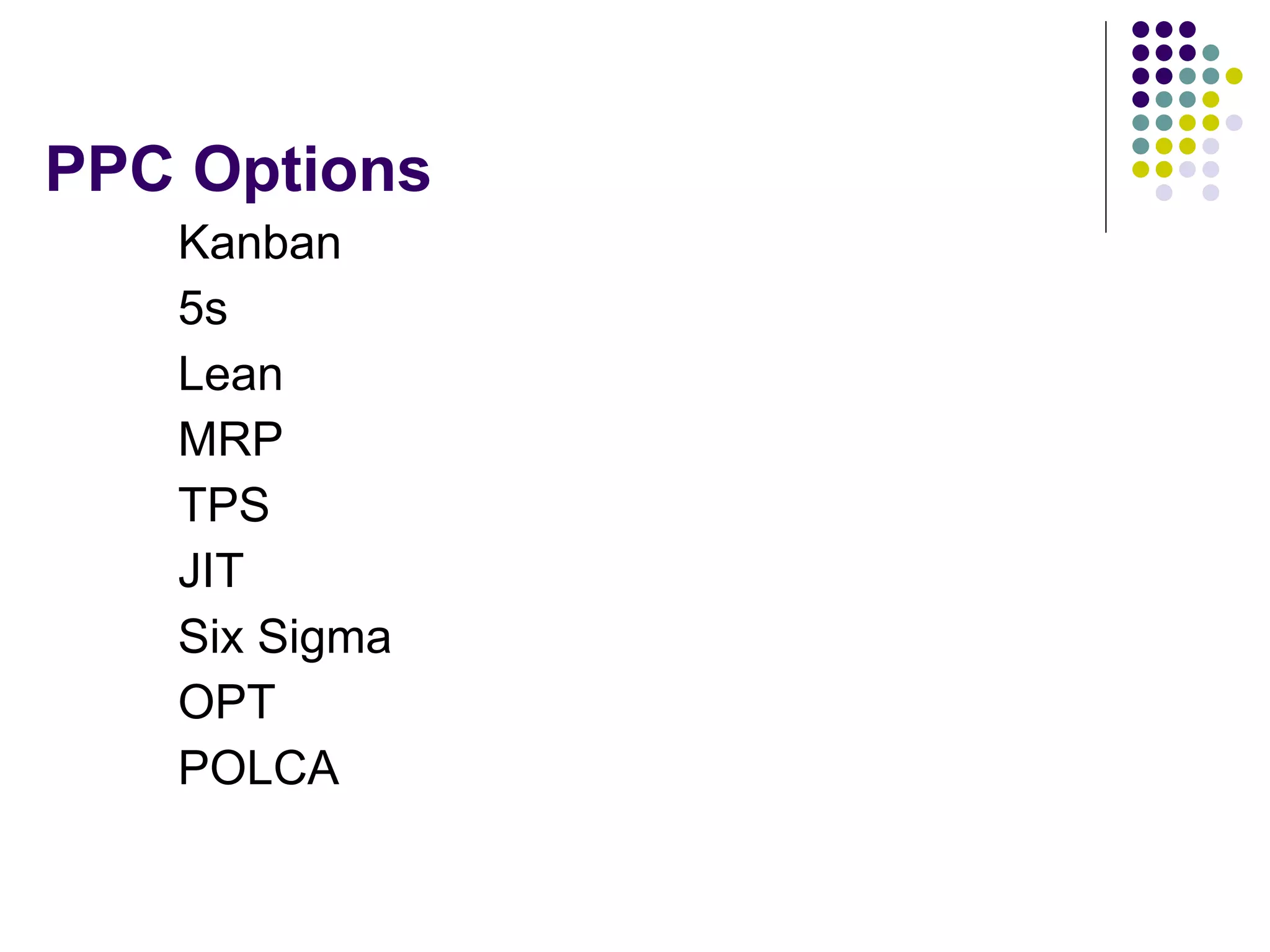
PPC Options
Kanban
5s
Lean
MRP
TPS
JIT
Six Sigma
OPT
POLCA
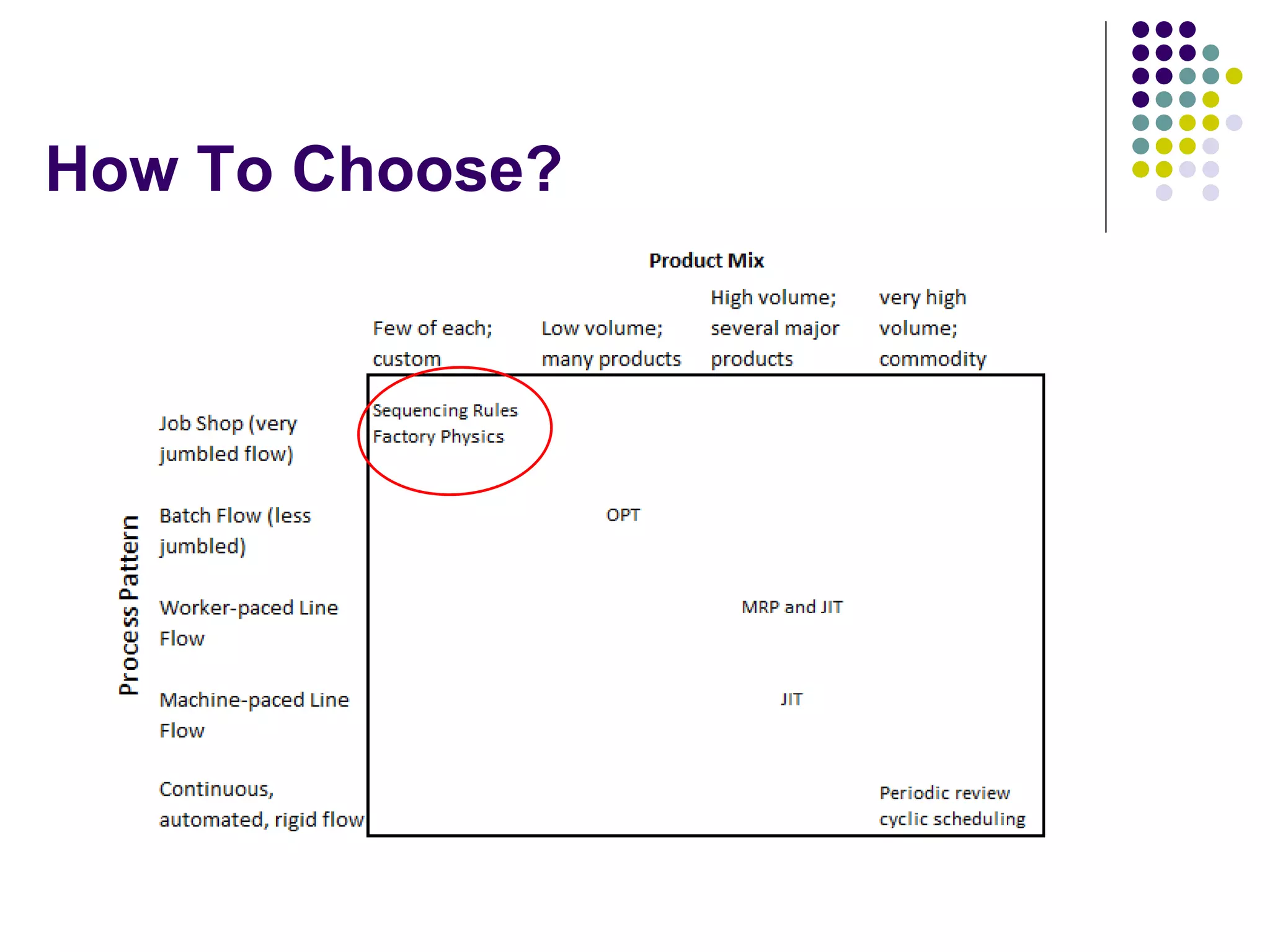
How To Choose?
Workload Control (WLC) Concept
• “Based on creating predictable and short
through-put times for each critical work
station”
• “predictable throughput times are important
for a good timing of order releases, for
quoting realistic delivery times, and for good
timing of capacity adjustments.”
SYSTEM COMPONENTS
1. Loop of Cards between the Shop Floor and
the Planning Office
2. Card Display Boards
3. Order Guiding Form
4. Support Staff
How it Works (Phases)
• Order Entry Phase
• Process Planning Phase
• Job Release Phase
• Job Execution Phase (Shop Floor)
• Monitoring and Control
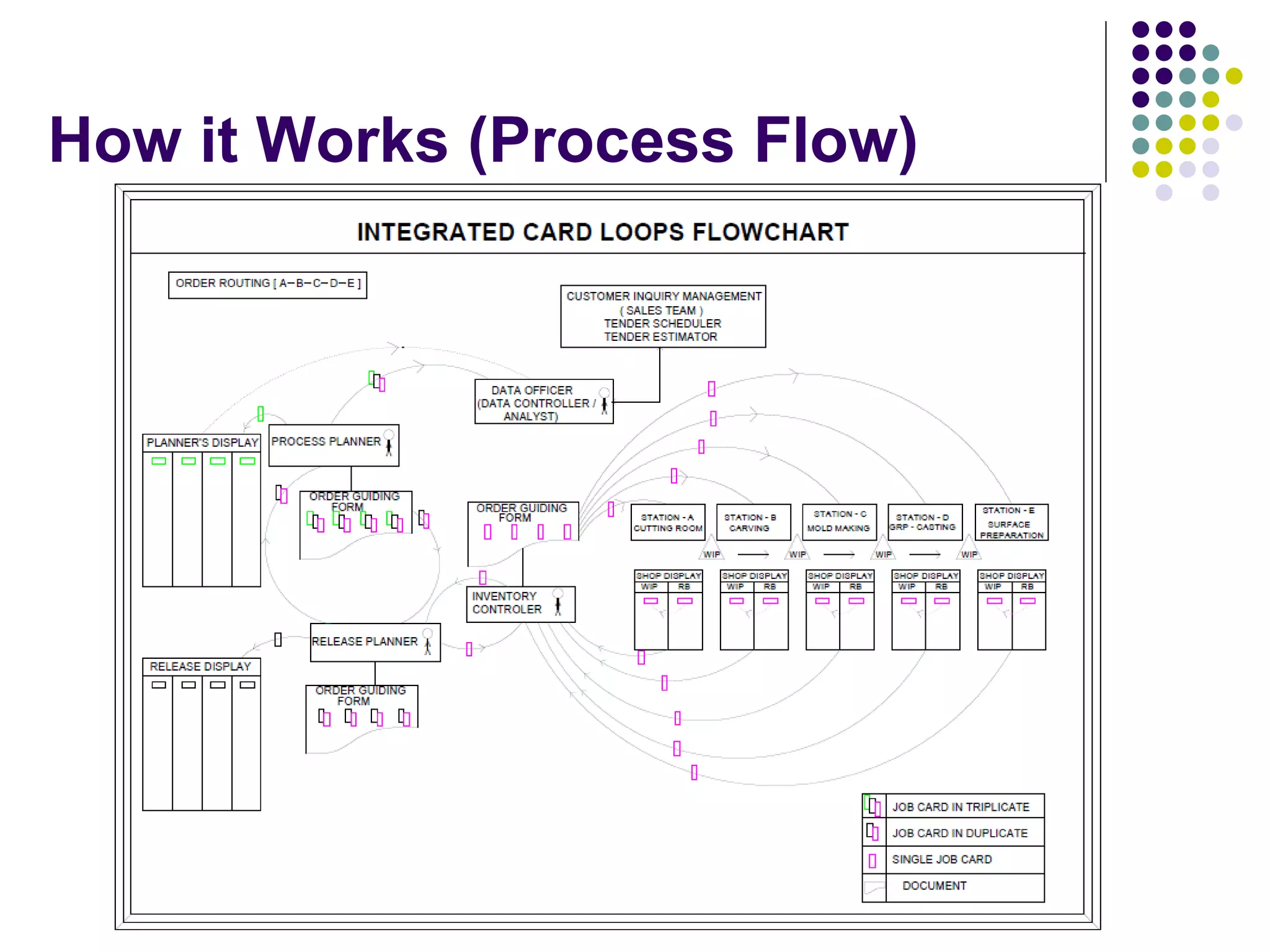
How it Works (Process Flow)
.
Demo (Today: Jan-01)
Jobs Simulation:
• Mickey Sculpture
• Oryx Sculpture
• Tweety Bird Cage
• AWR Farmhouse Pot Type 4
• KZ Doha Airplane Turbine
• Uniflora Pot Type 1
• VM Accessories Risers
• LMG Feature Wall Cutouts
• Frit Panels
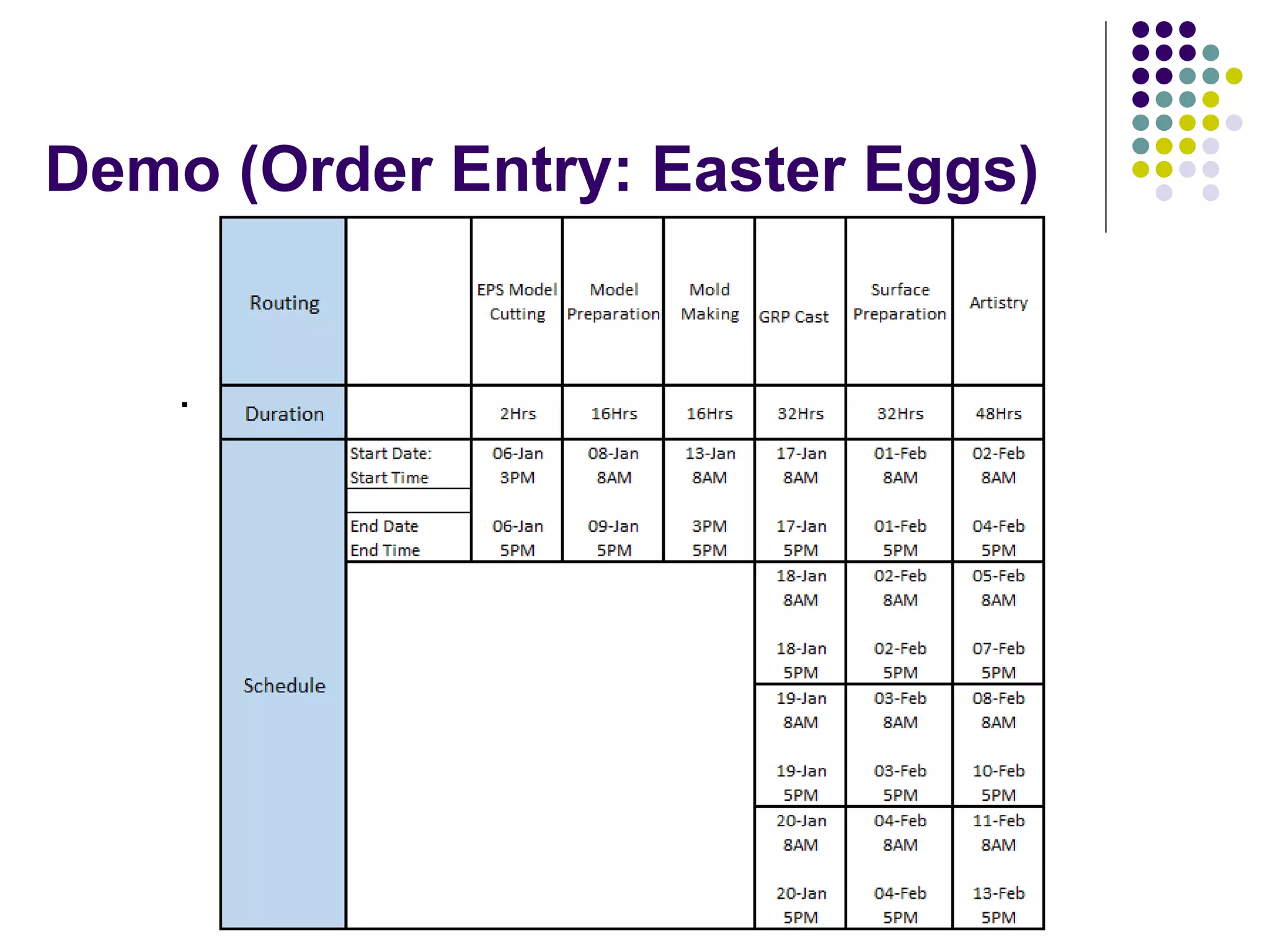
Demo (Order Entry: Easter Eggs)
.
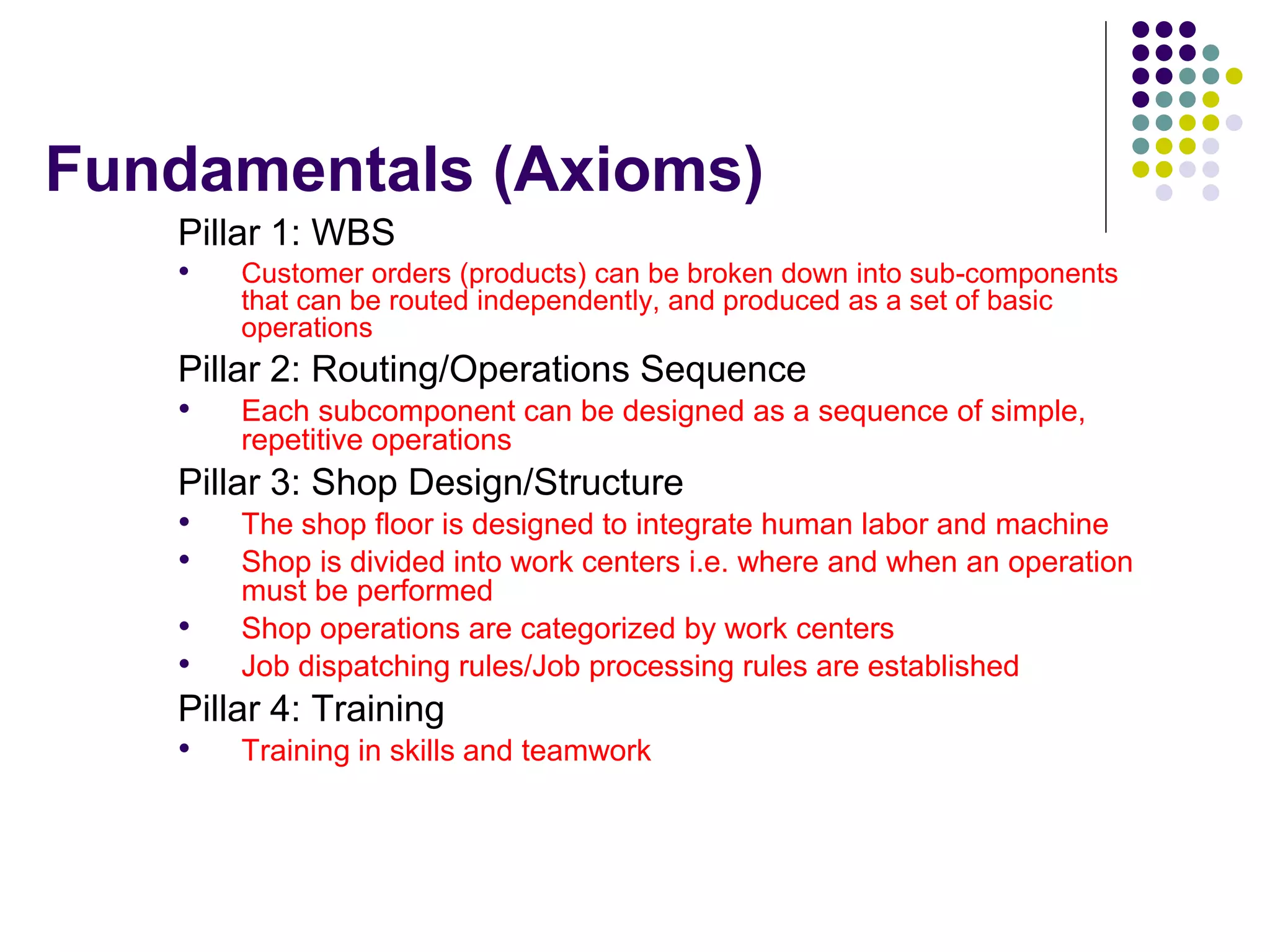
Fundamentals (Axioms)
Pillar 1: WBS
• Customer orders (products) can be broken down into sub-components
that can be routed independently, and produced as a set of basic
operations
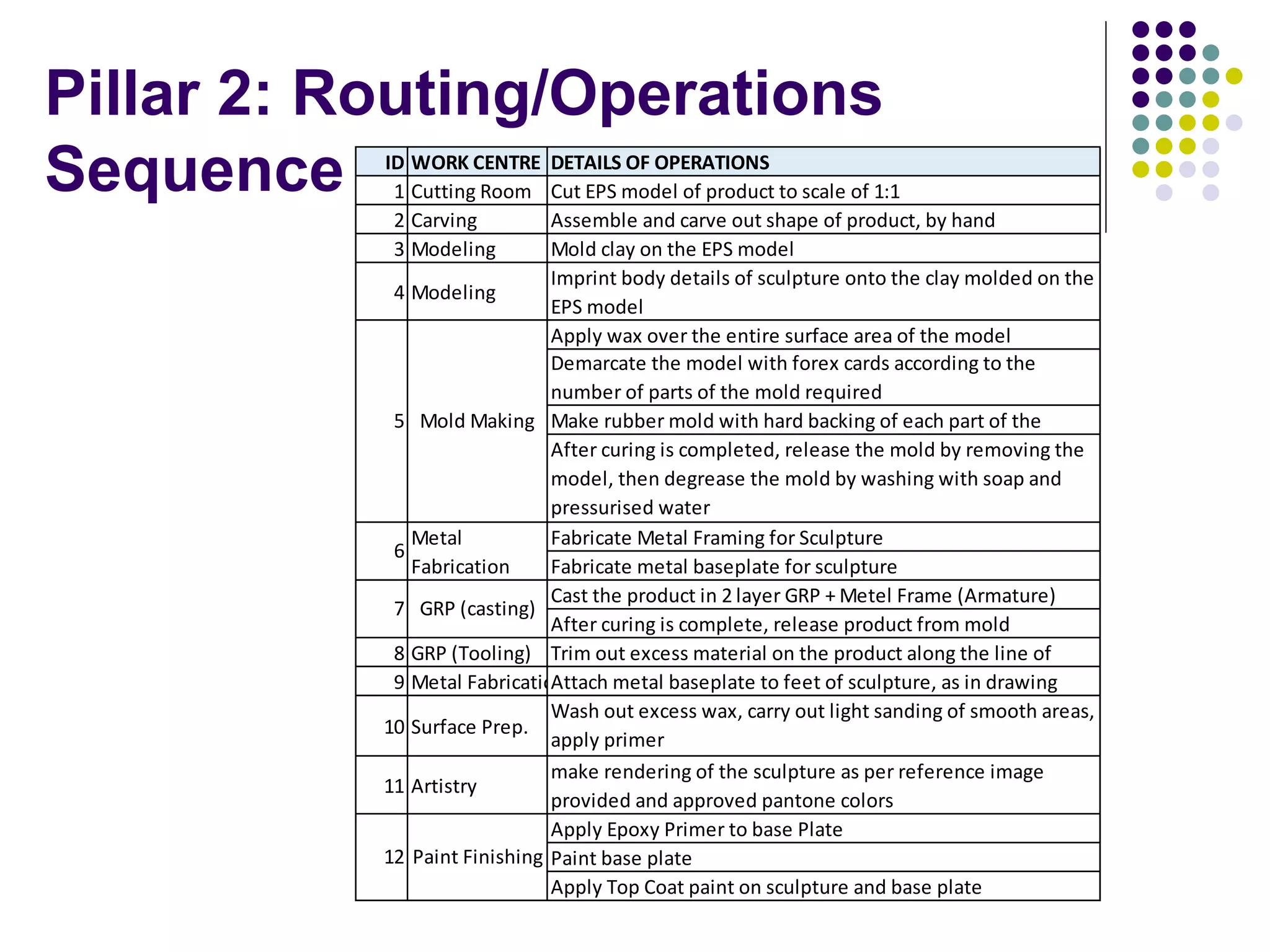
Pillar 2: Routing/Operations Sequence
• Each subcomponent can be designed as a sequence of simple,
repetitive operations
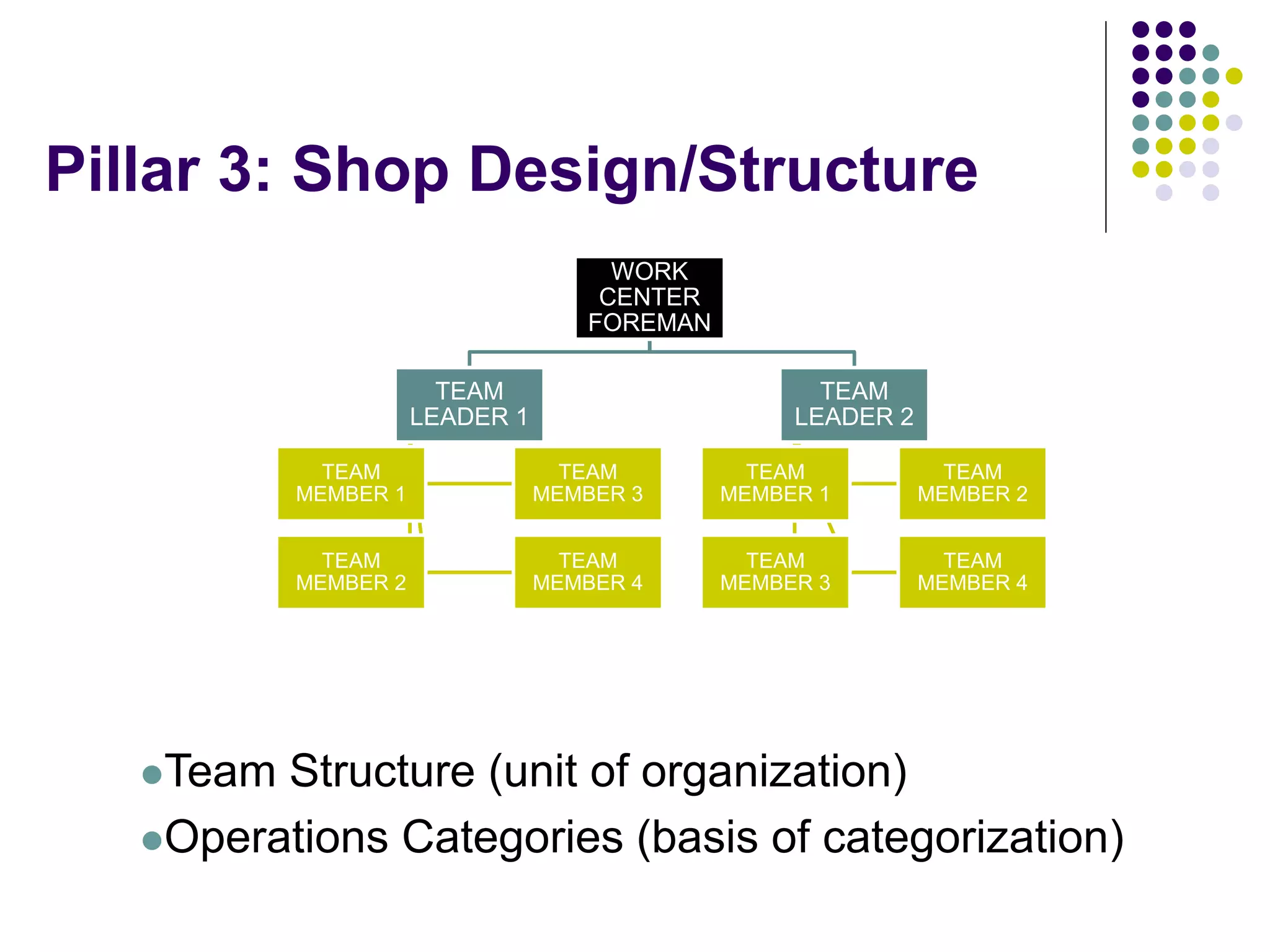
Pillar 3: Shop Design/Structure
• The shop floor is designed to integrate human labor and machine
• Shop is divided into work centers i.e. where and when an operation
must be performed
• Shop operations are categorized by work centers
• Job dispatching rules/Job processing rules are established
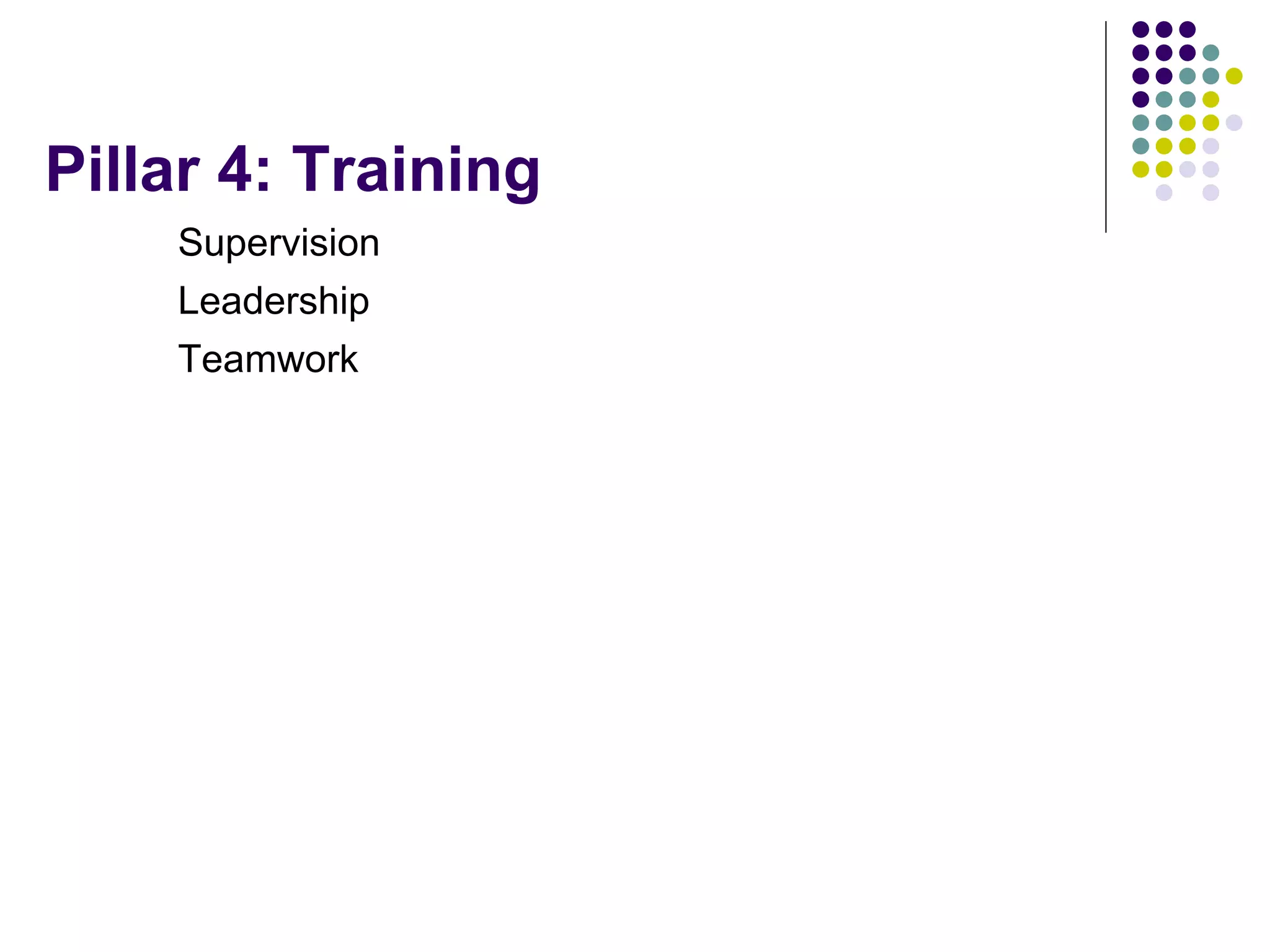
Pillar 4: Training
• Training in skills and teamwork
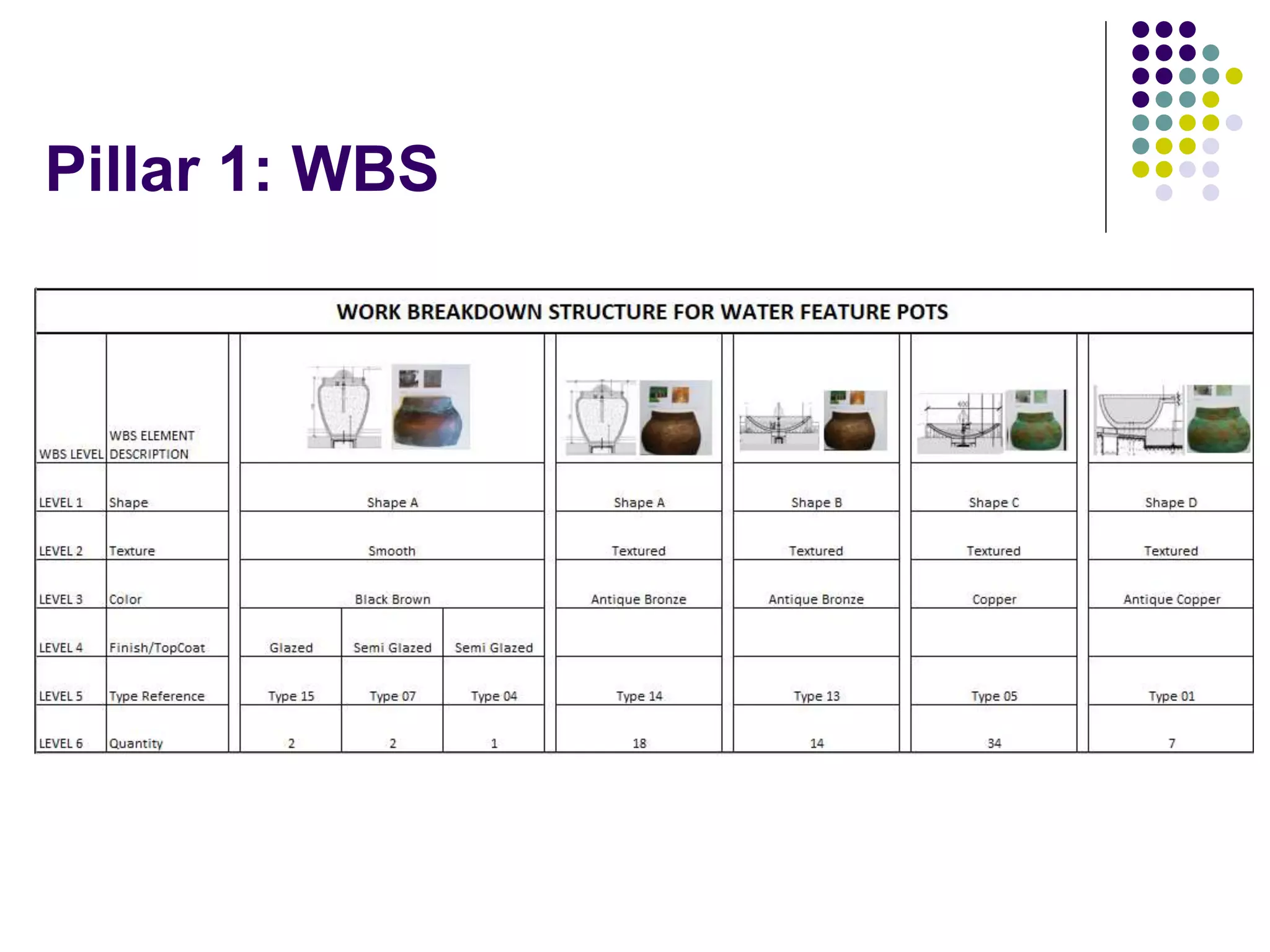
Pillar 1: WBS
.
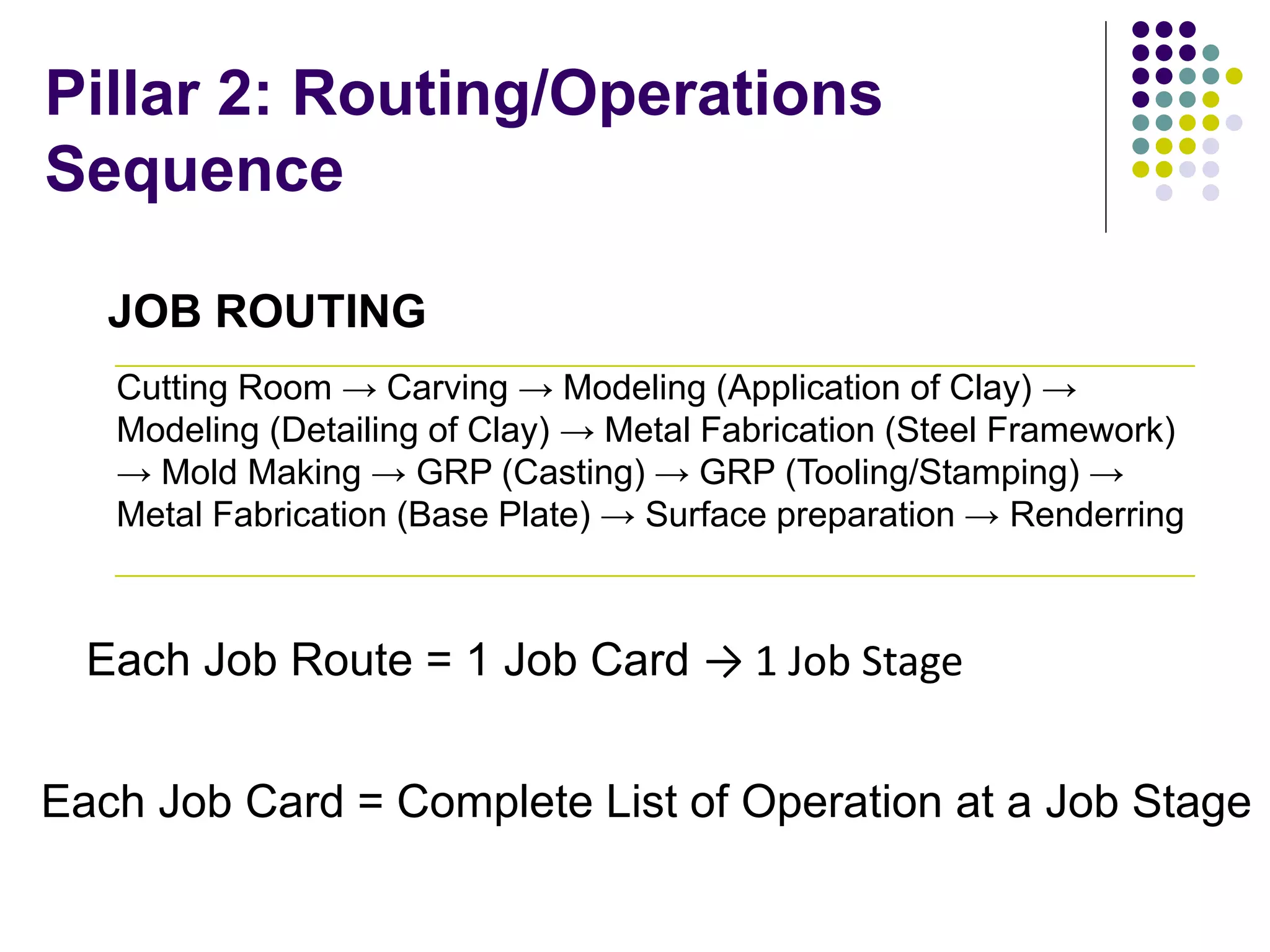
Pillar 2: Routing/Operations
Sequence
Cutting Room → Carving → Modeling (Application of Clay) →
Modeling (Detailing of Clay) → Metal Fabrication (Steel Framework)
→ Mold Making → GRP (Casting) → GRP (Tooling/Stamping) →
Metal Fabrication (Base Plate) → Surface preparation → Renderring
JOB ROUTING
Each Job Route = 1 Job Card → 1 Job Stage
Each Job Card = Complete List of Operation at a Job Stage
Pillar 2: Routing/Operations
Sequence ID WORK CENTRE
1 Cutting Room
2 Carving
3 Modeling
4 Modeling
8 GRP (Tooling)
9 Metal Fabrication
10 Surface Prep.
11 Artistry
Apply Top Coat paint on sculpture and base plate
12 Paint Finishing
6
7 GRP (casting)
Apply Epoxy Primer to base Plate
Paint base plate
Attach metal baseplate to feet of sculpture, as in drawing
Wash out excess wax, carry out light sanding of smooth areas,
apply primer
make rendering of the sculpture as per reference image
provided and approved pantone colors
Mold Making5
Metal
Fabrication
Fabricate Metal Framing for Sculpture
Fabricate metal baseplate for sculpture
Demarcate the model with forex cards according to the
number of parts of the mold required
Make rubber mold with hard backing of each part of the
After curing is completed, release the mold by removing the
model, then degrease the mold by washing with soap and
pressurised water
Cast the product in 2 layer GRP + Metel Frame (Armature)
After curing is complete, release product from mold
Trim out excess material on the product along the line of
DETAILS OF OPERATIONS
Cut EPS model of product to scale of 1:1
Assemble and carve out shape of product, by hand
Mold clay on the EPS model
Imprint body details of sculpture onto the clay molded on the
EPS model
Apply wax over the entire surface area of the model
Pillar 3: Shop Design/Structure
WORK
CENTER
FOREMAN
TEAM
LEADER 1
TEAM
MEMBER 1
TEAM
MEMBER 2
TEAM
MEMBER 3
TEAM
MEMBER 4
TEAM
LEADER 2
TEAM
MEMBER 1
TEAM
MEMBER 2
TEAM
MEMBER 3
TEAM
MEMBER 4
Team Structure (unit of organization)
Operations Categories (basis of categorization)
Pillar 4: Training
Supervision
Leadership
Teamwork
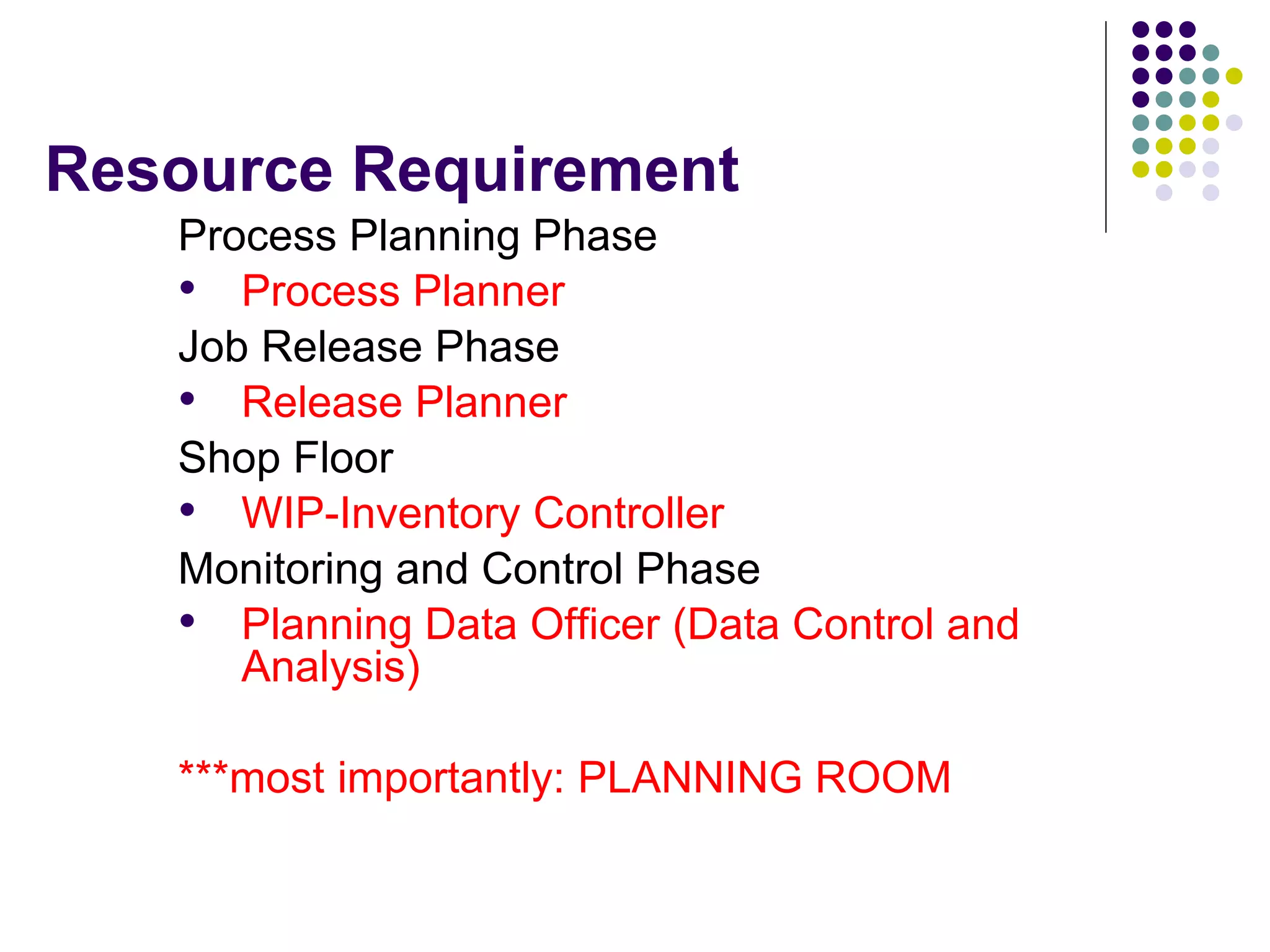
Resource Requirement
Process Planning Phase
• Process Planner
Job Release Phase
• Release Planner
Shop Floor
• WIP-Inventory Controller
Monitoring and Control Phase
• Planning Data Officer (Data Control and
Analysis)
***most importantly: PLANNING ROOM
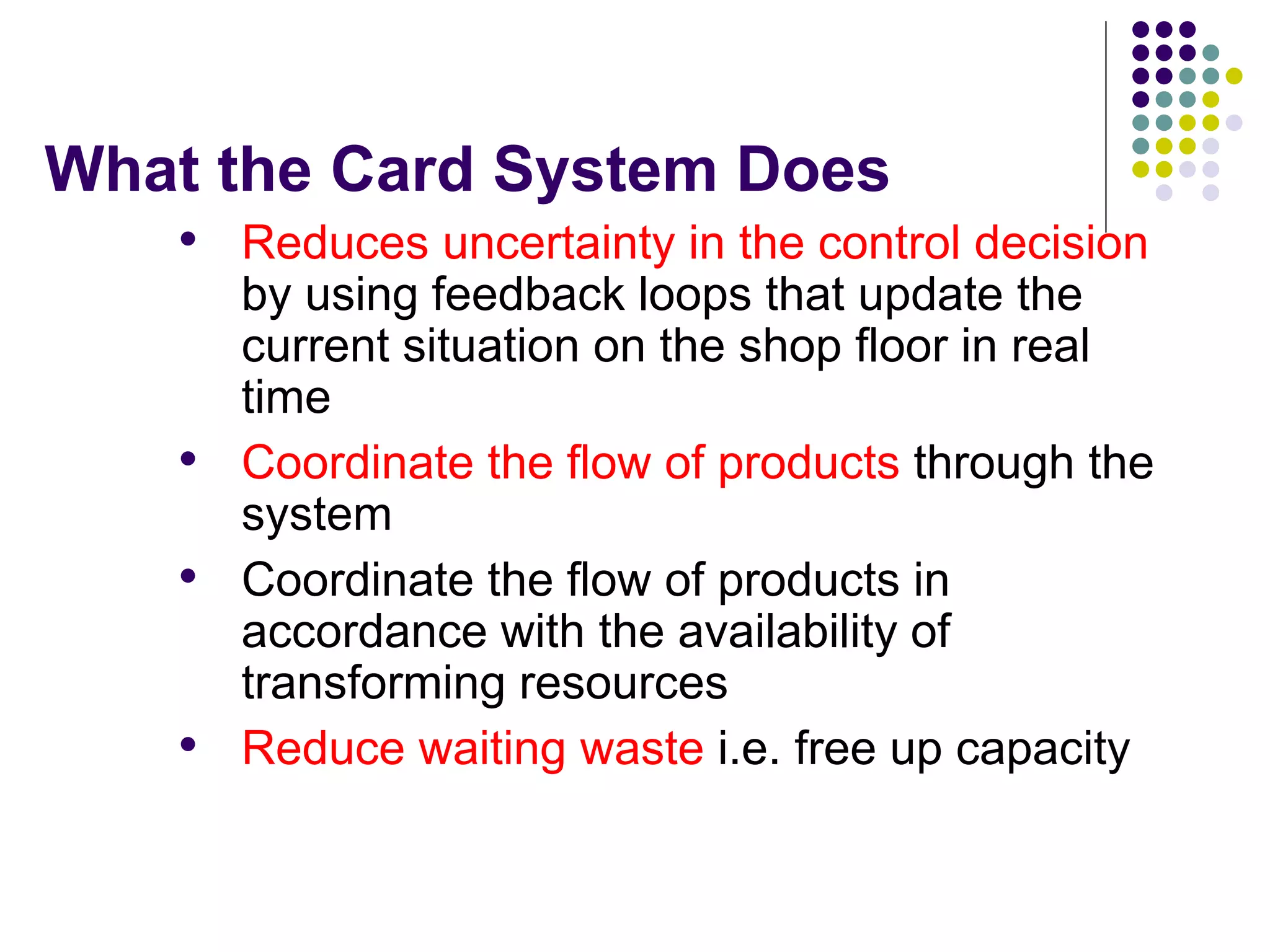
What the Card System Does
• Reduces uncertainty in the control decision
by using feedback loops that update the
current situation on the shop floor in real
time
• Coordinate the flow of products through the
system
• Coordinate the flow of products in
accordance with the availability of
transforming resources
• Reduce waiting waste i.e. free up capacity
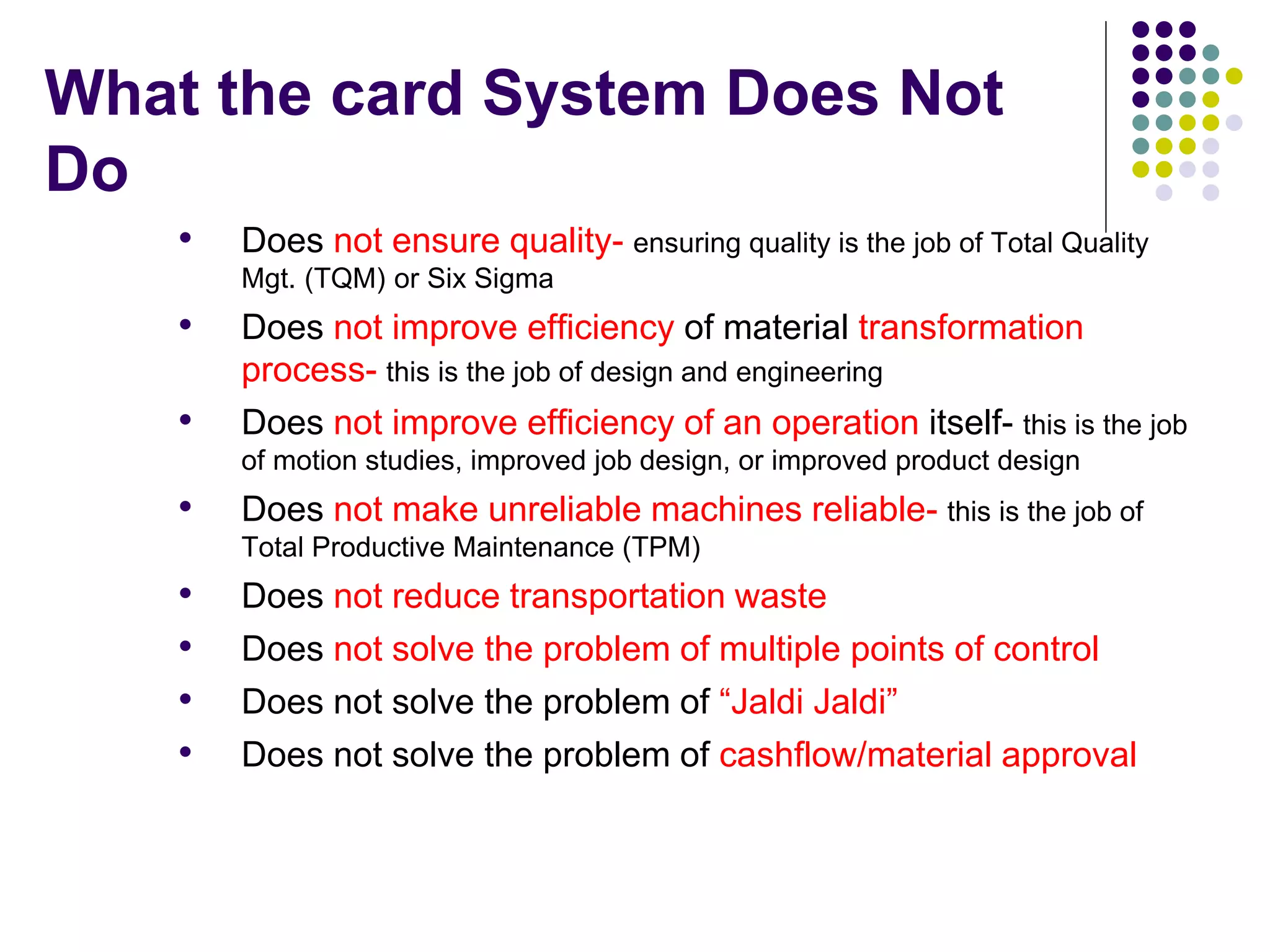
What the card System Does Not
Do
• Does not ensure quality- ensuring quality is the job of Total Quality
Mgt. (TQM) or Six Sigma
• Does not improve efficiency of material transformation
process- this is the job of design and engineering
• Does not improve efficiency of an operation itself- this is the job
of motion studies, improved job design, or improved product design
• Does not make unreliable machines reliable- this is the job of
Total Productive Maintenance (TPM)
• Does not reduce transportation waste
• Does not solve the problem of multiple points of control
• Does not solve the problem of “Jaldi Jaldi”
• Does not solve the problem of cashflow/material approval
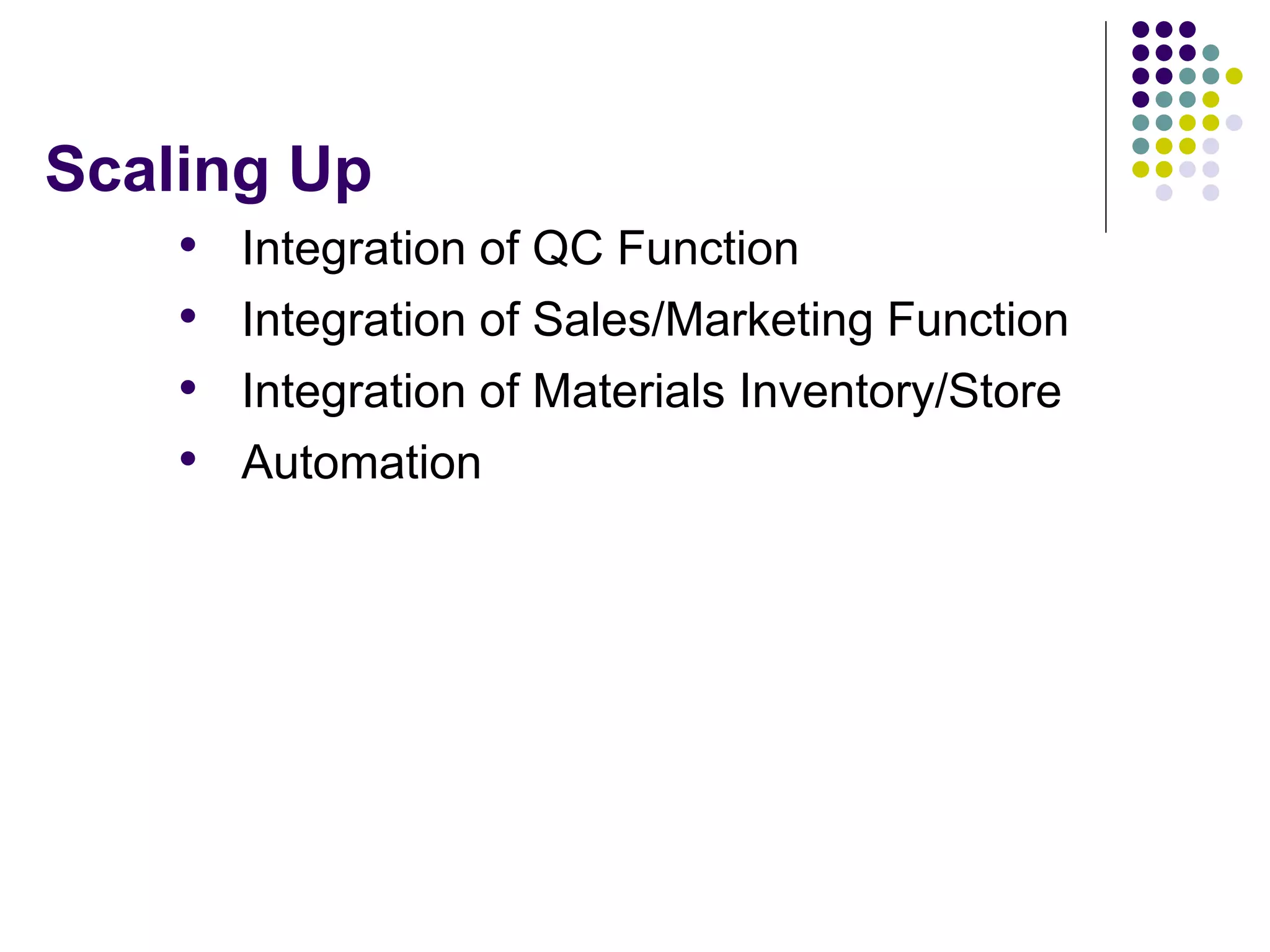
Scaling Up
• Integration of QC Function
• Integration of Sales/Marketing Function
• Integration of Materials Inventory/Store
• Automation

WIP Flow: A Card system for Production Planning and Control

  • 1.
    Card Based Production Planning&Control (PPC) System Presented by [Ibrahim Mohammed]
  • 2.
    Problem Statement Q: Howcan we quote realistic delivery times for Customer Order? Ans: • A system to keep stock and estimate current workload and shop through-put • A system to sequence product transformation • A system to monitor and control product transformation
  • 3.
  • 4.
  • 5.
    Workload Control (WLC)Concept • “Based on creating predictable and short through-put times for each critical work station” • “predictable throughput times are important for a good timing of order releases, for quoting realistic delivery times, and for good timing of capacity adjustments.”
  • 6.
    SYSTEM COMPONENTS 1. Loopof Cards between the Shop Floor and the Planning Office 2. Card Display Boards 3. Order Guiding Form 4. Support Staff
  • 7.
    How it Works(Phases) • Order Entry Phase • Process Planning Phase • Job Release Phase • Job Execution Phase (Shop Floor) • Monitoring and Control
  • 8.
    How it Works(Process Flow) .
  • 9.
    Demo (Today: Jan-01) JobsSimulation: • Mickey Sculpture • Oryx Sculpture • Tweety Bird Cage • AWR Farmhouse Pot Type 4 • KZ Doha Airplane Turbine • Uniflora Pot Type 1 • VM Accessories Risers • LMG Feature Wall Cutouts • Frit Panels
  • 10.
    Demo (Order Entry:Easter Eggs) .
  • 11.
    Fundamentals (Axioms) Pillar 1:WBS • Customer orders (products) can be broken down into sub-components that can be routed independently, and produced as a set of basic operations Pillar 2: Routing/Operations Sequence • Each subcomponent can be designed as a sequence of simple, repetitive operations Pillar 3: Shop Design/Structure • The shop floor is designed to integrate human labor and machine • Shop is divided into work centers i.e. where and when an operation must be performed • Shop operations are categorized by work centers • Job dispatching rules/Job processing rules are established Pillar 4: Training • Training in skills and teamwork
  • 12.
  • 13.
    Pillar 2: Routing/Operations Sequence CuttingRoom → Carving → Modeling (Application of Clay) → Modeling (Detailing of Clay) → Metal Fabrication (Steel Framework) → Mold Making → GRP (Casting) → GRP (Tooling/Stamping) → Metal Fabrication (Base Plate) → Surface preparation → Renderring JOB ROUTING Each Job Route = 1 Job Card → 1 Job Stage Each Job Card = Complete List of Operation at a Job Stage
  • 14.
    Pillar 2: Routing/Operations SequenceID WORK CENTRE 1 Cutting Room 2 Carving 3 Modeling 4 Modeling 8 GRP (Tooling) 9 Metal Fabrication 10 Surface Prep. 11 Artistry Apply Top Coat paint on sculpture and base plate 12 Paint Finishing 6 7 GRP (casting) Apply Epoxy Primer to base Plate Paint base plate Attach metal baseplate to feet of sculpture, as in drawing Wash out excess wax, carry out light sanding of smooth areas, apply primer make rendering of the sculpture as per reference image provided and approved pantone colors Mold Making5 Metal Fabrication Fabricate Metal Framing for Sculpture Fabricate metal baseplate for sculpture Demarcate the model with forex cards according to the number of parts of the mold required Make rubber mold with hard backing of each part of the After curing is completed, release the mold by removing the model, then degrease the mold by washing with soap and pressurised water Cast the product in 2 layer GRP + Metel Frame (Armature) After curing is complete, release product from mold Trim out excess material on the product along the line of DETAILS OF OPERATIONS Cut EPS model of product to scale of 1:1 Assemble and carve out shape of product, by hand Mold clay on the EPS model Imprint body details of sculpture onto the clay molded on the EPS model Apply wax over the entire surface area of the model
  • 15.
    Pillar 3: ShopDesign/Structure WORK CENTER FOREMAN TEAM LEADER 1 TEAM MEMBER 1 TEAM MEMBER 2 TEAM MEMBER 3 TEAM MEMBER 4 TEAM LEADER 2 TEAM MEMBER 1 TEAM MEMBER 2 TEAM MEMBER 3 TEAM MEMBER 4 Team Structure (unit of organization) Operations Categories (basis of categorization)
  • 16.
  • 17.
    Resource Requirement Process PlanningPhase • Process Planner Job Release Phase • Release Planner Shop Floor • WIP-Inventory Controller Monitoring and Control Phase • Planning Data Officer (Data Control and Analysis) ***most importantly: PLANNING ROOM
  • 18.
    What the CardSystem Does • Reduces uncertainty in the control decision by using feedback loops that update the current situation on the shop floor in real time • Coordinate the flow of products through the system • Coordinate the flow of products in accordance with the availability of transforming resources • Reduce waiting waste i.e. free up capacity
  • 19.
    What the cardSystem Does Not Do • Does not ensure quality- ensuring quality is the job of Total Quality Mgt. (TQM) or Six Sigma • Does not improve efficiency of material transformation process- this is the job of design and engineering • Does not improve efficiency of an operation itself- this is the job of motion studies, improved job design, or improved product design • Does not make unreliable machines reliable- this is the job of Total Productive Maintenance (TPM) • Does not reduce transportation waste • Does not solve the problem of multiple points of control • Does not solve the problem of “Jaldi Jaldi” • Does not solve the problem of cashflow/material approval
  • 20.
    Scaling Up • Integrationof QC Function • Integration of Sales/Marketing Function • Integration of Materials Inventory/Store • Automation