Web Services: 
Encapsulation, Reusability, and 
Simplicity 
#CSUC14 
Presented by 
Wing Ming Chan, September 16, 2014 
Upstate Medical University 
chanw@upstate.edu 
1
Topics 
 Encapsulation: data and data manipulation 
hiding 
 Usernames and passwords 
 Creating phantom entities in Cascade 
 Fully qualified identifiers 
 Reusability: code ready to use without 
modification 
 AssetOperationHandlerService 
 Asset and Property classes 
 Simplicity: lines of code 
 Cascade and AssetTree classes 
 CascadeInstances and Report classes 2
Part 0: Three Questions 
3
Purposes 
 Look for positive answers 
 Reveal the problems 
 Highlight the main issues 
4
Question 1 
 How many of you can write a web service 
program, doing something, anything, without 
hard-coding the username and password 
anywhere in your code? 
 Main concern 
 Security and encapsulation of sensitive data 
 Access restrictions 
5
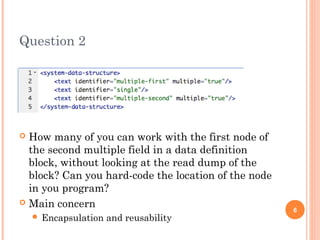
Question 2 
 How many of you can work with the first node of 
the second multiple field in a data definition 
block, without looking at the read dump of the 
block? Can you hard-code the location of the node 
in you program? 
 Main concern 
 Encapsulation and reusability 6
Locating Nodes 
7
Question 3 
 Besides the use of require_once or 
include_once, how many of you can use a 
single semi-colon in your code to do the following: 
 Associate metadata set 1 with all folders in a site 
(including Base Folder) 
 Associate metadata set 2 with all files in the site 
 Associate metadata set 3 with all symlinks in the site 
 Requirements: no program-specific data allowed 
in the required/included files; all information 
related to metadata sets, folders, files, and 
symlinks must show up in your code 
 Main concerns 
 Reusability and simplicity 
8
Part 1: Encapsulation 
9
The Typical Way of 
Starting a Program 
10
Problems? 
 Programs are tied with usernames, passwords, 
and WSDL URL’s 
 People can come and go 
 Changes of passwords 
 URL’s can change too (different instances) 
 Passwords exposed 
 Security 
 A single program used by multiple users 
 Usernames and passwords change depending on the 
users using the same program 
 Access restrictions 
11
Phantom: Episode I 
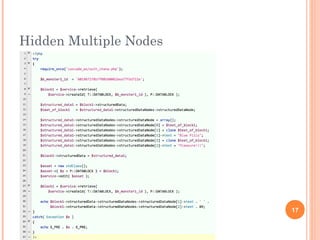
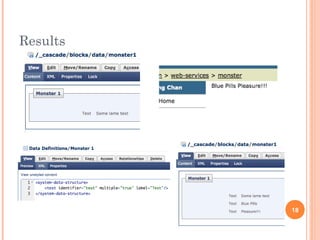
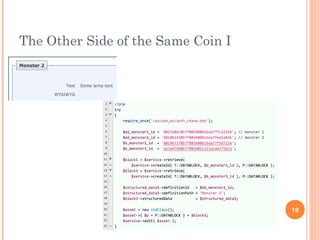
 Detachment of structuredData from 
dataDefinition in web services 
 Created by web services 
 Only affects data definition blocks (including those 
plugged into pages) 
 Can be created in pages, but haven’t figure out a way 
to reveal the hidden content 
12
Data Definitions 
13
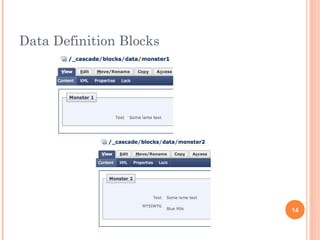
Data Definition Blocks 
14
REPLACING STRUCTUREDDATA 
15
Results 
16
Hidden Multiple Nodes 
17
Results 
18
The Other Side of the Same Coin I 
19
The Other Side of the Same Coin II 
20
Creating a Java Error 
21
A NIGHTMARE… 
22 
 Pretend that I am you enemy 
 What I can do to you: 
 Detachment of data definitions from content types 
 Assigning an empty string to a checkbox in data 
definition blocks 
 Data definition manipulation with phantom nodes 
 How long will it take to solve the problem: Days? 
Weeks?
Encapsulating Usernames and 
Passwords: a Two-Step Approach 
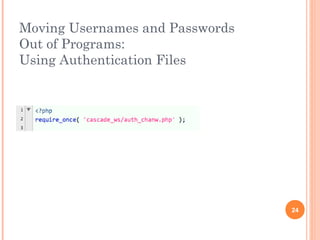
 Step 1: move usernames and passwords out of 
programs to authentication files 
 Step 2: hide usernames and passwords from the 
system altogether 
23
Moving Usernames and Passwords 
Out of Programs: 
Using Authentication Files 
24
Authentication File Example 
25
Password-Protected Page 
26
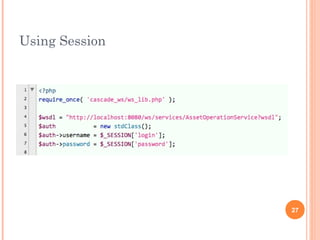
Using Session 
27
Using Command-Prompt Arguments 
28
Authentication File: 
Entry Point to Code Library 
29
The AssetOperationHandlerService 
Class: Encapsulating Operations 
 Encapsulation 
 Username and password 
 URL 
 The SoapClient object and all operations 
 All parameters required for operations 
 The instance $service: 
 Instantiated in the authentication files 
 Passed from client code to code library 
 Performs all basic operations in code library 
30
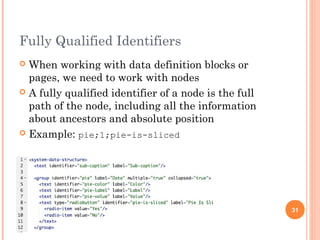
Fully Qualified Identifiers 
 When working with data definition blocks or 
pages, we need to work with nodes 
 A fully qualified identifier of a node is the full 
path of the node, including all the information 
about ancestors and absolute position 
 Example: pie;1;pie-is-sliced 
31
What Is Special About 
Fully Qualified Identifiers 
 Example: pie;1;pie-is-sliced 
 The ;1 part following an identifier indicates that 
the field is a multiple field 
 ;0 means that the node bearing this identifier is 
the first node in the set; ;1 means that the node 
is the second node of the set 
 Unlike array indexes, the fully qualified 
identifier of a node never changes, no matter how 
many cousins and siblings it has 
 A more complicated example: main-field; 
group;2;sub-group;1;text;3 
32
Why Fully Qualified Identifiers? 
 They never change: can be hard-coded in 
programs 
 Easy node look-up 
 Possible to use for and foreach loops 
 Encapsulation of arrays and stdClass objects 
33
DATADEFINITIONBLOCK::GETIDENTIF 
IERS 
34
Part 2: Reusability 
35
Why OOP? 
 Encapsulation 
 Hiding complicated program logic 
 Hiding data and raw data structures 
 Reusability 
 The entire library consists of reusable code 
 Easy object retrieval 
 Providing look-up mechanism 
 Setting and editing data and metadata, and 
preventing unacceptable input 
 Error checking and exception handling 
 Inheritance 
 Problems with web services 36
Problems with Web Services I 
 It is possible to delete the value of a required 
field using web services (e.g. in a metadata set) 
 Cascade won’t complain when an unacceptable 
boolean value is assigned to a field (e.g. fals 
instead of false) 
 An unacceptable boolean value is ignored 
 Unlike dateTime (which is represented by an object) 
 Cascade won’t complain when an unacceptable 
string value is assigned to a dropdown 
 An undefined item is introduced 
 An empty string will also work 
37
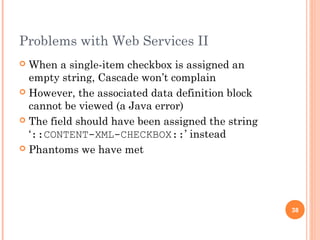
Problems with Web Services II 
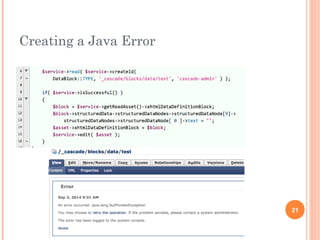
 When a single-item checkbox is assigned an 
empty string, Cascade won’t complain 
 However, the associated data definition block 
cannot be viewed (a Java error) 
 The field should have been assigned the string 
‘::CONTENT-XML-CHECKBOX::’ instead 
 Phantoms we have met 
38
Problems with Web Services III 
 Assignment of NULL vs. unset 
When modifying temporal settings for scheduled 
publishing (for a site, a publish set, or a destination), 
assignments of the NULL value to properties won’t 
work 
 Instead, we must unset the properties 
39
ASSET AND PROPERTY 
 Asset: an abstract class 
 Other abstract subclasses: ContainedAsset, 
Container, Block, Format, etc. 
 42 concrete classes corresponding to 42 asset 
types defined in the WSDL 
 All methods have returned values 
Method chaining possible 
 stdClass objects within an asset are 
represented by subclasses of Property 
40
Inheritance 
 Reusability 
 An asset class can be reused to deal with any assets 
of the same type 
Metadata-related classes can be reused in File, 
Page, Block (and its subclasses), Format (and its 
subclasses) and Symlink 
Members in a parent class inherited by child classes, 
avoiding repetition of code 
 Separate code files 
 Less code per file 
 Easier to maintain 
41
Exception Handling 
 All classes throw exceptions of various types 
 Client code is expected to deal with exceptions 
 Two modes of execution: strict and lenient 
 To throw or not to throw? Cascade::getAsset 
vs. Cascade::getX (e.g. Cascade::getPage) 
42
Part 3: Simplicity 
43
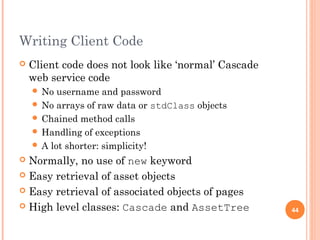
Writing Client Code 
 Client code does not look like ‘normal’ Cascade 
web service code 
 No username and password 
 No arrays of raw data or stdClass objects 
 Chained method calls 
 Handling of exceptions 
 A lot shorter: simplicity! 
 Normally, no use of new keyword 
 Easy retrieval of asset objects 
 Easy retrieval of associated objects of pages 
 High level classes: Cascade and AssetTree 44
Retrieving an Asset Object 
45
Dumping an Asset Object 
46
Working With 
A Data Definition Block 
47
Displaying Page-Related Information 
48
Setting Access Rights 
49
Setting Content Type 
50
Switch Content Type 
51
ASSETTREE 
 A tree structure consisting of: 
 Root container 
 Children 
 Sub-trees 
 What it is good for: 
 Creating reports 
 Modifying assets of a certain type or types 
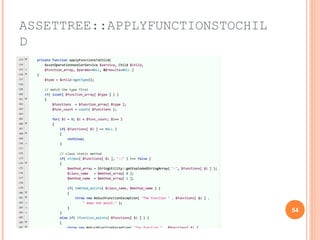
 The AssetTree::traverse method 
 Visits the root, every children of the root, and recursively all 
sub-trees (depth-first traversal) 
 Accepts global functions, parameters, and results array 
(passed in by reference) 
 Global functions as filters 52
ASSETTREE::TRAVERSE 
53
ASSETTREE::APPLYFUNCTIONSTOCHIL 
D 
54
MetadataSet Associations 
55
Global Function Used 
56
Publishing Every Page in a Folder 
57
AssetTree Recipes 
58
Phantom: Episode II 
 Detachment of structuredData from 
dataDefinition in web services 
 Created by changes of data definitions 
 Affects web services only 
59
CascadeInstances: 
The Ultimate Test for Simplicity 
60
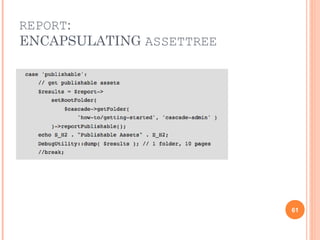
REPORT: 
ENCAPSULATING ASSETTREE 
61
Questions? 
 Tutorial: http://www.upstate.edu/cascade-admin/ 
projects/web-services/ 
 Email: chanw@upstate.edu 
 A web service user group? 
62

Web Services: Encapsulation, Reusability, and Simplicity

  • 1.
    Web Services: Encapsulation,Reusability, and Simplicity #CSUC14 Presented by Wing Ming Chan, September 16, 2014 Upstate Medical University chanw@upstate.edu 1
  • 2.
    Topics  Encapsulation:data and data manipulation hiding  Usernames and passwords  Creating phantom entities in Cascade  Fully qualified identifiers  Reusability: code ready to use without modification  AssetOperationHandlerService  Asset and Property classes  Simplicity: lines of code  Cascade and AssetTree classes  CascadeInstances and Report classes 2
  • 3.
    Part 0: ThreeQuestions 3
  • 4.
    Purposes  Lookfor positive answers  Reveal the problems  Highlight the main issues 4
  • 5.
    Question 1 How many of you can write a web service program, doing something, anything, without hard-coding the username and password anywhere in your code?  Main concern  Security and encapsulation of sensitive data  Access restrictions 5
  • 6.
    Question 2 How many of you can work with the first node of the second multiple field in a data definition block, without looking at the read dump of the block? Can you hard-code the location of the node in you program?  Main concern  Encapsulation and reusability 6
  • 7.
  • 8.
    Question 3 Besides the use of require_once or include_once, how many of you can use a single semi-colon in your code to do the following:  Associate metadata set 1 with all folders in a site (including Base Folder)  Associate metadata set 2 with all files in the site  Associate metadata set 3 with all symlinks in the site  Requirements: no program-specific data allowed in the required/included files; all information related to metadata sets, folders, files, and symlinks must show up in your code  Main concerns  Reusability and simplicity 8
  • 9.
  • 10.
    The Typical Wayof Starting a Program 10
  • 11.
    Problems?  Programsare tied with usernames, passwords, and WSDL URL’s  People can come and go  Changes of passwords  URL’s can change too (different instances)  Passwords exposed  Security  A single program used by multiple users  Usernames and passwords change depending on the users using the same program  Access restrictions 11
  • 12.
    Phantom: Episode I  Detachment of structuredData from dataDefinition in web services  Created by web services  Only affects data definition blocks (including those plugged into pages)  Can be created in pages, but haven’t figure out a way to reveal the hidden content 12
  • 13.
  • 14.
  • 15.
  • 16.
  • 17.
  • 18.
  • 19.
    The Other Sideof the Same Coin I 19
  • 20.
    The Other Sideof the Same Coin II 20
  • 21.
  • 22.
    A NIGHTMARE… 22  Pretend that I am you enemy  What I can do to you:  Detachment of data definitions from content types  Assigning an empty string to a checkbox in data definition blocks  Data definition manipulation with phantom nodes  How long will it take to solve the problem: Days? Weeks?
  • 23.
    Encapsulating Usernames and Passwords: a Two-Step Approach  Step 1: move usernames and passwords out of programs to authentication files  Step 2: hide usernames and passwords from the system altogether 23
  • 24.
    Moving Usernames andPasswords Out of Programs: Using Authentication Files 24
  • 25.
  • 26.
  • 27.
  • 28.
  • 29.
    Authentication File: EntryPoint to Code Library 29
  • 30.
    The AssetOperationHandlerService Class:Encapsulating Operations  Encapsulation  Username and password  URL  The SoapClient object and all operations  All parameters required for operations  The instance $service:  Instantiated in the authentication files  Passed from client code to code library  Performs all basic operations in code library 30
  • 31.
    Fully Qualified Identifiers  When working with data definition blocks or pages, we need to work with nodes  A fully qualified identifier of a node is the full path of the node, including all the information about ancestors and absolute position  Example: pie;1;pie-is-sliced 31
  • 32.
    What Is SpecialAbout Fully Qualified Identifiers  Example: pie;1;pie-is-sliced  The ;1 part following an identifier indicates that the field is a multiple field  ;0 means that the node bearing this identifier is the first node in the set; ;1 means that the node is the second node of the set  Unlike array indexes, the fully qualified identifier of a node never changes, no matter how many cousins and siblings it has  A more complicated example: main-field; group;2;sub-group;1;text;3 32
  • 33.
    Why Fully QualifiedIdentifiers?  They never change: can be hard-coded in programs  Easy node look-up  Possible to use for and foreach loops  Encapsulation of arrays and stdClass objects 33
  • 34.
  • 35.
  • 36.
    Why OOP? Encapsulation  Hiding complicated program logic  Hiding data and raw data structures  Reusability  The entire library consists of reusable code  Easy object retrieval  Providing look-up mechanism  Setting and editing data and metadata, and preventing unacceptable input  Error checking and exception handling  Inheritance  Problems with web services 36
  • 37.
    Problems with WebServices I  It is possible to delete the value of a required field using web services (e.g. in a metadata set)  Cascade won’t complain when an unacceptable boolean value is assigned to a field (e.g. fals instead of false)  An unacceptable boolean value is ignored  Unlike dateTime (which is represented by an object)  Cascade won’t complain when an unacceptable string value is assigned to a dropdown  An undefined item is introduced  An empty string will also work 37
  • 38.
    Problems with WebServices II  When a single-item checkbox is assigned an empty string, Cascade won’t complain  However, the associated data definition block cannot be viewed (a Java error)  The field should have been assigned the string ‘::CONTENT-XML-CHECKBOX::’ instead  Phantoms we have met 38
  • 39.
    Problems with WebServices III  Assignment of NULL vs. unset When modifying temporal settings for scheduled publishing (for a site, a publish set, or a destination), assignments of the NULL value to properties won’t work  Instead, we must unset the properties 39
  • 40.
    ASSET AND PROPERTY  Asset: an abstract class  Other abstract subclasses: ContainedAsset, Container, Block, Format, etc.  42 concrete classes corresponding to 42 asset types defined in the WSDL  All methods have returned values Method chaining possible  stdClass objects within an asset are represented by subclasses of Property 40
  • 41.
    Inheritance  Reusability  An asset class can be reused to deal with any assets of the same type Metadata-related classes can be reused in File, Page, Block (and its subclasses), Format (and its subclasses) and Symlink Members in a parent class inherited by child classes, avoiding repetition of code  Separate code files  Less code per file  Easier to maintain 41
  • 42.
    Exception Handling All classes throw exceptions of various types  Client code is expected to deal with exceptions  Two modes of execution: strict and lenient  To throw or not to throw? Cascade::getAsset vs. Cascade::getX (e.g. Cascade::getPage) 42
  • 43.
  • 44.
    Writing Client Code  Client code does not look like ‘normal’ Cascade web service code  No username and password  No arrays of raw data or stdClass objects  Chained method calls  Handling of exceptions  A lot shorter: simplicity!  Normally, no use of new keyword  Easy retrieval of asset objects  Easy retrieval of associated objects of pages  High level classes: Cascade and AssetTree 44
  • 45.
  • 46.
  • 47.
    Working With AData Definition Block 47
  • 48.
  • 49.
  • 50.
  • 51.
  • 52.
    ASSETTREE  Atree structure consisting of:  Root container  Children  Sub-trees  What it is good for:  Creating reports  Modifying assets of a certain type or types  The AssetTree::traverse method  Visits the root, every children of the root, and recursively all sub-trees (depth-first traversal)  Accepts global functions, parameters, and results array (passed in by reference)  Global functions as filters 52
  • 53.
  • 54.
  • 55.
  • 56.
  • 57.
    Publishing Every Pagein a Folder 57
  • 58.
  • 59.
    Phantom: Episode II  Detachment of structuredData from dataDefinition in web services  Created by changes of data definitions  Affects web services only 59
  • 60.
    CascadeInstances: The UltimateTest for Simplicity 60
  • 61.
  • 62.
    Questions?  Tutorial:http://www.upstate.edu/cascade-admin/ projects/web-services/  Email: chanw@upstate.edu  A web service user group? 62