Downloaded 19 times
![TRANSACTIONS ON DEPENDABLE AND SECURE COMPUTING 1
LDAP Injection Techniques
Jose Mar´ıa Alonso, Rodolfo Bord´on, Marta Beltr´an and Antonio Guzm´an
Abstract—The increase in the number of databases accessed only by
some applications has made code injection attacks an important threat
to almost any current system. If one of these applications accepts inputs
from a client and executes these inputs without first validating them,
the attackers are free to execute their own queries and therefore, to
extract, modify or delete the content of the database associated to the
application. Several works have analyzed SQL injection attacks and their
consequences. However, there is very little work in other code injection
techniques attacking other languages or protocols. In this paper a deep
analysis of the LDAP injection techniques is presented. Furthermore, a
clear distinction between classic and blind injection techniques is made.
Finally, a real LDAP environment has been implemented to evaluate
the security of applications based on LDAP and to exemplify the most
common vulnerabilities and their possible consequences.
Index Terms—Web applications security, code injection techniques,
LDAP.
I. INTRODUCTION
The amount of data stored in organizational databases has increased
very fast in last years due to the rapid advancement of information
technologies. And a lot of these data is sensitive, private and critical
to the organizations, their clients and partners.
Therefore, the databases are usually installed behind internal
firewalls, protected with intrusion detection mechanisms and accessed
only by some application programs. To access a database, users have
to connect to one of these applications and to submit queries trough
them to the database. Then, the threat to databases arises when these
application programs do not behave properly and send these queries
without validating user inputs first.
In fact, over a 50% web applications vulnerabilities are input
validation vulnerabilities ([1]) which allow the exploitation of code
injection techniques.
These attacks have proliferated in recent years causing severe
damages in several systems and applications. The SQL injection
techniques are the most widely used and studied ([2], [3], [4], [5])
but there are other injection techniques associated to other languages
or protocols such as XPath ([6], [7]) or LDAP ([8], [9]).
The only hope in preventing the consequences of this kind of
attacks lies in studying the different code injection possibilities and
in making them public and well known for all the programmers and
administrators ([10], [11], [12]).
In this paper the LDAP injection techniques are analyzed in
depth, because all the web applications based on LDAP trees can
be vulnerable to this kind of attacks. The key to exploit injection
techniques with LDAP is to concatenate attack filters to the filters
used to search in the directory services.
Using these techniques, an attacker may obtain direct access to
the hierarchical database underlying an LDAP tree, and therefore to
important information of the corporative network. And this can be
even more critical because the security of many applications and
services are based on LDAP directories in current single sign-on
Jose Mar´ıa Alonso and Rodolfo Bord´on are with Informatica64,
c/Juan Ramon Jimenez 8, 28933 M´ostoles, Madrid, Spain. Email:
chema@Informatica64.com,rodol@Informatica64.com
Marta Beltr´an and Antonio Guzm´an are with the Computing
Department, Universidad Rey Juan Carlos, Edificio Departamental
II, Campus de M´ostoles, 28933 M´ostoles, Madrid, Spain. E-mail:
marta.beltran@urjc.es,antonio.guzman@urjc.es
environments ([13], [14]). Although the vulnerabilities that lead to
these consequences are easy to understand and to solve, they persist
due to the lack of information about these attacks and their effects.
The main contributions of this paper are a first study of the LDAP
vulnerabilities and a deep analysis of the injection techniques which
can be used to exploit these vulnerabilities. Furthermore, a real
environment has been implemented to perform different experiments
in typical LDAP scenarios and to evaluate the possible danger of this
kind of attacks.
It is important to note that the use of filters to limit the information
that is showed to a client sending an LDAP search to the server
does not increase the security of the applications, because these
filters does not prevent the use of blind code injection techniques,
capable of exploiting injection techniques without having detailed
error messages from the server. Therefore, both, the classic and the
blind code injection techniques will be studied in depth in this paper.
This paper is organized as follows. Section 2 gives an LDAP
protocol overview necessary to understand the concepts used in the
rest of the paper. Section 3 presents the typical LDAP environment
where the LDAP injection attacks reported in Section 4 usually take
place. Section 5 summarizes the most important results obtained using
these injection techniques to exploit the reported vulnerabilities in
the typical environments. Based on these results, solutions for the
LDAP injection vulnerabilities are proposed in Section 6. And, finally,
Section 7 presents conclusions and future work.
II. LDAP OVERVIEW
Directories are hierarchical databases designed to store and to
organize information sharing certain common attributes:
• The information structure: a tree of directory entries.
• Powerful browsing and search capabilities
Therefore, a directory is a database specialized in searches instead
in updates and in processing specific queries instead in results listing.
Furthermore, a directory tolerates temporal inconsistencies between
its copies.
A directory service is a software application implemented to access
the directories information. It usually allows data replication and
distribution and acts as an abstraction layer between users and shared
resources.
The Lightweight Directory Access Protocol is a protocol for
querying and modifying directory services running over TCP/IP ([15],
[16]). It allows quick and efficient searches and updates of this kind
of services. The most widely used implementation of this protocol are
ADAM (Active Directory Application Mode, [17]) and OpenLDAP
([18]).
LDAP is object-oriented, therefore, every entry in a LDAP tree is
an instance of an object and must correspond to the rules fixed for
the attributes of that object.
LDAP is also based on the client/server model, therefore, clients
send operation requests to the server and the server responses with
the directory information. The most frequent operation request is to
search for directory entries, and to response these requests the server
has to test if an entry of the LDAP tree contains a given attribute
value. This test is performed using the LDAP filters defined in the
RFC 4515.](https://image.slidesharecdn.com/articuloiccs-140726081955-phpapp02/85/LDAP-Injection-Techniques-1-320.jpg)
![TRANSACTIONS ON DEPENDABLE AND SECURE COMPUTING 2
The structure of these filters can be summarized with:
Filter = ( filtercomp )
Filtercomp = and / or / not / item
And = & filterlist
Or = | filterlist
Not = ! filter
Filterlist = 1*filter
Item= simple / present / substring
Simple = attr filtertype assertionvalue
Filtertype = ”=” /” =”/ ”¿=” / ”¡=”
Present = attr = *
Substring = attr ”=” [initial] * [final]
Initial = assertionvalue
Final = assertionvalue
It can be seen that all the filters must be in brackets, and that
only a reduced set of logical (AND, OR and NOT) and relational
(≤, ≥, =, ) operators is available to construct them. In addition,
one special character, the asterisk, can be used to replace one or
more characters in the construction of the filters.
III. TYPICAL LDAP ENVIRONMENT
LDAP services are a key component for the daily operation
of many companies and institutions. Directory Services such as
Microsoft Active Directory, Novell E-Directory or RedHat Directory
Services are based on the LDAP protocol ([19]). But there are other
application and services taking advantage of the LDAP services.
These applications and services required in the past different
directories (with different user names and passwords) to work. For
example, a directory was required for the domain, a separate directory
for mailboxes and distribution lists, and more directories for remote
access, databases or web applications.
But new directories based on LDAP services are multi-purpose,
working as centralized information repositories for users authentica-
tion and enabling single sign-on environments.
This new scenario increases the productivity by reducing the
administration complexity and by improving security and fault toler-
ance. In practically all the environments, the applications based on
LDAP services use the directory with one of these purposes:
• Access control (user/password pair verification, users certificates
management).
• Privileges management.
• Resources management.
Due to the importance of the LDAP services for the corporative
networks, the LDAP servers are usually placed in the backend with
the rest of database servers.
IV. LDAP INJECTION
The LDAP injection attacks are based on the same techniques that
the SQL injection attacks.
The underlying concept is to take advantage of the parameters
introduced by the client to generate the LDAP query. A secure
application should filter these inputs before constructing the query
sent to the server. But in a vulnerable environment these parameters
are not filtered and the attacker can inject his code to change the
results obtained with the query.
Taking into consideration the structure of the LDAP filters ex-
plained in section II and the implementations of the most widely
used LDAP implementations, ADAM and OpenLDAP, the following
conclusions can be drawn about the code injection:
• ((normal query)(code injection)): If the filter used to construct
the query has this structure, the code injection has no results be-
cause the server only processes the first complete filter structure,
in this case, the normal query.
• (|(normal query)(code injection)): In this case, the code in-
jected at the right of the normal query is processed if the filter
sintaxis is correct, due to the | operator at the beginning of
the query. The OR logic operation is performed between the
results of the normal query and the results obtained with the
code injection if the application does not filter the parameters
introduced by the user.
• (&(normal query)(code injection)): In this last case, the code
injected at the right is processed again if the filter sintaxis is
correct, now due to the & operator at the beginning of the query.
The AND logic operation is performed between the results of
the normal query and the results obtained with the code injection
if the application does not filter the parameters introduced by
the user.
Therefore, only when the parameters introduced by the user are not
filtered and when the normal queries begin with a logical operator |
or &, code injection attacks can be performed.
In these cases, two kinds of injection can be generated depending
on the LDAP environment: classic code injection or blind code
injection.
A. Classic Code Injection
The typical test to know if an application is vulnerable to code
injection consists of sending to the server a query that generates an
invalid input. Therefore, if the server returns any error message, it is
clear for the attacker that the server has executed his query and that
he can exploit the code injection techniques to extract the information
he wants.
In the case of LDAP injection, two kinds of environments can be
distinguished:
• AND LDAP Injection: In this case the application constructs
the normal query to search in the LDAP tree with the & operator
and one or more parameters introduced by the user.
For example:
(& (parameter1=value1)(parameter2=value2))
Where value1 and value2 are the client’s inputs used to per-
form the search in the hierarchical database. The attacker can
inject code to the normal query using the client input value1,
maintaining a correct filter construction but using the query to
achieve his own objectives.
For example, suppose that this query lists all the documents
visible for the users with a low security level:
(& (directory=documents)(security level=low))
Where documents is the value given for the first client input and
low is the value given for the second. But if the attacker wants
to list all the documents visible for the high security level, he
can use a code injection technique:
(& (directory=documents)(security level=high))(&
(directory=documents)(security level=low))
Examining this query, the following structure has been injected
in the original query using the first client input value:
valu1= documents)(security level=high))(&
(directory=documents
LDAP only processes the first complete filter structure, then,
only the following query is processed:
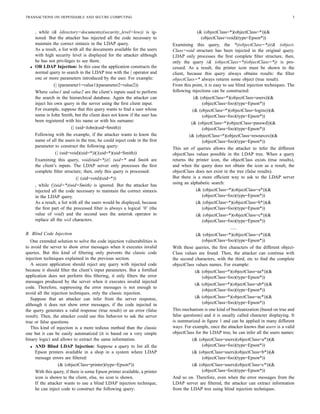
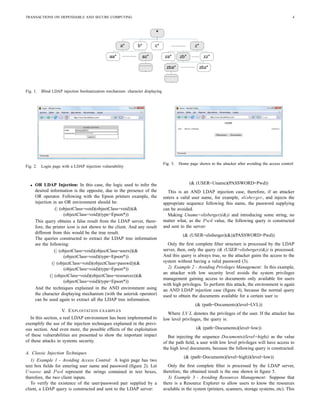
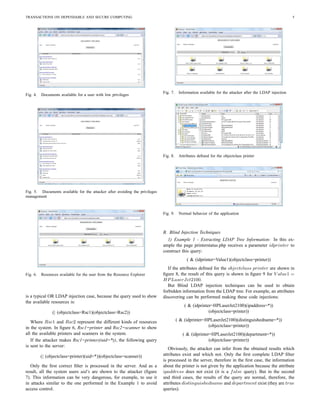
(& (directory=documents)(security level=high))](https://image.slidesharecdn.com/articuloiccs-140726081955-phpapp02/85/LDAP-Injection-Techniques-2-320.jpg)

![TRANSACTIONS ON DEPENDABLE AND SECURE COMPUTING 7
protection is needed to avoid this kind of injection vulnerabilities
too. It has been demonstrated with the presented examples, that it is
essential to filter the client inputs used to construct the LDAP queries
before sending them to the server. And that the AND and OR filter
constructions should be avoided.
Finally, a very interesting line for future research is working on
analyzing injection techniques with other protocols used to access
databases and directories. And to study the possible utilization of
mechanisms booleanization techniques such as character displaying
or charset reduction in other environments.
REFERENCES
[1] S. Barnum and G. McGraw, “Knowledge for software security,” IEEE
Security and Privacy Magazine, vol. 3(2), pp. 74–78, 2005.
[2] E. Bertino, A. Kamra, and J. Early, “Profiling database application to
detect SQL injection attacks,” in Proceedings of the IEEE International
Performance, Computing, and Communications Conference, 2007, pp.
449–458.
[3] X. Fug, X. Lu, B. Peltsverger, S. Chen, K. Qian, and L. Tao, “A
static analysis framework for detecting SQL injection vulnerabilities,”
in Proceedings of the 31st Annual International Computer Software and
Applications Conference, 2007, pp. 87–96.
[4] E. Merlo, D. Letarte, and G. Antoniol, “SQL-injection security evolution
analysis in PHP,” in Proceedings of the 9th IEEE International Workshop
on Web Site Evolution, 2007, pp. 45–49.
[5] S. Thomas and L. Williams, “Using automated fix generation to secure
SQL statements,” in Proceedings of the 3rd International Workshop on
Software Engineering for Secure Systems, 2007, pp. 9–19.
[6] “XPath 1.0 specification,” 1999, http://www.w3.org/TR/xpath.
[7] “XPath 2.0 specification,” 2007, http://www.w3.org/TR/xpath20/.
[8] “RFC 1777: Lightweight Directory Access Protocol v2,” 1995,
http://www.faqs.org/rfcs/rfc1777.html.
[9] “RFC 2251: Lightweight Directory Access Protocol v3,” 1997,
http://www.faqs.org/rfcs/rfc2251.html.
[10] T. Holz, S. Marechal, and F. Raynal, “New threats and attacks on the
world wide web,” IEEE Security and Privacy Magazine, vol. 4(2), 2006.
[11] G. Hermosillo, R. Gomez, L. Seinturier, and L. Duchien, “AProSec:
an aspect for programming secure web applications,” in Proceedings
of the Second International Conference on Availability, Reliability and
Security, 2007, pp. 1026–1033.
[12] N. Jovanovic, C. Kruegel, and E. Kirda, “Pixy: a static analysis tool for
detecting web application vulnerabilities,” in Proceedings of the IEEE
Symposium on Security and Privacy, 2006, pp. 6–15.
[13] E. Jamhour, “Distributed security management using LDAP directories,”
in Proceedings of the XXI Internatinal Conference of the Chilean
Computer Science Society, 2001, pp. 144–153.
[14] R. Sari and S. Hidayat, “Integrating web server applications with LDAP
authentication: Case study on human resources information system of
ui,” in Proceedings of the International Symposium on Communications
and Information Technologies, 2006, pp. 307–312.
[15] M. Wahl, T. Howes, and S. Kille, “Lightweight Directory Access
Protocol (v3),” 1997, www.ietf.org/rfc/rfc2251.
[16] V. Koutsonikola and A. Vakali, “LDAP: framework, practices, and
trends,” IEEE Internet Computing, vol. 8(5), pp. 66–72, 2004.
[17] M. Russinovich and D. Solomon, Microsoft Windows Internals. Mi-
crosoft Press, 2004.
[18] “OpenLDAP main page,” www.openldap.org.
[19] N. Klasen, “Directory services for Linux, in comparison with Novell
NDS and Microsoft Active Directory,” 2001, master Thesis, Aachen
University.](https://image.slidesharecdn.com/articuloiccs-140726081955-phpapp02/85/LDAP-Injection-Techniques-7-320.jpg)

This document analyzes LDAP injection techniques that can be used to exploit vulnerabilities in web applications that use LDAP directories. It discusses two types of LDAP injection - classic and blind. Classic injection allows attackers to directly execute malicious queries by appending injected code that will be processed by the LDAP server. Blind injection uses a binary approach to infer information from the server response without error messages. The document examines real examples of how attackers can use injected queries to view restricted documents or obtain a full list of users from the LDAP directory. It emphasizes that input validation is needed to prevent both classic and blind LDAP injection attacks.


