BP231523
MYTHILI.G
I-Msc.MICROBIOLOGY
 Wine is an alcoholic beverage typically made
from fermented grapes. Yeast consumes the
sugar in the grapes and converts it to
ethanol and carbon dioxide and releasing
heat in the process. Wine making practice is
one of the oldest ancient civilizations.
 Otherwise called vinification and the study
called as oenology.
1) Table wine
2) Sparkling wine
3) Fortified wine and
4) Aromatic wine.
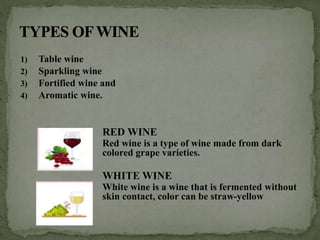
RED WINE
Red wine is a type of wine made from dark
colored grape varieties.
WHITE WINE
White wine is a wine that is fermented without
skin contact, color can be straw-yellow
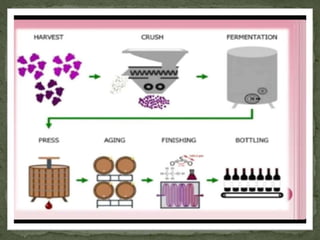
1) Viticulture
2) Harvesting
3) Crushing
4) Fermentation
5) Draining
6) Pressing
7) Mixing
8) Clarification
9) Aging
10) Bottling
 Viticulture is the cultivation and harvesting of grapes. It is a
branch of science of horticulture.
 Climate of the vineyards region.
 Sun exposure.
 Soil quality.
HARVESTING
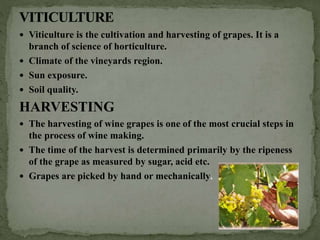
 The harvesting of wine grapes is one of the most crucial steps in
the process of wine making.
 The time of the harvest is determined primarily by the ripeness
of the grape as measured by sugar, acid etc.
 Grapes are picked by hand or mechanically.
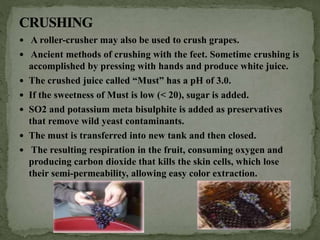
 A roller-crusher may also be used to crush grapes.
 Ancient methods of crushing with the feet. Sometime crushing is
accomplished by pressing with hands and produce white juice.
 The crushed juice called “Must” has a pH of 3.0.
 If the sweetness of Must is low (< 20), sugar is added.
 SO2 and potassium meta bisulphite is added as preservatives
that remove wild yeast contaminants.
 The must is transferred into new tank and then closed.
 The resulting respiration in the fruit, consuming oxygen and
producing carbon dioxide that kills the skin cells, which lose
their semi-permeability, allowing easy color extraction.
 After six hours of adding SO2 the starter culture is added. The Must is
inoculated with 3% yeast starter culture, Saccharomyces cerevisiae var
ellipsoideus.
 Nutrients like, ammonium sulphate is added as nitrogen source.
 Anaerobic condition, a temperature of 21 – 27 °C and pH at 3.0 – 3.6 are
maintained during fermentation.
 Partially fermented wine is decanted and again allowed to ferment for 7 –
10 days.
 After fermentation is completed, the wine is decanted from sediment of
yeast and particles of grape tissues.
 Fermented Must is filtered and fining agents such as casein, gelatine, egg
white, tannin may be added for clarification. Clearing of wine and
development of flavour take place during aging of at least 8 – 10 months.
• The purpose of draining and pressing is to separate the wine from the
skins.
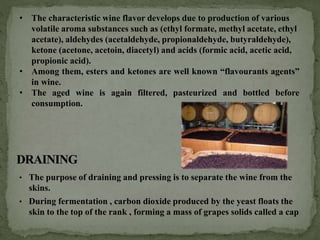
• During fermentation , carbon dioxide produced by the yeast floats the
skin to the top of the rank , forming a mass of grapes solids called a cap
• The characteristic wine flavor develops due to production of various
volatile aroma substances such as (ethyl formate, methyl acetate, ethyl
acetate), aldehydes (acetaldehyde, propionaldehyde, butyraldehyde),
ketone (acetone, acetoin, diacetyl) and acids (formic acid, acetic acid,
propionic acid).
• Among them, esters and ketones are well known “flavourants agents”
in wine.
• The aged wine is again filtered, pasteurized and bottled before
consumption.
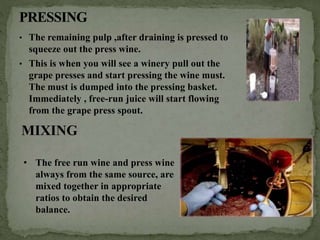
• The remaining pulp ,after draining is pressed to
squeeze out the press wine.
• This is when you will see a winery pull out the
grape presses and start pressing the wine must.
The must is dumped into the pressing basket.
Immediately , free-run juice will start flowing
from the grape press spout.
MIXING
• The free run wine and press wine
always from the same source, are
mixed together in appropriate
ratios to obtain the desired
balance.
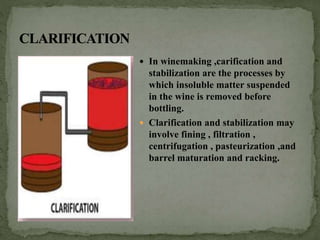
 In winemaking ,carification and
stabilization are the processes by
which insoluble matter suspended
in the wine is removed before
bottling.
 Clarification and stabilization may
involve fining , filtration ,
centrifugation , pasteurization ,and
barrel maturation and racking.
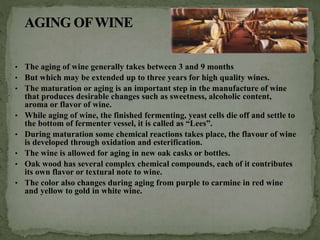
• The aging of wine generally takes between 3 and 9 months
• But which may be extended up to three years for high quality wines.
• The maturation or aging is an important step in the manufacture of wine
that produces desirable changes such as sweetness, alcoholic content,
aroma or flavor of wine.
• While aging of wine, the finished fermenting, yeast cells die off and settle to
the bottom of fermenter vessel, it is called as “Lees”.
• During maturation some chemical reactions takes place, the flavour of wine
is developed through oxidation and esterification.
• The wine is allowed for aging in new oak casks or bottles.
• Oak wood has several complex chemical compounds, each of it contributes
its own flavor or textural note to wine.
• The color also changes during aging from purple to carmine in red wine
and yellow to gold in white wine.
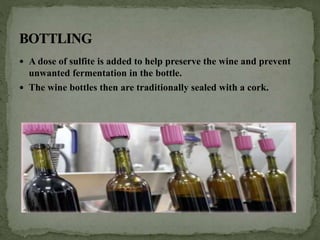
 A dose of sulfite is added to help preserve the wine and prevent
unwanted fermentation in the bottle.
 The wine bottles then are traditionally sealed with a cork.
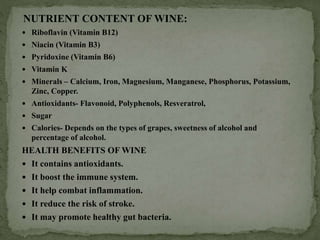
NUTRIENT CONTENT OF WINE:
 Riboflavin (Vitamin B12)
 Niacin (Vitamin B3)
 Pyridoxine (Vitamin B6)
 Vitamin K
 Minerals – Calcium, Iron, Magnesium, Manganese, Phosphorus, Potassium,
Zinc, Copper.
 Antioxidants- Flavonoid, Polyphenols, Resveratrol,
 Sugar
 Calories- Depends on the types of grapes, sweetness of alcohol and
percentage of alcohol.
HEALTH BENEFITS OF WINE
 It contains antioxidants.
 It boost the immune system.
 It help combat inflammation.
 It reduce the risk of stroke.
 It may promote healthy gut bacteria.
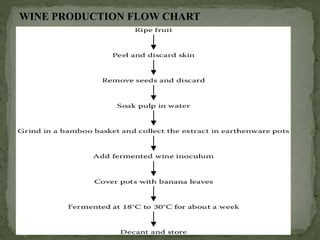
WINE PRODUCTION FLOW CHART
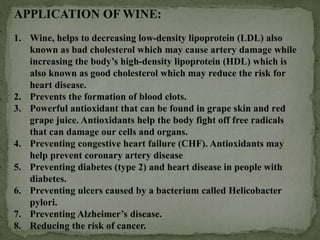
APPLICATION OF WINE:
1. Wine, helps to decreasing low-density lipoprotein (LDL) also
known as bad cholesterol which may cause artery damage while
increasing the body’s high-density lipoprotein (HDL) which is
also known as good cholesterol which may reduce the risk for
heart disease.
2. Prevents the formation of blood clots.
3. Powerful antioxidant that can be found in grape skin and red
grape juice. Antioxidants help the body fight off free radicals
that can damage our cells and organs.
4. Preventing congestive heart failure (CHF). Antioxidants may
help prevent coronary artery disease
5. Preventing diabetes (type 2) and heart disease in people with
diabetes.
6. Preventing ulcers caused by a bacterium called Helicobacter
pylori.
7. Preventing Alzheimer’s disease.
8. Reducing the risk of cancer.
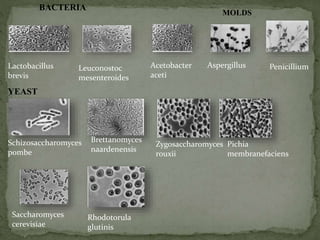
Lactobacillus
brevis
Leuconostoc
mesenteroides
Acetobacter
aceti
Aspergillus Penicillium
BACTERIA
MOLDS
Schizosaccharomyces
pombe
Brettanomyces
naardenensis
Zygosaccharomyces
rouxii
Pichia
membranefaciens
Saccharomyces
cerevisiae
Rhodotorula
glutinis
YEAST
wine production (large scale production).pptx

wine production (large scale production).pptx

  • 1.
  • 2.
     Wine isan alcoholic beverage typically made from fermented grapes. Yeast consumes the sugar in the grapes and converts it to ethanol and carbon dioxide and releasing heat in the process. Wine making practice is one of the oldest ancient civilizations.  Otherwise called vinification and the study called as oenology.
  • 3.
    1) Table wine 2)Sparkling wine 3) Fortified wine and 4) Aromatic wine. RED WINE Red wine is a type of wine made from dark colored grape varieties. WHITE WINE White wine is a wine that is fermented without skin contact, color can be straw-yellow
  • 4.
    1) Viticulture 2) Harvesting 3)Crushing 4) Fermentation 5) Draining 6) Pressing 7) Mixing 8) Clarification 9) Aging 10) Bottling
  • 5.
     Viticulture isthe cultivation and harvesting of grapes. It is a branch of science of horticulture.  Climate of the vineyards region.  Sun exposure.  Soil quality. HARVESTING  The harvesting of wine grapes is one of the most crucial steps in the process of wine making.  The time of the harvest is determined primarily by the ripeness of the grape as measured by sugar, acid etc.  Grapes are picked by hand or mechanically.
  • 6.
     A roller-crushermay also be used to crush grapes.  Ancient methods of crushing with the feet. Sometime crushing is accomplished by pressing with hands and produce white juice.  The crushed juice called “Must” has a pH of 3.0.  If the sweetness of Must is low (< 20), sugar is added.  SO2 and potassium meta bisulphite is added as preservatives that remove wild yeast contaminants.  The must is transferred into new tank and then closed.  The resulting respiration in the fruit, consuming oxygen and producing carbon dioxide that kills the skin cells, which lose their semi-permeability, allowing easy color extraction.
  • 7.
     After sixhours of adding SO2 the starter culture is added. The Must is inoculated with 3% yeast starter culture, Saccharomyces cerevisiae var ellipsoideus.  Nutrients like, ammonium sulphate is added as nitrogen source.  Anaerobic condition, a temperature of 21 – 27 °C and pH at 3.0 – 3.6 are maintained during fermentation.  Partially fermented wine is decanted and again allowed to ferment for 7 – 10 days.  After fermentation is completed, the wine is decanted from sediment of yeast and particles of grape tissues.  Fermented Must is filtered and fining agents such as casein, gelatine, egg white, tannin may be added for clarification. Clearing of wine and development of flavour take place during aging of at least 8 – 10 months.
  • 8.
    • The purposeof draining and pressing is to separate the wine from the skins. • During fermentation , carbon dioxide produced by the yeast floats the skin to the top of the rank , forming a mass of grapes solids called a cap • The characteristic wine flavor develops due to production of various volatile aroma substances such as (ethyl formate, methyl acetate, ethyl acetate), aldehydes (acetaldehyde, propionaldehyde, butyraldehyde), ketone (acetone, acetoin, diacetyl) and acids (formic acid, acetic acid, propionic acid). • Among them, esters and ketones are well known “flavourants agents” in wine. • The aged wine is again filtered, pasteurized and bottled before consumption.
  • 9.
    • The remainingpulp ,after draining is pressed to squeeze out the press wine. • This is when you will see a winery pull out the grape presses and start pressing the wine must. The must is dumped into the pressing basket. Immediately , free-run juice will start flowing from the grape press spout. MIXING • The free run wine and press wine always from the same source, are mixed together in appropriate ratios to obtain the desired balance.
  • 10.
     In winemaking,carification and stabilization are the processes by which insoluble matter suspended in the wine is removed before bottling.  Clarification and stabilization may involve fining , filtration , centrifugation , pasteurization ,and barrel maturation and racking.
  • 11.
    • The agingof wine generally takes between 3 and 9 months • But which may be extended up to three years for high quality wines. • The maturation or aging is an important step in the manufacture of wine that produces desirable changes such as sweetness, alcoholic content, aroma or flavor of wine. • While aging of wine, the finished fermenting, yeast cells die off and settle to the bottom of fermenter vessel, it is called as “Lees”. • During maturation some chemical reactions takes place, the flavour of wine is developed through oxidation and esterification. • The wine is allowed for aging in new oak casks or bottles. • Oak wood has several complex chemical compounds, each of it contributes its own flavor or textural note to wine. • The color also changes during aging from purple to carmine in red wine and yellow to gold in white wine.
  • 12.
     A doseof sulfite is added to help preserve the wine and prevent unwanted fermentation in the bottle.  The wine bottles then are traditionally sealed with a cork.
  • 13.
    NUTRIENT CONTENT OFWINE:  Riboflavin (Vitamin B12)  Niacin (Vitamin B3)  Pyridoxine (Vitamin B6)  Vitamin K  Minerals – Calcium, Iron, Magnesium, Manganese, Phosphorus, Potassium, Zinc, Copper.  Antioxidants- Flavonoid, Polyphenols, Resveratrol,  Sugar  Calories- Depends on the types of grapes, sweetness of alcohol and percentage of alcohol. HEALTH BENEFITS OF WINE  It contains antioxidants.  It boost the immune system.  It help combat inflammation.  It reduce the risk of stroke.  It may promote healthy gut bacteria.
  • 14.
  • 15.
    APPLICATION OF WINE: 1.Wine, helps to decreasing low-density lipoprotein (LDL) also known as bad cholesterol which may cause artery damage while increasing the body’s high-density lipoprotein (HDL) which is also known as good cholesterol which may reduce the risk for heart disease. 2. Prevents the formation of blood clots. 3. Powerful antioxidant that can be found in grape skin and red grape juice. Antioxidants help the body fight off free radicals that can damage our cells and organs. 4. Preventing congestive heart failure (CHF). Antioxidants may help prevent coronary artery disease 5. Preventing diabetes (type 2) and heart disease in people with diabetes. 6. Preventing ulcers caused by a bacterium called Helicobacter pylori. 7. Preventing Alzheimer’s disease. 8. Reducing the risk of cancer.
  • 16.