MICROBIAL
BIOTECHNOLOGY
PRODUCTION OF
WINE
RAMYA P
I M.Sc
Department of molecular
biology
Bangalore university
INTRODUCTION
 Undistilled product of fruit juice fermentation brought about by yeast.
 Produced by normal alcoholic fermentation of fruit juice, especially
grapes.
 Microbe used – Saccharomyces cerevesiae.
 Anaerobic conditions favour alcoholic fermentation liberating carbon
dioxide and ethyl alcohol.

 Science of wine production – ENOLOGY.
 Wine maker – ENOLOGIST.
 Someone who enjoys the wine – ENOPHILE.
HISTORY
 Earliest wine 8000BC in Mesopotamia.
 2500BC – Egyptians.
 Greeks and Romans worshiped a god of wine.
 Romans – Bacchus
 Greeks – Dionysus
HEALTH BENEFITS
 Decreased incident of heart attack and strokes.
 Reduced tumors.
 Blocks formation of amyloidal plaques which contribute to Alzheimer’s.
 Better dental health.
 Flavanoids ( anthocyanin) in grapes gives red colour to skin.
 Decreases cholesterol.
 Rich in antioxidants ( RESVERATROL).
 Ward off fungal infections and other diseases.
CLASSIFICATION OF WINE
 STILL TABLE WINES
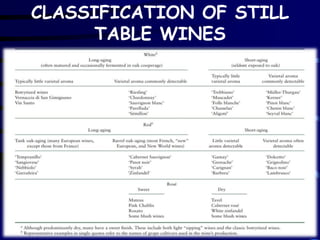
 The oldest division based on color, separates wine into red, white and
rose subgroups.
 Red wines – more flavourful, typically drier and more astringent than
white wines.
 White wines – more acidic, floral in nature and is aailable in a wide range
of sweetness cycles.
 Roses fall in between, being lighter than red wines but more astringent
than whites.
CLASSIFICATION OF STILL
TABLE WINES
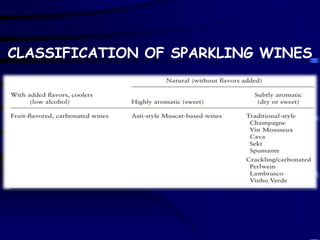
 SPARKLING WINES
 Classified based on the method of production.
 Three principal techniques are traditional (Champagne), transfer and
bulk (Charmat).
 Employ yeast to generate carbon dioxide that produces effervescence.
 Carbonated sparkling wines – carbon dioxide incorporated under
pressure.
 Include dry white wines such as vinho verde (malolactic fermentation).
CLASSIFICATION OF SPARKLING WINES
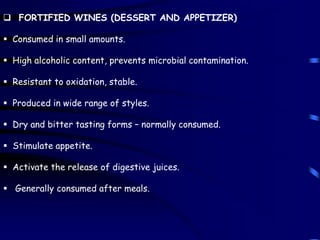
 FORTIFIED WINES (DESSERT AND APPETIZER)
 Consumed in small amounts.
 High alcoholic content, prevents microbial contamination.
 Resistant to oxidation, stable.
 Produced in wide range of styles.
 Dry and bitter tasting forms – normally consumed.
 Stimulate appetite.
 Activate the release of digestive juices.
 Generally consumed after meals.
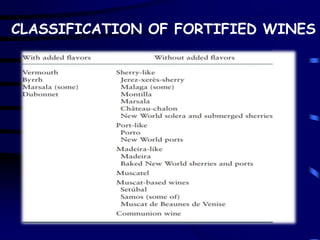
CLASSIFICATION OF FORTIFIED WINES
STRUCTURE OF GRAPES
PREPERATION OF STILL TABLE WINES
 SORTING: Harvested grapes are sorted at the winery.
 Whole bunches or clusters of healthy grapes are separated from
damaged fruit, leaves, dirt, etc., before crushing.
 For some fine wines, there’s a selection process in the vineyard or
berry-by-berry sorting.
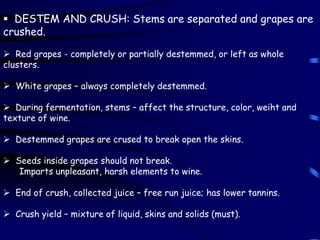
 DESTEM AND CRUSH: Stems are separated and grapes are
crushed.
 Red grapes - completely or partially destemmed, or left as whole
clusters.
 White grapes – always completely destemmed.
 During fermentation, stems – affect the structure, color, weiht and
texture of wine.
 Destemmed grapes are crused to break open the skins.
 Seeds inside grapes should not break.
Imparts unpleasant, harsh elements to wine.
 End of crush, collected juice – free run juice; has lower tannins.
 Crush yield – mixture of liquid, skins and solids (must).
 MACERATION AND PRESS: Must may macerate( soak
together).
 Red wine: must macerates, undergoes fermentation to extract the
phenolics in the grapes ; followed by pressing.
 Rose wine: maceration is kept brief, producing lightly colored juice that
is separated from the red grape skins during fermentation.
 White wine: pressed immediately before fermentation and the skins are
removed.
No maceration with skin.
 Maceration is simultaneous with fermentation.
 Inflatable membranes and pneumatic presses can execute long.
Slow periods of precise, minute amounts of pressure for an etremely
gentle pressing.
 High- tech presses to gently press grapes without crushing the seeds.
 High amounts of tannins in press juice than in free- run juice.
PRESSING
 FERMENTATION: Turns must into wine.
 Metabolism of yeast converts sugar to alcohol.
 Red wines: 1- 2 weeks, 50- 86ºF.
 Rose and white wines: 2- 4 weeks, 50- 68ºF.
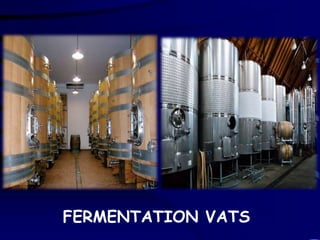
 Fermentation occurs in vats of stainless steel, lined with concrete or
wood.
 Too low temperature inibits extracting the best material from the
grapes
 Too high temperature decreases aroma and flovour complexity.
FERMENTATION VATS
VAT MATERIAL AND CHARACTER OF
WINE
 Steel tanks:
o Wines with fresh aromas and flavour.
o Temperature controlled systems are necessary.
 Concrete tanks:
o Excellent heat retention & consistent temperature.
o Allows softest micro-oxygenation, results in soft, round, plush textured
wines.
 Wood vats:
o Good heat retention, soft micro-oxygenation.
o Ability to maintain wild yeasts which can produce aromatic, complex and
profound wines.
CONCRETE VATS
 MALOLACTIC FERMENTATION (MLF): An optional method
that influences a wine’s style.
 After fermentation, wine contains malic acid.
 MLF converts to a softer, creamier lactic acids, enhances wine’s
roundness, texture and complexity.
 MLF is caused by bacteria either present in older wines or added soon
after fermentation begins in newer wineries.
 Warmer temperature is required.
 Most winemakers initiate MLF after alcoholic fermentation has
completed.
 MATURATION: Wine ages in vat or barrel to complete it’s
aroma and flavor development.
 Wine is aged in large stainless steel or concrete vats, large wood casks
or small oak barrels.
 Stainless steel - retain it’s fresh fruit aromas and lively, bright acidity.
 Large concrete or old wood vessels – soften the wines with a process of
micro-oxygenation.
 Micro-oxygenation introduces minute amounts of oxygen, helps soften
tannins, makes wine rounder, darker with more stable color.
 New oat vats or barrels: adds some wood tannins and aids the
development of phenolics.
OAK FACTORS THAT DETERMINE FLAVOR
PROFILE
 Fine- grained oak imparts neutral cinnamon and vanilla aromas.
 Coarse- grained oak contributes overt vanilla, dill, butter, coconut and
cedar aromas.
 Oak’s interior is charred or toasted by fire.
 BOTTLING: Preparing the wine for release.
 After barrel aging, final blending is done to ensure uniformity in
finished wine.
 finished wines undergo fining or filtration to remove impurities.
 Addition of SO2 to protect the wine.
 Natural wines require no fining, filtration or additives prior to bottling.
 BOTTLE AGING: Wine ages further in bottle.
 Majority of wines- immediate drinking. White and rose wines are best
when they are youthful.
 Some wines are designed to benefit from bottle aging in optimal clear
conditions.
 During their slow evolution, fine wines loses bold, primary fruit
characters but gain tremendous depth and complexity.
 They acquire secondary and tertiary aromas and flavors (forest floor,
cigar box, leather for reds, caramel, nuts, marzipan and beeswax for
whites.
 50 – 55º F and 70 – 90 % humidity, fine wines can age and evolve well
for a few years to several decades.
PRODUCTION OF SPARKLING WINE
Champagne method (also traditional method), used to make champagne and
Cava
 After a standard still – wine viniication the wine is bottled.
 A wine/ sugar/ yeast mixture called the liqueur de tirage is added,
followed by sealing the bottle.
 Key to Champagne method is the secondary fermentation, where the
released CO2 cannot escape the sealed bottle and makes the wine
effervescent.
 After fermentation, the bottle is tilted gradually or riddled, over 9
months to several years, to collect the dead yeast cells.
 The bottle neck is frozen and the cells are removed or disgorged.
 Before the bottle is finally recorked, the dosage, a wine and sugar syrup
mixture is added to give the wine it’s final style and sweetness.
PRODUCION OF FORIFIED WINES
Port and Sherry
 During still wine vinification and before fermentation is complete when
the desired amount of grape sugar is converted to alcohol, the wine is
fortified with wine grape spirit.
This halts fermentation and produces a wine with 15 – 22º C alcohol.
 For Ports the wines from different vineyards are tasted and earmarked
for different port types and aging;
Vintage, Late Bottled Vintage and Ruby are aged in large vats and
aged Tawnies are matured in small casks called pipes.
 For Sherries there are two main types, Finos and Olorosos and many
styles including Cream and PX.
Sherries are aged in a solera system, where numerous Sherries of
different ages are blended together.
REFERENCES
Ronald S Jackson, Wine science: Principles and applications.
Kob edu guide, Wine making.
Claudia Steen, Wine basics: From grapes to glasses.
Vaishali Rathi, Herbal wine: a review, A journal of nutrition and
weight loss.
THANK YOU

Wine producttion

  • 1.
    MICROBIAL BIOTECHNOLOGY PRODUCTION OF WINE RAMYA P IM.Sc Department of molecular biology Bangalore university
  • 2.
    INTRODUCTION  Undistilled productof fruit juice fermentation brought about by yeast.  Produced by normal alcoholic fermentation of fruit juice, especially grapes.  Microbe used – Saccharomyces cerevesiae.  Anaerobic conditions favour alcoholic fermentation liberating carbon dioxide and ethyl alcohol.  Science of wine production – ENOLOGY.  Wine maker – ENOLOGIST.  Someone who enjoys the wine – ENOPHILE.
  • 3.
    HISTORY  Earliest wine8000BC in Mesopotamia.  2500BC – Egyptians.  Greeks and Romans worshiped a god of wine.  Romans – Bacchus  Greeks – Dionysus
  • 4.
    HEALTH BENEFITS  Decreasedincident of heart attack and strokes.  Reduced tumors.  Blocks formation of amyloidal plaques which contribute to Alzheimer’s.  Better dental health.  Flavanoids ( anthocyanin) in grapes gives red colour to skin.  Decreases cholesterol.  Rich in antioxidants ( RESVERATROL).  Ward off fungal infections and other diseases.
  • 5.
    CLASSIFICATION OF WINE STILL TABLE WINES  The oldest division based on color, separates wine into red, white and rose subgroups.  Red wines – more flavourful, typically drier and more astringent than white wines.  White wines – more acidic, floral in nature and is aailable in a wide range of sweetness cycles.  Roses fall in between, being lighter than red wines but more astringent than whites.
  • 6.
  • 8.
     SPARKLING WINES Classified based on the method of production.  Three principal techniques are traditional (Champagne), transfer and bulk (Charmat).  Employ yeast to generate carbon dioxide that produces effervescence.  Carbonated sparkling wines – carbon dioxide incorporated under pressure.  Include dry white wines such as vinho verde (malolactic fermentation).
  • 9.
  • 11.
     FORTIFIED WINES(DESSERT AND APPETIZER)  Consumed in small amounts.  High alcoholic content, prevents microbial contamination.  Resistant to oxidation, stable.  Produced in wide range of styles.  Dry and bitter tasting forms – normally consumed.  Stimulate appetite.  Activate the release of digestive juices.  Generally consumed after meals.
  • 12.
  • 14.
  • 15.
    PREPERATION OF STILLTABLE WINES  SORTING: Harvested grapes are sorted at the winery.  Whole bunches or clusters of healthy grapes are separated from damaged fruit, leaves, dirt, etc., before crushing.  For some fine wines, there’s a selection process in the vineyard or berry-by-berry sorting.
  • 17.
     DESTEM ANDCRUSH: Stems are separated and grapes are crushed.  Red grapes - completely or partially destemmed, or left as whole clusters.  White grapes – always completely destemmed.  During fermentation, stems – affect the structure, color, weiht and texture of wine.  Destemmed grapes are crused to break open the skins.  Seeds inside grapes should not break. Imparts unpleasant, harsh elements to wine.  End of crush, collected juice – free run juice; has lower tannins.  Crush yield – mixture of liquid, skins and solids (must).
  • 19.
     MACERATION ANDPRESS: Must may macerate( soak together).  Red wine: must macerates, undergoes fermentation to extract the phenolics in the grapes ; followed by pressing.  Rose wine: maceration is kept brief, producing lightly colored juice that is separated from the red grape skins during fermentation.  White wine: pressed immediately before fermentation and the skins are removed. No maceration with skin.  Maceration is simultaneous with fermentation.  Inflatable membranes and pneumatic presses can execute long. Slow periods of precise, minute amounts of pressure for an etremely gentle pressing.  High- tech presses to gently press grapes without crushing the seeds.  High amounts of tannins in press juice than in free- run juice.
  • 21.
  • 22.
     FERMENTATION: Turnsmust into wine.  Metabolism of yeast converts sugar to alcohol.  Red wines: 1- 2 weeks, 50- 86ºF.  Rose and white wines: 2- 4 weeks, 50- 68ºF.  Fermentation occurs in vats of stainless steel, lined with concrete or wood.  Too low temperature inibits extracting the best material from the grapes  Too high temperature decreases aroma and flovour complexity.
  • 23.
  • 25.
    VAT MATERIAL ANDCHARACTER OF WINE  Steel tanks: o Wines with fresh aromas and flavour. o Temperature controlled systems are necessary.  Concrete tanks: o Excellent heat retention & consistent temperature. o Allows softest micro-oxygenation, results in soft, round, plush textured wines.  Wood vats: o Good heat retention, soft micro-oxygenation. o Ability to maintain wild yeasts which can produce aromatic, complex and profound wines.
  • 26.
  • 27.
     MALOLACTIC FERMENTATION(MLF): An optional method that influences a wine’s style.  After fermentation, wine contains malic acid.  MLF converts to a softer, creamier lactic acids, enhances wine’s roundness, texture and complexity.  MLF is caused by bacteria either present in older wines or added soon after fermentation begins in newer wineries.  Warmer temperature is required.  Most winemakers initiate MLF after alcoholic fermentation has completed.
  • 29.
     MATURATION: Wineages in vat or barrel to complete it’s aroma and flavor development.  Wine is aged in large stainless steel or concrete vats, large wood casks or small oak barrels.  Stainless steel - retain it’s fresh fruit aromas and lively, bright acidity.  Large concrete or old wood vessels – soften the wines with a process of micro-oxygenation.  Micro-oxygenation introduces minute amounts of oxygen, helps soften tannins, makes wine rounder, darker with more stable color.  New oat vats or barrels: adds some wood tannins and aids the development of phenolics.
  • 30.
    OAK FACTORS THATDETERMINE FLAVOR PROFILE  Fine- grained oak imparts neutral cinnamon and vanilla aromas.  Coarse- grained oak contributes overt vanilla, dill, butter, coconut and cedar aromas.  Oak’s interior is charred or toasted by fire.
  • 31.
     BOTTLING: Preparingthe wine for release.  After barrel aging, final blending is done to ensure uniformity in finished wine.  finished wines undergo fining or filtration to remove impurities.  Addition of SO2 to protect the wine.  Natural wines require no fining, filtration or additives prior to bottling.
  • 32.
     BOTTLE AGING:Wine ages further in bottle.  Majority of wines- immediate drinking. White and rose wines are best when they are youthful.  Some wines are designed to benefit from bottle aging in optimal clear conditions.  During their slow evolution, fine wines loses bold, primary fruit characters but gain tremendous depth and complexity.  They acquire secondary and tertiary aromas and flavors (forest floor, cigar box, leather for reds, caramel, nuts, marzipan and beeswax for whites.  50 – 55º F and 70 – 90 % humidity, fine wines can age and evolve well for a few years to several decades.
  • 35.
    PRODUCTION OF SPARKLINGWINE Champagne method (also traditional method), used to make champagne and Cava  After a standard still – wine viniication the wine is bottled.  A wine/ sugar/ yeast mixture called the liqueur de tirage is added, followed by sealing the bottle.  Key to Champagne method is the secondary fermentation, where the released CO2 cannot escape the sealed bottle and makes the wine effervescent.  After fermentation, the bottle is tilted gradually or riddled, over 9 months to several years, to collect the dead yeast cells.  The bottle neck is frozen and the cells are removed or disgorged.  Before the bottle is finally recorked, the dosage, a wine and sugar syrup mixture is added to give the wine it’s final style and sweetness.
  • 37.
    PRODUCION OF FORIFIEDWINES Port and Sherry  During still wine vinification and before fermentation is complete when the desired amount of grape sugar is converted to alcohol, the wine is fortified with wine grape spirit. This halts fermentation and produces a wine with 15 – 22º C alcohol.  For Ports the wines from different vineyards are tasted and earmarked for different port types and aging; Vintage, Late Bottled Vintage and Ruby are aged in large vats and aged Tawnies are matured in small casks called pipes.  For Sherries there are two main types, Finos and Olorosos and many styles including Cream and PX. Sherries are aged in a solera system, where numerous Sherries of different ages are blended together.
  • 39.
    REFERENCES Ronald S Jackson,Wine science: Principles and applications. Kob edu guide, Wine making. Claudia Steen, Wine basics: From grapes to glasses. Vaishali Rathi, Herbal wine: a review, A journal of nutrition and weight loss.
  • 40.