Wine Education
for Tasting Room Staff
      Robbin Gheesling
     Vineyard Adventures

   http://slidesha.re/AwZR0u
Roles in wine tourism
  & how they function


In-house winery staff

Incoming tour operators

Independent local tour guides
Considerations for Hiring

 People should be hired for their personality
and the ability to communicate.

 This should take precedence over ANY
qualification or degree they may already have.

 Hiring for a tourism role should be long-term,
not seasonal.
Why?
Facts and processes can be learned personality
           and friendliness cannot!

Pay attention to their credentials if they have
                them already

  Tourism initiatives should not ONLY be
       executed during high-season
Don’t just take my word
         for it...


Opinions from LinkedIn
“The 'skilled' factor is vital as having the right
level / amount of knowledge is one thing, but the
   ability to put it across to consumers and the
      trade in an enthusiastic, passionate and
        entertaining way is something else!!”
“ In Europe, we feel that wine is intrinsically linked to the
culture and culinary traditions of the region in which it's
grown. So it's important to present it to guests in that
manner, in a cultural context. This also gets across another
important point to guests: that wine is about enjoyment,
pleasure and conviviality! A great wine tour guide knows how
to impart a sense of cultural context, pleasure and
conviviality to guests that makes their trip an authentic
experience of the region they're visiting, and highly
memorable!”
“...we have found that it's essential to have a guide who is highly
knowledgeable about wine, but who also has two other very important
qualities: 1) experience working with tourists, and 2) impeccable customer
service skills. Guiding a wine-oriented tour is not the same as giving a wine
class.

You have to know how to provide information tailored to each person,
as some guests will have a great deal of wine knowledge and want very
detailed, high-level information, while others have less knowledge (and
interest) and will want a shorter, simpler answer.

There are also times to talk, and times to just let the clients enjoy the scenery
or the meal. Guiding is sometimes about teaching, and a lot about helping the
clients have a great time on their tour. Knowing how to provide great
customer service is terribly important. A wine expert who is incapable of
dealing with a client who needs to find a pharmacy, or needs their room to be
changed because of an issue at the hotel, or any of the myriad of issues that
come up during a tour, is not going to be a good guide.”
So is education important?


                  YES
A wine knowledgeable guide is prepared to give
the right amount of information to the tourist
            that wants to hear it.
Options for education?
In-house staff should have IN-HOUSE education.

Quality control of the training is maintained and it is
inexpensive

 In-house education is investing in your product and in a
long-term employee

They should participate in all facets of the winemaking
process on site

Include this when they are interviewed for the job. If
they don’t want to get dirty, consider someone else
Outside Credentials


Wine service (sommelier)

Academic (journalist, author)
The Major Options


 Court of Master Sommeliers (International -
London based)

 Wine and Spirit Education Trust
(International - London Based)

 Associazione Italiana Sommelier (Italy)
Court of Master Sommeliers
www.courtofmastersommeliers.org   www.mastersommeliers.org


      Focused on wine knowledge and service

     Table side etiquette is taught and part of the
    examination

     Teaches wines of the world

     Must pass Certified at a certain score to be
    INVITED to sit the next level of qualification.
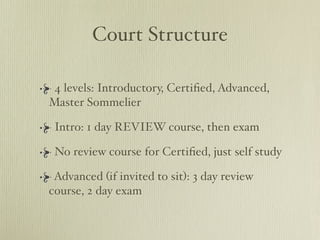
Court Structure

 4 levels: Introductory, Certified, Advanced,
Master Sommelier

 Intro: 1 day REVIEW course, then exam

 No review course for Certified, just self study

 Advanced (if invited to sit): 3 day review
course, 2 day exam
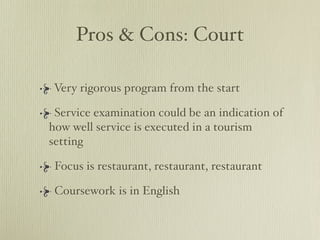
Pros & Cons: Court

Very rigorous program from the start

 Service examination could be an indication of
how well service is executed in a tourism
setting

 Focus is restaurant, restaurant, restaurant

 Coursework is in English
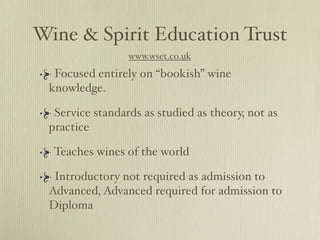
Wine & Spirit Education Trust
                 www.wset.co.uk
  Focused entirely on “bookish” wine
 knowledge.

  Service standards as studied as theory, not as
 practice

  Teaches wines of the world

  Introductory not required as admission to
 Advanced, Advanced required for admission to
 Diploma
WSET Structure
5 levels: Simply named Level 1-5

All have classroom instruction with tasting before exams

Level 1: for the absolute novice.

Level 2: Introduction to wines: e.g. What and where is
Chardonnay?

Level 3: 16 lesson course in-depth on wines of the world

Level 4: MUST pass Level 3 to enter the program

Intensive 3 year program with 6 units of exams
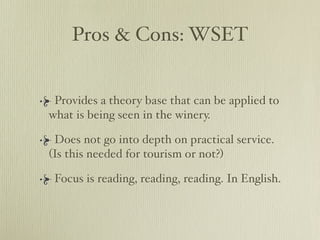
Pros & Cons: WSET


 Provides a theory base that can be applied to
what is being seen in the winery.

 Does not go into depth on practical service.
(Is this needed for tourism or not?)

 Focus is reading, reading, reading. In English.
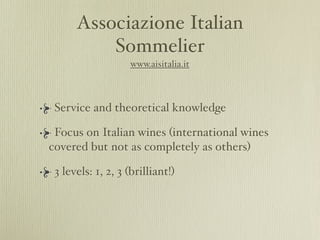
Associazione Italian
          Sommelier
                   www.aisitalia.it


 Service and theoretical knowledge

 Focus on Italian wines (international wines
covered but not as completely as others)

 3 levels: 1, 2, 3 (brilliant!)
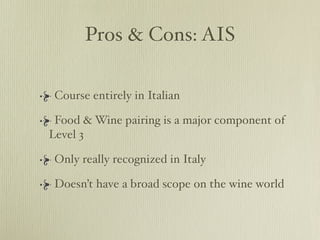
Pros & Cons: AIS

 Course entirely in Italian

 Food & Wine pairing is a major component of
Level 3

 Only really recognized in Italy

 Doesn’t have a broad scope on the wine world
In conclusion....


Hire on ability and aptitude.

 The education will follow.
Robbin Gheesling
Vineyard Adventures

robbin@vineyardadaventures.com

@robbin_g
@vineyardtravel