Submitted To: Sir Shahzad Ahmad
Former Lecturer Mechanical Department
MNS-UET Multan
Group Members:
(1) Sibtain Hashmi (2013-Bt-Mech-114)
(2) Syed Mesum Raza Naqvi (2013-Bt-Mech-116)
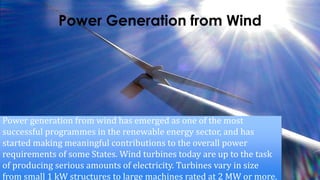
Power Generation from Wind
Power generation from wind has emerged as one of the most
successful programmes in the renewable energy sector, and has
started making meaningful contributions to the overall power
requirements of some States. Wind turbines today are up to the task
of producing serious amounts of electricity. Turbines vary in size
from small 1 kW structures to large machines rated at 2 MW or more.
What is “Renewable Energy”
Renewable energy is generally defined as
energy that comes from resources which
are naturally replenished on a human
timescale such as sunlight, wind, rain, tides,
waves and geothermal heat.
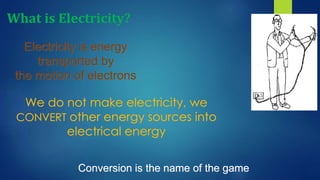
What is Electricity?
Electricity is energy
transported by
the motion of electrons
We do not make electricity, we
CONVERT other energy sources into
electrical energy
Conversion is the name of the game
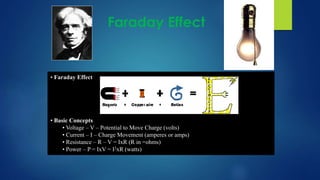
B Faraday Effect
• Faraday Effect
• Basic Concepts
• Voltage – V – Potential to Move Charge (volts)
• Current – I – Charge Movement (amperes or amps)
• Resistance – R – V = IxR (R in =ohms)
• Power – P = IxV = I2xR (watts)
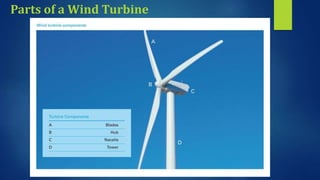
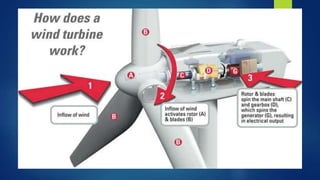
Parts of a Wind Turbine
Large Turbine:
• Able to Deliver Electricity at lower cost than
smaller turbines, because foundation costs are
independent of size.
Small Turbines:
• Local electrical grids may not be able to
handle the large electrical output from a large
turbine, so smaller turbines be more suitable.
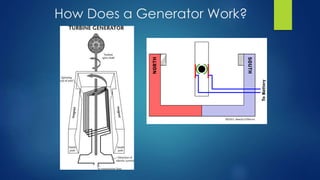
How Does a Generator Work?
Maintenance
Wind Turbine Perspective
Nacelle
56 tons
Tower
3 sections
Workers Blade
112’ long
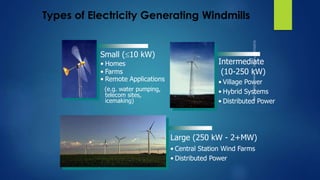
Types of Electricity Generating Windmills
Small (10 kW)
• Homes
• Farms
• Remote Applications
(e.g. water pumping,
telecom sites,
icemaking)
Large (250 kW - 2+MW)
• Central Station Wind Farms
• Distributed Power
Intermediate
(10-250 kW)
• Village Power
• Hybrid Systems
• Distributed Power
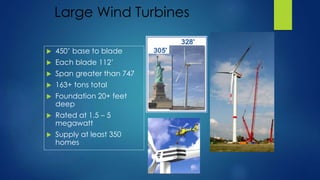
Large Wind Turbines
 450’ base to blade
 Each blade 112’
 Span greater than 747
 163+ tons total
 Foundation 20+ feet
deep
 Rated at 1.5 – 5
megawatt
 Supply at least 350
homes
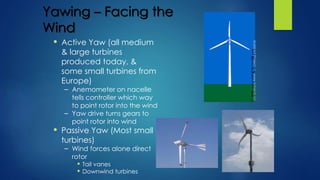
Yawing – Facing the
Wind
• Active Yaw (all medium
& large turbines
produced today, &
some small turbines from
Europe)
– Anemometer on nacelle
tells controller which way
to point rotor into the wind
– Yaw drive turns gears to
point rotor into wind
• Passive Yaw (Most small
turbines)
– Wind forces alone direct
rotor
• Tail vanes
• Downwind turbines
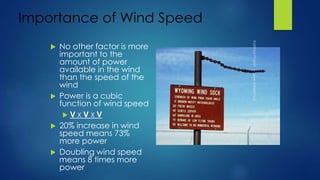
Importance of Wind Speed
 No other factor is more
important to the
amount of power
available in the wind
than the speed of the
wind
 Power is a cubic
function of wind speed
 V X V X V
 20% increase in wind
speed means 73%
more power
 Doubling wind speed
means 8 times more
power
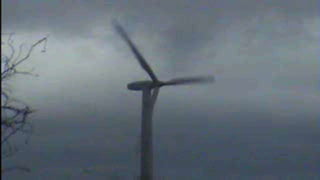
Disaster!
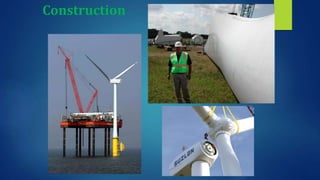
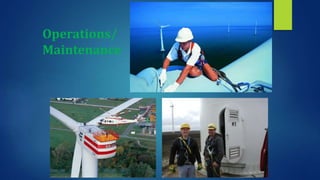
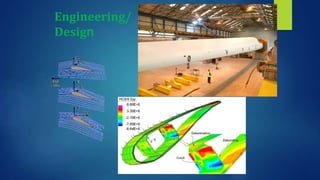
Jobs in the Wind Industry
Construction
Operations/
Maintenance
Engineering/
Design
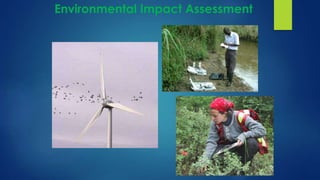
Environmental Impact Assessment
Wind Power is Fun!
Wind turbines

Wind turbines

  • 1.
    Submitted To: SirShahzad Ahmad Former Lecturer Mechanical Department MNS-UET Multan Group Members: (1) Sibtain Hashmi (2013-Bt-Mech-114) (2) Syed Mesum Raza Naqvi (2013-Bt-Mech-116)
  • 5.
    Power Generation fromWind Power generation from wind has emerged as one of the most successful programmes in the renewable energy sector, and has started making meaningful contributions to the overall power requirements of some States. Wind turbines today are up to the task of producing serious amounts of electricity. Turbines vary in size from small 1 kW structures to large machines rated at 2 MW or more.
  • 6.
    What is “RenewableEnergy” Renewable energy is generally defined as energy that comes from resources which are naturally replenished on a human timescale such as sunlight, wind, rain, tides, waves and geothermal heat.
  • 7.
    What is Electricity? Electricityis energy transported by the motion of electrons We do not make electricity, we CONVERT other energy sources into electrical energy Conversion is the name of the game
  • 8.
    B Faraday Effect •Faraday Effect • Basic Concepts • Voltage – V – Potential to Move Charge (volts) • Current – I – Charge Movement (amperes or amps) • Resistance – R – V = IxR (R in =ohms) • Power – P = IxV = I2xR (watts)
  • 9.
    Parts of aWind Turbine
  • 11.
    Large Turbine: • Ableto Deliver Electricity at lower cost than smaller turbines, because foundation costs are independent of size. Small Turbines: • Local electrical grids may not be able to handle the large electrical output from a large turbine, so smaller turbines be more suitable.
  • 12.
    How Does aGenerator Work?
  • 14.
  • 15.
    Wind Turbine Perspective Nacelle 56tons Tower 3 sections Workers Blade 112’ long
  • 16.
    Types of ElectricityGenerating Windmills Small (10 kW) • Homes • Farms • Remote Applications (e.g. water pumping, telecom sites, icemaking) Large (250 kW - 2+MW) • Central Station Wind Farms • Distributed Power Intermediate (10-250 kW) • Village Power • Hybrid Systems • Distributed Power
  • 17.
    Large Wind Turbines 450’ base to blade  Each blade 112’  Span greater than 747  163+ tons total  Foundation 20+ feet deep  Rated at 1.5 – 5 megawatt  Supply at least 350 homes
  • 18.
    Yawing – Facingthe Wind • Active Yaw (all medium & large turbines produced today, & some small turbines from Europe) – Anemometer on nacelle tells controller which way to point rotor into the wind – Yaw drive turns gears to point rotor into wind • Passive Yaw (Most small turbines) – Wind forces alone direct rotor • Tail vanes • Downwind turbines
  • 19.
    Importance of WindSpeed  No other factor is more important to the amount of power available in the wind than the speed of the wind  Power is a cubic function of wind speed  V X V X V  20% increase in wind speed means 73% more power  Doubling wind speed means 8 times more power
  • 20.
  • 21.
    Jobs in theWind Industry
  • 22.
  • 23.
  • 24.
  • 25.
  • 26.