Wind Energy: Bahrain World Trade Center
HINAATAH SHABIR
SEERAT AMEEN
ZAINAB HAMID
BUILDING CONSTRUCTION AND MATERIALS
BAR 702
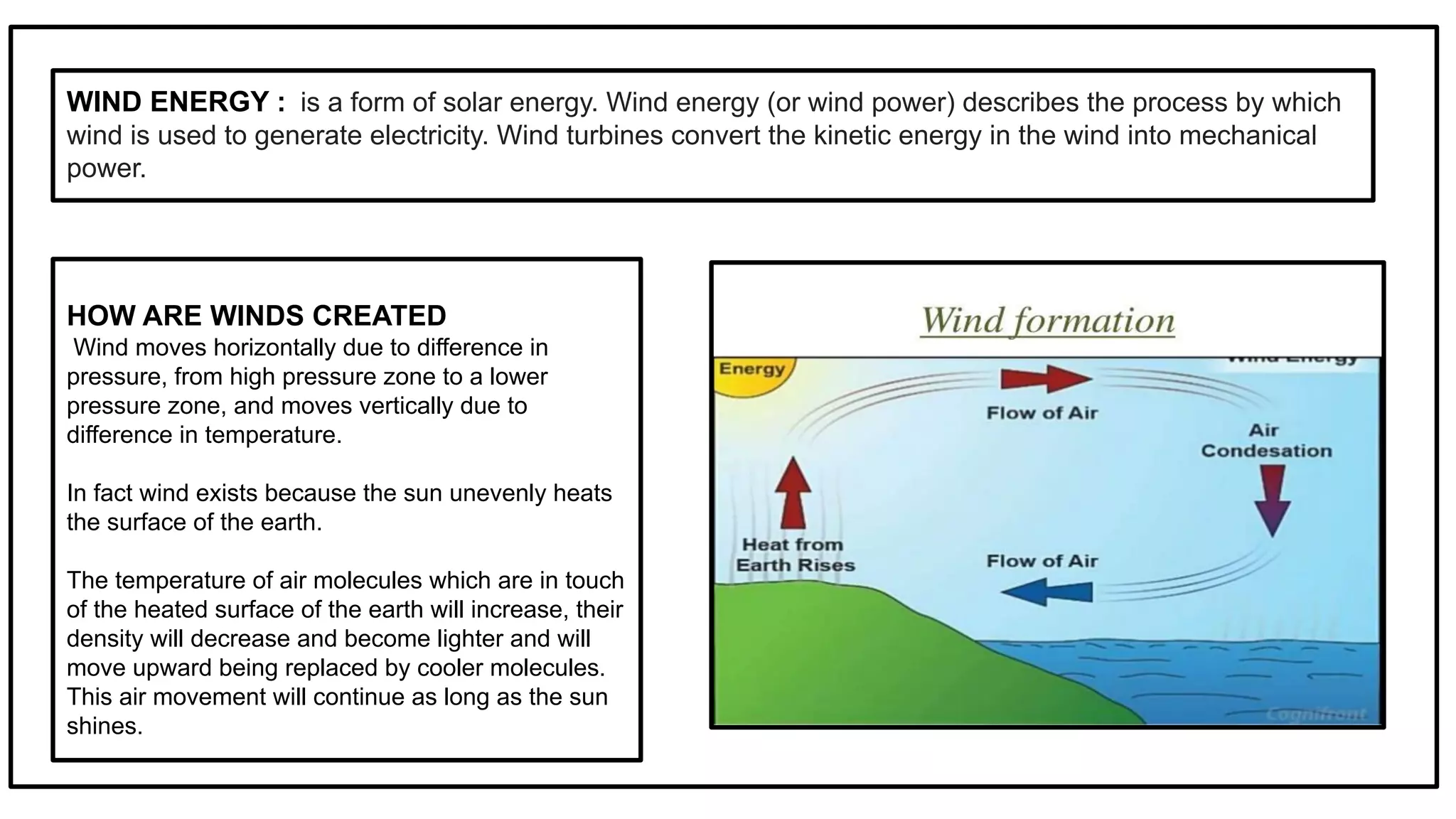
HOW ARE WINDS CREATED
Wind moves horizontally due to difference in
pressure, from high pressure zone to a lower
pressure zone, and moves vertically due to
difference in temperature.
In fact wind exists because the sun unevenly heats
the surface of the earth.
The temperature of air molecules which are in touch
of the heated surface of the earth will increase, their
density will decrease and become lighter and will
move upward being replaced by cooler molecules.
This air movement will continue as long as the sun
shines.
WIND ENERGY : is a form of solar energy. Wind energy (or wind power) describes the process by which
wind is used to generate electricity. Wind turbines convert the kinetic energy in the wind into mechanical
power.
ADVANTAGES OF WIND ENERGY
• Wind energy is a green energy source. Harnessing wind energy does not pollute the environment nearly
as much as fossil, coal and nuclear power do.
• The potential of wind power is absolutely incredible. Harnessing wind energy can be done almost
anywhere.
• Wind energy is a renewable source of energy. Wind is naturally occurring and there is no way we can
empty the energy resources.
COMPONENTS OF WIND TURBINE
● A wind turbine is used to harness the kinetic energy of
wind and convert it to electrical and mechanical
energy. Wind turbines consist of a foundation, a
tower, a nacelle and a rotor.
● The foundation is for supporting the turbine, while the
tower holds up the rotor and a nacelle (or box).
● The nacelle contains large primary components such
as the main axle, gearbox, generator, transformer
and control system.
● The rotor is made of 2 or 3 blades and the hub which
holds them in position as they turn.
● Wind turbines could be basically classified into two
groups; horizontal-axis turbines and vertical axis
turbines.
COMPONENTS OF WIND TURBINE:
Horizontal Axis Wind Turbines require a “yaw” mechanism to turn
the turbine against the wind direction in order to harvest the wind energy.
They are usually installed high up above ground level on a tower in order
to harvest the ample wind energy up in the sky.
There are 2 types of blades that are used on these turbines . The
turbines are usually installed on or close to the ground level. However,
the wind speed is always lower than that in the upper sky.
It operates in a limited range of wind direction.
It produces large amount of energy with high efficiency but are complex
in operation, maintenance and have high initial cost.
The Vertical Axis Wind Turbines
do not require a “yaw” mechanism to harvest the wind energy. Since the
blades rotate 360 degree on the vertical shaft of the wind turbines, wind of any
direction can turn the turbine.
VAWT are easy to build, maintain, safer mounted close to ground.
They can handle larger turbulence in wind than HAWT.
Mostly constructed with two blades.
It operates in any direction of wind.
TYPES OF WIND
TURBINE
IMPACT OF WIND ON PLAN AND BUILD FORM
Wind action on different height of buildings
Tall buildings are more critical for overturn
and possibly for the total horizontal deflection
at their tops.
The plan form of a building affects the airflow
around and through it. It could either aid or
hinder the natural flow of wind.
Wind action on different plan forms
Wind action on Built Forms Wind action on Semi-open Built Forms
Open-sided buildings or buildings with forms that
cup the wind tend to catch the wind, resulting in
more wind force than that assumed for the general
design pressures.
Buildings with rounded forms, rather than
rectangular forms with flat surfaces, offer less wind
resistance.
INTRODUCTION
Bahrain World Trade Center (also called Bahrain WTC or BWTC)
Height: 240-metre-high (787 ft),
No of floors: 50-floor,
Located in Manama, Bahrain.
Designed by the multinational architectural firm Atkins, construction
completed in 2008.
The Bahrain World Trade Center, located in the seafront of Manama,
Bahrain, is the first skyscraper in the world to integrate wind turbines
into its design.
The highly visible and dramatic wind turbines are seen as a strong
iconic statement about the importance of alternative energy sources.
BAHRAIN WIND CLIMATE
Micro onshore sea breeze: Bahrain World
Trade Centre Bahrain and Saudi Arabian land
masses heats up during the early hours of the
morning, creating uplift and cool sea breeze
replaces it resulting in a consistent onshore sea
breeze.
Bahrain wind rose :The Sea breeze effect
creates a consistent North Westerly onshore
breeze .
CONCEPTUAL INSPIRATION FOR THE TOWERS
The architects of the iconic building were inspired by traditional Arabian "wind towers," the idea which is successfully reflected in this skyscraper.
Traditional Arabian wind towers
FROM TRADITIONAL TO MODERN SYSTEM
Modern wind turbine
WIND ANALYSIS OF BAHRAIN WORLD TRADE CENTRE
● The aerofoil like buildings ensure
that any wind coming within a 45°
angle to either side of the central
axis will create a wind stream that
remains perpendicular to the
turbines. This allows the building to
take advantage of 70% of Bahrain’s
wind energy
● The wind turbines are expected to
provide 11% to 15% of the towers'
total power consumption, or
approximately 1.1 to 1.3 GWh a
year.
● The three turbines were turned on
for the first time on April 2008.
MICRO WIND CLIMATE ON THE BUILDING
● The elliptical plan forms and sail-shape
profiles of the towers act as aerofoils,
funnelling the onshore breeze between them
as well as creating a negative pressure
behind, thus accelerating the wind velocity
between the two towers
● Wind tunnel modeling and CFD modeling
taken at the uppermost turbine
● The wind increases from 12m/s to about
22m/s between the towers
CONCLUSION
Its very important to understand phenomena of wind over the building form to counteract the wind pressure on the structure.
Further, the design of tall buildings is not limited to wind sensitive design but rather using wind to the advantage of building.
THANKYOU

Wind energy

  • 1.
    Wind Energy: BahrainWorld Trade Center HINAATAH SHABIR SEERAT AMEEN ZAINAB HAMID BUILDING CONSTRUCTION AND MATERIALS BAR 702
  • 2.
    HOW ARE WINDSCREATED Wind moves horizontally due to difference in pressure, from high pressure zone to a lower pressure zone, and moves vertically due to difference in temperature. In fact wind exists because the sun unevenly heats the surface of the earth. The temperature of air molecules which are in touch of the heated surface of the earth will increase, their density will decrease and become lighter and will move upward being replaced by cooler molecules. This air movement will continue as long as the sun shines. WIND ENERGY : is a form of solar energy. Wind energy (or wind power) describes the process by which wind is used to generate electricity. Wind turbines convert the kinetic energy in the wind into mechanical power.
  • 3.
    ADVANTAGES OF WINDENERGY • Wind energy is a green energy source. Harnessing wind energy does not pollute the environment nearly as much as fossil, coal and nuclear power do. • The potential of wind power is absolutely incredible. Harnessing wind energy can be done almost anywhere. • Wind energy is a renewable source of energy. Wind is naturally occurring and there is no way we can empty the energy resources.
  • 4.
  • 5.
    ● A windturbine is used to harness the kinetic energy of wind and convert it to electrical and mechanical energy. Wind turbines consist of a foundation, a tower, a nacelle and a rotor. ● The foundation is for supporting the turbine, while the tower holds up the rotor and a nacelle (or box). ● The nacelle contains large primary components such as the main axle, gearbox, generator, transformer and control system. ● The rotor is made of 2 or 3 blades and the hub which holds them in position as they turn. ● Wind turbines could be basically classified into two groups; horizontal-axis turbines and vertical axis turbines. COMPONENTS OF WIND TURBINE:
  • 6.
    Horizontal Axis WindTurbines require a “yaw” mechanism to turn the turbine against the wind direction in order to harvest the wind energy. They are usually installed high up above ground level on a tower in order to harvest the ample wind energy up in the sky. There are 2 types of blades that are used on these turbines . The turbines are usually installed on or close to the ground level. However, the wind speed is always lower than that in the upper sky. It operates in a limited range of wind direction. It produces large amount of energy with high efficiency but are complex in operation, maintenance and have high initial cost. The Vertical Axis Wind Turbines do not require a “yaw” mechanism to harvest the wind energy. Since the blades rotate 360 degree on the vertical shaft of the wind turbines, wind of any direction can turn the turbine. VAWT are easy to build, maintain, safer mounted close to ground. They can handle larger turbulence in wind than HAWT. Mostly constructed with two blades. It operates in any direction of wind. TYPES OF WIND TURBINE
  • 7.
    IMPACT OF WINDON PLAN AND BUILD FORM Wind action on different height of buildings Tall buildings are more critical for overturn and possibly for the total horizontal deflection at their tops. The plan form of a building affects the airflow around and through it. It could either aid or hinder the natural flow of wind. Wind action on different plan forms
  • 8.
    Wind action onBuilt Forms Wind action on Semi-open Built Forms Open-sided buildings or buildings with forms that cup the wind tend to catch the wind, resulting in more wind force than that assumed for the general design pressures. Buildings with rounded forms, rather than rectangular forms with flat surfaces, offer less wind resistance.
  • 10.
    INTRODUCTION Bahrain World TradeCenter (also called Bahrain WTC or BWTC) Height: 240-metre-high (787 ft), No of floors: 50-floor, Located in Manama, Bahrain. Designed by the multinational architectural firm Atkins, construction completed in 2008. The Bahrain World Trade Center, located in the seafront of Manama, Bahrain, is the first skyscraper in the world to integrate wind turbines into its design. The highly visible and dramatic wind turbines are seen as a strong iconic statement about the importance of alternative energy sources.
  • 13.
    BAHRAIN WIND CLIMATE Microonshore sea breeze: Bahrain World Trade Centre Bahrain and Saudi Arabian land masses heats up during the early hours of the morning, creating uplift and cool sea breeze replaces it resulting in a consistent onshore sea breeze. Bahrain wind rose :The Sea breeze effect creates a consistent North Westerly onshore breeze .
  • 14.
    CONCEPTUAL INSPIRATION FORTHE TOWERS The architects of the iconic building were inspired by traditional Arabian "wind towers," the idea which is successfully reflected in this skyscraper. Traditional Arabian wind towers FROM TRADITIONAL TO MODERN SYSTEM Modern wind turbine
  • 15.
    WIND ANALYSIS OFBAHRAIN WORLD TRADE CENTRE ● The aerofoil like buildings ensure that any wind coming within a 45° angle to either side of the central axis will create a wind stream that remains perpendicular to the turbines. This allows the building to take advantage of 70% of Bahrain’s wind energy ● The wind turbines are expected to provide 11% to 15% of the towers' total power consumption, or approximately 1.1 to 1.3 GWh a year. ● The three turbines were turned on for the first time on April 2008.
  • 16.
    MICRO WIND CLIMATEON THE BUILDING ● The elliptical plan forms and sail-shape profiles of the towers act as aerofoils, funnelling the onshore breeze between them as well as creating a negative pressure behind, thus accelerating the wind velocity between the two towers ● Wind tunnel modeling and CFD modeling taken at the uppermost turbine ● The wind increases from 12m/s to about 22m/s between the towers
  • 17.
    CONCLUSION Its very importantto understand phenomena of wind over the building form to counteract the wind pressure on the structure. Further, the design of tall buildings is not limited to wind sensitive design but rather using wind to the advantage of building. THANKYOU