WILSON DISEASE-2
Presented By:Dr.Swarupa Tara Shamrao B
DNB NEUROLOGY RESIDENT,Choithram hospital,Indore
Clinical features
first and the fourth decades of life , although age at
presentation can vary from 2-years-old to 70-years old.
 The main clinical presentations:
hepatic, hemolytic, neurological and psychiatric
disease.
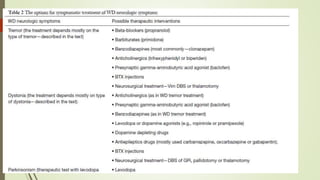
NEUROWILSON:
 Neurologic dysfunction - in 40% to 60% of individuals,
 Typical symptom onset at aprx 20 years of age
-broad reported range that extends from as early as 6 to as late as 72 years of
age.
 Basal ganglia based movement abnormalities are hallmarks of Wilson disease.
 Tremor is the initial neurologic feature in approximately 50% of individuals and
may be proximal or distal and evident at rest or with movement .
 The classic presentation is a proximal, coarse tremor involving the arms that has
been likened to a bird beating its wings.
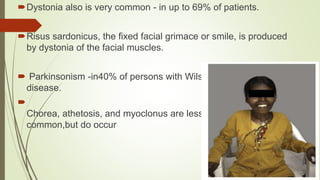
Dystonia also is very common - in up to 69% of patients.
Risus sardonicus, the fixed facial grimace or smile, is produced
by dystonia of the facial muscles.
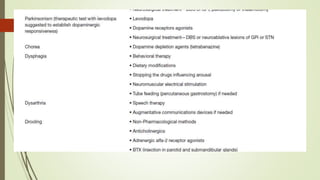
 Parkinsonism -in40% of persons with Wilson
disease.

Chorea, athetosis, and myoclonus are less
common,but do occur
Cerebellar dysfunction -in aprx 30% of individuals with Wilson
disease. Dysarthria may be cerebellar or hypokinetic in
character.
Dysarthria may progress to the point of complete anarthria.
 Dysphagia -in up to 50% of individuals at the time of diagnosis.
Some disturbance of gait is evident in 45% to 75% of patients at
the time of diagnosis and may range in character from
parkinsonian to cerebellar.
Other neurologic abnormalities, such as autonomic dysfunction,
seizures, and headaches, may occur in Wilson disease, but upper
motor neuron signs, lower motor neuron signs, sensory loss, and
Psychiatric Manifestations:

 Psychiatric symptoms(subtle personality changes to frank psychosis) - in aprx 30% to 40%
of individuals with Wilson disease.
 Acute psychosis may be the presenting feature of Wilson disease and is characterized by
paranoid ideation, delusional thinking, hallucinations, and even catatonia.
 Psychosis may first appear during recovery of motor function following initiation of copper
chelation therapy and in that setting is attributed to improved motor function unveiling
previously masked psychosis.
 Dementia is uncommon in Wilson disease but may develop in individuals with advanced
disease.
 Mild cognitive impairment is present more frequently
Phenotypic classification
 H1 – acute hepatic Wilson disease presenting as jaundice in previously healthy
subjects;
 H2 -chronic hepatic Wilson disease presenting as or evolves into end-stage liver
disease.
 N1- is used for neuropsychiatric disease associated with symptomatic liver disease
(i.e. patients with cirrhosis at diagnosis)
 N2 -neuropsychiatric disease with no associated symptomatic liver disease (the
apparent absence of liver disease needs to be confirmed by liver biopsy).
 NX -patient has not been investigated for any presence of liver disease.
When to suspect Wilson disease:
• Unexplained liver disease: increasedAST or ALT levels, hepato- and splenomegaly, steatosis or features of
chronic liver disease, at any age of onset, especially under the age of 40.
• Unexplained neurological disease, behavioral and/or psychiatric problems, with or without any associated liver
disease, at any age of onset.
• Family history: first-degree relatives of any patient diagnosed as havingWilson disease.
* All newborn babies physiologically have ceruloplasmin levels that are 50% of the normal adult values, making
diagnosis uncertain in the first 2–3 months of life.
As the effects of the disease do not become apparent until about 3 years of age, diagnostic testing is not done
in infancy.
Diagnosis:
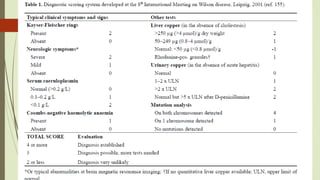
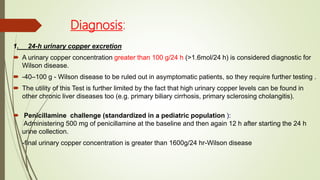
1. 24-h urinary copper excretion
 A urinary copper concentration greater than 100 g/24 h (>1.6mol/24 h) is considered diagnostic for
Wilson disease.
 -40–100 g - Wilson disease to be ruled out in asymptomatic patients, so they require further testing .
 The utility of this Test is further limited by the fact that high urinary copper levels can be found in
other chronic liver diseases too (e.g. primary biliary cirrhosis, primary sclerosing cholangitis).
 Penicillamine challenge (standardized in a pediatric population ):
Administering 500 mg of penicillamine at the baseline and then again 12 h after starting the 24 h
urine collection.
-final urinary copper concentration is greater than 1600g/24 hr-Wilson disease
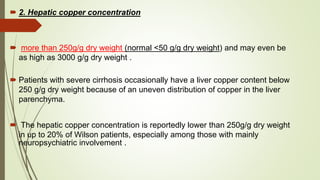
 2. Hepatic copper concentration
 more than 250g/g dry weight (normal <50 g/g dry weight) and may even be
as high as 3000 g/g dry weight .
 Patients with severe cirrhosis occasionally have a liver copper content below
250 g/g dry weight because of an uneven distribution of copper in the liver
parenchyma.
 The hepatic copper concentration is reportedly lower than 250g/g dry weight
in up to 20% of Wilson patients, especially among those with mainly
neuropsychiatric involvement .
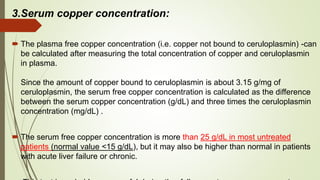
3.Serum copper concentration:
 The plasma free copper concentration (i.e. copper not bound to ceruloplasmin) -can
be calculated after measuring the total concentration of copper and ceruloplasmin
in plasma.
Since the amount of copper bound to ceruloplasmin is about 3.15 g/mg of
ceruloplasmin, the serum free copper concentration is calculated as the difference
between the serum copper concentration (g/dL) and three times the ceruloplasmin
concentration (mg/dL) .
 The serum free copper concentration is more than 25 g/dL in most untreated
patients (normal value <15 g/dL), but it may also be higher than normal in patients
with acute liver failure or chronic.
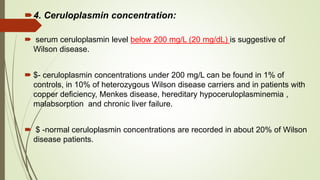
4. Ceruloplasmin concentration:
 serum ceruloplasmin level below 200 mg/L (20 mg/dL) is suggestive of
Wilson disease.
 $- ceruloplasmin concentrations under 200 mg/L can be found in 1% of
controls, in 10% of heterozygous Wilson disease carriers and in patients with
copper deficiency, Menkes disease, hereditary hypoceruloplasminemia ,
malabsorption and chronic liver failure.
 $ -normal ceruloplasmin concentrations are recorded in about 20% of Wilson
disease patients.
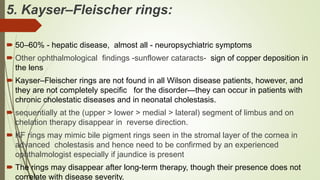
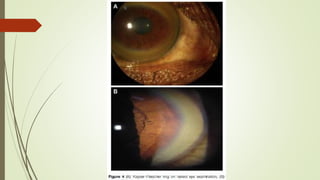
5. Kayser–Fleischer rings:
 50–60% - hepatic disease, almost all - neuropsychiatric symptoms
 Other ophthalmological findings -sunflower cataracts- sign of copper deposition in
the lens
 Kayser–Fleischer rings are not found in all Wilson disease patients, however, and
they are not completely specific for the disorder—they can occur in patients with
chronic cholestatic diseases and in neonatal cholestasis.
 sequentially at the (upper > lower > medial > lateral) segment of limbus and on
chelation therapy disappear in reverse direction.
 KF rings may mimic bile pigment rings seen in the stromal layer of the cornea in
advanced cholestasis and hence need to be confirmed by an experienced
ophthalmologist especially if jaundice is present
 The rings may disappear after long-term therapy, though their presence does not
correlate with disease severity.
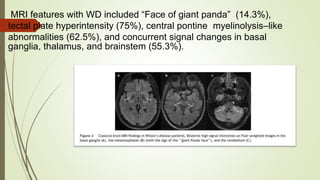
MRI features with WD included “Face of giant panda” (14.3%),
tectal plate hyperintensity (75%), central pontine myelinolysis–like
abnormalities (62.5%), and concurrent signal changes in basal
ganglia, thalamus, and brainstem (55.3%).
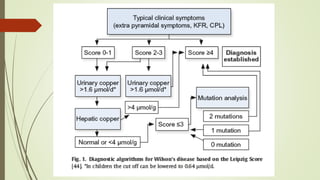
Genetic testing:
Given the variability of the biochemical and clinical features
of Wilson disease, mutation analysis is becoming more and
more essential to confirm a suspicion of the disorder.
Nearly 300 ATP7B mutations have been identified to date.
When mutations responsible for Wilson disease are
detected, condition can be confirmed,
but a negative result cannot exclude a diagnosis ofWilson
disease.
FAMILY SCREENING
-Advantages:
(1) allows early detection of disease in presymptomatic phase before a
devastating course,
(2) makes family wiser and the physician more prepared,
(3)identifies a healthy family member or a heterozygote carrier who can be a
potential donor for living related liver transplantation
 Screening is deferred till 2 years of age when presymptomatic patients can
be started on chelation therapy.
Screening can be initiated earlier if any stigmata of liver disease or occult
warning signs are detected (eg, hepatomegaly or fatty or nodular liver
sonologically in the absence of deranged liver function tests).
Current treatments
 General recommendations:
 Treatment for WD is based on the lifetime use of copper chelating agents
or zinc salts.
 Chelators (D-Penicillamine (DP) and Triethylenetetramine (TN)) induce the urinary
excretion of copper and
zinc salts which inhibits the intestinal absorption of copper
 Treatment should never be stopped, even during pregnancy, when in some cases the
dosage may be reduced.
 Combination with a low-copper diet is recommended at the beginning of the
chelation/zinc therapy.
Then in stable WD patients who are adherent to medical therapy, dietary copper
restrictions are less necessary with two food exceptions (shellfish and liver) .
 The treatment consists of two phases: an initial active chelation phase and a maintenance phase
when chelation should be more moderate to prevent copper deficiency
 Initial phase of active chelation
 The choice of the chelator is often oriented by the tolerability profile of the
treatment.
 DP is contraindicated in the event of allergy to penicillin and is known for its
many side effects; these may become acute within three weeks (hypersensitivity
reaction with fever, skin rash, lymphadenopathy or renal damage with
proproteinuria) or chronic nephropathy
 TN is much better tolerated (rare cases of sideroblastic anaemia, gastritis,
lupus-like syndrome, skin rash).
It causes four times fewer discontinuations of treatment than DP .
 TN is currently available in a limited number of countries; moreover, the
substance is unstable and should be stored in a tightly closed container at 2—8
◦C..
 Controlling liver disease is easier than controlling neurological symptoms.
 Hepatic improvement was reported in 90.7% of patients receiving DP and
92.6% of patients on TN, whereas the neurological forms only improved in 67.5% of
patients on DP and 55% of patients on TN .
 This difference in outcome could partly be explained by the paradoxical neurological
exacerbations (sometimes irreversible) that have been described at treatment initiation
in 13.8% of neurological patients on DP and in 8% of those receiving TN .
 Until now, the onset of neurological signs at the start of treatment has not been
described in patients with a pure liver phenotype. The inefficacy of intracerebral
chelation or excessive copper mobilization by chelating agents is the most common
hypotheses advanced to explain this paradoxical worsening .
 In newly diagnosed neurological patients with CuEXC > 2.08 !mol/L, it is
recommended to gradually increase the doses of chelators (by 150 mg every 10 days)
with subsequent adjustments as a function of 24-h urinary copper excretion and the
CuEXC assay, so as to reduce the risk of initial paradoxical worsening.
d-Penicillamine
 Wilson disease phenotype experience a clinical improvement after 6–8 weeks of treatment,
but it may take 6–12 months for the change to be noticeable. It is best to start patients on
lower doses, gradually increasing it up to the therapeutic range in order to improve its
tolerability
 For instance, d-PCA treatment is started at 125 mg/day for first week, then the dose is raised by 125 mg every week up
to a dose of 1.0–1.5 g/day
 daily dose of 25 mg of pyridoxine (vitamin B6) is usually added to the treatment regimen.
 Aprx 30% of patients have hypersensitive reactions in the first month of treatment
These early side effects are usually transient, but temporary drug withdrawal and
corticosteroids may be required.
 Late drug reactions can be seen even after years of uneventful treatment. late side effects
involve the skin (degenerative changes, elastosis perforans serpiginosa) and joints
(arthropathy), or may be mediated by immunological effects (lupus-like reactions, nephrotic
syndrome, myasthenia gravis).
Bone marrow depression may develop as an early or late side effect, so a full blood count
is needed before the treatment is started.
 Neurological symptoms reportedly become more severe in about 50% of patients taking d-
 Trientine:
 It is used as an alternative to d-PCA, both in the event of tolerance and as
front-line treatment because it has fewer side effects.
 It is thought to act by mobilizing tissue copper, albeit to a lesser degree than
d-PCA (hence the more limited side effects) .
 The usual starting dose of trientine is 750–1500 mg, divided between 2–3
doses a day, with 750–1000 mg as a maintenance dose. It should be taken
before meals or 2 h afterwards.
 Trientine is probably less toxic than d-PCA.
 The risk of neurological symptoms becoming worse when trientine is used
as first-line therapy is reportedly 26%
Maintenance phase and monitoring:
 Two options:
1. to pursue the use of a copper chelator, if possible TN which has fewer long-term
side effects than DP.
2. zinc monotherapy . Zinc acetate inhibits the intestinal absorption of copper, causing
mainly gastrointestinal disorders marked by gastric irritation, dyspeptic syndrome or abdominal pain. If
these digestive disorders persist, a proton pump inhibitor can be associated with the prescription.
 The main difficulty encountered during this maintenance phase is to ensure good
compliance with the treatment.
 Adjustment of the dose is very important to prevent neurological complications due to
copper deficiency which may be observed after numerous years of treatment,
essentially with zinc salts but also with Trientine
ZINC:
 Zinc is used mainly as a front-line therapy in patients who have not (or
not yet) developed symptoms, for maintenance therapy and for patients
with a mainly neuropsychiatric involvement, because aworsening of the
neurological picture is very uncommon in such cases .
 Zinc sulfate should be administered at a dose of 220 mg/day three times
daily (corresponding to 150 mg of elemental zinc a day), at least 1 h
before meals
Zinc is generally well tolerated. Gastric irritation is the most frequent
problem (10–15%) , but this can be overcome by replacing zinc sulfate
with zinc acetate, or by taking the first daily dose mid-morning rather than
before breakfast.
A mild, harmless increase in serum amylase and lipase concentrations
(that is not due to pancreatitis), a 20% reduction of high-density
Iatrogenic copper deficiency with zinc
therapy
Zinc toxicity can cause copper deficiency through entrapment of copper
in the enterocytes, which can subsequently cause sideroblastic anaemia
and subacute combined degeneration of the spinal cord.
 Copper deficiency may occur at differing times after the commencement
of zinc therapy, and hence regular neurological examination, copper
metabolism and haematological monitoring is necessary
Combination therapies:
The combined use of d-PCA and zinc is NOT RECOMMENDED,
as it does not make sense to administer a metal with a chelating
agent capable of neutralizing its effect.
If doses of chelators and zinc are to be administered in
combination, the interval between them must be as wide as
possible; this means taking medication numerous times during the
day and this is very likely to have a negative effect on compliance.
Tetrathiomolybdate:
 Tetrathiomolybdate has two mechanisms of action
1. complexes copper in the intestinal lumen, preventing its absorption.
2. once it has been absorbed, it complexes copper with albumin in the blood and makes the
copper unavailable for cellular uptake.
 Tetrathiomolybdate has been proposed as initial treatment for patients with neurological
signs and symptoms, but its use is restricted by the limited clinical experience with the drug
and it is not commercially available
 Neurological Wilson disease patients have been treated with doses of tetrathiomolybdate
varying from 120 to 410 mg/day for 8 weeks .
 Fewer patients on tetrathiomolybdate experienced a neurological deterioration than those
on trientine, and about 15% of patients on tetrathiomolybdate experienced only mild side
effects, which included bone marrow toxicity (anaemia, thrombocytopenia and neutropenia)
and rising aminotransferase levels, but both effects were reportedly transient and responded
to suspension of the drug.
Diet:
Foods rich in copper (e.g. liver, chocolate, nuts,
mushrooms and shellfish) should be avoided, at least in
the early years after diagnosis.
 More stringent dietary measures are unpleasant,
impractical and probably fail to postpone the progression
of disease .
 Drinking water usually contains less than 0.2 mg
copper per liter but up to 10% of domestic drinking water
has copper levels that may be too high for Wilson
Liver transplantation:
Liver transplantation is the ultimate treatment for patients with
Wilson disease.
Wilson disease patients should be considered for liver
transplantation when suitable medical therapy has failed or in
case of acute liver failure, when there is no time for other
therapies to take effect.
 Patients with a combination of hepatic and neuropsychiatric
conditions warrant careful neurological assessment, but liver
transplantation is contraindicated only in cases of severe
neurological impairment.
Asymptomatic forms:
Asymptomatic patients diagnosed from family screening also
require lifelong treatment.
The guidelines recommend the introduction of zinc acetate
therapy or DP, coupled with annual monitoring of the copper
balance.
Management during follow-up:
The outcome of therapy has to be monitored by regular physical and
neurological assessments.
Corneal slit lamp evaluation to assess any improvement of the
Kayser–Fleischer rings may also be helpful in the long-term follow-up.
Liver function tests should be performed and laboratory data collected
(e.g. blood counts, serum biochemical liver function tests, copper
metabolism indices, urinalysis, 24-h urinary copper and zinc excretion)
at intervals varying from 1 to 8 months, depending on the patient’s
clinical condition.
Patients should be followed up at least twice a year, in most cases, to
monitor clinical improvements, side effects of therapy and compliance,
which has to be checked periodically to prevent a rapid worsening of
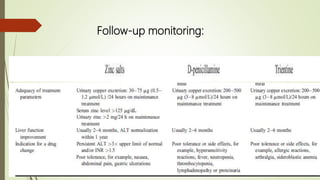
Follow-up monitoring:
 Practical guidelines for the follow-up of Wilson disease patients
‘A combination of gastroenterological, neurological and ophthalmological evaluations is
needed’.
 Compliance can be checked by measuring 24- hour urinary copper excretion.
 In the event of non-compliance, recommend more frequent follow-up visits and more
regular laboratory tests.
 Persistently high transaminase levels are seen in 20% of patients, without any evidence
of disease progression.
Wilson disease in pregnancy
Pregnancy is not contraindicated for patients with well
managed Wilson disease and compensated liver disease,
but
treatment must be continued throughout pregnancy and
breast feeding because its interruption could lead to acute liver
failure.
The safest drugs for pregnant Wilson disease patients are
zinc and trientine.
Newer Therapeutics:
 A recent study using the LEC rat model of WD offered an extra option for such
patients called methanobactin (MB), a peptide produced by
Methylosinus trichosporium with an extremely high affinity for Cu. Short-term MB
treatment efficiently reversed acute liver damage due to Cu accumulation.
 This beneficial effect was associated with disposal of intracellular Cu, in particular
from the mitochondria.
 Interestingly, the regular Cu chelators penicillamine and tetrathiomolybdate failed to
clean toxic metal from the mitochondrial stores. As a consequence,
 MB treatment prevented hepatocyte death and the subsequent liver failure,
elongating the life span of the LEC rat. Therefore this peptide seems to be a
potential therapeutic agent for acute WD.
 Recent study have suggested that liver X receptor (LXR)/retinoid
X receptor agonist may be used to combat Cu toxicity in WD. This approach does
not require Cu chelation. Careful investigation of the transcriptional and metabolic changes
insamples from WD patients and Atp7b-/- mice revealed dysregulation of LXR as one of the key
events in the pathogenesis of WD. Treatment with the LXR agonist T0901317 improved disease
manifestations in the Atp7b-/- mice despite substantial Cu overload.
 Moreover, liver fibrosis and inflammation significantly decreased in LXR agonist-treated animals,
while lipid profiles normalized and liver function and histology improved. Thus, the potential of
T0901317 for WD cure is likely to be further explored.

 Team's new research confirms that DPM-1001, a small molecule, robustly reduces copper levels in
cellsgrown in culture that were sampled from Wilson's disease patients, as well as systemically in a mouse
modelof Wilson's disease. It acts as a chelator -- a compound that interacts with a metal to facilitate its
naturalremoval.
 The team showed that DPM-1001 is orally available -- it could be taken as a pill -- and is "exquisitely
specific"for copper. Current de-coppering agents tend to affect levels of other metals in addition to copper --
anundesirable feature in a drug for an illness like Wilson's. Such drugs would likely be taken for extended
times,and the binding of metals other than copper may contribute to unwanted side effects.
 Pzer will make a candidate gene therapy for the liver conditionWilson disease under an
agreement with Vivet Therapeutics.
 The US pharmaceutical firm will make supplies of the candidate –known as VTX-801– for
a Phase I/II clinical trial due to start earlynext year.
 Wilson disease is characterized by the accumulation of copper intissue. It is an inherited disorder
caused by mutations in the geneencoding the ATP7B copper transporter.
 VTX-801 is an AAV livertropic capsid containing a single-stranded DNAgenome carrying ashortened
version of theATP7B gene, dubbed theATP7B-minigene. Vivetrelease promisingpreclinical data in
2019
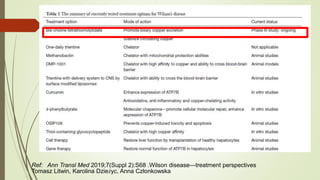
α-lipoic acid, may be suitable for the treatment of Wilson disease. This
hypothesis is supported by cell culture experiments where α-lipoic acid protected
hepatic cells from copper toxicity. These results provide a basis for elaboration of
new generation drugs that may provide better therapeutic outcomes.
 The main challenge today is WD therapy of the neurologic manifestation. The reason is that the negatively
charged chelators are unable to pass through the blood–brain barrier (BBB).
Bis-choline TTM(WTX101) is a first-in-class new type of copper chelator that by
forming a stable tripartite complex with albumin inhibits hepatocellular and neuronal uptake of copper as
well as induces a negative copperbalance by promotion of biliary excretion.
 It is effective in improving neurologic manifestations of WD.
 At present, a potential hepatotoxicity cannot be completely ruled out, but a dose adaption can overcome
this adverse event. This adds to the armament for fighting WD. Thus, in the case of a phase III trial, which
can confirm efficacy without severe adverse events, WTX101 may become a new therapeutic strategy,
particularly for neurologic-predominant WD with an advantage of once-daily dosage.
Genetic studies have provided opportunities to determine which proteins
may link thiamine to the pathology of Wilson’s disease, including gene p53,
Bcl-2, caspase-3,HO-1, and ApoE.
Thiamine can also act through a number of non-genomic mechanisms,
including
protein expression, 5-HT, oxidative stress, inflammation, and cellular
metabolism. Thiamine supplementation has
demonstrated the
beneficial role of thiamine in patients with Wilson’s
disease.
Ref: Ann Transl Med 2019;7(Suppl 2):S68 .Wilson disease—treatment perspectives
Tomasz Litwin, Karolina Dzieżyc, Anna Członkowska
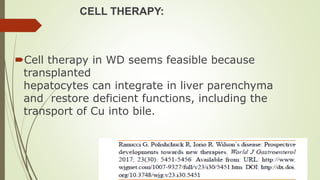
CELL THERAPY:
Cell therapy in WD seems feasible because
transplanted
hepatocytes can integrate in liver parenchyma
and restore deficient functions, including the
transport of Cu into bile.
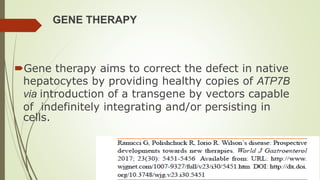
GENE THERAPY
Gene therapy aims to correct the defect in native
hepatocytes by providing healthy copies of ATP7B
via introduction of a transgene by vectors capable
of indefinitely integrating and/or persisting in
cells.
 SUMMARY:
 SuspectWilson disease at any age of onset, but particularly under the age of 40.
 There is no gold standard for diagnosis, which is based on a combination of clinical and laboratory findings.
 Start therapy as soon as possible:Wilson disease can be treated.
 Initial treatment of symptomatic patients with hepatic involvement should only include a chelating agent (d-
PCA or trientine).
 Treatment of symptom-free patients or those on maintenance therapy with a mainly hepatic involvement, can
safely be based on zinc salts.
 Patients with a mainly neuropsychiatric involvement should be treated from the start with zinc, while d-PCA
may make their neurological function deteriorate—though this issue is still very controversial.
THANK YOU !!!

Wilson disease

  • 1.
    WILSON DISEASE-2 Presented By:Dr.SwarupaTara Shamrao B DNB NEUROLOGY RESIDENT,Choithram hospital,Indore
  • 2.
    Clinical features first andthe fourth decades of life , although age at presentation can vary from 2-years-old to 70-years old.  The main clinical presentations: hepatic, hemolytic, neurological and psychiatric disease.
  • 3.
    NEUROWILSON:  Neurologic dysfunction- in 40% to 60% of individuals,  Typical symptom onset at aprx 20 years of age -broad reported range that extends from as early as 6 to as late as 72 years of age.  Basal ganglia based movement abnormalities are hallmarks of Wilson disease.  Tremor is the initial neurologic feature in approximately 50% of individuals and may be proximal or distal and evident at rest or with movement .  The classic presentation is a proximal, coarse tremor involving the arms that has been likened to a bird beating its wings.
  • 4.
    Dystonia also isvery common - in up to 69% of patients. Risus sardonicus, the fixed facial grimace or smile, is produced by dystonia of the facial muscles.  Parkinsonism -in40% of persons with Wilson disease.  Chorea, athetosis, and myoclonus are less common,but do occur
  • 5.
    Cerebellar dysfunction -inaprx 30% of individuals with Wilson disease. Dysarthria may be cerebellar or hypokinetic in character. Dysarthria may progress to the point of complete anarthria.  Dysphagia -in up to 50% of individuals at the time of diagnosis. Some disturbance of gait is evident in 45% to 75% of patients at the time of diagnosis and may range in character from parkinsonian to cerebellar. Other neurologic abnormalities, such as autonomic dysfunction, seizures, and headaches, may occur in Wilson disease, but upper motor neuron signs, lower motor neuron signs, sensory loss, and
  • 6.
    Psychiatric Manifestations:   Psychiatricsymptoms(subtle personality changes to frank psychosis) - in aprx 30% to 40% of individuals with Wilson disease.  Acute psychosis may be the presenting feature of Wilson disease and is characterized by paranoid ideation, delusional thinking, hallucinations, and even catatonia.  Psychosis may first appear during recovery of motor function following initiation of copper chelation therapy and in that setting is attributed to improved motor function unveiling previously masked psychosis.  Dementia is uncommon in Wilson disease but may develop in individuals with advanced disease.  Mild cognitive impairment is present more frequently
  • 7.
    Phenotypic classification  H1– acute hepatic Wilson disease presenting as jaundice in previously healthy subjects;  H2 -chronic hepatic Wilson disease presenting as or evolves into end-stage liver disease.  N1- is used for neuropsychiatric disease associated with symptomatic liver disease (i.e. patients with cirrhosis at diagnosis)  N2 -neuropsychiatric disease with no associated symptomatic liver disease (the apparent absence of liver disease needs to be confirmed by liver biopsy).  NX -patient has not been investigated for any presence of liver disease.
  • 8.
    When to suspectWilson disease: • Unexplained liver disease: increasedAST or ALT levels, hepato- and splenomegaly, steatosis or features of chronic liver disease, at any age of onset, especially under the age of 40. • Unexplained neurological disease, behavioral and/or psychiatric problems, with or without any associated liver disease, at any age of onset. • Family history: first-degree relatives of any patient diagnosed as havingWilson disease. * All newborn babies physiologically have ceruloplasmin levels that are 50% of the normal adult values, making diagnosis uncertain in the first 2–3 months of life. As the effects of the disease do not become apparent until about 3 years of age, diagnostic testing is not done in infancy.
  • 11.
    Diagnosis: 1. 24-h urinarycopper excretion  A urinary copper concentration greater than 100 g/24 h (>1.6mol/24 h) is considered diagnostic for Wilson disease.  -40–100 g - Wilson disease to be ruled out in asymptomatic patients, so they require further testing .  The utility of this Test is further limited by the fact that high urinary copper levels can be found in other chronic liver diseases too (e.g. primary biliary cirrhosis, primary sclerosing cholangitis).  Penicillamine challenge (standardized in a pediatric population ): Administering 500 mg of penicillamine at the baseline and then again 12 h after starting the 24 h urine collection. -final urinary copper concentration is greater than 1600g/24 hr-Wilson disease
  • 12.
     2. Hepaticcopper concentration  more than 250g/g dry weight (normal <50 g/g dry weight) and may even be as high as 3000 g/g dry weight .  Patients with severe cirrhosis occasionally have a liver copper content below 250 g/g dry weight because of an uneven distribution of copper in the liver parenchyma.  The hepatic copper concentration is reportedly lower than 250g/g dry weight in up to 20% of Wilson patients, especially among those with mainly neuropsychiatric involvement .
  • 13.
    3.Serum copper concentration: The plasma free copper concentration (i.e. copper not bound to ceruloplasmin) -can be calculated after measuring the total concentration of copper and ceruloplasmin in plasma. Since the amount of copper bound to ceruloplasmin is about 3.15 g/mg of ceruloplasmin, the serum free copper concentration is calculated as the difference between the serum copper concentration (g/dL) and three times the ceruloplasmin concentration (mg/dL) .  The serum free copper concentration is more than 25 g/dL in most untreated patients (normal value <15 g/dL), but it may also be higher than normal in patients with acute liver failure or chronic.
  • 14.
    4. Ceruloplasmin concentration: serum ceruloplasmin level below 200 mg/L (20 mg/dL) is suggestive of Wilson disease.  $- ceruloplasmin concentrations under 200 mg/L can be found in 1% of controls, in 10% of heterozygous Wilson disease carriers and in patients with copper deficiency, Menkes disease, hereditary hypoceruloplasminemia , malabsorption and chronic liver failure.  $ -normal ceruloplasmin concentrations are recorded in about 20% of Wilson disease patients.
  • 15.
    5. Kayser–Fleischer rings: 50–60% - hepatic disease, almost all - neuropsychiatric symptoms  Other ophthalmological findings -sunflower cataracts- sign of copper deposition in the lens  Kayser–Fleischer rings are not found in all Wilson disease patients, however, and they are not completely specific for the disorder—they can occur in patients with chronic cholestatic diseases and in neonatal cholestasis.  sequentially at the (upper > lower > medial > lateral) segment of limbus and on chelation therapy disappear in reverse direction.  KF rings may mimic bile pigment rings seen in the stromal layer of the cornea in advanced cholestasis and hence need to be confirmed by an experienced ophthalmologist especially if jaundice is present  The rings may disappear after long-term therapy, though their presence does not correlate with disease severity.
  • 17.
    MRI features withWD included “Face of giant panda” (14.3%), tectal plate hyperintensity (75%), central pontine myelinolysis–like abnormalities (62.5%), and concurrent signal changes in basal ganglia, thalamus, and brainstem (55.3%).
  • 18.
    Genetic testing: Given thevariability of the biochemical and clinical features of Wilson disease, mutation analysis is becoming more and more essential to confirm a suspicion of the disorder. Nearly 300 ATP7B mutations have been identified to date. When mutations responsible for Wilson disease are detected, condition can be confirmed, but a negative result cannot exclude a diagnosis ofWilson disease.
  • 19.
    FAMILY SCREENING -Advantages: (1) allowsearly detection of disease in presymptomatic phase before a devastating course, (2) makes family wiser and the physician more prepared, (3)identifies a healthy family member or a heterozygote carrier who can be a potential donor for living related liver transplantation  Screening is deferred till 2 years of age when presymptomatic patients can be started on chelation therapy. Screening can be initiated earlier if any stigmata of liver disease or occult warning signs are detected (eg, hepatomegaly or fatty or nodular liver sonologically in the absence of deranged liver function tests).
  • 20.
    Current treatments  Generalrecommendations:  Treatment for WD is based on the lifetime use of copper chelating agents or zinc salts.  Chelators (D-Penicillamine (DP) and Triethylenetetramine (TN)) induce the urinary excretion of copper and zinc salts which inhibits the intestinal absorption of copper  Treatment should never be stopped, even during pregnancy, when in some cases the dosage may be reduced.  Combination with a low-copper diet is recommended at the beginning of the chelation/zinc therapy. Then in stable WD patients who are adherent to medical therapy, dietary copper restrictions are less necessary with two food exceptions (shellfish and liver) .  The treatment consists of two phases: an initial active chelation phase and a maintenance phase when chelation should be more moderate to prevent copper deficiency
  • 21.
     Initial phaseof active chelation  The choice of the chelator is often oriented by the tolerability profile of the treatment.  DP is contraindicated in the event of allergy to penicillin and is known for its many side effects; these may become acute within three weeks (hypersensitivity reaction with fever, skin rash, lymphadenopathy or renal damage with proproteinuria) or chronic nephropathy  TN is much better tolerated (rare cases of sideroblastic anaemia, gastritis, lupus-like syndrome, skin rash). It causes four times fewer discontinuations of treatment than DP .  TN is currently available in a limited number of countries; moreover, the substance is unstable and should be stored in a tightly closed container at 2—8 ◦C..
  • 22.
     Controlling liverdisease is easier than controlling neurological symptoms.  Hepatic improvement was reported in 90.7% of patients receiving DP and 92.6% of patients on TN, whereas the neurological forms only improved in 67.5% of patients on DP and 55% of patients on TN .  This difference in outcome could partly be explained by the paradoxical neurological exacerbations (sometimes irreversible) that have been described at treatment initiation in 13.8% of neurological patients on DP and in 8% of those receiving TN .  Until now, the onset of neurological signs at the start of treatment has not been described in patients with a pure liver phenotype. The inefficacy of intracerebral chelation or excessive copper mobilization by chelating agents is the most common hypotheses advanced to explain this paradoxical worsening .  In newly diagnosed neurological patients with CuEXC > 2.08 !mol/L, it is recommended to gradually increase the doses of chelators (by 150 mg every 10 days) with subsequent adjustments as a function of 24-h urinary copper excretion and the CuEXC assay, so as to reduce the risk of initial paradoxical worsening.
  • 23.
    d-Penicillamine  Wilson diseasephenotype experience a clinical improvement after 6–8 weeks of treatment, but it may take 6–12 months for the change to be noticeable. It is best to start patients on lower doses, gradually increasing it up to the therapeutic range in order to improve its tolerability  For instance, d-PCA treatment is started at 125 mg/day for first week, then the dose is raised by 125 mg every week up to a dose of 1.0–1.5 g/day  daily dose of 25 mg of pyridoxine (vitamin B6) is usually added to the treatment regimen.  Aprx 30% of patients have hypersensitive reactions in the first month of treatment These early side effects are usually transient, but temporary drug withdrawal and corticosteroids may be required.  Late drug reactions can be seen even after years of uneventful treatment. late side effects involve the skin (degenerative changes, elastosis perforans serpiginosa) and joints (arthropathy), or may be mediated by immunological effects (lupus-like reactions, nephrotic syndrome, myasthenia gravis). Bone marrow depression may develop as an early or late side effect, so a full blood count is needed before the treatment is started.  Neurological symptoms reportedly become more severe in about 50% of patients taking d-
  • 24.
     Trientine:  Itis used as an alternative to d-PCA, both in the event of tolerance and as front-line treatment because it has fewer side effects.  It is thought to act by mobilizing tissue copper, albeit to a lesser degree than d-PCA (hence the more limited side effects) .  The usual starting dose of trientine is 750–1500 mg, divided between 2–3 doses a day, with 750–1000 mg as a maintenance dose. It should be taken before meals or 2 h afterwards.  Trientine is probably less toxic than d-PCA.  The risk of neurological symptoms becoming worse when trientine is used as first-line therapy is reportedly 26%
  • 25.
    Maintenance phase andmonitoring:  Two options: 1. to pursue the use of a copper chelator, if possible TN which has fewer long-term side effects than DP. 2. zinc monotherapy . Zinc acetate inhibits the intestinal absorption of copper, causing mainly gastrointestinal disorders marked by gastric irritation, dyspeptic syndrome or abdominal pain. If these digestive disorders persist, a proton pump inhibitor can be associated with the prescription.  The main difficulty encountered during this maintenance phase is to ensure good compliance with the treatment.  Adjustment of the dose is very important to prevent neurological complications due to copper deficiency which may be observed after numerous years of treatment, essentially with zinc salts but also with Trientine
  • 26.
    ZINC:  Zinc isused mainly as a front-line therapy in patients who have not (or not yet) developed symptoms, for maintenance therapy and for patients with a mainly neuropsychiatric involvement, because aworsening of the neurological picture is very uncommon in such cases .  Zinc sulfate should be administered at a dose of 220 mg/day three times daily (corresponding to 150 mg of elemental zinc a day), at least 1 h before meals Zinc is generally well tolerated. Gastric irritation is the most frequent problem (10–15%) , but this can be overcome by replacing zinc sulfate with zinc acetate, or by taking the first daily dose mid-morning rather than before breakfast. A mild, harmless increase in serum amylase and lipase concentrations (that is not due to pancreatitis), a 20% reduction of high-density
  • 27.
    Iatrogenic copper deficiencywith zinc therapy Zinc toxicity can cause copper deficiency through entrapment of copper in the enterocytes, which can subsequently cause sideroblastic anaemia and subacute combined degeneration of the spinal cord.  Copper deficiency may occur at differing times after the commencement of zinc therapy, and hence regular neurological examination, copper metabolism and haematological monitoring is necessary
  • 28.
    Combination therapies: The combineduse of d-PCA and zinc is NOT RECOMMENDED, as it does not make sense to administer a metal with a chelating agent capable of neutralizing its effect. If doses of chelators and zinc are to be administered in combination, the interval between them must be as wide as possible; this means taking medication numerous times during the day and this is very likely to have a negative effect on compliance.
  • 29.
    Tetrathiomolybdate:  Tetrathiomolybdate hastwo mechanisms of action 1. complexes copper in the intestinal lumen, preventing its absorption. 2. once it has been absorbed, it complexes copper with albumin in the blood and makes the copper unavailable for cellular uptake.  Tetrathiomolybdate has been proposed as initial treatment for patients with neurological signs and symptoms, but its use is restricted by the limited clinical experience with the drug and it is not commercially available  Neurological Wilson disease patients have been treated with doses of tetrathiomolybdate varying from 120 to 410 mg/day for 8 weeks .  Fewer patients on tetrathiomolybdate experienced a neurological deterioration than those on trientine, and about 15% of patients on tetrathiomolybdate experienced only mild side effects, which included bone marrow toxicity (anaemia, thrombocytopenia and neutropenia) and rising aminotransferase levels, but both effects were reportedly transient and responded to suspension of the drug.
  • 30.
    Diet: Foods rich incopper (e.g. liver, chocolate, nuts, mushrooms and shellfish) should be avoided, at least in the early years after diagnosis.  More stringent dietary measures are unpleasant, impractical and probably fail to postpone the progression of disease .  Drinking water usually contains less than 0.2 mg copper per liter but up to 10% of domestic drinking water has copper levels that may be too high for Wilson
  • 31.
    Liver transplantation: Liver transplantationis the ultimate treatment for patients with Wilson disease. Wilson disease patients should be considered for liver transplantation when suitable medical therapy has failed or in case of acute liver failure, when there is no time for other therapies to take effect.  Patients with a combination of hepatic and neuropsychiatric conditions warrant careful neurological assessment, but liver transplantation is contraindicated only in cases of severe neurological impairment.
  • 33.
    Asymptomatic forms: Asymptomatic patientsdiagnosed from family screening also require lifelong treatment. The guidelines recommend the introduction of zinc acetate therapy or DP, coupled with annual monitoring of the copper balance.
  • 34.
    Management during follow-up: Theoutcome of therapy has to be monitored by regular physical and neurological assessments. Corneal slit lamp evaluation to assess any improvement of the Kayser–Fleischer rings may also be helpful in the long-term follow-up. Liver function tests should be performed and laboratory data collected (e.g. blood counts, serum biochemical liver function tests, copper metabolism indices, urinalysis, 24-h urinary copper and zinc excretion) at intervals varying from 1 to 8 months, depending on the patient’s clinical condition. Patients should be followed up at least twice a year, in most cases, to monitor clinical improvements, side effects of therapy and compliance, which has to be checked periodically to prevent a rapid worsening of
  • 35.
  • 36.
     Practical guidelinesfor the follow-up of Wilson disease patients ‘A combination of gastroenterological, neurological and ophthalmological evaluations is needed’.  Compliance can be checked by measuring 24- hour urinary copper excretion.  In the event of non-compliance, recommend more frequent follow-up visits and more regular laboratory tests.  Persistently high transaminase levels are seen in 20% of patients, without any evidence of disease progression.
  • 37.
    Wilson disease inpregnancy Pregnancy is not contraindicated for patients with well managed Wilson disease and compensated liver disease, but treatment must be continued throughout pregnancy and breast feeding because its interruption could lead to acute liver failure. The safest drugs for pregnant Wilson disease patients are zinc and trientine.
  • 42.
  • 43.
     A recentstudy using the LEC rat model of WD offered an extra option for such patients called methanobactin (MB), a peptide produced by Methylosinus trichosporium with an extremely high affinity for Cu. Short-term MB treatment efficiently reversed acute liver damage due to Cu accumulation.  This beneficial effect was associated with disposal of intracellular Cu, in particular from the mitochondria.  Interestingly, the regular Cu chelators penicillamine and tetrathiomolybdate failed to clean toxic metal from the mitochondrial stores. As a consequence,  MB treatment prevented hepatocyte death and the subsequent liver failure, elongating the life span of the LEC rat. Therefore this peptide seems to be a potential therapeutic agent for acute WD.
  • 44.
     Recent studyhave suggested that liver X receptor (LXR)/retinoid X receptor agonist may be used to combat Cu toxicity in WD. This approach does not require Cu chelation. Careful investigation of the transcriptional and metabolic changes insamples from WD patients and Atp7b-/- mice revealed dysregulation of LXR as one of the key events in the pathogenesis of WD. Treatment with the LXR agonist T0901317 improved disease manifestations in the Atp7b-/- mice despite substantial Cu overload.  Moreover, liver fibrosis and inflammation significantly decreased in LXR agonist-treated animals, while lipid profiles normalized and liver function and histology improved. Thus, the potential of T0901317 for WD cure is likely to be further explored.
  • 45.
      Team's newresearch confirms that DPM-1001, a small molecule, robustly reduces copper levels in cellsgrown in culture that were sampled from Wilson's disease patients, as well as systemically in a mouse modelof Wilson's disease. It acts as a chelator -- a compound that interacts with a metal to facilitate its naturalremoval.  The team showed that DPM-1001 is orally available -- it could be taken as a pill -- and is "exquisitely specific"for copper. Current de-coppering agents tend to affect levels of other metals in addition to copper -- anundesirable feature in a drug for an illness like Wilson's. Such drugs would likely be taken for extended times,and the binding of metals other than copper may contribute to unwanted side effects.
  • 46.
     Pzer willmake a candidate gene therapy for the liver conditionWilson disease under an agreement with Vivet Therapeutics.  The US pharmaceutical firm will make supplies of the candidate –known as VTX-801– for a Phase I/II clinical trial due to start earlynext year.  Wilson disease is characterized by the accumulation of copper intissue. It is an inherited disorder caused by mutations in the geneencoding the ATP7B copper transporter.  VTX-801 is an AAV livertropic capsid containing a single-stranded DNAgenome carrying ashortened version of theATP7B gene, dubbed theATP7B-minigene. Vivetrelease promisingpreclinical data in 2019
  • 47.
    α-lipoic acid, maybe suitable for the treatment of Wilson disease. This hypothesis is supported by cell culture experiments where α-lipoic acid protected hepatic cells from copper toxicity. These results provide a basis for elaboration of new generation drugs that may provide better therapeutic outcomes.
  • 48.
     The mainchallenge today is WD therapy of the neurologic manifestation. The reason is that the negatively charged chelators are unable to pass through the blood–brain barrier (BBB). Bis-choline TTM(WTX101) is a first-in-class new type of copper chelator that by forming a stable tripartite complex with albumin inhibits hepatocellular and neuronal uptake of copper as well as induces a negative copperbalance by promotion of biliary excretion.  It is effective in improving neurologic manifestations of WD.  At present, a potential hepatotoxicity cannot be completely ruled out, but a dose adaption can overcome this adverse event. This adds to the armament for fighting WD. Thus, in the case of a phase III trial, which can confirm efficacy without severe adverse events, WTX101 may become a new therapeutic strategy, particularly for neurologic-predominant WD with an advantage of once-daily dosage.
  • 49.
    Genetic studies haveprovided opportunities to determine which proteins may link thiamine to the pathology of Wilson’s disease, including gene p53, Bcl-2, caspase-3,HO-1, and ApoE. Thiamine can also act through a number of non-genomic mechanisms, including protein expression, 5-HT, oxidative stress, inflammation, and cellular metabolism. Thiamine supplementation has demonstrated the beneficial role of thiamine in patients with Wilson’s disease.
  • 50.
    Ref: Ann TranslMed 2019;7(Suppl 2):S68 .Wilson disease—treatment perspectives Tomasz Litwin, Karolina Dzieżyc, Anna Członkowska
  • 51.
    CELL THERAPY: Cell therapyin WD seems feasible because transplanted hepatocytes can integrate in liver parenchyma and restore deficient functions, including the transport of Cu into bile.
  • 52.
    GENE THERAPY Gene therapyaims to correct the defect in native hepatocytes by providing healthy copies of ATP7B via introduction of a transgene by vectors capable of indefinitely integrating and/or persisting in cells.
  • 53.
     SUMMARY:  SuspectWilsondisease at any age of onset, but particularly under the age of 40.  There is no gold standard for diagnosis, which is based on a combination of clinical and laboratory findings.  Start therapy as soon as possible:Wilson disease can be treated.  Initial treatment of symptomatic patients with hepatic involvement should only include a chelating agent (d- PCA or trientine).  Treatment of symptom-free patients or those on maintenance therapy with a mainly hepatic involvement, can safely be based on zinc salts.  Patients with a mainly neuropsychiatric involvement should be treated from the start with zinc, while d-PCA may make their neurological function deteriorate—though this issue is still very controversial.
  • 54.