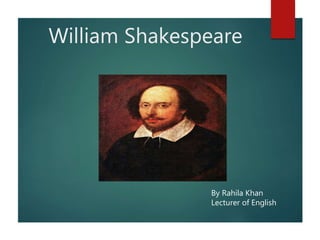
William Shakespeare
By Rahila Khan
Lecturer of English
Childhood
 William Shakespeare was born in Stratford-upon-Avon, a quiet market town on
April 23, 1564.
 He was baptized at Holy Trinity Church on April 26,1564.
 William Shakespeare was the third of eight children born to Mary Arden and
John Shakespeare, but he was the first of their children to survive past infancy.
 Three of the children died in there youth
 The Stratford of William Shakespeare’s childhood was a peaceful town
surrounded by farms, woods, fields, and the flow of the river Avon.
 William attended his first professional theater performance at the age of eleven.
 All of these performances had an impact on the early development of William’s
dramatic and poetic interests.
Parents
 His father, John Shakespeare, had a remarkable run of
success as a tradesman, alderman, and high bailiff(mayor) of
Stratford. He was a glover(maker of gloves and leather
goods.)
 His mother, Mary Arden, was a local heiress.
 She was a woman who inherits or has a right of inheritance.
The family home
 Shakespeare’s birthplace has been restored and
turned into a museum.
 William Shakespeare’s birthplace was on Henley
Street, where his father had lived for several years.
 John was married to Mary Arden, a wealthy
landowner’s daughter.
Shakespeare’s schooldays
 At the age of five, Shakespeare began attending school six days a week at King
Edward VI Grammar School.
 The long school day began around seven in the morning and ended around
five at night.
 At school, boys studied mostly Latin.
 Shakespeare was removed from school to serve in his father’s glove-making
business at the age of fifteen.
 He did not go to a university, but he read what books he could get hold of in
his spare time.
 William didn’t spend all of his teenage years working. He found time for play
and romance in Stratford, attracting the woman who was soon to become his
wife.
Married Life
 When William was eighteen years old, he married Anne Hathaway, who was eight
years older than him and pregnant.
 The marriage was a hurried affair, taking place in secret rather than in a public
ceremony.
 At the age of twenty, Shakespeare had a wife and three children to provide for.
 Six months after their marriage, in May of 1583, their first child, Susanna, was born.
 Two years later, William and Anne welcomed twins, a girl and a boy, into their family.
The girl, Judith, was a healthy child, but the boy, Hamnet, did not live through his later
childhood years.
 Shakespeare would see his wife and children little in the next eleven years, most likely
visiting only once a year.
Buying a New Place
 Shakespeare bought a large, expensive Stratford house, “New
Place”, in 1597. It was the second largest house in Stratford.
 This was quite early in his career. He was still working in
London most of the time, but it gave his wife and children
their own home, and proved to everyone that Shakespeare
had paid off all his family’s debts.
 At the end of his career, Shakespeare retired to Stratford and
lived at New Place until he died in 1616.
Theater
 William Shakespeare is the most influential writer in the world, but he left us
no journals or letters, however, he left us only his poems and his plays.
 He had an ability to capture the interests and imaginations of playgoers of
that time.
 Shakespeare had became an actor and playwright in 1592.
 The theater was divided into higher-priced balcony seats and the cheap floor
space, where the groundlings stood.
 Shakespeare’s plays had a darling mixture of violence and romance, and
Shakespeare’s words brought his audiences straight into the heart of each and
every character.
 As a playwright, he mad little money for the writing he did, and he made even
less money for his acting.
 Shakespeare became part owner of London’s Globe Theater, which became
the home of The Lord Chamberlain’s Men.
Later Life
 At the age of 46, Shakespeare moved back to Stratford as a
wealthy gentleman.
 He continued to write plays and hold his connections to the
Globe Theater, but in 1613, the Globe Theater burned down,
indicating Shakespeare’s retirement from the theater.
 Shakespeare entertained Ben Jonson and the poet Michael
Brayton one night in April 1616. They had a entertaining
time together, drinking wine, eating, and laughing about
their lives.
Death
 Soon after that night, Shakespeare felt ill.
 He died on his birthday, April 23, at the age of 52, and was
buried two days later inside the chancel of the Holy Trinity
Church in Stratford.
 By the time of his death at age fifty-two, Shakespeare had
produced nearly 40 plays and more than 150 sonnets. He had
earned a good reputation as a poet of the people.
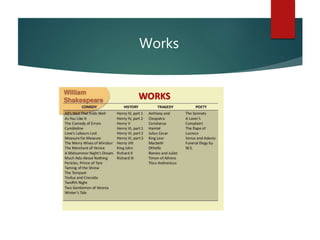
Works
Style
 Shakespeare's first plays were written in the conventional style of the day
later he began to adapt the traditional styles.
 Shakespeare combined the two throughout his career.
 Shakespeare's standard poetic form was blank verse.
 Once Shakespeare mastered traditional blank verse, he began to add new
power and flexibility in plays such as Julius Caesar and Hamlet.
 The late romances, inspired a last poetic style in which long and short
sentences are set against one another, clauses are piled up, subject and
object are reversed, and words are omitted, creating an effect of
spontaneity.
 Like all playwrights of the time, he dramatised stories from sources such
as Plutarch and Holinshed.
Critical Reputation
 Ben Jonson said about Shakespeare that, "He was not of an age, but for all time".
 John Dryden rated Shakespeare saying, “I love Shakespeare".
 During the Romantic era, Shakespeare was praised by Samuel Taylor Coleridge; and the critic
August Wilhelm Schlegel translated his plays in the spirit of German Romanticism.
 Essayist Thomas Carlyle wrote that, " King Shakespeare does not he shine, in crowned
sovereignty, over us all, as the noblest, gentlest, yet strongest of rallying signs;
indestructible".
 The poet and critic T. S. Eliot said Shakespeare's "primitiveness" in fact made him truly
modern.
 Eliot, along with G. Wilson Knight and the school of New Criticism, led a movement towards
a closer reading of Shakespeare's imagery.
 In the 1950s, a wave of new critical approaches replaced modernism and paved the way for
"post-modern" studies of Shakespeare.
 By the 1980s, Shakespeare studies were open to movements such as structuralism, feminism,
New Historicism, African American studies, and queer studies.
THANKYOU!
Thankyou!!!

William shakespeare

  • 1.
    William Shakespeare By RahilaKhan Lecturer of English
  • 2.
    Childhood  William Shakespearewas born in Stratford-upon-Avon, a quiet market town on April 23, 1564.  He was baptized at Holy Trinity Church on April 26,1564.  William Shakespeare was the third of eight children born to Mary Arden and John Shakespeare, but he was the first of their children to survive past infancy.  Three of the children died in there youth  The Stratford of William Shakespeare’s childhood was a peaceful town surrounded by farms, woods, fields, and the flow of the river Avon.  William attended his first professional theater performance at the age of eleven.  All of these performances had an impact on the early development of William’s dramatic and poetic interests.
  • 3.
    Parents  His father,John Shakespeare, had a remarkable run of success as a tradesman, alderman, and high bailiff(mayor) of Stratford. He was a glover(maker of gloves and leather goods.)  His mother, Mary Arden, was a local heiress.  She was a woman who inherits or has a right of inheritance.
  • 4.
    The family home Shakespeare’s birthplace has been restored and turned into a museum.  William Shakespeare’s birthplace was on Henley Street, where his father had lived for several years.  John was married to Mary Arden, a wealthy landowner’s daughter.
  • 5.
    Shakespeare’s schooldays  Atthe age of five, Shakespeare began attending school six days a week at King Edward VI Grammar School.  The long school day began around seven in the morning and ended around five at night.  At school, boys studied mostly Latin.  Shakespeare was removed from school to serve in his father’s glove-making business at the age of fifteen.  He did not go to a university, but he read what books he could get hold of in his spare time.  William didn’t spend all of his teenage years working. He found time for play and romance in Stratford, attracting the woman who was soon to become his wife.
  • 6.
    Married Life  WhenWilliam was eighteen years old, he married Anne Hathaway, who was eight years older than him and pregnant.  The marriage was a hurried affair, taking place in secret rather than in a public ceremony.  At the age of twenty, Shakespeare had a wife and three children to provide for.  Six months after their marriage, in May of 1583, their first child, Susanna, was born.  Two years later, William and Anne welcomed twins, a girl and a boy, into their family. The girl, Judith, was a healthy child, but the boy, Hamnet, did not live through his later childhood years.  Shakespeare would see his wife and children little in the next eleven years, most likely visiting only once a year.
  • 7.
    Buying a NewPlace  Shakespeare bought a large, expensive Stratford house, “New Place”, in 1597. It was the second largest house in Stratford.  This was quite early in his career. He was still working in London most of the time, but it gave his wife and children their own home, and proved to everyone that Shakespeare had paid off all his family’s debts.  At the end of his career, Shakespeare retired to Stratford and lived at New Place until he died in 1616.
  • 8.
    Theater  William Shakespeareis the most influential writer in the world, but he left us no journals or letters, however, he left us only his poems and his plays.  He had an ability to capture the interests and imaginations of playgoers of that time.  Shakespeare had became an actor and playwright in 1592.  The theater was divided into higher-priced balcony seats and the cheap floor space, where the groundlings stood.  Shakespeare’s plays had a darling mixture of violence and romance, and Shakespeare’s words brought his audiences straight into the heart of each and every character.  As a playwright, he mad little money for the writing he did, and he made even less money for his acting.  Shakespeare became part owner of London’s Globe Theater, which became the home of The Lord Chamberlain’s Men.
  • 9.
    Later Life  Atthe age of 46, Shakespeare moved back to Stratford as a wealthy gentleman.  He continued to write plays and hold his connections to the Globe Theater, but in 1613, the Globe Theater burned down, indicating Shakespeare’s retirement from the theater.  Shakespeare entertained Ben Jonson and the poet Michael Brayton one night in April 1616. They had a entertaining time together, drinking wine, eating, and laughing about their lives.
  • 10.
    Death  Soon afterthat night, Shakespeare felt ill.  He died on his birthday, April 23, at the age of 52, and was buried two days later inside the chancel of the Holy Trinity Church in Stratford.  By the time of his death at age fifty-two, Shakespeare had produced nearly 40 plays and more than 150 sonnets. He had earned a good reputation as a poet of the people.
  • 11.
  • 12.
    Style  Shakespeare's firstplays were written in the conventional style of the day later he began to adapt the traditional styles.  Shakespeare combined the two throughout his career.  Shakespeare's standard poetic form was blank verse.  Once Shakespeare mastered traditional blank verse, he began to add new power and flexibility in plays such as Julius Caesar and Hamlet.  The late romances, inspired a last poetic style in which long and short sentences are set against one another, clauses are piled up, subject and object are reversed, and words are omitted, creating an effect of spontaneity.  Like all playwrights of the time, he dramatised stories from sources such as Plutarch and Holinshed.
  • 13.
    Critical Reputation  BenJonson said about Shakespeare that, "He was not of an age, but for all time".  John Dryden rated Shakespeare saying, “I love Shakespeare".  During the Romantic era, Shakespeare was praised by Samuel Taylor Coleridge; and the critic August Wilhelm Schlegel translated his plays in the spirit of German Romanticism.  Essayist Thomas Carlyle wrote that, " King Shakespeare does not he shine, in crowned sovereignty, over us all, as the noblest, gentlest, yet strongest of rallying signs; indestructible".  The poet and critic T. S. Eliot said Shakespeare's "primitiveness" in fact made him truly modern.  Eliot, along with G. Wilson Knight and the school of New Criticism, led a movement towards a closer reading of Shakespeare's imagery.  In the 1950s, a wave of new critical approaches replaced modernism and paved the way for "post-modern" studies of Shakespeare.  By the 1980s, Shakespeare studies were open to movements such as structuralism, feminism, New Historicism, African American studies, and queer studies.
  • 14.
  • 15.