E-Learning Module for
Adults
Wildfires
Part 2: Preparedness
e-Learning for the Prevention, Preparedness and Response to
Natural Disasters
2
• How to get information about on-going wildfires.
• What you can do to be better prepared for wildfires:
- Living near an area at risk.
- Traveling to an area at risk.
• The importance of following advice and guidance from professionals.
Part 2: Preparedness
e-Learning for the Prevention, Preparedness and Response to
Natural Disasters
3
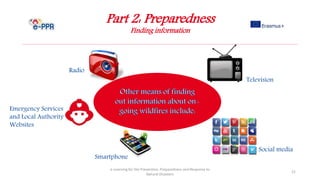
Part 2: Preparedness
Finding information
e-Learning for the Prevention, Preparedness and Response to
Natural Disasters
4
www.meteoalarm.eu provides information to European citizens to help prepare for extreme weather,
including wildfires.
Part 2: Preparedness
Finding information
e-Learning for the Prevention, Preparedness and Response to
Natural Disasters
5
www.meteoalarm.eu provides information to European citizens to help prepare for extreme weather,
including wildfires.
•The system will alert you to the possible occurrence of severe weather, such as heavy rain with risk of
flooding, severe thunderstorms, gale-force winds, heat waves, forest fires (wildfires), fog, snow or extreme cold
with blizzards, avalanches or severe coastal tides.
Part 2: Preparedness
Finding information
e-Learning for the Prevention, Preparedness and Response to
Natural Disasters
6
www.meteoalarm.eu provides information to European citizens to help prepare for extreme weather,
including wildfires.
•The system will alert you to the possible occurrence of severe weather, such as heavy rain with risk of
flooding, severe thunderstorms, gale-force winds, heat waves, forest fires (wildfires), fog, snow or extreme cold
with blizzards, avalanches or severe coastal tides.
•In one glance you will be able to see where in Europe the weather might become extreme and/or dangerous.
Part 2: Preparedness
Finding information
e-Learning for the Prevention, Preparedness and Response to
Natural Disasters
7
www.meteoalarm.eu provides information to European citizens to help prepare for extreme weather,
including wildfires.
•The system will alert you to the possible occurrence of severe weather, such as heavy rain with risk of
flooding, severe thunderstorms, gale-force winds, heat waves, forest fires (wildfires), fog, snow or extreme cold
with blizzards, avalanches or severe coastal tides.
•In one glance you will be able to see where in Europe the weather might become extreme and/or dangerous.
•Visit www.meteoalarm.eu . This site integrates severe weather information originating from the official
National Public Weather Services across a large number of European countries. This information is presented
in a simple and consistent way to make it easier to compare and interpret.
e-Learning for the Prevention, Preparedness and Response to
Natural Disasters
8
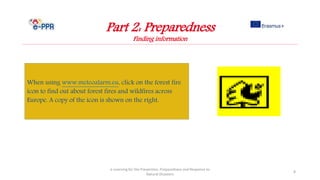
When using www.meteoalarm.eu, click on the forest fire
icon to find out about forest fires and wildfires across
Europe. A copy of the icon is shown on the right.
Part 2: Preparedness
Finding information
Part 2: Preparedness
Finding information
e-Learning for the Prevention, Preparedness and Response to
Natural Disasters
9
The participating countries are:
Austria, Bosnia-Herzegovina, Belgium, Bulgaria, Switzerland, Cyprus, Czech Republic,
Germany, Denmark, Estonia, Spain, Finland, France, Greece, Croatia, Hungary, Ireland, Iceland,
Italy, Luxemburg, Latvia, Former Yugoslav Republic of Macedonia, Malta, Montenegro,
Netherlands, Norway, Poland, Portugal, Romania, Serbia, Sweden, Slovenia, Slovakia, United
Kingdom.
www.meteoalarm.eu is developed for EUMETNET, the Network of European Meteorological
Services. This initiative is supported by the World Meteorological Organization (WMO).
Part 2: Preparedness
Finding information
e-Learning for the Prevention, Preparedness and Response to
Natural Disasters
10
The participating countries are:
Austria, Bosnia-Herzegovina, Belgium, Bulgaria, Switzerland, Cyprus, Czech Republic,
Germany, Denmark, Estonia, Spain, Finland, France, Greece, Croatia, Hungary, Ireland, Iceland,
Italy, Luxemburg, Latvia, Former Yugoslav Republic of Macedonia, Malta, Montenegro,
Netherlands, Norway, Poland, Portugal, Romania, Serbia, Sweden, Slovenia, Slovakia, United
Kingdom.
www.meteoalarm.eu is developed for EUMETNET, the Network of European Meteorological
Services. This initiative is supported by the World Meteorological Organization (WMO).
Part 2: Preparedness
Finding information
e-Learning for the Prevention, Preparedness and Response to
Natural Disasters
11
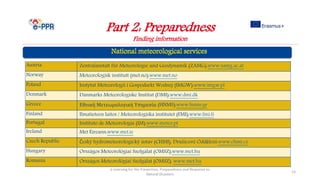
National meteorological services from each country will provide information and alerts on
severe weather.
Check the weather forecasts to see if the weather conditions are favourable to the ignition and
spreading of a wildfire (dry weather, wind, etc.).
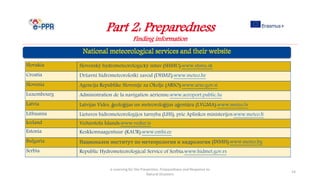
The next slides contain a list of the meteorological services from the EU and neighbouring
countries.
Part 2: Preparedness
Finding information
e-Learning for the Prevention, Preparedness and Response to
Natural Disasters
12
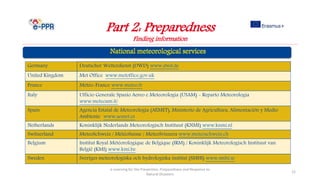
Germany Deutscher Wetterdienst (DWD) www.dwd.de
United Kingdom Met Office www.metoffice.gov.uk
France Météo-France www.meteo.fr
Italy Ufficio Generale Spazio Aereo e Meteorologia (USAM) - Reparto Meteorologia
www.meteoam.it/
Spain Agencia Estatal de Meteorología (AEMET), Ministerio de Agricultura, Alimentación y Medio
Ambiente www.aemet.es
Netherlands Koninklijk Nederlands Meteorologisch Instituut (KNMI) www.knmi.nl
Switzerland MeteoSchweiz / MétéoSuisse / MeteoSvizzera www.meteoschweiz.ch
Belgium Institut Royal Météorologique de Belgique (IRM) / Koninklijk Meteorologisch Instituut van
België (KMI) www.kmi.be
Sweden Sveriges meteorologiska och hydrologiska institut (SMHI) www.smhi.se
Part 2: Preparedness
Finding information
e-Learning for the Prevention, Preparedness and Response to
Natural Disasters
13
Austria Zentralanstalt für Meteorologie und Geodynamik (ZAMG):www.zamg.ac.at
Norway Meteorologisk institutt (met.no):www.met.no
Poland Instytut Meteorologii i Gospodarki Wodnej (IMGW):www.imgw.pl
Denmark Danmarks Meteorologiske Institut (DMI):www.dmi.dk
Greece Εθνική Μετεωρολογική Υπηρεσία (HNMS):www.hnms.gr
Finland Ilmatieteen laitos / Meteorologiska institutet (FMI):www.fmi.fi
Portugal Instituto de Meteorologia (IM):www.meteo.pt
Ireland Met Éireann:www.met.ie
Czech Republic Český hydrometeorologický ústav (CHMI), Družicové Oddělení:www.chmi.cz
Hungary Országos Meteorológiai Szolgálat (OMSZ):www.met.hu
Romania Országos Meteorológiai Szolgálat (OMSZ): www.met.hu
Part 2: Preparedness
Finding information
e-Learning for the Prevention, Preparedness and Response to
Natural Disasters
14
Slovakia Slovenský hydrometeorologický ústav (SHMU):www.shmu.sk
Croatia Državni hidrometeorološki zavod (DHMZ):www.meteo.hr
Slovenia Agencija Republike Slovenije za Okolje (ARSO):www.arso.gov.si
Luxembourg Administration de la navigation aérienne:www.aeroport.public.lu
Latvia Latvijas Vides, ģeoloģijas un meteoroloģijas aģentūra (LVGMA):www.meteo.lv
Lithuania Lietuvos hidrometeorologijos tarnyba (LHS), prie Aplinkos ministerijos:www.meteo.lt
Iceland Veðurstofa Íslands:www.vedur.is
Estonia Keskkonnaagentuur (KAUR):www.emhi.ee
Bulgaria Национален институт по метеорология и хидрология (INMH):www.meteo.bg
Serbia Republic Hydrometeorological Service of Serbia:www.hidmet.gov.rs
e-Learning for the Prevention, Preparedness and Response to
Natural Disasters
15
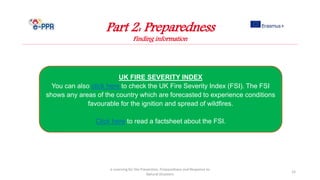
UK FIRE SEVERITY INDEX
You can also click here to check the UK Fire Severity Index (FSI). The FSI
shows any areas of the country which are forecasted to experience conditions
favourable for the ignition and spread of wildfires.
Click here to read a factsheet about the FSI.
Part 2: Preparedness
Finding information
Part 2: Preparedness
Finding information
e-Learning for the Prevention, Preparedness and Response to
Natural Disasters
16
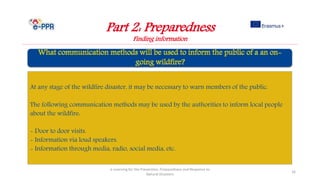
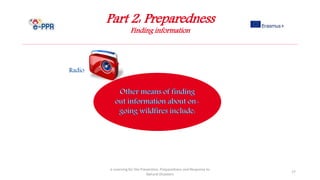
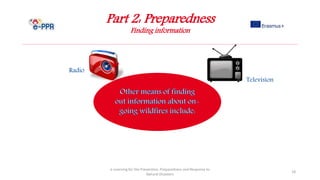
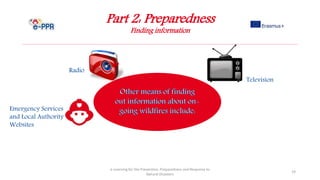
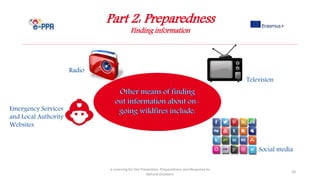
At any stage of the wildfire disaster, it may be necessary to warn members of the public.
The following communication methods may be used by the authorities to inform local people
about the wildfire:
- Door to door visits.
- Information via loud speakers.
- Information through media, radio, social media, etc.
Part 2: Preparedness
Finding information
e-Learning for the Prevention, Preparedness and Response to
Natural Disasters
17
Radio
Part 2: Preparedness
Finding information
e-Learning for the Prevention, Preparedness and Response to
Natural Disasters
18
Radio
Television
Part 2: Preparedness
Finding information
e-Learning for the Prevention, Preparedness and Response to
Natural Disasters
19
Emergency Services
and Local Authority
Websites
Radio
Television
Part 2: Preparedness
Finding information
e-Learning for the Prevention, Preparedness and Response to
Natural Disasters
20
Emergency Services
and Local Authority
Websites
Radio
Television
Social media
Part 2: Preparedness
Finding information
e-Learning for the Prevention, Preparedness and Response to
Natural Disasters
21
Emergency Services
and Local Authority
Websites
Radio
Television
Smartphone
Social media
Part 2: Preparedness
e-Learning for the Prevention, Preparedness and Response to
Natural Disasters
22
Part 2: Preparedness
How to be better prepared?
e-Learning for the Prevention, Preparedness and Response to
Natural Disasters
23
To be able to react safely during an emergency (such as a wildfire, storm, flood or loss of power etc.), it is
important to be prepared. A good way to be prepared is to make an emergency plan for your home. If you are
a parent, then make sure you involve your children and anyone else who lives with you. Every member of your
household should know the plan and should know what to do if there is an emergency.
Part 2: Preparedness
How to be better prepared?
e-Learning for the Prevention, Preparedness and Response to
Natural Disasters
24
To be able to react safely during an emergency (such as a wildfire, storm, flood or loss of power etc.), it is
important to be prepared. A good way to be prepared is to make an emergency plan for your home. If you are
a parent, then make sure you involve your children and anyone else who lives with you. Every member of your
household should know the plan and should know what to do if there is an emergency.
An emergency plan is a plan of what to do during an emergency and what you will need to do before leaving
your home in an emergency.
The next few slides contain some suggestions for what to include within your Home Emergency Plan.
Part 2: Preparedness
How to be better prepared?
e-Learning for the Prevention, Preparedness and Response to
Natural Disasters
25
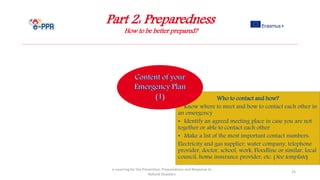
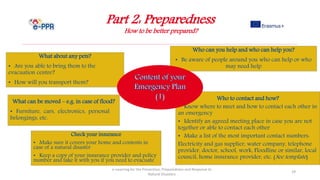
Who to contact and how?
• Know where to meet and how to contact each other in
an emergency
• Identify an agreed meeting place in case you are not
together or able to contact each other
• Make a list of the most important contact numbers:
Electricity and gas supplier, water company, telephone
provider, doctor, school, work, Floodline or similar, local
council, home insurance provider, etc. (See template)
Part 2: Preparedness
How to be better prepared?
e-Learning for the Prevention, Preparedness and Response to
Natural Disasters
26
Who to contact and how?
• Know where to meet and how to contact each other in
an emergency
• Identify an agreed meeting place in case you are not
together or able to contact each other
• Make a list of the most important contact numbers:
Electricity and gas supplier, water company, telephone
provider, doctor, school, work, Floodline or similar, local
council, home insurance provider, etc. (See template)
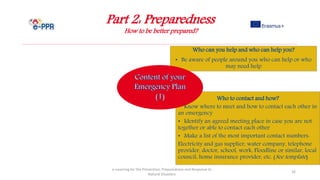
Who can you help and who can help you?
• Be aware of people around you who can help or who
may need help
Part 2: Preparedness
How to be better prepared?
e-Learning for the Prevention, Preparedness and Response to
Natural Disasters
27
Who to contact and how?
• Know where to meet and how to contact each other in
an emergency
• Identify an agreed meeting place in case you are not
together or able to contact each other
• Make a list of the most important contact numbers:
Electricity and gas supplier, water company, telephone
provider, doctor, school, work, Floodline or similar, local
council, home insurance provider, etc. (See template)
Who can you help and who can help you?
• Be aware of people around you who can help or who
may need help
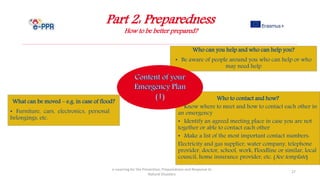
What can be moved – e.g. in case of flood?
• Furniture, cars, electronics, personal
belongings, etc.
Part 2: Preparedness
How to be better prepared?
e-Learning for the Prevention, Preparedness and Response to
Natural Disasters
28
Who to contact and how?
• Know where to meet and how to contact each other in
an emergency
• Identify an agreed meeting place in case you are not
together or able to contact each other
• Make a list of the most important contact numbers:
Electricity and gas supplier, water company, telephone
provider, doctor, school, work, Floodline or similar, local
council, home insurance provider, etc. (See template)
Who can you help and who can help you?
• Be aware of people around you who can help or who
may need help
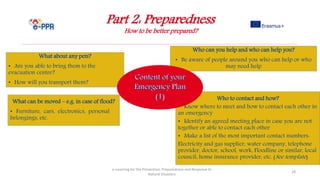
What about any pets?
• Are you able to bring them to the
evacuation centre?
• How will you transport them?
What can be moved – e.g. in case of flood?
• Furniture, cars, electronics, personal
belongings, etc.
Part 2: Preparedness
How to be better prepared?
e-Learning for the Prevention, Preparedness and Response to
Natural Disasters
29
Who to contact and how?
• Know where to meet and how to contact each other in
an emergency
• Identify an agreed meeting place in case you are not
together or able to contact each other
• Make a list of the most important contact numbers:
Electricity and gas supplier, water company, telephone
provider, doctor, school, work, Floodline or similar, local
council, home insurance provider, etc. (See template)
Who can you help and who can help you?
• Be aware of people around you who can help or who
may need help
What about any pets?
• Are you able to bring them to the
evacuation centre?
• How will you transport them?
What can be moved – e.g. in case of flood?
• Furniture, cars, electronics, personal
belongings, etc.
Check your insurance
• Make sure it covers your home and contents in
case of a natural disaster
• Keep a copy of your insurance provider and policy
number and take it with you if you need to evacuate
Part 2: Preparedness
How to be better prepared?
e-Learning for the Prevention, Prepare
dness and Response to Natural Disasters
30
Know your way out of your home in case of fire
• Where are the keys kept when the door is
locked?
• Practice finding way out crawling on the floor
and blindfolded
Part 2: Preparedness
How to be better prepared?
e-Learning for the Prevention, Prepare
dness and Response to Natural Disasters
31
Know your way out of your home in case of fire
• Where are the keys kept when the door is
locked?
• Practice finding way out crawling on the floor
and blindfolded
Emergency number
Call 999 if someone is ill, injured or in a
potentially life-threatening situation
Part 2: Preparedness
How to be better prepared?
e-Learning for the Prevention, Prepare
dness and Response to Natural Disasters
32
Know your way out of your home in case of fire
• Where are the keys kept when the door is
locked?
• Practice finding way out crawling on the floor
and blindfolded
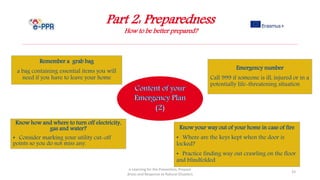
Remember a grab bag
a bag containing essential items you will
need if you have to leave your home
Emergency number
Call 999 if someone is ill, injured or in a
potentially life-threatening situation
Part 2: Preparedness
How to be better prepared?
e-Learning for the Prevention, Prepare
dness and Response to Natural Disasters
33
Know how and where to turn off electricity,
gas and water?
• Consider marking your utility cut-off
points so you do not miss any.
Know your way out of your home in case of fire
• Where are the keys kept when the door is
locked?
• Practice finding way out crawling on the floor
and blindfolded
Remember a grab bag
a bag containing essential items you will
need if you have to leave your home
Emergency number
Call 999 if someone is ill, injured or in a
potentially life-threatening situation
Part 2: Preparedness
How to be better prepared?
e-Learning for the Prevention, Preparedness and Response to
Natural Disasters
34
Make sure you practise your Home Emergency Plan with your family and household. It is
important that you all know it and know what to do in case of an emergency. This will help
keep you safe and possibly help you to save your most important belongings. Pretend there is
an emergency and try to follow the plan, escape the house and find a place of safety.
Part 2: Preparedness
How to be better prepared?
e-Learning for the Prevention, Preparedness and Response to
Natural Disasters
35
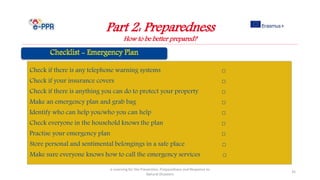
Check if there is any telephone warning systems □
Check if your insurance covers □
Check if there is anything you can do to protect your property □
Make an emergency plan and grab bag □
Identify who can help you/who you can help □
Check everyone in the household knows the plan □
Practise your emergency plan □
Store personal and sentimental belongings in a safe place □
Make sure everyone knows how to call the emergency services □
Image courtesy of John Kasawa
at FreeDigitalPhotos.net
Part 2: Preparedness
How to be better prepared?
e-Learning for the Prevention, Preparedness and Response to
Natural Disasters
36
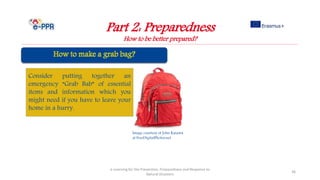
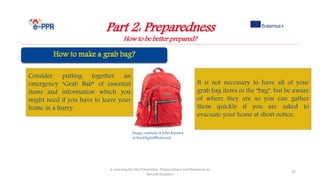
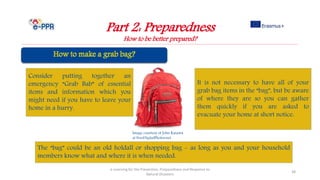
Consider putting together an
emergency “Grab Bab” of essential
items and information which you
might need if you have to leave your
home in a hurry.
Image courtesy of John Kasawa
at FreeDigitalPhotos.net
Part 2: Preparedness
How to be better prepared?
e-Learning for the Prevention, Preparedness and Response to
Natural Disasters
37
Consider putting together an
emergency “Grab Bab” of essential
items and information which you
might need if you have to leave your
home in a hurry.
It is not necessary to have all of your
grab bag items in the “bag”, but be aware
of where they are so you can gather
them quickly if you are asked to
evacuate your home at short notice.
Image courtesy of John Kasawa
at FreeDigitalPhotos.net
Part 2: Preparedness
How to be better prepared?
e-Learning for the Prevention, Preparedness and Response to
Natural Disasters
38
Consider putting together an
emergency “Grab Bab” of essential
items and information which you
might need if you have to leave your
home in a hurry.
It is not necessary to have all of your
grab bag items in the “bag”, but be aware
of where they are so you can gather
them quickly if you are asked to
evacuate your home at short notice.
The “bag” could be an old holdall or shopping bag - as long as you and your household
members know what and where it is when needed.
Part 2: Preparedness
How to be better prepared?
e-Learning for the Prevention, Preparedness and Response to
Natural Disasters
39
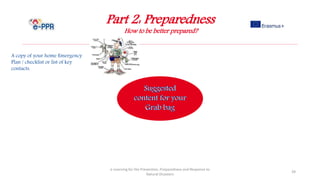
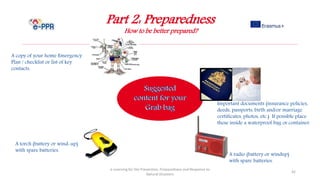
A copy of your home Emergency
Plan / checklist or list of key
contacts.
Part 2: Preparedness
How to be better prepared?
e-Learning for the Prevention, Preparedness and Response to
Natural Disasters
40
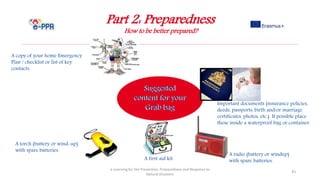
A copy of your home Emergency
Plan / checklist or list of key
contacts.
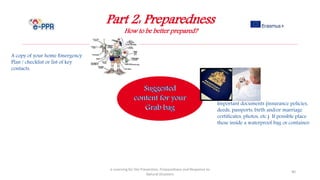
Important documents (insurance policies,
deeds, passports, birth and/or marriage
certificates, photos, etc.) If possible place
these inside a waterproof bag or container.
Part 2: Preparedness
How to be better prepared?
e-Learning for the Prevention, Preparedness and Response to
Natural Disasters
41
A copy of your home Emergency
Plan / checklist or list of key
contacts.
Important documents (insurance policies,
deeds, passports, birth and/or marriage
certificates, photos, etc.) If possible place
these inside a waterproof bag or container.
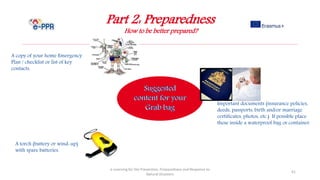
A torch (battery or wind-up)
with spare batteries.
Part 2: Preparedness
How to be better prepared?
e-Learning for the Prevention, Preparedness and Response to
Natural Disasters
42
A copy of your home Emergency
Plan / checklist or list of key
contacts.
Important documents (insurance policies,
deeds, passports, birth and/or marriage
certificates, photos, etc.) If possible place
these inside a waterproof bag or container.
A torch (battery or wind-up)
with spare batteries.
A radio (battery or windup)
with spare batteries.
Part 2: Preparedness
How to be better prepared?
e-Learning for the Prevention, Preparedness and Response to
Natural Disasters
43
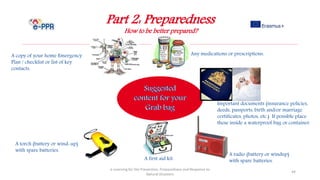
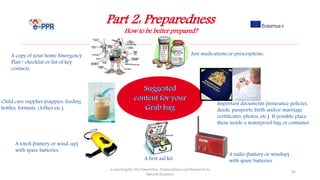
A first aid kit.
A copy of your home Emergency
Plan / checklist or list of key
contacts.
Important documents (insurance policies,
deeds, passports, birth and/or marriage
certificates, photos, etc.) If possible place
these inside a waterproof bag or container.
A torch (battery or wind-up)
with spare batteries.
A radio (battery or windup)
with spare batteries.
Part 2: Preparedness
How to be better prepared?
e-Learning for the Prevention, Preparedness and Response to
Natural Disasters
44
A first aid kit.
A copy of your home Emergency
Plan / checklist or list of key
contacts.
Important documents (insurance policies,
deeds, passports, birth and/or marriage
certificates, photos, etc.) If possible place
these inside a waterproof bag or container.
A torch (battery or wind-up)
with spare batteries.
A radio (battery or windup)
with spare batteries.
Any medications or prescriptions.
Part 2: Preparedness
How to be better prepared?
e-Learning for the Prevention, Preparedness and Response to
Natural Disasters
45
A first aid kit.
A copy of your home Emergency
Plan / checklist or list of key
contacts.
Important documents (insurance policies,
deeds, passports, birth and/or marriage
certificates, photos, etc.) If possible place
these inside a waterproof bag or container.
A torch (battery or wind-up)
with spare batteries.
A radio (battery or windup)
with spare batteries.
Any medications or prescriptions.
Child care supplies (nappies, feeding
bottles, formula, clothes etc.)
Part 2: Preparedness
How to be better prepared?
e-Learning for the Prevention, Preparedness and Response to
Natural Disasters
46
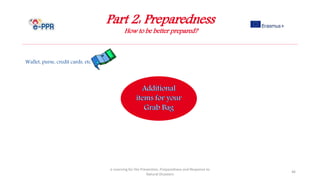
Wallet, purse, credit cards, etc.
Part 2: Preparedness
How to be better prepared?
e-Learning for the Prevention, Preparedness and Response to
Natural Disasters
47
Wallet, purse, credit cards, etc.
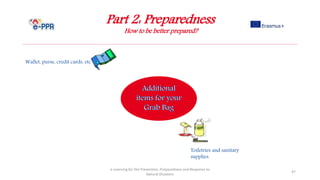
Toiletries and sanitary
supplies.
Part 2: Preparedness
How to be better prepared?
e-Learning for the Prevention, Preparedness and Response to
Natural Disasters
48
Wallet, purse, credit cards, etc.
Toiletries and sanitary
supplies.
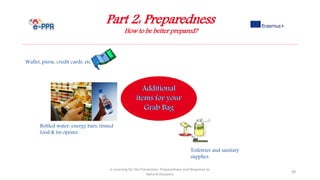
Bottled water, energy bars, tinned
food & tin opener.
Part 2: Preparedness
How to be better prepared?
e-Learning for the Prevention, Preparedness and Response to
Natural Disasters
49
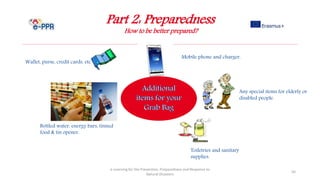
Wallet, purse, credit cards, etc.
Toiletries and sanitary
supplies.
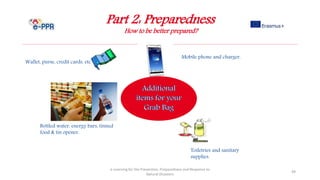
Mobile phone and charger.
Bottled water, energy bars, tinned
food & tin opener.
Part 2: Preparedness
How to be better prepared?
e-Learning for the Prevention, Preparedness and Response to
Natural Disasters
50
Wallet, purse, credit cards, etc.
Any special items for elderly or
disabled people.
Toiletries and sanitary
supplies.
Mobile phone and charger.
Bottled water, energy bars, tinned
food & tin opener.
Part 2: Preparedness
How to be better prepared?
e-Learning for the Prevention, Preparedness and Response to
Natural Disasters
51
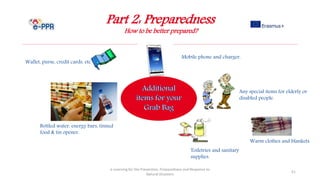
Wallet, purse, credit cards, etc.
Any special items for elderly or
disabled people.
Toiletries and sanitary
supplies.
Mobile phone and charger.
Bottled water, energy bars, tinned
food & tin opener.
Warm clothes and blankets.
Part 2: Preparedness
How to be better prepared?
e-Learning for the Prevention, Preparedness and Response to
Natural Disasters
52
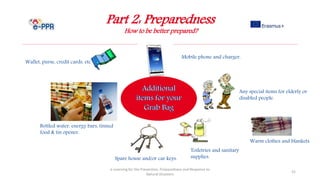
Spare house and/or car keys.
Wallet, purse, credit cards, etc.
Any special items for elderly or
disabled people.
Toiletries and sanitary
supplies.
Mobile phone and charger.
Bottled water, energy bars, tinned
food & tin opener.
Warm clothes and blankets.
Part 2: Preparedness
How to be better prepared?
e-Learning for the Prevention, Preparedness and Response to
Natural Disasters
53
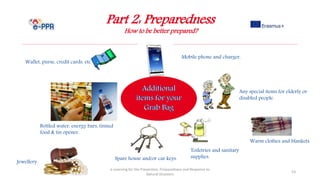
Spare house and/or car keys.
Wallet, purse, credit cards, etc.
Any special items for elderly or
disabled people.
Jewellery.
Toiletries and sanitary
supplies.
Mobile phone and charger.
Bottled water, energy bars, tinned
food & tin opener.
Warm clothes and blankets.
Part 2: Preparedness
How to be better prepared?
e-Learning for the Prevention, Preparedness and Response to
Natural Disasters
54
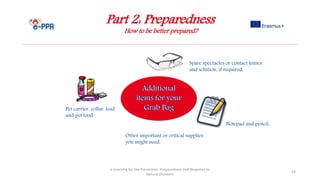
Other important or critical supplies
you might need.
Pet carrier, collar, lead
and pet food.
Notepad and pencil.
Spare spectacles or contact lenses
and solution, if required.
Part 2: Preparedness
Better prepared : visiting an area at risk?
e-Learning for the Prevention, Preparedness and Response to
Natural Disasters
55
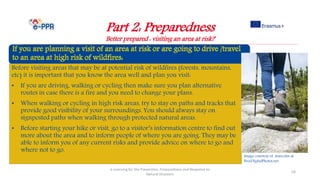
Before visiting areas that may be at potential risk of wildfires (forests, mountains,
etc) it is important that you know the area well and plan you visit:
Image courtesy of marcolm at
FreeDigitalPhotos.net
Part 2: Preparedness
Better prepared : visiting an area at risk?
e-Learning for the Prevention, Preparedness and Response to
Natural Disasters
56
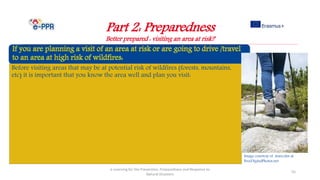
Before visiting areas that may be at potential risk of wildfires (forests, mountains,
etc) it is important that you know the area well and plan you visit:
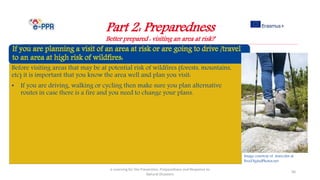
• If you are driving, walking or cycling then make sure you plan alternative
routes in case there is a fire and you need to change your plans.
Image courtesy of marcolm at
FreeDigitalPhotos.net
Part 2: Preparedness
Better prepared : visiting an area at risk?
e-Learning for the Prevention, Preparedness and Response to
Natural Disasters
57
Before visiting areas that may be at potential risk of wildfires (forests, mountains,
etc) it is important that you know the area well and plan you visit:
• If you are driving, walking or cycling then make sure you plan alternative
routes in case there is a fire and you need to change your plans.
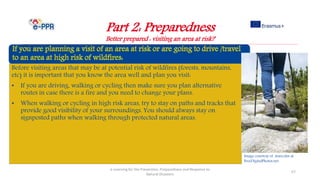
• When walking or cycling in high risk areas, try to stay on paths and tracks that
provide good visibility of your surroundings. You should always stay on
signposted paths when walking through protected natural areas.
Image courtesy of marcolm at
FreeDigitalPhotos.net
Part 2: Preparedness
Better prepared : visiting an area at risk?
e-Learning for the Prevention, Preparedness and Response to
Natural Disasters
58
Before visiting areas that may be at potential risk of wildfires (forests, mountains,
etc) it is important that you know the area well and plan you visit:
• If you are driving, walking or cycling then make sure you plan alternative
routes in case there is a fire and you need to change your plans.
• When walking or cycling in high risk areas, try to stay on paths and tracks that
provide good visibility of your surroundings. You should always stay on
signposted paths when walking through protected natural areas.
• Before starting your hike or visit, go to a visitor’s information centre to find out
more about the area and to inform people of where you are going. They may be
able to inform you of any current risks and provide advice on where to go and
where not to go.
Image courtesy of marcolm at
FreeDigitalPhotos.net
Part 2: Preparedness
Better prepared : visiting an area at risk?
e-Learning for the Prevention, Preparedness and Response to
Natural Disasters
59
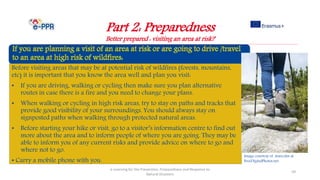
Before visiting areas that may be at potential risk of wildfires (forests, mountains,
etc) it is important that you know the area well and plan you visit:
• If you are driving, walking or cycling then make sure you plan alternative
routes in case there is a fire and you need to change your plans.
• When walking or cycling in high risk areas, try to stay on paths and tracks that
provide good visibility of your surroundings. You should always stay on
signposted paths when walking through protected natural areas.
• Before starting your hike or visit, go to a visitor’s information centre to find out
more about the area and to inform people of where you are going. They may be
able to inform you of any current risks and provide advice on where to go and
where not to go.
• Carry a mobile phone with you.
Image courtesy of marcolm at
FreeDigitalPhotos.net
Image courtesy of digitalart at
FreeDigitalPhotos.net
Part 2: Preparedness
How to be better prepared?
e-Learning for the Prevention, Preparedness and Response to
Natural Disasters
60
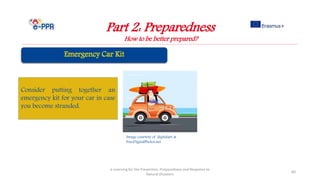
Consider putting together an
emergency kit for your car in case
you become stranded.
Part 2: Preparedness
Driving in Wildfires
e-Learning for the Prevention, Preparedness and Response to
Natural Disasters
61
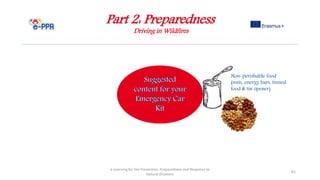
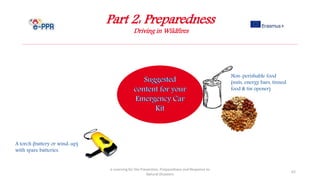
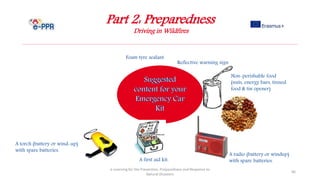
Non-perishable food
(nuts, energy bars, tinned
food & tin opener)
Part 2: Preparedness
Driving in Wildfires
e-Learning for the Prevention, Preparedness and Response to
Natural Disasters
62
Non-perishable food
(nuts, energy bars, tinned
food & tin opener)
A torch (battery or wind-up)
with spare batteries.
Part 2: Preparedness
Driving in Wildfires
e-Learning for the Prevention, Preparedness and Response to
Natural Disasters
63
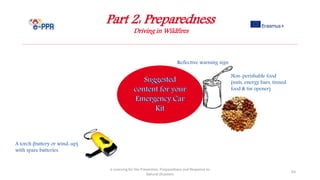
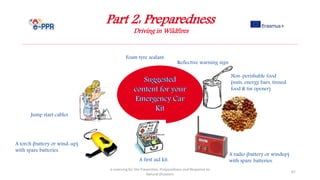
Reflective warning sign
Non-perishable food
(nuts, energy bars, tinned
food & tin opener)
A torch (battery or wind-up)
with spare batteries.
Part 2: Preparedness
Driving in Wildfires
e-Learning for the Prevention, Preparedness and Response to
Natural Disasters
64
Reflective warning sign
Non-perishable food
(nuts, energy bars, tinned
food & tin opener)
A torch (battery or wind-up)
with spare batteries.
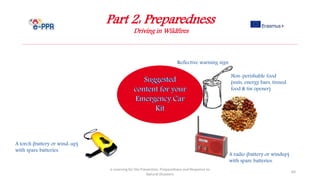
A radio (battery or windup)
with spare batteries.
Part 2: Preparedness
Driving in Wildfires
e-Learning for the Prevention, Preparedness and Response to
Natural Disasters
65
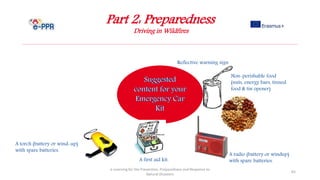
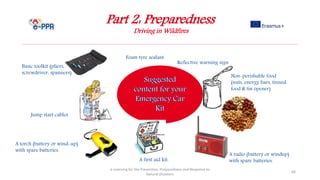
A first aid kit.
Reflective warning sign
Non-perishable food
(nuts, energy bars, tinned
food & tin opener)
A torch (battery or wind-up)
with spare batteries.
A radio (battery or windup)
with spare batteries.
Part 2: Preparedness
Driving in Wildfires
e-Learning for the Prevention, Preparedness and Response to
Natural Disasters
66
A first aid kit.
Reflective warning sign
Non-perishable food
(nuts, energy bars, tinned
food & tin opener)
A torch (battery or wind-up)
with spare batteries.
A radio (battery or windup)
with spare batteries.
Foam tyre sealant
Part 2: Preparedness
Driving in Wildfires
e-Learning for the Prevention, Preparedness and Response to
Natural Disasters
67
A first aid kit.
Reflective warning sign
Non-perishable food
(nuts, energy bars, tinned
food & tin opener)
A torch (battery or wind-up)
with spare batteries.
A radio (battery or windup)
with spare batteries.
Foam tyre sealant
Jump start cables
Part 2: Preparedness
Driving in Wildfires
e-Learning for the Prevention, Preparedness and Response to
Natural Disasters
68
A first aid kit.
Reflective warning sign
Non-perishable food
(nuts, energy bars, tinned
food & tin opener)
A torch (battery or wind-up)
with spare batteries.
A radio (battery or windup)
with spare batteries.
Foam tyre sealant
Jump start cables
Basic toolkit (pliers,
screwdriver, spanners)
Part 2: Preparedness
Driving in Wildfires
e-Learning for the Prevention, Preparedness and Response to
Natural Disasters
69
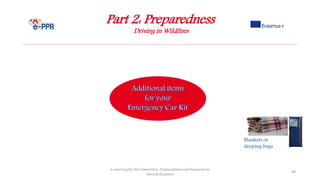
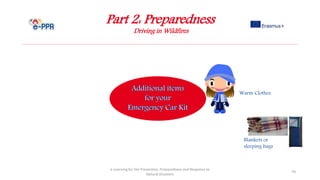
Blankets or
sleeping bags
Part 2: Preparedness
Driving in Wildfires
e-Learning for the Prevention, Preparedness and Response to
Natural Disasters
70
Warm Clothes
Blankets or
sleeping bags
Part 2: Preparedness
Driving in Wildfires
e-Learning for the Prevention, Preparedness and Response to
Natural Disasters
71
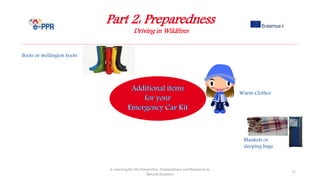
Warm Clothes
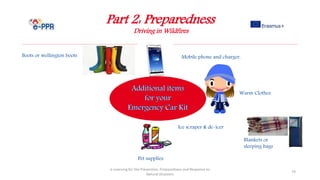
Boots or wellington boots
Blankets or
sleeping bags
Part 2: Preparedness
Driving in Wildfires
e-Learning for the Prevention, Preparedness and Response to
Natural Disasters
72
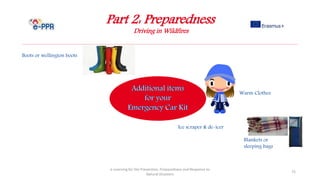
Warm Clothes
Boots or wellington boots
Blankets or
sleeping bags
Ice scraper & de-icer
Part 2: Preparedness
Driving in Wildfires
e-Learning for the Prevention, Preparedness and Response to
Natural Disasters
73
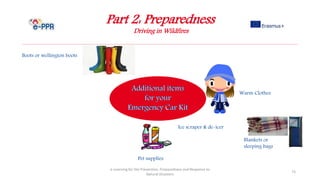
Pet supplies
Warm Clothes
Boots or wellington boots
Blankets or
sleeping bags
Ice scraper & de-icer
Part 2: Preparedness
Driving in Wildfires
e-Learning for the Prevention, Preparedness and Response to
Natural Disasters
74
Pet supplies
Warm Clothes
Boots or wellington boots Mobile phone and charger.
Blankets or
sleeping bags
Ice scraper & de-icer
Part 2: Preparedness
Driving in Wildfires
e-Learning for the Prevention, Preparedness and Response to
Natural Disasters
75
Pet supplies
Warm Clothes
Boots or wellington boots Mobile phone and charger.
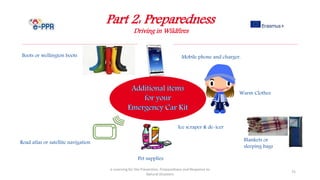
Road atlas or satellite navigation Blankets or
sleeping bags
Ice scraper & de-icer
Part 2: Preparedness
Driving in Wildfires
e-Learning for the Prevention, Preparedness and Response to
Natural Disasters
76
Pet supplies
Warm Clothes
Boots or wellington boots Mobile phone and charger.
Road atlas or satellite navigation Blankets or
sleeping bags
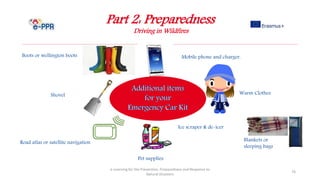
Shovel
Ice scraper & de-icer
Part 2: Preparedness
How to be better prepared?
e-Learning for the Prevention, Preparedness and Response to
Natural Disasters
77
Video: On Call Wildfire Series - "Preparedness“
Part 2: Preparedness
e-Learning for the Prevention, Preparedness and Response to
Natural Disasters
79
Part 2: Preparedness
How to be better prepared?
e-Learning for the Prevention, Preparedness and Response to
Natural Disasters
80
Listen out for national and local
advice and guidance. Look out for
weather bulletins, traffic warnings,
news alerts from Emergency
Services about travel disruption
(road, rail, air and sea).
Part 2: Preparedness
How to be better prepared?
e-Learning for the Prevention, Preparedness and Response to
Natural Disasters
81
Listen out for national and local
advice and guidance. Look out for
weather bulletins, traffic warnings,
news alerts from Emergency
Services about travel disruption
(road, rail, air and sea).
Consider – Is it safe to visit this area?
Is it safe to take this route? Can I
escape/get away easily in the event of
a wildfire?
Part 2: Preparedness
How to be better prepared?
e-Learning for the Prevention, Preparedness and Response to
Natural Disasters
82
Listen out for national and local
advice and guidance. Look out for
weather bulletins, traffic warnings,
news alerts from Emergency
Services about travel disruption
(road, rail, air and sea).
Consider – Is it safe to visit this area?
Is it safe to take this route? Can I
escape/get away easily in the event of
a wildfire?
If advised to stay indoors, do so and if you are told to leave
your house, then you need to do it, even though it may go
against your instinct to stay within the security of your own
home.
Part 2: Preparedness
How to be better prepared?
e-Learning for the Prevention, Preparedness and Response to
Natural Disasters
83
If you do need to evacuate:
• Follow the instructions given to you by the authorities.
The instructions are for your own safety
Part 2: Preparedness
How to be better prepared?
e-Learning for the Prevention, Preparedness and Response to
Natural Disasters
84
If you do need to evacuate:
• Follow the instructions given to you by the authorities.
The instructions are for your own safety
• Stay on the routes indicated to you
Part 2: Preparedness
How to be better prepared?
e-Learning for the Prevention, Preparedness and Response to
Natural Disasters
85
If you do need to evacuate:
• Follow the instructions given to you by the authorities.
The instructions are for your own safety
• Stay on the routes indicated to you
• Do not try to go back to where you came from/your
house until the emergency services or authorities say it
is safe to return
e-Learning for the Prevention, Preparedness and Response to
Natural Disasters
Part 2: Preparedness
86
We hope you enjoyed this module!
The content of this module was developed thanks to the support of the Junta de Andalucía and the e-PPR
Partners, unless specified otherwise.
This educational resource has been produced by the partners of the e-PPR Project (e-Learning for the Prevention, Preparedness and
Response to Natural Disasters) with the support of the Erasmus+ programme.
Unless otherwise stated, this educational resource is licensed under a Creative Commons Attribution-ShareAlike 4.0 International
License. It is attributed to the partners of the e-PPR project. Further information can be found at www.e-ppr.eu
The authors are committed to respecting the intellectual property rights of others, and have taken all reasonable efforts to ensure that
the reproduction of content (text, pictures, etc.) has been done with the full consent of copyright holders and that all copyright holders
are acknowledged in such reproductions. If you feel that your copyright has not been fully respected, please contact us by email at
projectmanager@e-ppr.eu.
If you are going to use parts of the content with materials whose copyright holder(s) is/are not the authors, it is your responsibility to
make sure you do so, respecting the original holder’s copyrights.
This content is the sole responsibility of the project partners and can in no way be taken to reflect the views of the European Union.
e-Learning for the Prevention, Preparedness and Response to
Natural Disasters
87
Copyright Statement

Adults - Wildfires - Preparedness

  • 1.
  • 2.
    Part 2: Preparedness e-Learningfor the Prevention, Preparedness and Response to Natural Disasters 2 • How to get information about on-going wildfires. • What you can do to be better prepared for wildfires: - Living near an area at risk. - Traveling to an area at risk. • The importance of following advice and guidance from professionals.
  • 3.
    Part 2: Preparedness e-Learningfor the Prevention, Preparedness and Response to Natural Disasters 3
  • 4.
    Part 2: Preparedness Findinginformation e-Learning for the Prevention, Preparedness and Response to Natural Disasters 4 www.meteoalarm.eu provides information to European citizens to help prepare for extreme weather, including wildfires.
  • 5.
    Part 2: Preparedness Findinginformation e-Learning for the Prevention, Preparedness and Response to Natural Disasters 5 www.meteoalarm.eu provides information to European citizens to help prepare for extreme weather, including wildfires. •The system will alert you to the possible occurrence of severe weather, such as heavy rain with risk of flooding, severe thunderstorms, gale-force winds, heat waves, forest fires (wildfires), fog, snow or extreme cold with blizzards, avalanches or severe coastal tides.
  • 6.
    Part 2: Preparedness Findinginformation e-Learning for the Prevention, Preparedness and Response to Natural Disasters 6 www.meteoalarm.eu provides information to European citizens to help prepare for extreme weather, including wildfires. •The system will alert you to the possible occurrence of severe weather, such as heavy rain with risk of flooding, severe thunderstorms, gale-force winds, heat waves, forest fires (wildfires), fog, snow or extreme cold with blizzards, avalanches or severe coastal tides. •In one glance you will be able to see where in Europe the weather might become extreme and/or dangerous.
  • 7.
    Part 2: Preparedness Findinginformation e-Learning for the Prevention, Preparedness and Response to Natural Disasters 7 www.meteoalarm.eu provides information to European citizens to help prepare for extreme weather, including wildfires. •The system will alert you to the possible occurrence of severe weather, such as heavy rain with risk of flooding, severe thunderstorms, gale-force winds, heat waves, forest fires (wildfires), fog, snow or extreme cold with blizzards, avalanches or severe coastal tides. •In one glance you will be able to see where in Europe the weather might become extreme and/or dangerous. •Visit www.meteoalarm.eu . This site integrates severe weather information originating from the official National Public Weather Services across a large number of European countries. This information is presented in a simple and consistent way to make it easier to compare and interpret.
  • 8.
    e-Learning for thePrevention, Preparedness and Response to Natural Disasters 8 When using www.meteoalarm.eu, click on the forest fire icon to find out about forest fires and wildfires across Europe. A copy of the icon is shown on the right. Part 2: Preparedness Finding information
  • 9.
    Part 2: Preparedness Findinginformation e-Learning for the Prevention, Preparedness and Response to Natural Disasters 9 The participating countries are: Austria, Bosnia-Herzegovina, Belgium, Bulgaria, Switzerland, Cyprus, Czech Republic, Germany, Denmark, Estonia, Spain, Finland, France, Greece, Croatia, Hungary, Ireland, Iceland, Italy, Luxemburg, Latvia, Former Yugoslav Republic of Macedonia, Malta, Montenegro, Netherlands, Norway, Poland, Portugal, Romania, Serbia, Sweden, Slovenia, Slovakia, United Kingdom. www.meteoalarm.eu is developed for EUMETNET, the Network of European Meteorological Services. This initiative is supported by the World Meteorological Organization (WMO).
  • 10.
    Part 2: Preparedness Findinginformation e-Learning for the Prevention, Preparedness and Response to Natural Disasters 10 The participating countries are: Austria, Bosnia-Herzegovina, Belgium, Bulgaria, Switzerland, Cyprus, Czech Republic, Germany, Denmark, Estonia, Spain, Finland, France, Greece, Croatia, Hungary, Ireland, Iceland, Italy, Luxemburg, Latvia, Former Yugoslav Republic of Macedonia, Malta, Montenegro, Netherlands, Norway, Poland, Portugal, Romania, Serbia, Sweden, Slovenia, Slovakia, United Kingdom. www.meteoalarm.eu is developed for EUMETNET, the Network of European Meteorological Services. This initiative is supported by the World Meteorological Organization (WMO).
  • 11.
    Part 2: Preparedness Findinginformation e-Learning for the Prevention, Preparedness and Response to Natural Disasters 11 National meteorological services from each country will provide information and alerts on severe weather. Check the weather forecasts to see if the weather conditions are favourable to the ignition and spreading of a wildfire (dry weather, wind, etc.). The next slides contain a list of the meteorological services from the EU and neighbouring countries.
  • 12.
    Part 2: Preparedness Findinginformation e-Learning for the Prevention, Preparedness and Response to Natural Disasters 12 Germany Deutscher Wetterdienst (DWD) www.dwd.de United Kingdom Met Office www.metoffice.gov.uk France Météo-France www.meteo.fr Italy Ufficio Generale Spazio Aereo e Meteorologia (USAM) - Reparto Meteorologia www.meteoam.it/ Spain Agencia Estatal de Meteorología (AEMET), Ministerio de Agricultura, Alimentación y Medio Ambiente www.aemet.es Netherlands Koninklijk Nederlands Meteorologisch Instituut (KNMI) www.knmi.nl Switzerland MeteoSchweiz / MétéoSuisse / MeteoSvizzera www.meteoschweiz.ch Belgium Institut Royal Météorologique de Belgique (IRM) / Koninklijk Meteorologisch Instituut van België (KMI) www.kmi.be Sweden Sveriges meteorologiska och hydrologiska institut (SMHI) www.smhi.se
  • 13.
    Part 2: Preparedness Findinginformation e-Learning for the Prevention, Preparedness and Response to Natural Disasters 13 Austria Zentralanstalt für Meteorologie und Geodynamik (ZAMG):www.zamg.ac.at Norway Meteorologisk institutt (met.no):www.met.no Poland Instytut Meteorologii i Gospodarki Wodnej (IMGW):www.imgw.pl Denmark Danmarks Meteorologiske Institut (DMI):www.dmi.dk Greece Εθνική Μετεωρολογική Υπηρεσία (HNMS):www.hnms.gr Finland Ilmatieteen laitos / Meteorologiska institutet (FMI):www.fmi.fi Portugal Instituto de Meteorologia (IM):www.meteo.pt Ireland Met Éireann:www.met.ie Czech Republic Český hydrometeorologický ústav (CHMI), Družicové Oddělení:www.chmi.cz Hungary Országos Meteorológiai Szolgálat (OMSZ):www.met.hu Romania Országos Meteorológiai Szolgálat (OMSZ): www.met.hu
  • 14.
    Part 2: Preparedness Findinginformation e-Learning for the Prevention, Preparedness and Response to Natural Disasters 14 Slovakia Slovenský hydrometeorologický ústav (SHMU):www.shmu.sk Croatia Državni hidrometeorološki zavod (DHMZ):www.meteo.hr Slovenia Agencija Republike Slovenije za Okolje (ARSO):www.arso.gov.si Luxembourg Administration de la navigation aérienne:www.aeroport.public.lu Latvia Latvijas Vides, ģeoloģijas un meteoroloģijas aģentūra (LVGMA):www.meteo.lv Lithuania Lietuvos hidrometeorologijos tarnyba (LHS), prie Aplinkos ministerijos:www.meteo.lt Iceland Veðurstofa Íslands:www.vedur.is Estonia Keskkonnaagentuur (KAUR):www.emhi.ee Bulgaria Национален институт по метеорология и хидрология (INMH):www.meteo.bg Serbia Republic Hydrometeorological Service of Serbia:www.hidmet.gov.rs
  • 15.
    e-Learning for thePrevention, Preparedness and Response to Natural Disasters 15 UK FIRE SEVERITY INDEX You can also click here to check the UK Fire Severity Index (FSI). The FSI shows any areas of the country which are forecasted to experience conditions favourable for the ignition and spread of wildfires. Click here to read a factsheet about the FSI. Part 2: Preparedness Finding information
  • 16.
    Part 2: Preparedness Findinginformation e-Learning for the Prevention, Preparedness and Response to Natural Disasters 16 At any stage of the wildfire disaster, it may be necessary to warn members of the public. The following communication methods may be used by the authorities to inform local people about the wildfire: - Door to door visits. - Information via loud speakers. - Information through media, radio, social media, etc.
  • 17.
    Part 2: Preparedness Findinginformation e-Learning for the Prevention, Preparedness and Response to Natural Disasters 17 Radio
  • 18.
    Part 2: Preparedness Findinginformation e-Learning for the Prevention, Preparedness and Response to Natural Disasters 18 Radio Television
  • 19.
    Part 2: Preparedness Findinginformation e-Learning for the Prevention, Preparedness and Response to Natural Disasters 19 Emergency Services and Local Authority Websites Radio Television
  • 20.
    Part 2: Preparedness Findinginformation e-Learning for the Prevention, Preparedness and Response to Natural Disasters 20 Emergency Services and Local Authority Websites Radio Television Social media
  • 21.
    Part 2: Preparedness Findinginformation e-Learning for the Prevention, Preparedness and Response to Natural Disasters 21 Emergency Services and Local Authority Websites Radio Television Smartphone Social media
  • 22.
    Part 2: Preparedness e-Learningfor the Prevention, Preparedness and Response to Natural Disasters 22
  • 23.
    Part 2: Preparedness Howto be better prepared? e-Learning for the Prevention, Preparedness and Response to Natural Disasters 23 To be able to react safely during an emergency (such as a wildfire, storm, flood or loss of power etc.), it is important to be prepared. A good way to be prepared is to make an emergency plan for your home. If you are a parent, then make sure you involve your children and anyone else who lives with you. Every member of your household should know the plan and should know what to do if there is an emergency.
  • 24.
    Part 2: Preparedness Howto be better prepared? e-Learning for the Prevention, Preparedness and Response to Natural Disasters 24 To be able to react safely during an emergency (such as a wildfire, storm, flood or loss of power etc.), it is important to be prepared. A good way to be prepared is to make an emergency plan for your home. If you are a parent, then make sure you involve your children and anyone else who lives with you. Every member of your household should know the plan and should know what to do if there is an emergency. An emergency plan is a plan of what to do during an emergency and what you will need to do before leaving your home in an emergency. The next few slides contain some suggestions for what to include within your Home Emergency Plan.
  • 25.
    Part 2: Preparedness Howto be better prepared? e-Learning for the Prevention, Preparedness and Response to Natural Disasters 25 Who to contact and how? • Know where to meet and how to contact each other in an emergency • Identify an agreed meeting place in case you are not together or able to contact each other • Make a list of the most important contact numbers: Electricity and gas supplier, water company, telephone provider, doctor, school, work, Floodline or similar, local council, home insurance provider, etc. (See template)
  • 26.
    Part 2: Preparedness Howto be better prepared? e-Learning for the Prevention, Preparedness and Response to Natural Disasters 26 Who to contact and how? • Know where to meet and how to contact each other in an emergency • Identify an agreed meeting place in case you are not together or able to contact each other • Make a list of the most important contact numbers: Electricity and gas supplier, water company, telephone provider, doctor, school, work, Floodline or similar, local council, home insurance provider, etc. (See template) Who can you help and who can help you? • Be aware of people around you who can help or who may need help
  • 27.
    Part 2: Preparedness Howto be better prepared? e-Learning for the Prevention, Preparedness and Response to Natural Disasters 27 Who to contact and how? • Know where to meet and how to contact each other in an emergency • Identify an agreed meeting place in case you are not together or able to contact each other • Make a list of the most important contact numbers: Electricity and gas supplier, water company, telephone provider, doctor, school, work, Floodline or similar, local council, home insurance provider, etc. (See template) Who can you help and who can help you? • Be aware of people around you who can help or who may need help What can be moved – e.g. in case of flood? • Furniture, cars, electronics, personal belongings, etc.
  • 28.
    Part 2: Preparedness Howto be better prepared? e-Learning for the Prevention, Preparedness and Response to Natural Disasters 28 Who to contact and how? • Know where to meet and how to contact each other in an emergency • Identify an agreed meeting place in case you are not together or able to contact each other • Make a list of the most important contact numbers: Electricity and gas supplier, water company, telephone provider, doctor, school, work, Floodline or similar, local council, home insurance provider, etc. (See template) Who can you help and who can help you? • Be aware of people around you who can help or who may need help What about any pets? • Are you able to bring them to the evacuation centre? • How will you transport them? What can be moved – e.g. in case of flood? • Furniture, cars, electronics, personal belongings, etc.
  • 29.
    Part 2: Preparedness Howto be better prepared? e-Learning for the Prevention, Preparedness and Response to Natural Disasters 29 Who to contact and how? • Know where to meet and how to contact each other in an emergency • Identify an agreed meeting place in case you are not together or able to contact each other • Make a list of the most important contact numbers: Electricity and gas supplier, water company, telephone provider, doctor, school, work, Floodline or similar, local council, home insurance provider, etc. (See template) Who can you help and who can help you? • Be aware of people around you who can help or who may need help What about any pets? • Are you able to bring them to the evacuation centre? • How will you transport them? What can be moved – e.g. in case of flood? • Furniture, cars, electronics, personal belongings, etc. Check your insurance • Make sure it covers your home and contents in case of a natural disaster • Keep a copy of your insurance provider and policy number and take it with you if you need to evacuate
  • 30.
    Part 2: Preparedness Howto be better prepared? e-Learning for the Prevention, Prepare dness and Response to Natural Disasters 30 Know your way out of your home in case of fire • Where are the keys kept when the door is locked? • Practice finding way out crawling on the floor and blindfolded
  • 31.
    Part 2: Preparedness Howto be better prepared? e-Learning for the Prevention, Prepare dness and Response to Natural Disasters 31 Know your way out of your home in case of fire • Where are the keys kept when the door is locked? • Practice finding way out crawling on the floor and blindfolded Emergency number Call 999 if someone is ill, injured or in a potentially life-threatening situation
  • 32.
    Part 2: Preparedness Howto be better prepared? e-Learning for the Prevention, Prepare dness and Response to Natural Disasters 32 Know your way out of your home in case of fire • Where are the keys kept when the door is locked? • Practice finding way out crawling on the floor and blindfolded Remember a grab bag a bag containing essential items you will need if you have to leave your home Emergency number Call 999 if someone is ill, injured or in a potentially life-threatening situation
  • 33.
    Part 2: Preparedness Howto be better prepared? e-Learning for the Prevention, Prepare dness and Response to Natural Disasters 33 Know how and where to turn off electricity, gas and water? • Consider marking your utility cut-off points so you do not miss any. Know your way out of your home in case of fire • Where are the keys kept when the door is locked? • Practice finding way out crawling on the floor and blindfolded Remember a grab bag a bag containing essential items you will need if you have to leave your home Emergency number Call 999 if someone is ill, injured or in a potentially life-threatening situation
  • 34.
    Part 2: Preparedness Howto be better prepared? e-Learning for the Prevention, Preparedness and Response to Natural Disasters 34 Make sure you practise your Home Emergency Plan with your family and household. It is important that you all know it and know what to do in case of an emergency. This will help keep you safe and possibly help you to save your most important belongings. Pretend there is an emergency and try to follow the plan, escape the house and find a place of safety.
  • 35.
    Part 2: Preparedness Howto be better prepared? e-Learning for the Prevention, Preparedness and Response to Natural Disasters 35 Check if there is any telephone warning systems □ Check if your insurance covers □ Check if there is anything you can do to protect your property □ Make an emergency plan and grab bag □ Identify who can help you/who you can help □ Check everyone in the household knows the plan □ Practise your emergency plan □ Store personal and sentimental belongings in a safe place □ Make sure everyone knows how to call the emergency services □
  • 36.
    Image courtesy ofJohn Kasawa at FreeDigitalPhotos.net Part 2: Preparedness How to be better prepared? e-Learning for the Prevention, Preparedness and Response to Natural Disasters 36 Consider putting together an emergency “Grab Bab” of essential items and information which you might need if you have to leave your home in a hurry.
  • 37.
    Image courtesy ofJohn Kasawa at FreeDigitalPhotos.net Part 2: Preparedness How to be better prepared? e-Learning for the Prevention, Preparedness and Response to Natural Disasters 37 Consider putting together an emergency “Grab Bab” of essential items and information which you might need if you have to leave your home in a hurry. It is not necessary to have all of your grab bag items in the “bag”, but be aware of where they are so you can gather them quickly if you are asked to evacuate your home at short notice.
  • 38.
    Image courtesy ofJohn Kasawa at FreeDigitalPhotos.net Part 2: Preparedness How to be better prepared? e-Learning for the Prevention, Preparedness and Response to Natural Disasters 38 Consider putting together an emergency “Grab Bab” of essential items and information which you might need if you have to leave your home in a hurry. It is not necessary to have all of your grab bag items in the “bag”, but be aware of where they are so you can gather them quickly if you are asked to evacuate your home at short notice. The “bag” could be an old holdall or shopping bag - as long as you and your household members know what and where it is when needed.
  • 39.
    Part 2: Preparedness Howto be better prepared? e-Learning for the Prevention, Preparedness and Response to Natural Disasters 39 A copy of your home Emergency Plan / checklist or list of key contacts.
  • 40.
    Part 2: Preparedness Howto be better prepared? e-Learning for the Prevention, Preparedness and Response to Natural Disasters 40 A copy of your home Emergency Plan / checklist or list of key contacts. Important documents (insurance policies, deeds, passports, birth and/or marriage certificates, photos, etc.) If possible place these inside a waterproof bag or container.
  • 41.
    Part 2: Preparedness Howto be better prepared? e-Learning for the Prevention, Preparedness and Response to Natural Disasters 41 A copy of your home Emergency Plan / checklist or list of key contacts. Important documents (insurance policies, deeds, passports, birth and/or marriage certificates, photos, etc.) If possible place these inside a waterproof bag or container. A torch (battery or wind-up) with spare batteries.
  • 42.
    Part 2: Preparedness Howto be better prepared? e-Learning for the Prevention, Preparedness and Response to Natural Disasters 42 A copy of your home Emergency Plan / checklist or list of key contacts. Important documents (insurance policies, deeds, passports, birth and/or marriage certificates, photos, etc.) If possible place these inside a waterproof bag or container. A torch (battery or wind-up) with spare batteries. A radio (battery or windup) with spare batteries.
  • 43.
    Part 2: Preparedness Howto be better prepared? e-Learning for the Prevention, Preparedness and Response to Natural Disasters 43 A first aid kit. A copy of your home Emergency Plan / checklist or list of key contacts. Important documents (insurance policies, deeds, passports, birth and/or marriage certificates, photos, etc.) If possible place these inside a waterproof bag or container. A torch (battery or wind-up) with spare batteries. A radio (battery or windup) with spare batteries.
  • 44.
    Part 2: Preparedness Howto be better prepared? e-Learning for the Prevention, Preparedness and Response to Natural Disasters 44 A first aid kit. A copy of your home Emergency Plan / checklist or list of key contacts. Important documents (insurance policies, deeds, passports, birth and/or marriage certificates, photos, etc.) If possible place these inside a waterproof bag or container. A torch (battery or wind-up) with spare batteries. A radio (battery or windup) with spare batteries. Any medications or prescriptions.
  • 45.
    Part 2: Preparedness Howto be better prepared? e-Learning for the Prevention, Preparedness and Response to Natural Disasters 45 A first aid kit. A copy of your home Emergency Plan / checklist or list of key contacts. Important documents (insurance policies, deeds, passports, birth and/or marriage certificates, photos, etc.) If possible place these inside a waterproof bag or container. A torch (battery or wind-up) with spare batteries. A radio (battery or windup) with spare batteries. Any medications or prescriptions. Child care supplies (nappies, feeding bottles, formula, clothes etc.)
  • 46.
    Part 2: Preparedness Howto be better prepared? e-Learning for the Prevention, Preparedness and Response to Natural Disasters 46 Wallet, purse, credit cards, etc.
  • 47.
    Part 2: Preparedness Howto be better prepared? e-Learning for the Prevention, Preparedness and Response to Natural Disasters 47 Wallet, purse, credit cards, etc. Toiletries and sanitary supplies.
  • 48.
    Part 2: Preparedness Howto be better prepared? e-Learning for the Prevention, Preparedness and Response to Natural Disasters 48 Wallet, purse, credit cards, etc. Toiletries and sanitary supplies. Bottled water, energy bars, tinned food & tin opener.
  • 49.
    Part 2: Preparedness Howto be better prepared? e-Learning for the Prevention, Preparedness and Response to Natural Disasters 49 Wallet, purse, credit cards, etc. Toiletries and sanitary supplies. Mobile phone and charger. Bottled water, energy bars, tinned food & tin opener.
  • 50.
    Part 2: Preparedness Howto be better prepared? e-Learning for the Prevention, Preparedness and Response to Natural Disasters 50 Wallet, purse, credit cards, etc. Any special items for elderly or disabled people. Toiletries and sanitary supplies. Mobile phone and charger. Bottled water, energy bars, tinned food & tin opener.
  • 51.
    Part 2: Preparedness Howto be better prepared? e-Learning for the Prevention, Preparedness and Response to Natural Disasters 51 Wallet, purse, credit cards, etc. Any special items for elderly or disabled people. Toiletries and sanitary supplies. Mobile phone and charger. Bottled water, energy bars, tinned food & tin opener. Warm clothes and blankets.
  • 52.
    Part 2: Preparedness Howto be better prepared? e-Learning for the Prevention, Preparedness and Response to Natural Disasters 52 Spare house and/or car keys. Wallet, purse, credit cards, etc. Any special items for elderly or disabled people. Toiletries and sanitary supplies. Mobile phone and charger. Bottled water, energy bars, tinned food & tin opener. Warm clothes and blankets.
  • 53.
    Part 2: Preparedness Howto be better prepared? e-Learning for the Prevention, Preparedness and Response to Natural Disasters 53 Spare house and/or car keys. Wallet, purse, credit cards, etc. Any special items for elderly or disabled people. Jewellery. Toiletries and sanitary supplies. Mobile phone and charger. Bottled water, energy bars, tinned food & tin opener. Warm clothes and blankets.
  • 54.
    Part 2: Preparedness Howto be better prepared? e-Learning for the Prevention, Preparedness and Response to Natural Disasters 54 Other important or critical supplies you might need. Pet carrier, collar, lead and pet food. Notepad and pencil. Spare spectacles or contact lenses and solution, if required.
  • 55.
    Part 2: Preparedness Betterprepared : visiting an area at risk? e-Learning for the Prevention, Preparedness and Response to Natural Disasters 55 Before visiting areas that may be at potential risk of wildfires (forests, mountains, etc) it is important that you know the area well and plan you visit: Image courtesy of marcolm at FreeDigitalPhotos.net
  • 56.
    Part 2: Preparedness Betterprepared : visiting an area at risk? e-Learning for the Prevention, Preparedness and Response to Natural Disasters 56 Before visiting areas that may be at potential risk of wildfires (forests, mountains, etc) it is important that you know the area well and plan you visit: • If you are driving, walking or cycling then make sure you plan alternative routes in case there is a fire and you need to change your plans. Image courtesy of marcolm at FreeDigitalPhotos.net
  • 57.
    Part 2: Preparedness Betterprepared : visiting an area at risk? e-Learning for the Prevention, Preparedness and Response to Natural Disasters 57 Before visiting areas that may be at potential risk of wildfires (forests, mountains, etc) it is important that you know the area well and plan you visit: • If you are driving, walking or cycling then make sure you plan alternative routes in case there is a fire and you need to change your plans. • When walking or cycling in high risk areas, try to stay on paths and tracks that provide good visibility of your surroundings. You should always stay on signposted paths when walking through protected natural areas. Image courtesy of marcolm at FreeDigitalPhotos.net
  • 58.
    Part 2: Preparedness Betterprepared : visiting an area at risk? e-Learning for the Prevention, Preparedness and Response to Natural Disasters 58 Before visiting areas that may be at potential risk of wildfires (forests, mountains, etc) it is important that you know the area well and plan you visit: • If you are driving, walking or cycling then make sure you plan alternative routes in case there is a fire and you need to change your plans. • When walking or cycling in high risk areas, try to stay on paths and tracks that provide good visibility of your surroundings. You should always stay on signposted paths when walking through protected natural areas. • Before starting your hike or visit, go to a visitor’s information centre to find out more about the area and to inform people of where you are going. They may be able to inform you of any current risks and provide advice on where to go and where not to go. Image courtesy of marcolm at FreeDigitalPhotos.net
  • 59.
    Part 2: Preparedness Betterprepared : visiting an area at risk? e-Learning for the Prevention, Preparedness and Response to Natural Disasters 59 Before visiting areas that may be at potential risk of wildfires (forests, mountains, etc) it is important that you know the area well and plan you visit: • If you are driving, walking or cycling then make sure you plan alternative routes in case there is a fire and you need to change your plans. • When walking or cycling in high risk areas, try to stay on paths and tracks that provide good visibility of your surroundings. You should always stay on signposted paths when walking through protected natural areas. • Before starting your hike or visit, go to a visitor’s information centre to find out more about the area and to inform people of where you are going. They may be able to inform you of any current risks and provide advice on where to go and where not to go. • Carry a mobile phone with you. Image courtesy of marcolm at FreeDigitalPhotos.net
  • 60.
    Image courtesy ofdigitalart at FreeDigitalPhotos.net Part 2: Preparedness How to be better prepared? e-Learning for the Prevention, Preparedness and Response to Natural Disasters 60 Consider putting together an emergency kit for your car in case you become stranded.
  • 61.
    Part 2: Preparedness Drivingin Wildfires e-Learning for the Prevention, Preparedness and Response to Natural Disasters 61 Non-perishable food (nuts, energy bars, tinned food & tin opener)
  • 62.
    Part 2: Preparedness Drivingin Wildfires e-Learning for the Prevention, Preparedness and Response to Natural Disasters 62 Non-perishable food (nuts, energy bars, tinned food & tin opener) A torch (battery or wind-up) with spare batteries.
  • 63.
    Part 2: Preparedness Drivingin Wildfires e-Learning for the Prevention, Preparedness and Response to Natural Disasters 63 Reflective warning sign Non-perishable food (nuts, energy bars, tinned food & tin opener) A torch (battery or wind-up) with spare batteries.
  • 64.
    Part 2: Preparedness Drivingin Wildfires e-Learning for the Prevention, Preparedness and Response to Natural Disasters 64 Reflective warning sign Non-perishable food (nuts, energy bars, tinned food & tin opener) A torch (battery or wind-up) with spare batteries. A radio (battery or windup) with spare batteries.
  • 65.
    Part 2: Preparedness Drivingin Wildfires e-Learning for the Prevention, Preparedness and Response to Natural Disasters 65 A first aid kit. Reflective warning sign Non-perishable food (nuts, energy bars, tinned food & tin opener) A torch (battery or wind-up) with spare batteries. A radio (battery or windup) with spare batteries.
  • 66.
    Part 2: Preparedness Drivingin Wildfires e-Learning for the Prevention, Preparedness and Response to Natural Disasters 66 A first aid kit. Reflective warning sign Non-perishable food (nuts, energy bars, tinned food & tin opener) A torch (battery or wind-up) with spare batteries. A radio (battery or windup) with spare batteries. Foam tyre sealant
  • 67.
    Part 2: Preparedness Drivingin Wildfires e-Learning for the Prevention, Preparedness and Response to Natural Disasters 67 A first aid kit. Reflective warning sign Non-perishable food (nuts, energy bars, tinned food & tin opener) A torch (battery or wind-up) with spare batteries. A radio (battery or windup) with spare batteries. Foam tyre sealant Jump start cables
  • 68.
    Part 2: Preparedness Drivingin Wildfires e-Learning for the Prevention, Preparedness and Response to Natural Disasters 68 A first aid kit. Reflective warning sign Non-perishable food (nuts, energy bars, tinned food & tin opener) A torch (battery or wind-up) with spare batteries. A radio (battery or windup) with spare batteries. Foam tyre sealant Jump start cables Basic toolkit (pliers, screwdriver, spanners)
  • 69.
    Part 2: Preparedness Drivingin Wildfires e-Learning for the Prevention, Preparedness and Response to Natural Disasters 69 Blankets or sleeping bags
  • 70.
    Part 2: Preparedness Drivingin Wildfires e-Learning for the Prevention, Preparedness and Response to Natural Disasters 70 Warm Clothes Blankets or sleeping bags
  • 71.
    Part 2: Preparedness Drivingin Wildfires e-Learning for the Prevention, Preparedness and Response to Natural Disasters 71 Warm Clothes Boots or wellington boots Blankets or sleeping bags
  • 72.
    Part 2: Preparedness Drivingin Wildfires e-Learning for the Prevention, Preparedness and Response to Natural Disasters 72 Warm Clothes Boots or wellington boots Blankets or sleeping bags Ice scraper & de-icer
  • 73.
    Part 2: Preparedness Drivingin Wildfires e-Learning for the Prevention, Preparedness and Response to Natural Disasters 73 Pet supplies Warm Clothes Boots or wellington boots Blankets or sleeping bags Ice scraper & de-icer
  • 74.
    Part 2: Preparedness Drivingin Wildfires e-Learning for the Prevention, Preparedness and Response to Natural Disasters 74 Pet supplies Warm Clothes Boots or wellington boots Mobile phone and charger. Blankets or sleeping bags Ice scraper & de-icer
  • 75.
    Part 2: Preparedness Drivingin Wildfires e-Learning for the Prevention, Preparedness and Response to Natural Disasters 75 Pet supplies Warm Clothes Boots or wellington boots Mobile phone and charger. Road atlas or satellite navigation Blankets or sleeping bags Ice scraper & de-icer
  • 76.
    Part 2: Preparedness Drivingin Wildfires e-Learning for the Prevention, Preparedness and Response to Natural Disasters 76 Pet supplies Warm Clothes Boots or wellington boots Mobile phone and charger. Road atlas or satellite navigation Blankets or sleeping bags Shovel Ice scraper & de-icer
  • 77.
    Part 2: Preparedness Howto be better prepared? e-Learning for the Prevention, Preparedness and Response to Natural Disasters 77 Video: On Call Wildfire Series - "Preparedness“
  • 78.
    Part 2: Preparedness e-Learningfor the Prevention, Preparedness and Response to Natural Disasters 79
  • 79.
    Part 2: Preparedness Howto be better prepared? e-Learning for the Prevention, Preparedness and Response to Natural Disasters 80 Listen out for national and local advice and guidance. Look out for weather bulletins, traffic warnings, news alerts from Emergency Services about travel disruption (road, rail, air and sea).
  • 80.
    Part 2: Preparedness Howto be better prepared? e-Learning for the Prevention, Preparedness and Response to Natural Disasters 81 Listen out for national and local advice and guidance. Look out for weather bulletins, traffic warnings, news alerts from Emergency Services about travel disruption (road, rail, air and sea). Consider – Is it safe to visit this area? Is it safe to take this route? Can I escape/get away easily in the event of a wildfire?
  • 81.
    Part 2: Preparedness Howto be better prepared? e-Learning for the Prevention, Preparedness and Response to Natural Disasters 82 Listen out for national and local advice and guidance. Look out for weather bulletins, traffic warnings, news alerts from Emergency Services about travel disruption (road, rail, air and sea). Consider – Is it safe to visit this area? Is it safe to take this route? Can I escape/get away easily in the event of a wildfire? If advised to stay indoors, do so and if you are told to leave your house, then you need to do it, even though it may go against your instinct to stay within the security of your own home.
  • 82.
    Part 2: Preparedness Howto be better prepared? e-Learning for the Prevention, Preparedness and Response to Natural Disasters 83 If you do need to evacuate: • Follow the instructions given to you by the authorities. The instructions are for your own safety
  • 83.
    Part 2: Preparedness Howto be better prepared? e-Learning for the Prevention, Preparedness and Response to Natural Disasters 84 If you do need to evacuate: • Follow the instructions given to you by the authorities. The instructions are for your own safety • Stay on the routes indicated to you
  • 84.
    Part 2: Preparedness Howto be better prepared? e-Learning for the Prevention, Preparedness and Response to Natural Disasters 85 If you do need to evacuate: • Follow the instructions given to you by the authorities. The instructions are for your own safety • Stay on the routes indicated to you • Do not try to go back to where you came from/your house until the emergency services or authorities say it is safe to return
  • 85.
    e-Learning for thePrevention, Preparedness and Response to Natural Disasters Part 2: Preparedness 86 We hope you enjoyed this module! The content of this module was developed thanks to the support of the Junta de Andalucía and the e-PPR Partners, unless specified otherwise.
  • 86.
    This educational resourcehas been produced by the partners of the e-PPR Project (e-Learning for the Prevention, Preparedness and Response to Natural Disasters) with the support of the Erasmus+ programme. Unless otherwise stated, this educational resource is licensed under a Creative Commons Attribution-ShareAlike 4.0 International License. It is attributed to the partners of the e-PPR project. Further information can be found at www.e-ppr.eu The authors are committed to respecting the intellectual property rights of others, and have taken all reasonable efforts to ensure that the reproduction of content (text, pictures, etc.) has been done with the full consent of copyright holders and that all copyright holders are acknowledged in such reproductions. If you feel that your copyright has not been fully respected, please contact us by email at projectmanager@e-ppr.eu. If you are going to use parts of the content with materials whose copyright holder(s) is/are not the authors, it is your responsibility to make sure you do so, respecting the original holder’s copyrights. This content is the sole responsibility of the project partners and can in no way be taken to reflect the views of the European Union. e-Learning for the Prevention, Preparedness and Response to Natural Disasters 87 Copyright Statement