W
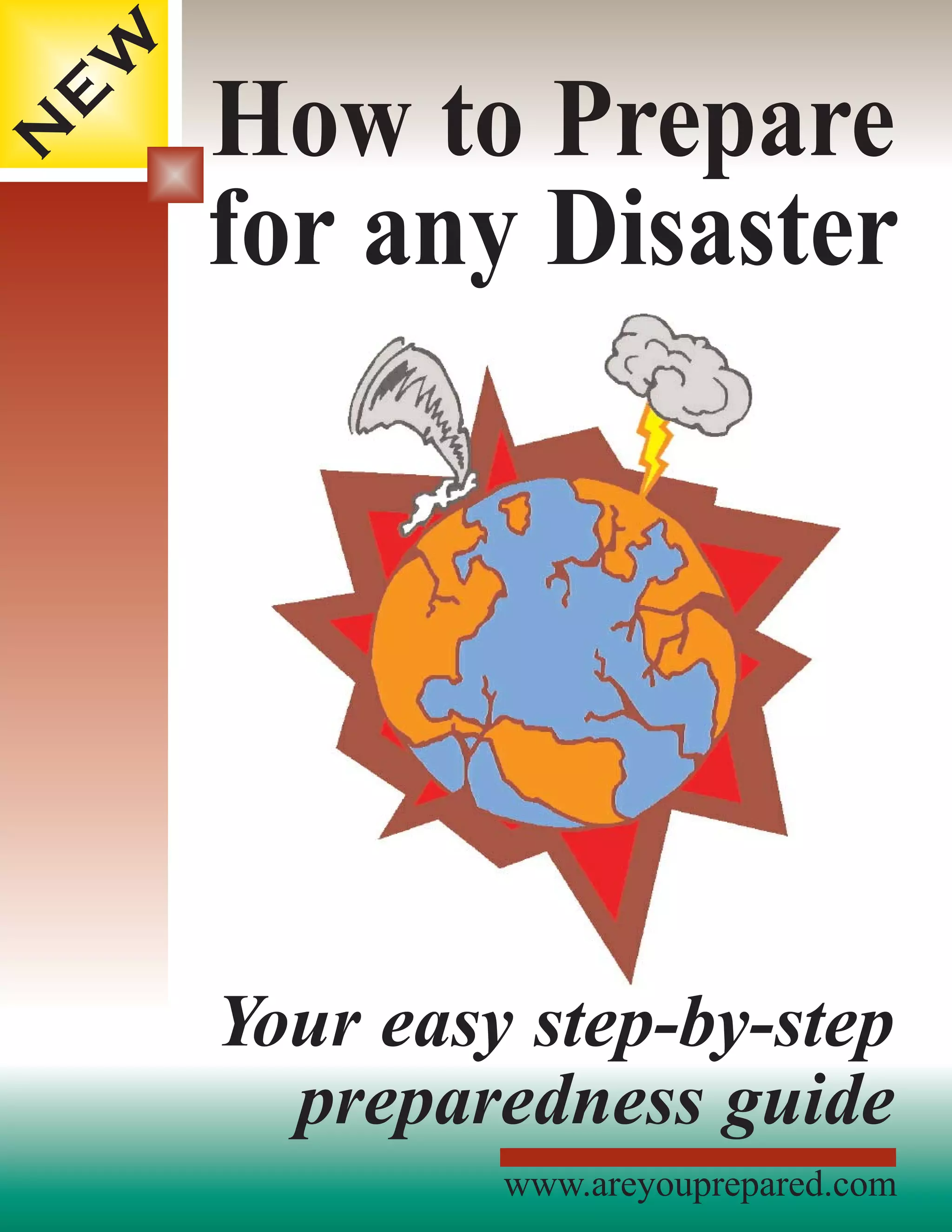
        How to Prepare
E
N


        for any Disaster


        Your easy step-by-step
          preparedness guide
                 www.areyouprepared.com
Congratulations!
   You’ve taken the first step to getting ready for any disaster.
                                             Step 1
                                     Know How to Prepare
                      (Learning and Understanding the Preparedness Process)

           This book will help you understand the importance of making preparations
                    before anything happens, and help you know what to do
                       and how to act before, during and after a disaster.

                                           Step 2
                                Have the Necessities Ready
You may have many of these items already. After reading this book, you should have a pretty
good idea about what you will need. If you feel that you are missing something, check out our
          website at www.areyouprepared.com for a complete list of the necessities.

     Read, discuss and become familiar with the information
   contained in this book so that, in the event of an emergency,
     you can act in a responsible manner to avoid a tragedy.
This booklet is intended to assist others in dealing with emergencies. The final decision of any action
taken during a real emergency is the sole responsibility of the person involved. Emergency
Preparedness Center and “areyouprepared.com” has made its best effort to produce a high quality,
informative and helpful book. But they make no representation or warranties of any kind with regard to
the completeness or accuracy of the contents of the book. They assume no liability for danger, harm,
difficulty or injury of persons or property, or actions undertaken by any person in attempting to utilize
the information contained within this book.

No part of this publication may be stored in a retrieval system, transmitted, or reproduced in any way,
including but not limited, to digital copying and printing, without the prior agreement and written per-
mission of the publisher.


             EMERGENCY PREPAREDNESS CENTER
                  www.areyouprepared.com
                                 520 C North Main Street Suite 202
                                      Heber City, Utah 84032
               Knowledge • Peace Of Mind • Preparation

www.areyouprepared.com                                        ©2001 Emergency Preparedness Center
info@areyouprepared.com                                                                    page 2
Table of Contents
                         CHAPTER 1
             Getting Ready Before Anything Happens
                                   (What to do Now!)

      7.    Creating Your Own Disaster Plan of Action
            Finding out what could happen in your area?
            4 Steps to putting it together.
            How to practice and maintain your plan.
            Your Contact Information. (Post this information by the phone)

      12.   How Safe is Your House?
            Checklist
            Controlling your utilities:
                   How to shut them off in an emergency.
                   What to do with them after an emergency.

      14.   Preparing some Necessities for Quick Action
            3 Day (72 Hrs.) Evacuation Kit-
                   How to Make a 72 Hour Kit.

            First Aid-
                    How to Make a First Aid Kit.

            Emergency Water-
                  Recommended amount needed.
                  How to purify water.
                  How to store water.
                  Emergency Water sources inside and out of your home.

      18.   Take Important Actions and Have this Information in place NOW.

      20.   How to Report an Emergency.

      22.   Evacuation-
            Necessary preparations before an evacuation.
            How to evacuate.
            Evacuation worksheet .

      24.   Action Plan Checklist (Are You Ready?)
            Be sure all members of your family know this.

www.areyouprepared.com                             ©2001 Emergency Preparedness Center
info@areyouprepared.com                                                         page 3
CHAPTER 2
                        Knowing What to Do:
                    Taking the Appropriate Action
                                (Before - During - After)


      26.   Acts of Violence: Nuclear or Other Wars
                   9 steps to prepare
                   The dangers
                   Finding safety
                   Shelter
                   Radiation

      27.   Terrorism, Riots, Looting, Bomb Threats and Other Violence
                   The dangers
                   Finding safety

      28.   Hazardous Chemical: Transportation accidents, Accidental spills,
            Intentional
            The dangers
            8 steps to take to prepare
            What to do if it happens

      29.   Earthquakes
            7 steps to prepare
            What to do during if your are:
                    indoors.
                    outdoors.
                    in your car.
            After the quake, what next?

      31.   Extreme Weather: Hurricane,
            Tornado, Winter Storms, Lightning
            & Thunder, Drought & Extreme
            Heat.
            13 steps to prepare
            What to do during
            The dangers
            Steps to following after it has passed

      35.   Famine
            6 steps to prepare
            Actions to take during

www.areyouprepared.com                               ©2001 Emergency Preparedness Center
info@areyouprepared.com                                                           page 4
36.   Plagues
            What is a plague?
            4 steps to prepare for
            What to do during

      37.   Floods
            5 steps to prepare
            7 steps to take during
            The dangers and what to do after


                                     CHAPTER 3
                                      Recovery

      38.   How to Reduce Anxiety and Fear.
            Be prepared - 4 steps to take

      38.   How to Recover (Children).
            6 important points

      38.   How to Recover (Adults).
            Helping yourself
            Helping children and others


                              CHAPTER 4
                          Long Term Preparations
                            You might need them for a while
                      (Helpful suggestions for each of the following)

      40.   Food
            Do you want to just survive or do it in style
            What are your options?
            Advantages and disadvantages
            Priorities in building your food storage program
            Recommendations
            How much?
            How to store
            Rotation


www.areyouprepared.com                               ©2001 Emergency Preparedness Center
info@areyouprepared.com                                                           page 5
42.   Water
            Find, store and purify
            Recommended amounts

      42.   Clothes
            Storage plan

      42.   Finance
            Cash, important documents and insurances

      43.   Shelter
            Alternative Suggestions

      43.   Heat
            Alternative Suggestions

      43.   Light
            Alternative Suggestions

      43.   Fuel
            Suggestions

      43.   Cooking
            Easy alternatives

      44.   Sanitation
            List of necessary items to store


                                  CHAPTER 5
      45.   Other Important Web Sites


www.areyouprepared.com                            ©2001 Emergency Preparedness Center
info@areyouprepared.com                                                        page 6
CHAPTER 1
                  CREATING YOUR DISASTER PLAN
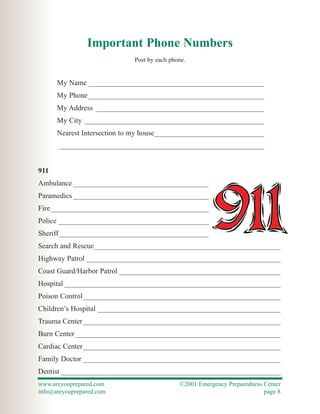
     Where will you & your family be WHEN IT STRIKES!
             Work? School? Home? Traveling?
         Will you know What to do and where to go?


              4 STEPS TO SAFETY
      1. Finding Out What Could Happen in Your Area.
A.   Contact the organizations that are listed at the front of this booklet. They can give you the
     phone numbers to your local chapter who can tell you what disasters could happen in your
     area.
B.   Find out what your community’s warning signals are, what they sound like and what you
     should do when you hear them.
C.   Learn about the disaster plans at work, school, daycare and other places where your family
     spends time.
D.   If you have animals, find out about animal care. They may not be allowed in some places
     during and after a disaster.
E.   Find out how to help the elderly and disabled.

                            2. Create a Disaster Plan for your family.
A.   Meet with your family and discuss what types of disasters could happen in your area and
     what to do. (Page 25)
B.   Discuss the steps of evacuation. (Page 22)
C.   Choose 2 places to meet family members:
     1. Outside your house if members are home.
     2. Outside your neighborhood in case you can’t get to your home. (City park, church,
     school play ground, etc.)
D.   Ask an out-of-state family member or friend to be your family’s “Contact Person”. After a
     disaster, communications can be difficult. Many times it is easier to get through to your
     contact person out of state than to make a local call. If your family members become sepa-
     rated in a disaster, have them call this person and let them know where they are and if all is
     well with them.

                                3. Practice and Maintain your plan
A.   Conduct fire and emergency evacuation drills.
B.   Quiz your family every six months so they don’t forget.
C.   Test and recharge fire extinguishers.
D.   Check/rotate food & water in your evacuation-kit every 6 months.
E.   Test smoke detectors monthly. Change batteries every 6 months.
F.   Remember to always remain calm. Panic causes accidents.

www.areyouprepared.com                                    ©2001 Emergency Preparedness Center
info@areyouprepared.com                                                                page 7
Important Phone Numbers
                             Post by each phone.


      My Name ________________________________________________
      My Phone ________________________________________________
      My Address ______________________________________________
      My City _________________________________________________
      Nearest Intersection to my house______________________________
       ________________________________________________________


911
Ambulance _____________________________________
Paramedics _____________________________________
Fire ___________________________________________
Police _________________________________________
Sheriff_________________________________________
Search and Rescue___________________________________________________
Highway Patrol _____________________________________________________
Coast Guard/Harbor Patrol ____________________________________________
Hospital ___________________________________________________________
Poison Control______________________________________________________
Children’s Hospital __________________________________________________
Trauma Center______________________________________________________
Burn Center ________________________________________________________
Cardiac Center______________________________________________________
Family Doctor ______________________________________________________
Dentist ____________________________________________________________
www.areyouprepared.com                       ©2001 Emergency Preparedness Center
info@areyouprepared.com                                                   page 8
Veterinarian ________________________________________________________
Pharmacy __________________________________________________________
Employer __________________________________________________________
Father’s Work ______________________________________________________
Mother’s Work______________________________________________________
Other Relatives _____________________________________________________
Neighbor __________________________________________________________
Out-of-Town Contact Person __________________________________________
__________________________________________________________________
Out-of-State Contact Person ___________________________________________
__________________________________________________________________
Church Leader ______________________________________________________
Babysitter _________________________________________________________
Daycare Center _____________________________________________________
Pre-School _________________________________________________________
Elementary School __________________________________________________
Middle School ______________________________________________________
Junior High ________________________________________________________
High School________________________________________________________
Gas_______________________________________________________________
Power_____________________________________________________________
Telephone _________________________________________________________
Handyman _________________________________________________________
Electrician _________________________________________________________
Plumber ___________________________________________________________
Mechanic __________________________________________________________
Family Attorney ____________________________________________________

www.areyouprepared.com                   ©2001 Emergency Preparedness Center
info@areyouprepared.com                                               page 9
Accountant ________________________________________________________
Banker or Financial Advisor ___________________________________________
Insurance Agent_____________________________________________________
Mortgage Company__________________________________________________
Landlord __________________________________________________________
Emergency Roadside Assistance________________________________________
Taxi ______________________________________________________________
Public Transportation ________________________________________________
Weather ___________________________________________________________
Road Conditions ____________________________________________________
Avalanche__________________________________________________________
Forest Service ______________________________________________________
Snow Removal _____________________________________________________
Time and Temperature________________________________________________
Animal Control _____________________________________________________
American Red Cross _________________________________________________
Disaster Clean -up Company __________________________________________
Crisis Hotline ______________________________________________________
Social Worker ______________________________________________________
Health Department __________________________________________________
Others: ____________________________________________________________
__________________________________________________________________
__________________________________________________________________
__________________________________________________________________
__________________________________________________________________
__________________________________________________________________
__________________________________________________________________

www.areyouprepared.com                   ©2001 Emergency Preparedness Center
info@areyouprepared.com                                             page 10
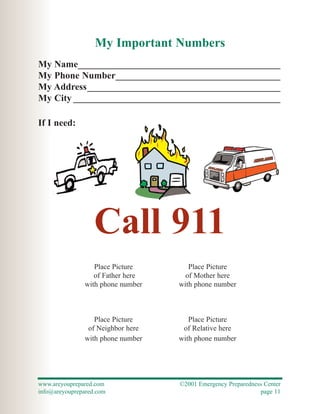
My Important Numbers
My Name___________________________________________
My Phone Number___________________________________
My Address_________________________________________
My City ____________________________________________

If I need:


                   Call 911
                  Place Picture       Place Picture
                  of Father here     of Mother here
               with phone number   with phone number


                  Place Picture       Place Picture
                of Neighbor here    of Relative here
               with phone number   with phone number


www.areyouprepared.com             ©2001 Emergency Preparedness Center
info@areyouprepared.com                                       page 11
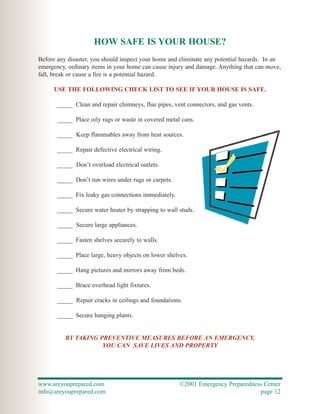
HOW SAFE IS YOUR HOUSE?
Before any disaster, you should inspect your home and eliminate any potential hazards. In an
emergency, ordinary items in your home can cause injury and damage. Anything that can move,
fall, break or cause a fire is a potential hazard.

     USE THE FOLLOWING CHECK LIST TO SEE IF YOUR HOUSE IS SAFE.

       _____ Clean and repair chimneys, flue pipes, vent connectors, and gas vents.

       _____ Place oily rags or waste in covered metal cans.

       _____ Keep flammables away from heat sources.

       _____ Repair defective electrical wiring.

       _____ Don’t overload electrical outlets.

       _____ Don’t run wires under rugs or carpets.

       _____ Fix leaky gas connections immediately.

       _____ Secure water heater by strapping to wall studs.

       _____ Secure large appliances.

       _____ Fasten shelves securely to walls.

       _____ Place large, heavy objects on lower shelves.

       _____ Hang pictures and mirrors away from beds.

       _____ Brace overhead light fixtures.

       _____ Repair cracks in ceilings and foundations.

       _____ Secure hanging plants.


          BY TAKING PREVENTIVE MEASURES BEFORE AN EMERGENCY,
                     YOU CAN SAVE LIVES AND PROPERTY


www.areyouprepared.com                                ©2001 Emergency Preparedness Center
info@areyouprepared.com                                                          page 12
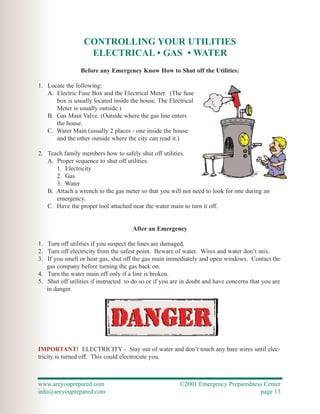
CONTROLLING YOUR UTILITIES
                   ELECTRICAL • GAS • WATER
                 Before any Emergency Know How to Shut off the Utilities:

1. Locate the following:
   A. Electric Fuse Box and the Electrical Meter. (The fuse
      box is usually located inside the house. The Electrical
      Meter is usually outside.)
   B. Gas Main Valve. (Outside where the gas line enters
      the house.
   C. Water Main (usually 2 places - one inside the house
      and the other outside where the city can read it.)

2. Teach family members how to safely shut off utilities.
   A. Proper sequence to shut off utilities.
      1. Electricity
      2. Gas
      3. Water
   B. Attach a wrench to the gas meter so that you will not need to look for one during an
      emergency.
   C. Have the proper tool attached near the water main to turn it off.


                                      After an Emergency

1. Turn off utilities if you suspect the lines are damaged.
2. Turn off electricity from the safest point. Beware of water. Wires and water don’t mix.
3. If you smell or hear gas, shut off the gas main immediately and open windows. Contact the
   gas company before turning the gas back on.
4. Turn the water main off only if a line is broken.
5. Shut off utilities if instructed to do so or if you are in doubt and have concerns that you are
   in danger.


IMPORTANT! ELECTRICITY - Stay out of water and don’t touch any bare wires until elec-
tricity is turned off. This could electrocute you.


www.areyouprepared.com                                   ©2001 Emergency Preparedness Center
info@areyouprepared.com                                                             page 13
PREPARING SOME NECESSITIES
                       FOR QUICK ACTION

                         3 DAY EVACUATION KIT
When an emergency strikes you may be forced to leave your home and have only enough time
to grab the family and your evacuation-kit. There is a good
chance that you may not be able to return for a few days and
that outside help may not be available for days.

1. Your evacuation-kit should contain the necessary items to
   sustain life for the first critical hours/days following a
   disaster.
2. When assembling a kit remember to make it:
   A. Portable so that a woman or child could carry it.
   B. Easy to use.
3. Include the following essentials -


        Food:                      First Aid Kit                Misc. Items:
        MREs for 3 days            (see page 15)                Extra set of Car Keys
        Instant Cereal                                          Credit Cards and Case
        Instant Hot Chocolate      Sanitation:                  List of Family
        Food Bars                  Toilet Paper                     Physicians
                                   Soap/Shampoo                 Special Items for
        Shelter/Bedding:           Toothbrush/Paste                 Infants,Elderly or
        Tube Tent                  Personal Hygiene Items           Disabled Family
        Rain Poncho                                                 Members
        Space Blanket              Heat/Light:                  1 Gallon of Water per
        Wool Blanket               Pocket Hand Warmers              person per day
        Sleeping Bags              Matches/Candles
                                   Propane Stove                Communications:
        Water:                     Fire Starter Kit               Battery Powered
        Water Purification         Flashlight                     Radio
        Tablets                    Gloves                         Extra Batteries

Store these items in a sturdy, easy to carry backpack or duffel bag. Larger families may need
several packs. Be sure it is accessible in the event of an emergency or evacuation.


www.areyouprepared.com                                 ©2001 Emergency Preparedness Center
info@areyouprepared.com                                                           page 14
FIRST AID
                                How to Make a First Aid Kit

1. When assembling your First Aid Kit, take into consideration
   the following:
   A. Specific health needs of family members.
   B. Include the necessary medications and equipment for
   them.
   C. Items that your family is familiar with and knows how to
   use properly.

2. Discuss with your family doctor your special needs. He can
   inform you of the specific medications/prescriptions you
   need and explain how to use, store and rotate them.

3. The following is a list of BASIC MEDICAL SUPPLIES recommended for a kit.
   Upgrade it as you increase your training:

           First Aid Manual                     Insect Repellent
           Sterile Adhesive Bandages            Moistened Towelettes
           Sterile Gauze Pads                   Antiseptic-Cream
           Hypoallergenic Adhesive Tape         Neosporin
           Triangular Bandages                  Petroleum Jelly
           Roller Bandages - 2 & 3 inches       Aspirin or
           Scissors                                 Non-Aspirin Pain Reliever
           Tweezers                             Laxatives
           Needle                               Anti-Diarrhea Medication
           Thermometer                          Syrup of Ipecac -
           Tongue Blades                            To induce vomiting if advised
           Assorted Sizes of Safety Pins            by Poison Control
           Latex Gloves                         Antacid
           Antiseptic Soap                      Sterile Adhesive Bandages
           Rubbing Alcohol                          in assorted Sizes
           Cotton                               Special Medications for Family
           Disposable Diapers


NOTE:
     The American Red Cross offers classes in First Aid and CPR that cost little or nothing.


www.areyouprepared.com                                ©2001 Emergency Preparedness Center
info@areyouprepared.com                                                          page 15
EMERGENCY WATER
                                 The Absolute Necessity
            Bare minimum per person per day for cooking and drinking is 1 Gallon.
                       Add additional water for bathing & washing.


                                How to Purify Water
   Before purifying water in any manner, filter out debris by passing it through a clean cloth.

                                                Boil
   Bring water to a full rolling boil for at least 5 minutes. Add another minute per 1000 ft. that
you are above sea level. After boiling, you may improve the taste of the water by pouring it
back and forth from one container to another to aerate it.

                                              Bleach
    Use bleach that has sodium hypo-chlorite as its only active ingredient. Add the following
dosage according to clear or cloudy water then let stand for 30 minutes. A slight oder of chlo-
rine should be detectable if the water is properly treated. Add a little more until smell is
detectable.

                                      QUART                 GALLON
                      Clear           2 Drops               8 Drops
                      Cloudy          4 Drops               16 Drops

                                            Iodine
                                          2% Tincture

                      Clear           3 Drops               12 Drops
                      Cloudy          6 Drops               24 Drops
                               Wait 30 minutes before using water.

                                            Tablets
       Usually 1 tablet per quart. Double if cloudy. These can be bought at most drug stores.


                                      Mechanical Filters
       There are many filters to choose from that can filter out the contaminants. Price ranges
between $10-600. The Katadyn PF Pocket Filter is one of the better ones. It can filter 1 quart of
water per minute, weighs 23 ounces, is about the size of a flashlight.


www.areyouprepared.com                                   ©2001 Emergency Preparedness Center
info@areyouprepared.com                                                             page 16
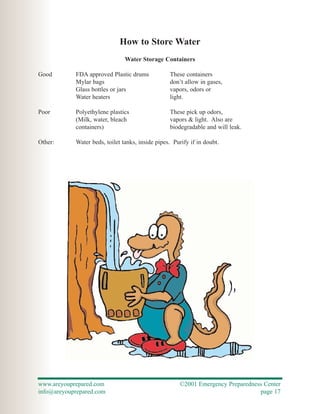
How to Store Water
                                Water Storage Containers

Good        FDA approved Plastic drums            These containers
            Mylar bags                            don’t allow in gases,
            Glass bottles or jars                 vapors, odors or
            Water heaters                         light.

Poor        Polyethylene plastics                 These pick up odors,
            (Milk, water, bleach                  vapors & light. Also are
            containers)                           biodegradable and will leak.

Other:      Water beds, toilet tanks, inside pipes. Purify if in doubt.


www.areyouprepared.com                                ©2001 Emergency Preparedness Center
info@areyouprepared.com                                                          page 17
TAKE IMPORTANT ACTIONS
    AND HAVE THIS INFORMATION IN PLACE NOW!
                     These are the little things that are usually overlooked
                    and can make your life difficult if they’re not in order.


        Bank Statements                                and Jewelry
        Credit Card accounts                       Net Worth Statement
        Bank Loan agreements                       Stocks, Bonds and other securities
        Tax records                                Accounts receivable information
        Important guarantees, warranties and       Purchase contracts
            sales receipts                         All contracts
        Copies of your inventory video,            Photocopy of documents that you
            photos and written copy                    have in your wallet or purse
        Computer back up tapes                     Certificates of birth, marriage, and
        Insurance policies                             death
        Mortgage documents                         Divorce decrees
        Deeds                                      Adoption and custody papers
        Vehicle Titles and Bill of Sales           Name, address and number of your
        Wills and Trusts                               Accountant, Attorney, Executor,
        Medical records                                Trustees, Stockbroker and
        Employee benefit information                   Insurance agents
        Letter of Instruction in case of death     Location of your spare keys
        Funeral and burial plans                   Citizenship papers
        Copy of your family’s Disaster Plan        Military papers
        Journals & Family Histories                Passports, visas
        Cherished family items: photos,            Social security card
            slides, videos, books, scrapbooks      Employment records
        Safe deposit box location, number,         Patents, copyrights
            inventory of contents, key             School transcripts, diplomas
        Investment portfolio
        Record of gold, sliver, collectibles


                                           Insurance
Carry enough of the right kind of insurance: Renters, homeowner’s, fire, flood, earthquake, etc.
Be aware that not all general insurance policies cover damage from natural disasters and war.

                                         Immunizations
Keep immunizations current for all of your family members.
Store your important papers in a safe, fire proof place such as a safety deposit box, freezer or
hidden safe. Make duplicate copies of all important documents.

www.areyouprepared.com                                   ©2001 Emergency Preparedness Center
info@areyouprepared.com                                                             page 18
Know and have Wallet I.D. with the following information
                              on every one in your family.

Name tag
Driver’s license or other identification
Medical problems
Prescription medication (name, dosage, prescription
number and date prescribed)
Eyeglass/contact lens prescription
Blood Type
Doctor’s name, number and address


                  Vehicles
At all times keep your gas tank in your
vehicle at least 1/2 way full. Have an extra
set of keys.

                    Cash
Have on hand at least $100 in small bills.


                      VITAL FAMILY DOCUMENTS

                                             Inventory
Take inventory of Your home, garage, premises and where you work. Make a complete written
itemized list of all the contents. Include serial numbers, make, model numbers, physical
description, where and when you purchased them, price and current value. Take pictures and
videotape all of these in their normal locations.

                                         Duplicates
Make duplicates of your photos, video and written documents and kept them in another location
out side your home.

          Consider duplicating and preserving the above documents and records
                                to prevent loss in a disaster.

 (And any other important items that we may have missed)


www.areyouprepared.com                                ©2001 Emergency Preparedness Center
info@areyouprepared.com                                                          page 19
HOW TO REPORT AN EMERGENCY


                                       Dial 911
                            Keep calm, speak slowly and clearly.
        Tell what type of emergency: Fire, traffic accident, medical, drowning or other.

Always give this information:
   Where is the emergency.
   What happened.
   How many people are involved.
   What condition are they in.
   What is being done.
   Your name, address and phone number.

Ask what you can do to help. Some actions may include:
    CPR.
    Control any bleeding with direct pressure.
    Heimlich maneuver for someone choking.
    Keeping the victim warm if needed.
    Cool them off if heat stroke.
    How to prevent further injury to the victim with a neck
injury or broken bones.


www.areyouprepared.com                                 ©2001 Emergency Preparedness Center
info@areyouprepared.com                                                           page 20
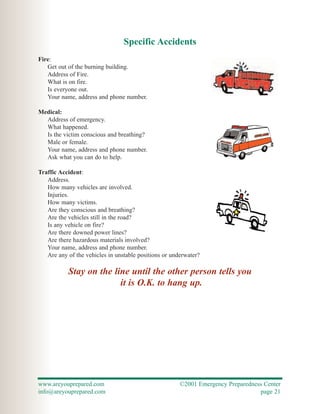
Specific Accidents
Fire:
   Get out of the burning building.
   Address of Fire.
   What is on fire.
   Is everyone out.
   Your name, address and phone number.

Medical:
  Address of emergency.
  What happened.
  Is the victim conscious and breathing?
  Male or female.
  Your name, address and phone number.
  Ask what you can do to help.

Traffic Accident:
   Address.
   How many vehicles are involved.
   Injuries.
   How many victims.
   Are they conscious and breathing?
   Are the vehicles still in the road?
   Is any vehicle on fire?
   Are there downed power lines?
   Are there hazardous materials involved?
   Your name, address and phone number.
   Are any of the vehicles in unstable positions or underwater?

           Stay on the line until the other person tells you
                         it is O.K. to hang up.


www.areyouprepared.com                                 ©2001 Emergency Preparedness Center
info@areyouprepared.com                                                           page 21
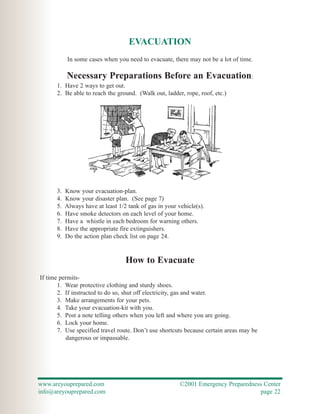
EVACUATION
           In some cases when you need to evacuate, there may not be a lot of time.

           Necessary Preparations Before an Evacuation:
      1. Have 2 ways to get out.
      2. Be able to reach the ground. (Walk out, ladder, rope, roof, etc.)


      3.   Know your evacuation-plan.
      4.   Know your disaster plan. (See page 7)
      5.   Always have at least 1/2 tank of gas in your vehicle(s).
      6.   Have smoke detectors on each level of your home.
      7.   Have a whistle in each bedroom for warning others.
      8.   Have the appropriate fire extinguishers.
      9.   Do the action plan check list on page 24.


                                   How to Evacuate
If time permits-
       1. Wear protective clothing and sturdy shoes.
       2. If instructed to do so, shut off electricity, gas and water.
       3. Make arrangements for your pets.
       4. Take your evacuation-kit with you.
       5. Post a note telling others when you left and where you are going.
       6. Lock your home.
       7. Use specified travel route. Don’t use shortcuts because certain areas may be
          dangerous or impassable.


www.areyouprepared.com                                   ©2001 Emergency Preparedness Center
info@areyouprepared.com                                                             page 22
House Plan
                  This page is blank and is designed to be a worksheet.
         Draw the floor plan of your house and design your own evacuation plan .
                              Practice this with your family.


www.areyouprepared.com                              ©2001 Emergency Preparedness Center
info@areyouprepared.com                                                        page 23
ACTION PLAN CHECKLIST

              Are You Ready?
       Take the time to ensure that all members
         of your family know the following:


    YES        NO

   _____     _____     Know your family disaster
             plan. (Page 7)

   _____     _____      Family evacuation plan. (Page 22-23)

   _____     _____      Emergency numbers posted by phones.

   _____     _____      Know how & when to call 911.

   _____     _____      Know how to turn off electricity, gas & water. (Page 13)

   _____     _____      First Aid Kit. (Page 15)

   _____     _____      Trained in CPR & First Aid. (Call the American Red Cross)

   _____     _____      3 Day Evacuation Kit. (Page 14)

   _____     _____      Know where to go if city sirens go off.

   _____     _____      Smoke detectors on each level of your home.

   _____     _____      Fire extinguishers and know how to use them.

   _____     _____      Whistles in every bedroom.

   _____     _____      Eliminate fire hazards. (Page 12)

   _____     _____      Adequate insurance coverage. (Home, life, fire, etc.)

   _____     _____      Immunizations up to date.


www.areyouprepared.com                               ©2001 Emergency Preparedness Center
info@areyouprepared.com                                                         page 24
CHAPTER 2
             Knowing what to do and taking the appropriate action
               in each of the following disasters can save lives.
                           (Before - During - After)


2.1 Acts of Violence:
    Nuclear or Other Wars, Riots, Looting,
    Bomb Threats, Terrorism

2.2 Hazardous Chemical Spills

2.3 Earthquakes

2.4 Extreme Weather:
    Hurricane, Tornado, Winter Storms,
    Lightning & Thunder, Drought & Extreme Heat

2.5 Fires

2.6 Famine

2.7 Plagues

2.8 Floods


www.areyouprepared.com                       ©2001 Emergency Preparedness Center
info@areyouprepared.com                                                 page 25
VIOLENCE
                 1. NUCLEAR OR OTHER WARS, RIOTS, LOOTING,
                       BOMB THREATS, TERRORISM, ETC.

   Violence is continuing to increase. Even if a conflict is happening in another location,
the effects can affect us sharply in the form of rationing, economic unrest and possible loss of
loved ones.
    Should violence break out in your area, there are several things your family should know
and consider.

                                           BEFORE:

1. Learn about the affects of violence in your area..
2. Contact local authorities for their emergency plan of action.
   (Evacuation, fall out shelters, etc.)
3. Know your evacuation plan. (Page 22)
4. Have your 3-day evacuation kit accessible. (Page 14)
5. Know your disaster plan. (Page 7)
6. Lock doors and windows at night and when you are away.
7. Designate a safe place in your home for shelter that is:
   A. Away from windows.
   B. Has an exit.
   C. Safe from fallout.
   D. Equipped with protective devices for your family’s defense.
   E. Equipped with extra supplies. (Food, water, fuel, etc.)
8. Practice family evacuation plan.
9. Have some training in First Aid & CPR if possible.

                                          DURING:
                                     Find safety—safely!!!

1. Nuclear War:
   A. You may be warned in one of many ways:
      1. See a flash
      2. Hear a blast
      3. Feel the heat
      4. Hear a warning signal on the radio, TV or city siren.

NOTE: Any one of these dangers can be fatal within a few seconds after the explosion even if
it is many miles away. Never look at the flash.

   B. Dangers if the explosion is some distance away:
      1. Heat wave could arrive within 5 seconds and can cause serious burns.

www.areyouprepared.com                                   ©2001 Emergency Preparedness Center
info@areyouprepared.com                                                             page 26
2. Blast wave within as little as 30 seconds causing serious injury.
        3. Fallout/radiation arrives later causing other serious injuries.

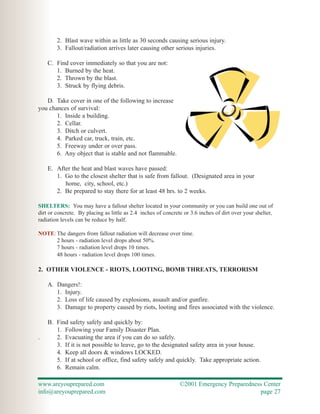
    C. Find cover immediately so that you are not:
       1. Burned by the heat.
       2. Thrown by the blast.
       3. Struck by flying debris.

   D. Take cover in one of the following to increase
you chances of survival:
       1. Inside a building.
       2. Cellar.
       3. Ditch or culvert.
       4. Parked car, truck, train, etc.
       5. Freeway under or over pass.
       6. Any object that is stable and not flammable.

    E. After the heat and blast waves have passed:
       1. Go to the closest shelter that is safe from fallout. (Designated area in your
          home, city, school, etc.)
       2. Be prepared to stay there for at least 48 hrs. to 2 weeks.

SHELTERS: You may have a fallout shelter located in your community or you can build one out of
dirt or concrete. By placing as little as 2.4 inches of concrete or 3.6 inches of dirt over your shelter,
radiation levels can be reduce by half.

NOTE: The dangers from fallout radiation will decrease over time.
      2 hours - radiation level drops about 50%.
      7 hours - radiation level drops 10 times.
      48 hours - radiation level drops 100 times.

2. OTHER VIOLENCE - RIOTS, LOOTING, BOMB THREATS, TERRORISM

    A. Dangers!:
       1. Injury.
       2. Loss of life caused by explosions, assault and/or gunfire.
       3. Damage to property caused by riots, looting and fires associated with the violence.

    B. Find safety safely and quickly by:
       1. Following your Family Disaster Plan.
.      2. Evacuating the area if you can do so safely.
       3. If it is not possible to leave, go to the designated safety area in your house.
       4. Keep all doors & windows LOCKED.
       5. If at school or office, find safety safely and quickly. Take appropriate action.
       6. Remain calm.

www.areyouprepared.com                                         ©2001 Emergency Preparedness Center
info@areyouprepared.com                                                                   page 27
HAZARDOUS CHEMICAL SPILL
    This can be harmful to the environment as well as to our health. There are many chemicals
that can be a threat to us. Usually they become hazardous to us and our surroundings if they
are uncontrollably released in one of the following ways:

   1. Transportation accidents involving trucks or trains.
   2. Accidental spill including faulty valves, explosions, ruptures due to natural disasters.
   3. Intentionally dumped.

THE DANGERS!

   1.   Fires
   2.   Explosions
   3.   Toxic gases that can be disabling or fatal.
   4.   Possible contamination of the area.


BEFORE:

   1.   Know what could happen in your area.
   2.   Have your 3-day evacuation kit easily accessible.
   3.   Have on hand a 14-day supply of food, water, fuel, etc.
   4.   Know your disaster plan. (Page 7)
   5.   Know your evacuation plan. (Page 22)
   6.   Have some training in First Aid and CPR if possible.
   7.   Know your local warning signal and evacuation route.
   8.   Have and know how to use your fire extinguisher. (House, car, office.)


DURING:

   1. STAY away from the scene of the accident
   2. DON’T inhale gases, fumes or smoke.
   3. DON’T touch the spilled material.
   4. LISTEN to local authorities. Follow your evacuation plan if told to do so.
   5. If the spill can’t be identified, stay away from any accident victim until the
        authorities arrive.
   6. Treat victims if it is safe to do so.
   7. Take your 3-day evacuation kit with you if you are evacuated.
   8. Protect your food, water and clothing from becoming contaminated.


www.areyouprepared.com                                   ©2001 Emergency Preparedness Center
info@areyouprepared.com                                                             page 28
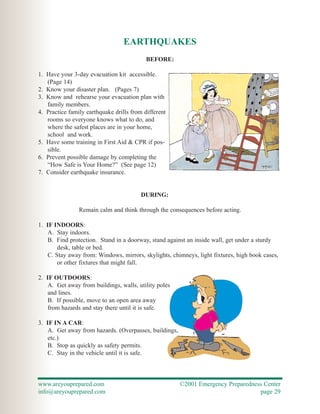
EARTHQUAKES
                                           BEFORE:

1. Have your 3-day evacuation kit accessible.
   (Page 14)
2. Know your disaster plan. (Pages 7)
3. Know and rehearse your evacuation plan with
   family members.
4. Practice family earthquake drills from different
   rooms so everyone knows what to do, and
   where the safest places are in your home,
   school and work.
5. Have some training in First Aid & CPR if pos-
   sible.
6. Prevent possible damage by completing the
   “How Safe is Your Home?” (See page 12)
7. Consider earthquake insurance.


                                         DURING:

                Remain calm and think through the consequences before acting.

1. IF INDOORS:
    A. Stay indoors.
    B. Find protection. Stand in a doorway, stand against an inside wall, get under a sturdy
        desk, table or bed.
    C. Stay away from: Windows, mirrors, skylights, chimneys, light fixtures, high book cases,
        or other fixtures that might fall.

2. IF OUTDOORS:
    A. Get away from buildings, walls, utility poles
    and lines.
    B. If possible, move to an open area away
    from hazards and stay there until it is safe.

3. IF IN A CAR:
    A. Get away from hazards. (Overpasses, buildings,
    etc.)
    B. Stop as quickly as safety permits.
    C. Stay in the vehicle until it is safe.


www.areyouprepared.com                                  ©2001 Emergency Preparedness Center
info@areyouprepared.com                                                            page 29
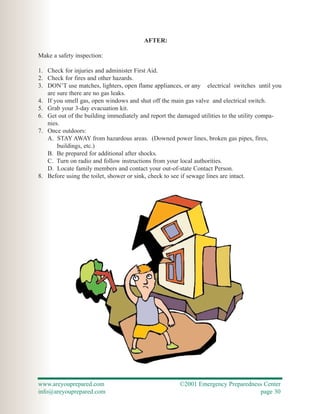
AFTER:

Make a safety inspection:

1. Check for injuries and administer First Aid.
2. Check for fires and other hazards.
3. DON’T use matches, lighters, open flame appliances, or any electrical switches until you
   are sure there are no gas leaks.
4. If you smell gas, open windows and shut off the main gas valve and electrical switch.
5. Grab your 3-day evacuation kit.
6. Get out of the building immediately and report the damaged utilities to the utility compa-
   nies.
7. Once outdoors:
   A. STAY AWAY from hazardous areas. (Downed power lines, broken gas pipes, fires,
       buildings, etc.)
   B. Be prepared for additional after shocks.
   C. Turn on radio and follow instructions from your local authorities.
   D. Locate family members and contact your out-of-state Contact Person.
8. Before using the toilet, shower or sink, check to see if sewage lines are intact.


www.areyouprepared.com                                ©2001 Emergency Preparedness Center
info@areyouprepared.com                                                          page 30
EXTREME WEATHER
HURRICANE: Winds in a wide circular motion:
    Category One      73-95 mph
    Category Two      96-110 mph
    Category Three    111-130 mph
    Category Four     131-155 mph
    Category Five     over 155 mph

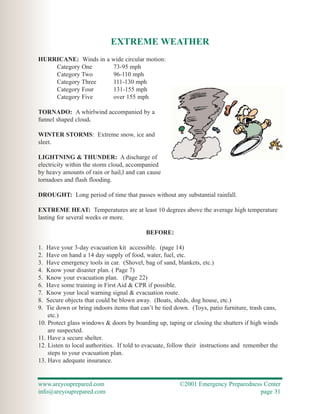
TORNADO: A whirlwind accompanied by a
funnel shaped cloud.

WINTER STORMS: Extreme snow, ice and
sleet.

LIGHTNING & THUNDER: A discharge of
electricity within the storm cloud, accompanied
by heavy amounts of rain or hail,l and can cause
tornadoes and flash flooding.

DROUGHT: Long period of time that passes without any substantial rainfall.

EXTREME HEAT: Temperatures are at least 10 degrees above the average high temperature
lasting for several weeks or more.

                                           BEFORE:

1. Have your 3-day evacuation kit accessible. (page 14)
2. Have on hand a 14 day supply of food, water, fuel, etc.
3. Have emergency tools in car. (Shovel, bag of sand, blankets, etc.)
4. Know your disaster plan. ( Page 7)
5. Know your evacuation plan. (Page 22)
6. Have some training in First Aid & CPR if possible.
7. Know your local warning signal & evacuation route.
8. Secure objects that could be blown away. (Boats, sheds, dog house, etc.)
9. Tie down or bring indoors items that can’t be tied down. (Toys, patio furniture, trash cans,
    etc.)
10. Protect glass windows & doors by boarding up, taping or closing the shutters if high winds
    are suspected.
11. Have a secure shelter.
12. Listen to local authorities. If told to evacuate, follow their instructions and remember the
    steps to your evacuation plan.
13. Have adequate insurance.


www.areyouprepared.com                                  ©2001 Emergency Preparedness Center
info@areyouprepared.com                                                            page 31
DURING:

1.   Have your 3-day evacuation kit wherever you are.
2.   Stay inside a secure and stable building.
3.   Continue to listen to local authorities.
4.   Stay away from glass windows, doors, skylights, etc.
5.   One of the safest places to go during a destructive windstorm is in the corner of the building
     next to the wall, away from glass.
6.   In a HURRICANE, be aware of the “Eye” of the hurricane. The storm may calm down for
     a few minutes then could become worse than before the “Eye” had passed.
7.   In a TORNADO, don’t stay in your car, trailer or mobile home. Find a secure and stable
     building or lie in a ditch and shield your head. Cover your face with clothing to prevent
     suffocation from the dust.
8.   In a WINTER STORM, don’t drive unless needed. Be aware of the snow load on your roof
     and other areas that could collapse by the weight.
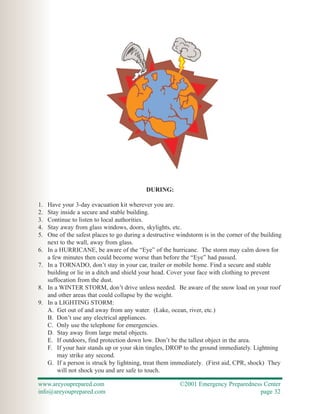
9.   In a LIGHTING STORM:
     A. Get out of and away from any water. (Lake, ocean, river, etc.)
     B. Don’t use any electrical appliances.
     C. Only use the telephone for emergencies.
     D. Stay away from large metal objects.
     E. If outdoors, find protection down low. Don’t be the tallest object in the area.
     F. If your hair stands up or your skin tingles, DROP to the ground immediately. Lightning
         may strike any second.
     G. If a person is struck by lightning, treat them immediately. (First aid, CPR, shock) They
         will not shock you and are safe to touch.

www.areyouprepared.com                                    ©2001 Emergency Preparedness Center
info@areyouprepared.com                                                              page 32
10. In the event of DROUGHT AND EXTREME HEAT:
    A. The dangers are:
        1. Heat strains on the body. This occurs when your body core temperature is above 99
            degrees.
        2. Heat impairment occurs when your body temperature is around 102 degrees.
        3. Heatstroke, heart attacks, and collapsing from water depletion all occur when over
            exposed to the heat for a long period of time.
        4. Prolonged drought can damage agricultural production and seriously impact the com-
            munity economy.
    B. Treat the dangers:
        1. Wear loose fitting & porous clothes. Also a hat with a wide brim.
        2. Drink lots of water to keep body fluid & salt level close to normal.
        3. Rest regularly and stay in the shade.
        4. In the event of a drought, conserve water to avoid depletion of supplies.

                                             AFTER:

1.  Administer First Aid to those in need.
2.  Stay sheltered until notified by officials that it is safe.
3.  Stay in contact with local authorities for other instructions.
4.  Stay away from damaged areas.
5.  Be aware of and report any hazards to proper authorities.
        A. Damaged roads, bridges, buildings
        B. Broken gas, water and sewer lines and downed power lines.
6. Don’t use electrical appliances or turn on the electricity if the area is wet. Don’t stand in
    water when working with electricity.
7. Don’t go sightseeing in the disaster areas.
8. Use caution when driving through affected areas.
9. Don’t use open flame if you suspect a gas line to be broken.
10. Inspect food for contamination. Discard if contaminated.
11. Check water supplies for contamination. Purify water if in doubt.


www.areyouprepared.com                                   ©2001 Emergency Preparedness Center
info@areyouprepared.com                                                             page 33
FIRES
                                          BEFORE:

1. Have your 3 day evacuation-kit accessible. (Page 14)
2. Know your disaster plan. (Page 7)
3. Know your evacuation plan. (Page 22)
4. Practice family fire drills from different rooms so everyone knows what to do and how to
   escape a fire.
5. Have some training in First Aid and CPR if possible. (See Red Cross)
6. Prevent possible damage by completing the Home Hazard List. (See Page 12)
7. Have fire insurance.

                                          DURING:

If indoors:
1. Call the Fire Department.
2. Contain the fire if possible. If not, get outdoors immediately.
3. DON’T HIDE.
4. Execute your evacuation-plan and practiced fire drills.
5. Warn others with your whistle.
6. Stay low to the ground if the room has smoke in it.
7. Feel any closed doors to see if they are hot before you open them.
8. If the door is hot, escape through the window or another exit.
9. If you catch on fire, DON’T RUN.
     Drop to the ground and roll over and over to smother the flames.
8. Go to the family’s predetermined meeting place in the yard and take roll call.
9. If you couldn’t call the fire department from inside, send someone to call now.
10. If possible, turn off gas and electricity from outside the building.

If outdoors:

1.   STAY OUTDOORS!
2.   Call fire department.
3.   Meet other family members at your predetermined meeting place.
4.   Watch little children so they don’t go back inside.
5.   If you see someone on fire, wrap them in a blanket or coat to smother the flames. DON’T
      use your bare hands.

                                           AFTER:


1. DON’T re-enter the building until proper officials have given permission.


www.areyouprepared.com                                 ©2001 Emergency Preparedness Center
info@areyouprepared.com                                                           page 34
FAMINE
    Famine is something that we don’t give much thought. We think of third world countries
when we talk about it. It is something that we are not immune to and should consider the
effects and what we can do to prepare our families.


                                           BEFORE:

1. Learn about gardening and how to can fruits and vegetables.
2. Learn about good nutrition.
3. Learn how to store food and water for an extended period of time.
   (See Page 40-42)
4. Store and have at least 1 year supply of food for each
   family member. (See page 40-42)
5. Have a water source. (Well, water purifier, etc.)
6. Store garden seeds and have the necessary hand tools
   to grow them.


                                           DURING:

You don’t know how long it will last so:
1. Ration your supplies as if they had to last you indefinitely.
2. Plan ahead for the future. (Continue to store seeds, grains, etc.)
3. Help others around you as much as possible.
4. Learn and take notes in case you get another chance to prepare.


www.areyouprepared.com                                   ©2001 Emergency Preparedness Center
info@areyouprepared.com                                                             page 35
PLAGUES
    A plague is an epidemic on a larger scale. It may be transmitted by other people, small ani-
mals, rats, mice, flies or mosquitoes. The results can affect large groups of people in the same
area or could be spread worldwide.


                                          BEFORE:

1.   Learn what health hazards could affect your family
2.   Have everyone current with their immunization shots.
3.   Learn about good hygiene and cleanliness.
4.   Keep your body healthy. Don’t smoke, drink alcohol, eat too
     much, etc.


                           DURING:

1. STAY away from contaminated areas. Avoid unclean areas
   and groups of people where disease and germs may be.
2. Continue to watch your diet and personal hygiene.
3. Keep your home and surrounding area free of rodents as
   much as possible.
4. Contact local professional medical authorities for
   additional help.


www.areyouprepared.com                                  ©2001 Emergency Preparedness Center
info@areyouprepared.com                                                            page 36
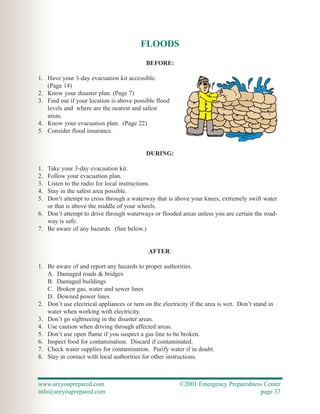
FLOODS
                                            BEFORE:

1. Have your 3-day evacuation kit accessible.
   (Page 14)
2. Know your disaster plan. (Page 7)
3. Find out if your location is above possible flood
   levels and where are the nearest and safest
   areas.
4. Know your evacuation plan. (Page 22)
5. Consider flood insurance.


                                            DURING:

1. Take your 3-day evacuation kit.
2. Follow your evacuation plan.
3. Listen to the radio for local instructions.
4. Stay in the safest area possible.
5. Don’t attempt to cross through a waterway that is above your knees, extremely swift water
   or that is above the middle of your wheels.
6. Don’t attempt to drive through waterways or flooded areas unless you are certain the road-
   way is safe.
7. Be aware of any hazards. (See below.)


                                             AFTER:

1. Be aware of and report any hazards to proper authorities.
   A. Damaged roads & bridges
   B. Damaged buildings
   C. Broken gas, water and sewer lines
   D. Downed power lines
2. Don’t use electrical appliances or turn on the electricity if the area is wet. Don’t stand in
   water when working with electricity.
3. Don’t go sightseeing in the disaster areas.
4. Use caution when driving through affected areas.
5. Don’t use open flame if you suspect a gas line to be broken.
6. Inspect food for contamination. Discard if contaminated.
7. Check water supplies for contamination. Purify water if in doubt.
8. Stay in contact with local authorities for other instructions.


www.areyouprepared.com                                   ©2001 Emergency Preparedness Center
info@areyouprepared.com                                                             page 37
CHAPTER 3
                                      RECOVERY
   Disasters usually strike quickly and without warning. This can be very frightening for
adults, but are especially traumatic for children. Reduce anxiety and fear with the following:

                                           BEFORE:

1. Know and teach each family member your Disaster & Evacuation plans.
2. Teach your children how to recognize the danger signals.
   A. Smoke detectors.
   B. Fire alarms.
   C. Local warning horns or sirens from city officials.
3. Explain how to call for help.
4. Help them memorize the important family information.:
   A. Name.
   B. Address.
   C. Phone number.
   D. Know where to meet in case of an emergency. Younger children can carry a small card
      that lists emergency information to give to an adult or baby-sitter.


                                     DURING & AFTER:

   CHILDREN:
1. Look to you for stability, security, and
   guidance.
2. If we react with alarm, the child could become
   more frightened.
3. They see our fear as proof that the danger is
   real.
4. Their fears may come from their imagination.
   Take these feelings seriously.
5. A child who feels afraid is afraid.
6. After a disaster, a child is most afraid that:
   A. It will happen again.
   B. Someone will be hurt or killed.
   C. They will be separated from their family
       and/or be left alone.


www.areyouprepared.com                                  ©2001 Emergency Preparedness Center
info@areyouprepared.com                                                            page 38
ADULTS:
1. Cope and recover quicker by:
   A. Adequately prepare for a disaster.
   B. Remain calm during the disaster.
   C. Act responsibly.

2. Help children and others in need emotionally by:
   A. Understanding how they feel.
   B. Reassure them with love and firmness. They need to be
      reassured by your words and actions.
   C. Keep the family together as much as possible. Children
      get anxious and worry that someone may not return.
   D. Don’t ignore the emotional needs of the child.
   E. Explain the facts about the event.
   F. Encourage them to talk.
   G. Listen to them.
   H. Include them in recovery activities.
      1. Give them chores. This will help them feel a part.
      2. Having chores helps them feel they are helping to make things better.
      3. Assist the elderly and disabled.


www.areyouprepared.com                                ©2001 Emergency Preparedness Center
info@areyouprepared.com                                                          page 39
CHAPTER 4
                       LONG TERM PREPARATIONS

                                            FOOD
                              Store what you eat, eat what you store.

First of all ask yourself, “ Do I want to just survive or will I enjoy eating this kind of food?
How difficult will it be to prepare during difficult times? What kind of budget do I have?”

1. Build your food storage program systematically and according to priorities.
2. Determine your need for a month, 6 months or even a year.
3. Choose food preservation methods according to your situation.
   A. Space
   B. Storage Conditions
   C. Climate
   D. Cost

        What are my Options?         Advantages                    Disadvantages
        Grocery Store/               Canned/boxed and easy         Some items don’t have a
        Bulk foods                   to prepare.                   very long shelf life.
                                                                   Avoid glass containers.

        Freeze Dried                 Already prepared just         Cost
                                     add a little water, heat
                                     or eat cold. Up to 20
                                     year shelf life

        MRES                         Already prepared, open        Cost
                                     and eat, 5 year shelf life.

        Dehydrated Foods             Affordable and stores         Difficult to prepare,
                                     well in air tight contain-    requires water, heat and
                                     ers with long shelf life.     fuel to prepare. May
                                     Up to 20 years shelf          not taste like you’re use
                                     life.                         to.

        Garden                       Fresh and healthy             Weeding—depending on
                                     Inexpensive                   how you look at it.
                                                                   Seasonal

        Fast Food                    Tastes good.                  Expense and may not be
                                                                   available all the time.


www.areyouprepared.com                                     ©2001 Emergency Preparedness Center
info@areyouprepared.com                                                               page 40
RECOMMENDATIONS
Store some of everything. Don’t just buy wheat and powered milk and think “Life will be
great!” Store the kind of foods you eat in all of these categories.

If you have the money and like the convenience of already prepared foods,
store Freeze Dried and MREs.

If you are on a tight budget, buy a little extra each time you go to the grocery store,
plant a garden, avoid fast food and save your money for some extras.


                                                      How Much?

This varies depending upon your age, size and needs. We offer a computerized print out of how
much your family needs for 1-1000 months of storage with a listing of how many calories, fat,
protein, etc., that the food will give you. This is customized to fit your family’s needs by taking
into consideration the age of each member, then calculates a balanced diet.
 Email us at info@areyouprepared.com for more about this.

            Here is a sample of the very basics for survival for an average person.

                 Foods . . . . . . . . . . . . . . . . . . . . . . . . . . . . . . Lbs. per person
                                                                                                for 1 year
                 Grains . . . . . . . . . . . . . . . . . . . . . . . . . . . . . . . . . . . . . . . . 300
                 Powdered Milk . . . . . . . . . . . . . . . . . . . . . . . . . . . . . . . . . . 75
                 Sugar/Honey . . . . . . . . . . . . . . . . . . . . . . . . . . . . . . . . . . . . 60
                 Salt . . . . . . . . . . . . . . . . . . . . . . . . . . . . . . . . . . . . . . . . . . . . 5
                 Fats/Oils . . . . . . . . . . . . . . . . . . . . . . . . . . . . . . . . . . . . . . . 20
                 Legumes . . . . . . . . . . . . . . . . . . . . . . . . . . . . . . . . . . . . . . . 60
                 Fresh or Dried Vegetables . . . . . . . . . . . . . . . . . . . . . . . . . 370
                 Canned or pickled . . . . . . . . . . . . . . . . . . . . . . . . . . . . . . . 370


                                                    How to Store?

Containers are very important. To extend the shelf life of the foods, choose the containers and
how they are packaged wisely. Air, light, heat, moisture, pests, etc., will destroy your food if
allowed in any container.


www.areyouprepared.com                                                     ©2001 Emergency Preparedness Center
info@areyouprepared.com                                                                               page 41
Recommendation:

There are advantages and disadvantages to every
container. We recommend using the following for
the different food groups to accomplish an optimal
food storage program. Don’t store all in just one
type of container.
                     Your choices

1. Paper and plastic bags: Not good for long term
   storage. Rotate these items within 6 months to a
   year.
2. 5 or 6 gal plastic food grade buckets: Great for storing wheat, grains, beans and sugar.
   If packaged properly, food will store a very long time.
3. No.10 double enameled cans: If packaged properly, food will store for a very long time.
4. Bottles: For canning and preserving fruits and vegetables.
5. Metal cans: Not recommended because of rusting.

                                           Rotation

Rotation is very important. Food loses it nutritional value over time and when it is exposed to
light and heat. Always keep it cool and in a dark room. If you had a 1 year supply of food and
you ate from it once a week, you would rotate your entire 1 year supply in 7 years.


                                         WATER
We’ve already discussed the importance of water and how to find, store and purify it. (See
Chapter 1.3). It is recommended to storage 1 gal per person per day for 2 weeks. It becomes
impossible to store enough water for 1 year for a person. Having a source of water and know-
ing how to purify it, becomes very important.


                                       CLOTHES
If times become difficult it may be nice to have on hand extra clothes to go through and wear if
for some reason you can’t buy them. Every 6 months to a year go through your clothes and see
what you really wear and what you don’t. Take the ones that you don’t wear and put away in
time of need. As you rotate out of your closet also rotate out of your storage box keeping the
best items. Also store a few pair of shoes.


www.areyouprepared.com                                  ©2001 Emergency Preparedness Center
info@areyouprepared.com                                                            page 42
FINANCES
Have on hand $100 cash in small bills, credit cards, checkbook.
Put all of your important documents in a safe, fire proof place.
Have all of the necessary insurances in place to protect you against losses.

Consider the necessities and
luxuries that a camper, travel
trailer or motor home can provide
during difficult times, as you
think about the following.

                                        SHELTER
    If you are temporally displaced you may be able to go to a friends/relative or stay in a
Motel. If not, here are some alternative temporary shelters you may consider. Tent, camper,
travel trailer, motor home, community shelter, bomb shelter or any other out building that is
safe. If you would like more information about bomb shelters and how to build one, email us at
info@areyouprepared.com and we’ll send you more information


                                           HEAT
    Heat is critical during the cooler times of the year. Consider having on hand some of the
following: Space Blanket, Hand Warmers, Portable Heater, Matches, Fuel for the Heater, Wood
Burning Stove/Fireplace, Wood, Camper, Travel Trailer, Motor Home, Blankets, Sleep Bags.


                                          LIGHT
   Matches, Flashlight, Batteries, Lantern, Cyalume Chemical Light sticks, Candles.
Remember to have batteries and fuel on hand.

                                            FUEL
    Many fuels do store very well and can be dangerous. Propane is one of the easiest and
safest to store.


www.areyouprepared.com                                   ©2001 Emergency Preparedness Center
info@areyouprepared.com                                                             page 43
COOKING
   If you have prepared well you may have storage foods that don’t need a lot of cooking.
Freeze Dried foods and MREs are great because there is little or no cooking. But if you have to
cook, think of using your Patio Gas BBQ or camper/travel trailer/ motor home’s stove.
Remember to have sufficient fuel on hand for these.


                                    SANITATION
    Keeping clean during disasters and emergencies is essential to maintain good health and is
often difficult to accomplish. Think for a moment: what would you do with out running water?
 Here is a list of some sanitation supplies.
    Portable camping toilet, heavy-duty plastic bags, metal trash cans, paper towels, rubber
gloves, scrubbing pads, detergent, rodent traps, disinfectants, shovel, liquid soap, shampoo,
towelettes, wash cloths, disposable plates, cups, eating utensils, pocket knife, infant supplies,
disposable diapers, toiletries just to name a few.


www.areyouprepared.com                                  ©2001 Emergency Preparedness Center
info@areyouprepared.com                                                            page 44
CHAPTER 6
                    OTHER IMPORTANT WEB SITES
                           Important Web Sites that can be very helpful

    This one link has it all. It will take you to
hundreds of valuable links for any hazard,
disaster, or emergency:
www.colorado.edu/hazards/sites/sites.html

References and Acknowledgments
    We want to thank the American Red Cross
and FEMA for their resources and contribu-
tions to this guide book.


NOTE: Twice a Year
1. Review disaster & evacuation plans.
2. Check and replace those items that have expired.

    The Disaster Plan and Evacuation sections are VERY CRITICAL and SHOULD BE
rehearsed many times BEFORE an emergency.


www.areyouprepared.com                                  ©2001 Emergency Preparedness Center
info@areyouprepared.com                                                            page 45
Now You Know
                    Step 1: How to Prepare
  We hope that through reading this information you have
gained a better understand on how to become prepared. You
should also have a feel for the necessities that you already have
on hand and for those items that you need in case of an emer-
gency.

            Step 2: Get Ready with the Necessities
   Take inventory of your situation and get what you need.

    If we can assist you any further, please visit our Website at www.areyouprepared.com as we
continue to have updates and new information available. Whether you buy from our company
or not, we hope that we have helped you in some way to become better prepared.


           Good luck in your preparations and remember...

                 It is better to be 5 years early,
                      than 1 minute too late.


www.areyouprepared.com                                ©2001 Emergency Preparedness Center
info@areyouprepared.com                                                          page 46

How To Prepare For Any Disaster

  • 1.
    W How to Prepare E N for any Disaster Your easy step-by-step preparedness guide www.areyouprepared.com
  • 2.
    Congratulations! You’ve taken the first step to getting ready for any disaster. Step 1 Know How to Prepare (Learning and Understanding the Preparedness Process) This book will help you understand the importance of making preparations before anything happens, and help you know what to do and how to act before, during and after a disaster. Step 2 Have the Necessities Ready You may have many of these items already. After reading this book, you should have a pretty good idea about what you will need. If you feel that you are missing something, check out our website at www.areyouprepared.com for a complete list of the necessities. Read, discuss and become familiar with the information contained in this book so that, in the event of an emergency, you can act in a responsible manner to avoid a tragedy. This booklet is intended to assist others in dealing with emergencies. The final decision of any action taken during a real emergency is the sole responsibility of the person involved. Emergency Preparedness Center and “areyouprepared.com” has made its best effort to produce a high quality, informative and helpful book. But they make no representation or warranties of any kind with regard to the completeness or accuracy of the contents of the book. They assume no liability for danger, harm, difficulty or injury of persons or property, or actions undertaken by any person in attempting to utilize the information contained within this book. No part of this publication may be stored in a retrieval system, transmitted, or reproduced in any way, including but not limited, to digital copying and printing, without the prior agreement and written per- mission of the publisher. EMERGENCY PREPAREDNESS CENTER www.areyouprepared.com 520 C North Main Street Suite 202 Heber City, Utah 84032 Knowledge • Peace Of Mind • Preparation www.areyouprepared.com ©2001 Emergency Preparedness Center info@areyouprepared.com page 2
  • 3.
    Table of Contents CHAPTER 1 Getting Ready Before Anything Happens (What to do Now!) 7. Creating Your Own Disaster Plan of Action Finding out what could happen in your area? 4 Steps to putting it together. How to practice and maintain your plan. Your Contact Information. (Post this information by the phone) 12. How Safe is Your House? Checklist Controlling your utilities: How to shut them off in an emergency. What to do with them after an emergency. 14. Preparing some Necessities for Quick Action 3 Day (72 Hrs.) Evacuation Kit- How to Make a 72 Hour Kit. First Aid- How to Make a First Aid Kit. Emergency Water- Recommended amount needed. How to purify water. How to store water. Emergency Water sources inside and out of your home. 18. Take Important Actions and Have this Information in place NOW. 20. How to Report an Emergency. 22. Evacuation- Necessary preparations before an evacuation. How to evacuate. Evacuation worksheet . 24. Action Plan Checklist (Are You Ready?) Be sure all members of your family know this. www.areyouprepared.com ©2001 Emergency Preparedness Center info@areyouprepared.com page 3
  • 4.
    CHAPTER 2 Knowing What to Do: Taking the Appropriate Action (Before - During - After) 26. Acts of Violence: Nuclear or Other Wars 9 steps to prepare The dangers Finding safety Shelter Radiation 27. Terrorism, Riots, Looting, Bomb Threats and Other Violence The dangers Finding safety 28. Hazardous Chemical: Transportation accidents, Accidental spills, Intentional The dangers 8 steps to take to prepare What to do if it happens 29. Earthquakes 7 steps to prepare What to do during if your are: indoors. outdoors. in your car. After the quake, what next? 31. Extreme Weather: Hurricane, Tornado, Winter Storms, Lightning & Thunder, Drought & Extreme Heat. 13 steps to prepare What to do during The dangers Steps to following after it has passed 35. Famine 6 steps to prepare Actions to take during www.areyouprepared.com ©2001 Emergency Preparedness Center info@areyouprepared.com page 4
  • 5.
    36. Plagues What is a plague? 4 steps to prepare for What to do during 37. Floods 5 steps to prepare 7 steps to take during The dangers and what to do after CHAPTER 3 Recovery 38. How to Reduce Anxiety and Fear. Be prepared - 4 steps to take 38. How to Recover (Children). 6 important points 38. How to Recover (Adults). Helping yourself Helping children and others CHAPTER 4 Long Term Preparations You might need them for a while (Helpful suggestions for each of the following) 40. Food Do you want to just survive or do it in style What are your options? Advantages and disadvantages Priorities in building your food storage program Recommendations How much? How to store Rotation www.areyouprepared.com ©2001 Emergency Preparedness Center info@areyouprepared.com page 5
  • 6.
    42. Water Find, store and purify Recommended amounts 42. Clothes Storage plan 42. Finance Cash, important documents and insurances 43. Shelter Alternative Suggestions 43. Heat Alternative Suggestions 43. Light Alternative Suggestions 43. Fuel Suggestions 43. Cooking Easy alternatives 44. Sanitation List of necessary items to store CHAPTER 5 45. Other Important Web Sites www.areyouprepared.com ©2001 Emergency Preparedness Center info@areyouprepared.com page 6
  • 7.
    CHAPTER 1 CREATING YOUR DISASTER PLAN Where will you & your family be WHEN IT STRIKES! Work? School? Home? Traveling? Will you know What to do and where to go? 4 STEPS TO SAFETY 1. Finding Out What Could Happen in Your Area. A. Contact the organizations that are listed at the front of this booklet. They can give you the phone numbers to your local chapter who can tell you what disasters could happen in your area. B. Find out what your community’s warning signals are, what they sound like and what you should do when you hear them. C. Learn about the disaster plans at work, school, daycare and other places where your family spends time. D. If you have animals, find out about animal care. They may not be allowed in some places during and after a disaster. E. Find out how to help the elderly and disabled. 2. Create a Disaster Plan for your family. A. Meet with your family and discuss what types of disasters could happen in your area and what to do. (Page 25) B. Discuss the steps of evacuation. (Page 22) C. Choose 2 places to meet family members: 1. Outside your house if members are home. 2. Outside your neighborhood in case you can’t get to your home. (City park, church, school play ground, etc.) D. Ask an out-of-state family member or friend to be your family’s “Contact Person”. After a disaster, communications can be difficult. Many times it is easier to get through to your contact person out of state than to make a local call. If your family members become sepa- rated in a disaster, have them call this person and let them know where they are and if all is well with them. 3. Practice and Maintain your plan A. Conduct fire and emergency evacuation drills. B. Quiz your family every six months so they don’t forget. C. Test and recharge fire extinguishers. D. Check/rotate food & water in your evacuation-kit every 6 months. E. Test smoke detectors monthly. Change batteries every 6 months. F. Remember to always remain calm. Panic causes accidents. www.areyouprepared.com ©2001 Emergency Preparedness Center info@areyouprepared.com page 7
  • 8.
    Important Phone Numbers Post by each phone. My Name ________________________________________________ My Phone ________________________________________________ My Address ______________________________________________ My City _________________________________________________ Nearest Intersection to my house______________________________ ________________________________________________________ 911 Ambulance _____________________________________ Paramedics _____________________________________ Fire ___________________________________________ Police _________________________________________ Sheriff_________________________________________ Search and Rescue___________________________________________________ Highway Patrol _____________________________________________________ Coast Guard/Harbor Patrol ____________________________________________ Hospital ___________________________________________________________ Poison Control______________________________________________________ Children’s Hospital __________________________________________________ Trauma Center______________________________________________________ Burn Center ________________________________________________________ Cardiac Center______________________________________________________ Family Doctor ______________________________________________________ Dentist ____________________________________________________________ www.areyouprepared.com ©2001 Emergency Preparedness Center info@areyouprepared.com page 8
  • 9.
    Veterinarian ________________________________________________________ Pharmacy __________________________________________________________ Employer__________________________________________________________ Father’s Work ______________________________________________________ Mother’s Work______________________________________________________ Other Relatives _____________________________________________________ Neighbor __________________________________________________________ Out-of-Town Contact Person __________________________________________ __________________________________________________________________ Out-of-State Contact Person ___________________________________________ __________________________________________________________________ Church Leader ______________________________________________________ Babysitter _________________________________________________________ Daycare Center _____________________________________________________ Pre-School _________________________________________________________ Elementary School __________________________________________________ Middle School ______________________________________________________ Junior High ________________________________________________________ High School________________________________________________________ Gas_______________________________________________________________ Power_____________________________________________________________ Telephone _________________________________________________________ Handyman _________________________________________________________ Electrician _________________________________________________________ Plumber ___________________________________________________________ Mechanic __________________________________________________________ Family Attorney ____________________________________________________ www.areyouprepared.com ©2001 Emergency Preparedness Center info@areyouprepared.com page 9
  • 10.
    Accountant ________________________________________________________ Banker orFinancial Advisor ___________________________________________ Insurance Agent_____________________________________________________ Mortgage Company__________________________________________________ Landlord __________________________________________________________ Emergency Roadside Assistance________________________________________ Taxi ______________________________________________________________ Public Transportation ________________________________________________ Weather ___________________________________________________________ Road Conditions ____________________________________________________ Avalanche__________________________________________________________ Forest Service ______________________________________________________ Snow Removal _____________________________________________________ Time and Temperature________________________________________________ Animal Control _____________________________________________________ American Red Cross _________________________________________________ Disaster Clean -up Company __________________________________________ Crisis Hotline ______________________________________________________ Social Worker ______________________________________________________ Health Department __________________________________________________ Others: ____________________________________________________________ __________________________________________________________________ __________________________________________________________________ __________________________________________________________________ __________________________________________________________________ __________________________________________________________________ __________________________________________________________________ www.areyouprepared.com ©2001 Emergency Preparedness Center info@areyouprepared.com page 10
  • 11.
    My Important Numbers MyName___________________________________________ My Phone Number___________________________________ My Address_________________________________________ My City ____________________________________________ If I need: Call 911 Place Picture Place Picture of Father here of Mother here with phone number with phone number Place Picture Place Picture of Neighbor here of Relative here with phone number with phone number www.areyouprepared.com ©2001 Emergency Preparedness Center info@areyouprepared.com page 11
  • 12.
    HOW SAFE ISYOUR HOUSE? Before any disaster, you should inspect your home and eliminate any potential hazards. In an emergency, ordinary items in your home can cause injury and damage. Anything that can move, fall, break or cause a fire is a potential hazard. USE THE FOLLOWING CHECK LIST TO SEE IF YOUR HOUSE IS SAFE. _____ Clean and repair chimneys, flue pipes, vent connectors, and gas vents. _____ Place oily rags or waste in covered metal cans. _____ Keep flammables away from heat sources. _____ Repair defective electrical wiring. _____ Don’t overload electrical outlets. _____ Don’t run wires under rugs or carpets. _____ Fix leaky gas connections immediately. _____ Secure water heater by strapping to wall studs. _____ Secure large appliances. _____ Fasten shelves securely to walls. _____ Place large, heavy objects on lower shelves. _____ Hang pictures and mirrors away from beds. _____ Brace overhead light fixtures. _____ Repair cracks in ceilings and foundations. _____ Secure hanging plants. BY TAKING PREVENTIVE MEASURES BEFORE AN EMERGENCY, YOU CAN SAVE LIVES AND PROPERTY www.areyouprepared.com ©2001 Emergency Preparedness Center info@areyouprepared.com page 12
  • 13.
    CONTROLLING YOUR UTILITIES ELECTRICAL • GAS • WATER Before any Emergency Know How to Shut off the Utilities: 1. Locate the following: A. Electric Fuse Box and the Electrical Meter. (The fuse box is usually located inside the house. The Electrical Meter is usually outside.) B. Gas Main Valve. (Outside where the gas line enters the house. C. Water Main (usually 2 places - one inside the house and the other outside where the city can read it.) 2. Teach family members how to safely shut off utilities. A. Proper sequence to shut off utilities. 1. Electricity 2. Gas 3. Water B. Attach a wrench to the gas meter so that you will not need to look for one during an emergency. C. Have the proper tool attached near the water main to turn it off. After an Emergency 1. Turn off utilities if you suspect the lines are damaged. 2. Turn off electricity from the safest point. Beware of water. Wires and water don’t mix. 3. If you smell or hear gas, shut off the gas main immediately and open windows. Contact the gas company before turning the gas back on. 4. Turn the water main off only if a line is broken. 5. Shut off utilities if instructed to do so or if you are in doubt and have concerns that you are in danger. IMPORTANT! ELECTRICITY - Stay out of water and don’t touch any bare wires until elec- tricity is turned off. This could electrocute you. www.areyouprepared.com ©2001 Emergency Preparedness Center info@areyouprepared.com page 13
  • 14.
    PREPARING SOME NECESSITIES FOR QUICK ACTION 3 DAY EVACUATION KIT When an emergency strikes you may be forced to leave your home and have only enough time to grab the family and your evacuation-kit. There is a good chance that you may not be able to return for a few days and that outside help may not be available for days. 1. Your evacuation-kit should contain the necessary items to sustain life for the first critical hours/days following a disaster. 2. When assembling a kit remember to make it: A. Portable so that a woman or child could carry it. B. Easy to use. 3. Include the following essentials - Food: First Aid Kit Misc. Items: MREs for 3 days (see page 15) Extra set of Car Keys Instant Cereal Credit Cards and Case Instant Hot Chocolate Sanitation: List of Family Food Bars Toilet Paper Physicians Soap/Shampoo Special Items for Shelter/Bedding: Toothbrush/Paste Infants,Elderly or Tube Tent Personal Hygiene Items Disabled Family Rain Poncho Members Space Blanket Heat/Light: 1 Gallon of Water per Wool Blanket Pocket Hand Warmers person per day Sleeping Bags Matches/Candles Propane Stove Communications: Water: Fire Starter Kit Battery Powered Water Purification Flashlight Radio Tablets Gloves Extra Batteries Store these items in a sturdy, easy to carry backpack or duffel bag. Larger families may need several packs. Be sure it is accessible in the event of an emergency or evacuation. www.areyouprepared.com ©2001 Emergency Preparedness Center info@areyouprepared.com page 14
  • 15.
    FIRST AID How to Make a First Aid Kit 1. When assembling your First Aid Kit, take into consideration the following: A. Specific health needs of family members. B. Include the necessary medications and equipment for them. C. Items that your family is familiar with and knows how to use properly. 2. Discuss with your family doctor your special needs. He can inform you of the specific medications/prescriptions you need and explain how to use, store and rotate them. 3. The following is a list of BASIC MEDICAL SUPPLIES recommended for a kit. Upgrade it as you increase your training: First Aid Manual Insect Repellent Sterile Adhesive Bandages Moistened Towelettes Sterile Gauze Pads Antiseptic-Cream Hypoallergenic Adhesive Tape Neosporin Triangular Bandages Petroleum Jelly Roller Bandages - 2 & 3 inches Aspirin or Scissors Non-Aspirin Pain Reliever Tweezers Laxatives Needle Anti-Diarrhea Medication Thermometer Syrup of Ipecac - Tongue Blades To induce vomiting if advised Assorted Sizes of Safety Pins by Poison Control Latex Gloves Antacid Antiseptic Soap Sterile Adhesive Bandages Rubbing Alcohol in assorted Sizes Cotton Special Medications for Family Disposable Diapers NOTE: The American Red Cross offers classes in First Aid and CPR that cost little or nothing. www.areyouprepared.com ©2001 Emergency Preparedness Center info@areyouprepared.com page 15
  • 16.
    EMERGENCY WATER The Absolute Necessity Bare minimum per person per day for cooking and drinking is 1 Gallon. Add additional water for bathing & washing. How to Purify Water Before purifying water in any manner, filter out debris by passing it through a clean cloth. Boil Bring water to a full rolling boil for at least 5 minutes. Add another minute per 1000 ft. that you are above sea level. After boiling, you may improve the taste of the water by pouring it back and forth from one container to another to aerate it. Bleach Use bleach that has sodium hypo-chlorite as its only active ingredient. Add the following dosage according to clear or cloudy water then let stand for 30 minutes. A slight oder of chlo- rine should be detectable if the water is properly treated. Add a little more until smell is detectable. QUART GALLON Clear 2 Drops 8 Drops Cloudy 4 Drops 16 Drops Iodine 2% Tincture Clear 3 Drops 12 Drops Cloudy 6 Drops 24 Drops Wait 30 minutes before using water. Tablets Usually 1 tablet per quart. Double if cloudy. These can be bought at most drug stores. Mechanical Filters There are many filters to choose from that can filter out the contaminants. Price ranges between $10-600. The Katadyn PF Pocket Filter is one of the better ones. It can filter 1 quart of water per minute, weighs 23 ounces, is about the size of a flashlight. www.areyouprepared.com ©2001 Emergency Preparedness Center info@areyouprepared.com page 16
  • 17.
    How to StoreWater Water Storage Containers Good FDA approved Plastic drums These containers Mylar bags don’t allow in gases, Glass bottles or jars vapors, odors or Water heaters light. Poor Polyethylene plastics These pick up odors, (Milk, water, bleach vapors & light. Also are containers) biodegradable and will leak. Other: Water beds, toilet tanks, inside pipes. Purify if in doubt. www.areyouprepared.com ©2001 Emergency Preparedness Center info@areyouprepared.com page 17
  • 18.
    TAKE IMPORTANT ACTIONS AND HAVE THIS INFORMATION IN PLACE NOW! These are the little things that are usually overlooked and can make your life difficult if they’re not in order. Bank Statements and Jewelry Credit Card accounts Net Worth Statement Bank Loan agreements Stocks, Bonds and other securities Tax records Accounts receivable information Important guarantees, warranties and Purchase contracts sales receipts All contracts Copies of your inventory video, Photocopy of documents that you photos and written copy have in your wallet or purse Computer back up tapes Certificates of birth, marriage, and Insurance policies death Mortgage documents Divorce decrees Deeds Adoption and custody papers Vehicle Titles and Bill of Sales Name, address and number of your Wills and Trusts Accountant, Attorney, Executor, Medical records Trustees, Stockbroker and Employee benefit information Insurance agents Letter of Instruction in case of death Location of your spare keys Funeral and burial plans Citizenship papers Copy of your family’s Disaster Plan Military papers Journals & Family Histories Passports, visas Cherished family items: photos, Social security card slides, videos, books, scrapbooks Employment records Safe deposit box location, number, Patents, copyrights inventory of contents, key School transcripts, diplomas Investment portfolio Record of gold, sliver, collectibles Insurance Carry enough of the right kind of insurance: Renters, homeowner’s, fire, flood, earthquake, etc. Be aware that not all general insurance policies cover damage from natural disasters and war. Immunizations Keep immunizations current for all of your family members. Store your important papers in a safe, fire proof place such as a safety deposit box, freezer or hidden safe. Make duplicate copies of all important documents. www.areyouprepared.com ©2001 Emergency Preparedness Center info@areyouprepared.com page 18
  • 19.
    Know and haveWallet I.D. with the following information on every one in your family. Name tag Driver’s license or other identification Medical problems Prescription medication (name, dosage, prescription number and date prescribed) Eyeglass/contact lens prescription Blood Type Doctor’s name, number and address Vehicles At all times keep your gas tank in your vehicle at least 1/2 way full. Have an extra set of keys. Cash Have on hand at least $100 in small bills. VITAL FAMILY DOCUMENTS Inventory Take inventory of Your home, garage, premises and where you work. Make a complete written itemized list of all the contents. Include serial numbers, make, model numbers, physical description, where and when you purchased them, price and current value. Take pictures and videotape all of these in their normal locations. Duplicates Make duplicates of your photos, video and written documents and kept them in another location out side your home. Consider duplicating and preserving the above documents and records to prevent loss in a disaster. (And any other important items that we may have missed) www.areyouprepared.com ©2001 Emergency Preparedness Center info@areyouprepared.com page 19
  • 20.
    HOW TO REPORTAN EMERGENCY Dial 911 Keep calm, speak slowly and clearly. Tell what type of emergency: Fire, traffic accident, medical, drowning or other. Always give this information: Where is the emergency. What happened. How many people are involved. What condition are they in. What is being done. Your name, address and phone number. Ask what you can do to help. Some actions may include: CPR. Control any bleeding with direct pressure. Heimlich maneuver for someone choking. Keeping the victim warm if needed. Cool them off if heat stroke. How to prevent further injury to the victim with a neck injury or broken bones. www.areyouprepared.com ©2001 Emergency Preparedness Center info@areyouprepared.com page 20
  • 21.
    Specific Accidents Fire: Get out of the burning building. Address of Fire. What is on fire. Is everyone out. Your name, address and phone number. Medical: Address of emergency. What happened. Is the victim conscious and breathing? Male or female. Your name, address and phone number. Ask what you can do to help. Traffic Accident: Address. How many vehicles are involved. Injuries. How many victims. Are they conscious and breathing? Are the vehicles still in the road? Is any vehicle on fire? Are there downed power lines? Are there hazardous materials involved? Your name, address and phone number. Are any of the vehicles in unstable positions or underwater? Stay on the line until the other person tells you it is O.K. to hang up. www.areyouprepared.com ©2001 Emergency Preparedness Center info@areyouprepared.com page 21
  • 22.
    EVACUATION In some cases when you need to evacuate, there may not be a lot of time. Necessary Preparations Before an Evacuation: 1. Have 2 ways to get out. 2. Be able to reach the ground. (Walk out, ladder, rope, roof, etc.) 3. Know your evacuation-plan. 4. Know your disaster plan. (See page 7) 5. Always have at least 1/2 tank of gas in your vehicle(s). 6. Have smoke detectors on each level of your home. 7. Have a whistle in each bedroom for warning others. 8. Have the appropriate fire extinguishers. 9. Do the action plan check list on page 24. How to Evacuate If time permits- 1. Wear protective clothing and sturdy shoes. 2. If instructed to do so, shut off electricity, gas and water. 3. Make arrangements for your pets. 4. Take your evacuation-kit with you. 5. Post a note telling others when you left and where you are going. 6. Lock your home. 7. Use specified travel route. Don’t use shortcuts because certain areas may be dangerous or impassable. www.areyouprepared.com ©2001 Emergency Preparedness Center info@areyouprepared.com page 22
  • 23.
    House Plan This page is blank and is designed to be a worksheet. Draw the floor plan of your house and design your own evacuation plan . Practice this with your family. www.areyouprepared.com ©2001 Emergency Preparedness Center info@areyouprepared.com page 23
  • 24.
    ACTION PLAN CHECKLIST Are You Ready? Take the time to ensure that all members of your family know the following: YES NO _____ _____ Know your family disaster plan. (Page 7) _____ _____ Family evacuation plan. (Page 22-23) _____ _____ Emergency numbers posted by phones. _____ _____ Know how & when to call 911. _____ _____ Know how to turn off electricity, gas & water. (Page 13) _____ _____ First Aid Kit. (Page 15) _____ _____ Trained in CPR & First Aid. (Call the American Red Cross) _____ _____ 3 Day Evacuation Kit. (Page 14) _____ _____ Know where to go if city sirens go off. _____ _____ Smoke detectors on each level of your home. _____ _____ Fire extinguishers and know how to use them. _____ _____ Whistles in every bedroom. _____ _____ Eliminate fire hazards. (Page 12) _____ _____ Adequate insurance coverage. (Home, life, fire, etc.) _____ _____ Immunizations up to date. www.areyouprepared.com ©2001 Emergency Preparedness Center info@areyouprepared.com page 24
  • 25.
    CHAPTER 2 Knowing what to do and taking the appropriate action in each of the following disasters can save lives. (Before - During - After) 2.1 Acts of Violence: Nuclear or Other Wars, Riots, Looting, Bomb Threats, Terrorism 2.2 Hazardous Chemical Spills 2.3 Earthquakes 2.4 Extreme Weather: Hurricane, Tornado, Winter Storms, Lightning & Thunder, Drought & Extreme Heat 2.5 Fires 2.6 Famine 2.7 Plagues 2.8 Floods www.areyouprepared.com ©2001 Emergency Preparedness Center info@areyouprepared.com page 25
  • 26.
    VIOLENCE 1. NUCLEAR OR OTHER WARS, RIOTS, LOOTING, BOMB THREATS, TERRORISM, ETC. Violence is continuing to increase. Even if a conflict is happening in another location, the effects can affect us sharply in the form of rationing, economic unrest and possible loss of loved ones. Should violence break out in your area, there are several things your family should know and consider. BEFORE: 1. Learn about the affects of violence in your area.. 2. Contact local authorities for their emergency plan of action. (Evacuation, fall out shelters, etc.) 3. Know your evacuation plan. (Page 22) 4. Have your 3-day evacuation kit accessible. (Page 14) 5. Know your disaster plan. (Page 7) 6. Lock doors and windows at night and when you are away. 7. Designate a safe place in your home for shelter that is: A. Away from windows. B. Has an exit. C. Safe from fallout. D. Equipped with protective devices for your family’s defense. E. Equipped with extra supplies. (Food, water, fuel, etc.) 8. Practice family evacuation plan. 9. Have some training in First Aid & CPR if possible. DURING: Find safety—safely!!! 1. Nuclear War: A. You may be warned in one of many ways: 1. See a flash 2. Hear a blast 3. Feel the heat 4. Hear a warning signal on the radio, TV or city siren. NOTE: Any one of these dangers can be fatal within a few seconds after the explosion even if it is many miles away. Never look at the flash. B. Dangers if the explosion is some distance away: 1. Heat wave could arrive within 5 seconds and can cause serious burns. www.areyouprepared.com ©2001 Emergency Preparedness Center info@areyouprepared.com page 26
  • 27.
    2. Blast wavewithin as little as 30 seconds causing serious injury. 3. Fallout/radiation arrives later causing other serious injuries. C. Find cover immediately so that you are not: 1. Burned by the heat. 2. Thrown by the blast. 3. Struck by flying debris. D. Take cover in one of the following to increase you chances of survival: 1. Inside a building. 2. Cellar. 3. Ditch or culvert. 4. Parked car, truck, train, etc. 5. Freeway under or over pass. 6. Any object that is stable and not flammable. E. After the heat and blast waves have passed: 1. Go to the closest shelter that is safe from fallout. (Designated area in your home, city, school, etc.) 2. Be prepared to stay there for at least 48 hrs. to 2 weeks. SHELTERS: You may have a fallout shelter located in your community or you can build one out of dirt or concrete. By placing as little as 2.4 inches of concrete or 3.6 inches of dirt over your shelter, radiation levels can be reduce by half. NOTE: The dangers from fallout radiation will decrease over time. 2 hours - radiation level drops about 50%. 7 hours - radiation level drops 10 times. 48 hours - radiation level drops 100 times. 2. OTHER VIOLENCE - RIOTS, LOOTING, BOMB THREATS, TERRORISM A. Dangers!: 1. Injury. 2. Loss of life caused by explosions, assault and/or gunfire. 3. Damage to property caused by riots, looting and fires associated with the violence. B. Find safety safely and quickly by: 1. Following your Family Disaster Plan. . 2. Evacuating the area if you can do so safely. 3. If it is not possible to leave, go to the designated safety area in your house. 4. Keep all doors & windows LOCKED. 5. If at school or office, find safety safely and quickly. Take appropriate action. 6. Remain calm. www.areyouprepared.com ©2001 Emergency Preparedness Center info@areyouprepared.com page 27
  • 28.
    HAZARDOUS CHEMICAL SPILL This can be harmful to the environment as well as to our health. There are many chemicals that can be a threat to us. Usually they become hazardous to us and our surroundings if they are uncontrollably released in one of the following ways: 1. Transportation accidents involving trucks or trains. 2. Accidental spill including faulty valves, explosions, ruptures due to natural disasters. 3. Intentionally dumped. THE DANGERS! 1. Fires 2. Explosions 3. Toxic gases that can be disabling or fatal. 4. Possible contamination of the area. BEFORE: 1. Know what could happen in your area. 2. Have your 3-day evacuation kit easily accessible. 3. Have on hand a 14-day supply of food, water, fuel, etc. 4. Know your disaster plan. (Page 7) 5. Know your evacuation plan. (Page 22) 6. Have some training in First Aid and CPR if possible. 7. Know your local warning signal and evacuation route. 8. Have and know how to use your fire extinguisher. (House, car, office.) DURING: 1. STAY away from the scene of the accident 2. DON’T inhale gases, fumes or smoke. 3. DON’T touch the spilled material. 4. LISTEN to local authorities. Follow your evacuation plan if told to do so. 5. If the spill can’t be identified, stay away from any accident victim until the authorities arrive. 6. Treat victims if it is safe to do so. 7. Take your 3-day evacuation kit with you if you are evacuated. 8. Protect your food, water and clothing from becoming contaminated. www.areyouprepared.com ©2001 Emergency Preparedness Center info@areyouprepared.com page 28
  • 29.
    EARTHQUAKES BEFORE: 1. Have your 3-day evacuation kit accessible. (Page 14) 2. Know your disaster plan. (Pages 7) 3. Know and rehearse your evacuation plan with family members. 4. Practice family earthquake drills from different rooms so everyone knows what to do, and where the safest places are in your home, school and work. 5. Have some training in First Aid & CPR if pos- sible. 6. Prevent possible damage by completing the “How Safe is Your Home?” (See page 12) 7. Consider earthquake insurance. DURING: Remain calm and think through the consequences before acting. 1. IF INDOORS: A. Stay indoors. B. Find protection. Stand in a doorway, stand against an inside wall, get under a sturdy desk, table or bed. C. Stay away from: Windows, mirrors, skylights, chimneys, light fixtures, high book cases, or other fixtures that might fall. 2. IF OUTDOORS: A. Get away from buildings, walls, utility poles and lines. B. If possible, move to an open area away from hazards and stay there until it is safe. 3. IF IN A CAR: A. Get away from hazards. (Overpasses, buildings, etc.) B. Stop as quickly as safety permits. C. Stay in the vehicle until it is safe. www.areyouprepared.com ©2001 Emergency Preparedness Center info@areyouprepared.com page 29
  • 30.
    AFTER: Make a safetyinspection: 1. Check for injuries and administer First Aid. 2. Check for fires and other hazards. 3. DON’T use matches, lighters, open flame appliances, or any electrical switches until you are sure there are no gas leaks. 4. If you smell gas, open windows and shut off the main gas valve and electrical switch. 5. Grab your 3-day evacuation kit. 6. Get out of the building immediately and report the damaged utilities to the utility compa- nies. 7. Once outdoors: A. STAY AWAY from hazardous areas. (Downed power lines, broken gas pipes, fires, buildings, etc.) B. Be prepared for additional after shocks. C. Turn on radio and follow instructions from your local authorities. D. Locate family members and contact your out-of-state Contact Person. 8. Before using the toilet, shower or sink, check to see if sewage lines are intact. www.areyouprepared.com ©2001 Emergency Preparedness Center info@areyouprepared.com page 30
  • 31.
    EXTREME WEATHER HURRICANE: Windsin a wide circular motion: Category One 73-95 mph Category Two 96-110 mph Category Three 111-130 mph Category Four 131-155 mph Category Five over 155 mph TORNADO: A whirlwind accompanied by a funnel shaped cloud. WINTER STORMS: Extreme snow, ice and sleet. LIGHTNING & THUNDER: A discharge of electricity within the storm cloud, accompanied by heavy amounts of rain or hail,l and can cause tornadoes and flash flooding. DROUGHT: Long period of time that passes without any substantial rainfall. EXTREME HEAT: Temperatures are at least 10 degrees above the average high temperature lasting for several weeks or more. BEFORE: 1. Have your 3-day evacuation kit accessible. (page 14) 2. Have on hand a 14 day supply of food, water, fuel, etc. 3. Have emergency tools in car. (Shovel, bag of sand, blankets, etc.) 4. Know your disaster plan. ( Page 7) 5. Know your evacuation plan. (Page 22) 6. Have some training in First Aid & CPR if possible. 7. Know your local warning signal & evacuation route. 8. Secure objects that could be blown away. (Boats, sheds, dog house, etc.) 9. Tie down or bring indoors items that can’t be tied down. (Toys, patio furniture, trash cans, etc.) 10. Protect glass windows & doors by boarding up, taping or closing the shutters if high winds are suspected. 11. Have a secure shelter. 12. Listen to local authorities. If told to evacuate, follow their instructions and remember the steps to your evacuation plan. 13. Have adequate insurance. www.areyouprepared.com ©2001 Emergency Preparedness Center info@areyouprepared.com page 31
  • 32.
    DURING: 1. Have your 3-day evacuation kit wherever you are. 2. Stay inside a secure and stable building. 3. Continue to listen to local authorities. 4. Stay away from glass windows, doors, skylights, etc. 5. One of the safest places to go during a destructive windstorm is in the corner of the building next to the wall, away from glass. 6. In a HURRICANE, be aware of the “Eye” of the hurricane. The storm may calm down for a few minutes then could become worse than before the “Eye” had passed. 7. In a TORNADO, don’t stay in your car, trailer or mobile home. Find a secure and stable building or lie in a ditch and shield your head. Cover your face with clothing to prevent suffocation from the dust. 8. In a WINTER STORM, don’t drive unless needed. Be aware of the snow load on your roof and other areas that could collapse by the weight. 9. In a LIGHTING STORM: A. Get out of and away from any water. (Lake, ocean, river, etc.) B. Don’t use any electrical appliances. C. Only use the telephone for emergencies. D. Stay away from large metal objects. E. If outdoors, find protection down low. Don’t be the tallest object in the area. F. If your hair stands up or your skin tingles, DROP to the ground immediately. Lightning may strike any second. G. If a person is struck by lightning, treat them immediately. (First aid, CPR, shock) They will not shock you and are safe to touch. www.areyouprepared.com ©2001 Emergency Preparedness Center info@areyouprepared.com page 32
  • 33.
    10. In theevent of DROUGHT AND EXTREME HEAT: A. The dangers are: 1. Heat strains on the body. This occurs when your body core temperature is above 99 degrees. 2. Heat impairment occurs when your body temperature is around 102 degrees. 3. Heatstroke, heart attacks, and collapsing from water depletion all occur when over exposed to the heat for a long period of time. 4. Prolonged drought can damage agricultural production and seriously impact the com- munity economy. B. Treat the dangers: 1. Wear loose fitting & porous clothes. Also a hat with a wide brim. 2. Drink lots of water to keep body fluid & salt level close to normal. 3. Rest regularly and stay in the shade. 4. In the event of a drought, conserve water to avoid depletion of supplies. AFTER: 1. Administer First Aid to those in need. 2. Stay sheltered until notified by officials that it is safe. 3. Stay in contact with local authorities for other instructions. 4. Stay away from damaged areas. 5. Be aware of and report any hazards to proper authorities. A. Damaged roads, bridges, buildings B. Broken gas, water and sewer lines and downed power lines. 6. Don’t use electrical appliances or turn on the electricity if the area is wet. Don’t stand in water when working with electricity. 7. Don’t go sightseeing in the disaster areas. 8. Use caution when driving through affected areas. 9. Don’t use open flame if you suspect a gas line to be broken. 10. Inspect food for contamination. Discard if contaminated. 11. Check water supplies for contamination. Purify water if in doubt. www.areyouprepared.com ©2001 Emergency Preparedness Center info@areyouprepared.com page 33
  • 34.
    FIRES BEFORE: 1. Have your 3 day evacuation-kit accessible. (Page 14) 2. Know your disaster plan. (Page 7) 3. Know your evacuation plan. (Page 22) 4. Practice family fire drills from different rooms so everyone knows what to do and how to escape a fire. 5. Have some training in First Aid and CPR if possible. (See Red Cross) 6. Prevent possible damage by completing the Home Hazard List. (See Page 12) 7. Have fire insurance. DURING: If indoors: 1. Call the Fire Department. 2. Contain the fire if possible. If not, get outdoors immediately. 3. DON’T HIDE. 4. Execute your evacuation-plan and practiced fire drills. 5. Warn others with your whistle. 6. Stay low to the ground if the room has smoke in it. 7. Feel any closed doors to see if they are hot before you open them. 8. If the door is hot, escape through the window or another exit. 9. If you catch on fire, DON’T RUN. Drop to the ground and roll over and over to smother the flames. 8. Go to the family’s predetermined meeting place in the yard and take roll call. 9. If you couldn’t call the fire department from inside, send someone to call now. 10. If possible, turn off gas and electricity from outside the building. If outdoors: 1. STAY OUTDOORS! 2. Call fire department. 3. Meet other family members at your predetermined meeting place. 4. Watch little children so they don’t go back inside. 5. If you see someone on fire, wrap them in a blanket or coat to smother the flames. DON’T use your bare hands. AFTER: 1. DON’T re-enter the building until proper officials have given permission. www.areyouprepared.com ©2001 Emergency Preparedness Center info@areyouprepared.com page 34
  • 35.
    FAMINE Famine is something that we don’t give much thought. We think of third world countries when we talk about it. It is something that we are not immune to and should consider the effects and what we can do to prepare our families. BEFORE: 1. Learn about gardening and how to can fruits and vegetables. 2. Learn about good nutrition. 3. Learn how to store food and water for an extended period of time. (See Page 40-42) 4. Store and have at least 1 year supply of food for each family member. (See page 40-42) 5. Have a water source. (Well, water purifier, etc.) 6. Store garden seeds and have the necessary hand tools to grow them. DURING: You don’t know how long it will last so: 1. Ration your supplies as if they had to last you indefinitely. 2. Plan ahead for the future. (Continue to store seeds, grains, etc.) 3. Help others around you as much as possible. 4. Learn and take notes in case you get another chance to prepare. www.areyouprepared.com ©2001 Emergency Preparedness Center info@areyouprepared.com page 35
  • 36.
    PLAGUES A plague is an epidemic on a larger scale. It may be transmitted by other people, small ani- mals, rats, mice, flies or mosquitoes. The results can affect large groups of people in the same area or could be spread worldwide. BEFORE: 1. Learn what health hazards could affect your family 2. Have everyone current with their immunization shots. 3. Learn about good hygiene and cleanliness. 4. Keep your body healthy. Don’t smoke, drink alcohol, eat too much, etc. DURING: 1. STAY away from contaminated areas. Avoid unclean areas and groups of people where disease and germs may be. 2. Continue to watch your diet and personal hygiene. 3. Keep your home and surrounding area free of rodents as much as possible. 4. Contact local professional medical authorities for additional help. www.areyouprepared.com ©2001 Emergency Preparedness Center info@areyouprepared.com page 36
  • 37.
    FLOODS BEFORE: 1. Have your 3-day evacuation kit accessible. (Page 14) 2. Know your disaster plan. (Page 7) 3. Find out if your location is above possible flood levels and where are the nearest and safest areas. 4. Know your evacuation plan. (Page 22) 5. Consider flood insurance. DURING: 1. Take your 3-day evacuation kit. 2. Follow your evacuation plan. 3. Listen to the radio for local instructions. 4. Stay in the safest area possible. 5. Don’t attempt to cross through a waterway that is above your knees, extremely swift water or that is above the middle of your wheels. 6. Don’t attempt to drive through waterways or flooded areas unless you are certain the road- way is safe. 7. Be aware of any hazards. (See below.) AFTER: 1. Be aware of and report any hazards to proper authorities. A. Damaged roads & bridges B. Damaged buildings C. Broken gas, water and sewer lines D. Downed power lines 2. Don’t use electrical appliances or turn on the electricity if the area is wet. Don’t stand in water when working with electricity. 3. Don’t go sightseeing in the disaster areas. 4. Use caution when driving through affected areas. 5. Don’t use open flame if you suspect a gas line to be broken. 6. Inspect food for contamination. Discard if contaminated. 7. Check water supplies for contamination. Purify water if in doubt. 8. Stay in contact with local authorities for other instructions. www.areyouprepared.com ©2001 Emergency Preparedness Center info@areyouprepared.com page 37
  • 38.
    CHAPTER 3 RECOVERY Disasters usually strike quickly and without warning. This can be very frightening for adults, but are especially traumatic for children. Reduce anxiety and fear with the following: BEFORE: 1. Know and teach each family member your Disaster & Evacuation plans. 2. Teach your children how to recognize the danger signals. A. Smoke detectors. B. Fire alarms. C. Local warning horns or sirens from city officials. 3. Explain how to call for help. 4. Help them memorize the important family information.: A. Name. B. Address. C. Phone number. D. Know where to meet in case of an emergency. Younger children can carry a small card that lists emergency information to give to an adult or baby-sitter. DURING & AFTER: CHILDREN: 1. Look to you for stability, security, and guidance. 2. If we react with alarm, the child could become more frightened. 3. They see our fear as proof that the danger is real. 4. Their fears may come from their imagination. Take these feelings seriously. 5. A child who feels afraid is afraid. 6. After a disaster, a child is most afraid that: A. It will happen again. B. Someone will be hurt or killed. C. They will be separated from their family and/or be left alone. www.areyouprepared.com ©2001 Emergency Preparedness Center info@areyouprepared.com page 38
  • 39.
    ADULTS: 1. Cope andrecover quicker by: A. Adequately prepare for a disaster. B. Remain calm during the disaster. C. Act responsibly. 2. Help children and others in need emotionally by: A. Understanding how they feel. B. Reassure them with love and firmness. They need to be reassured by your words and actions. C. Keep the family together as much as possible. Children get anxious and worry that someone may not return. D. Don’t ignore the emotional needs of the child. E. Explain the facts about the event. F. Encourage them to talk. G. Listen to them. H. Include them in recovery activities. 1. Give them chores. This will help them feel a part. 2. Having chores helps them feel they are helping to make things better. 3. Assist the elderly and disabled. www.areyouprepared.com ©2001 Emergency Preparedness Center info@areyouprepared.com page 39
  • 40.
    CHAPTER 4 LONG TERM PREPARATIONS FOOD Store what you eat, eat what you store. First of all ask yourself, “ Do I want to just survive or will I enjoy eating this kind of food? How difficult will it be to prepare during difficult times? What kind of budget do I have?” 1. Build your food storage program systematically and according to priorities. 2. Determine your need for a month, 6 months or even a year. 3. Choose food preservation methods according to your situation. A. Space B. Storage Conditions C. Climate D. Cost What are my Options? Advantages Disadvantages Grocery Store/ Canned/boxed and easy Some items don’t have a Bulk foods to prepare. very long shelf life. Avoid glass containers. Freeze Dried Already prepared just Cost add a little water, heat or eat cold. Up to 20 year shelf life MRES Already prepared, open Cost and eat, 5 year shelf life. Dehydrated Foods Affordable and stores Difficult to prepare, well in air tight contain- requires water, heat and ers with long shelf life. fuel to prepare. May Up to 20 years shelf not taste like you’re use life. to. Garden Fresh and healthy Weeding—depending on Inexpensive how you look at it. Seasonal Fast Food Tastes good. Expense and may not be available all the time. www.areyouprepared.com ©2001 Emergency Preparedness Center info@areyouprepared.com page 40
  • 41.
    RECOMMENDATIONS Store some ofeverything. Don’t just buy wheat and powered milk and think “Life will be great!” Store the kind of foods you eat in all of these categories. If you have the money and like the convenience of already prepared foods, store Freeze Dried and MREs. If you are on a tight budget, buy a little extra each time you go to the grocery store, plant a garden, avoid fast food and save your money for some extras. How Much? This varies depending upon your age, size and needs. We offer a computerized print out of how much your family needs for 1-1000 months of storage with a listing of how many calories, fat, protein, etc., that the food will give you. This is customized to fit your family’s needs by taking into consideration the age of each member, then calculates a balanced diet. Email us at info@areyouprepared.com for more about this. Here is a sample of the very basics for survival for an average person. Foods . . . . . . . . . . . . . . . . . . . . . . . . . . . . . . Lbs. per person for 1 year Grains . . . . . . . . . . . . . . . . . . . . . . . . . . . . . . . . . . . . . . . . 300 Powdered Milk . . . . . . . . . . . . . . . . . . . . . . . . . . . . . . . . . . 75 Sugar/Honey . . . . . . . . . . . . . . . . . . . . . . . . . . . . . . . . . . . . 60 Salt . . . . . . . . . . . . . . . . . . . . . . . . . . . . . . . . . . . . . . . . . . . . 5 Fats/Oils . . . . . . . . . . . . . . . . . . . . . . . . . . . . . . . . . . . . . . . 20 Legumes . . . . . . . . . . . . . . . . . . . . . . . . . . . . . . . . . . . . . . . 60 Fresh or Dried Vegetables . . . . . . . . . . . . . . . . . . . . . . . . . 370 Canned or pickled . . . . . . . . . . . . . . . . . . . . . . . . . . . . . . . 370 How to Store? Containers are very important. To extend the shelf life of the foods, choose the containers and how they are packaged wisely. Air, light, heat, moisture, pests, etc., will destroy your food if allowed in any container. www.areyouprepared.com ©2001 Emergency Preparedness Center info@areyouprepared.com page 41
  • 42.
    Recommendation: There are advantagesand disadvantages to every container. We recommend using the following for the different food groups to accomplish an optimal food storage program. Don’t store all in just one type of container. Your choices 1. Paper and plastic bags: Not good for long term storage. Rotate these items within 6 months to a year. 2. 5 or 6 gal plastic food grade buckets: Great for storing wheat, grains, beans and sugar. If packaged properly, food will store a very long time. 3. No.10 double enameled cans: If packaged properly, food will store for a very long time. 4. Bottles: For canning and preserving fruits and vegetables. 5. Metal cans: Not recommended because of rusting. Rotation Rotation is very important. Food loses it nutritional value over time and when it is exposed to light and heat. Always keep it cool and in a dark room. If you had a 1 year supply of food and you ate from it once a week, you would rotate your entire 1 year supply in 7 years. WATER We’ve already discussed the importance of water and how to find, store and purify it. (See Chapter 1.3). It is recommended to storage 1 gal per person per day for 2 weeks. It becomes impossible to store enough water for 1 year for a person. Having a source of water and know- ing how to purify it, becomes very important. CLOTHES If times become difficult it may be nice to have on hand extra clothes to go through and wear if for some reason you can’t buy them. Every 6 months to a year go through your clothes and see what you really wear and what you don’t. Take the ones that you don’t wear and put away in time of need. As you rotate out of your closet also rotate out of your storage box keeping the best items. Also store a few pair of shoes. www.areyouprepared.com ©2001 Emergency Preparedness Center info@areyouprepared.com page 42
  • 43.
    FINANCES Have on hand$100 cash in small bills, credit cards, checkbook. Put all of your important documents in a safe, fire proof place. Have all of the necessary insurances in place to protect you against losses. Consider the necessities and luxuries that a camper, travel trailer or motor home can provide during difficult times, as you think about the following. SHELTER If you are temporally displaced you may be able to go to a friends/relative or stay in a Motel. If not, here are some alternative temporary shelters you may consider. Tent, camper, travel trailer, motor home, community shelter, bomb shelter or any other out building that is safe. If you would like more information about bomb shelters and how to build one, email us at info@areyouprepared.com and we’ll send you more information HEAT Heat is critical during the cooler times of the year. Consider having on hand some of the following: Space Blanket, Hand Warmers, Portable Heater, Matches, Fuel for the Heater, Wood Burning Stove/Fireplace, Wood, Camper, Travel Trailer, Motor Home, Blankets, Sleep Bags. LIGHT Matches, Flashlight, Batteries, Lantern, Cyalume Chemical Light sticks, Candles. Remember to have batteries and fuel on hand. FUEL Many fuels do store very well and can be dangerous. Propane is one of the easiest and safest to store. www.areyouprepared.com ©2001 Emergency Preparedness Center info@areyouprepared.com page 43
  • 44.
    COOKING If you have prepared well you may have storage foods that don’t need a lot of cooking. Freeze Dried foods and MREs are great because there is little or no cooking. But if you have to cook, think of using your Patio Gas BBQ or camper/travel trailer/ motor home’s stove. Remember to have sufficient fuel on hand for these. SANITATION Keeping clean during disasters and emergencies is essential to maintain good health and is often difficult to accomplish. Think for a moment: what would you do with out running water? Here is a list of some sanitation supplies. Portable camping toilet, heavy-duty plastic bags, metal trash cans, paper towels, rubber gloves, scrubbing pads, detergent, rodent traps, disinfectants, shovel, liquid soap, shampoo, towelettes, wash cloths, disposable plates, cups, eating utensils, pocket knife, infant supplies, disposable diapers, toiletries just to name a few. www.areyouprepared.com ©2001 Emergency Preparedness Center info@areyouprepared.com page 44
  • 45.
    CHAPTER 6 OTHER IMPORTANT WEB SITES Important Web Sites that can be very helpful This one link has it all. It will take you to hundreds of valuable links for any hazard, disaster, or emergency: www.colorado.edu/hazards/sites/sites.html References and Acknowledgments We want to thank the American Red Cross and FEMA for their resources and contribu- tions to this guide book. NOTE: Twice a Year 1. Review disaster & evacuation plans. 2. Check and replace those items that have expired. The Disaster Plan and Evacuation sections are VERY CRITICAL and SHOULD BE rehearsed many times BEFORE an emergency. www.areyouprepared.com ©2001 Emergency Preparedness Center info@areyouprepared.com page 45
  • 46.
    Now You Know Step 1: How to Prepare We hope that through reading this information you have gained a better understand on how to become prepared. You should also have a feel for the necessities that you already have on hand and for those items that you need in case of an emer- gency. Step 2: Get Ready with the Necessities Take inventory of your situation and get what you need. If we can assist you any further, please visit our Website at www.areyouprepared.com as we continue to have updates and new information available. Whether you buy from our company or not, we hope that we have helped you in some way to become better prepared. Good luck in your preparations and remember... It is better to be 5 years early, than 1 minute too late. www.areyouprepared.com ©2001 Emergency Preparedness Center info@areyouprepared.com page 46