Copyright © 2017, Dave Derrick
Converting and Migrating Wiki
Markup to HTML
• This presentation describes the tasks involved in converting Wiki pages to HTML, however many of the
procedures are applicable to creating, updating, and maintaining existing HTML pages.
• These procedures describe using Microsoft Expressions because it is free, relatively easy to use,
relatively bug-free, and offers Design (wysiwyg), Code, and Split views for easier editing. Other HTML-
compatible authoring tools can be used in its place, although many of the Expression-specific details
contained in this presentation may not apply.
General
• Converting Wiki markup to HTML:
Overview: How to Convert Wiki to HTML
• Creating a new HTML site:
How to Create a New HTML Site
• Preparing a new HTML page:
How to Add Formats to a New HTML Page
How to Add the Footer to a New HTML Page
How to Create and Link TOC Entries
How to Add “Return to Top” Links
How to Insert Illustrations
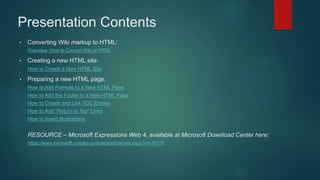
RESOURCE – Microsoft Expressions Web 4, available at Microsoft Download Center here:
https://www.microsoft.com/en-us/download/details.aspx?id=36179
Presentation Contents
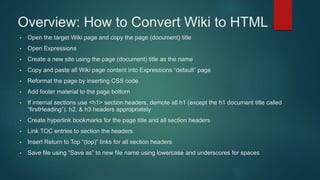
• Open the target Wiki page and copy the page (document) title
• Open Expressions
• Create a new site using the page (document) title as the name
• Copy and paste all Wiki page content into Expressions “default” page
• Reformat the page by inserting CSS code
• Add footer material to the page bottom
• If internal sections use <h1> section headers, demote all h1 (except the h1 document title called
“firstHeading”), h2, & h3 headers appropriately
• Create hyperlink bookmarks for the page title and all section headers
• Link TOC entries to section the headers
• Insert Return to Top “(top)” links for all section headers
• Save file using “Save as” to new file name using lowercase and underscores for spaces
Overview: How to Convert Wiki to HTML
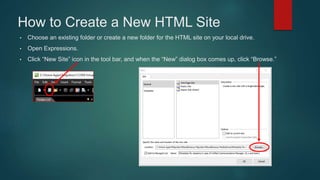
• Choose an existing folder or create a new folder for the HTML site on your local drive.
• Open Expressions.
• Click “New Site” icon in the tool bar, and when the “New” dialog box comes up, click “Browse.”
How to Create a New HTML Site
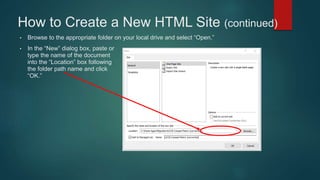
• Browse to the appropriate folder on your local drive and select “Open.”
• In the “New” dialog box, paste or
type the name of the document
into the “Location” box following
the folder path name and click
“OK.”
How to Create a New HTML Site (continued)
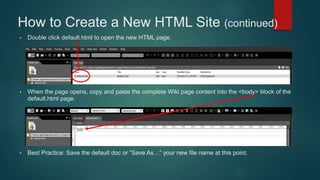
• Double click default.html to open the new HTML page.
• When the page opens, copy and paste the complete Wiki page content into the <body> block of the
default.html page.
• Best Practice: Save the default doc or “Save As…” your new file name at this point.
How to Create a New HTML Site (continued)
How to Add Formats to a New HTML Page
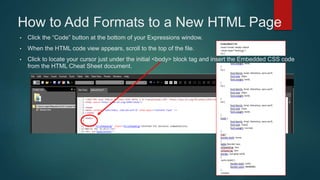
• Click the “Code” button at the bottom of your Expressions window.
• When the HTML code view appears, scroll to the top of the file.
• Click to locate your cursor just under the initial <body> block tag and insert the Embedded CSS code
from the HTML Cheat Sheet document.
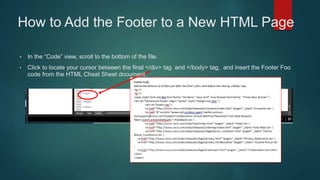
• In the “Code” view, scroll to the bottom of the file.
• Click to locate your cursor between the final </div> tag and </body> tag, and insert the Footer Foo
code from the HTML Cheat Sheet document.
How to Add the Footer to a New HTML Page
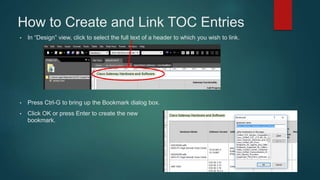
• In “Design” view, click to select the full text of a header to which you wish to link.
• Press Ctrl-G to bring up the Bookmark dialog box.
• Click OK or press Enter to create the new
bookmark.
How to Create and Link TOC Entries
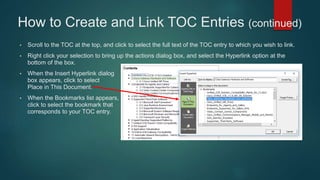
• Scroll to the TOC at the top, and click to select the full text of the TOC entry to which you wish to link.
• Right click your selection to bring up the actions dialog box, and select the Hyperlink option at the
bottom of the box.
• When the Insert Hyperlink dialog
box appears, click to select
Place in This Document.
• When the Bookmarks list appears,
click to select the bookmark that
corresponds to your TOC entry.
How to Create and Link TOC Entries (continued)
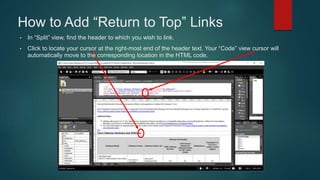
• In “Split” view, find the header to which you wish to link.
• Click to locate your cursor at the right-most end of the header text. Your “Code” view cursor will
automatically move to the corresponding location in the HTML code.
How to Add “Return to Top” Links
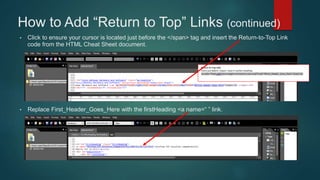
• Click to ensure your cursor is located just before the </span> tag and insert the Return-to-Top Link
code from the HTML Cheat Sheet document.
• Replace First_Header_Goes_Here with the firstHeading <a name=“ ” link.
How to Add “Return to Top” Links (continued)
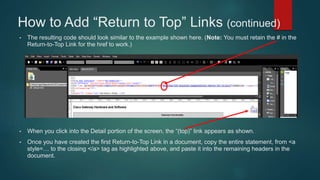
• The resulting code should look similar to the example shown here. (Note: You must retain the # in the
Return-to-Top Link for the href to work.)
• When you click into the Detail portion of the screen, the “(top)” link appears as shown.
• Once you have created the first Return-to-Top Link in a document, copy the entire statement, from <a
style=… to the closing </a> tag as highlighted above, and paste it into the remaining headers in the
document.
How to Add “Return to Top” Links (continued)
• Existing illustrations are copied along with text and tables, but the files are saved separately in the
HTML site folder.
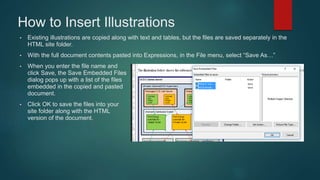
• With the full document contents pasted into Expressions, in the File menu, select “Save As…”
• When you enter the file name and
click Save, the Save Embedded Files
dialog pops up with a list of the files
embedded in the copied and pasted
document.
• Click OK to save the files into your
site folder along with the HTML
version of the document.
How to Insert Illustrations
• To insert a new illustration, copy the graphic source file into the folder containing your HTML page.
• Open the graphic file and copy the graphic. (WEM accepts .JPG and .PNG. It may also accept .GIF.)
• In “Design” view, create an empty paragraph where you want your graphic to be located.
• Click inside the empty paragraph and select paste to insert your graphic.
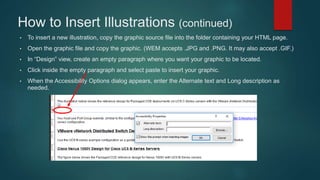
• When the Accessibility Options dialog appears, enter the Alternate text and Long description as
needed.
How to Insert Illustrations (continued)
• Click “OK,” and the graphic appears
inside the selected paragraph tag.
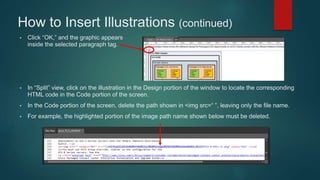
• In “Split” view, click on the illustration in the Design portion of the window to locate the corresponding
HTML code in the Code portion of the screen.
• In the Code portion of the screen, delete the path shown in <img src=“ ”, leaving only the file name.
• For example, the highlighted portion of the image path name shown below must be deleted.
How to Insert Illustrations (continued)

Wiki to HTML Conversion

  • 1.
    Copyright © 2017,Dave Derrick Converting and Migrating Wiki Markup to HTML
  • 2.
    • This presentationdescribes the tasks involved in converting Wiki pages to HTML, however many of the procedures are applicable to creating, updating, and maintaining existing HTML pages. • These procedures describe using Microsoft Expressions because it is free, relatively easy to use, relatively bug-free, and offers Design (wysiwyg), Code, and Split views for easier editing. Other HTML- compatible authoring tools can be used in its place, although many of the Expression-specific details contained in this presentation may not apply. General
  • 3.
    • Converting Wikimarkup to HTML: Overview: How to Convert Wiki to HTML • Creating a new HTML site: How to Create a New HTML Site • Preparing a new HTML page: How to Add Formats to a New HTML Page How to Add the Footer to a New HTML Page How to Create and Link TOC Entries How to Add “Return to Top” Links How to Insert Illustrations RESOURCE – Microsoft Expressions Web 4, available at Microsoft Download Center here: https://www.microsoft.com/en-us/download/details.aspx?id=36179 Presentation Contents
  • 4.
    • Open thetarget Wiki page and copy the page (document) title • Open Expressions • Create a new site using the page (document) title as the name • Copy and paste all Wiki page content into Expressions “default” page • Reformat the page by inserting CSS code • Add footer material to the page bottom • If internal sections use <h1> section headers, demote all h1 (except the h1 document title called “firstHeading”), h2, & h3 headers appropriately • Create hyperlink bookmarks for the page title and all section headers • Link TOC entries to section the headers • Insert Return to Top “(top)” links for all section headers • Save file using “Save as” to new file name using lowercase and underscores for spaces Overview: How to Convert Wiki to HTML
  • 5.
    • Choose anexisting folder or create a new folder for the HTML site on your local drive. • Open Expressions. • Click “New Site” icon in the tool bar, and when the “New” dialog box comes up, click “Browse.” How to Create a New HTML Site
  • 6.
    • Browse tothe appropriate folder on your local drive and select “Open.” • In the “New” dialog box, paste or type the name of the document into the “Location” box following the folder path name and click “OK.” How to Create a New HTML Site (continued)
  • 7.
    • Double clickdefault.html to open the new HTML page. • When the page opens, copy and paste the complete Wiki page content into the <body> block of the default.html page. • Best Practice: Save the default doc or “Save As…” your new file name at this point. How to Create a New HTML Site (continued)
  • 8.
    How to AddFormats to a New HTML Page • Click the “Code” button at the bottom of your Expressions window. • When the HTML code view appears, scroll to the top of the file. • Click to locate your cursor just under the initial <body> block tag and insert the Embedded CSS code from the HTML Cheat Sheet document.
  • 9.
    • In the“Code” view, scroll to the bottom of the file. • Click to locate your cursor between the final </div> tag and </body> tag, and insert the Footer Foo code from the HTML Cheat Sheet document. How to Add the Footer to a New HTML Page
  • 10.
    • In “Design”view, click to select the full text of a header to which you wish to link. • Press Ctrl-G to bring up the Bookmark dialog box. • Click OK or press Enter to create the new bookmark. How to Create and Link TOC Entries
  • 11.
    • Scroll tothe TOC at the top, and click to select the full text of the TOC entry to which you wish to link. • Right click your selection to bring up the actions dialog box, and select the Hyperlink option at the bottom of the box. • When the Insert Hyperlink dialog box appears, click to select Place in This Document. • When the Bookmarks list appears, click to select the bookmark that corresponds to your TOC entry. How to Create and Link TOC Entries (continued)
  • 12.
    • In “Split”view, find the header to which you wish to link. • Click to locate your cursor at the right-most end of the header text. Your “Code” view cursor will automatically move to the corresponding location in the HTML code. How to Add “Return to Top” Links
  • 13.
    • Click toensure your cursor is located just before the </span> tag and insert the Return-to-Top Link code from the HTML Cheat Sheet document. • Replace First_Header_Goes_Here with the firstHeading <a name=“ ” link. How to Add “Return to Top” Links (continued)
  • 14.
    • The resultingcode should look similar to the example shown here. (Note: You must retain the # in the Return-to-Top Link for the href to work.) • When you click into the Detail portion of the screen, the “(top)” link appears as shown. • Once you have created the first Return-to-Top Link in a document, copy the entire statement, from <a style=… to the closing </a> tag as highlighted above, and paste it into the remaining headers in the document. How to Add “Return to Top” Links (continued)
  • 15.
    • Existing illustrationsare copied along with text and tables, but the files are saved separately in the HTML site folder. • With the full document contents pasted into Expressions, in the File menu, select “Save As…” • When you enter the file name and click Save, the Save Embedded Files dialog pops up with a list of the files embedded in the copied and pasted document. • Click OK to save the files into your site folder along with the HTML version of the document. How to Insert Illustrations
  • 16.
    • To inserta new illustration, copy the graphic source file into the folder containing your HTML page. • Open the graphic file and copy the graphic. (WEM accepts .JPG and .PNG. It may also accept .GIF.) • In “Design” view, create an empty paragraph where you want your graphic to be located. • Click inside the empty paragraph and select paste to insert your graphic. • When the Accessibility Options dialog appears, enter the Alternate text and Long description as needed. How to Insert Illustrations (continued)
  • 17.
    • Click “OK,”and the graphic appears inside the selected paragraph tag. • In “Split” view, click on the illustration in the Design portion of the window to locate the corresponding HTML code in the Code portion of the screen. • In the Code portion of the screen, delete the path shown in <img src=“ ”, leaving only the file name. • For example, the highlighted portion of the image path name shown below must be deleted. How to Insert Illustrations (continued)