The	Role	of	CS	Departments	in	
The	US	President’s	“CS	for	All”	
Initiative
Mark	Guzdial (moderator),
Barbara	Ericson,
W.	Richards	(Rick)	Adrion,
Megean Garvin
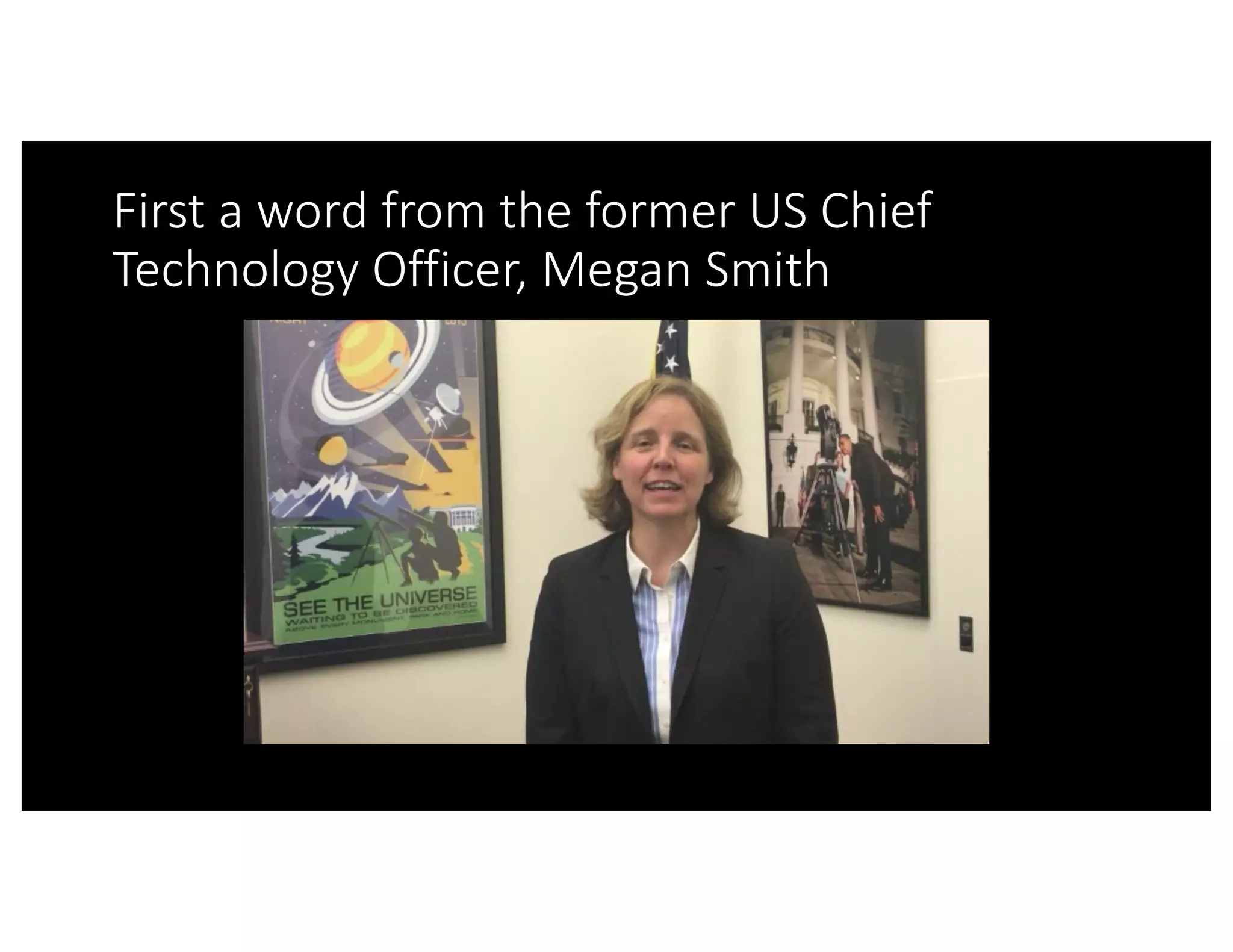
First	a	word	from	the	former	US	Chief	
Technology	Officer,	Megan	Smith
What	role	can	Computer	Science	
departments	play	in	meeting	the	
challenge	of	CS	for	All?
Barbara	Ericson
Influencing	future	students
CSforAll
Barbara Ericson
Georgia Tech
ericson@cc.gatech.edu
Overview
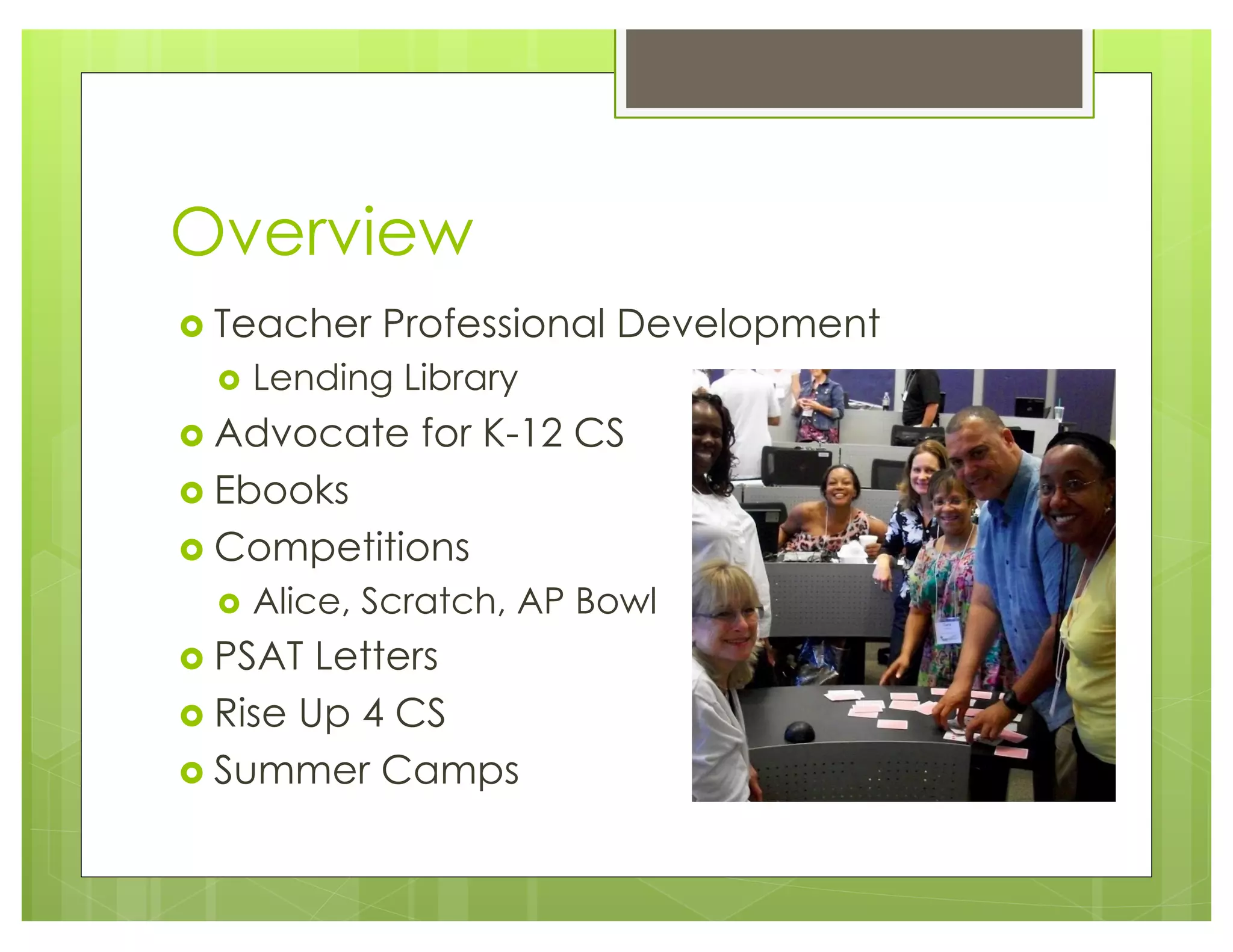
› Teacher Professional Development
› Lending Library
› Advocate for K-12 CS
› Ebooks
› Competitions
› Alice, Scratch, AP Bowl
› PSAT Letters
› Rise Up 4 CS
› Summer Camps
Teacher Professional Dev
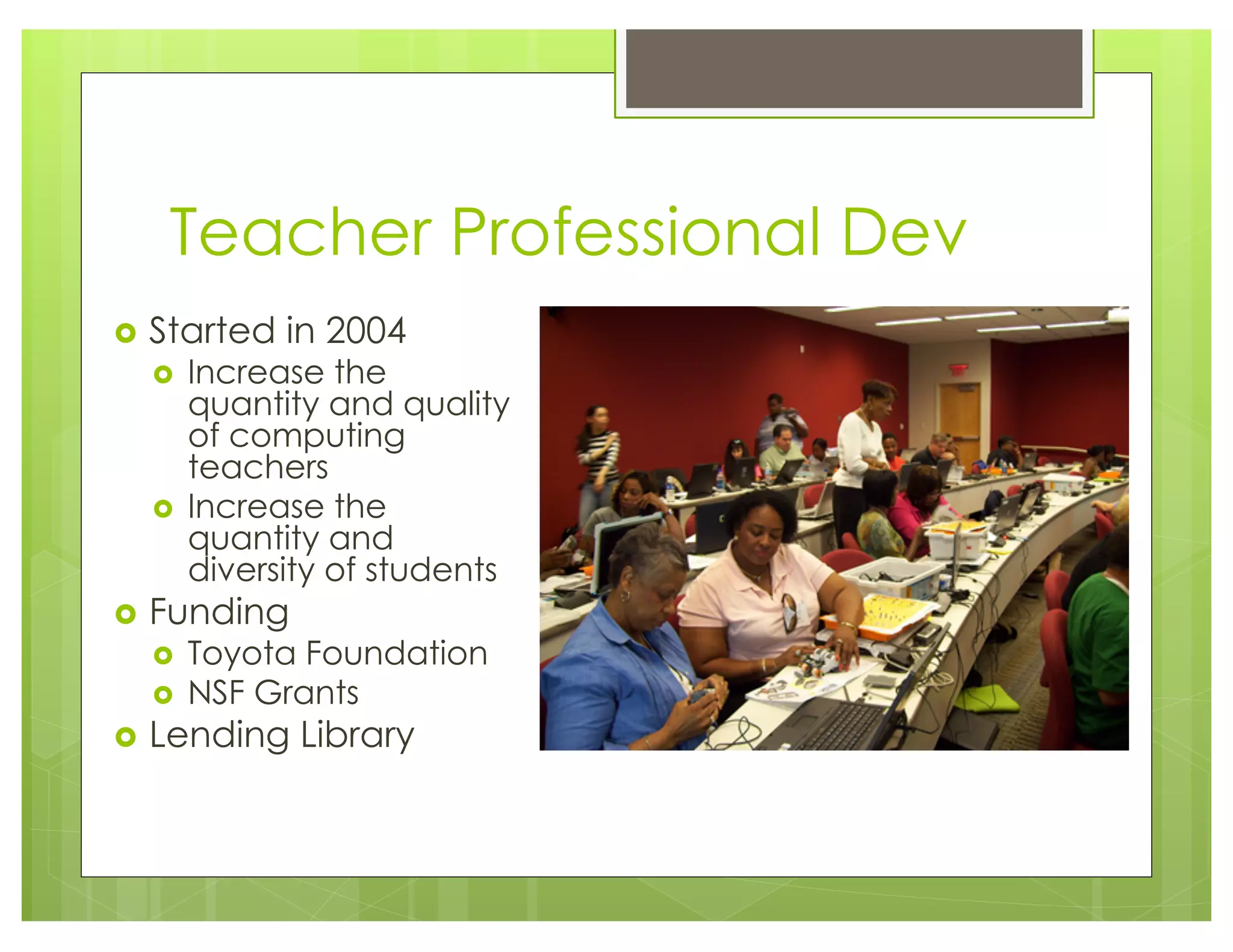
› Started in 2004
› Increase the
quantity and quality
of computing
teachers
› Increase the
quantity and
diversity of students
› Funding
› Toyota Foundation
› NSF Grants
› Lending Library
Advocate for K-12 CS
› Standards
Committee
› CS Endorsement
› CS Counts as a
4th Science
› 2012
› CS Task Force
0
500
1000
1500
2000
2500
2004 2005 2006 2007 2008 2009 2010 2011 2012 2013 2014 2015 2016
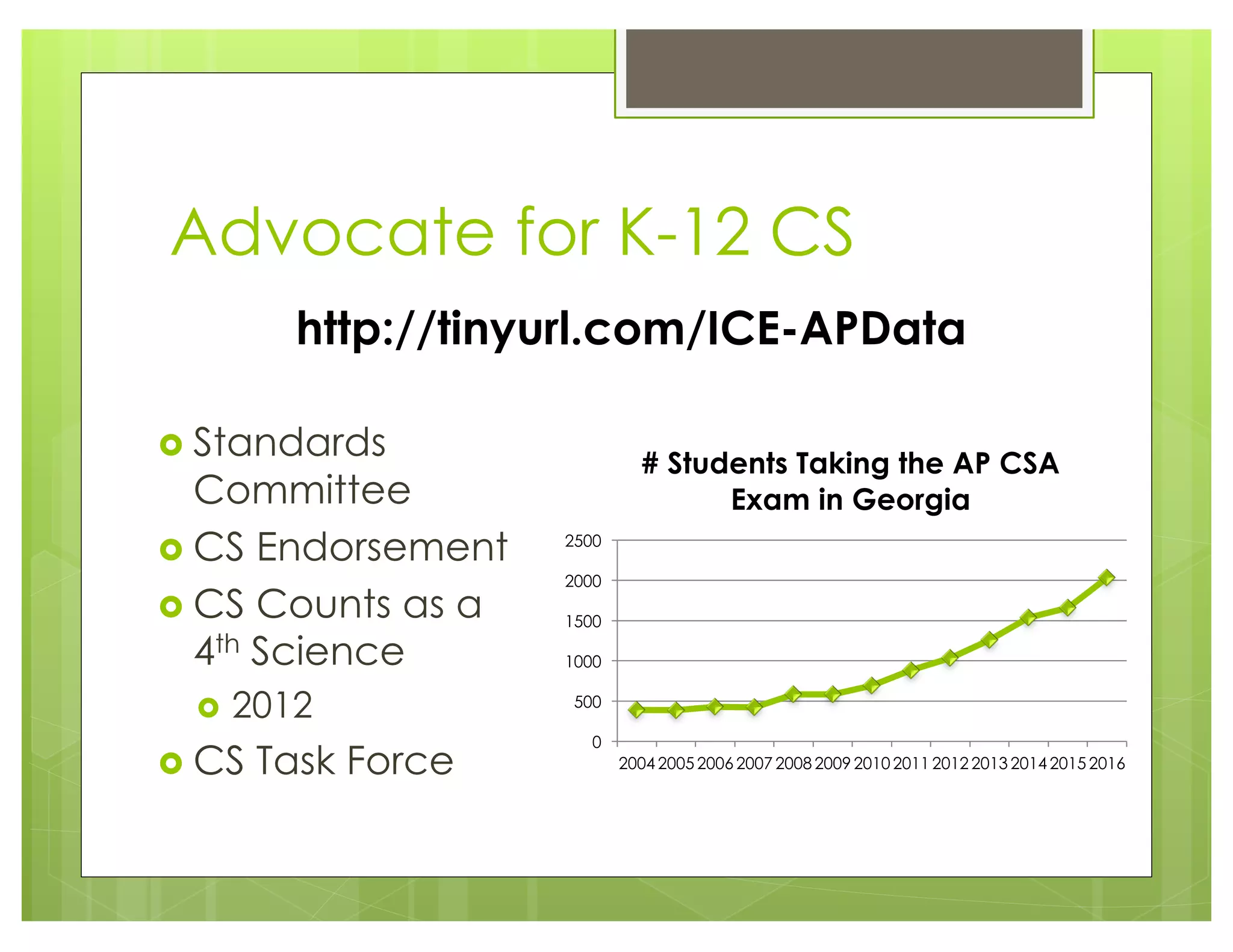
# Students Taking the AP CSA
Exam in Georgia
http://tinyurl.com/ICE-APData
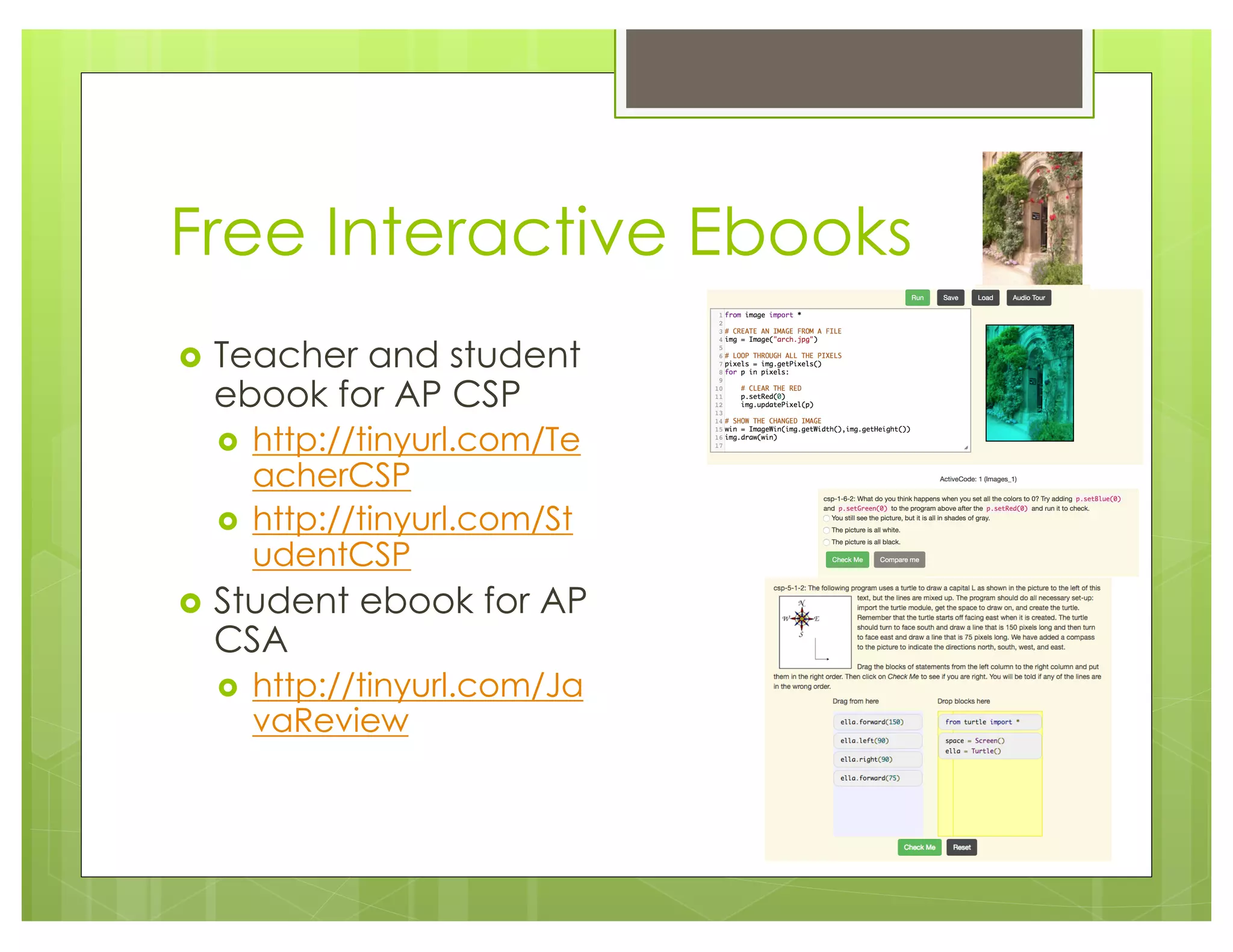
Free Interactive Ebooks
› Teacher and student
ebook for AP CSP
› http://tinyurl.com/Te
acherCSP
› http://tinyurl.com/St
udentCSP
› Student ebook for AP
CSA
› http://tinyurl.com/Ja
vaReview
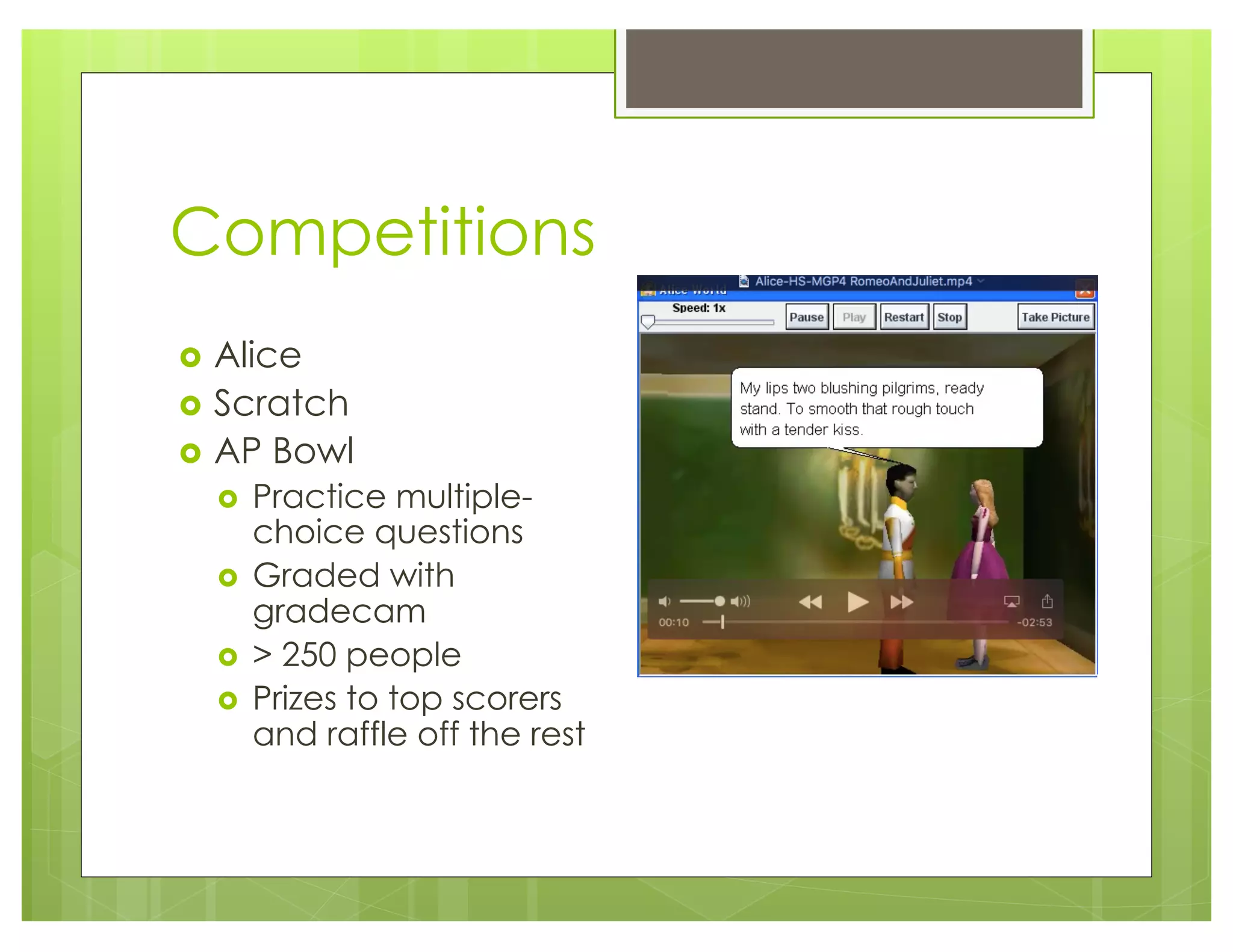
Competitions
› Alice
› Scratch
› AP Bowl
› Practice multiple-
choice questions
› Graded with
gradecam
› > 250 people
› Prizes to top scorers
and raffle off the rest
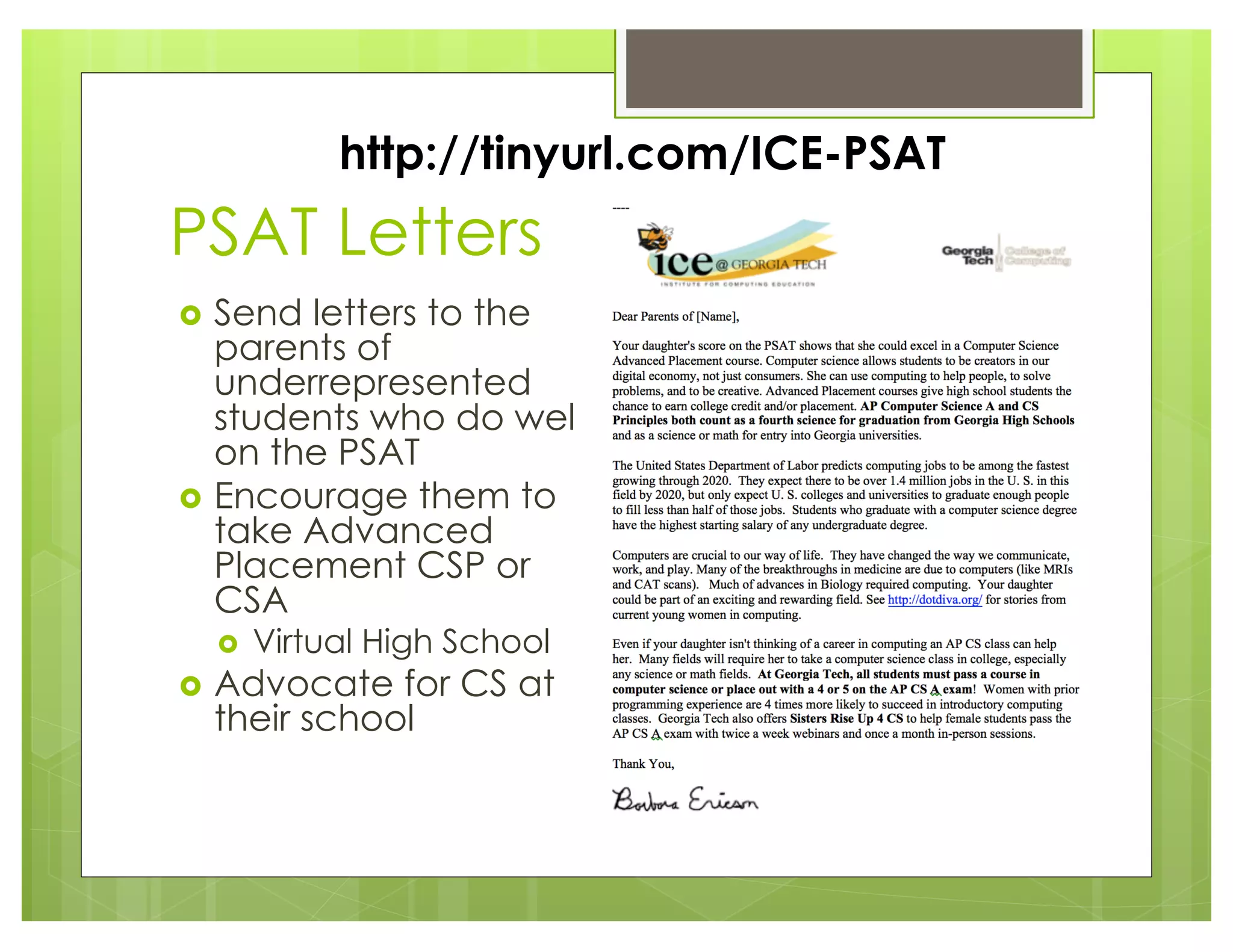
PSAT Letters
› Send letters to the
parents of
underrepresented
students who do well
on the PSAT
› Encourage them to
take Advanced
Placement CSP or
CSA
› Virtual High School
› Advocate for CS at
their school
http://tinyurl.com/ICE-PSAT
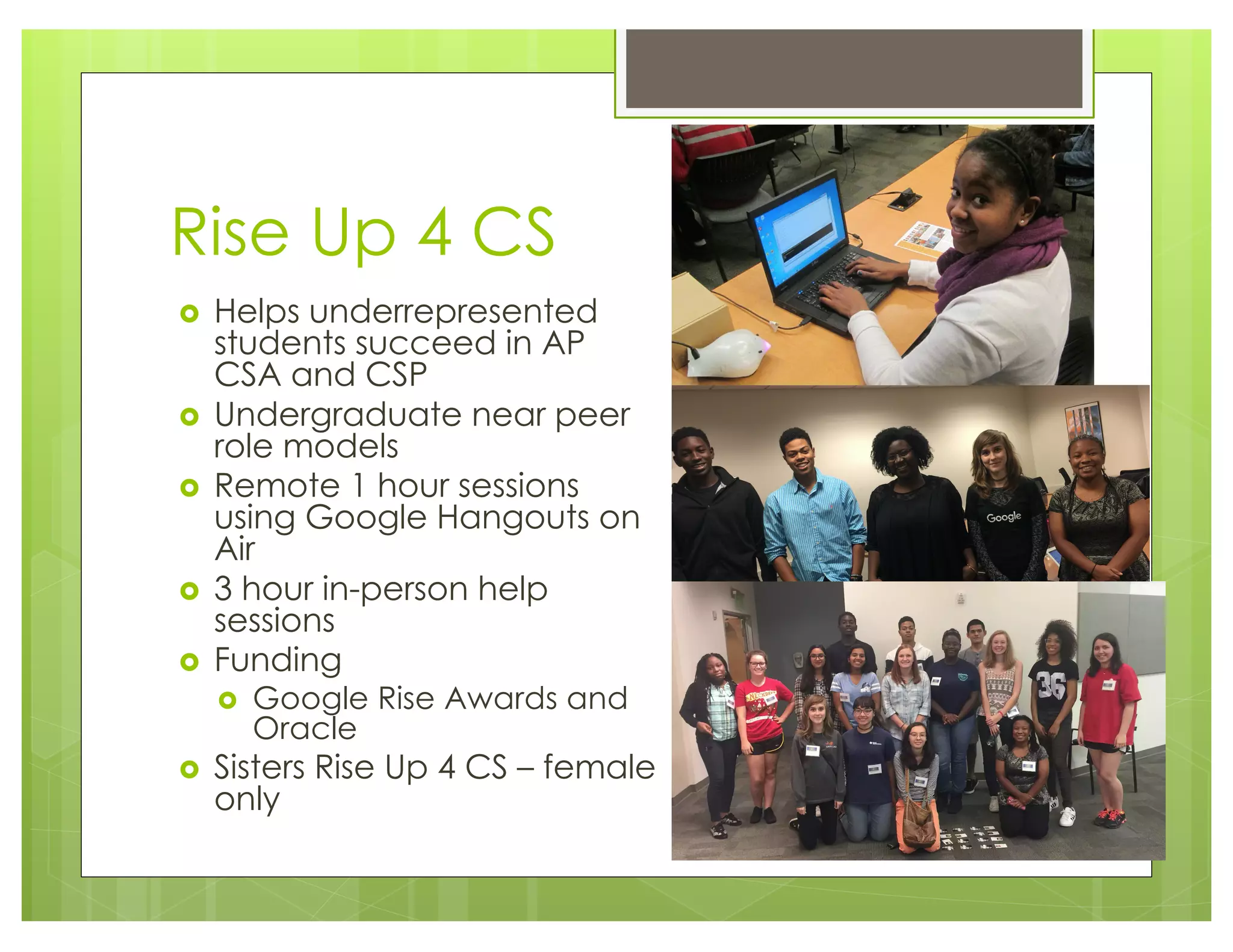
Rise Up 4 CS
› Helps underrepresented
students succeed in AP
CSA and CSP
› Undergraduate near peer
role models
› Remote 1 hour sessions
using Google Hangouts on
Air
› 3 hour in-person help
sessions
› Funding
› Google Rise Awards and
Oracle
› Sisters Rise Up 4 CS – female
only
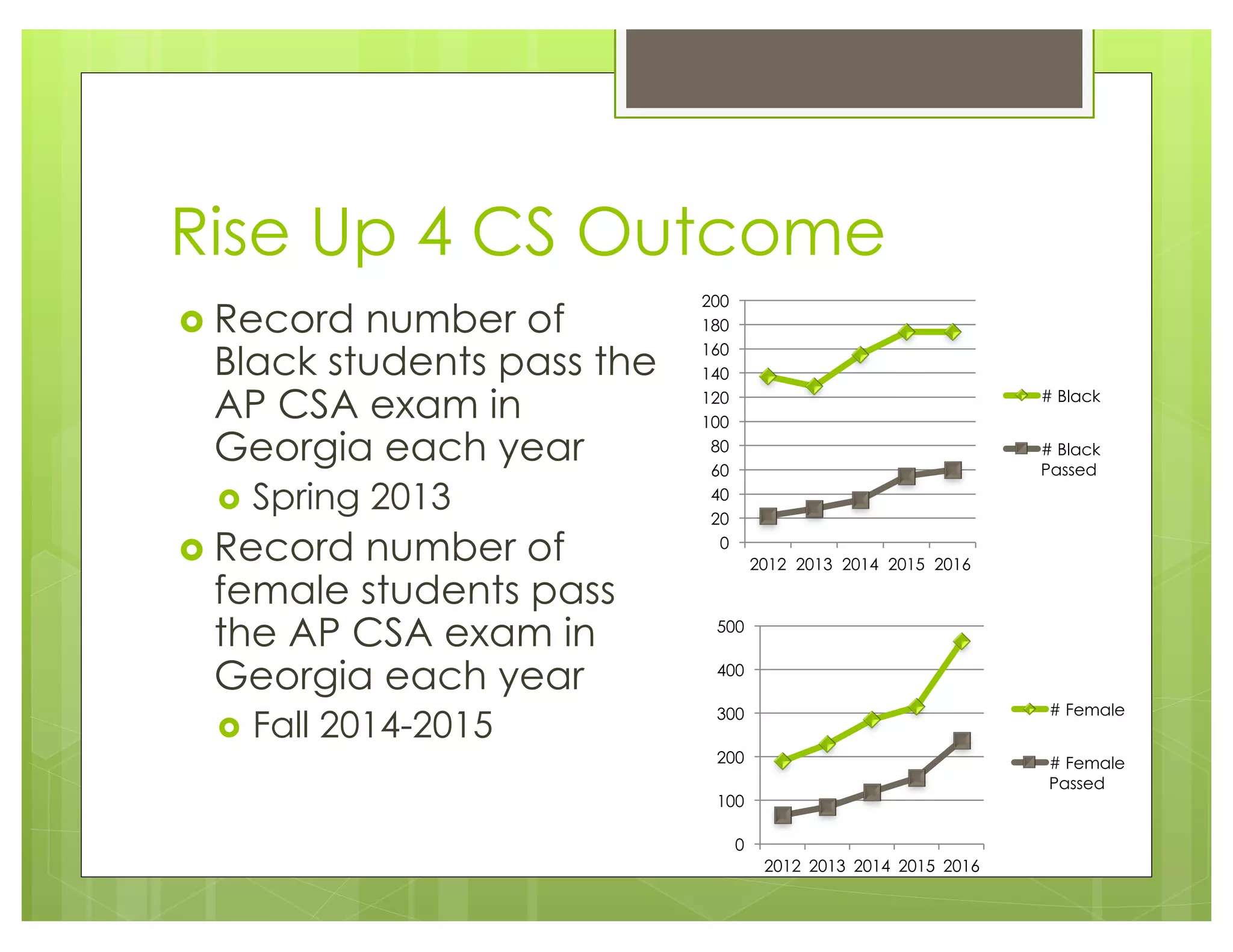
Rise Up 4 CS Outcome
› Record number of
Black students pass the
AP CSA exam in
Georgia each year
› Spring 2013
› Record number of
female students pass
the AP CSA exam in
Georgia each year
› Fall 2014-2015
0
20
40
60
80
100
120
140
160
180
200
2012 2013 2014 2015 2016
# Black
# Black
Passed
0
100
200
300
400
500
2012 2013 2014 2015 2016
# Female
# Female
Passed
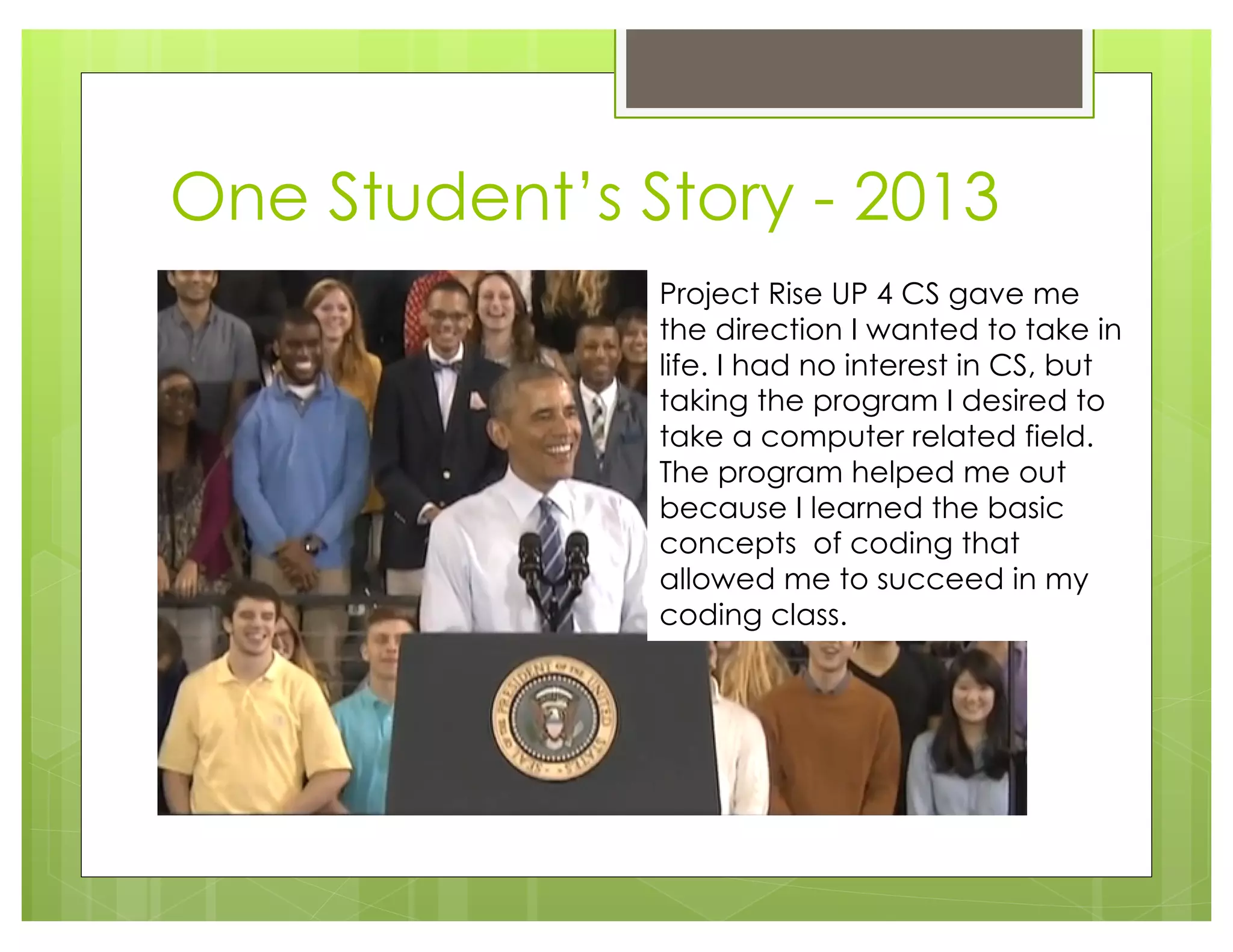
One Student’s Story - 2013
Project Rise UP 4 CS gave me
the direction I wanted to take in
life. I had no interest in CS, but
taking the program I desired to
take a computer related field.
The program helped me out
because I learned the basic
concepts of coding that
allowed me to succeed in my
coding class.
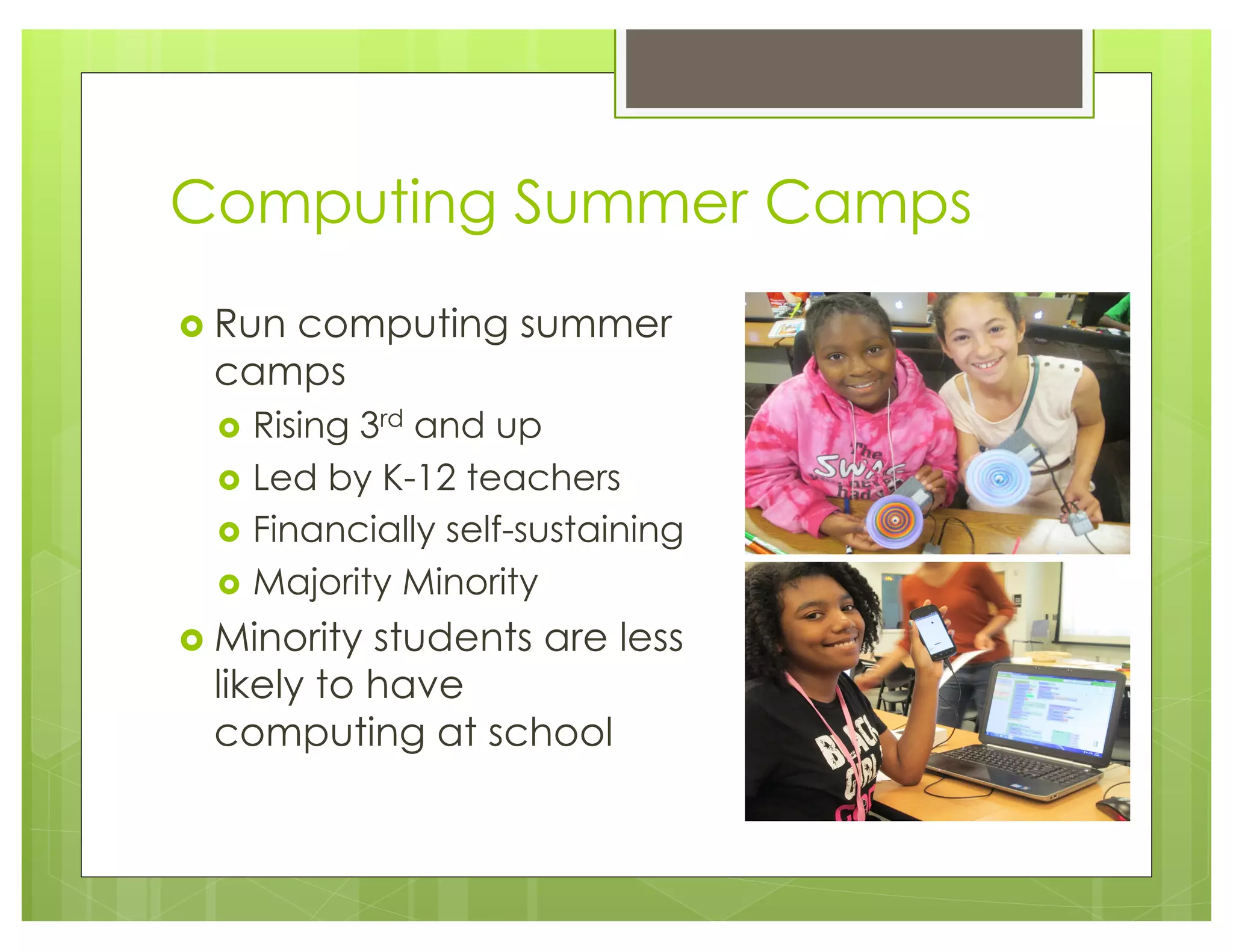
Computing Summer Camps
› Run computing summer
camps
› Rising 3rd and up
› Led by K-12 teachers
› Financially self-sustaining
› Majority Minority
› Minority students are less
likely to have
computing at school
W.	Richards	(Rick)	Adrion
Providing	subject	matter	expertise
Providing	Subject-Ma4er	Exper8se	
•  CS	faculty	can	provide	valuable	input	to:	
– Higher	educa8on	admission	requirements	
– K12	learning	and	CS	educa8on	research	
– State	ac8ons	on	educa8on	
– Standards	
– Engaging	your	local	or	regional	schools/districts	
– Licensure/Cer8fica8on	
– Pre-service	teacher	educa8on	programs
How	can	I	contribute?	
•  Higher	educa8on	admission	requirements	
–  Typically	AP	CS-A	counts	for	credit/placement,	but	not	as	an	
admission	factor	(as	part	of	minimum	academic	record)	
–  While	AP	CSP	may	count	for	credit	-	What	about	towards	a	
degree?	As	an	admission	factor?	To	sa8sfy	a	GenEd	requirement?	
–  College	credit	increases	student	(and	parent)	interest	in	K-12	CS	
•  K12	learning	and	CS	educa8on	research	
–  Look	at	real	problems	of	interest	to	schools	and	districts,	e.g.,	NSF	
CS	for	All	RPP	
•  Offer	opinions	on	state	ac8ons	
–  As	an	example,	make	sure	CS	is	in	the	state	Every	Student	
Succeeds	Act	(ESSA)	plan	
Get	your	college	to	report	
to	the	College	Board
Why	should	you	care	about	K-12	CS	standards?	
•  Standards	affect	all	schools,	not	just	highly	resourced	
districts	->	can	contribute	to	broadening	par8cipa8on,	
inclusion,	and	the	school	to	college/career	pipeline	
•  Can	help	bring	more	CS-ready	students	and	students	
with	CS	knowledge	across	all	disciplines	to	college	
•  SEA/LEA	staff,	schools	struggle	with	understanding	
computer	science	and	computa8onal	thinking	
•  Standards	are	not	frequently	revised,	so	CS	standards	
must	be	forward	looking	
•  Standards	help	define	licensure,	in	turn	highly	qualified	
teachers	->	more	engaged	students
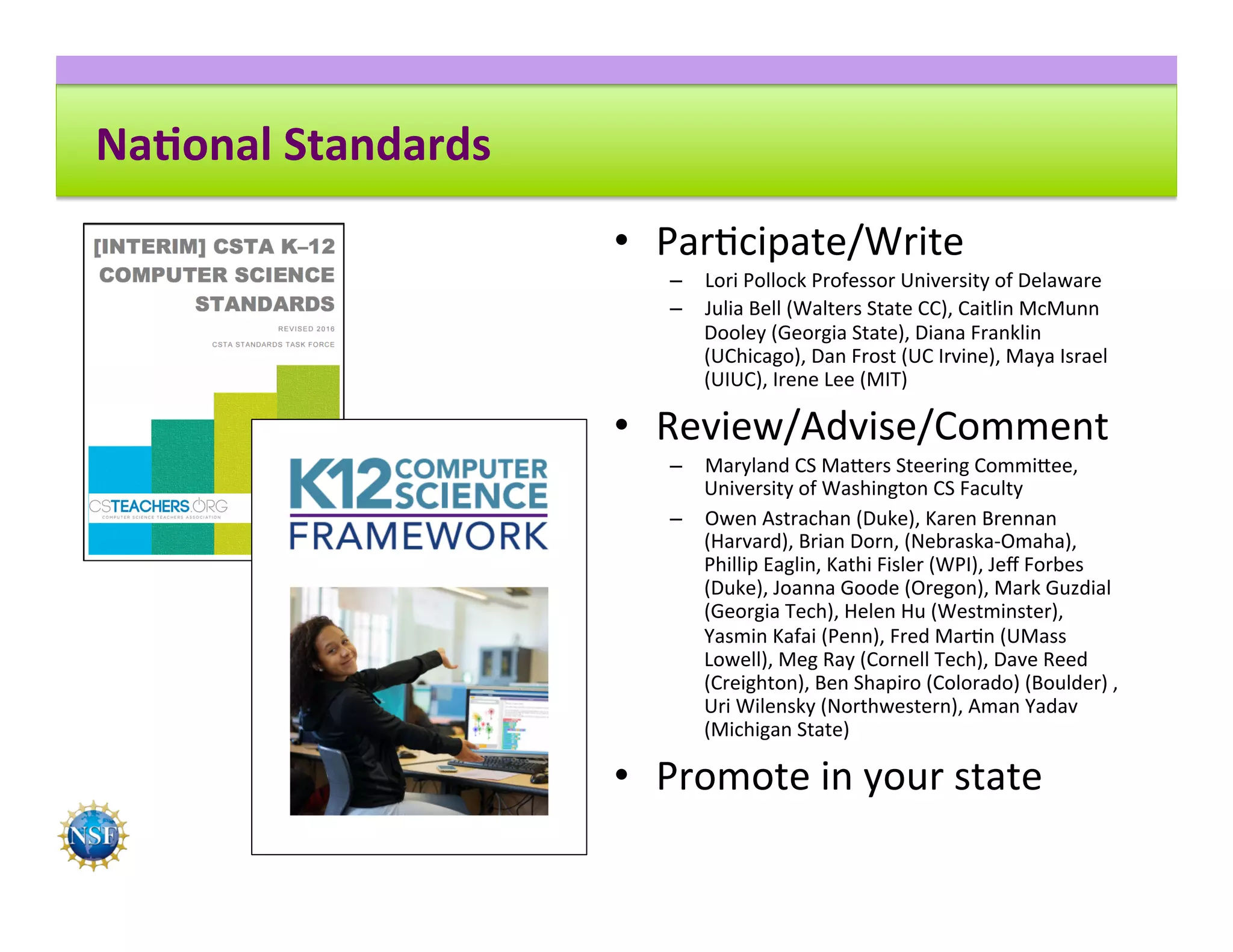
Na8onal	Standards	
•  Par8cipate/Write	
–  Lori	Pollock	Professor	University	of	Delaware	
–  Julia	Bell	(Walters	State	CC),	Caitlin	McMunn	
Dooley	(Georgia	State),	Diana	Franklin	
(UChicago),	Dan	Frost	(UC	Irvine),	Maya	Israel	
(UIUC),	Irene	Lee	(MIT)	
•  Review/Advise/Comment	
–  Maryland	CS	Ma^ers	Steering	Commi^ee,	
University	of	Washington	CS	Faculty	
–  Owen	Astrachan	(Duke),	Karen	Brennan	
(Harvard),	Brian	Dorn,	(Nebraska-Omaha),		
Phillip	Eaglin,	Kathi	Fisler	(WPI),	Jeff	Forbes	
(Duke),	Joanna	Goode	(Oregon),	Mark	Guzdial	
(Georgia	Tech),	Helen	Hu	(Westminster),	
Yasmin	Kafai	(Penn),	Fred	Mar8n	(UMass	
Lowell),	Meg	Ray	(Cornell	Tech),	Dave	Reed	
(Creighton),	Ben	Shapiro	(Colorado)	(Boulder)	,	
Uri	Wilensky	(Northwestern),	Aman	Yadav	
(Michigan	State)	
•  Promote	in	your	state
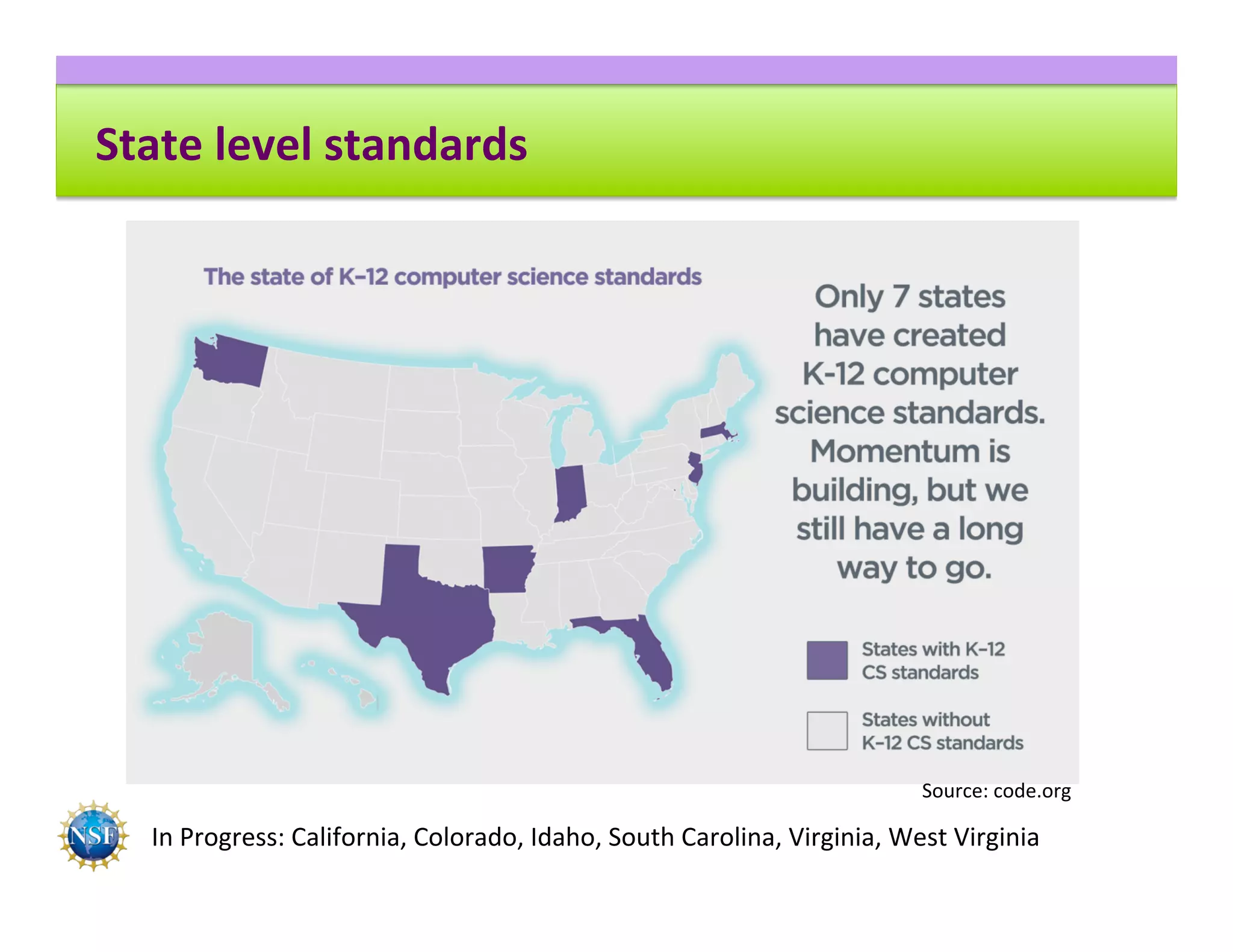
State	level	standards	
In	Progress:	California,	Colorado,	Idaho,	South	Carolina,	Virginia,	West	Virginia	
Source:	code.org
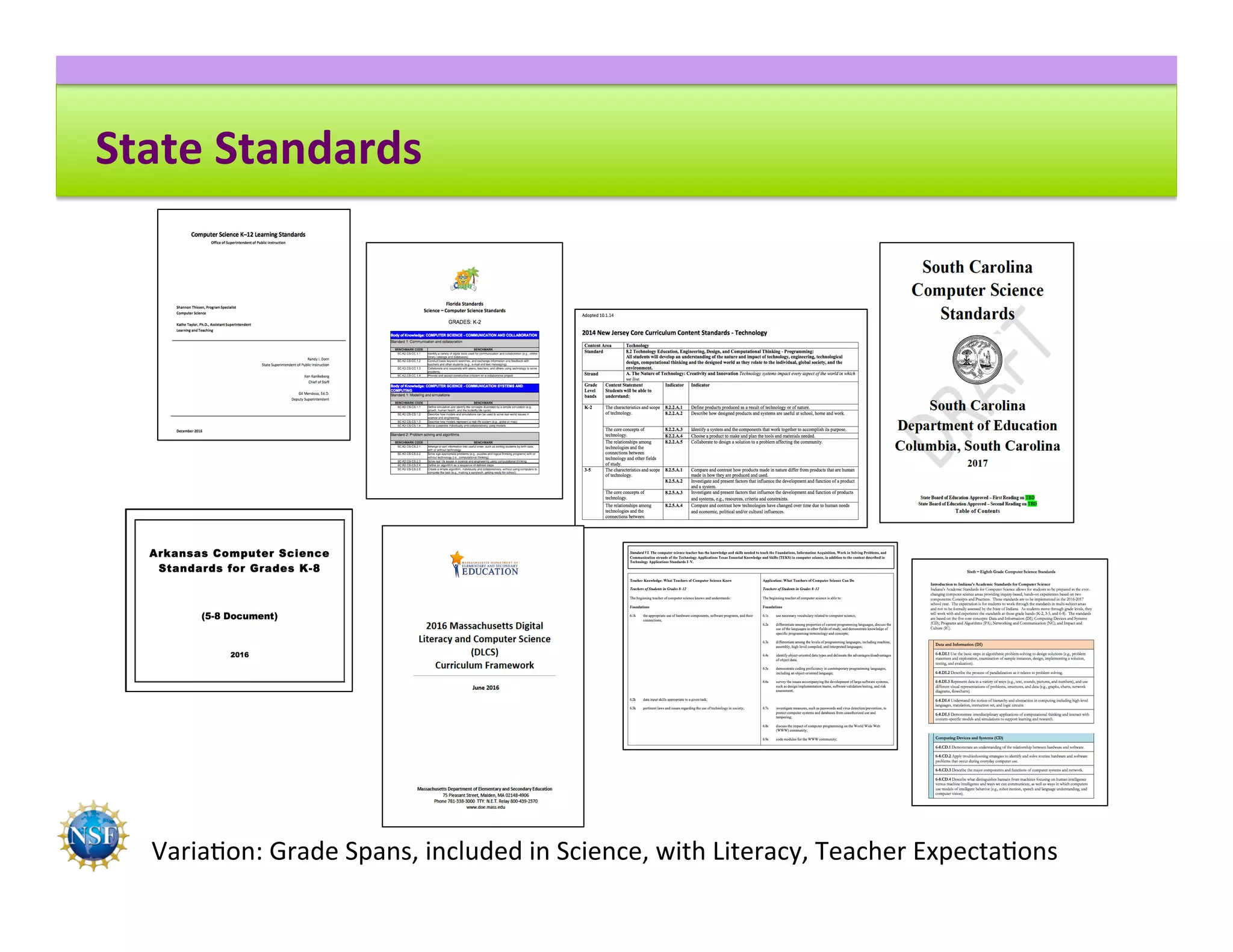
State	Standards	
Varia8on:	Grade	Spans,	included	in	Science,	with	Literacy,	Teacher	Expecta8ons
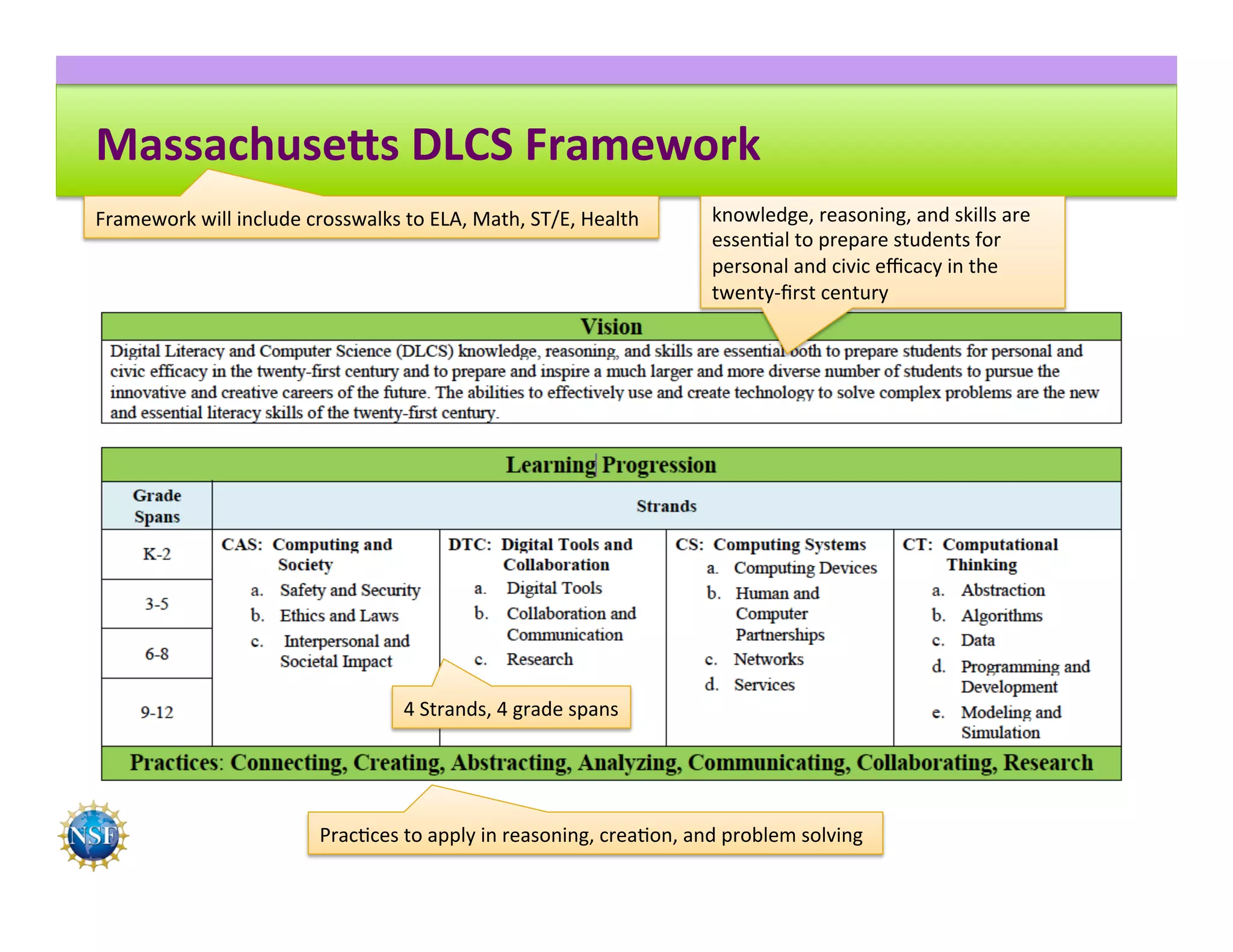
Massachuse4s	DLCS	Framework	
knowledge,	reasoning,	and	skills	are	
essen8al	to	prepare	students	for	
personal	and	civic	efficacy	in	the	
twenty-first	century		
Prac8ces	to	apply	in	reasoning,	crea8on,	and	problem	solving	
4	Strands,	4	grade	spans	
Framework	will	include	crosswalks	to	ELA,	Math,	ST/E,	Health
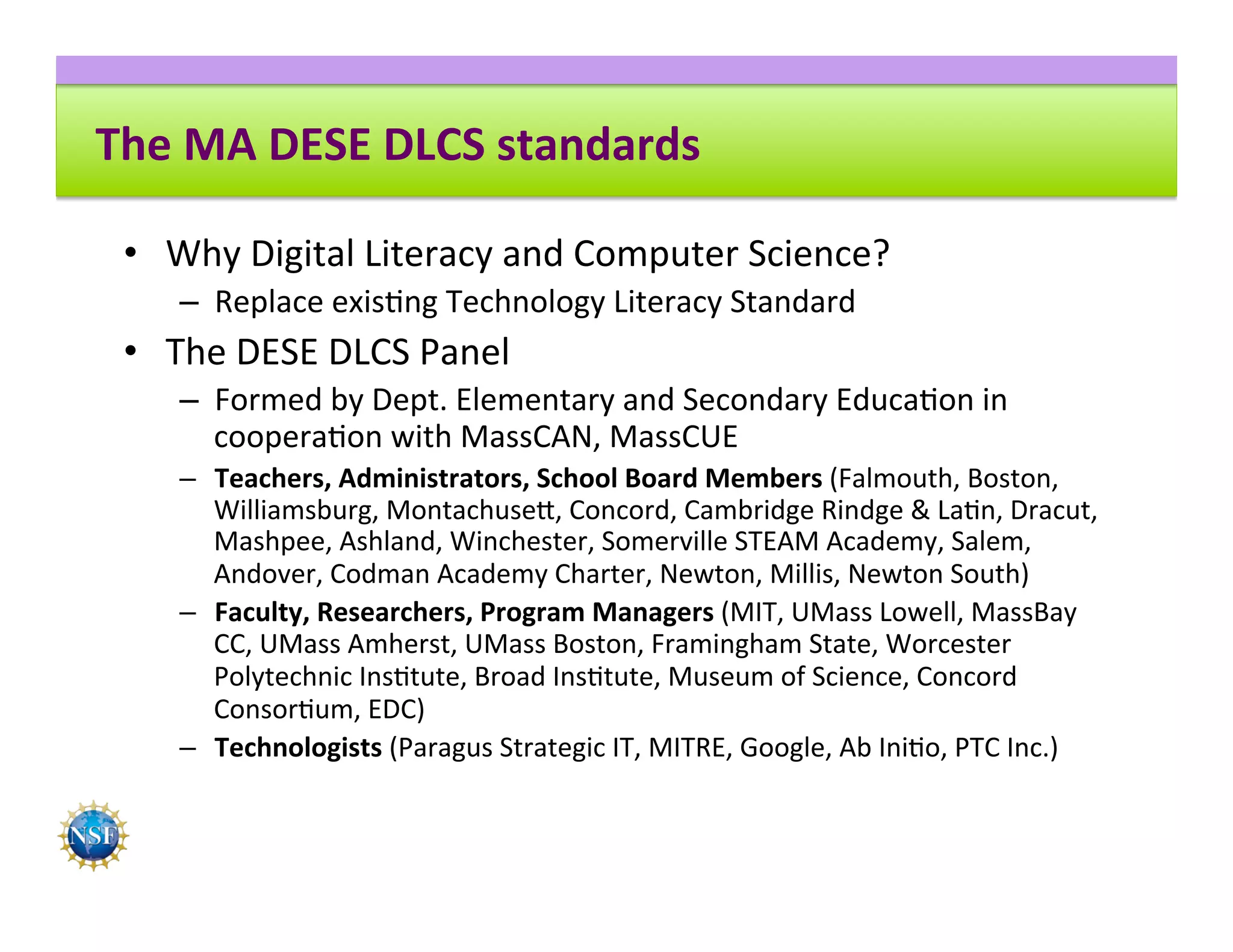
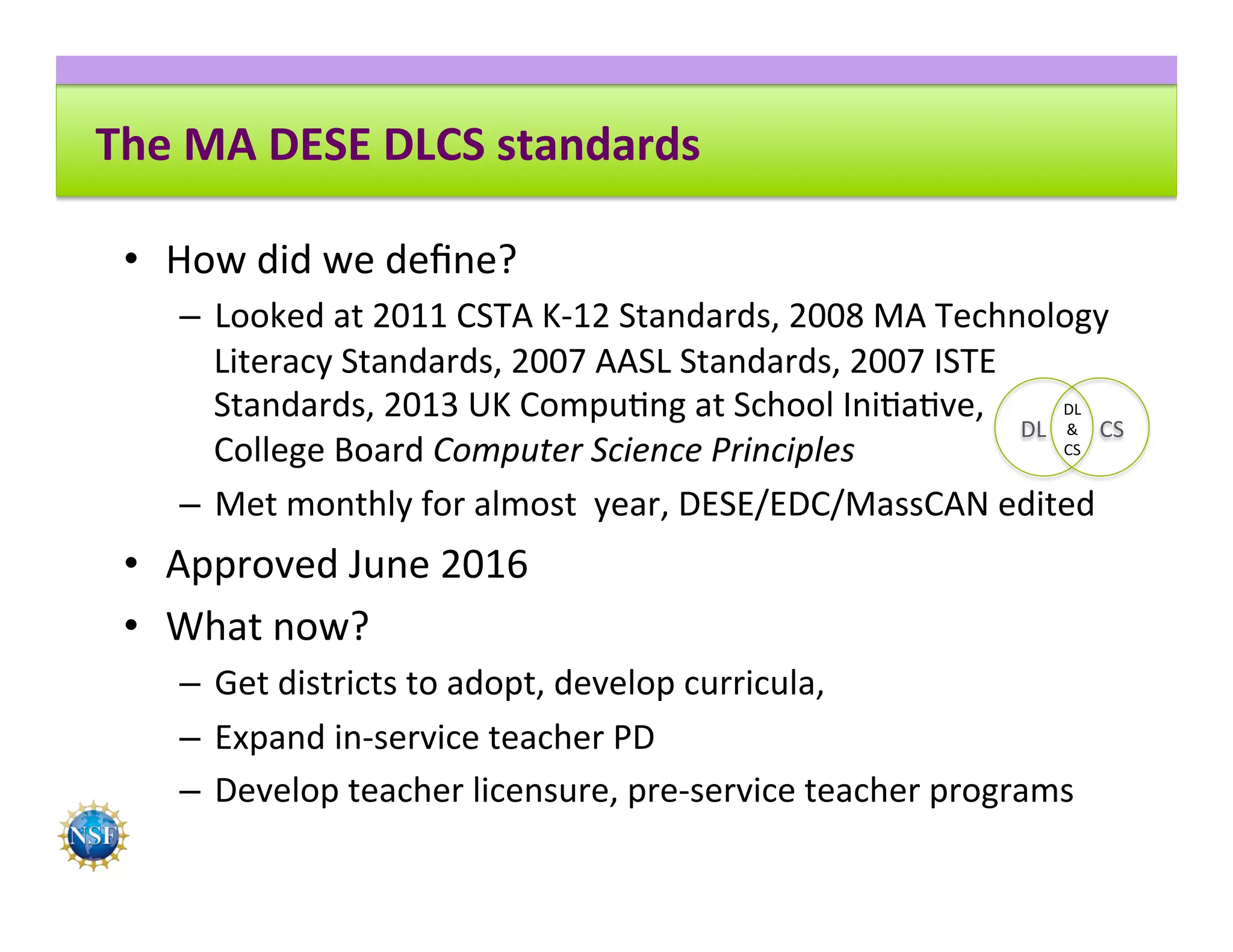
The	MA	DESE	DLCS	standards	
•  Why	Digital	Literacy	and	Computer	Science?	
–  Replace	exis8ng	Technology	Literacy	Standard		
•  The	DESE	DLCS	Panel	
–  Formed	by	Dept.	Elementary	and	Secondary	Educa8on	in	
coopera8on	with	MassCAN,	MassCUE	
–  Teachers,	Administrators,	School	Board	Members	(Falmouth,	Boston,	
Williamsburg,	Montachuse^,	Concord,	Cambridge	Rindge	&	La8n,	Dracut,	
Mashpee,	Ashland,	Winchester,	Somerville	STEAM	Academy,	Salem,	
Andover,	Codman	Academy	Charter,	Newton,	Millis,	Newton	South)	
–  Faculty,	Researchers,	Program	Managers	(MIT,	UMass	Lowell,	MassBay	
CC,	UMass	Amherst,	UMass	Boston,	Framingham	State,	Worcester	
Polytechnic	Ins8tute,	Broad	Ins8tute,	Museum	of	Science,	Concord	
Consor8um,	EDC)	
–  Technologists	(Paragus	Strategic	IT,	MITRE,	Google,	Ab	Ini8o,	PTC	Inc.)
The	MA	DESE	DLCS	standards	
•  How	did	we	define?	
–  Looked	at	2011	CSTA	K-12	Standards,	2008	MA	Technology	
Literacy	Standards,	2007	AASL	Standards,	2007	ISTE	
Standards,	2013	UK	Compu8ng	at	School	Ini8a8ve,		
College	Board	Computer	Science	Principles	
–  Met	monthly	for	almost		year,	DESE/EDC/MassCAN	edited	
•  Approved	June	2016	
•  What	now?	
–  Get	districts	to	adopt,	develop	curricula,		
–  Expand	in-service	teacher	PD	
–  Develop	teacher	licensure,	pre-service	teacher	programs	
DL	 CS	
DL	
&	
CS
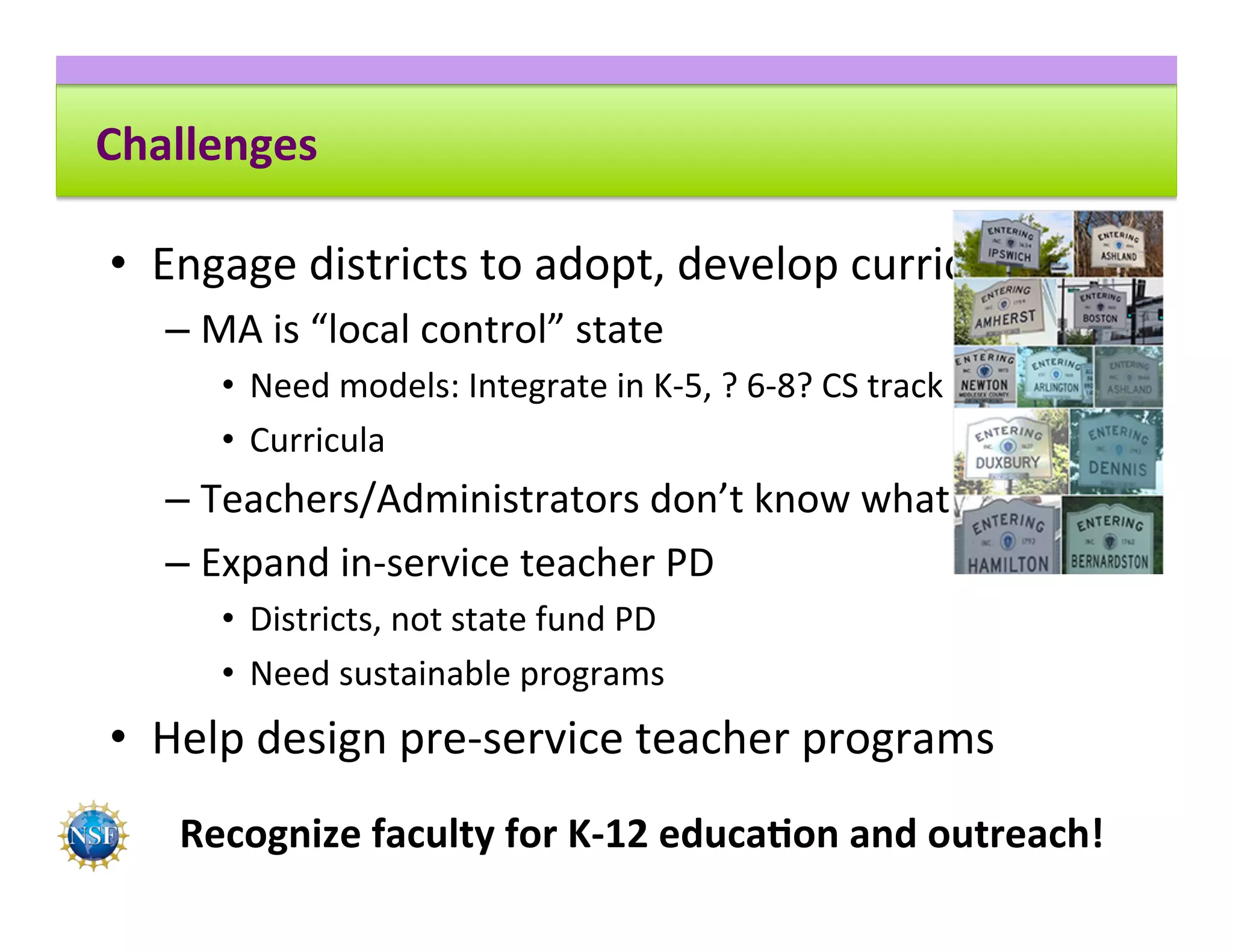
Challenges	
•  Engage	districts	to	adopt,	develop	curricula	
– MA	is	“local	control”	state	
•  Need	models:	Integrate	in	K-5,	?	6-8?	CS	track	9-12	
•  Curricula	
– Teachers/Administrators	don’t	know	what	CS	is	
– Expand	in-service	teacher	PD	
•  Districts,	not	state	fund	PD	
•  Need	sustainable	programs	
•  Help	design	pre-service	teacher	programs	
Recognize	faculty	for	K-12	educa8on	and	outreach!
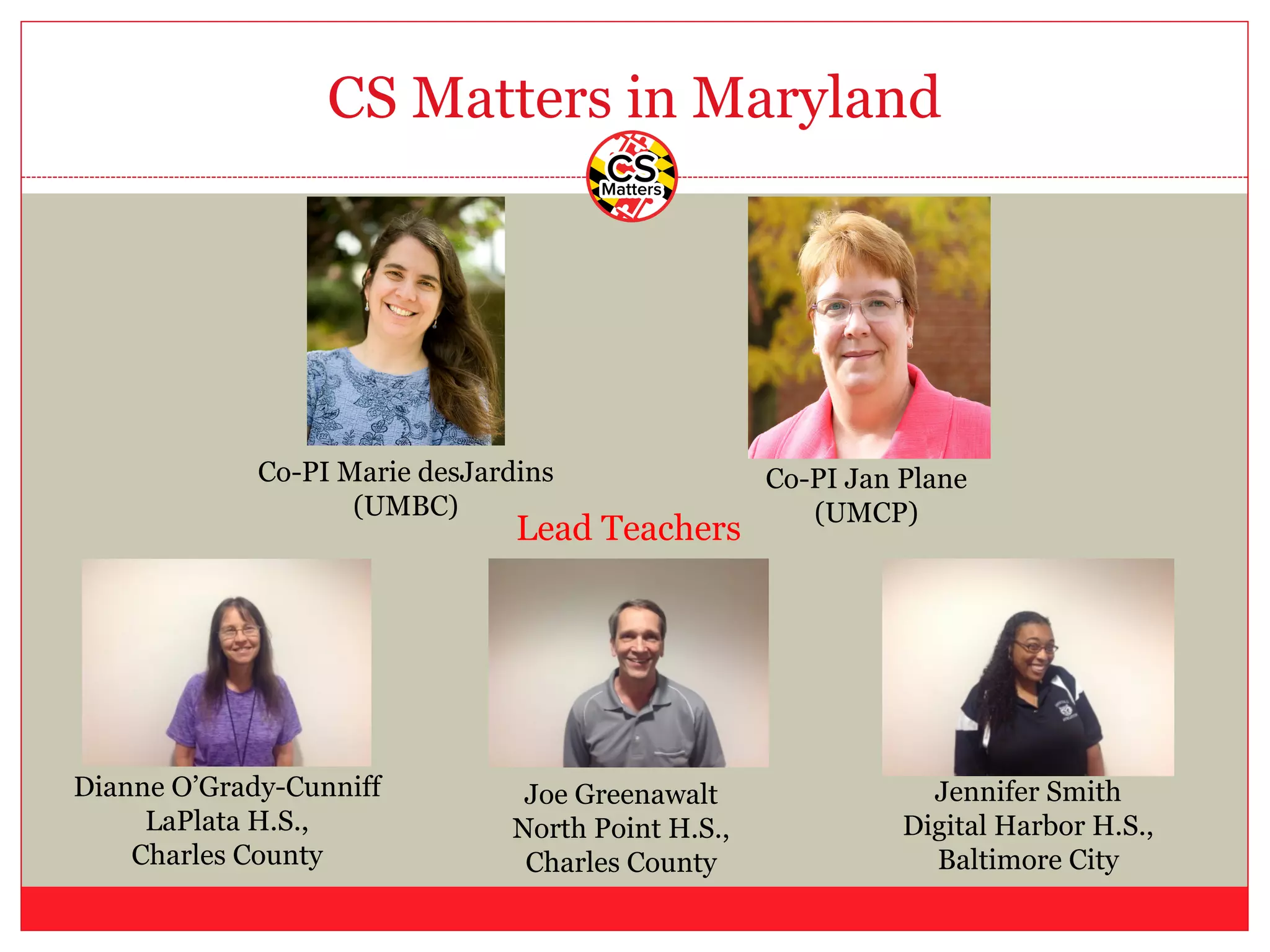
Megean Garvin
Providing	leadership
Maryland Computing Education
Megean E. Garvin, Ph.D.
UMBC
CS Matters in MD
mgarvin@umbc.edu
CS Matters in Maryland
Co-PI Jan Plane
(UMCP)
Co-PI Marie desJardins
(UMBC)
Dianne O’Grady-Cunniff
LaPlata H.S.,
Charles County
Joe Greenawalt
North Point H.S.,
Charles County
Jennifer Smith
Digital Harbor H.S.,
Baltimore City
Lead Teachers
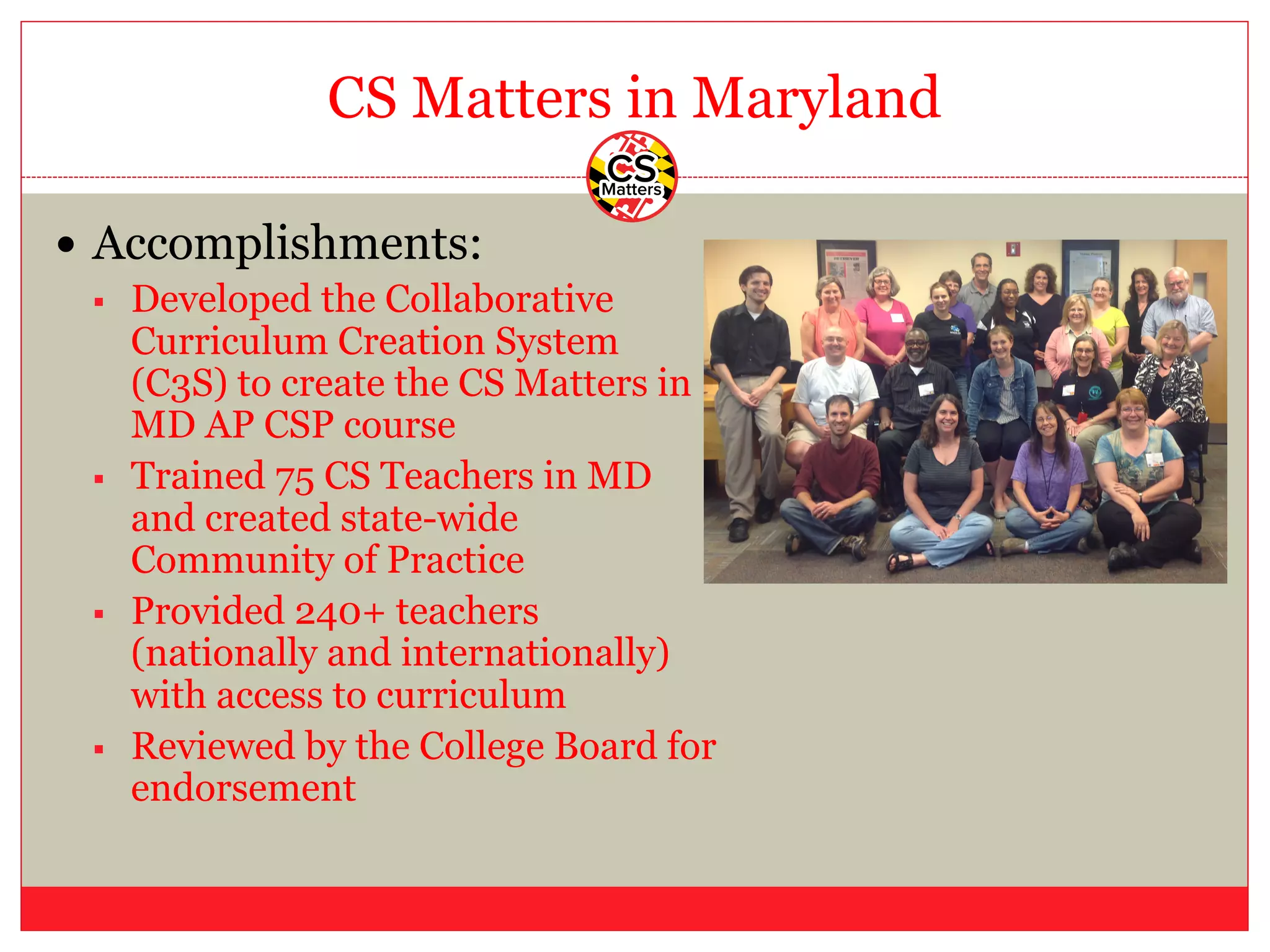
CS Matters in Maryland
— Accomplishments:
§ Developed the Collaborative
Curriculum Creation System
(C3S) to create the CS Matters in
MD AP CSP course
§ Trained 75 CS Teachers in MD
and created state-wide
Community of Practice
§ Provided 240+ teachers
(nationally and internationally)
with access to curriculum
§ Reviewed by the College Board for
endorsement
CS Matters in Maryland
— Partnership networks:
§ Steering committee members
(35+ from MSDE, school
systems, universities, industry,
and nonprofits)
§ Maryland Chapter of Computer
Science Teachers Association
(hundreds)
§ Summit and other event
attendees (hundreds)
§ State CS Education Contact
Database (over 1,000)
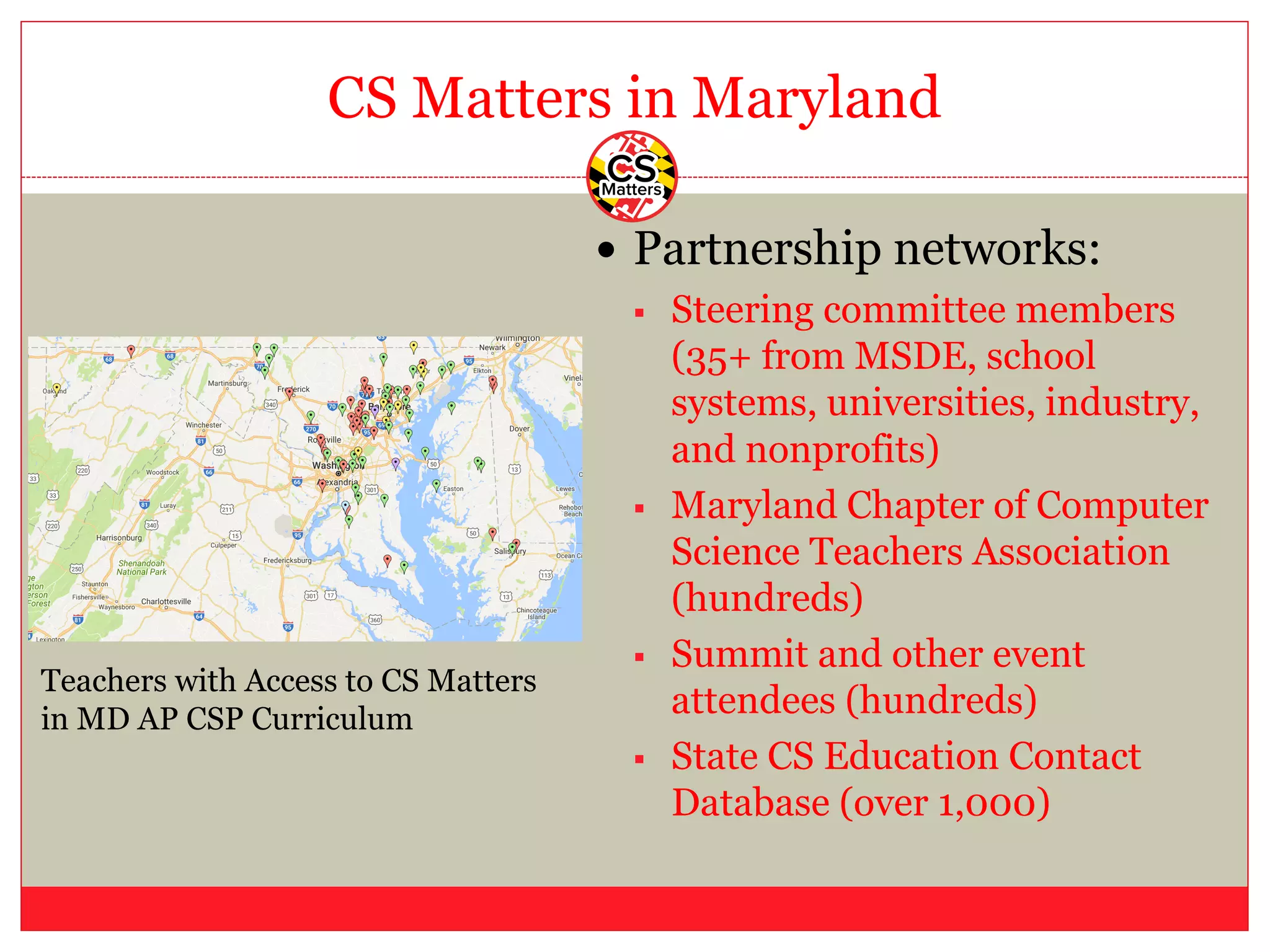
Teachers with Access to CS Matters
in MD AP CSP Curriculum
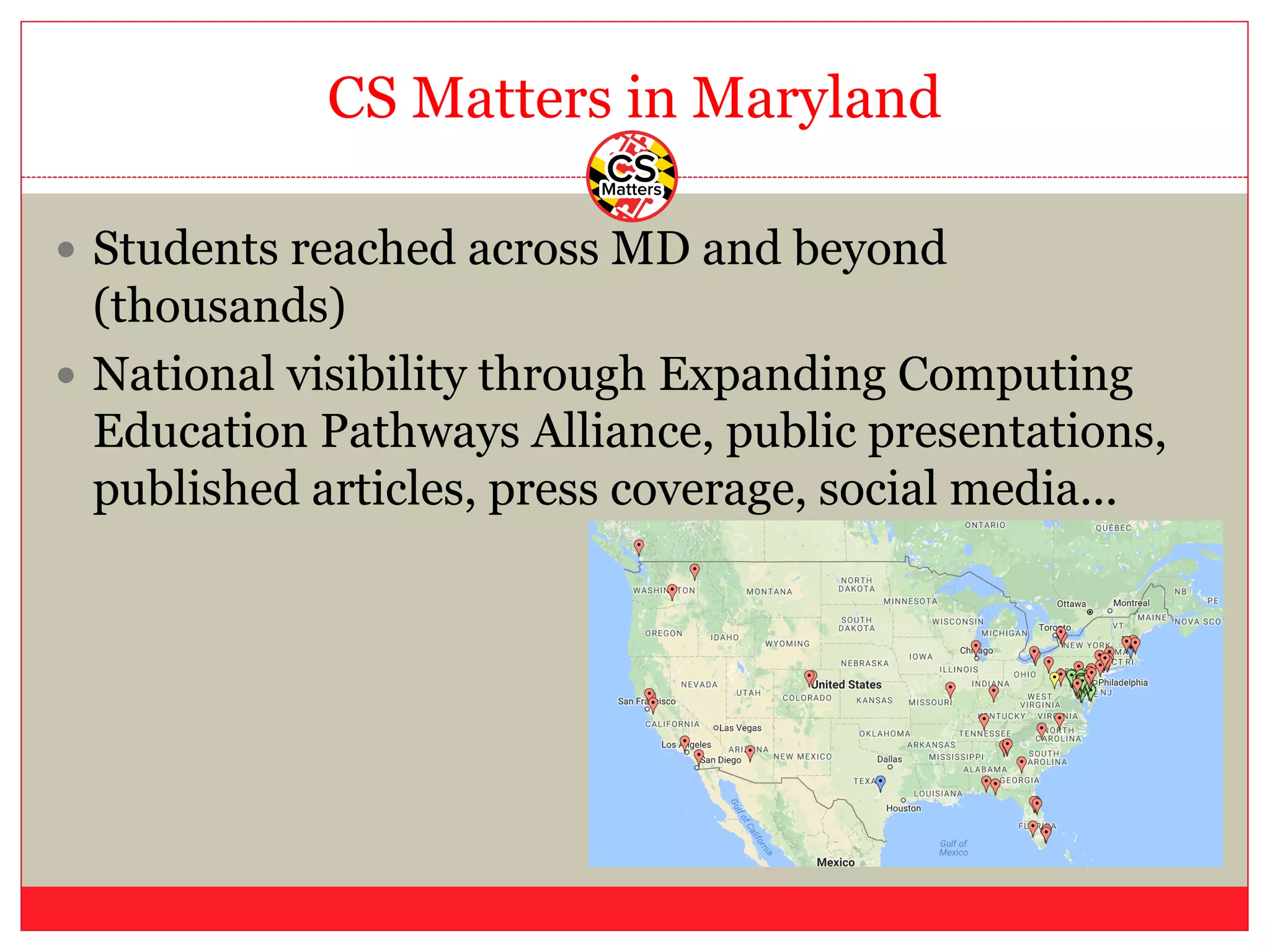
CS Matters in Maryland
— Students reached across MD and beyond
(thousands)
— National visibility through Expanding Computing
Education Pathways Alliance, public presentations,
published articles, press coverage, social media...
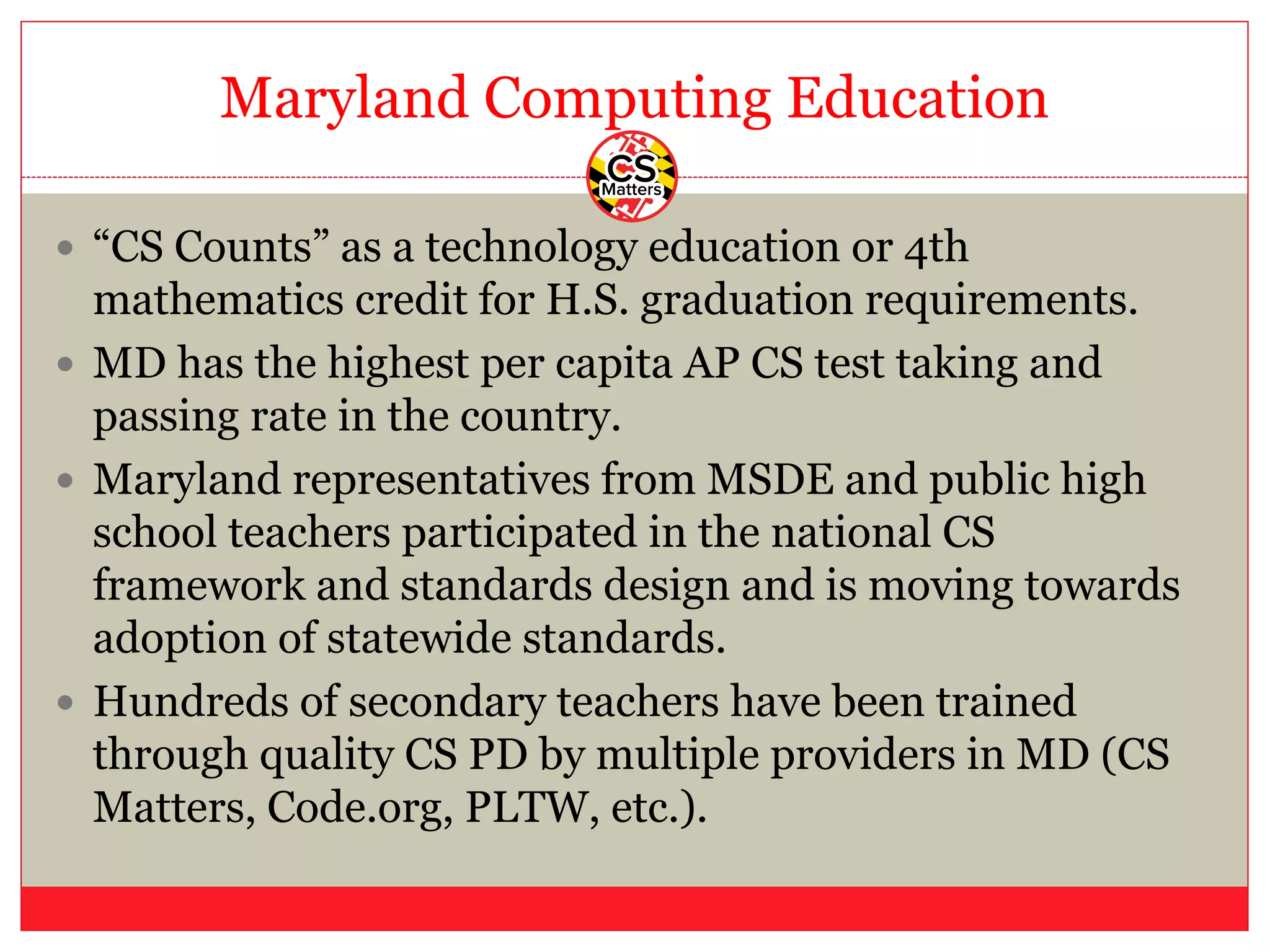
Maryland Computing Education
— “CS Counts” as a technology education or 4th
mathematics credit for H.S. graduation requirements.
— MD has the highest per capita AP CS test taking and
passing rate in the country.
— Maryland representatives from MSDE and public high
school teachers participated in the national CS
framework and standards design and is moving towards
adoption of statewide standards.
— Hundreds of secondary teachers have been trained
through quality CS PD by multiple providers in MD (CS
Matters, Code.org, PLTW, etc.).
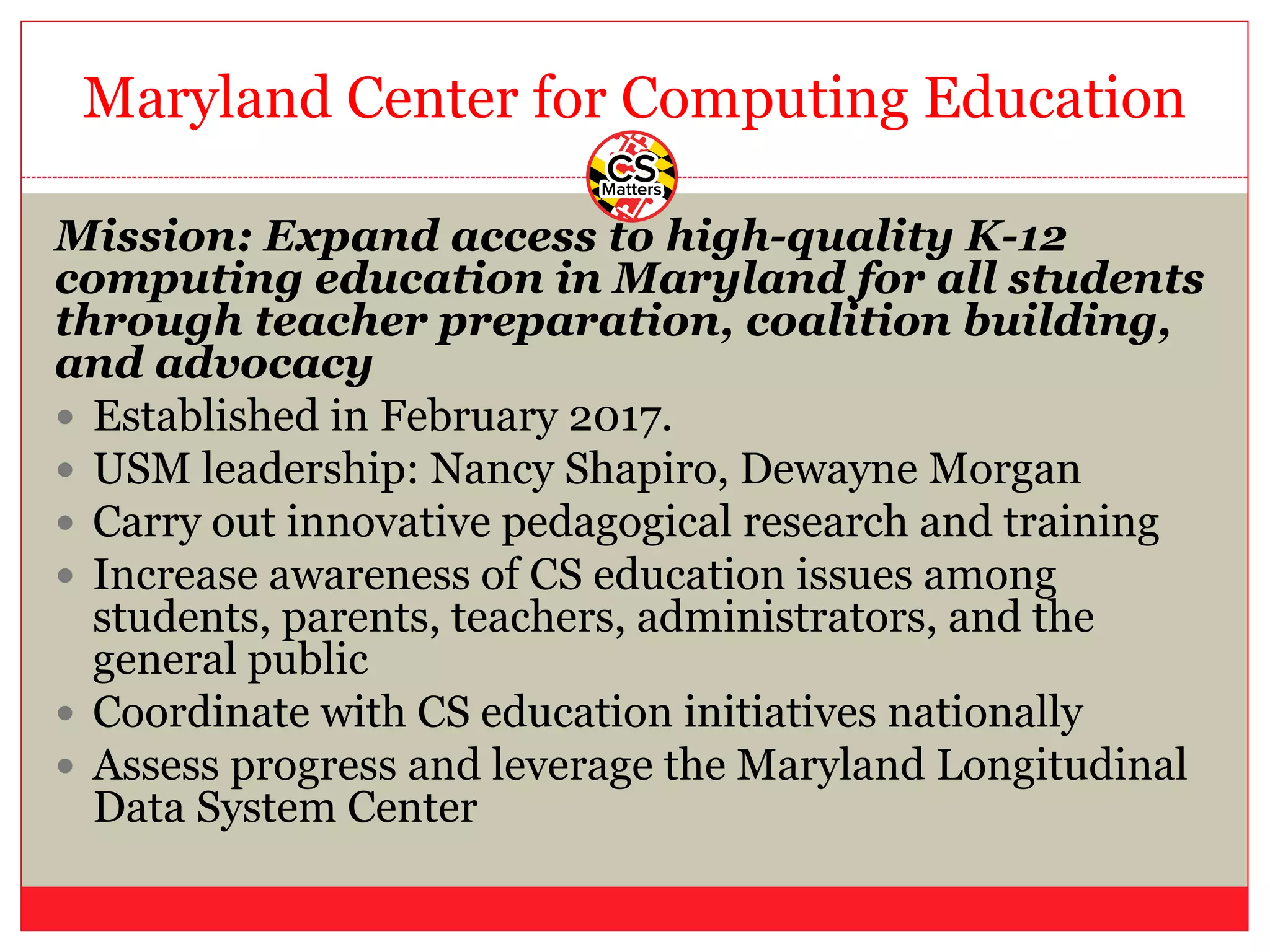
Maryland Center for Computing Education
Mission: Expand access to high-quality K-12
computing education in Maryland for all students
through teacher preparation, coalition building,
and advocacy
— Established in February 2017.
— USM leadership: Nancy Shapiro, Dewayne Morgan
— Carry out innovative pedagogical research and training
— Increase awareness of CS education issues among
students, parents, teachers, administrators, and the
general public
— Coordinate with CS education initiatives nationally
— Assess progress and leverage the Maryland Longitudinal
Data System Center
Your	turn!	Suggested	Questions
• Do	you	see	the	"CS	for	All"	effort	changing	under	President	Trump's	
administration?
• Some	Universities	are	starting	CS	teacher	professional	learning	at	the	
undergraduate	level	("pre-service").	What	role	(if	any)	do	you	see	CS	
departments	playing	in	teacher	development	at	the	undergraduate	
level?
• How	can	CS	departments	help	in	getting	CS	education	to	high	school	
students	in	rural	communities?
• What	role	should	CS	departments	play	in	developing	the	research	
base	to	support	the	"CS	for	All"	effort?

The Role of CS Departments in The US President’s “CS for All” Initiative: Panel from SIGCSE 2017