1Creating shared commitmentin the political contextDr. Jeff ConklinCogNexus Institutecognexus.org
© 2010 CogNexus Institute2OverviewWicked ProblemsOpportunity Driven Problem SolvingSocial ComplexityTaming the ProblemTackling the ProblemDialogueShared Understanding
© 2010 CogNexus Institute3Utah History Fair, Utah State University
© 2010 CogNexus Institute4History“Wicked problems” introduced by Horst Rittel“On the Planning Crisis: Systems Analysis of the ‘First and Second Generations”, 1972“Dilemmas in a General Theory of Planning”, 1973 (with M. Webber)10 defining characteristicsE.g. “1. There is no definitive formulation of a wicked problem”‘Wicked’ = malignant, vicious, tricky, aggressive‘Tame’ = benign, stable, straightforward, docile
© 2010 CogNexus Institute5History“Wicked” reflects Rittel’s concern with ethics.  “[It is unethical] for the planner to treat a wicked problem as though it were a tame one, or to tame a wicked problem prematurely, or to refuse to recognize the inherent wickedness of social problems.” (Rittel & Webber, Dilemmas, p. 161)
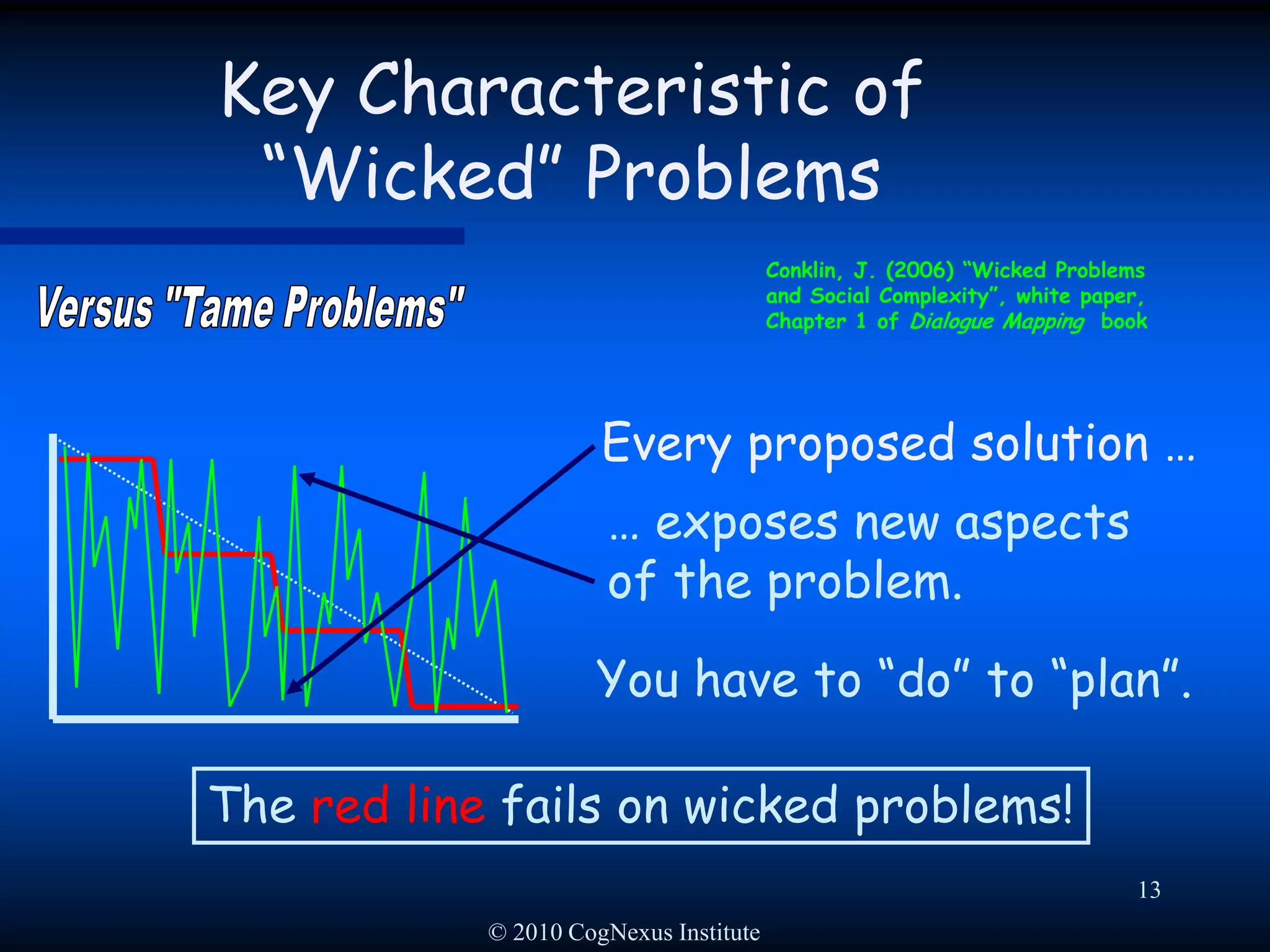
© 2010 CogNexus Institute6Definition of Wicked ProblemsEach potential solution illuminates new aspects of the wicked problem.Wicked problems have no stopping rule. Solutions to wicked problems are not right or wrong.Every wicked problem is essentially unique and novel. Every solution to a wicked problem is a "one-shot operation".Wicked problems have no given alternative solutions.
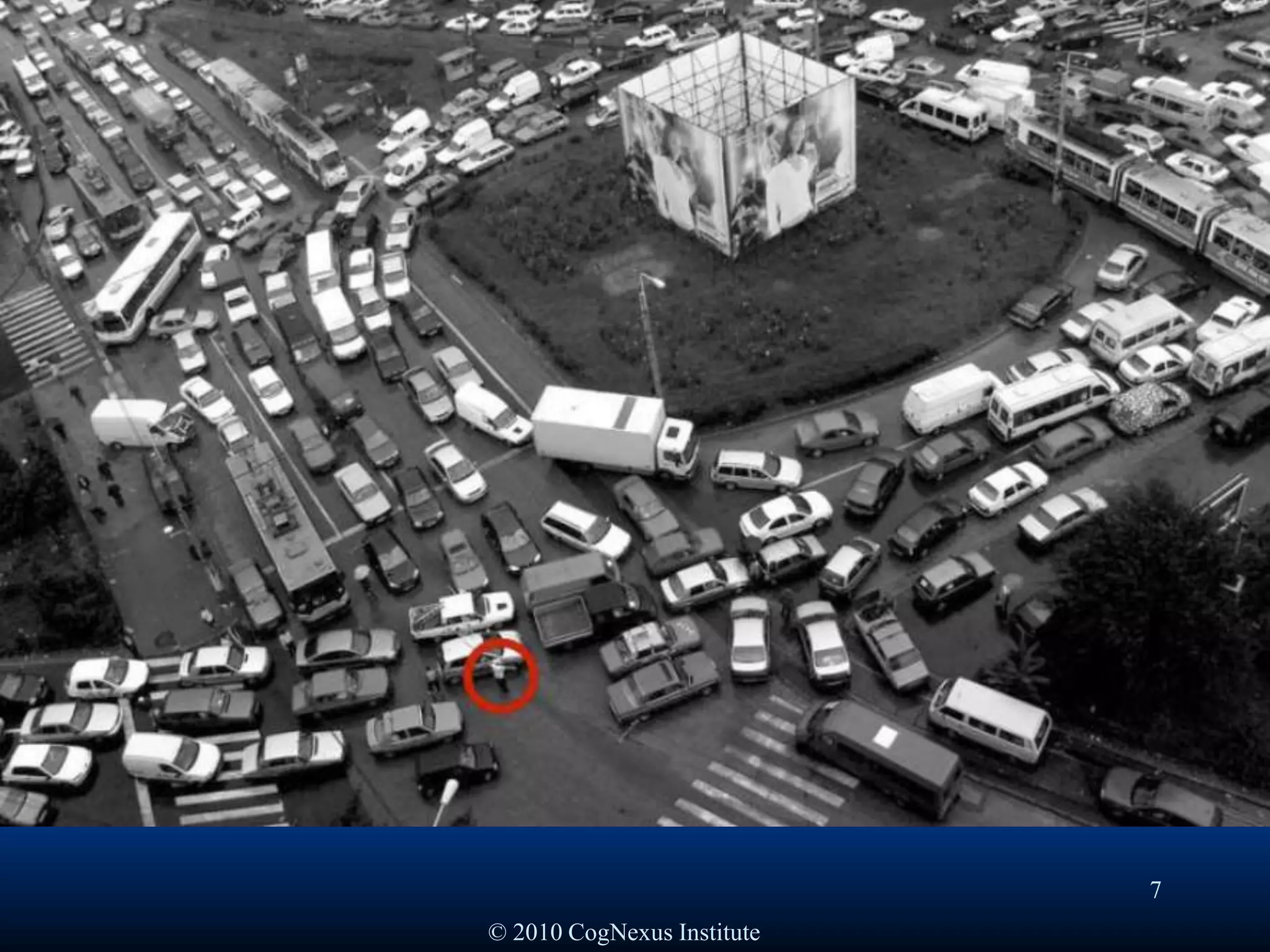
© 2010 CogNexus Institute7
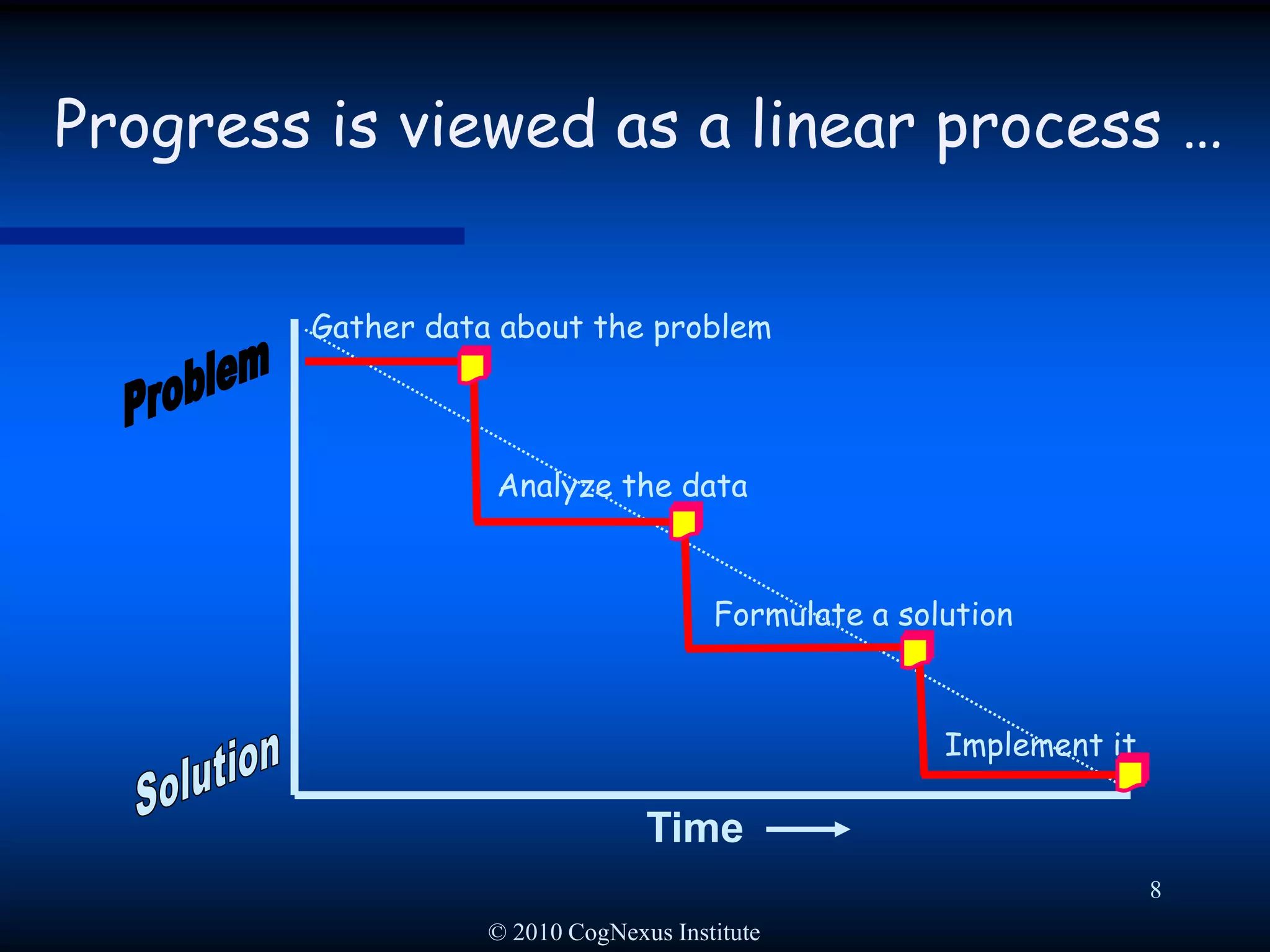
© 2010 CogNexus Institute8Gather data about the problemAnalyze the dataFormulate a solutionImplement itProgress is viewed as a linear process …ProblemSolutionTime
© 2010 CogNexus Institute9
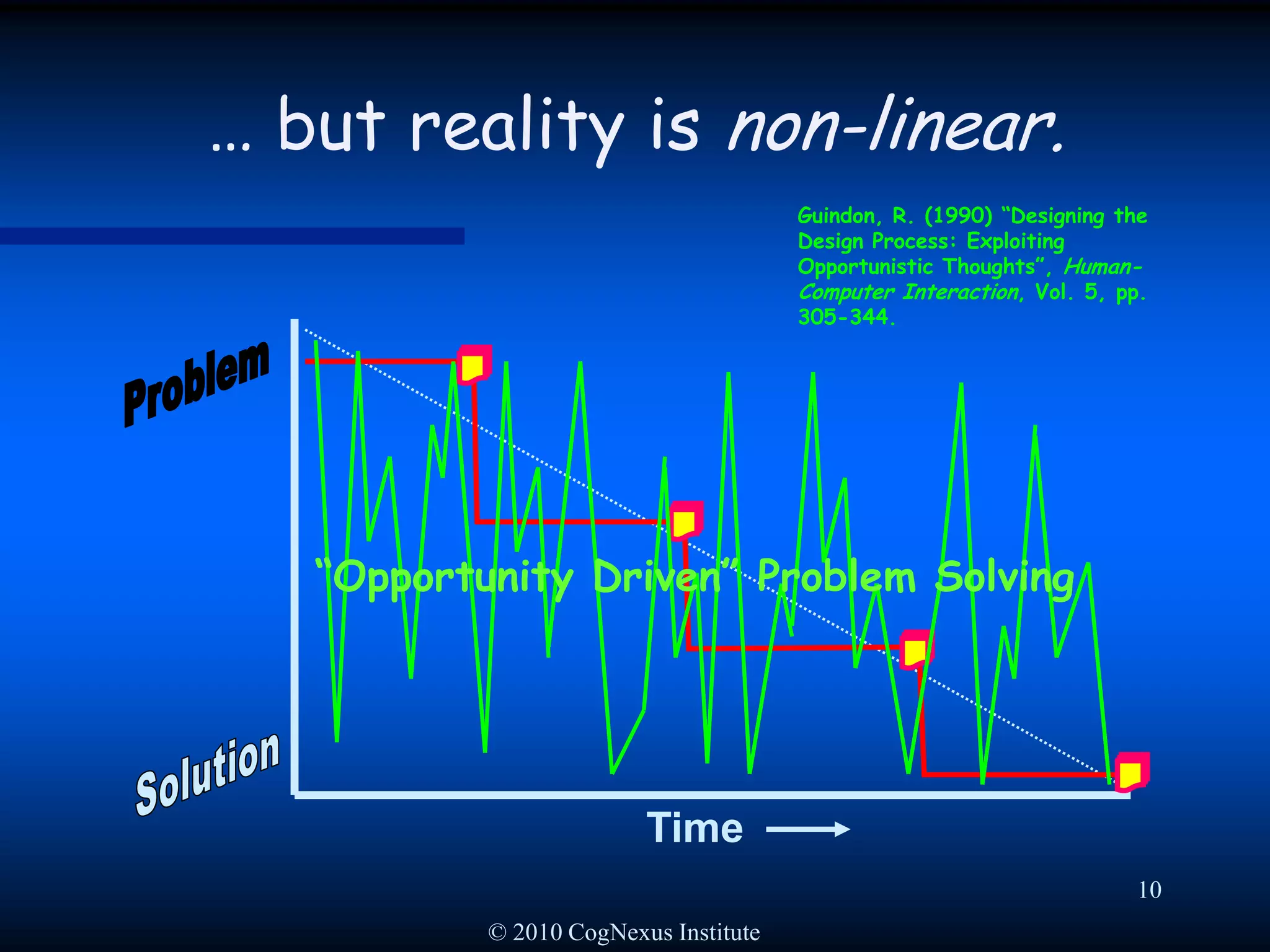
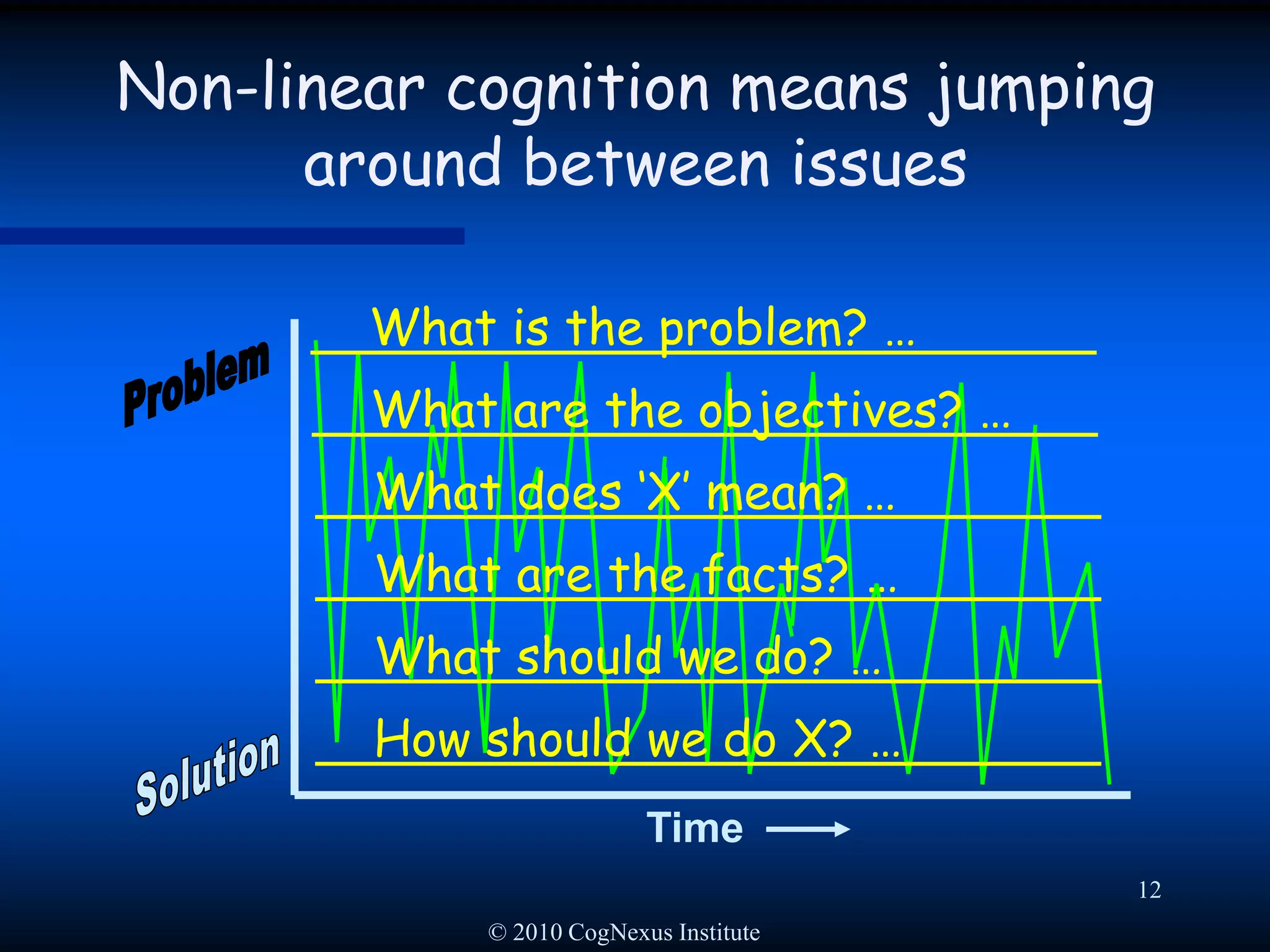
© 2010 CogNexus Institute10… but reality is non-linear.Guindon, R. (1990) “Designing the Design Process: Exploiting Opportunistic Thoughts”, Human-Computer Interaction, Vol. 5, pp. 305-344.Problem“Opportunity Driven” Problem SolvingSolutionTime
© 2010 CogNexus Institute11 Late efforts to understand the real problem
Early attempts at solutions
  Experiments
  Prototypes
  HunchesHow We Humans Actually Approach Novel Problems Design process is non-linear, 	‘Opportunity-Driven’© 2010 CogNexus Institute12What is the problem? …What are the objectives? …What does ‘X’ mean? …What should we do? …What are the facts? …How should we do X? …Non-linear cognition means jumping around between issuesProblemSolutionTime
© 2010 CogNexus Institute13Key Characteristic of “Wicked” ProblemsThe red line fails on wicked problems!Conklin, J. (2006) “Wicked Problems and Social Complexity”, white paper, Chapter 1 of Dialogue Mapping  bookVersus "Tame Problems"Every proposed solution …… exposes new aspects of the problem.You have to “do” to “plan”.
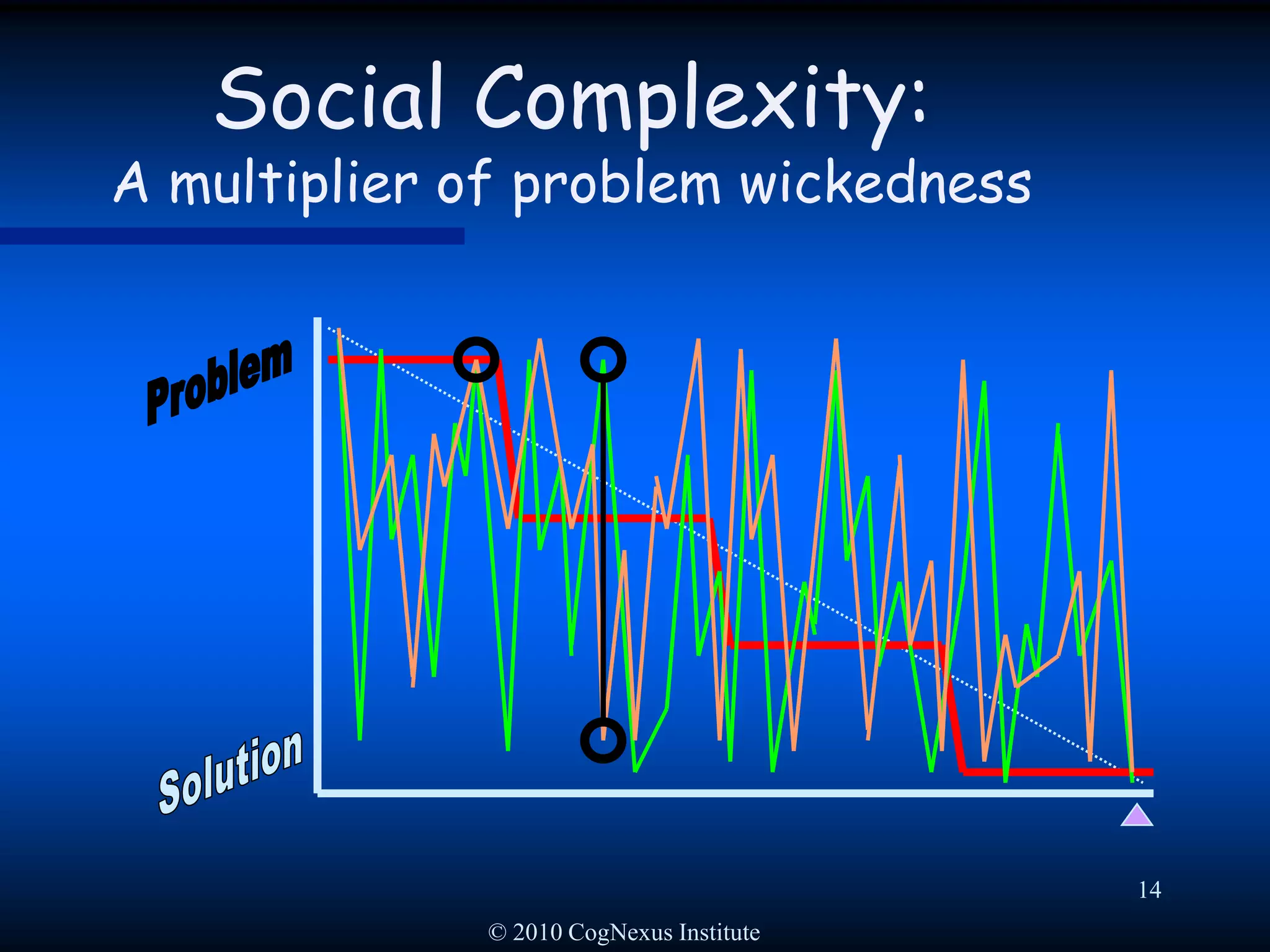
© 2010 CogNexus Institute14Social Complexity:A multiplier of problem wickednessProblemSolution
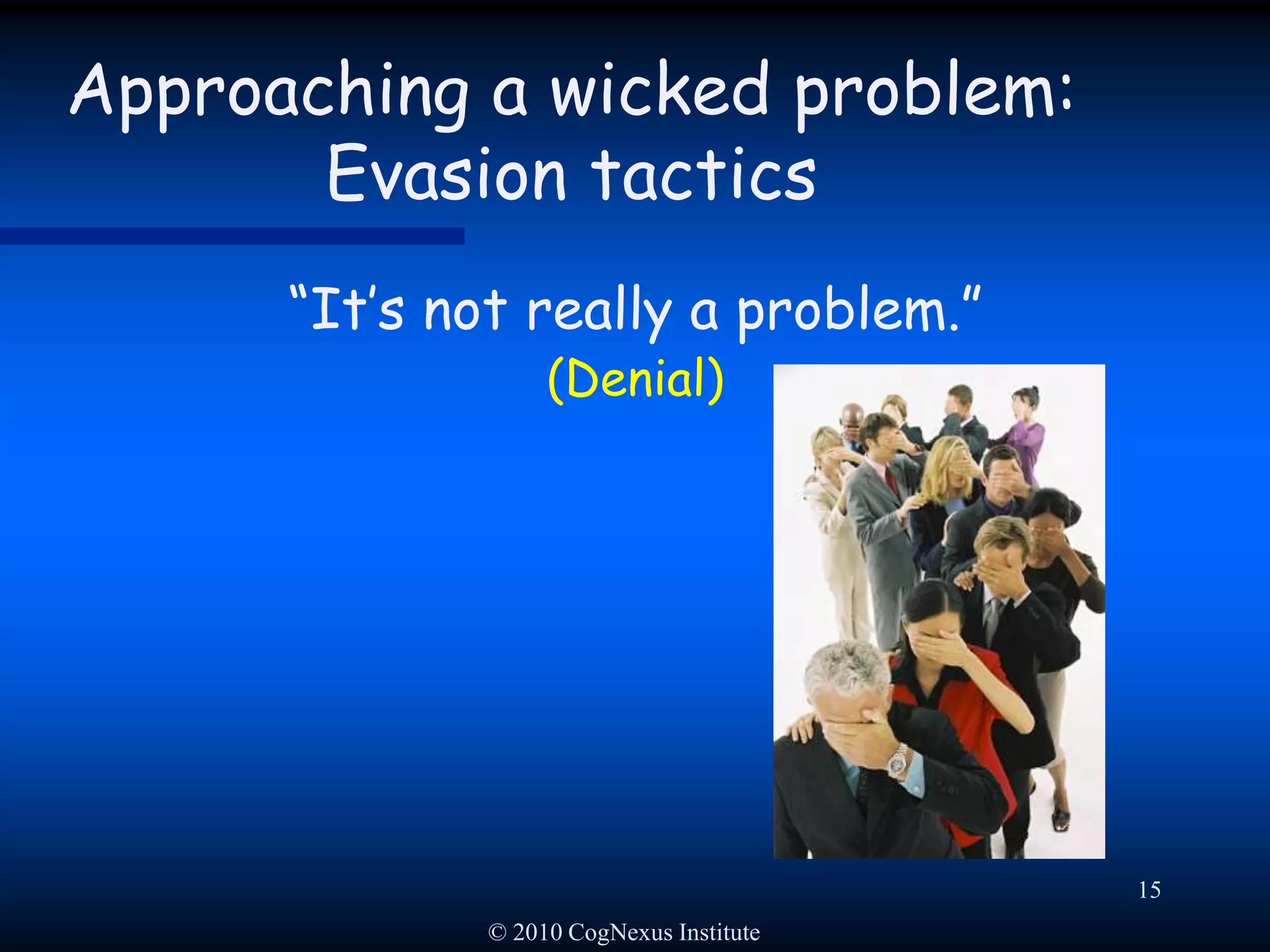
© 2010 CogNexus Institute15Approaching a wicked problem: Evasion tactics“It’s not really a problem.”(Denial)
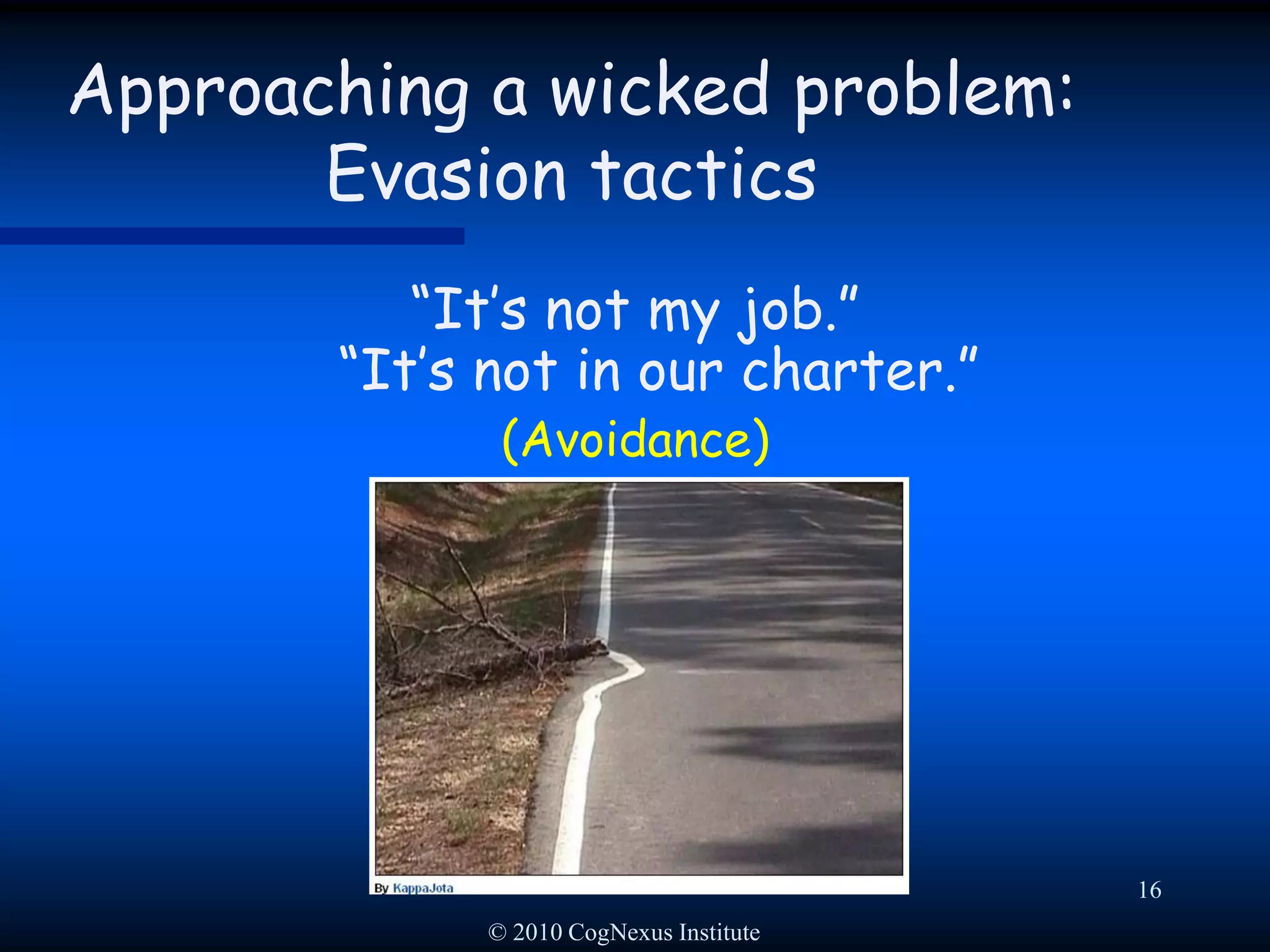
© 2010 CogNexus Institute16Approaching a wicked problem: Evasion tactics“It’s not my job.”“It’s not in our charter.”(Avoidance)
© 2010 CogNexus Institute17Approaching a wicked problem: Evasion tactics“We understand the problem, and we’ve already solved it!”(Engineering)
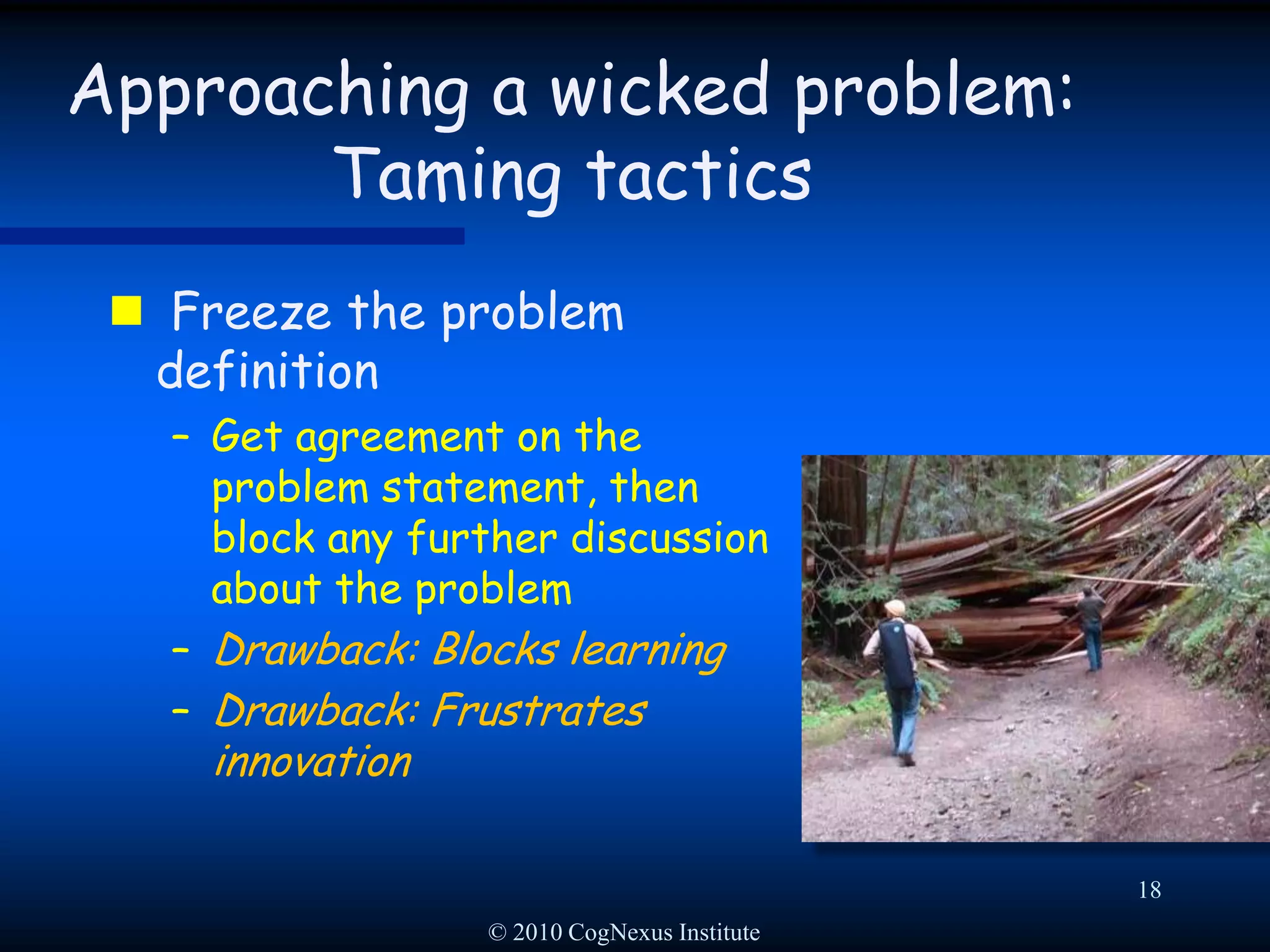
© 2010 CogNexus Institute18Approaching a wicked problem: Taming tactics Freeze the problem definitionGet agreement on the problem statement, then block any further discussion about the problemDrawback: Blocks learningDrawback: Frustrates innovation
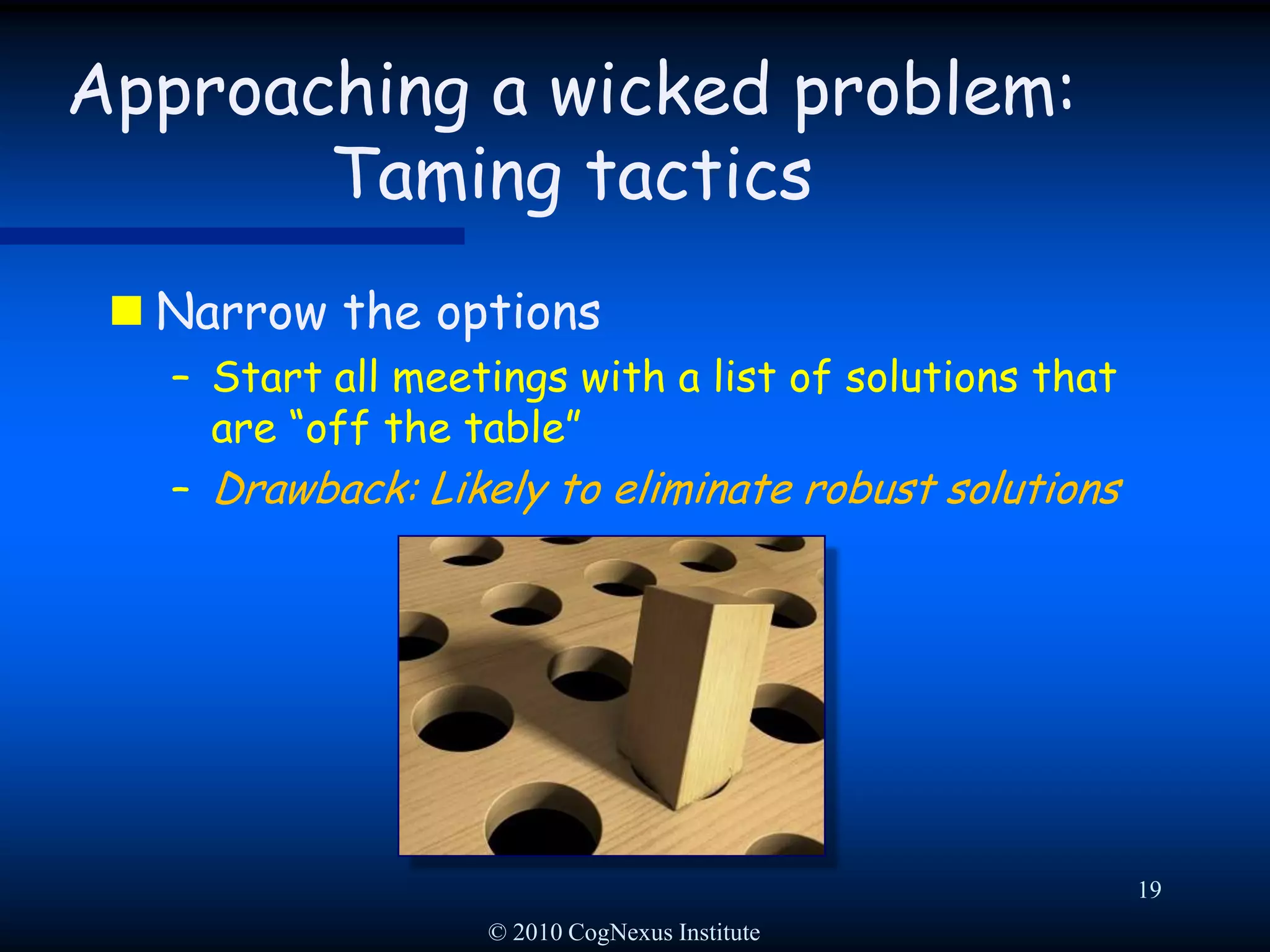
© 2010 CogNexus Institute19Approaching a wicked problem: Taming tacticsNarrow the optionsStart all meetings with a list of solutions that are “off the table”Drawback: Likely to eliminate robust solutions
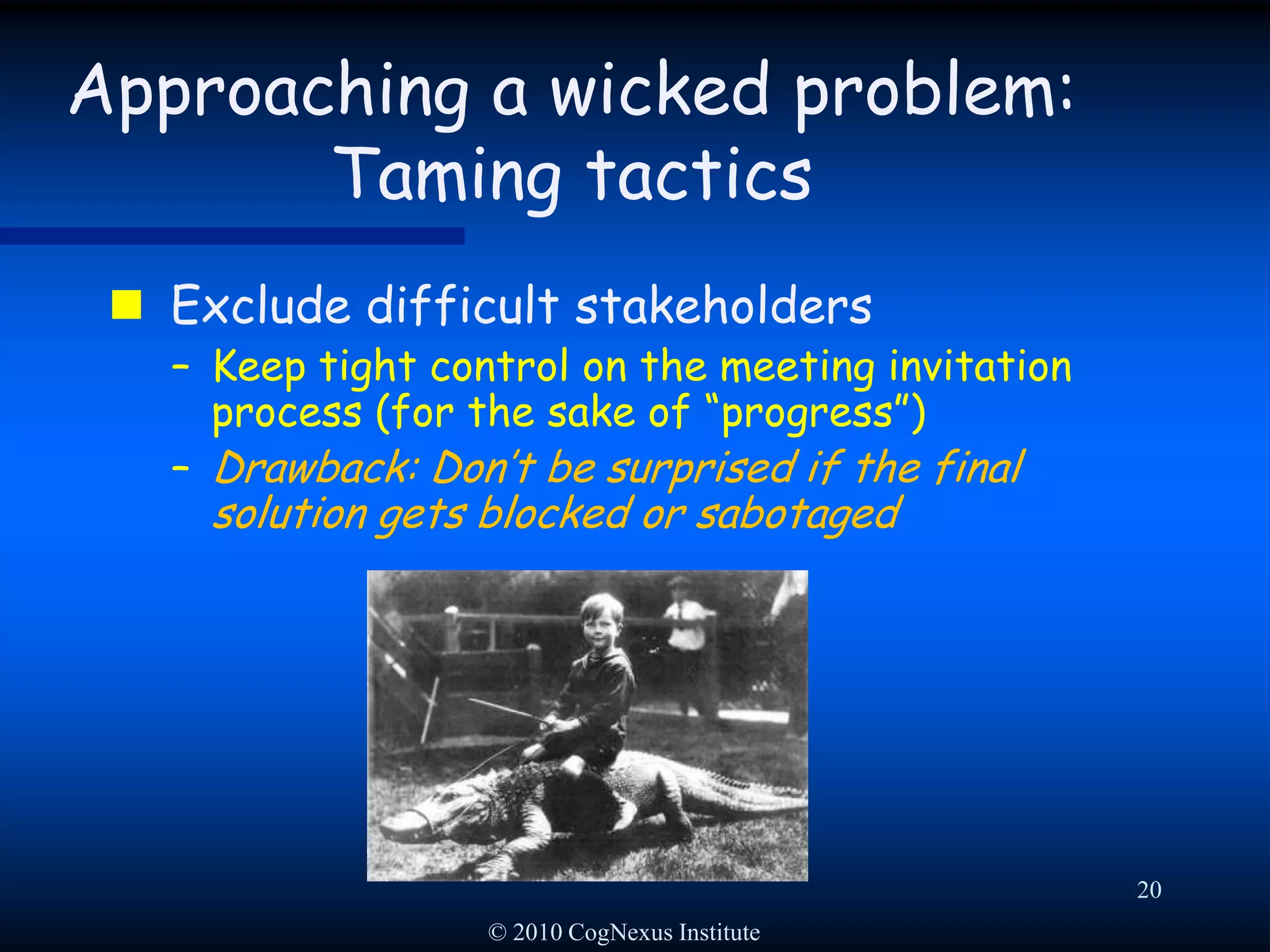
© 2010 CogNexus Institute20Approaching a wicked problem: Taming tactics Exclude difficult stakeholdersKeep tight control on the meeting invitation process (for the sake of “progress”)Drawback: Don’t be surprised if the final solution gets blocked or sabotaged
© 2010 CogNexus Institute21Approaching a wicked problem: Taming tacticsRefocus on a smaller tame problemPick a sub-problem that you’re confident you can solveDrawback:  Early success, followed by ugly unintended consequencesDrawback: The problem becomes more wicked
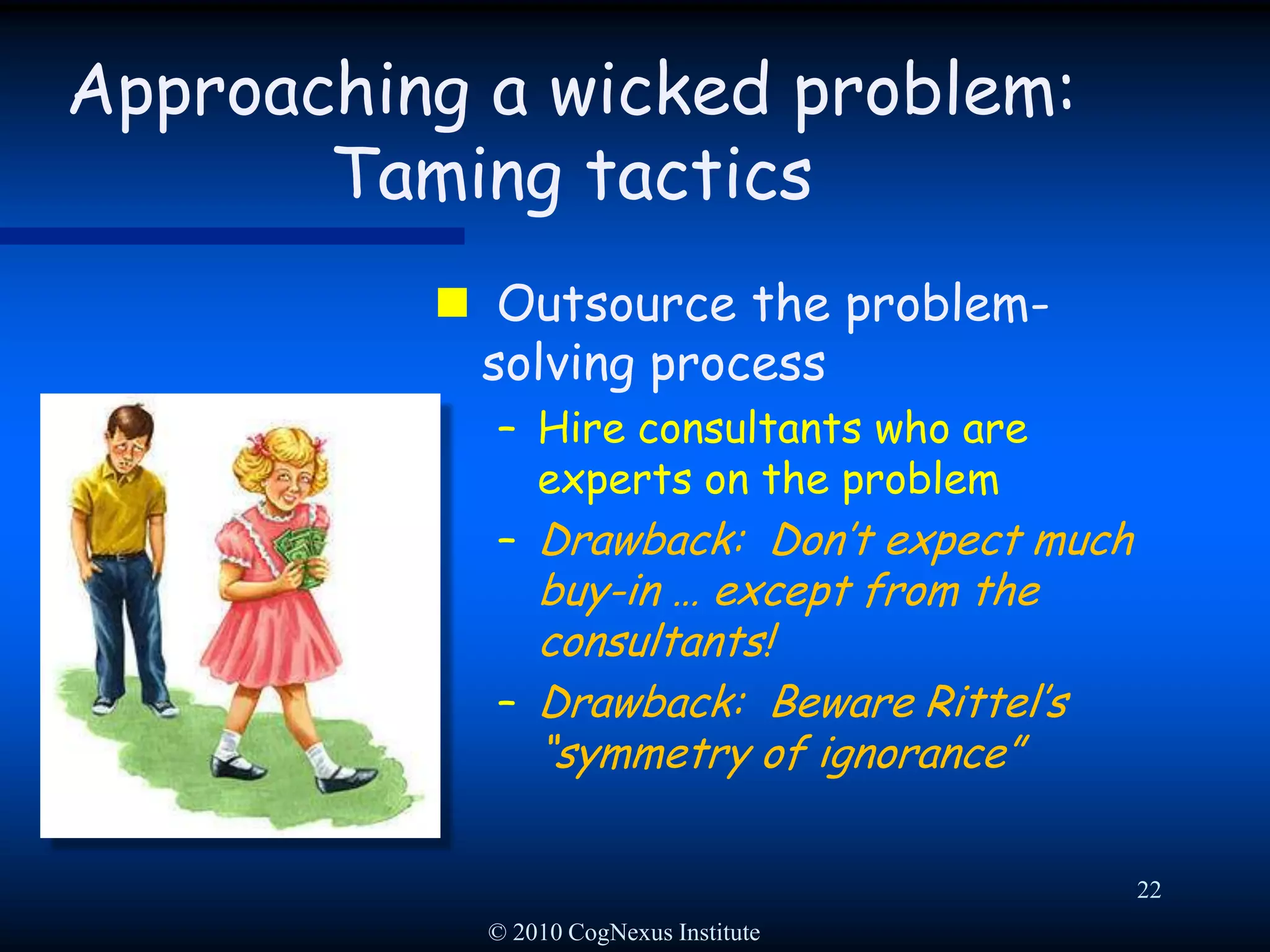
© 2010 CogNexus Institute22Approaching a wicked problem: Taming tactics Outsource the problem-solving processHire consultants who are experts on the problemDrawback:  Don’t expect much buy-in … except from the consultants!Drawback:  Beware Rittel’s “symmetry of ignorance”
© 2010 CogNexus Institute23Tackling Wicked Problems
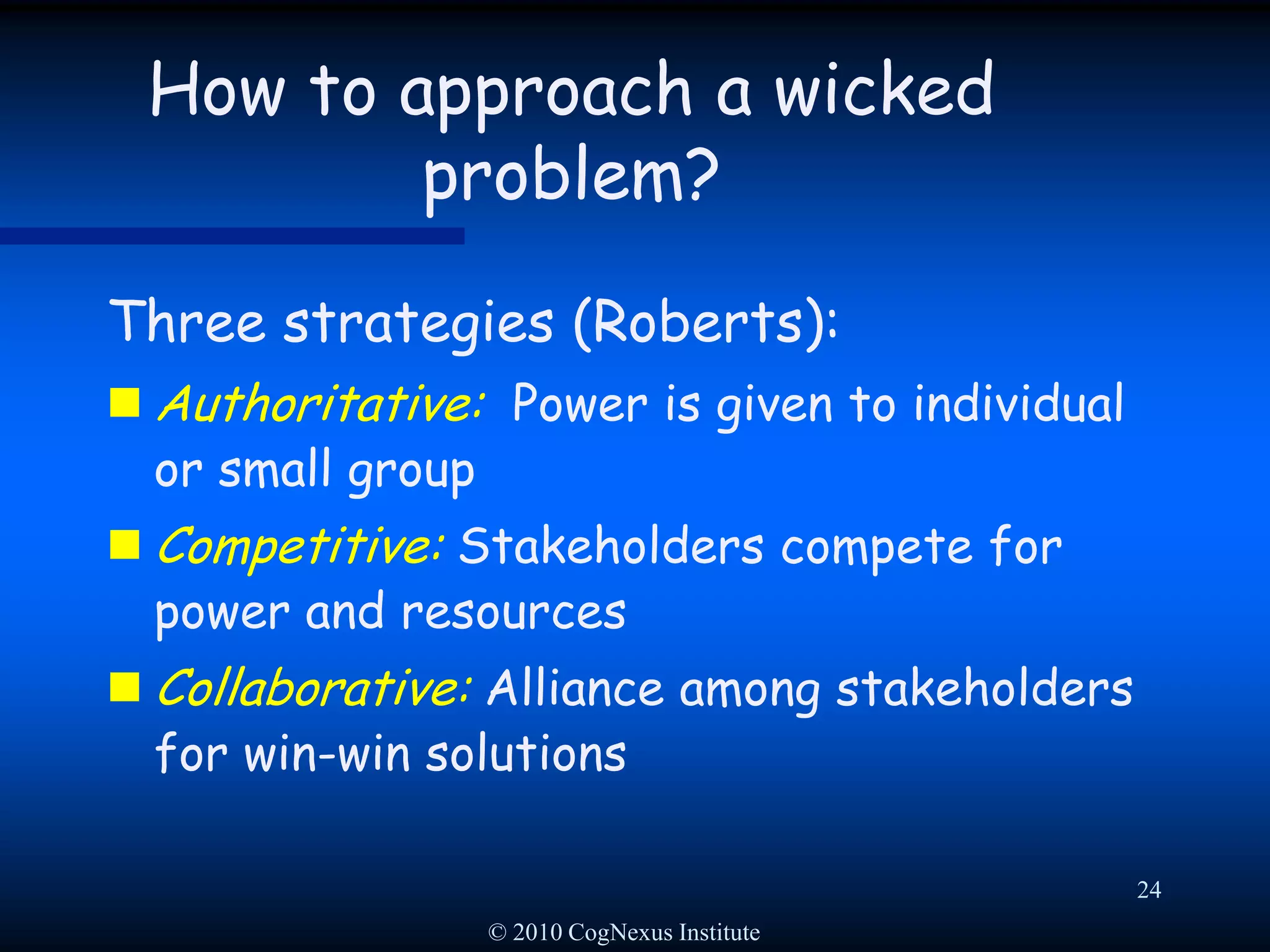
© 2010 CogNexus Institute24How to approach a wicked problem?Three strategies (Roberts):Authoritative:  Power is given to individual or small groupCompetitive:Stakeholders compete for power and resourcesCollaborative:Alliance among stakeholders for win-win solutions
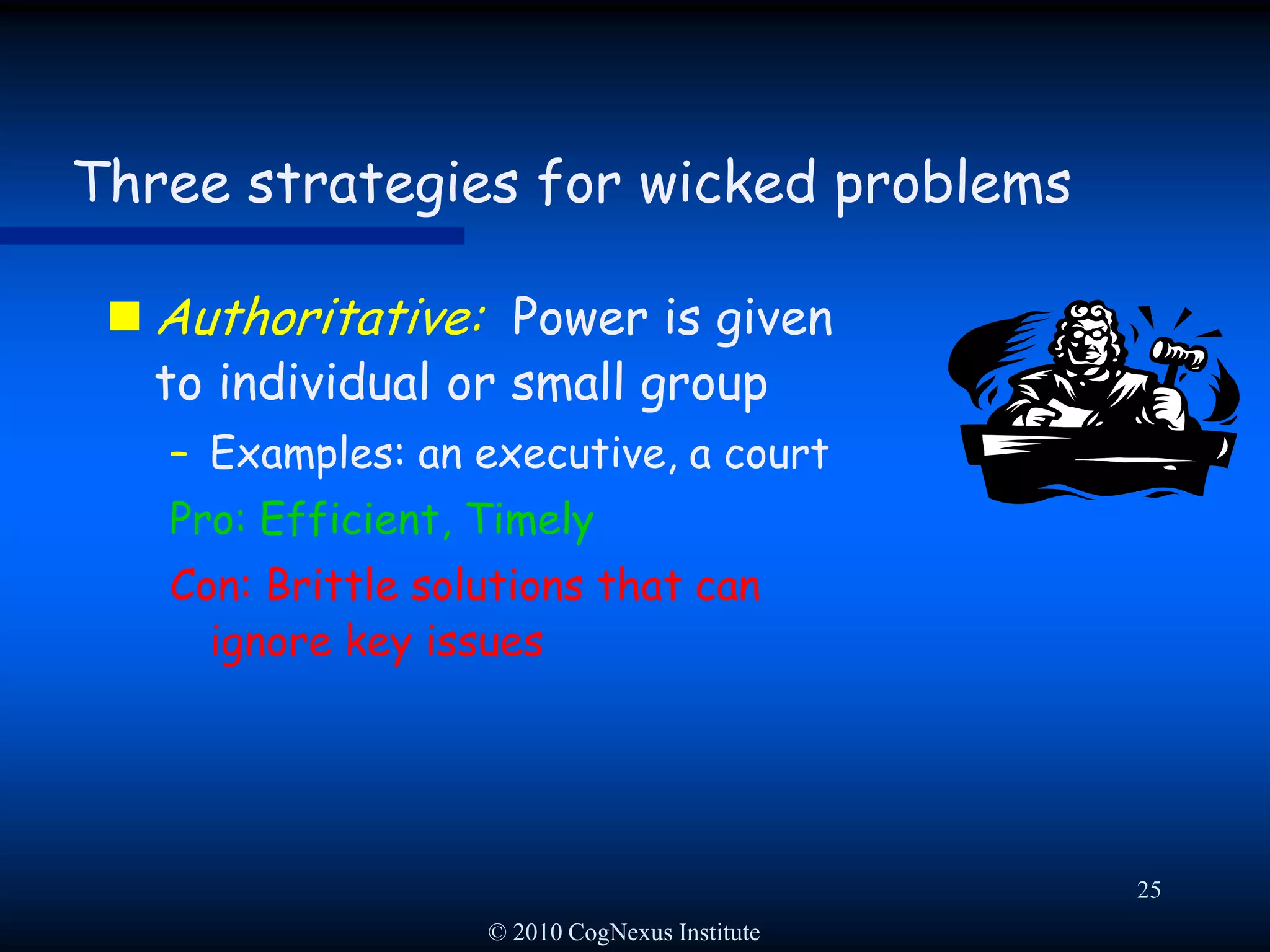
© 2010 CogNexus Institute25Three strategies for wicked problemsAuthoritative:  Power is given to individual or small group Examples: an executive, a courtPro: Efficient, TimelyCon: Brittle solutions that can ignore key issues
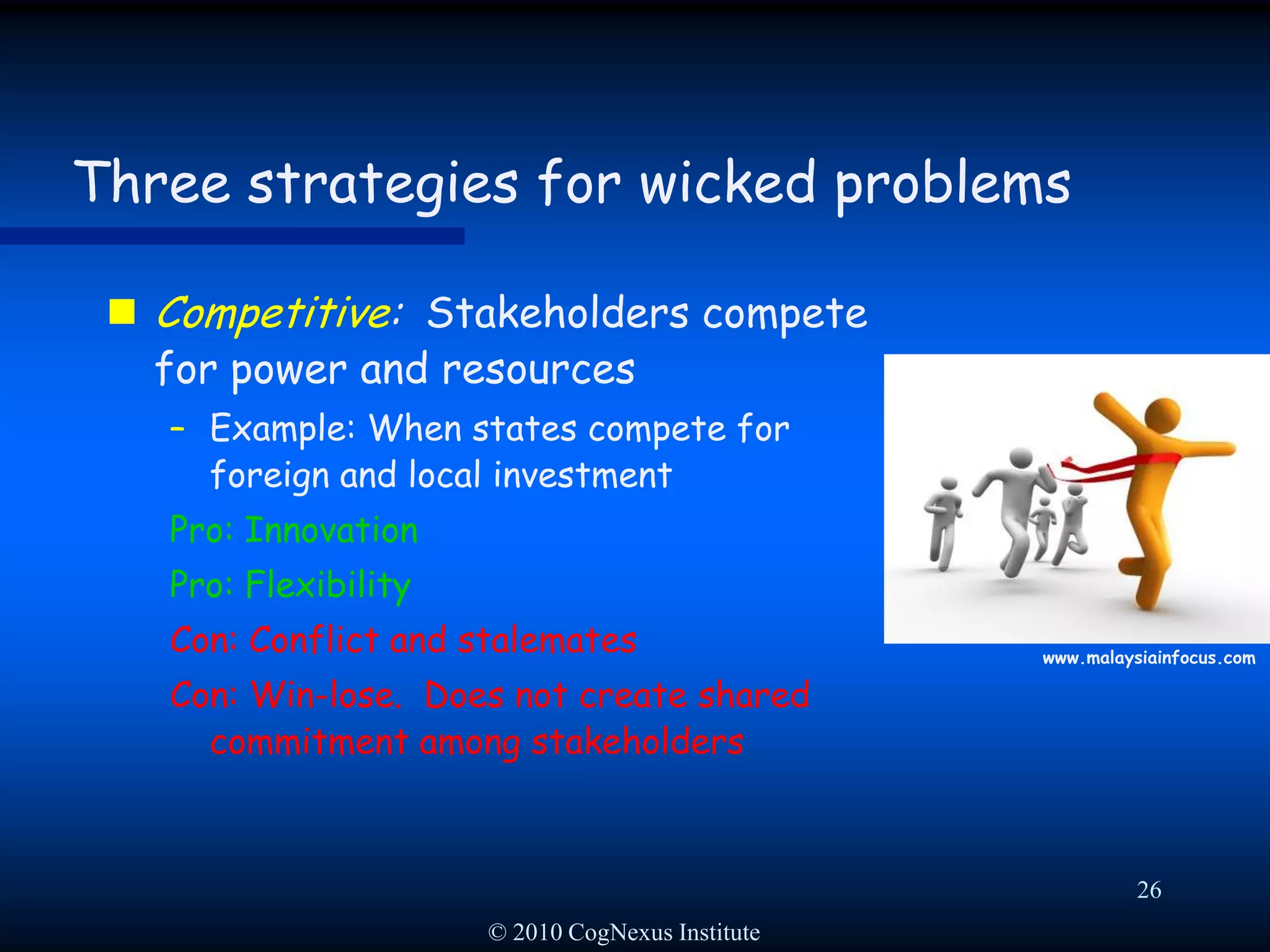
© 2010 CogNexus Institute26Three strategies for wicked problemsCompetitive:  Stakeholders compete for power and resourcesExample: When states compete for foreign and local investmentPro: InnovationPro: FlexibilityCon: Conflict and stalematesCon: Win-lose.  Does not create shared commitment among stakeholderswww.malaysiainfocus.com
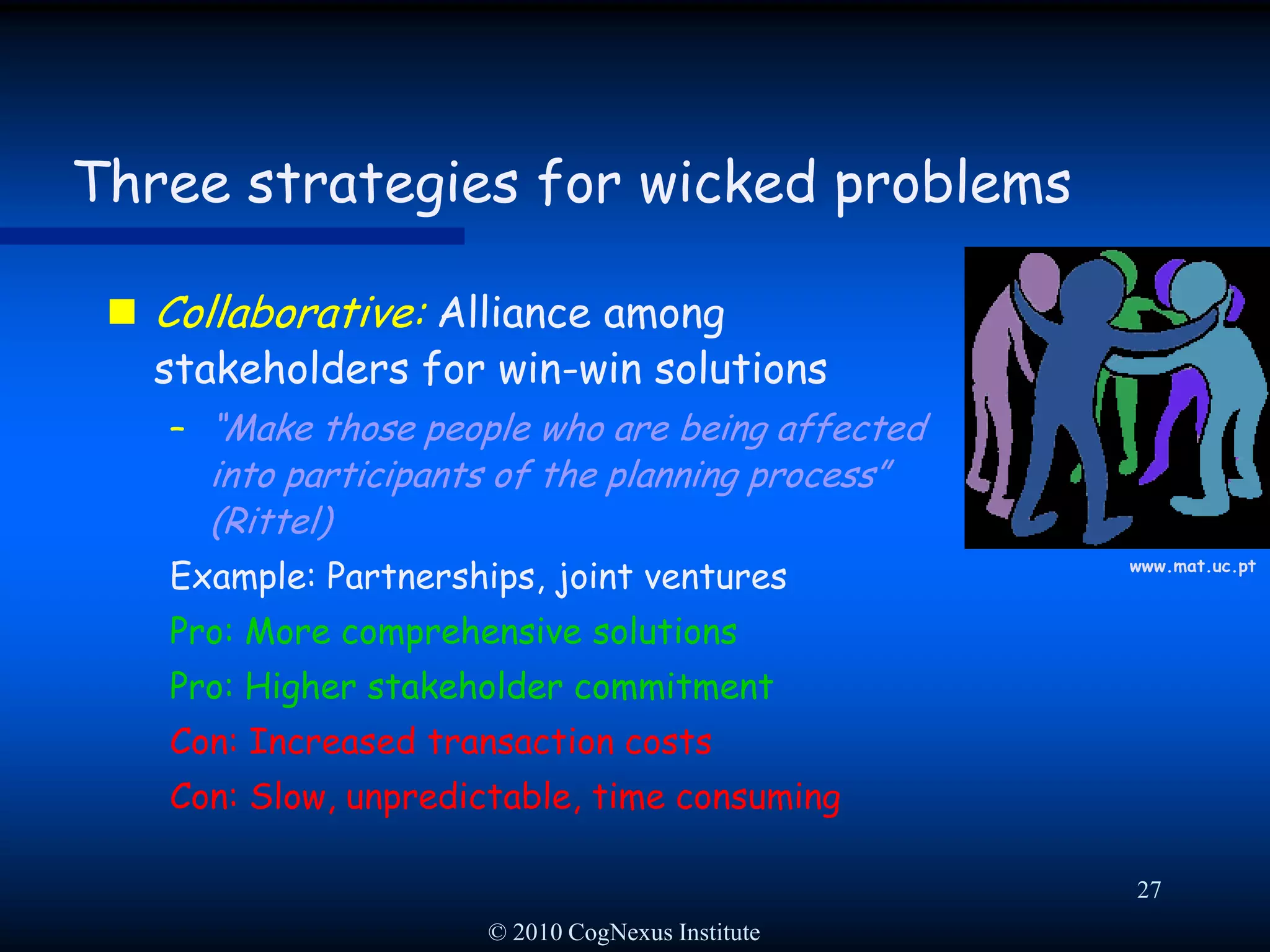
© 2010 CogNexus Institute27Three strategies for wicked problemsCollaborative:Alliance among stakeholders for win-win solutions“Make those people who are being affected into participants of the planning process” (Rittel)Example: Partnerships, joint venturesPro: More comprehensive solutionsPro: Higher stakeholder commitmentCon: Increased transaction costsCon: Slow, unpredictable, time consumingwww.mat.uc.pt
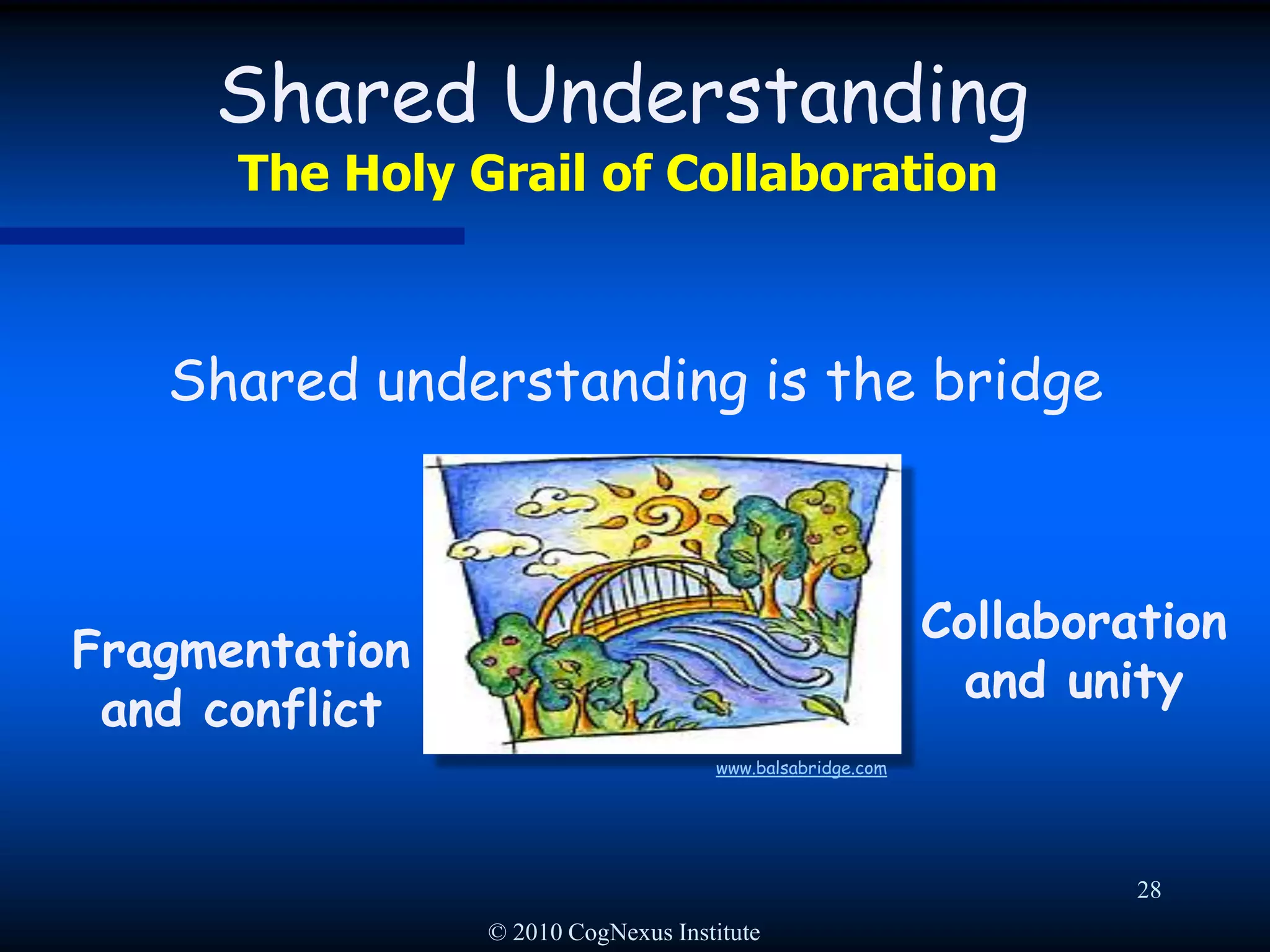
© 2010 CogNexus Institute28Shared UnderstandingThe Holy Grail of CollaborationShared understanding is the bridgeCollaboration and unityFragmentation and conflict www.balsabridge.com
© 2010 CogNexus Institute29Shared UnderstandingShared understanding … of what?Purpose and objectivesWho the stakeholders areWhat the problem isWhat the options areConstraints on the solutionDeliberation and decision process
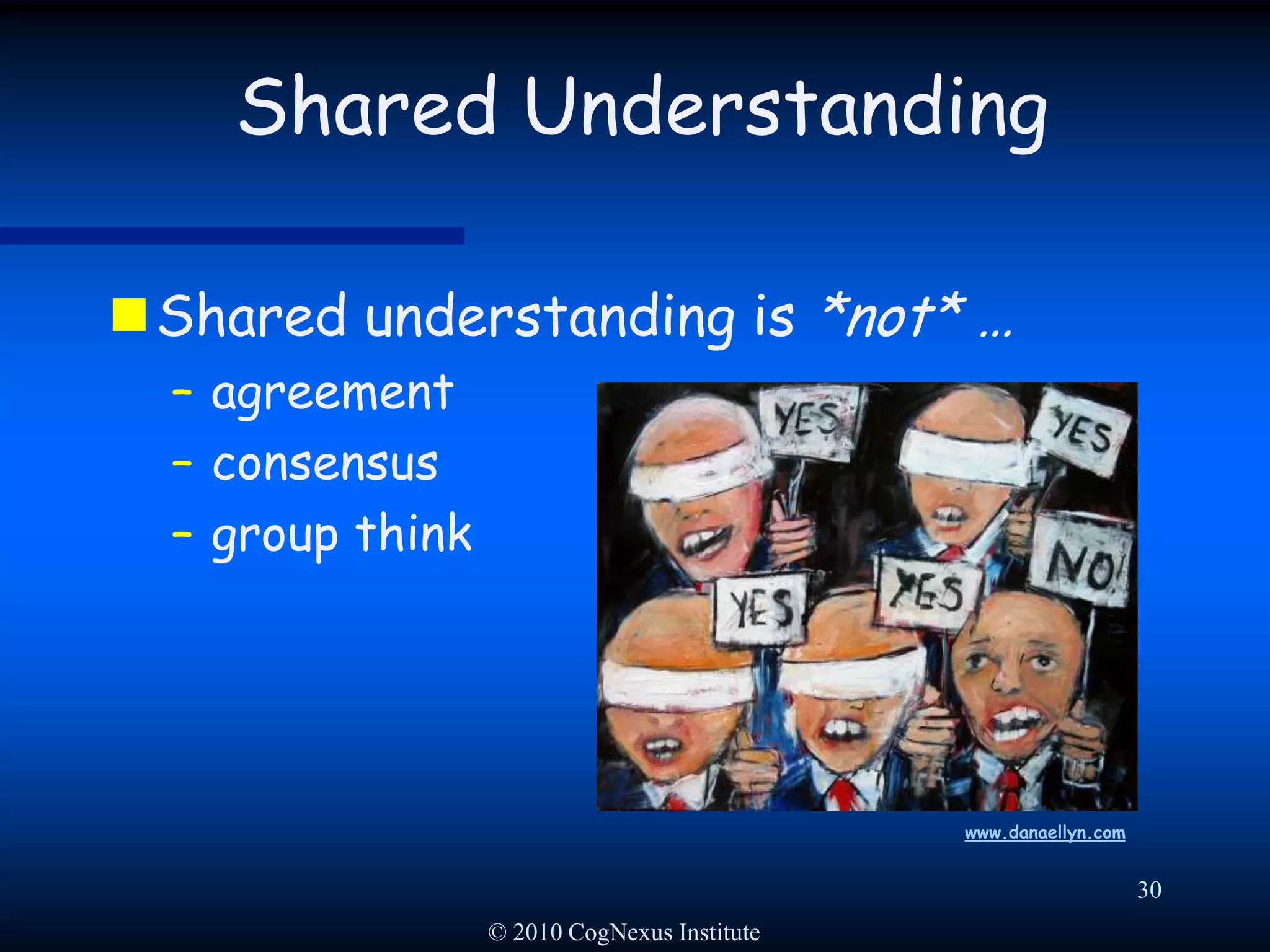
© 2010 CogNexus Institute30Shared UnderstandingShared understanding is *not* …agreementconsensusgroup thinkwww.danaellyn.com
© 2010 CogNexus Institute31Shared UnderstandingWhat is shared is the range of perspectives among the stakeholdersStakeholders understand what the others needEach perspective is held as valid (if not “correct”)We agree to disagree
© 2010 CogNexus Institute32How to Create Shared UnderstandingDialogueListeningTransparency
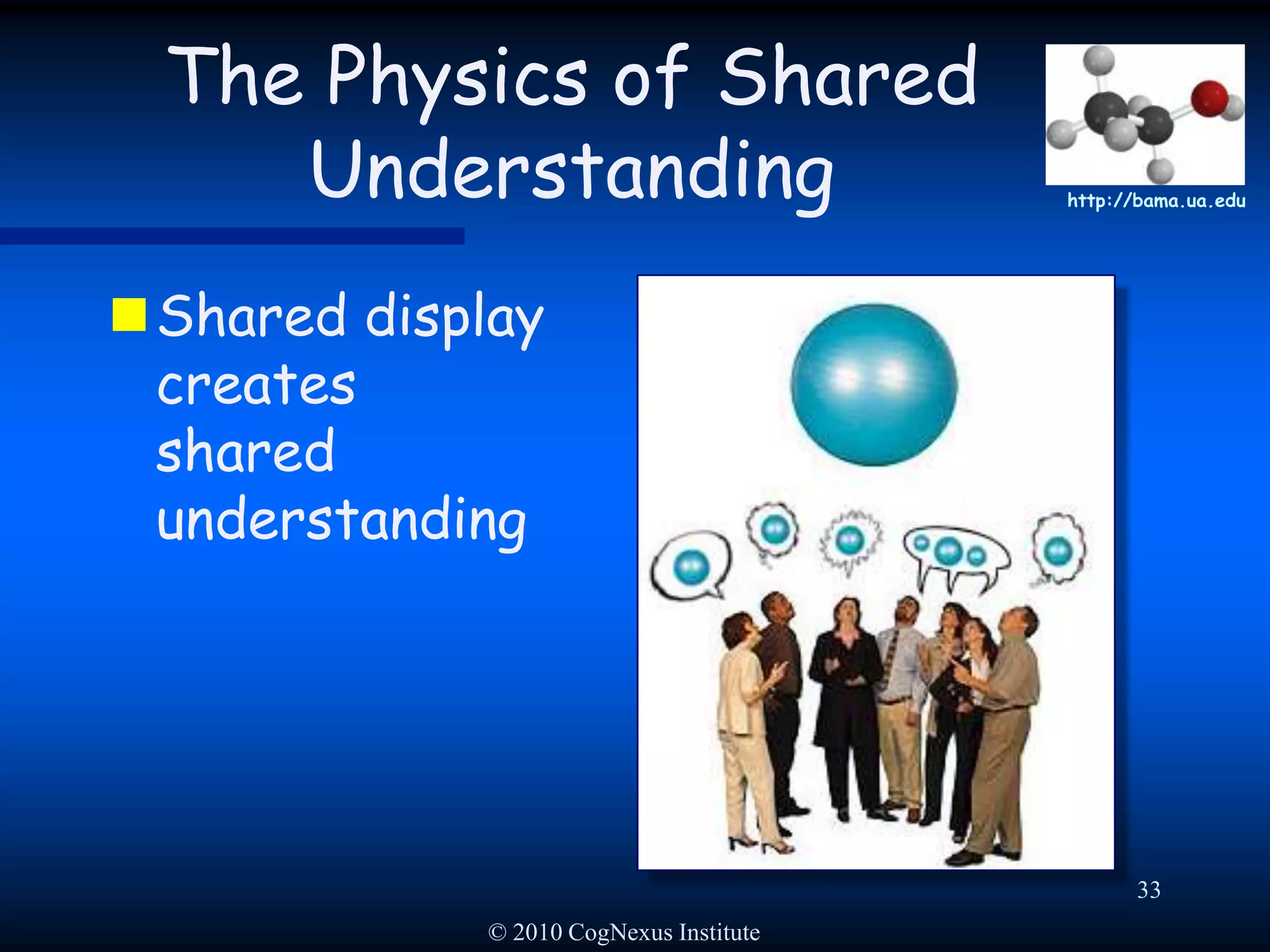
© 2010 CogNexus Institute33The Physics of Shared UnderstandingShared display creates shared understandinghttp://bama.ua.edu

Conklin

  • 1.
    1Creating shared commitmentinthe political contextDr. Jeff ConklinCogNexus Institutecognexus.org
  • 2.
    © 2010 CogNexusInstitute2OverviewWicked ProblemsOpportunity Driven Problem SolvingSocial ComplexityTaming the ProblemTackling the ProblemDialogueShared Understanding
  • 3.
    © 2010 CogNexusInstitute3Utah History Fair, Utah State University
  • 4.
    © 2010 CogNexusInstitute4History“Wicked problems” introduced by Horst Rittel“On the Planning Crisis: Systems Analysis of the ‘First and Second Generations”, 1972“Dilemmas in a General Theory of Planning”, 1973 (with M. Webber)10 defining characteristicsE.g. “1. There is no definitive formulation of a wicked problem”‘Wicked’ = malignant, vicious, tricky, aggressive‘Tame’ = benign, stable, straightforward, docile
  • 5.
    © 2010 CogNexusInstitute5History“Wicked” reflects Rittel’s concern with ethics. “[It is unethical] for the planner to treat a wicked problem as though it were a tame one, or to tame a wicked problem prematurely, or to refuse to recognize the inherent wickedness of social problems.” (Rittel & Webber, Dilemmas, p. 161)
  • 6.
    © 2010 CogNexusInstitute6Definition of Wicked ProblemsEach potential solution illuminates new aspects of the wicked problem.Wicked problems have no stopping rule. Solutions to wicked problems are not right or wrong.Every wicked problem is essentially unique and novel. Every solution to a wicked problem is a "one-shot operation".Wicked problems have no given alternative solutions.
  • 7.
  • 8.
    © 2010 CogNexusInstitute8Gather data about the problemAnalyze the dataFormulate a solutionImplement itProgress is viewed as a linear process …ProblemSolutionTime
  • 9.
  • 10.
    © 2010 CogNexusInstitute10… but reality is non-linear.Guindon, R. (1990) “Designing the Design Process: Exploiting Opportunistic Thoughts”, Human-Computer Interaction, Vol. 5, pp. 305-344.Problem“Opportunity Driven” Problem SolvingSolutionTime
  • 11.
    © 2010 CogNexusInstitute11 Late efforts to understand the real problem
  • 12.
  • 13.
  • 14.
  • 15.
    HunchesHowWe Humans Actually Approach Novel Problems Design process is non-linear, ‘Opportunity-Driven’© 2010 CogNexus Institute12What is the problem? …What are the objectives? …What does ‘X’ mean? …What should we do? …What are the facts? …How should we do X? …Non-linear cognition means jumping around between issuesProblemSolutionTime
  • 16.
    © 2010 CogNexusInstitute13Key Characteristic of “Wicked” ProblemsThe red line fails on wicked problems!Conklin, J. (2006) “Wicked Problems and Social Complexity”, white paper, Chapter 1 of Dialogue Mapping bookVersus "Tame Problems"Every proposed solution …… exposes new aspects of the problem.You have to “do” to “plan”.
  • 17.
    © 2010 CogNexusInstitute14Social Complexity:A multiplier of problem wickednessProblemSolution
  • 18.
    © 2010 CogNexusInstitute15Approaching a wicked problem: Evasion tactics“It’s not really a problem.”(Denial)
  • 19.
    © 2010 CogNexusInstitute16Approaching a wicked problem: Evasion tactics“It’s not my job.”“It’s not in our charter.”(Avoidance)
  • 20.
    © 2010 CogNexusInstitute17Approaching a wicked problem: Evasion tactics“We understand the problem, and we’ve already solved it!”(Engineering)
  • 21.
    © 2010 CogNexusInstitute18Approaching a wicked problem: Taming tactics Freeze the problem definitionGet agreement on the problem statement, then block any further discussion about the problemDrawback: Blocks learningDrawback: Frustrates innovation
  • 22.
    © 2010 CogNexusInstitute19Approaching a wicked problem: Taming tacticsNarrow the optionsStart all meetings with a list of solutions that are “off the table”Drawback: Likely to eliminate robust solutions
  • 23.
    © 2010 CogNexusInstitute20Approaching a wicked problem: Taming tactics Exclude difficult stakeholdersKeep tight control on the meeting invitation process (for the sake of “progress”)Drawback: Don’t be surprised if the final solution gets blocked or sabotaged
  • 24.
    © 2010 CogNexusInstitute21Approaching a wicked problem: Taming tacticsRefocus on a smaller tame problemPick a sub-problem that you’re confident you can solveDrawback: Early success, followed by ugly unintended consequencesDrawback: The problem becomes more wicked
  • 25.
    © 2010 CogNexusInstitute22Approaching a wicked problem: Taming tactics Outsource the problem-solving processHire consultants who are experts on the problemDrawback: Don’t expect much buy-in … except from the consultants!Drawback: Beware Rittel’s “symmetry of ignorance”
  • 26.
    © 2010 CogNexusInstitute23Tackling Wicked Problems
  • 27.
    © 2010 CogNexusInstitute24How to approach a wicked problem?Three strategies (Roberts):Authoritative: Power is given to individual or small groupCompetitive:Stakeholders compete for power and resourcesCollaborative:Alliance among stakeholders for win-win solutions
  • 28.
    © 2010 CogNexusInstitute25Three strategies for wicked problemsAuthoritative: Power is given to individual or small group Examples: an executive, a courtPro: Efficient, TimelyCon: Brittle solutions that can ignore key issues
  • 29.
    © 2010 CogNexusInstitute26Three strategies for wicked problemsCompetitive: Stakeholders compete for power and resourcesExample: When states compete for foreign and local investmentPro: InnovationPro: FlexibilityCon: Conflict and stalematesCon: Win-lose. Does not create shared commitment among stakeholderswww.malaysiainfocus.com
  • 30.
    © 2010 CogNexusInstitute27Three strategies for wicked problemsCollaborative:Alliance among stakeholders for win-win solutions“Make those people who are being affected into participants of the planning process” (Rittel)Example: Partnerships, joint venturesPro: More comprehensive solutionsPro: Higher stakeholder commitmentCon: Increased transaction costsCon: Slow, unpredictable, time consumingwww.mat.uc.pt
  • 31.
    © 2010 CogNexusInstitute28Shared UnderstandingThe Holy Grail of CollaborationShared understanding is the bridgeCollaboration and unityFragmentation and conflict www.balsabridge.com
  • 32.
    © 2010 CogNexusInstitute29Shared UnderstandingShared understanding … of what?Purpose and objectivesWho the stakeholders areWhat the problem isWhat the options areConstraints on the solutionDeliberation and decision process
  • 33.
    © 2010 CogNexusInstitute30Shared UnderstandingShared understanding is *not* …agreementconsensusgroup thinkwww.danaellyn.com
  • 34.
    © 2010 CogNexusInstitute31Shared UnderstandingWhat is shared is the range of perspectives among the stakeholdersStakeholders understand what the others needEach perspective is held as valid (if not “correct”)We agree to disagree
  • 35.
    © 2010 CogNexusInstitute32How to Create Shared UnderstandingDialogueListeningTransparency
  • 36.
    © 2010 CogNexusInstitute33The Physics of Shared UnderstandingShared display creates shared understandinghttp://bama.ua.edu
  • 37.
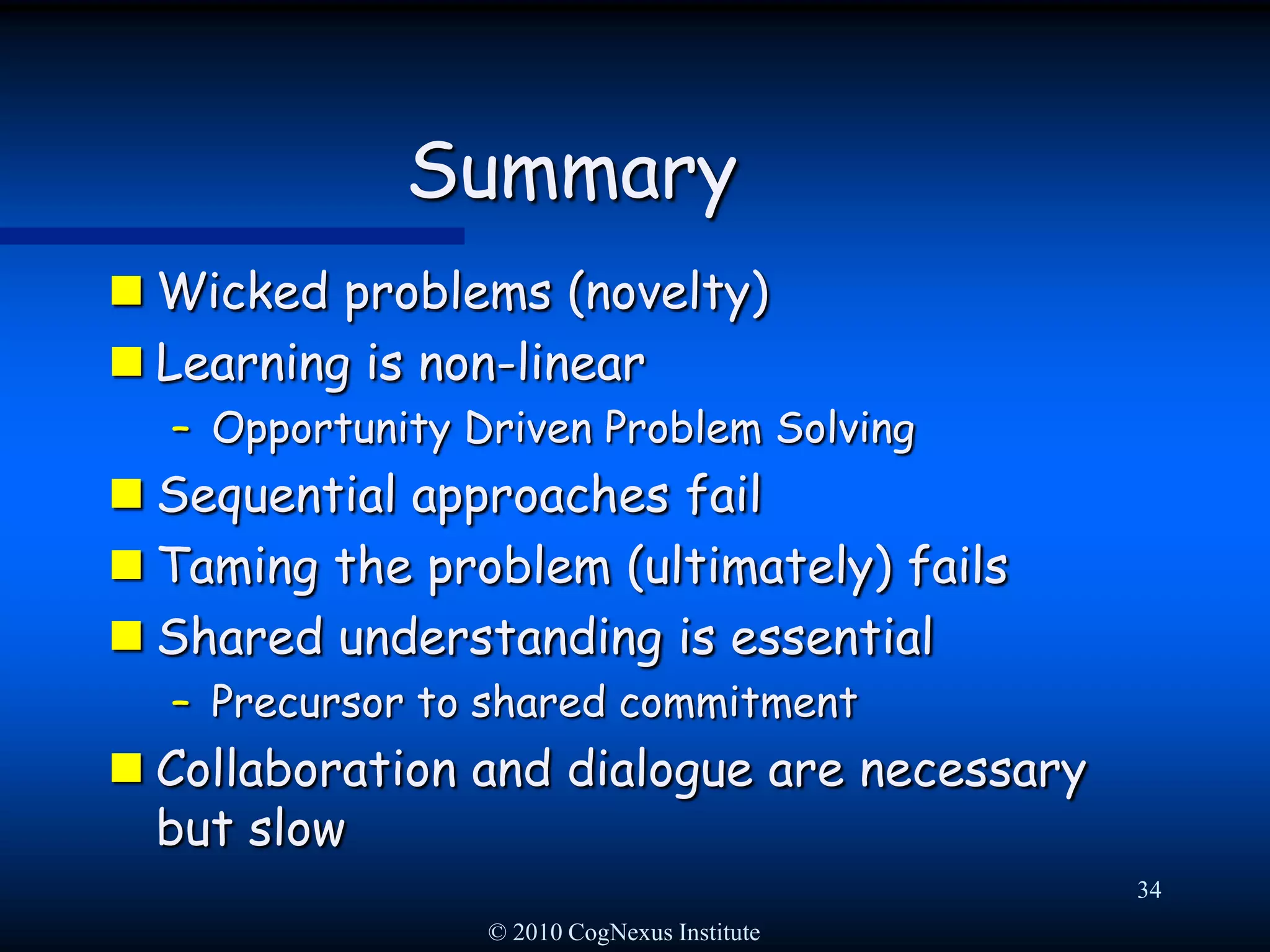
    SummaryWicked problems (novelty)Learningis non-linearOpportunity Driven Problem SolvingSequential approaches failTaming the problem (ultimately) failsShared understanding is essentialPrecursor to shared commitmentCollaboration and dialogue are necessary but slow© 2010 CogNexus Institute34
  • 38.
    SummaryWanted: A wayto conduct dialogue (i.e. meetings) that…Is more efficient (avoids repetition, grand-standing, hand waving, etc.)Supports listeningTracks multiple perspectivesAllows multiple issues to be explored in parallel© 2010 CogNexus Institute35
  • 39.
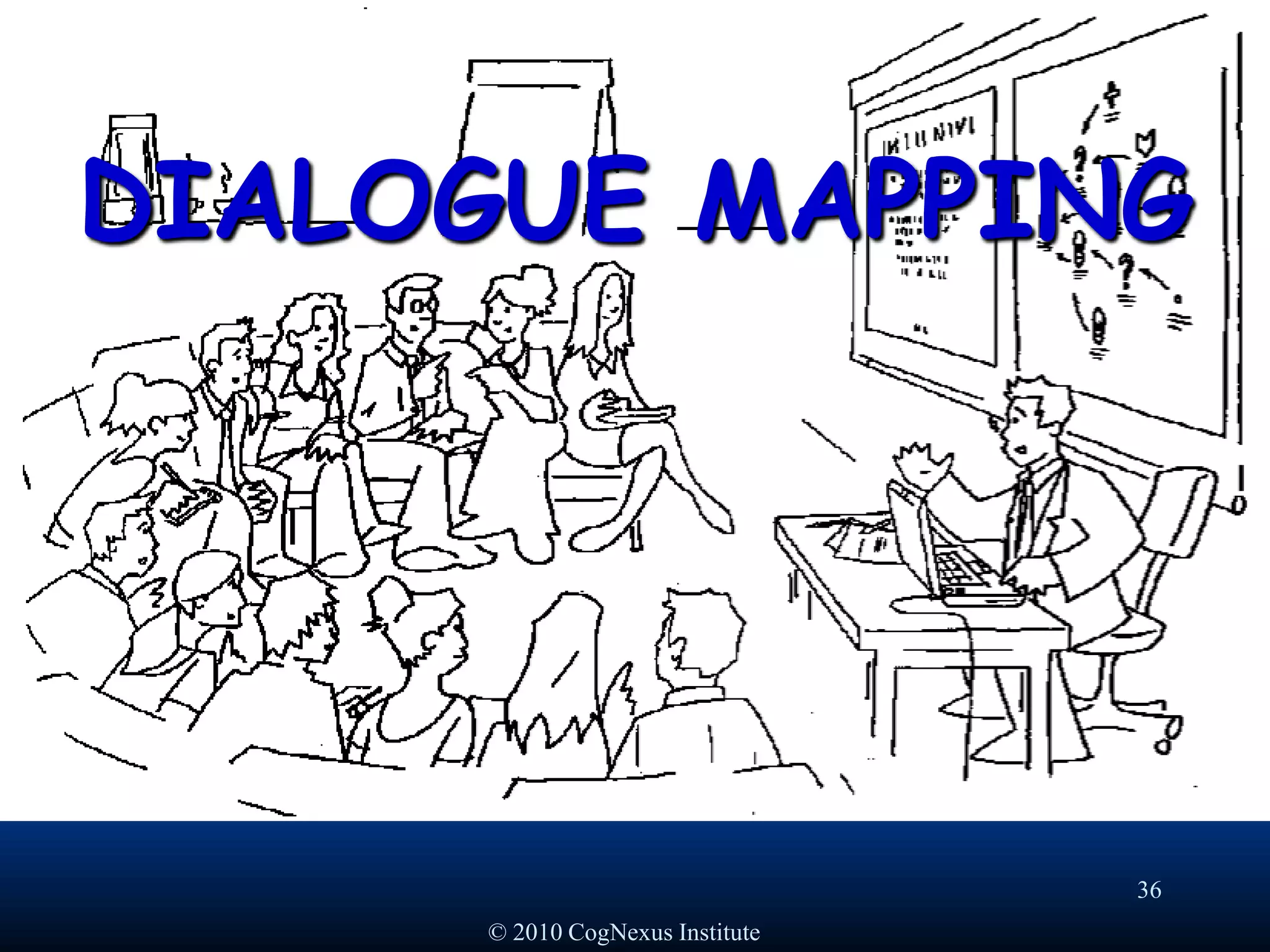
    © 2010 CogNexusInstitute36Dialogue Mapping

Editor's Notes

  • #19 You can’t really solve a wicked problem, and it doesn’t work to avoid or tame them, but you can take them on: tackle them.
  • #24 Shared understanding is the ‘holy grail’ of collaboration.
  • #25 Authentic listening (awareness of your “already listening” that colors what you can hear)Transparency about your true concerns and interests.