TEACHER REFRESHER COURSE1st – 12th August 2011Londonby Violeta Cristià
1st Session:  IntroductorySessionIn that session we introduced ourselves to each other. We were 2 teachers from Germany, one from Latvia, one from Portugal and me.  After that, we completed a chart saying the reasons for becoming a teacher, our teaching training, our first job, pleasures from teaching...The other activity was solving a riddle. Nobody guessed the answer. Try it!
“A man and a woman are going for a walk. They want to walk arm in arm, but their steps are of different lengths. In fact, the woman’s step is two thirds of the man’s step. They start at the same time, and their first step is onto their left foot (so they are both standing on their right foot when they make the first step). Continue...
Obviously, since the woman’s step is shorter and they want to walk together, she will have to take more steps than her partner in the same amount of time. How many steps will they each have to take before their left feet hit the ground at the same time again?”	From David Lazear
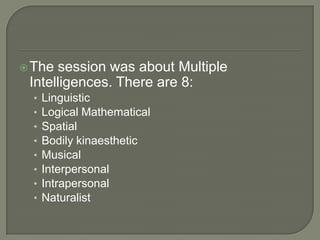
2nd Session: LearningStyles
The session was about Multiple Intelligences. There are 8:LinguisticLogical MathematicalSpatialBodily kinaestheticMusicalInterpersonalIntrapersonalNaturalist
I remembered that everyone has tendencies to a different multiple intelligences. So, as a teachers, we have to prepare different kind of activities for take in to account all the students.
Linguistic intelligenceInvolves sensitivity to spoken and written language, the ability to learn languages, and the capacity to use language to accomplish certain goals. This intelligence includes the ability to effectively use language to express oneself rhetorically or poetically; and language as a means to remember information. Writers, poets, lawyers and speakers are among those that Howard Gardner sees as having high linguistic intelligence.
Logical-mathematical intelligenceConsists of the capacity to analyze problems logically, carry out mathematical operations, and investigate issues scientifically. In Howard Gardner's words, it entails the ability to detect patterns, reason deductively and think logically. This intelligence is most often associated with scientific and mathematical thinking.
Musical intelligenceInvolves skill in the performance, composition, and appreciation of musical patterns. It encompasses the capacity to recognize and compose musical pitches, tones, and rhythms. According to Howard Gardner musical intelligence runs in an almost structural parallel to linguistic intelligence.
Bodily-kinesthetic intelligenceEntails the potential of using one's whole body or parts of the body to solve problems. It is the ability to use mental abilities to coordinate bodily movements. Howard Gardner sees mental and physical activity as related.
Spatial intelligenceInvolves the potential to recognize and use the patterns of wide space and more confined areas.
Interpersonal intelligenceIs concerned with the capacity to understand the intentions, motivations and desires of other people. It allows people to work effectively with others. Educators, salespeople, religious and political leaders and counsellors all need a well-developed interpersonal intelligence.
Intrapersonal intelligenceEntails the capacity to understand oneself, to appreciate one's feelings, fears and motivations. In Howard Gardner's view it involves having an effective working model of ourselves, and to be able to use such information to regulate our lives.
More informationYou can find more information about Multiple Intelligences and Howard Garner in:http://www.infed.org/thinkers/gardner.htm
3rd Session:  EFL ApproachesOverviewIn that session we revised different Approaches/Methodologies/Theories:Communicative Language LearningThe Silent WaySuggestopaediaTotal Physical ResponseThe Communicative ApproachThe Humanistic ApproachThe Audio-Lingual MethodDogme
We worked in small groups and we extract the main characteristics of every Approach.  Then, all the group discussed about them.Our conclusion was that it is better to get the most interesting things of every Approach instead focus on one of them.
More informationYou can find more information about the different Approaches /Methodologies/ Theories in: CommunicativeLanguageLearning: http://personal.ashland.edu/poverlan/holes/comm-lang-lrng-ovrview.pdfTheSilentWay: http://www.englishraven.com/method_silent.html
Suggestopaedia: http://lcce.valahia.ro/volum/59.mdumitrana.pdfTotal Physical Response: http://www.teachingenglish.org.uk/content/total-physical-response-tprTheCommunicativeApproach: http://www.teachingenglish.org.uk/think/knowledge-wiki/communicative-approachTheHumanisticApproach: http://www.psychlotron.org.uk/newResources/approaches/AS_AQB_approaches_HumanisticBasics.pdf
The Audio-Lingual Method: http://myenglishpages.com/blog/the-audiolingual-approachDogme: http://www.teachingenglish.org.uk/articles/dogme-a-teachers-view
4th Session:  RevisitingDictation
The topic in the 4th session was "Dictation".  We have to ask us about:Who gives the dictation, and who to?Who controls the pace of the dictation?Who chooses or creates the text?Who corrects it?
After talked about these questions, the teacher presented us different kind of dictations. Running dictationSpeed controlPast endingsAssociationsMutual dictationConnectionsShouting dictation
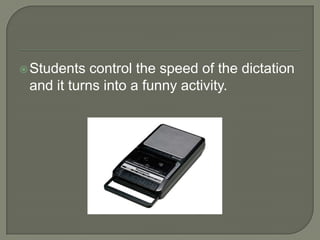
Speed controlUsually it is the reader who controls the speed of the dictation. In this exercise, the writers dictate the speed they need and want. The writers have to be as a tape recorder:StartStopGo back to...Start again
Students control the speed of the dictation and it turns into a funny activity.
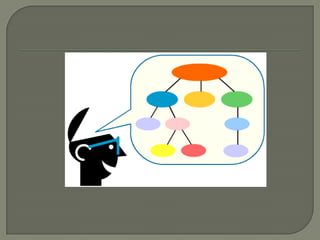
AssociationsDictate different words to your students and after each word leave them time to write down the first three associated words that come to their minds. For example:“wing”: plane,  bird,  sky“nose”: handkerchief,  red,  cold
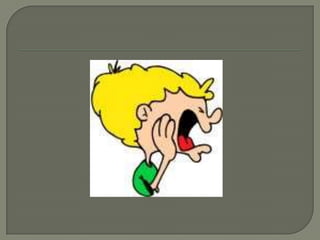
ShoutingdictationStudents work in pairs. They have a sheet with some information: places and their telephone numbers. But every student has some gaps. One of them has information the other one want doesn't have and viceversa. They have to stay in a distance and when the teacher says "start", all the students, working with their partner, have to start shouting the information that they need to complete their worksheet. It is funny!
Teacher refresher course

Teacher refresher course

  • 1.
    TEACHER REFRESHER COURSE1st– 12th August 2011Londonby Violeta Cristià
  • 2.
    1st Session: IntroductorySessionIn that session we introduced ourselves to each other. We were 2 teachers from Germany, one from Latvia, one from Portugal and me. After that, we completed a chart saying the reasons for becoming a teacher, our teaching training, our first job, pleasures from teaching...The other activity was solving a riddle. Nobody guessed the answer. Try it!
  • 3.
    “A man anda woman are going for a walk. They want to walk arm in arm, but their steps are of different lengths. In fact, the woman’s step is two thirds of the man’s step. They start at the same time, and their first step is onto their left foot (so they are both standing on their right foot when they make the first step). Continue...
  • 4.
    Obviously, since thewoman’s step is shorter and they want to walk together, she will have to take more steps than her partner in the same amount of time. How many steps will they each have to take before their left feet hit the ground at the same time again?” From David Lazear
  • 5.
  • 6.
    The session wasabout Multiple Intelligences. There are 8:LinguisticLogical MathematicalSpatialBodily kinaestheticMusicalInterpersonalIntrapersonalNaturalist
  • 7.
    I remembered thateveryone has tendencies to a different multiple intelligences. So, as a teachers, we have to prepare different kind of activities for take in to account all the students.
  • 8.
    Linguistic intelligenceInvolves sensitivityto spoken and written language, the ability to learn languages, and the capacity to use language to accomplish certain goals. This intelligence includes the ability to effectively use language to express oneself rhetorically or poetically; and language as a means to remember information. Writers, poets, lawyers and speakers are among those that Howard Gardner sees as having high linguistic intelligence.
  • 9.
    Logical-mathematical intelligenceConsists ofthe capacity to analyze problems logically, carry out mathematical operations, and investigate issues scientifically. In Howard Gardner's words, it entails the ability to detect patterns, reason deductively and think logically. This intelligence is most often associated with scientific and mathematical thinking.
  • 10.
    Musical intelligenceInvolves skillin the performance, composition, and appreciation of musical patterns. It encompasses the capacity to recognize and compose musical pitches, tones, and rhythms. According to Howard Gardner musical intelligence runs in an almost structural parallel to linguistic intelligence.
  • 11.
    Bodily-kinesthetic intelligenceEntails thepotential of using one's whole body or parts of the body to solve problems. It is the ability to use mental abilities to coordinate bodily movements. Howard Gardner sees mental and physical activity as related.
  • 12.
    Spatial intelligenceInvolves thepotential to recognize and use the patterns of wide space and more confined areas.
  • 13.
    Interpersonal intelligenceIs concernedwith the capacity to understand the intentions, motivations and desires of other people. It allows people to work effectively with others. Educators, salespeople, religious and political leaders and counsellors all need a well-developed interpersonal intelligence.
  • 14.
    Intrapersonal intelligenceEntails thecapacity to understand oneself, to appreciate one's feelings, fears and motivations. In Howard Gardner's view it involves having an effective working model of ourselves, and to be able to use such information to regulate our lives.
  • 15.
    More informationYou canfind more information about Multiple Intelligences and Howard Garner in:http://www.infed.org/thinkers/gardner.htm
  • 16.
    3rd Session: EFL ApproachesOverviewIn that session we revised different Approaches/Methodologies/Theories:Communicative Language LearningThe Silent WaySuggestopaediaTotal Physical ResponseThe Communicative ApproachThe Humanistic ApproachThe Audio-Lingual MethodDogme
  • 17.
    We worked insmall groups and we extract the main characteristics of every Approach. Then, all the group discussed about them.Our conclusion was that it is better to get the most interesting things of every Approach instead focus on one of them.
  • 18.
    More informationYou canfind more information about the different Approaches /Methodologies/ Theories in: CommunicativeLanguageLearning: http://personal.ashland.edu/poverlan/holes/comm-lang-lrng-ovrview.pdfTheSilentWay: http://www.englishraven.com/method_silent.html
  • 19.
    Suggestopaedia: http://lcce.valahia.ro/volum/59.mdumitrana.pdfTotal PhysicalResponse: http://www.teachingenglish.org.uk/content/total-physical-response-tprTheCommunicativeApproach: http://www.teachingenglish.org.uk/think/knowledge-wiki/communicative-approachTheHumanisticApproach: http://www.psychlotron.org.uk/newResources/approaches/AS_AQB_approaches_HumanisticBasics.pdf
  • 20.
    The Audio-Lingual Method:http://myenglishpages.com/blog/the-audiolingual-approachDogme: http://www.teachingenglish.org.uk/articles/dogme-a-teachers-view
  • 21.
    4th Session: RevisitingDictation
  • 22.
    The topic inthe 4th session was "Dictation". We have to ask us about:Who gives the dictation, and who to?Who controls the pace of the dictation?Who chooses or creates the text?Who corrects it?
  • 23.
    After talked aboutthese questions, the teacher presented us different kind of dictations. Running dictationSpeed controlPast endingsAssociationsMutual dictationConnectionsShouting dictation
  • 24.
    Speed controlUsually itis the reader who controls the speed of the dictation. In this exercise, the writers dictate the speed they need and want. The writers have to be as a tape recorder:StartStopGo back to...Start again
  • 25.
    Students control thespeed of the dictation and it turns into a funny activity.
  • 26.
    AssociationsDictate different wordsto your students and after each word leave them time to write down the first three associated words that come to their minds. For example:“wing”: plane, bird, sky“nose”: handkerchief, red, cold
  • 28.
    ShoutingdictationStudents work inpairs. They have a sheet with some information: places and their telephone numbers. But every student has some gaps. One of them has information the other one want doesn't have and viceversa. They have to stay in a distance and when the teacher says "start", all the students, working with their partner, have to start shouting the information that they need to complete their worksheet. It is funny!