Introduction to WiMAX
    BP Tiwari


                       beyond4g.org

1
Presentation outline

     Drivers of Mobile broadband
     Overview of WiMAX
     – WiMAX technology
     – WiMAX Performance
     – WiMAX Evolution
     WiMAX Ecosystem and Devices
     WiMAX Commercial Deployments


                                            Beyond 4G


2                   Introduction to WiMAX
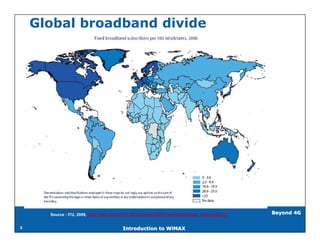
Global broadband divide


      Source : ITU, 2009, http://www.itu.int/ITU-D/ict/papers/2009/Press%20briefing_Telecom09.pdf   Beyond 4G


3                                          Introduction to WiMAX
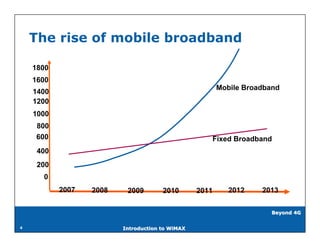
The rise of mobile broadband

    1800
    1600
                                                        Mobile Broadband
    1400
    1200
    1000
    800
    600                                             Fixed Broadband
     400
     200
      0
           2007   2008    2009        2010       2011      2012    2013

                                                                     Beyond 4G


4                        Introduction to WiMAX
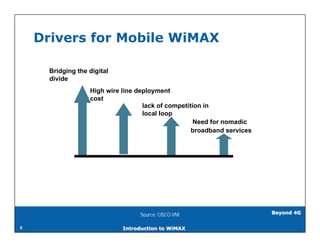
Drivers for Mobile WiMAX

      Bridging the digital
      divide
                   High wire line deployment
                   cost
                                    lack of competition in
                                    local loop
                                                     Need for nomadic
                                                    broadband services


                                  Source: CISCO VNI                      Beyond 4G


5                            Introduction to WiMAX
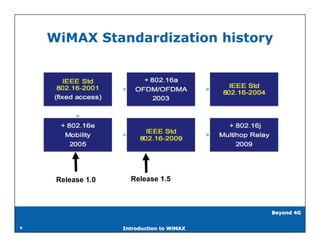
WiMAX Standardization history


     Release 1.0     Release 1.5


                                           Beyond 4G


6                  Introduction to WiMAX
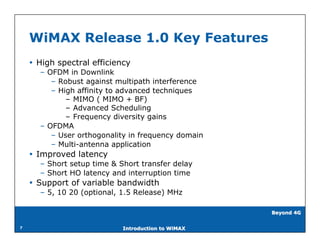
WiMAX Release 1.0 Key Features
     High spectral efficiency
      – OFDM in Downlink
         – Robust against multipath interference
         – High affinity to advanced techniques
             – MIMO ( MIMO + BF)
             – Advanced Scheduling
             – Frequency diversity gains
      – OFDMA
         – User orthogonality in frequency domain
         – Multi-antenna application
     Improved latency
      – Short setup time & Short transfer delay
      – Short HO latency and interruption time
     Support of variable bandwidth
      – 5, 10 20 (optional, 1.5 Release) MHz

                                                    Beyond 4G


7                           Introduction to WiMAX
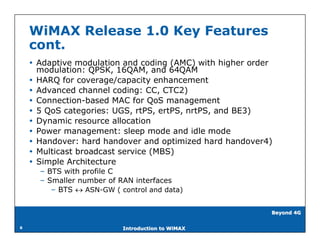
WiMAX Release 1.0 Key Features
    cont.
     Adaptive modulation and coding (AMC) with higher order
      modulation: QPSK, 16QAM, and 64QAM
     HARQ for coverage/capacity enhancement
     Advanced channel coding: CC, CTC2)
     Connection-based MAC for QoS management
     5 QoS categories: UGS, rtPS, ertPS, nrtPS, and BE3)
     Dynamic resource allocation
     Power management: sleep mode and idle mode
     Handover: hard handover and optimized hard handover4)
     Multicast broadcast service (MBS)
     Simple Architecture
      – BTS with profile C
      – Smaller number of RAN interfaces
         – BTS  ASN-GW ( control and data)


                                                           Beyond 4G


8                          Introduction to WiMAX
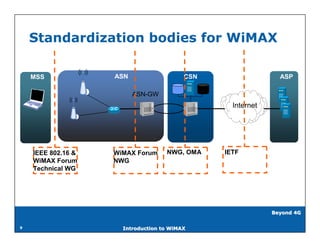
Standardization bodies for WiMAX

    MSS             ASN                   CSN                       ASP

                                                HA
                          ASN-GW
                                                       Internet


    IEEE 802.16 &   WiMAX Forum     NWG, OMA         IETF
    WiMAX Forum     NWG
    Technical WG


                                                                  Beyond 4G


9                     Introduction to WiMAX
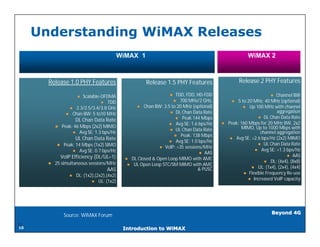
Understanding WiMAX Releases
                                          WiMAX 1                                                 WiMAX 2


       Release 1.0 PHY Features                      Release 1.5 PHY Features                 Release 2 PHY Features

                  ● Scalable-OFDMA                              ● TDD, FDD, HD-FDD                           ● Channel BW
                             ● TDD                               ● 700 MHz/2 GHz,         ● 5 to 20 MHz, 40 MHz (optional)
               ● 2.3/2.5/3.4/3.8 GHz            ● Chan BW: 3.5 to 20 MHz (optional)            ● Up 100 MHz with channel
              ● Chan BW: 5 to10 MHz                             ● DL Chan Data Rate                            aggregation
                                                                  ● Peak 144 Mbps                     ● DL Chan Data Rate
                   DL Chan Data Rate
                                                               ● Avg SE: 1.6 bps/Hz   ● Peak: 160 Mbps for 20 MHz BW, 2x2
          ● Peak: 46 Mbps (2x2) MIMO                                                          MIMO, Up to 1000 Mbps with
                                                                ● UL Chan Data Rate
                 ● Avg SE: 1.3 bps/Hz                                                                  channel aggregation
                                                                 ● Peak: 138 Mbps
                   UL Chan Data Rate                                                     ● Avg SE: >2.6 bps/Hz (2x2) MIMO
                                                               ● Avg SE: 1.0 bps/Hz
          ● Peak: 14 Mbps (1x2) SIMO                                                                  ● UL Chan Data Rate
                                                           ● VoIP: >35 sessions/MHz
                 ● Avg SE: 0.7 bps/Hz                                                                ● Avg SE: >1.3 bps/Hz
                                                                              ● AAS
            VoIP Efficiency (DL/UL=1)                                                                               ● AAS
                                            ● DL Closed & Open Loop MIMO with AMC
       ● 25 simultaneous sessions/MHz                                                                    ● DL: (4x4), (8x8)
                                             ● UL Open Loop STC/SM MIMO with AMC
                                  AAS                                        & PUSC                ● UL: (1x4), (2x4), (4x4)
                                                                                               ● Flexible Frequency Re-use
                ● DL: (1x2),(2x2),(4x2)
                                                                                                  ● Increased VoIP capacity
                          ● UL: (1x2)


                                                                                                              Beyond 4G
             Source: WiMAX Forum
10
10                                         Introduction to WiMAX
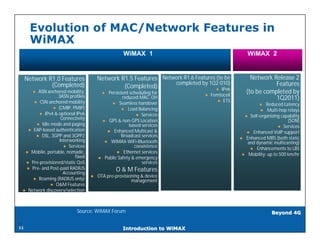
Evolution of MAC/Network Features in
        WiMAX
                                           MobileWiMAX 1
                                                 WiMAX Release 1                                 WiMAX 2


     Network R1.0 Features              Network R1.5 Features Network R1.6 Features (to be         Network Release 2
              (Completed)                                         completed by 1Q2 010)                     Features
                                                 (Completed)                        ● IPv6
         ● ASN anchored mobility,         ● Persistent scheduling for           ● Femtocell
                                                                                                 (to be completed by
                     3ASN profiles                  reduced MAC OH                                          1Q2011)
         ● CSN anchored mobility                                                     ● ETS
                                              ● Seamless handover                                      ● Reduced Latency
                   ● (CMIP, PMIP)                  ● Load Balancing                                    ● Multi-hop relays
            ● IPv4 & optional IPv6                         ● Services                           ● Self-organizing capability
                       Connectivity       ● GPS & non-GPS Location                                                   (SON)
          ● Idle mode and paging                       based services                                           ● Services
       ● EAP-based authentication           ● Enhanced Multicast &                               ● Enhanced VoIP support
          ● DSL, 3GPP and 3GPP2                    Broadcast services                         ● Enhanced MBS (both static
                      Interworking         ● WiMAX-WiFi-Bluetooth                                and dynamic multicasting)
                        ● Services                        coexistence                             ● Enhancements to LBS
      ● Mobile, portable, nomadic,               ● Ethernet services                           ● Mobility: up to 500 km/hr
                              fixed      ● Public Safety & emergency
      ● Pre-provisioned/static QoS                           services
      ● Pre- and Post-paid RADIUS                O & M Features
                        Accounting
                                      ● OTA pre-provisioning & device
         ● Roaming (RADIUS only)                        management
                 ● O&M Features
     ● Network discovery/selection


                               Source: WiMAX Forum                                                            Beyond 4G

11
11                                                  Introduction to WiMAX
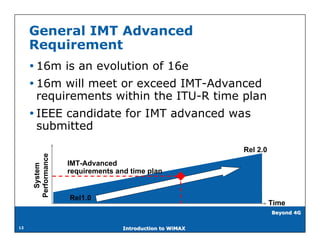
General IMT Advanced
     Requirement
      16m is an evolution of 16e
      16m will meet or exceed IMT-Advanced
       requirements within the ITU-R time plan
      IEEE candidate for IMT advanced was
       submitted
                                                          Rel 2.0
     Performance


                   IMT-Advanced
       System


                   requirements and time plan


                   Rel1.0
                                                                    Time
                                                                    Beyond 4G


12                                Introduction to WiMAX
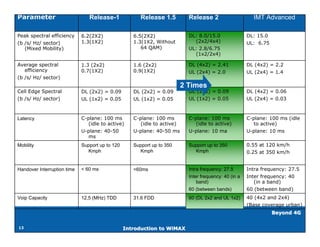
Parameter                       Release-1              Release 1.5          Release 2                     IMT Advanced

Peak spectral efficiency     6.2(2X2)               6.5(2X2)                DL: 8.0/15.0                DL: 15.0
(b /s/ Hz/ sector)           1.3(1X2)               1.3(1X2, Without          (2x2/4x4)                 UL: 6.75
   (Mixed Mobility)                                    64 QAM)              UL: 2.8/6.75
                                                                              (1x2/2x4)

Average spectral             1.3 (2x2)              1.6 (2x2)               DL (4x2) = 2.41             DL (4x2) = 2.2
   efficiency                0.7(1X2)               0.9(1X2)                UL (2x4) = 2.0              UL (2x4) = 1.4
(b /s/ Hz/ sector)
                                                                          2 Times
Cell Edge Spectral           DL (2x2) = 0.09        DL (2x2) = 0.09         DL (2x2) = 0.09             DL (4x2) = 0.06
(b /s/ Hz/ sector)           UL (1x2) = 0.05        UL (1x2) = 0.05         UL (1x2) = 0.05             UL (2x4) = 0.03


Latency                      C-plane: 100 ms        C-plane: 100 ms         C-plane: 100 ms             C-plane: 100 ms (idle
                                (idle to active)       (idle to active)        (idle to active)            to active)
                             U-plane: 40-50         U-plane: 40-50 ms       U-plane: 10 ma              U-plane: 10 ms
                                ms
Mobility                     Support up to 120      Support up to 350       Support up to 350           0.55 at 120 km/h
                               Kmph                   Kmph                    Kmph                      0.25 at 350 km/h


Handover Interruption time   < 60 ms                <60ms                   Intra frequency: 27.5       Intra frequency: 27.5
                                                                            Inter frequency: 40 (in a   Inter frequency: 40
                                                                                band)                      (in a band)
                                                                            60 (between bands)          60 (between band)
Voip Capacity                12,5 (MHz) TDD         31.6 FDD                60 (DL 2x2 and UL 1x2)      40 (4x2 and 2x4)
                                                                                                        (Base coverage urban)
                                                                                                                   Beyond 4G


13                                               Introduction to WiMAX
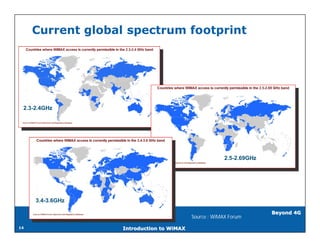
Current global spectrum footprint


 2.3-2.4GHz


                                                       2.5-2.69GHz


     3.4-3.6GHz

                                                                     Beyond 4G
                                          Source : WiMAX Forum

14                Introduction to WiMAX
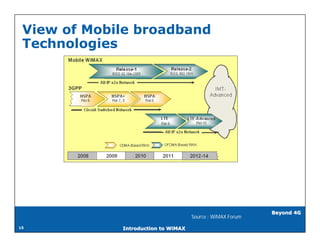
View of Mobile broadband
 Technologies


                                                            Beyond 4G
                                     Source : WiMAX Forum

15           Introduction to WiMAX
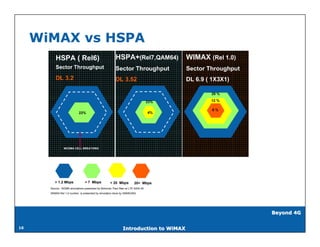
WiMAX vs HSPA
          HSPA ( Rel6)                                    HSPA+(Rel7,QAM64)              WIMAX (Rel 1.0)
          Sector Throughput                               Sector Throughput              Sector Throughput
          DL 3.2                                          DL 3.52                        DL 6.9 ( 1X3X1)

                                                                                                 20 %

                                                                                   23%           12 %

                                                                                                  8%
                             23%                                                   4%


                 WCDMA CELL BREATHING


          > 1.2 Mbps             > 7 Mbps            > 20 Mbps          20+ Mbps
       Source : NGMN simulaitons presented by Motorola, Paul Sten at LTE ASIA 09
       WIMAX Rel 1.0 number is presented by simulation done by SAMSUNG


                                                                                                             Beyond 4G


16                                                             Introduction to WiMAX
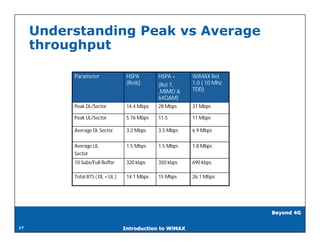
Understanding Peak vs Average
     throughput

          Parameter                HSPA        HSPA +     WiMAX Rel
                                   (Rel6)      (Rel 7,    1.0 ( 10 Mhz
                                               ,MIMO &    TDD)
                                               64QAM)
          Peak DL/Sector           14.4 Mbps   28 Mbps    37 Mbps

          Peak UL/Sector           5.76 Mbps   11.5       11 Mbps

          Average DL Sector        3.2 Mbps    3.5 Mbps   6.9 Mbps


          Average UL               1.5 Mbps    1.5 Mbps   1.8 Mbps
          Sector
          10 Subs/Full Buffer      320 kbps    350 kbps   690 kbps

          Total BTS ( DL + UL )    14.1 Mbps   15 Mbps    26.1 Mbps


                                                                         Beyond 4G


17                                Introduction to WiMAX
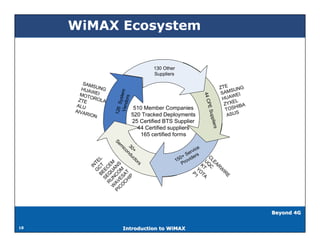
WiMAX Ecosystem
                                                                                                 END


                                      130 Other
                                      Suppliers

        SAM
            S                                                                    ZTE UNG
        HUA UNG                                                                       S
           WEI                                                                    SAM EI


                   Vend tem
       MOT


                                                                 44 C
                                                                                       W
           O                                                                      HUA L


                       ors
      ZTE ROLA


                      Sys
                                                                                   ZYXE IBA


                                                                     PE S
     ALU                                                                                H
                               510 Member Companies                                 TOS
                  126
     AlVA                                                                               S
         RION                 520 Tracked Deployments                                ASU


                                                                         u
                                                                      pplie
                              25 Certified BTS Supplier
                                44 Certified suppliers


                                                                            rs
                                 165 certified forms
                  Se


                                                           ice
                    m
                     30 ndu


                                                        erv s
                      ic

                        + ct
                        o


                                                     + S er
                                                   50 ovid


                                                         C QC
                                                  1 r
                 B CT L


                                                          LE
                   G TE


                            or


                                                     P


                                                           U T A
           W UN UA M
         PI AV CO NS


                              s


                                                            AR
                     IN


             R Q CE


                                                             K T


                                                              W
           C E M
               SE EE


                                                               YO 1
             C AT


                                                                IR
                                                                 P


                                                                  E
               IP
            O S
              H


                                                                                              Beyond 4G


18                    Introduction to WiMAX
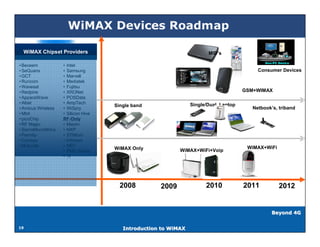
WiMAX Devices Roadmap

  WiMAX Chipset Providers                                                MID’s

• Beceem              • Intel
• SeQuans             • Samsung                                                              Consumer Devices
• GCT                 • Marvell
• Runcom              • Mediatek
• Wavesat             • Fujitsu
• Redpine             • XRONet                                                          GSM+WIMAX
• AppaceWave          • POSData
• Altair              • AmpTech                                   Single/Dual, Laptop
                                       Single band
• Amicus Wireless     • WiSpry                                                             Netbook’s, triband
• Mbit                • Silicon Hive
• picoChip            RF-Only
• RF Magic            • Maxim
• SierraMonolithics   • NXP
• Parmity             • STMicro
• Comsys              • Infineon
• Motorola            • NEC                                                              WiMAX+WiFi
                                       WiMAX Only            WiMAX+WiFi+Voip
                      • PMC-Sierra
                      • TI


                                         2008         2009              2010            2011          2012


                                                                                                   Beyond 4G


19                                        Introduction to WiMAX
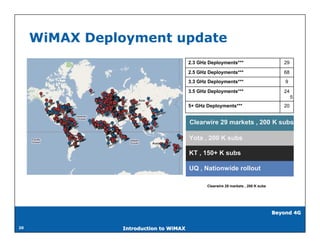
WiMAX Deployment update
                                       2.3 GHz Deployments***                        29

                                       2.5 GHz Deployments***                        68
                                       3.3 GHz Deployments***                         9

                                       3.5 GHz Deployments***                        24
                                                                                          5
                                       5+ GHz Deployments***                         20


                                       Clearwire 29 markets , 200 K subs

                                       Yota , 200 K subs

                                       KT , 150+ K subs

                                       UQ , Nationwide rollout

                                              Clearwire 29 markets , 200 K subs


                                                                                  Beyond 4G


20             Introduction to WiMAX
Thanks


                                      Beyond 4G


21            Introduction to WiMAX

Wi Max Introduction V2

  • 1.
    Introduction to WiMAX BP Tiwari beyond4g.org 1
  • 2.
    Presentation outline  Drivers of Mobile broadband  Overview of WiMAX – WiMAX technology – WiMAX Performance – WiMAX Evolution  WiMAX Ecosystem and Devices  WiMAX Commercial Deployments Beyond 4G 2 Introduction to WiMAX
  • 3.
    Global broadband divide Source : ITU, 2009, http://www.itu.int/ITU-D/ict/papers/2009/Press%20briefing_Telecom09.pdf Beyond 4G 3 Introduction to WiMAX
  • 4.
    The rise ofmobile broadband 1800 1600 Mobile Broadband 1400 1200 1000 800 600 Fixed Broadband 400 200 0 2007 2008 2009 2010 2011 2012 2013 Beyond 4G 4 Introduction to WiMAX
  • 5.
    Drivers for MobileWiMAX Bridging the digital divide High wire line deployment cost lack of competition in local loop Need for nomadic broadband services Source: CISCO VNI Beyond 4G 5 Introduction to WiMAX
  • 6.
    WiMAX Standardization history Release 1.0 Release 1.5 Beyond 4G 6 Introduction to WiMAX
  • 7.
    WiMAX Release 1.0Key Features  High spectral efficiency – OFDM in Downlink – Robust against multipath interference – High affinity to advanced techniques – MIMO ( MIMO + BF) – Advanced Scheduling – Frequency diversity gains – OFDMA – User orthogonality in frequency domain – Multi-antenna application  Improved latency – Short setup time & Short transfer delay – Short HO latency and interruption time  Support of variable bandwidth – 5, 10 20 (optional, 1.5 Release) MHz Beyond 4G 7 Introduction to WiMAX
  • 8.
    WiMAX Release 1.0Key Features cont.  Adaptive modulation and coding (AMC) with higher order modulation: QPSK, 16QAM, and 64QAM  HARQ for coverage/capacity enhancement  Advanced channel coding: CC, CTC2)  Connection-based MAC for QoS management  5 QoS categories: UGS, rtPS, ertPS, nrtPS, and BE3)  Dynamic resource allocation  Power management: sleep mode and idle mode  Handover: hard handover and optimized hard handover4)  Multicast broadcast service (MBS)  Simple Architecture – BTS with profile C – Smaller number of RAN interfaces – BTS  ASN-GW ( control and data) Beyond 4G 8 Introduction to WiMAX
  • 9.
    Standardization bodies forWiMAX MSS ASN CSN ASP HA ASN-GW Internet IEEE 802.16 & WiMAX Forum NWG, OMA IETF WiMAX Forum NWG Technical WG Beyond 4G 9 Introduction to WiMAX
  • 10.
    Understanding WiMAX Releases WiMAX 1 WiMAX 2 Release 1.0 PHY Features Release 1.5 PHY Features Release 2 PHY Features ● Scalable-OFDMA ● TDD, FDD, HD-FDD ● Channel BW ● TDD ● 700 MHz/2 GHz, ● 5 to 20 MHz, 40 MHz (optional) ● 2.3/2.5/3.4/3.8 GHz ● Chan BW: 3.5 to 20 MHz (optional) ● Up 100 MHz with channel ● Chan BW: 5 to10 MHz ● DL Chan Data Rate aggregation ● Peak 144 Mbps ● DL Chan Data Rate DL Chan Data Rate ● Avg SE: 1.6 bps/Hz ● Peak: 160 Mbps for 20 MHz BW, 2x2 ● Peak: 46 Mbps (2x2) MIMO MIMO, Up to 1000 Mbps with ● UL Chan Data Rate ● Avg SE: 1.3 bps/Hz channel aggregation ● Peak: 138 Mbps UL Chan Data Rate ● Avg SE: >2.6 bps/Hz (2x2) MIMO ● Avg SE: 1.0 bps/Hz ● Peak: 14 Mbps (1x2) SIMO ● UL Chan Data Rate ● VoIP: >35 sessions/MHz ● Avg SE: 0.7 bps/Hz ● Avg SE: >1.3 bps/Hz ● AAS VoIP Efficiency (DL/UL=1) ● AAS ● DL Closed & Open Loop MIMO with AMC ● 25 simultaneous sessions/MHz ● DL: (4x4), (8x8) ● UL Open Loop STC/SM MIMO with AMC AAS & PUSC ● UL: (1x4), (2x4), (4x4) ● Flexible Frequency Re-use ● DL: (1x2),(2x2),(4x2) ● Increased VoIP capacity ● UL: (1x2) Beyond 4G Source: WiMAX Forum 10 10 Introduction to WiMAX
  • 11.
    Evolution of MAC/NetworkFeatures in WiMAX MobileWiMAX 1 WiMAX Release 1 WiMAX 2 Network R1.0 Features Network R1.5 Features Network R1.6 Features (to be Network Release 2 (Completed) completed by 1Q2 010) Features (Completed) ● IPv6 ● ASN anchored mobility, ● Persistent scheduling for ● Femtocell (to be completed by 3ASN profiles reduced MAC OH 1Q2011) ● CSN anchored mobility ● ETS ● Seamless handover ● Reduced Latency ● (CMIP, PMIP) ● Load Balancing ● Multi-hop relays ● IPv4 & optional IPv6 ● Services ● Self-organizing capability Connectivity ● GPS & non-GPS Location (SON) ● Idle mode and paging based services ● Services ● EAP-based authentication ● Enhanced Multicast & ● Enhanced VoIP support ● DSL, 3GPP and 3GPP2 Broadcast services ● Enhanced MBS (both static Interworking ● WiMAX-WiFi-Bluetooth and dynamic multicasting) ● Services coexistence ● Enhancements to LBS ● Mobile, portable, nomadic, ● Ethernet services ● Mobility: up to 500 km/hr fixed ● Public Safety & emergency ● Pre-provisioned/static QoS services ● Pre- and Post-paid RADIUS O & M Features Accounting ● OTA pre-provisioning & device ● Roaming (RADIUS only) management ● O&M Features ● Network discovery/selection Source: WiMAX Forum Beyond 4G 11 11 Introduction to WiMAX
  • 12.
    General IMT Advanced Requirement  16m is an evolution of 16e  16m will meet or exceed IMT-Advanced requirements within the ITU-R time plan  IEEE candidate for IMT advanced was submitted Rel 2.0 Performance IMT-Advanced System requirements and time plan Rel1.0 Time Beyond 4G 12 Introduction to WiMAX
  • 13.
    Parameter Release-1 Release 1.5 Release 2 IMT Advanced Peak spectral efficiency 6.2(2X2) 6.5(2X2) DL: 8.0/15.0 DL: 15.0 (b /s/ Hz/ sector) 1.3(1X2) 1.3(1X2, Without (2x2/4x4) UL: 6.75 (Mixed Mobility) 64 QAM) UL: 2.8/6.75 (1x2/2x4) Average spectral 1.3 (2x2) 1.6 (2x2) DL (4x2) = 2.41 DL (4x2) = 2.2 efficiency 0.7(1X2) 0.9(1X2) UL (2x4) = 2.0 UL (2x4) = 1.4 (b /s/ Hz/ sector) 2 Times Cell Edge Spectral DL (2x2) = 0.09 DL (2x2) = 0.09 DL (2x2) = 0.09 DL (4x2) = 0.06 (b /s/ Hz/ sector) UL (1x2) = 0.05 UL (1x2) = 0.05 UL (1x2) = 0.05 UL (2x4) = 0.03 Latency C-plane: 100 ms C-plane: 100 ms C-plane: 100 ms C-plane: 100 ms (idle (idle to active) (idle to active) (idle to active) to active) U-plane: 40-50 U-plane: 40-50 ms U-plane: 10 ma U-plane: 10 ms ms Mobility Support up to 120 Support up to 350 Support up to 350 0.55 at 120 km/h Kmph Kmph Kmph 0.25 at 350 km/h Handover Interruption time < 60 ms <60ms Intra frequency: 27.5 Intra frequency: 27.5 Inter frequency: 40 (in a Inter frequency: 40 band) (in a band) 60 (between bands) 60 (between band) Voip Capacity 12,5 (MHz) TDD 31.6 FDD 60 (DL 2x2 and UL 1x2) 40 (4x2 and 2x4) (Base coverage urban) Beyond 4G 13 Introduction to WiMAX
  • 14.
    Current global spectrumfootprint 2.3-2.4GHz 2.5-2.69GHz 3.4-3.6GHz Beyond 4G Source : WiMAX Forum 14 Introduction to WiMAX
  • 15.
    View of Mobilebroadband Technologies Beyond 4G Source : WiMAX Forum 15 Introduction to WiMAX
  • 16.
    WiMAX vs HSPA HSPA ( Rel6) HSPA+(Rel7,QAM64) WIMAX (Rel 1.0) Sector Throughput Sector Throughput Sector Throughput DL 3.2 DL 3.52 DL 6.9 ( 1X3X1) 20 % 23% 12 % 8% 23% 4% WCDMA CELL BREATHING > 1.2 Mbps > 7 Mbps > 20 Mbps 20+ Mbps Source : NGMN simulaitons presented by Motorola, Paul Sten at LTE ASIA 09 WIMAX Rel 1.0 number is presented by simulation done by SAMSUNG Beyond 4G 16 Introduction to WiMAX
  • 17.
    Understanding Peak vsAverage throughput Parameter HSPA HSPA + WiMAX Rel (Rel6) (Rel 7, 1.0 ( 10 Mhz ,MIMO & TDD) 64QAM) Peak DL/Sector 14.4 Mbps 28 Mbps 37 Mbps Peak UL/Sector 5.76 Mbps 11.5 11 Mbps Average DL Sector 3.2 Mbps 3.5 Mbps 6.9 Mbps Average UL 1.5 Mbps 1.5 Mbps 1.8 Mbps Sector 10 Subs/Full Buffer 320 kbps 350 kbps 690 kbps Total BTS ( DL + UL ) 14.1 Mbps 15 Mbps 26.1 Mbps Beyond 4G 17 Introduction to WiMAX
  • 18.
    WiMAX Ecosystem END 130 Other Suppliers SAM S ZTE UNG HUA UNG S WEI SAM EI Vend tem MOT 44 C W O HUA L ors ZTE ROLA Sys ZYXE IBA PE S ALU H 510 Member Companies TOS 126 AlVA S RION 520 Tracked Deployments ASU u pplie 25 Certified BTS Supplier 44 Certified suppliers rs 165 certified forms Se ice m 30 ndu erv s ic + ct o + S er 50 ovid C QC 1 r B CT L LE G TE or P U T A W UN UA M PI AV CO NS s AR IN R Q CE K T W C E M SE EE YO 1 C AT IR P E IP O S H Beyond 4G 18 Introduction to WiMAX
  • 19.
    WiMAX Devices Roadmap WiMAX Chipset Providers MID’s • Beceem • Intel • SeQuans • Samsung Consumer Devices • GCT • Marvell • Runcom • Mediatek • Wavesat • Fujitsu • Redpine • XRONet GSM+WIMAX • AppaceWave • POSData • Altair • AmpTech Single/Dual, Laptop Single band • Amicus Wireless • WiSpry Netbook’s, triband • Mbit • Silicon Hive • picoChip RF-Only • RF Magic • Maxim • SierraMonolithics • NXP • Parmity • STMicro • Comsys • Infineon • Motorola • NEC WiMAX+WiFi WiMAX Only WiMAX+WiFi+Voip • PMC-Sierra • TI 2008 2009 2010 2011 2012 Beyond 4G 19 Introduction to WiMAX
  • 20.
    WiMAX Deployment update 2.3 GHz Deployments*** 29 2.5 GHz Deployments*** 68 3.3 GHz Deployments*** 9 3.5 GHz Deployments*** 24 5 5+ GHz Deployments*** 20 Clearwire 29 markets , 200 K subs Yota , 200 K subs KT , 150+ K subs UQ , Nationwide rollout Clearwire 29 markets , 200 K subs Beyond 4G 20 Introduction to WiMAX
  • 21.
    Thanks Beyond 4G 21 Introduction to WiMAX