Real Talk About College
High School  VS College Counselor plans student classes each year & schedules appointments Student plans and registers for his/her own classes; Student schedules appointments with counselor Classes are one year long Classes may be 7-18 weeks long at different times and different locations Grades reflect quizzes, attendance, extra credit, homework, conduct Tests are given less frequently; grades may be based on midterm and final exams Parents have access to student information Students 18+ years must give parents permission to access school records Open House, mid-term progress reports Students monitor their own progress Students take specific courses for graduation You choose from a large list of courses Teachers meet with students throughout the day, before or after class College instructors have private offices & office hours Classes are smaller & meet every day Classes are larger and may only meet once a week
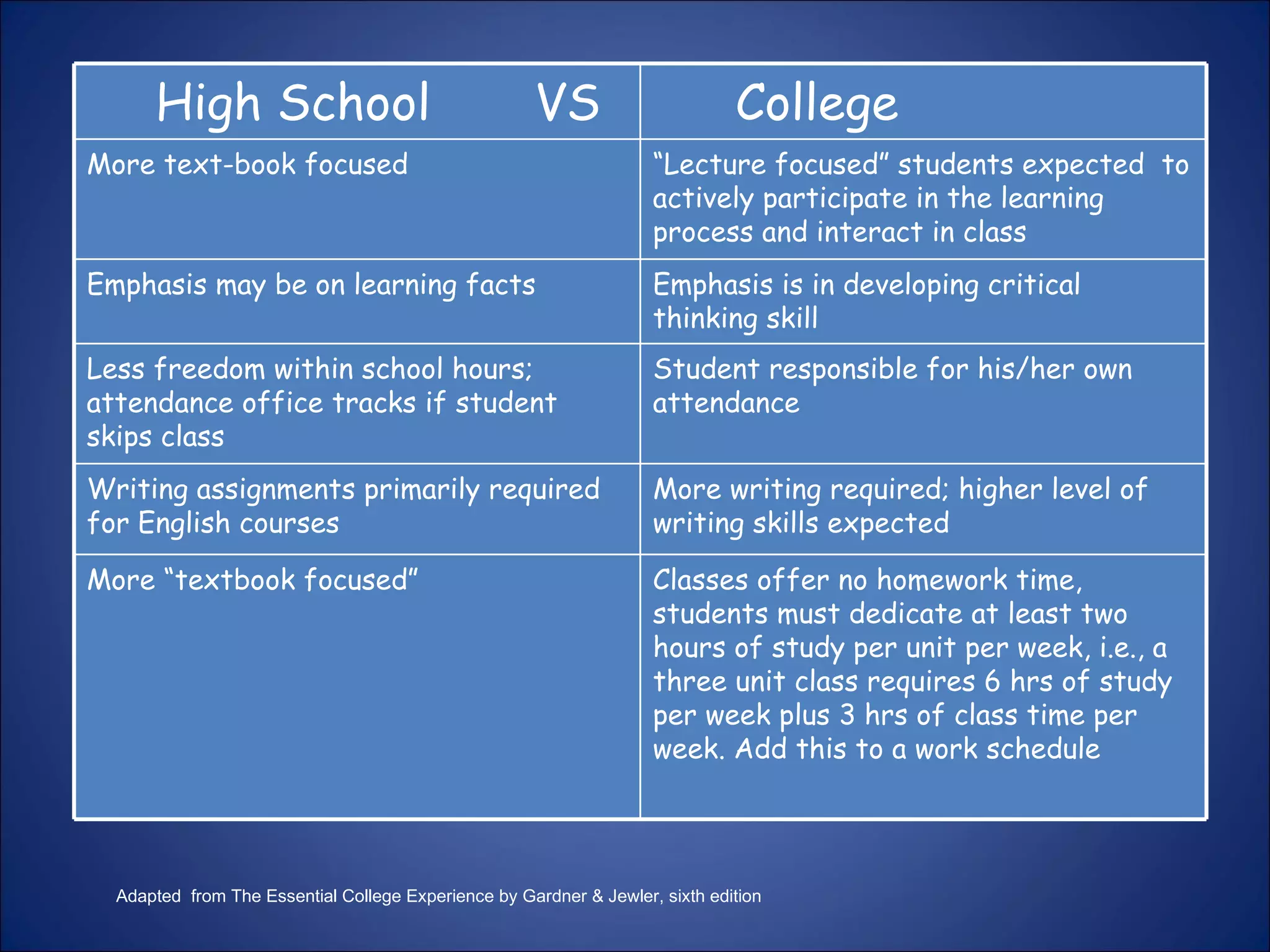
Adapted  from The Essential College Experience by Gardner & Jewler, sixth edition High School  VS College More text-book focused “ Lecture focused” students expected  to actively participate in the learning process and interact in class Emphasis may be on learning facts Emphasis is in developing critical thinking skill Less freedom within school hours; attendance office tracks if student skips class Student responsible for his/her own attendance Writing assignments primarily required for English courses More writing required; higher level of writing skills expected More “textbook focused” Classes offer no homework time, students must dedicate at least two hours of study per unit per week, i.e., a three unit class requires 6 hrs of study per week plus 3 hrs of class time per week. Add this to a work schedule
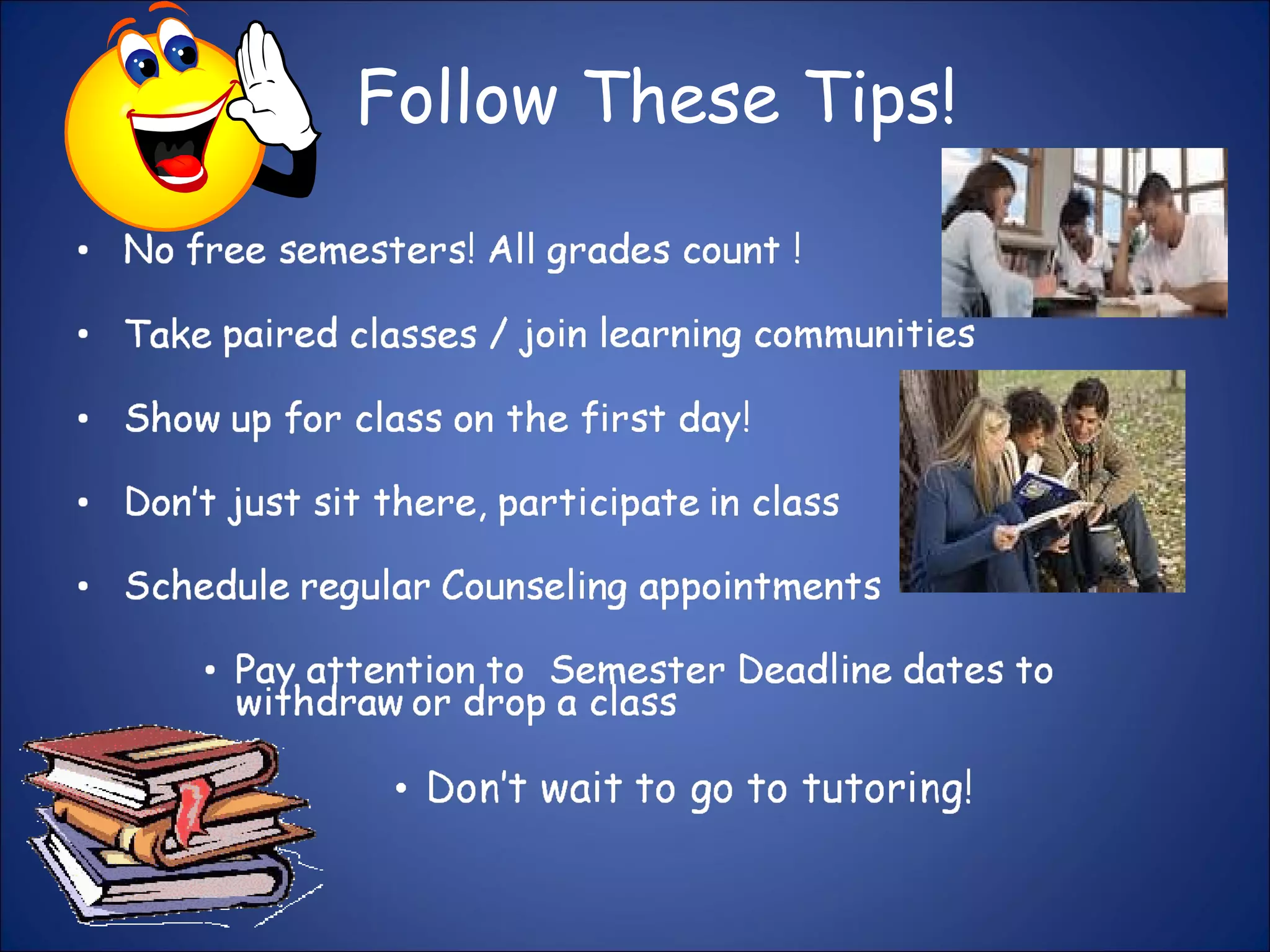
Follow These Tips!
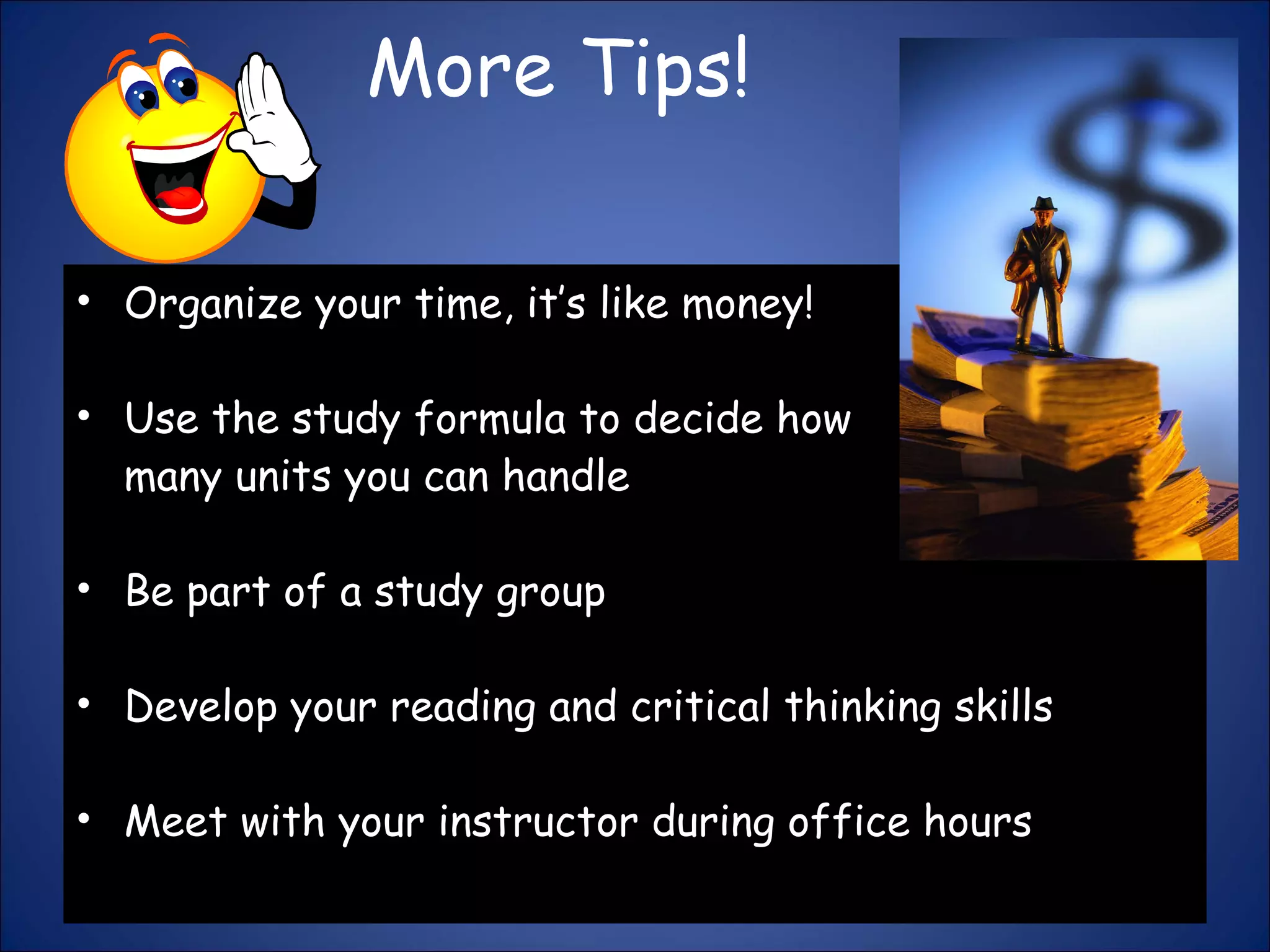
More Tips! Organize your time, it’s like money!  Use the study formula to decide how many units you can handle Be part of a study group  Develop your reading and critical thinking skills Meet with your instructor during office hours
Study Formula and Why you should know it Study Formula: At Least 2 hours of study per unit per week
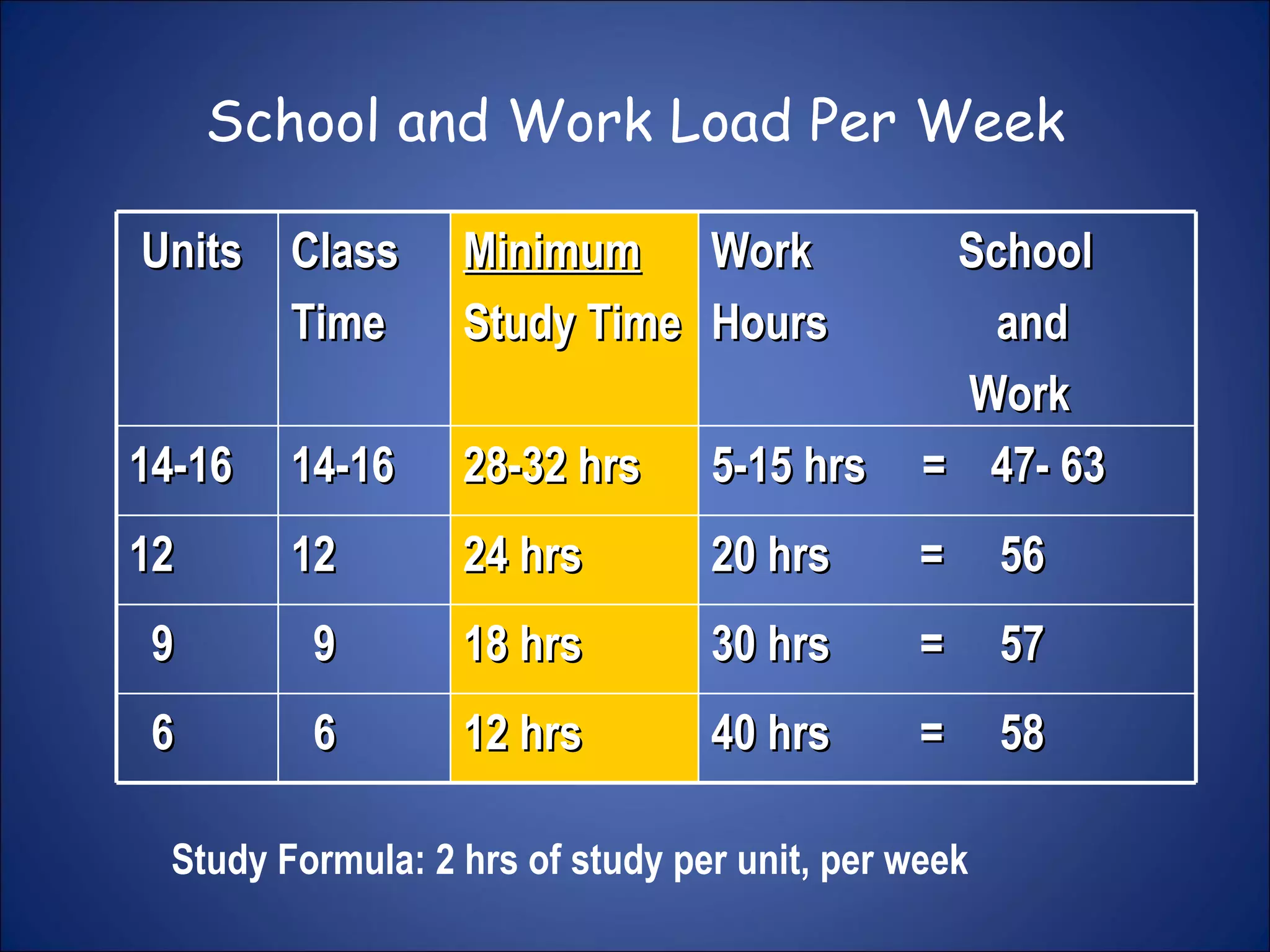
School and Work Load Per Week Study Formula: 2 hrs of study per unit, per week Units  Class Time  Minimum Study Time Work  School Hours  and Work 14-16 14-16  28-32 hrs 5-15 hrs  =  47- 63 12 12 24 hrs 20 hrs  =  56 9 9 18 hrs 30 hrs  =  57 6 6 12 hrs 40 hrs  =  58
Follow These Steps Do your best on the  College Placement Test Attend the Early Admission Program Orientation to College and complete the registration worksheet  Ask Questions if you’re confused!! Know how to register and get on a waiting list for each semester-it’s your job now! Take your Math, Reading, Writing courses right away Schedule a counseling appointment early in the semester for a Student Education Plan
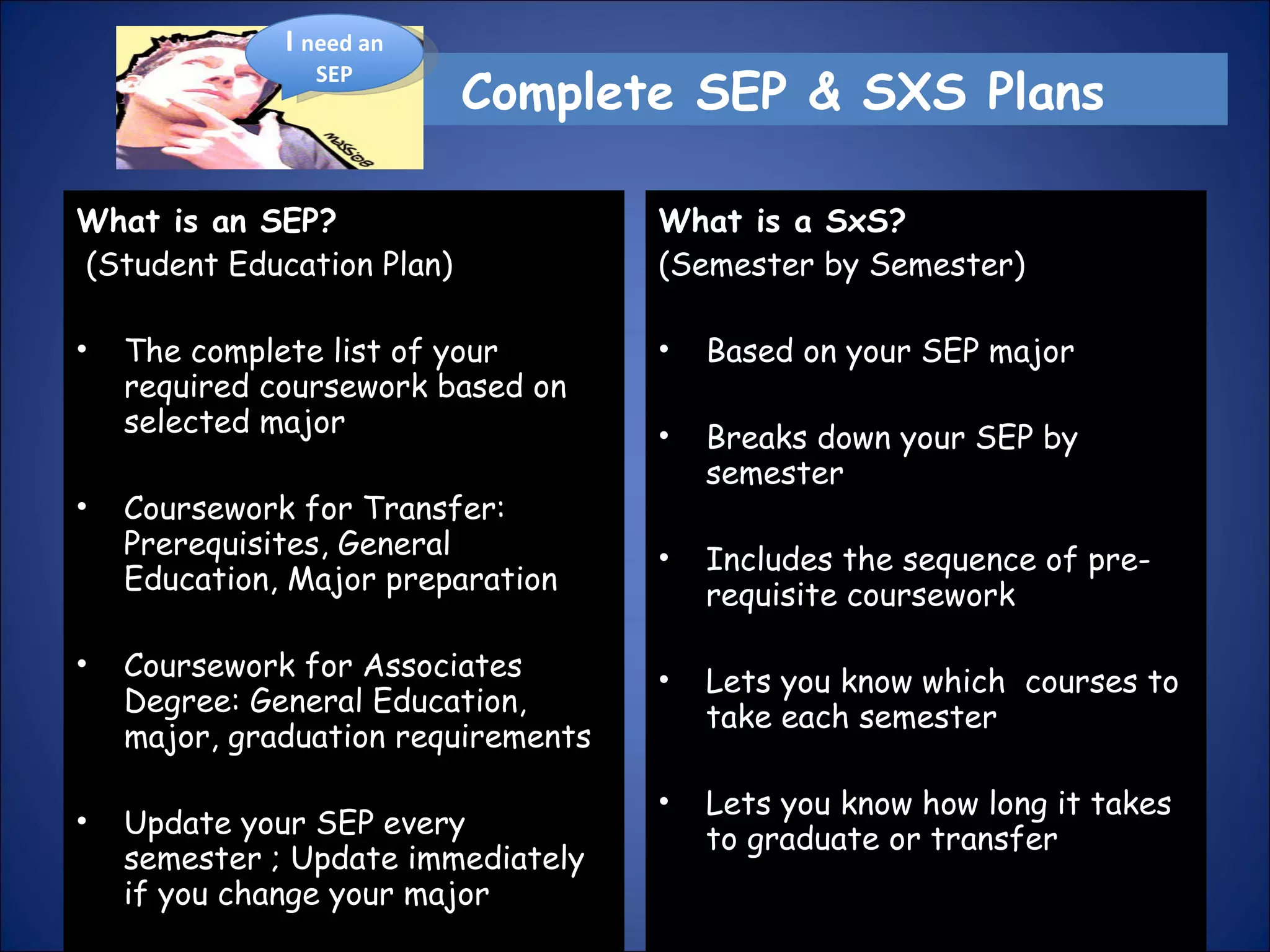
What is an SEP? (Student Education Plan) The complete list of your required coursework based on selected major Coursework for Transfer: Prerequisites, General Education, Major preparation Coursework for Associates Degree: General Education, major, graduation requirements Update your SEP every semester ; Update immediately if you change your major What is a SxS? (Semester by Semester) Based on your SEP major Breaks down your SEP by semester Includes the sequence of pre-requisite coursework Lets you know which  courses to take each semester Lets you know how long it takes to graduate or transfer Complete SEP & SXS Plans I  need an SEP

Real Talk About College

  • 1.
  • 2.
    High School VS College Counselor plans student classes each year & schedules appointments Student plans and registers for his/her own classes; Student schedules appointments with counselor Classes are one year long Classes may be 7-18 weeks long at different times and different locations Grades reflect quizzes, attendance, extra credit, homework, conduct Tests are given less frequently; grades may be based on midterm and final exams Parents have access to student information Students 18+ years must give parents permission to access school records Open House, mid-term progress reports Students monitor their own progress Students take specific courses for graduation You choose from a large list of courses Teachers meet with students throughout the day, before or after class College instructors have private offices & office hours Classes are smaller & meet every day Classes are larger and may only meet once a week
  • 3.
    Adapted fromThe Essential College Experience by Gardner & Jewler, sixth edition High School VS College More text-book focused “ Lecture focused” students expected to actively participate in the learning process and interact in class Emphasis may be on learning facts Emphasis is in developing critical thinking skill Less freedom within school hours; attendance office tracks if student skips class Student responsible for his/her own attendance Writing assignments primarily required for English courses More writing required; higher level of writing skills expected More “textbook focused” Classes offer no homework time, students must dedicate at least two hours of study per unit per week, i.e., a three unit class requires 6 hrs of study per week plus 3 hrs of class time per week. Add this to a work schedule
  • 4.
  • 5.
    More Tips! Organizeyour time, it’s like money! Use the study formula to decide how many units you can handle Be part of a study group Develop your reading and critical thinking skills Meet with your instructor during office hours
  • 6.
    Study Formula andWhy you should know it Study Formula: At Least 2 hours of study per unit per week
  • 7.
    School and WorkLoad Per Week Study Formula: 2 hrs of study per unit, per week Units Class Time Minimum Study Time Work School Hours and Work 14-16 14-16 28-32 hrs 5-15 hrs = 47- 63 12 12 24 hrs 20 hrs = 56 9 9 18 hrs 30 hrs = 57 6 6 12 hrs 40 hrs = 58
  • 8.
    Follow These StepsDo your best on the College Placement Test Attend the Early Admission Program Orientation to College and complete the registration worksheet Ask Questions if you’re confused!! Know how to register and get on a waiting list for each semester-it’s your job now! Take your Math, Reading, Writing courses right away Schedule a counseling appointment early in the semester for a Student Education Plan
  • 9.
    What is anSEP? (Student Education Plan) The complete list of your required coursework based on selected major Coursework for Transfer: Prerequisites, General Education, Major preparation Coursework for Associates Degree: General Education, major, graduation requirements Update your SEP every semester ; Update immediately if you change your major What is a SxS? (Semester by Semester) Based on your SEP major Breaks down your SEP by semester Includes the sequence of pre-requisite coursework Lets you know which courses to take each semester Lets you know how long it takes to graduate or transfer Complete SEP & SXS Plans I need an SEP