


AGILE and the
ENTREPRISE
CULTURE
BY
Etienne
Laverdière &
Hugo
Villeneuve
AGILE TOUR
MONTREAL
2014
2014
15.11
2	
  02
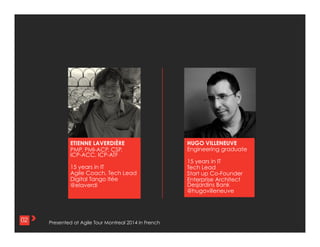
ETIENNE LAVERDIÈRE
PMP, PMI-ACP, CSP,
ICP-ACC, ICP-ATF
15 years in IT
Agile Coach, Tech Lead
Digital Tango ltée
@elaverdi
HUGO VILLENEUVE
Engineering graduate
15 years in IT
Tech Lead
Start up Co-Founder
Enterprise Architect
Desjardins Bank
@hugovilleneuve
Presented at Agile Tour Montreal 2014 in French : http://goo.gl/69lvBa
3	
  03
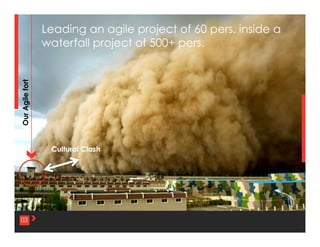
OurAgilefort	
  
Leading an agile project of 60 pers. inside a
waterfall project of 500+ pers.
Cultural Clash	
  
4	
  
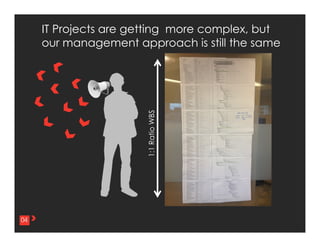
IT Projects are getting more complex, but
our management approach is still the same
04
1:1RatioWBS	
  
5	
  
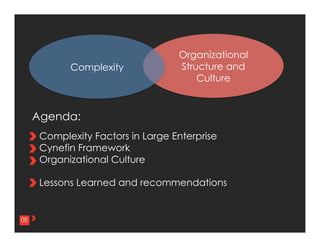
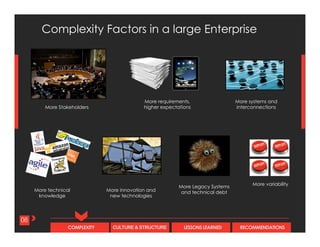
Complexity Factors in Large Enterprise
Cynefin Framework
Organizational Culture
Lessons Learned and recommendations
05
Organizational
Structure and
Culture
Complexity
Agenda:
6	
  
Complexity
06
CULTURE & STRUCTURECOMPLEXITY LESSONS LEARNED RECOMMENDATIONS
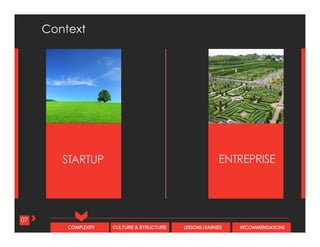
ENTREPRISESTARTUP
Context
07
CULTURE & STRUCTURECOMPLEXITY LESSONS LEARNED RECOMMENDATIONS
More Stakeholders
More variability
More systems and
interconnections
More technical
knowledge
More requirements,
higher expectations
More innovation and
new technologies
More Legacy Systems
and technical debt
08
Complexity Factors in a large Enterprise
CULTURE & STRUCTURECOMPLEXITY LESSONS LEARNED RECOMMENDATIONS
09
CULTURE & STRUCTURECOMPLEXITY LESSONS LEARNED RECOMMENDATIONS
10
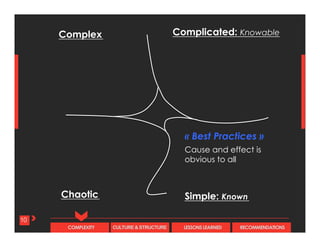
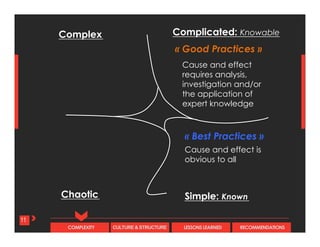
Complicated: Knowable
Simple: Known
Cause and effect is
obvious to all
« Best Practices »
Complex
Chaotic
CULTURE & STRUCTURECOMPLEXITY LESSONS LEARNED RECOMMENDATIONS
11
Cause and effect
requires analysis,
investigation and/or
the application of
expert knowledge
« Good Practices »
« Best Practices »
Complicated: Knowable
Simple: Known
Cause and effect is
obvious to all
Complex
Chaotic
CULTURE & STRUCTURECOMPLEXITY LESSONS LEARNED RECOMMENDATIONS
12
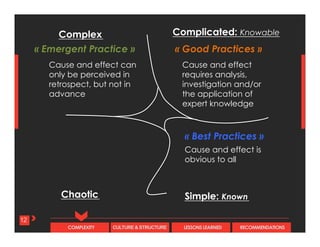
Cause and effect can
only be perceived in
retrospect, but not in
advance
« Good Practices »
« Best Practices »
Complicated: Knowable
Simple: Known
Cause and effect
requires analysis,
investigation and/or
the application of
expert knowledge
Cause and effect is
obvious to all
Complex
Chaotic
« Emergent Practice »
CULTURE & STRUCTURECOMPLEXITY LESSONS LEARNED RECOMMENDATIONS
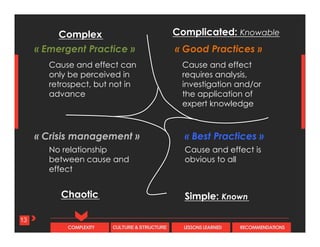
No relationship
between cause and
effect
13
« Good Practices »
« Best Practices »
Complicated: Knowable
Simple: Known
Cause and effect can
only be perceived in
retrospect, but not in
advance
Cause and effect
requires analysis,
investigation and/or
the application of
expert knowledge
Cause and effect is
obvious to all
« Crisis management »	
  
Complex
Chaotic
« Emergent Practice »
CULTURE & STRUCTURECOMPLEXITY LESSONS LEARNED RECOMMENDATIONS
14
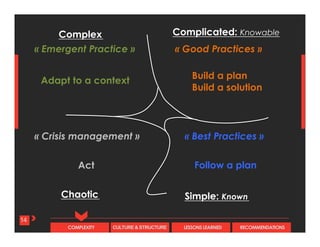
« Good Practices »
« Best Practices »« Crisis management »	
  
Complicated: KnowableComplex
Chaotic Simple: Known
« Emergent Practice »
Follow a plan
Build a plan
Build a solution
Adapt to a context
Act	
  
CULTURE & STRUCTURECOMPLEXITY LESSONS LEARNED RECOMMENDATIONS
15
« Good Practices »
« Best Practices »
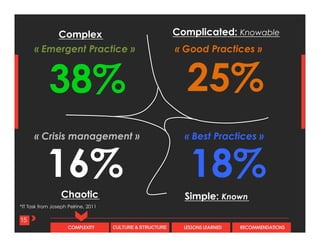
16%	
  
38%	
   25%	
  
18%	
  
Complicated: Knowable
Simple: Known
« Crisis management »	
  
Complex
Chaotic
« Emergent Practice »
Task repartition in a standard IT Project	
  
Joseph Pelrine, On Understanding Software Agility - A Social Complexity Point Of View, 2011	
  
CULTURE & STRUCTURECOMPLEXITY LESSONS LEARNED RECOMMENDATIONS
Traditional
managementAgile	
  
16
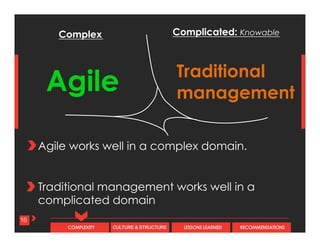
Agile works well in a complex domain.
Traditional management works well in a
complicated domain
Complicated: KnowableComplex
CULTURE & STRUCTURECOMPLEXITY LESSONS LEARNED RECOMMENDATIONS
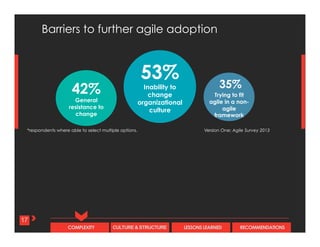
53%
Inability to
change
organizational
culture
42%
General
resistance to
change
17
Barriers to further agile adoption
Trying to fit
agile in a non-
agile
framework
35%
Version One: Agile Survey 2013	
  *respondents where able to select multiple options.	
  
CULTURE & STRUCTURECOMPLEXITY LESSONS LEARNED RECOMMENDATIONS
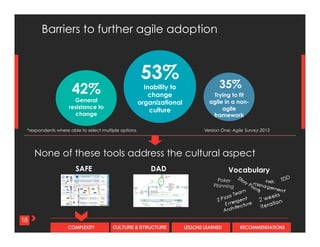
SAFE DAD Vocabulary
None of these tools address the cultural aspect
Poker
Planning
18
53%
Inability to
change
organizational
culture
42%
General
resistance to
change
Barriers to further agile adoption
Trying to fit
agile in a non-
agile
framework
35%
Version One: Agile Survey 2013	
  *respondents where able to select multiple options.	
  
CULTURE & STRUCTURECOMPLEXITY LESSONS LEARNED RECOMMENDATIONS
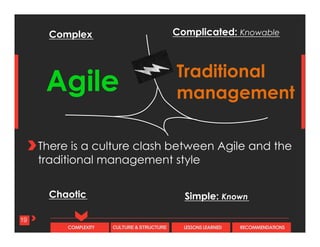
Agile	
  
19
There is a culture clash between Agile and the
traditional management style
Traditional
management
Complicated: KnowableComplex
Chaotic Simple: Known
20	
  
Culture
&
Organizational
Structure
20
CULTURE & STRUCTURECOMPLEXITY LESSONS LEARNED RECOMMENDATIONS
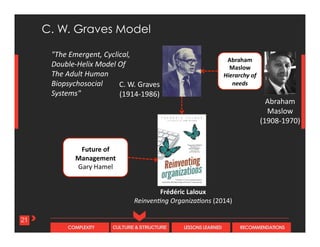
Abraham	
  
Maslow	
  
(1908-­‐1970)	
  
"The	
  Emergent,	
  Cyclical,	
  	
  
Double-­‐Helix	
  Model	
  Of	
  	
  
The	
  Adult	
  Human	
  
Biopsychosocial	
  
Systems"	
  
C.	
  W.	
  Graves	
  
(1914-­‐1986)	
  
Future	
  of	
  
Management	
  
Gary	
  Hamel	
  
21
C. W. Graves Model
Frédéric	
  Laloux	
  
ReinvenEng	
  OrganizaEons	
  (2014)	
  
Abraham	
  
Maslow	
  	
  
Hierarchy	
  of	
  
needs	
  
CULTURE & STRUCTURECOMPLEXITY LESSONS LEARNED RECOMMENDATIONS
22
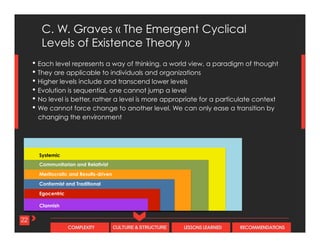
C. W. Graves « The Emergent Cyclical
Levels of Existence Theory »
• Each level represents a way of thinking, a world view, a paradigm of thought
• They are applicable to individuals and organizations
• Higher levels include and transcend lower levels
• Evolution is sequential, one cannot jump a level
• No level is better, rather a level is more appropriate for a particulate context
• We cannot force change to another level. We can only ease a transition by
changing the environment
Systemic
Conformist and Traditional
Egocentric
Clannish
Meritocratic and Results-driven
Communitarian and Relativist
CULTURE & STRUCTURECOMPLEXITY LESSONS LEARNED RECOMMENDATIONS
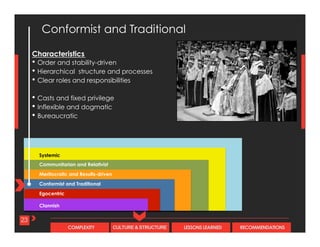
Characteristics
• Order and stability-driven
• Hierarchical structure and processes
• Clear roles and responsibilities
• Casts and fixed privilege
• Inflexible and dogmatic
• Bureaucratic
23
Conformist and Traditional
Systemic
Conformist and Traditional
Egocentric
Clannish
Meritocratic and Results-driven
Communitarian and Relativist
CULTURE & STRUCTURECOMPLEXITY LESSONS LEARNED RECOMMENDATIONS
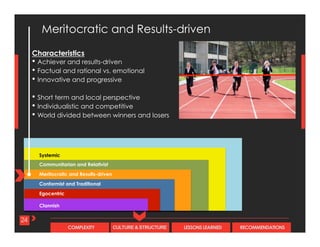
Characteristics
• Achiever and results-driven
• Factual and rational vs. emotional
• Innovative and progressive
• Short term and local perspective
• Individualistic and competitive
• World divided between winners and losers
24
Meritocratic and Results-driven
Systemic
Conformist and Traditional
Egocentric
Clannish
Meritocratic and Results-driven
Communitarian and Relativist
CULTURE & STRUCTURECOMPLEXITY LESSONS LEARNED RECOMMENDATIONS
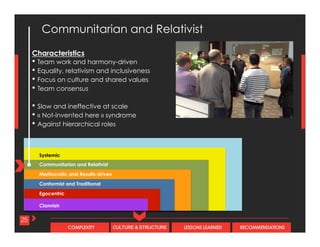
Characteristics
• Team work and harmony-driven
• Equality, relativism and inclusiveness
• Focus on culture and shared values
• Team consensus
• Slow and ineffective at scale
• « Not-invented here » syndrome
• Against hierarchical roles
25
Communitarian and Relativist
Systemic
Conformist and Traditional
Egocentric
Clannish
Meritocratic and Results-driven
Communitarian and Relativist
CULTURE & STRUCTURECOMPLEXITY LESSONS LEARNED RECOMMENDATIONS
In Summary
26
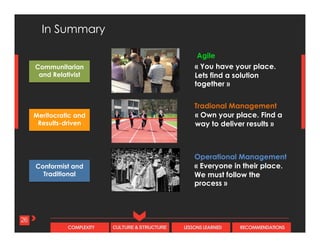
Communitarian
and Relativist
Meritocratic and
Results-driven
Conformist and
Traditional
« Everyone in their place.
We must follow the
process »
« Own your place. Find a
way to deliver results »
« You have your place.
Lets find a solution
together »
Agile	
  
Tradional Management	
  
Operational Management	
  
CULTURE & STRUCTURECOMPLEXITY LESSONS LEARNED RECOMMENDATIONS
27
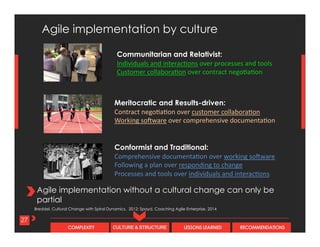
Agile implementation without a cultural change can only be
partial
Agile implementation by culture
Conformist and Traditional:
Comprehensive	
  documentaGon	
  over	
  working	
  soJware	
  
Following	
  a	
  plan	
  over	
  responding	
  to	
  change	
  
Processes	
  and	
  tools	
  over	
  individuals	
  and	
  interacGons	
  
Meritocratic and Results-driven:	
  
Contract	
  negoGaGon	
  over	
  customer	
  collaboraGon	
  
Working	
  soJware	
  over	
  comprehensive	
  documentaGon	
  
Communitarian and Relativist:
Individuals	
  and	
  interacGons	
  over	
  processes	
  and	
  tools	
  
Customer	
  collaboraGon	
  over	
  contract	
  negoGaGon	
  
Breddel, Cultural Change with Spiral Dynamics, 2012; Spayd, Coaching Agile Enterprise, 2014
CULTURE & STRUCTURECOMPLEXITY LESSONS LEARNED RECOMMENDATIONS
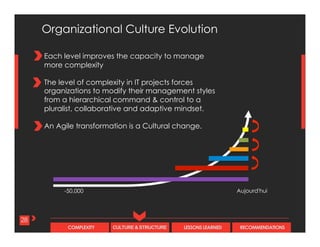
Each level improves the capacity to manage
more complexity
The level of complexity in IT projects forces
organizations to modify their management styles
from a hierarchical command & control to a
pluralist, collaborative and adaptive mindset.
An Agile transformation is a Cultural change.
-50,000 Aujourd'hui
28
Organizational Culture Evolution
29	
  
Lessons
Learned
29
CULTURE & STRUCTURECOMPLEXITY LESSONS LEARNED RECOMMENDATIONS
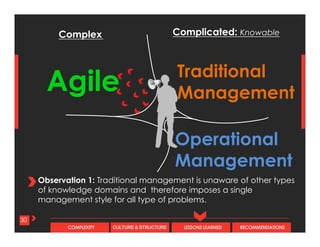
Agile	
   Traditional
Management	
  
30
Observation 1: Traditional management is unaware of other types
of knowledge domains and therefore imposes a single
management style for all type of problems.
Operational
Management	
  
Complicated: KnowableComplex
CULTURE & STRUCTURECOMPLEXITY LESSONS LEARNED RECOMMENDATIONS
31
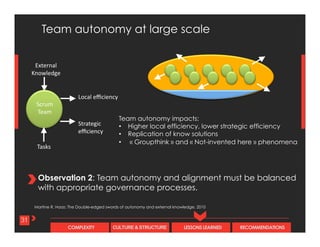
Martine R. Haas: The Double-edged swords of autonomy and external knowledge, 2010
Local	
  efficiency	
  
Scrum	
  
Team	
  
Strategic	
  
efficiency	
  
External	
  
Knowledge	
  
Tasks	
  
Team autonomy impacts:
•  Higher local efficiency, lower strategic efficiency
•  Replication of know solutions
•  « Groupthink » and « Not-invented here » phenomena
Observation 2: Team autonomy and alignment must be balanced
with appropriate governance processes.
Team autonomy at large scale
32	
  
Recommendations
32
CULTURE & STRUCTURECOMPLEXITY LESSONS LEARNED RECOMMENDATIONS
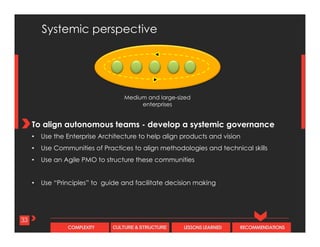
To align autonomous teams - develop a systemic governance
•  Use the Enterprise Architecture to help align products and vision
•  Use Communities of Practices to align methodologies and technical skills
•  Use an Agile PMO to structure these communities
•  Use “Principles” to guide and facilitate decision making
Systemic perspective
33
Medium and large-sized
enterprises
CULTURE & STRUCTURECOMPLEXITY LESSONS LEARNED RECOMMENDATIONS
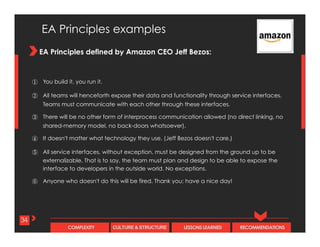
EA Principles defined by Amazon CEO Jeff Bezos:
EA Principles examples
34
①  You build it, you run it.
②  All teams will henceforth expose their data and functionality through service interfaces.
Teams must communicate with each other through these interfaces.
③  There will be no other form of interprocess communication allowed (no direct linking, no
shared-memory model, no back-doors whatsoever).
④  It doesn't matter what technology they use. (Jeff Bezos doesn't care.)
⑤  All service interfaces, without exception, must be designed from the ground up to be
externalizable. That is to say, the team must plan and design to be able to expose the
interface to developers in the outside world. No exceptions.
⑥  Anyone who doesn't do this will be fired. Thank you; have a nice day!
CULTURE & STRUCTURECOMPLEXITY LESSONS LEARNED RECOMMENDATIONS
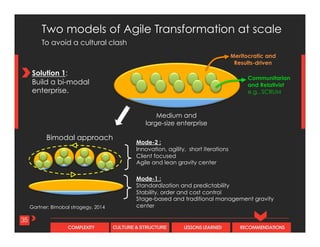
Medium and
large-size enterprise
Bimodal approach
Mode-2 :
Innovation, agility, short iterations
Client focused
Agile and lean gravity center
Mode-1 :
Standardization and predictability
Stability, order and cost control
Stage-based and traditional management gravity
center
Two models of Agile Transformation at scale
35
Meritocratic and
Results-driven
Communitarian
and Relativist
e.g.. SCRUM
Solution 1:
Build a bi-modal
enterprise.
To avoid a cultural clash
Gartner: Bimobal stragegy, 2014
CULTURE & STRUCTURECOMPLEXITY LESSONS LEARNED RECOMMENDATIONS
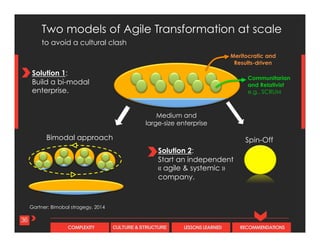
Spin-Off
36
Solution 2:
Start an independent
« agile & systemic »
company.
Medium and
large-size enterprise
Bimodal approach
Two models of Agile Transformation at scale
Meritocratic and
Results-driven
Communitarian
and Relativist
e.g.. SCRUM
Solution 1:
Build a bi-modal
enterprise.
to avoid a cultural clash
Gartner: Bimobal stragegy, 2014
CULTURE & STRUCTURECOMPLEXITY LESSONS LEARNED RECOMMENDATIONS
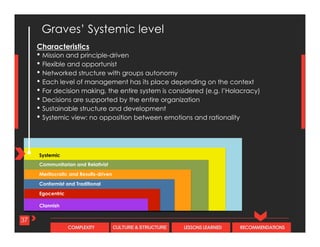
Characteristics
• Mission and principle-driven
• Flexible and opportunist
• Networked structure with groups autonomy
• Each level of management has its place depending on the context
• For decision making, the entire system is considered (e.g. l’Holacracy)
• Decision supported by the entire organization
• Sustainable structure and development
• Systemic view: no opposition between emotions and rationality
37
Graves’ Systemic level for IT
Systemic
Conformist and Traditional
Egocentric
Clannish
Meritocratic and Results-driven
Communitarian and Relativist
38	
  
2007	
  2014	
  
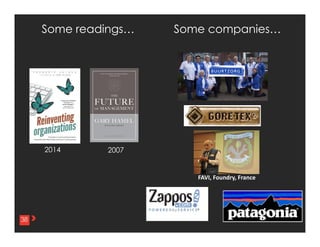
Some readings…
38
Some companies…
FAVI,	
  Foundry,	
  France	
  
39	
  
Questions ?	
  	
  
39
40	


Russell L. Ackoff: From Mechanistic to social
Systemic Thinking, System Thinking in Action
Conference, 1993
Dajo Breddel: Cultural Change with Spiral
Dynamics, http://tinyurl.com/qdjn5yf, 2012.
Chabreuil: La spirale dynamique, Interedition, 2008.
Cowan & Beck: Spiral Dynamics: Mastering Values,
Leadership and Change, Wiley-Blackwell, 1996
Martine R. Haas: The Double-edged swords of
autonomy and external knowledge: Analyzing
team effectiveness in a multinational organization
in Academy of Management Journal 2010, Vol. 53,
No. 5, University of Pennsylvania, 2010.
Gary Hamel and Bill Breen: The Future of
Management, Harvard Business Review Press, 2007
Clare W. Graves: Levels of Existence: an Open
System Theory of Values in Journal of Humanistic
Psychology 1970; 10, 131
Frederic Laloux: Reinventing Organization, Nelson
Parker, 2014
References
40
Joseph Pelrine: On Understanding Software Agility -
A Social Complexity Point Of View in E:CO Issue
Vol. 13 Nos. 1-2, 2011
Snowden, Boone: A Leader’s Framework for
Decision Making in Harvard Business Review,
Novembre 2007
Kurtz. Snowden, The new dynamics of strategy:
Sense-making in a complex and complicated
world, http://tinyurl.com/ldgsa2x, 2003
Michael Spayd: Time’s arrow: The evolution of
complexity in Downloading the Integral Operating
System (IOS) A Framework for Agile Enterprise
Transformation, 2014 http://tinyurl.com/o74fqdy
Michael Spayd: What would it mean to Coach an
Agile Enterprise?, http://tinyurl.com/peozpk8, 2014
* * *
Deloitte: Scalling Edge, A Pragmatic Pathway to
broad internal change, 2012
Gartner: Bimobal stragegy, http://
www.gartner.com/newsroom/id/2865718, 2014
Version One: 8th Annual State of Agile Survey 2013,
http://www.versionone.com/pdf/2013-state-of-
agile-survey.pdf

Agile and the Enterprise Culture

  • 1.
    AGILE and the ENTREPRISE CULTURE BY Etienne Laverdière& Hugo Villeneuve AGILE TOUR MONTREAL 2014 2014 15.11
  • 2.
    2  02 ETIENNE LAVERDIÈRE PMP,PMI-ACP, CSP, ICP-ACC, ICP-ATF 15 years in IT Agile Coach, Tech Lead Digital Tango ltée @elaverdi HUGO VILLENEUVE Engineering graduate 15 years in IT Tech Lead Start up Co-Founder Enterprise Architect Desjardins Bank @hugovilleneuve Presented at Agile Tour Montreal 2014 in French : http://goo.gl/69lvBa
  • 3.
    3  03 OurAgilefort   Leadingan agile project of 60 pers. inside a waterfall project of 500+ pers. Cultural Clash  
  • 4.
    4   IT Projectsare getting more complex, but our management approach is still the same 04 1:1RatioWBS  
  • 5.
    5   Complexity Factorsin Large Enterprise Cynefin Framework Organizational Culture Lessons Learned and recommendations 05 Organizational Structure and Culture Complexity Agenda:
  • 6.
  • 7.
    CULTURE & STRUCTURECOMPLEXITYLESSONS LEARNED RECOMMENDATIONS ENTREPRISESTARTUP Context 07
  • 8.
    CULTURE & STRUCTURECOMPLEXITYLESSONS LEARNED RECOMMENDATIONS More Stakeholders More variability More systems and interconnections More technical knowledge More requirements, higher expectations More innovation and new technologies More Legacy Systems and technical debt 08 Complexity Factors in a large Enterprise
  • 9.
    CULTURE & STRUCTURECOMPLEXITYLESSONS LEARNED RECOMMENDATIONS 09
  • 10.
    CULTURE & STRUCTURECOMPLEXITYLESSONS LEARNED RECOMMENDATIONS 10 Complicated: Knowable Simple: Known Cause and effect is obvious to all « Best Practices » Complex Chaotic
  • 11.
    CULTURE & STRUCTURECOMPLEXITYLESSONS LEARNED RECOMMENDATIONS 11 Cause and effect requires analysis, investigation and/or the application of expert knowledge « Good Practices » « Best Practices » Complicated: Knowable Simple: Known Cause and effect is obvious to all Complex Chaotic
  • 12.
    CULTURE & STRUCTURECOMPLEXITYLESSONS LEARNED RECOMMENDATIONS 12 Cause and effect can only be perceived in retrospect, but not in advance « Good Practices » « Best Practices » Complicated: Knowable Simple: Known Cause and effect requires analysis, investigation and/or the application of expert knowledge Cause and effect is obvious to all Complex Chaotic « Emergent Practice »
  • 13.
    CULTURE & STRUCTURECOMPLEXITYLESSONS LEARNED RECOMMENDATIONS No relationship between cause and effect 13 « Good Practices » « Best Practices » Complicated: Knowable Simple: Known Cause and effect can only be perceived in retrospect, but not in advance Cause and effect requires analysis, investigation and/or the application of expert knowledge Cause and effect is obvious to all « Crisis management »   Complex Chaotic « Emergent Practice »
  • 14.
    CULTURE & STRUCTURECOMPLEXITYLESSONS LEARNED RECOMMENDATIONS 14 « Good Practices » « Best Practices »« Crisis management »   Complicated: KnowableComplex Chaotic Simple: Known « Emergent Practice » Follow a plan Build a plan Build a solution Adapt to a context Act  
  • 15.
    CULTURE & STRUCTURECOMPLEXITYLESSONS LEARNED RECOMMENDATIONS 15 « Good Practices » « Best Practices » 16%   38%   25%   18%   Complicated: Knowable Simple: Known « Crisis management »   Complex Chaotic « Emergent Practice » Task repartition in a standard IT Project   Joseph Pelrine, On Understanding Software Agility - A Social Complexity Point Of View, 2011  
  • 16.
    CULTURE & STRUCTURECOMPLEXITYLESSONS LEARNED RECOMMENDATIONS Traditional managementAgile   16 Agile works well in a complex domain. Traditional management works well in a complicated domain Complicated: KnowableComplex
  • 17.
    CULTURE & STRUCTURECOMPLEXITYLESSONS LEARNED RECOMMENDATIONS 53% Inability to change organizational culture 42% General resistance to change 17 Barriers to further agile adoption Trying to fit agile in a non- agile framework 35% Version One: Agile Survey 2013  *respondents where able to select multiple options.  
  • 18.
    CULTURE & STRUCTURECOMPLEXITYLESSONS LEARNED RECOMMENDATIONS SAFE DAD Vocabulary None of these tools address the cultural aspect Poker Planning 18 53% Inability to change organizational culture 42% General resistance to change Barriers to further agile adoption Trying to fit agile in a non- agile framework 35% Version One: Agile Survey 2013  *respondents where able to select multiple options.  
  • 19.
    CULTURE & STRUCTURECOMPLEXITYLESSONS LEARNED RECOMMENDATIONS Agile   19 There is a culture clash between Agile and the traditional management style Traditional management Complicated: KnowableComplex Chaotic Simple: Known
  • 20.
  • 21.
    CULTURE & STRUCTURECOMPLEXITYLESSONS LEARNED RECOMMENDATIONS Abraham   Maslow   (1908-­‐1970)   "The  Emergent,  Cyclical,     Double-­‐Helix  Model  Of     The  Adult  Human   Biopsychosocial   Systems"   C.  W.  Graves   (1914-­‐1986)   Future  of   Management   Gary  Hamel   21 C. W. Graves Model Frédéric  Laloux   ReinvenEng  OrganizaEons  (2014)   Abraham   Maslow     Hierarchy  of   needs  
  • 22.
    CULTURE & STRUCTURECOMPLEXITYLESSONS LEARNED RECOMMENDATIONS 22 C. W. Graves « The Emergent Cyclical Levels of Existence Theory » • Each level represents a way of thinking, a world view, a paradigm of thought • They are applicable to individuals and organizations • Higher levels include and transcend lower levels • Evolution is sequential, one cannot jump a level • No level is better, rather a level is more appropriate for a particulate context • We cannot force change to another level. We can only ease a transition by changing the environment Systemic Conformist and Traditional Egocentric Clannish Meritocratic and Results-driven Communitarian and Relativist
  • 23.
    CULTURE & STRUCTURECOMPLEXITYLESSONS LEARNED RECOMMENDATIONS Characteristics • Order and stability-driven • Hierarchical structure and processes • Clear roles and responsibilities • Casts and fixed privilege • Inflexible and dogmatic • Bureaucratic 23 Conformist and Traditional Systemic Conformist and Traditional Egocentric Clannish Meritocratic and Results-driven Communitarian and Relativist
  • 24.
    CULTURE & STRUCTURECOMPLEXITYLESSONS LEARNED RECOMMENDATIONS Characteristics • Achiever and results-driven • Factual and rational vs. emotional • Innovative and progressive • Short term and local perspective • Individualistic and competitive • World divided between winners and losers 24 Meritocratic and Results-driven Systemic Conformist and Traditional Egocentric Clannish Meritocratic and Results-driven Communitarian and Relativist
  • 25.
    CULTURE & STRUCTURECOMPLEXITYLESSONS LEARNED RECOMMENDATIONS Characteristics • Team work and harmony-driven • Equality, relativism and inclusiveness • Focus on culture and shared values • Team consensus • Slow and ineffective at scale • « Not-invented here » syndrome • Against hierarchical roles 25 Communitarian and Relativist Systemic Conformist and Traditional Egocentric Clannish Meritocratic and Results-driven Communitarian and Relativist
  • 26.
    CULTURE & STRUCTURECOMPLEXITYLESSONS LEARNED RECOMMENDATIONS In Summary 26 Communitarian and Relativist Meritocratic and Results-driven Conformist and Traditional « Everyone in their place. We must follow the process » « Own your place. Find a way to deliver results » « You have your place. Lets find a solution together » Agile   Tradional Management   Operational Management  
  • 27.
    CULTURE & STRUCTURECOMPLEXITYLESSONS LEARNED RECOMMENDATIONS 27 Agile implementation without a cultural change can only be partial Agile implementation by culture Conformist and Traditional: Comprehensive  documentaGon  over  working  soJware   Following  a  plan  over  responding  to  change   Processes  and  tools  over  individuals  and  interacGons   Meritocratic and Results-driven:   Contract  negoGaGon  over  customer  collaboraGon   Working  soJware  over  comprehensive  documentaGon   Communitarian and Relativist: Individuals  and  interacGons  over  processes  and  tools   Customer  collaboraGon  over  contract  negoGaGon   Breddel, Cultural Change with Spiral Dynamics, 2012; Spayd, Coaching Agile Enterprise, 2014
  • 28.
    CULTURE & STRUCTURECOMPLEXITYLESSONS LEARNED RECOMMENDATIONS Each level improves the capacity to manage more complexity The level of complexity in IT projects forces organizations to modify their management styles from a hierarchical command & control to a pluralist, collaborative and adaptive mindset. An Agile transformation is a Cultural change. -50,000 Aujourd'hui 28 Organizational Culture Evolution
  • 29.
  • 30.
    CULTURE & STRUCTURECOMPLEXITYLESSONS LEARNED RECOMMENDATIONS Agile   Traditional Management   30 Observation 1: Traditional management is unaware of other types of knowledge domains and therefore imposes a single management style for all type of problems. Operational Management   Complicated: KnowableComplex
  • 31.
    CULTURE & STRUCTURECOMPLEXITYLESSONS LEARNED RECOMMENDATIONS 31 Martine R. Haas: The Double-edged swords of autonomy and external knowledge, 2010 Local  efficiency   Scrum   Team   Strategic   efficiency   External   Knowledge   Tasks   Team autonomy impacts: •  Higher local efficiency, lower strategic efficiency •  Replication of know solutions •  « Groupthink » and « Not-invented here » phenomena Observation 2: Team autonomy and alignment must be balanced with appropriate governance processes. Team autonomy at large scale
  • 32.
  • 33.
    CULTURE & STRUCTURECOMPLEXITYLESSONS LEARNED RECOMMENDATIONS To align autonomous teams - develop a systemic governance •  Use the Enterprise Architecture to help align products and vision •  Use Communities of Practices to align methodologies and technical skills •  Use an Agile PMO to structure these communities •  Use “Principles” to guide and facilitate decision making Systemic perspective 33 Medium and large-sized enterprises
  • 34.
    CULTURE & STRUCTURECOMPLEXITYLESSONS LEARNED RECOMMENDATIONS EA Principles defined by Amazon CEO Jeff Bezos: EA Principles examples 34 ①  You build it, you run it. ②  All teams will henceforth expose their data and functionality through service interfaces. Teams must communicate with each other through these interfaces. ③  There will be no other form of interprocess communication allowed (no direct linking, no shared-memory model, no back-doors whatsoever). ④  It doesn't matter what technology they use. (Jeff Bezos doesn't care.) ⑤  All service interfaces, without exception, must be designed from the ground up to be externalizable. That is to say, the team must plan and design to be able to expose the interface to developers in the outside world. No exceptions. ⑥  Anyone who doesn't do this will be fired. Thank you; have a nice day!
  • 35.
    CULTURE & STRUCTURECOMPLEXITYLESSONS LEARNED RECOMMENDATIONS Medium and large-size enterprise Bimodal approach Mode-2 : Innovation, agility, short iterations Client focused Agile and lean gravity center Mode-1 : Standardization and predictability Stability, order and cost control Stage-based and traditional management gravity center Two models of Agile Transformation at scale 35 Meritocratic and Results-driven Communitarian and Relativist e.g.. SCRUM Solution 1: Build a bi-modal enterprise. To avoid a cultural clash Gartner: Bimobal stragegy, 2014
  • 36.
    CULTURE & STRUCTURECOMPLEXITYLESSONS LEARNED RECOMMENDATIONS Spin-Off 36 Solution 2: Start an independent « agile & systemic » company. Medium and large-size enterprise Bimodal approach Two models of Agile Transformation at scale Meritocratic and Results-driven Communitarian and Relativist e.g.. SCRUM Solution 1: Build a bi-modal enterprise. to avoid a cultural clash Gartner: Bimobal stragegy, 2014
  • 37.
    CULTURE & STRUCTURECOMPLEXITYLESSONS LEARNED RECOMMENDATIONS Characteristics • Mission and principle-driven • Flexible and opportunist • Networked structure with groups autonomy • Each level of management has its place depending on the context • For decision making, the entire system is considered (e.g. l’Holacracy) • Decision supported by the entire organization • Sustainable structure and development • Systemic view: no opposition between emotions and rationality 37 Graves’ Systemic level for IT Systemic Conformist and Traditional Egocentric Clannish Meritocratic and Results-driven Communitarian and Relativist
  • 38.
    38   2007  2014   Some readings… 38 Some companies… FAVI,  Foundry,  France  
  • 39.
  • 40.
    40       Russell L. Ackoff: From Mechanistic to social Systemic Thinking, System Thinking in Action Conference, 1993 Dajo Breddel: Cultural Change with Spiral Dynamics, http://tinyurl.com/qdjn5yf, 2012. Chabreuil: La spirale dynamique, Interedition, 2008. Cowan & Beck: Spiral Dynamics: Mastering Values, Leadership and Change, Wiley-Blackwell, 1996 Martine R. Haas: The Double-edged swords of autonomy and external knowledge: Analyzing team effectiveness in a multinational organization in Academy of Management Journal 2010, Vol. 53, No. 5, University of Pennsylvania, 2010. Gary Hamel and Bill Breen: The Future of Management, Harvard Business Review Press, 2007 Clare W. Graves: Levels of Existence: an Open System Theory of Values in Journal of Humanistic Psychology 1970; 10, 131 Frederic Laloux: Reinventing Organization, Nelson Parker, 2014 References 40 Joseph Pelrine: On Understanding Software Agility - A Social Complexity Point Of View in E:CO Issue Vol. 13 Nos. 1-2, 2011 Snowden, Boone: A Leader’s Framework for Decision Making in Harvard Business Review, Novembre 2007 Kurtz. Snowden, The new dynamics of strategy: Sense-making in a complex and complicated world, http://tinyurl.com/ldgsa2x, 2003 Michael Spayd: Time’s arrow: The evolution of complexity in Downloading the Integral Operating System (IOS) A Framework for Agile Enterprise Transformation, 2014 http://tinyurl.com/o74fqdy Michael Spayd: What would it mean to Coach an Agile Enterprise?, http://tinyurl.com/peozpk8, 2014 * * * Deloitte: Scalling Edge, A Pragmatic Pathway to broad internal change, 2012 Gartner: Bimobal stragegy, http:// www.gartner.com/newsroom/id/2865718, 2014 Version One: 8th Annual State of Agile Survey 2013, http://www.versionone.com/pdf/2013-state-of- agile-survey.pdf