LiDAR- Why Do We need it?  Benefits of Having High Resolution LiDAR Data September 16 th , 2009 GIS in The Rockies Presented by: Jamie Young  General Manager – LiDAR services
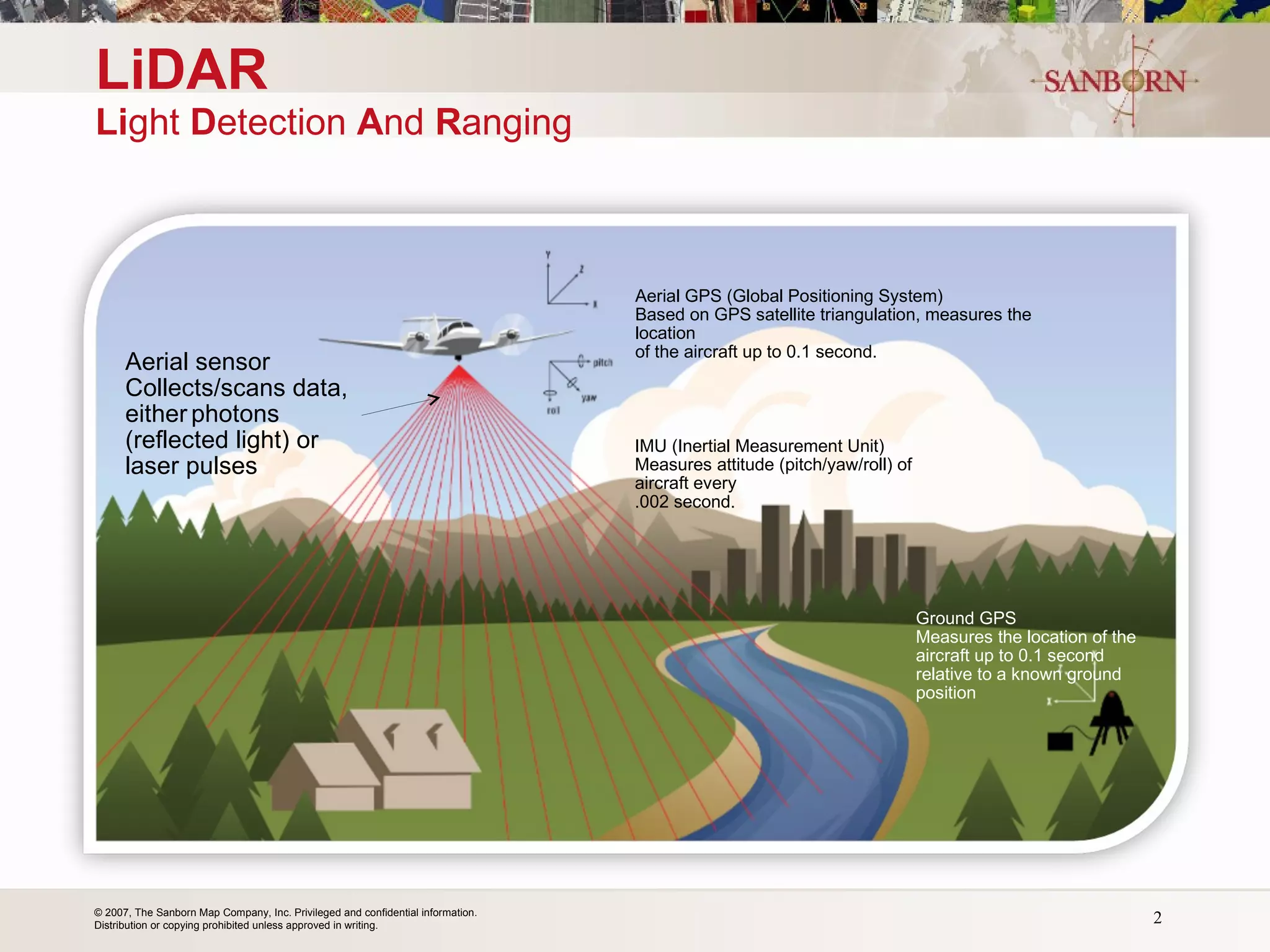
LiDAR Li ght  D etection  A nd  R anging Aerial sensor Collects/scans data, either   photons (reflected light) or laser pulses Aerial GPS (Global Positioning System)  Based on GPS satellite triangulation, measures the location  of the aircraft up to 0.1 second. IMU (Inertial Measurement Unit) Measures attitude (pitch/yaw/roll) of aircraft every  .002 second. Ground GPS Measures the location of the aircraft up to 0.1 second relative to a known ground position
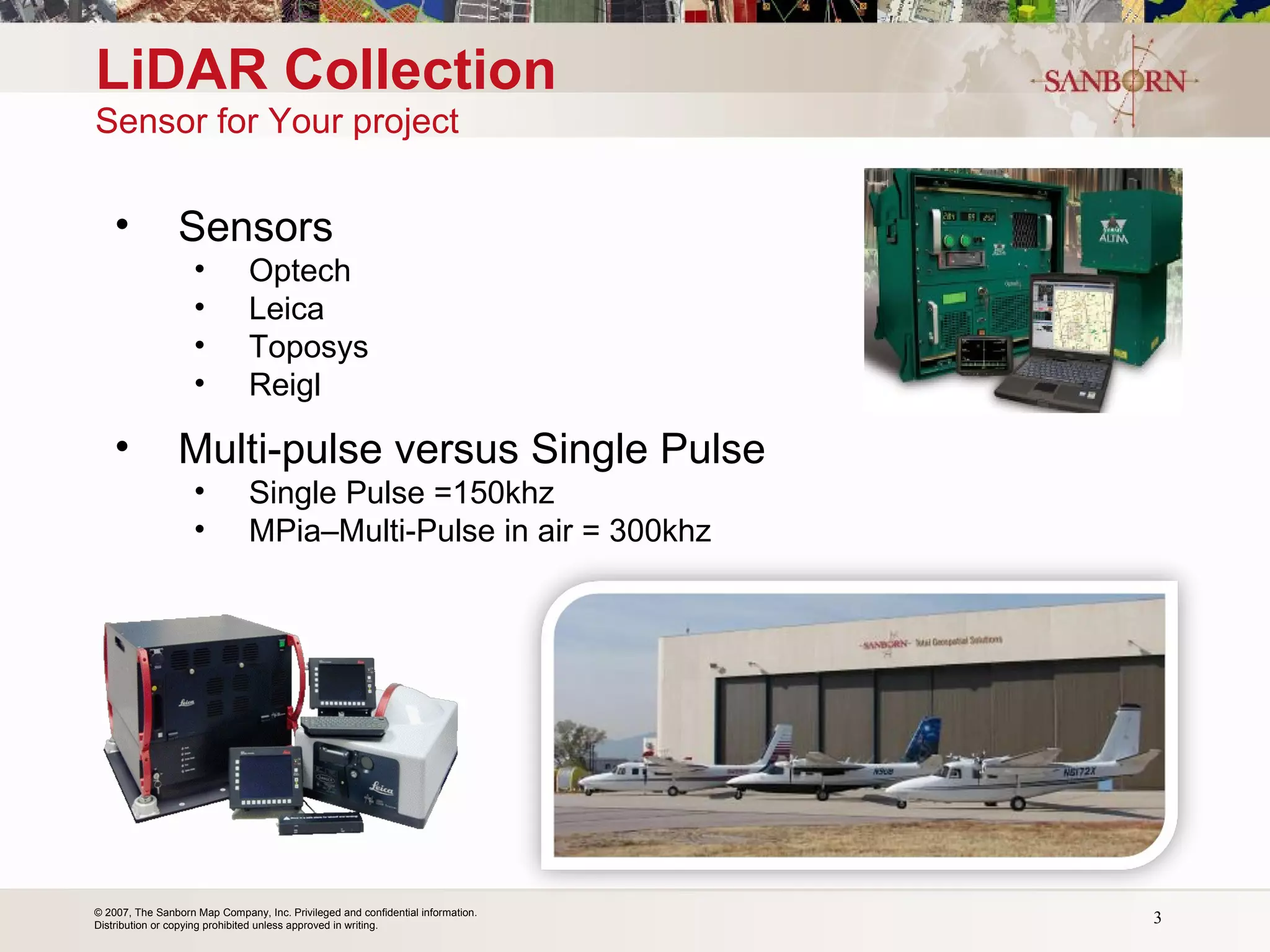
LiDAR Collection   Sensor for Your project Sensors  Optech Leica Toposys Reigl Multi-pulse versus Single Pulse Single Pulse =150khz MPia – Multi-Pulse in air = 300khz
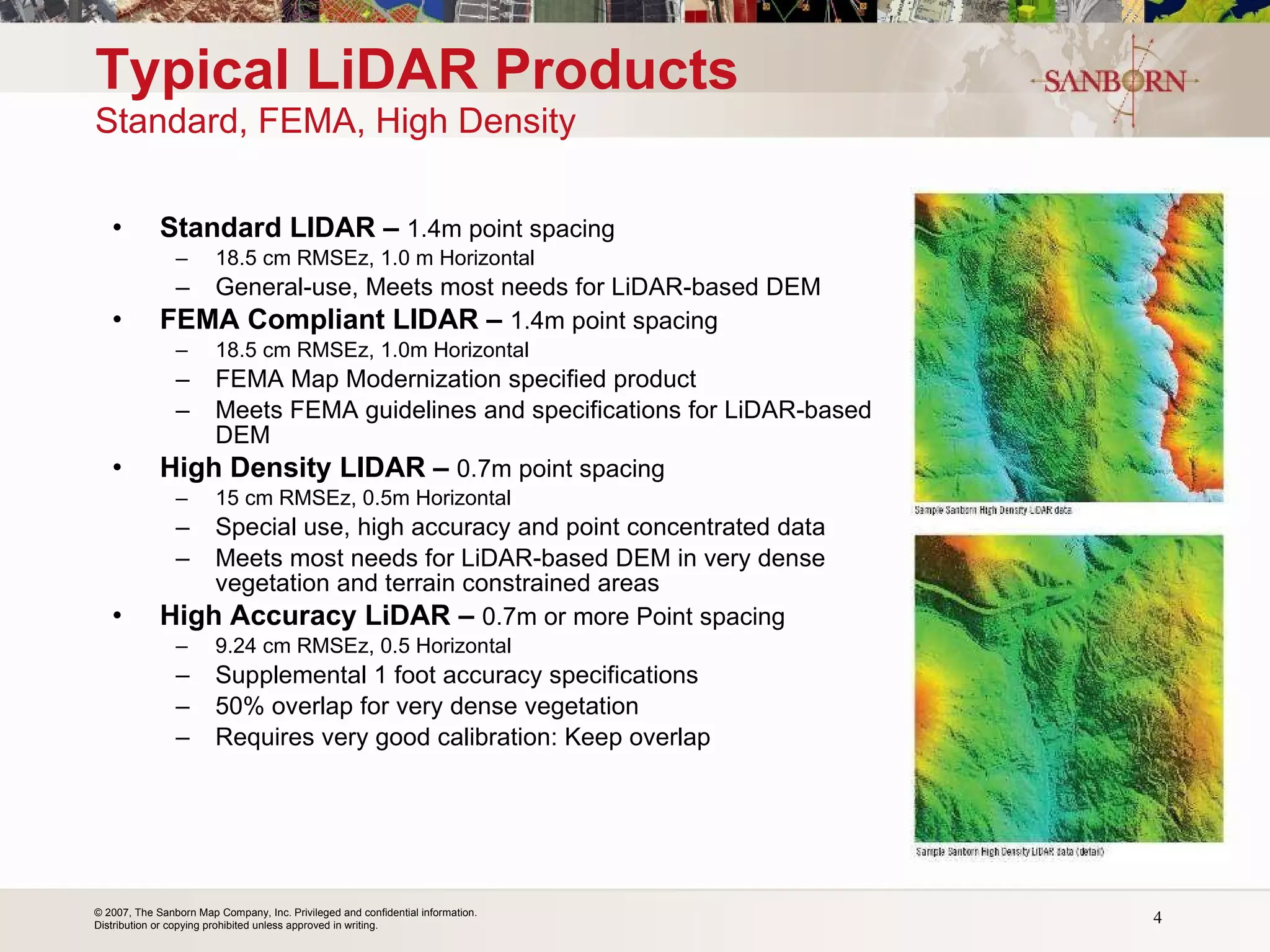
Standard LIDAR –  1.4m point spacing  18.5 cm RMSEz, 1.0 m Horizontal General-use, Meets most needs for LiDAR-based DEM FEMA Compliant LIDAR –  1.4m point spacing 18.5 cm RMSEz, 1.0m Horizontal FEMA Map Modernization specified product Meets FEMA guidelines and specifications for LiDAR-based DEM High Density LIDAR –  0.7m point spacing 15 cm RMSEz, 0.5m Horizontal  Special use, high accuracy and point concentrated data  Meets most needs for LiDAR-based DEM in very dense vegetation and terrain constrained areas High Accuracy LiDAR –   0.7m or more Point spacing 9.24 cm RMSEz, 0.5 Horizontal Supplemental 1 foot accuracy specifications 50% overlap for very dense vegetation Requires very good calibration: Keep overlap Typical LiDAR Products Standard, FEMA, High Density
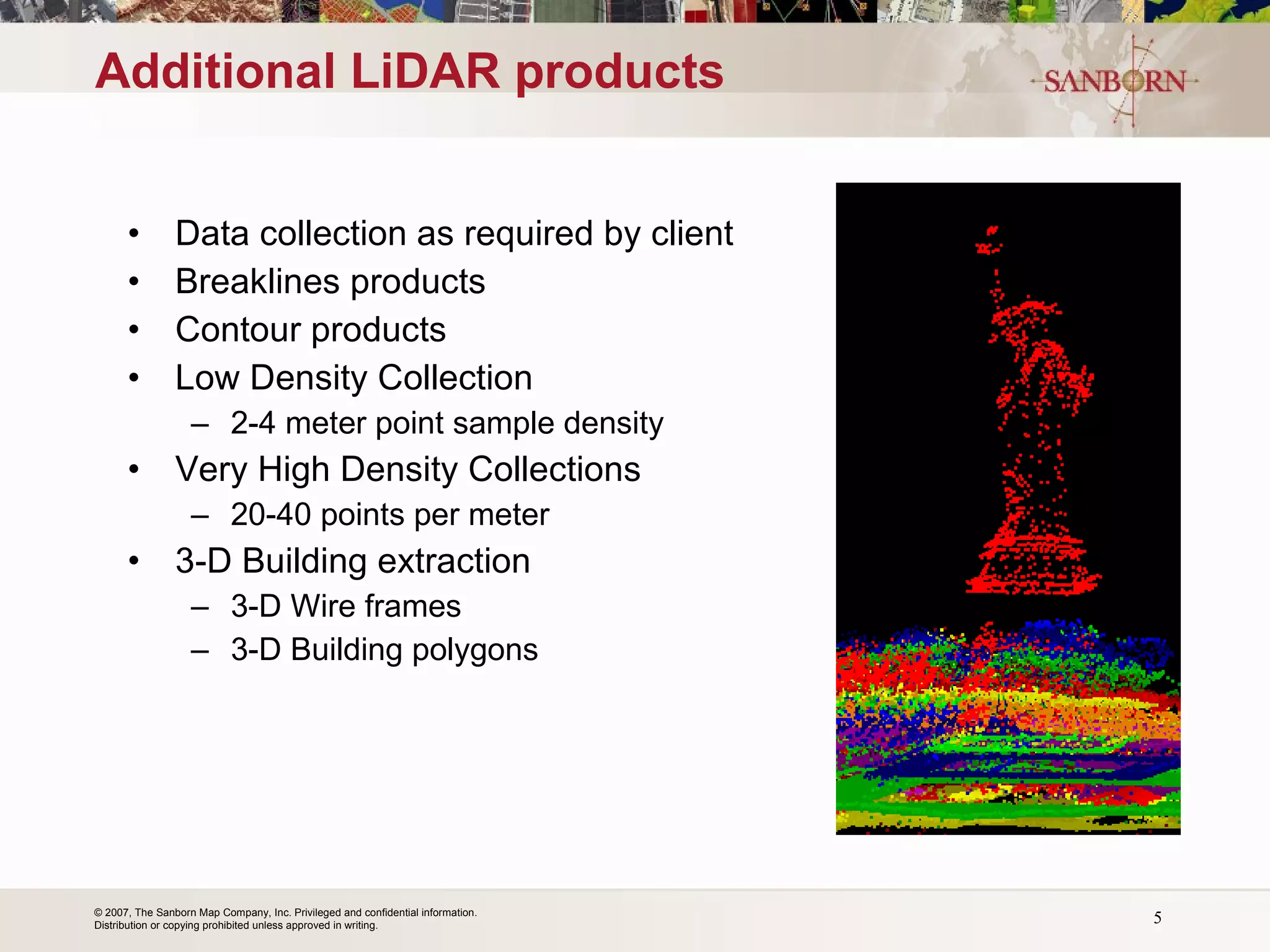
Additional LiDAR products Data collection as required by client Breaklines products Contour products  Low Density Collection 2-4 meter point sample density Very High Density Collections 20-40 points per meter 3-D Building extraction 3-D Wire frames 3-D Building polygons
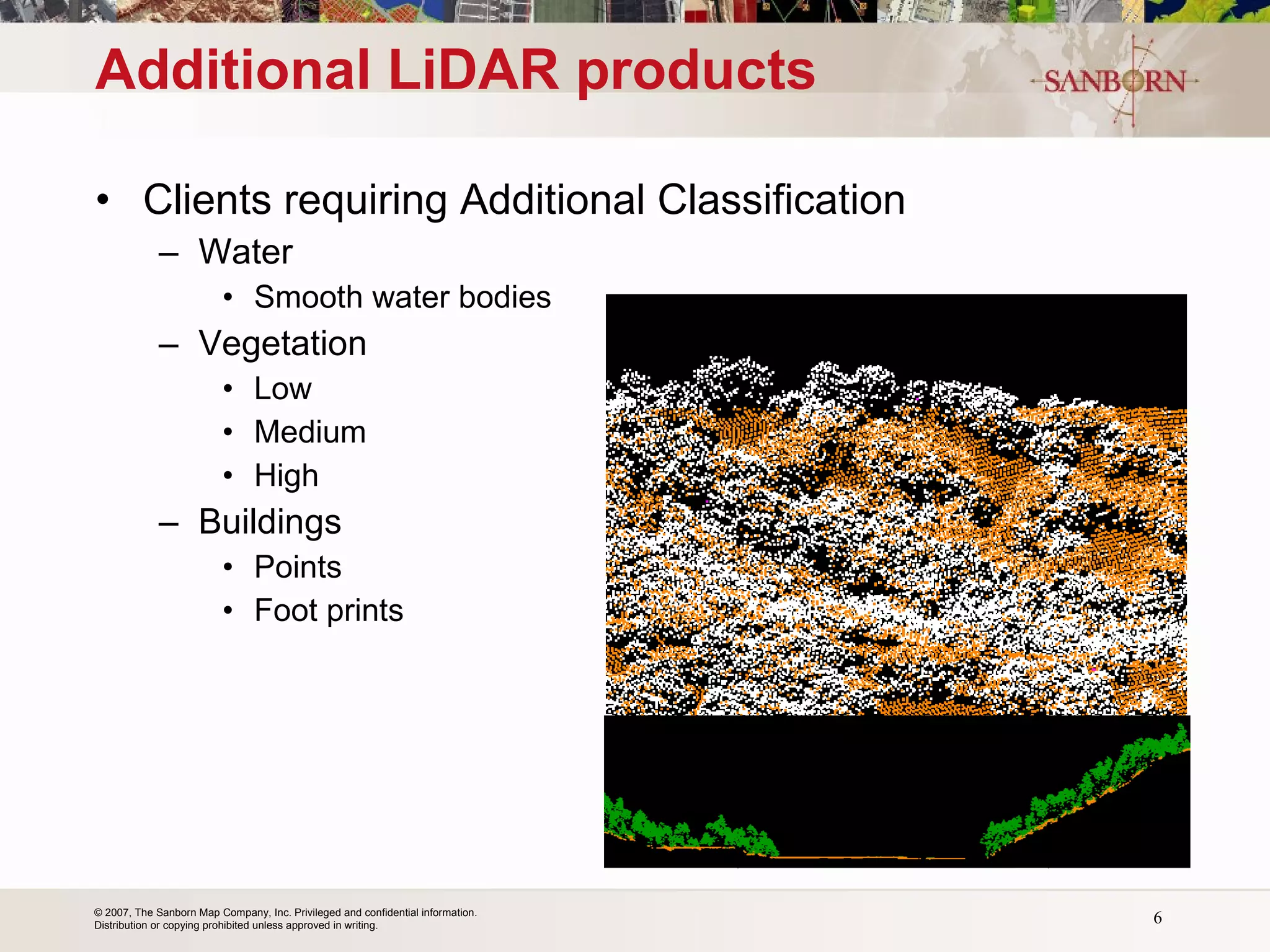
Additional LiDAR products Clients requiring Additional Classification Water Smooth water bodies Vegetation Low Medium High Buildings Points Foot prints
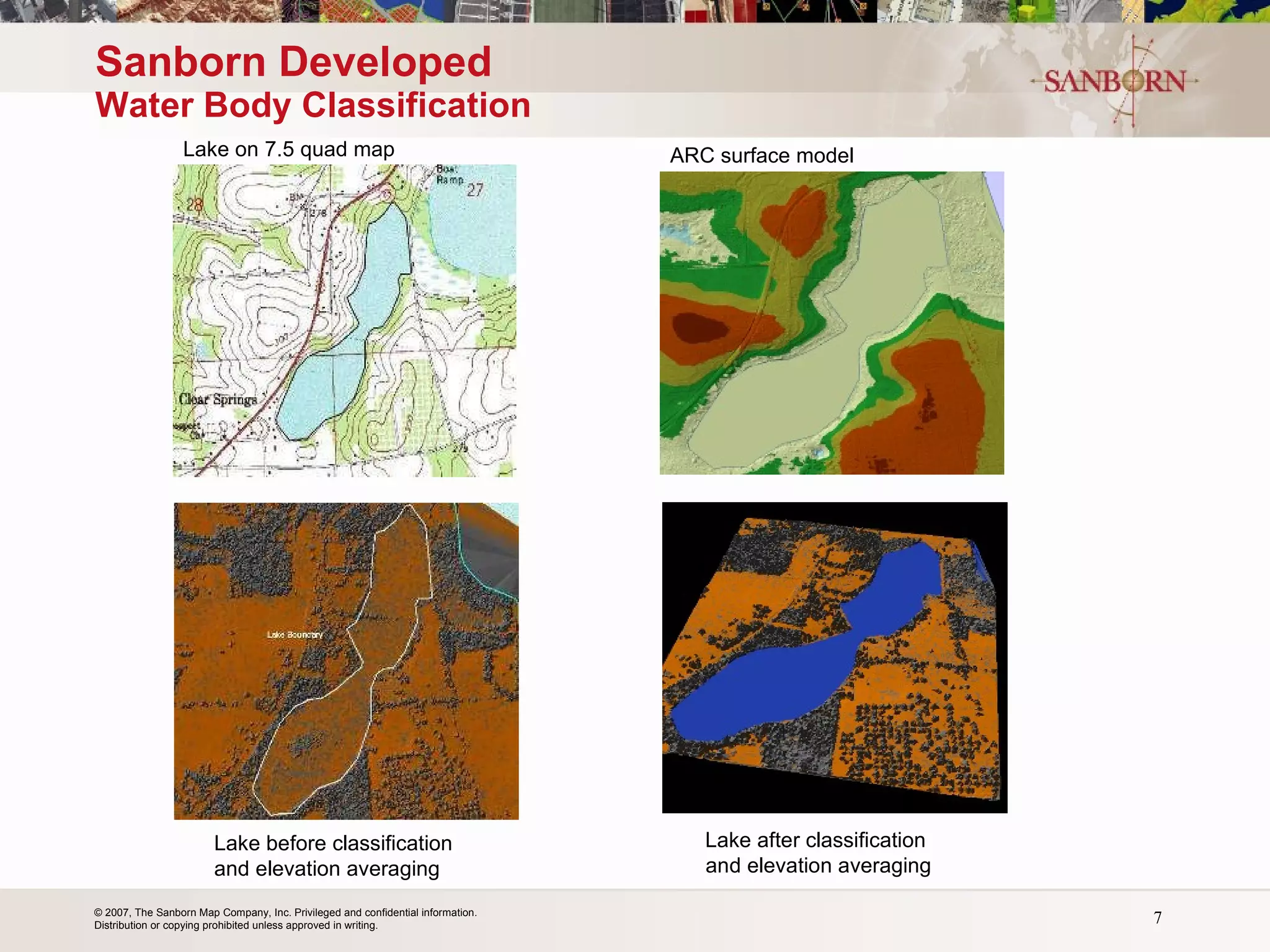
Sanborn Developed   Water Body Classification Lake on 7.5 quad map Lake before classification  and elevation averaging Lake after classification and elevation averaging ARC surface model
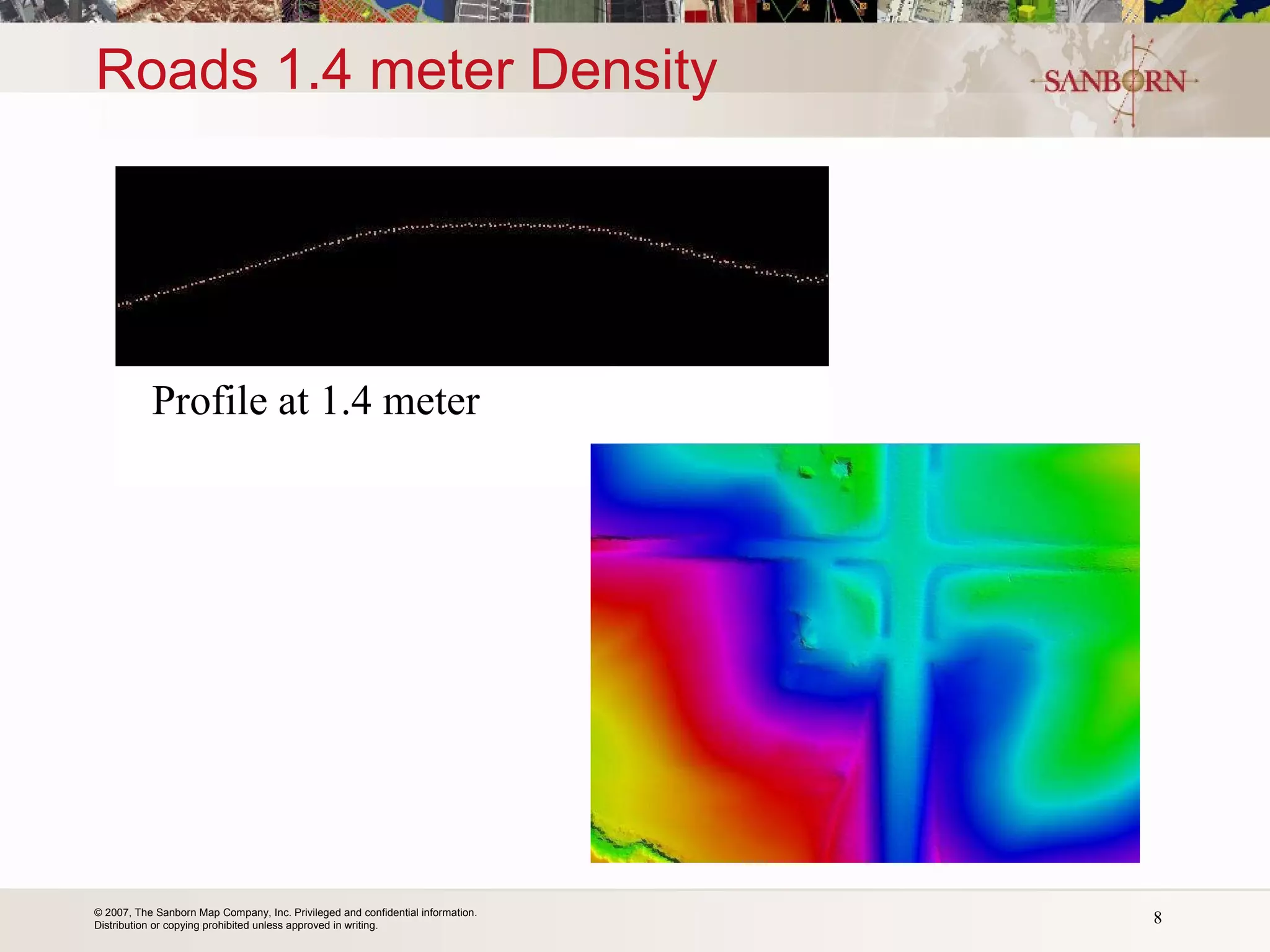
Roads 1.4 meter Density Profile at 1.4 meter
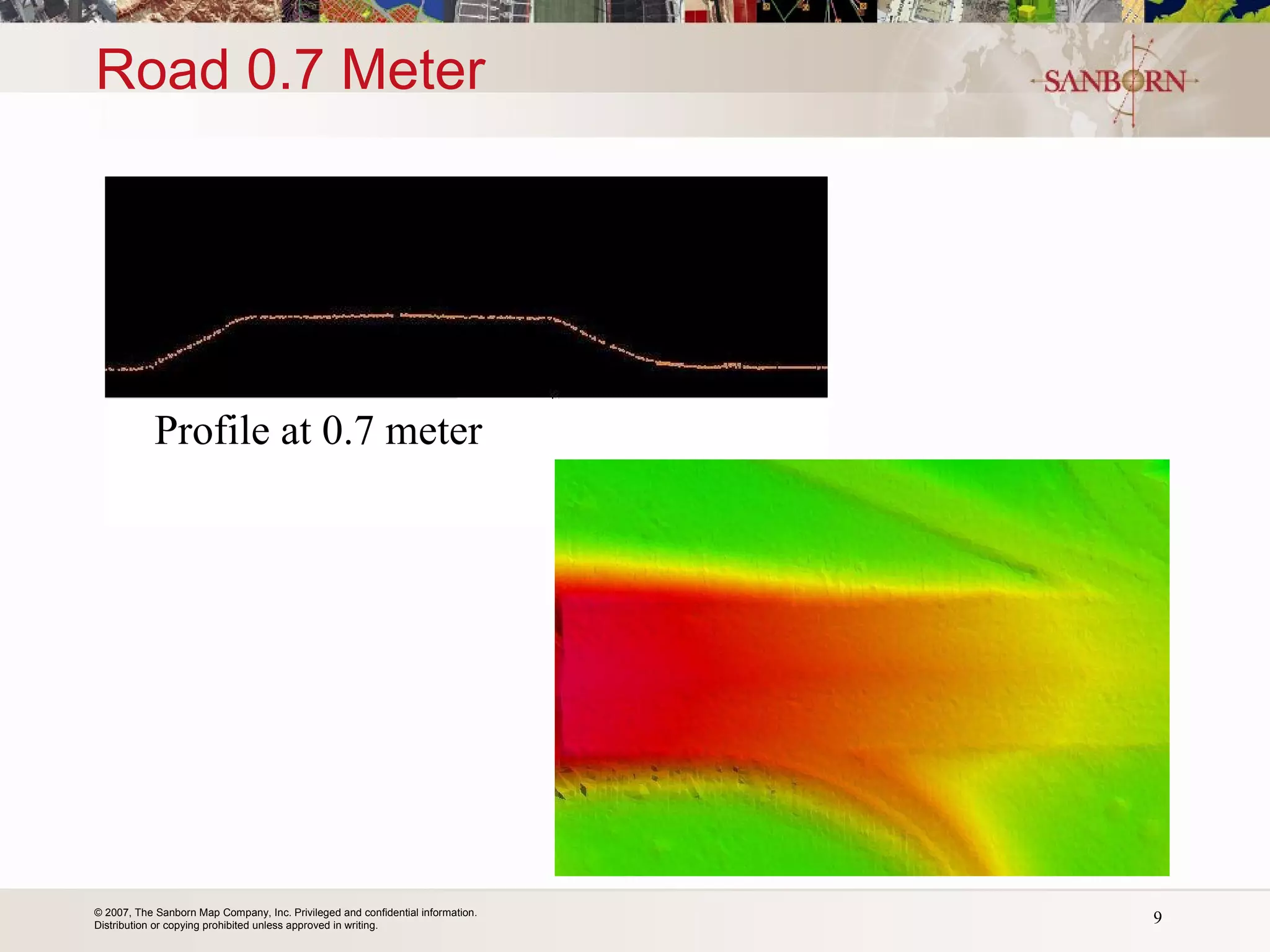
Road 0.7 Meter Profile at 0.7 meter
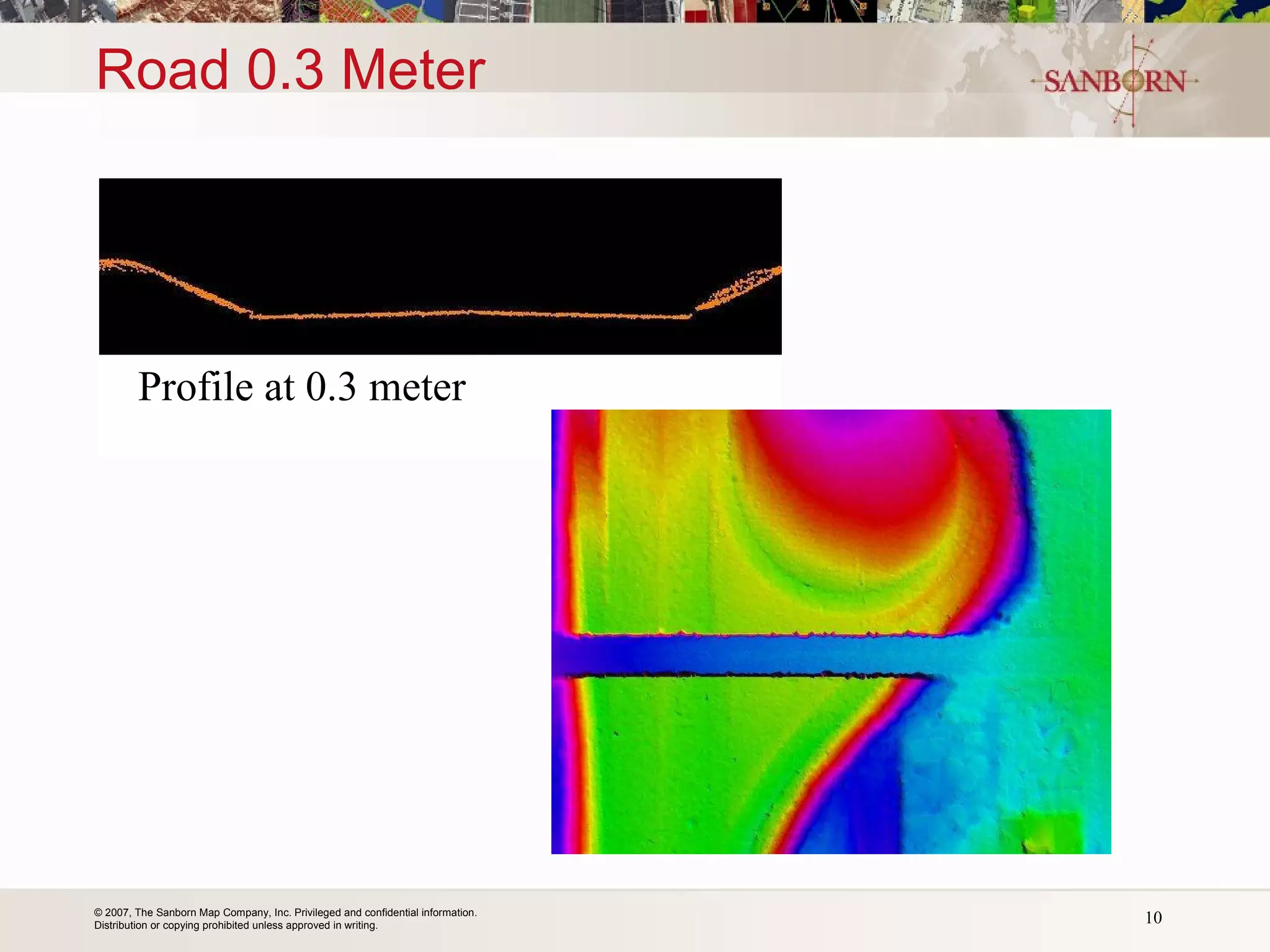
Road 0.3 Meter  Profile at 0.3 meter
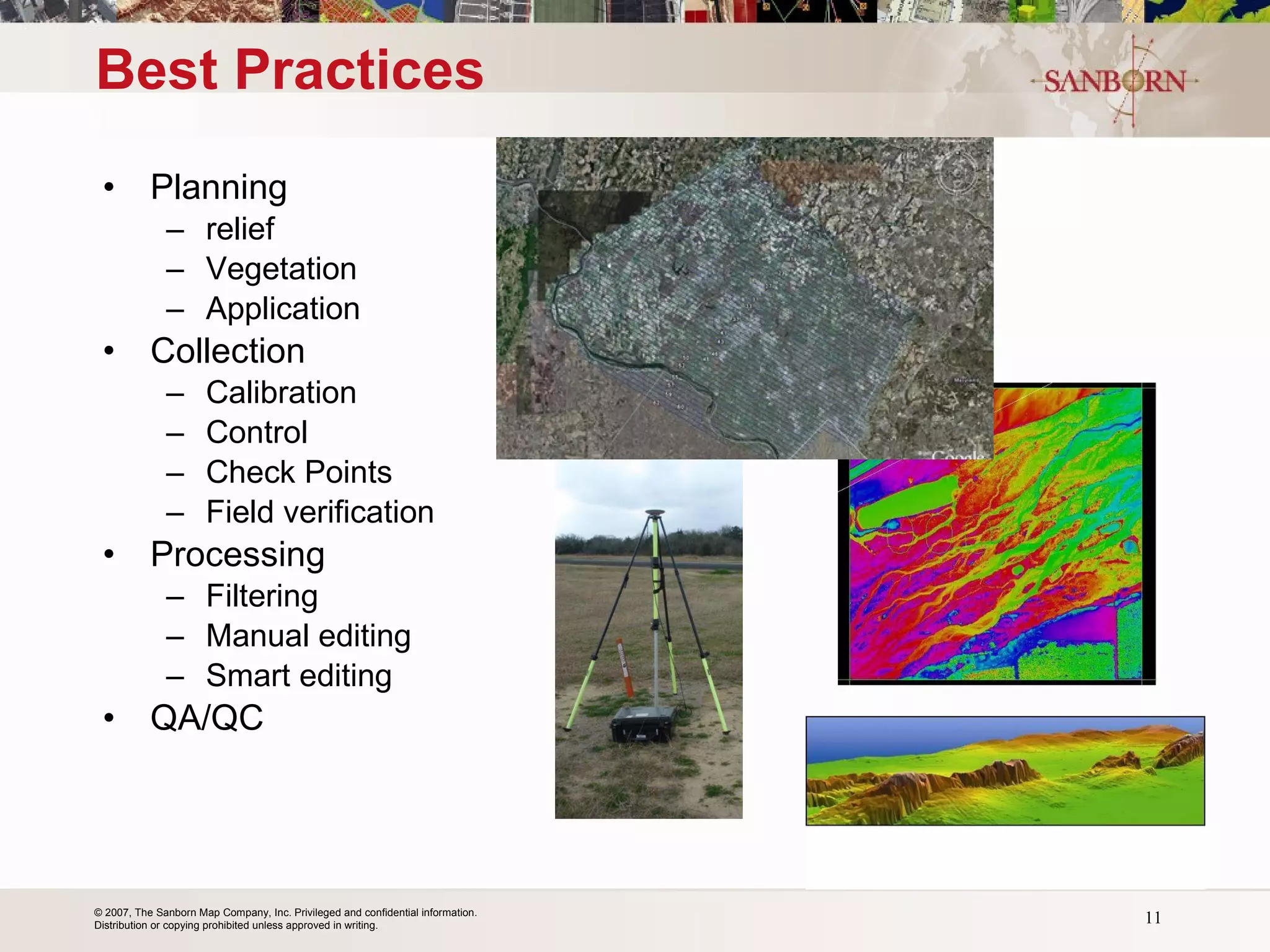
Best Practices Planning relief Vegetation Application Collection Calibration Control Check Points Field verification Processing Filtering Manual editing Smart editing QA/QC
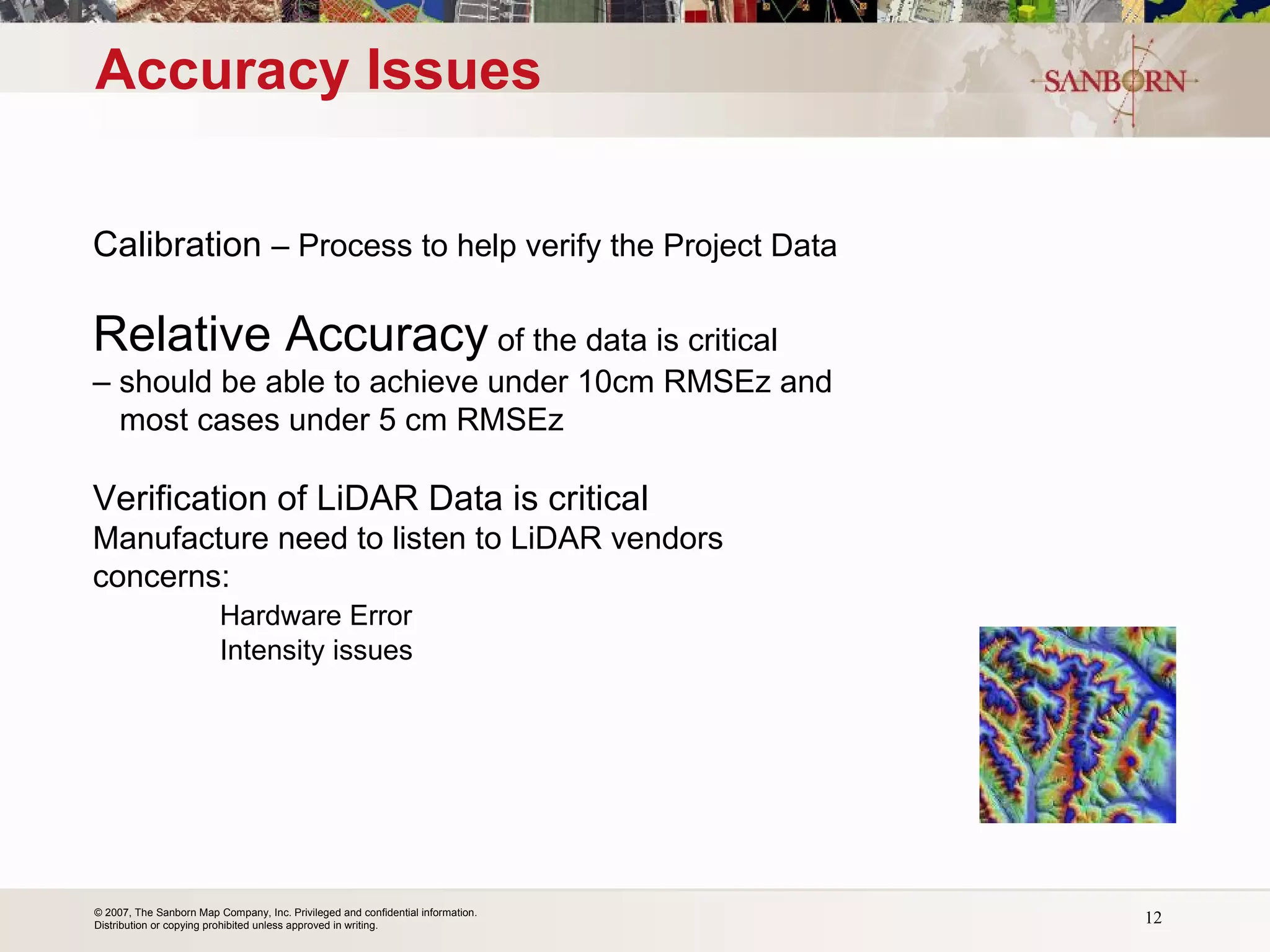
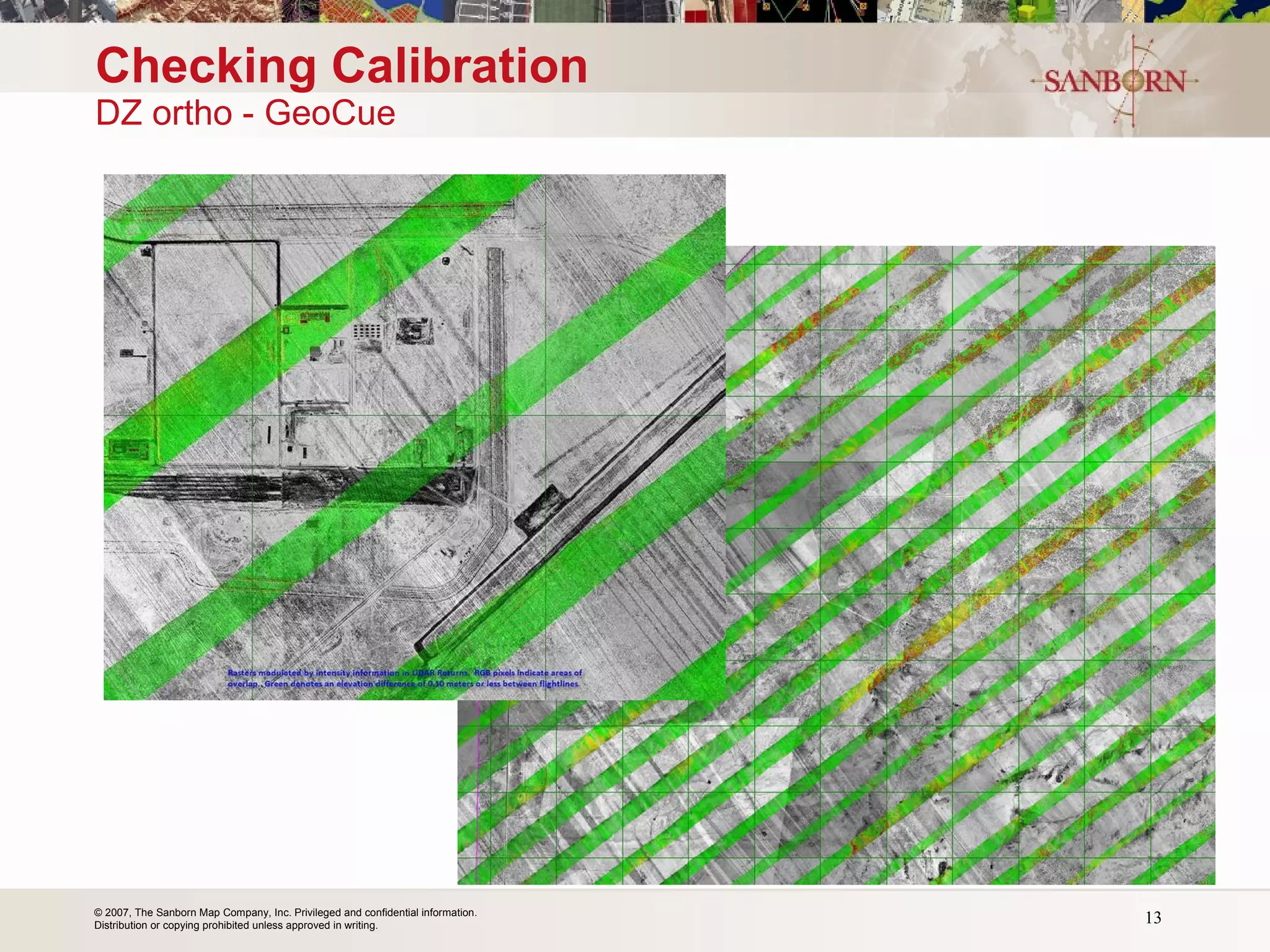
Accuracy Issues Calibration  – Process to help verify the Project Data Relative Accuracy  of the data is critical  –  should be able to achieve under 10cm RMSEz and    most cases under 5 cm RMSEz  Verification of LiDAR Data is critical  Manufacture need to listen to LiDAR vendors  concerns: Hardware Error Intensity issues
Checking Calibration DZ ortho - GeoCue
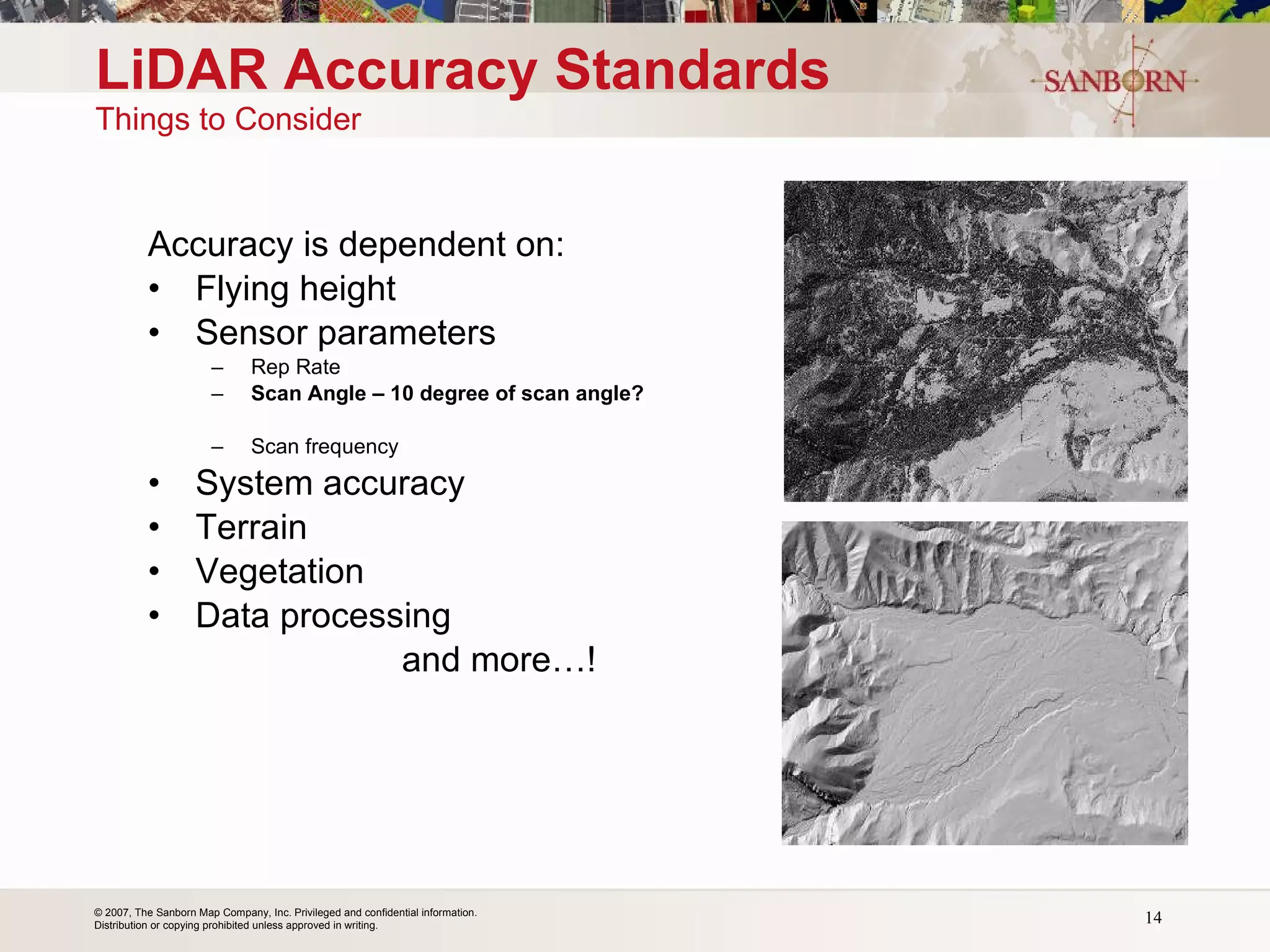
LiDAR Accuracy Standards Things to Consider Accuracy is dependent on: Flying height Sensor parameters Rep Rate Scan Angle – 10 degree of scan angle? Scan frequency System accuracy  Terrain Vegetation Data processing and more…!
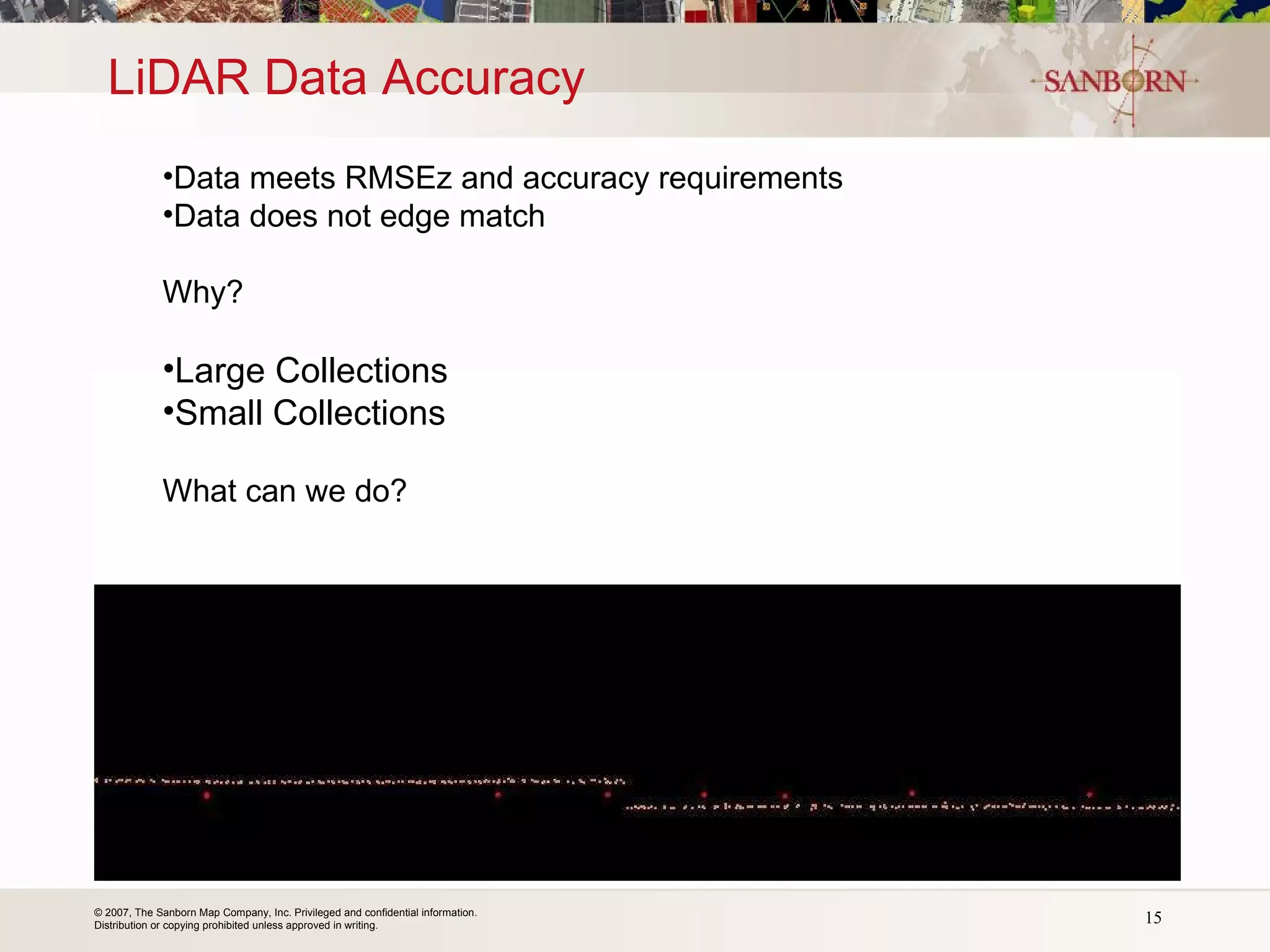
LiDAR Data Accuracy Data meets RMSEz and accuracy requirements Data does not edge match Why? Large Collections Small Collections What can we do?
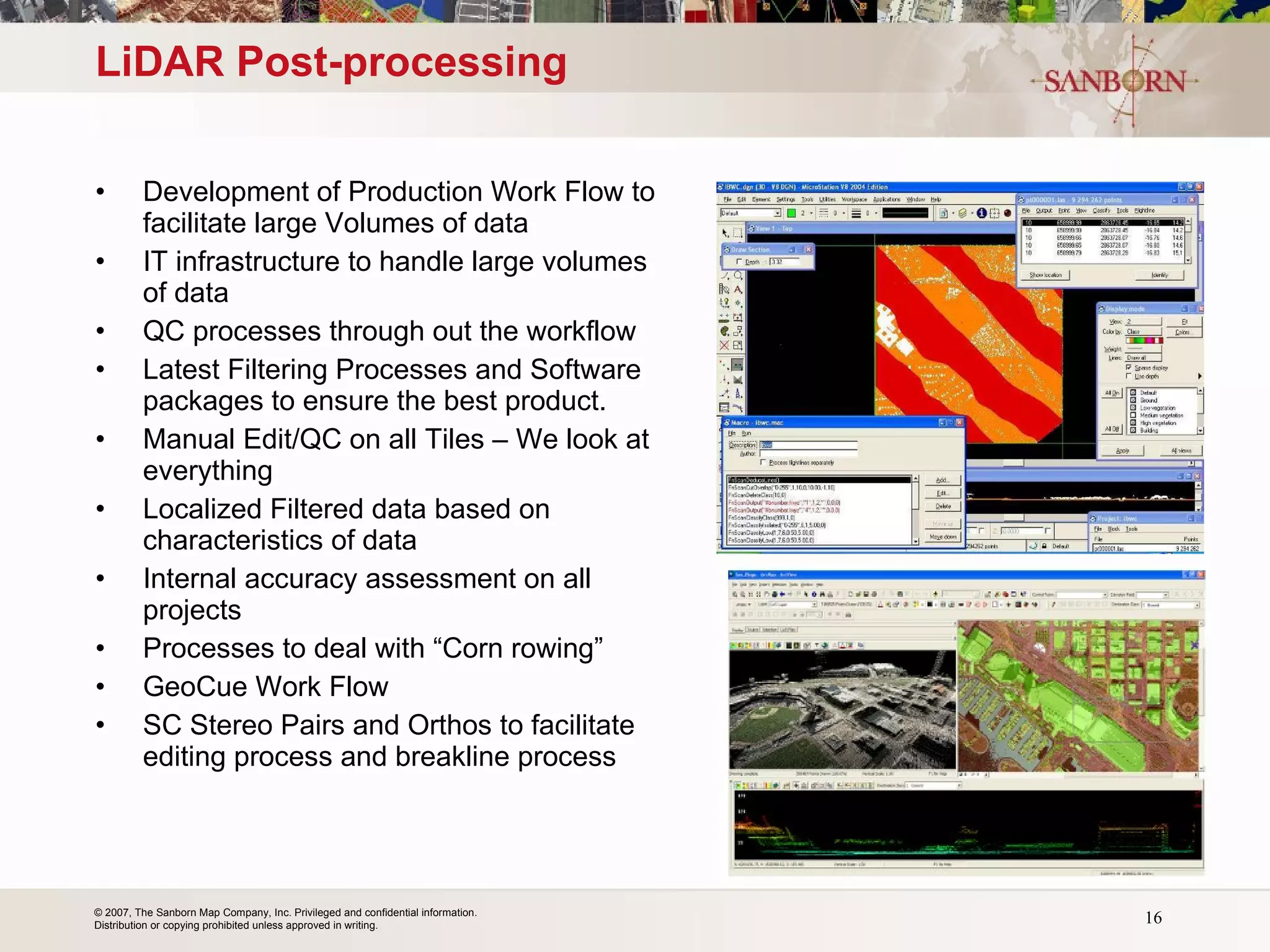
LiDAR Post-processing Development of Production Work Flow to facilitate large Volumes of data IT infrastructure to handle large volumes of data QC processes through out the workflow Latest Filtering Processes and Software packages to ensure the best product. Manual Edit/QC on all Tiles – We look at everything Localized Filtered data based on characteristics of data Internal accuracy assessment on all projects Processes to deal with “Corn rowing” GeoCue Work Flow SC Stereo Pairs and Orthos to facilitate editing process and breakline process
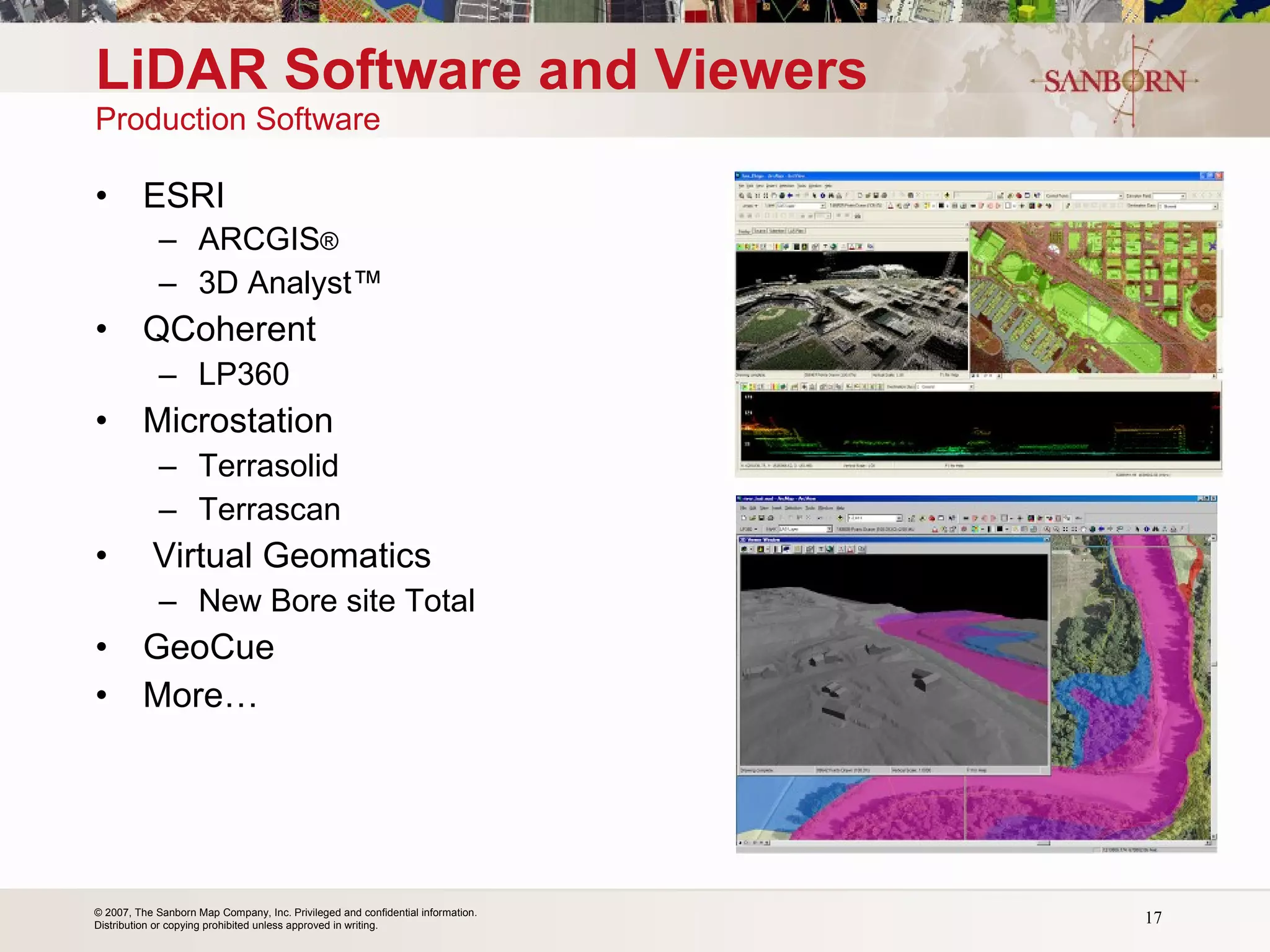
LiDAR Software and Viewers Production Software ESRI ARCGIS ® 3D Analyst ™   QCoherent  LP360 Microstation Terrasolid Terrascan Virtual Geomatics New Bore site Total  GeoCue More…
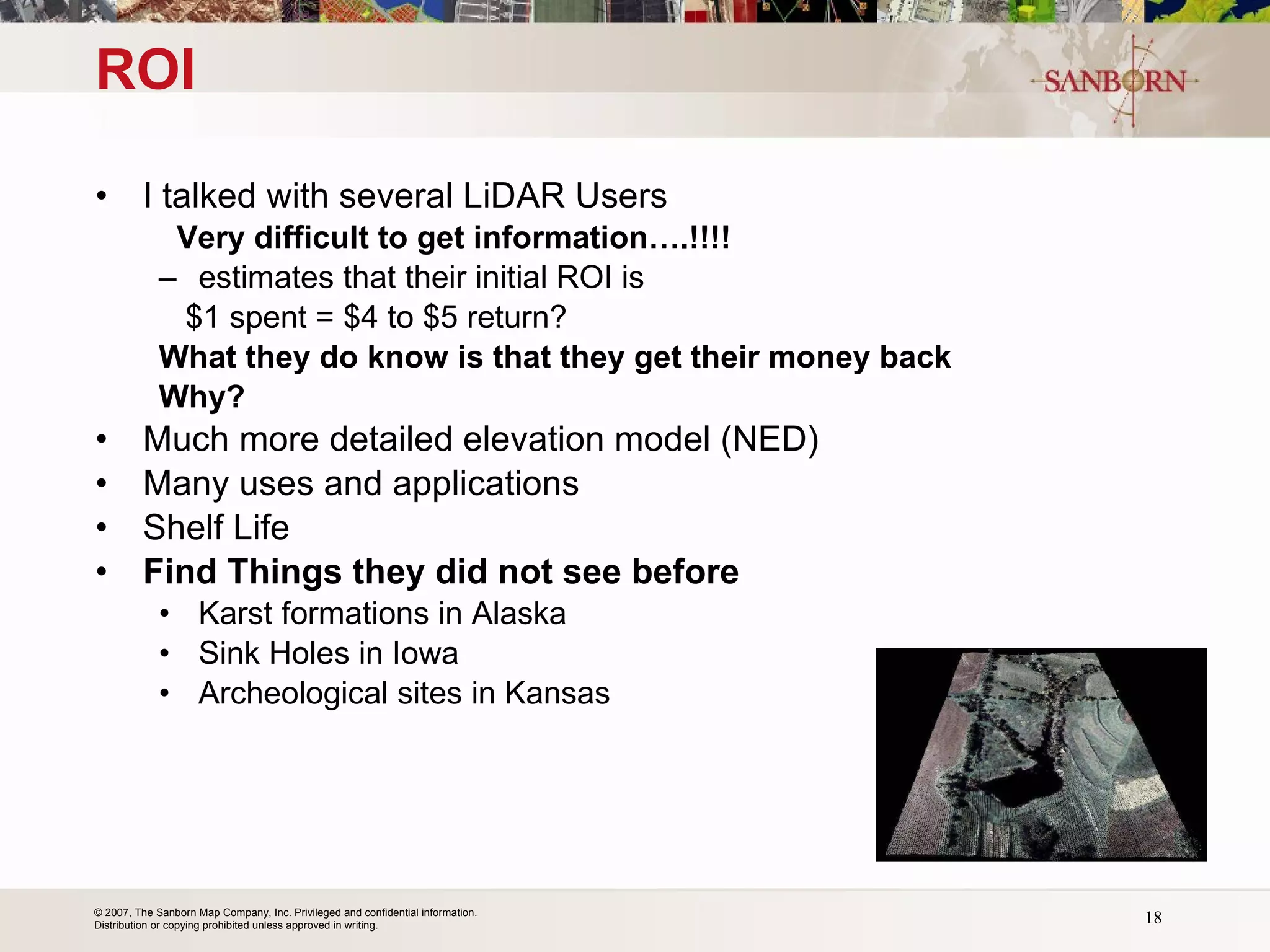
ROI I talked with several LiDAR Users  Very difficult to get information….!!!! estimates that their initial ROI is  $1 spent = $4 to $5 return? What they do know is that they get their money back Why? Much more detailed elevation model (NED) Many uses and applications Shelf Life Find Things they did not see before Karst formations in Alaska Sink Holes in Iowa Archeological sites in Kansas
What Else  What clients have to say… Less expensive?  – more economical than traditional surveying or Photogrammetry Faster data?  much more detailed Collection around the clock No AT, orthorectification or mosaicing required Reliable terrain data  –penetrates canopy Non-intrusive  – no land access required for paneling or surveying More accurate  then auto-correlation Multiple uses
What Else? Clear shortcomings in existing elevation data sets that make shareholders tasks impossible to complete LiDAR lifespan   Most states -10 years FEMA -15 to 20 years Current elevation data does not meet business needs Consider  different resolutions  in  different areas  to get most money out of collection.  Better, cheaper, faster? Remote assess to some regions a concern. Is it here?
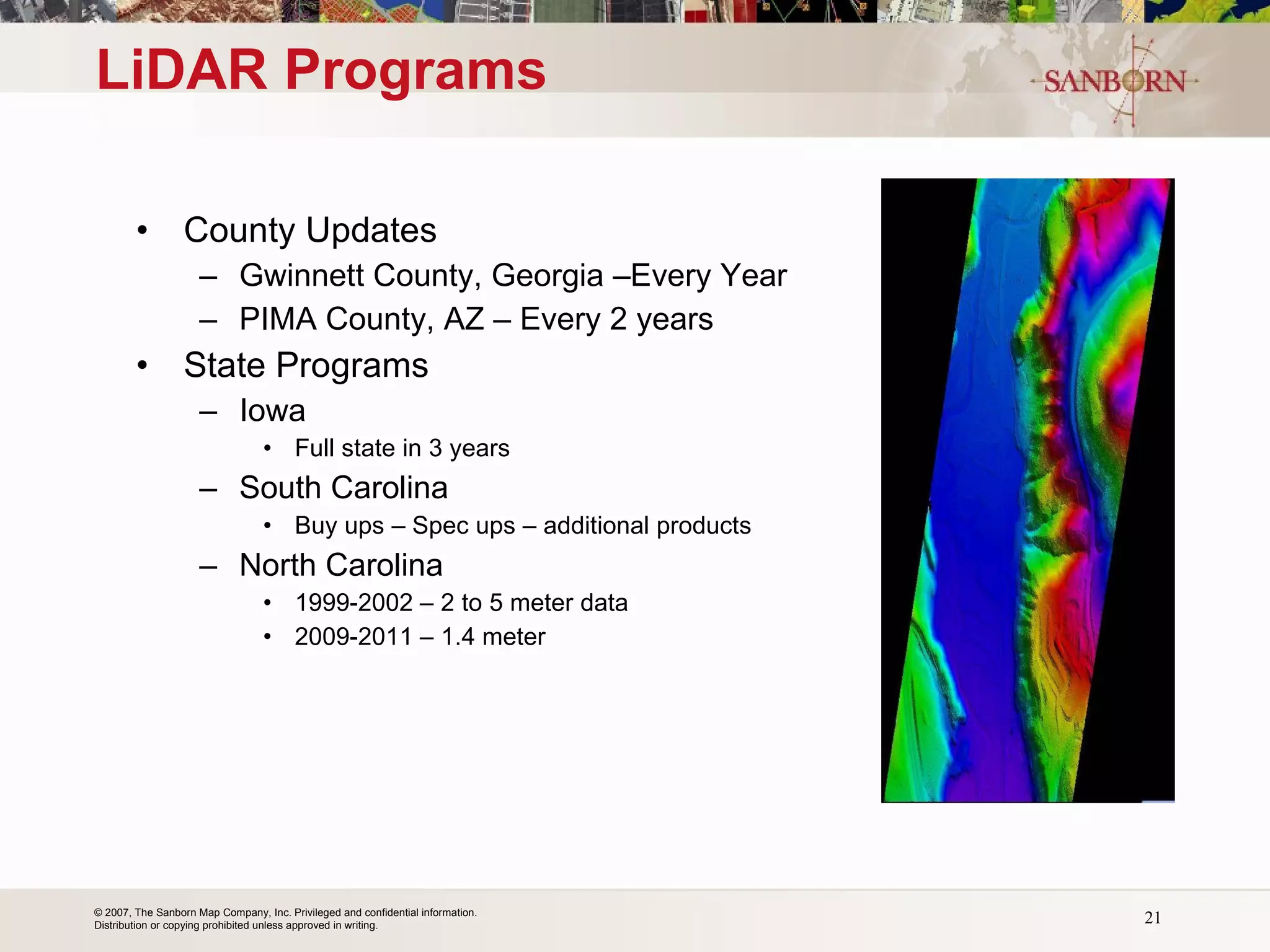
LiDAR Programs County Updates Gwinnett County, Georgia –Every Year PIMA County, AZ – Every 2 years State Programs Iowa Full state in 3 years South Carolina Buy ups – Spec ups – additional products North Carolina 1999-2002 – 2 to 5 meter data 2009-2011 – 1.4 meter
What else? Consider including  many agencies  to spread the cost Determine the best resolution for all How do you prioritize collection? Population or money usually does this Set up a  contracting vehicle  or use an existing one Lastly- QA/QC cost to make sure your data is good
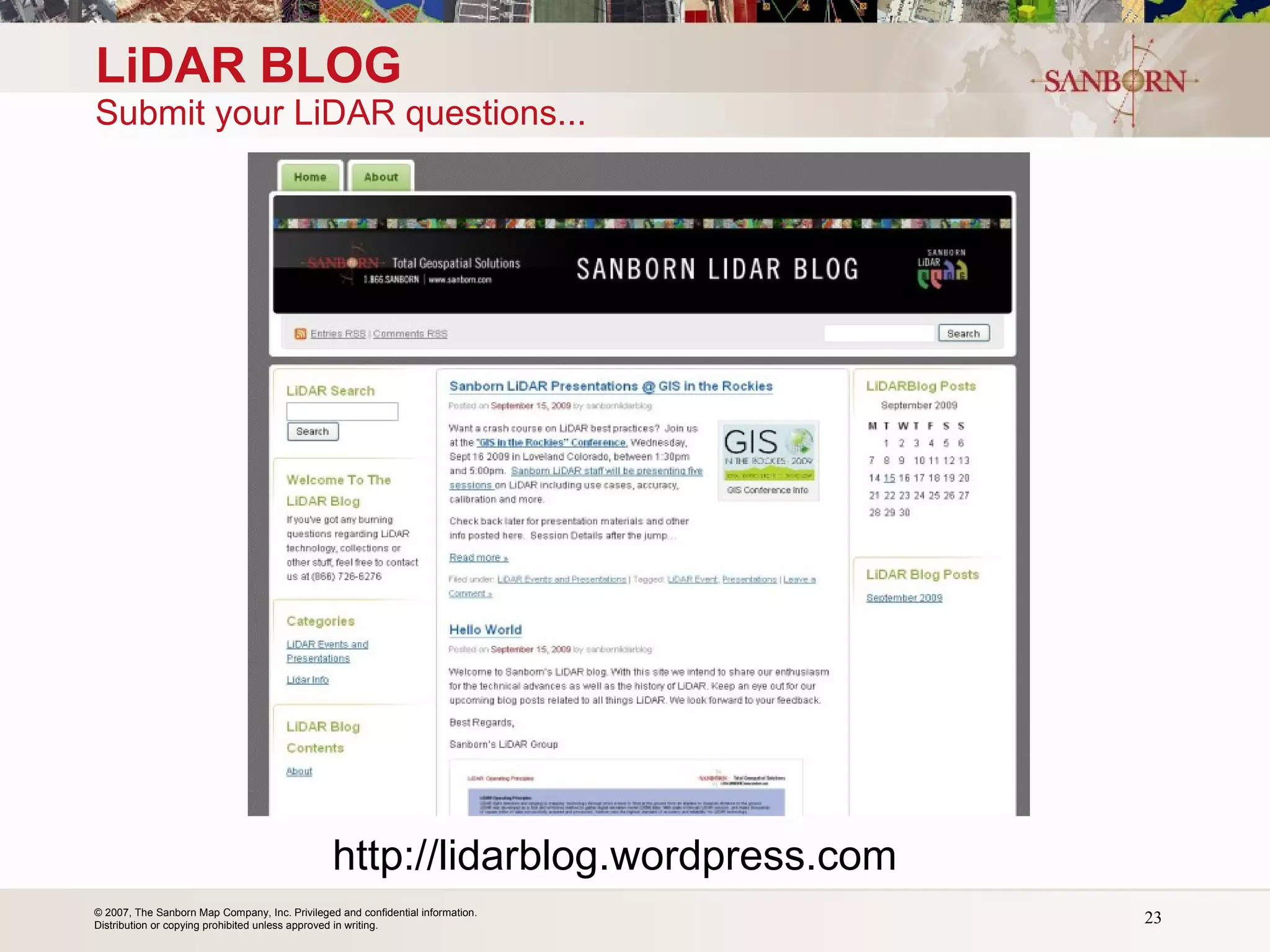
LiDAR BLOG Submit your LiDAR questions... http://lidarblog.wordpress.com
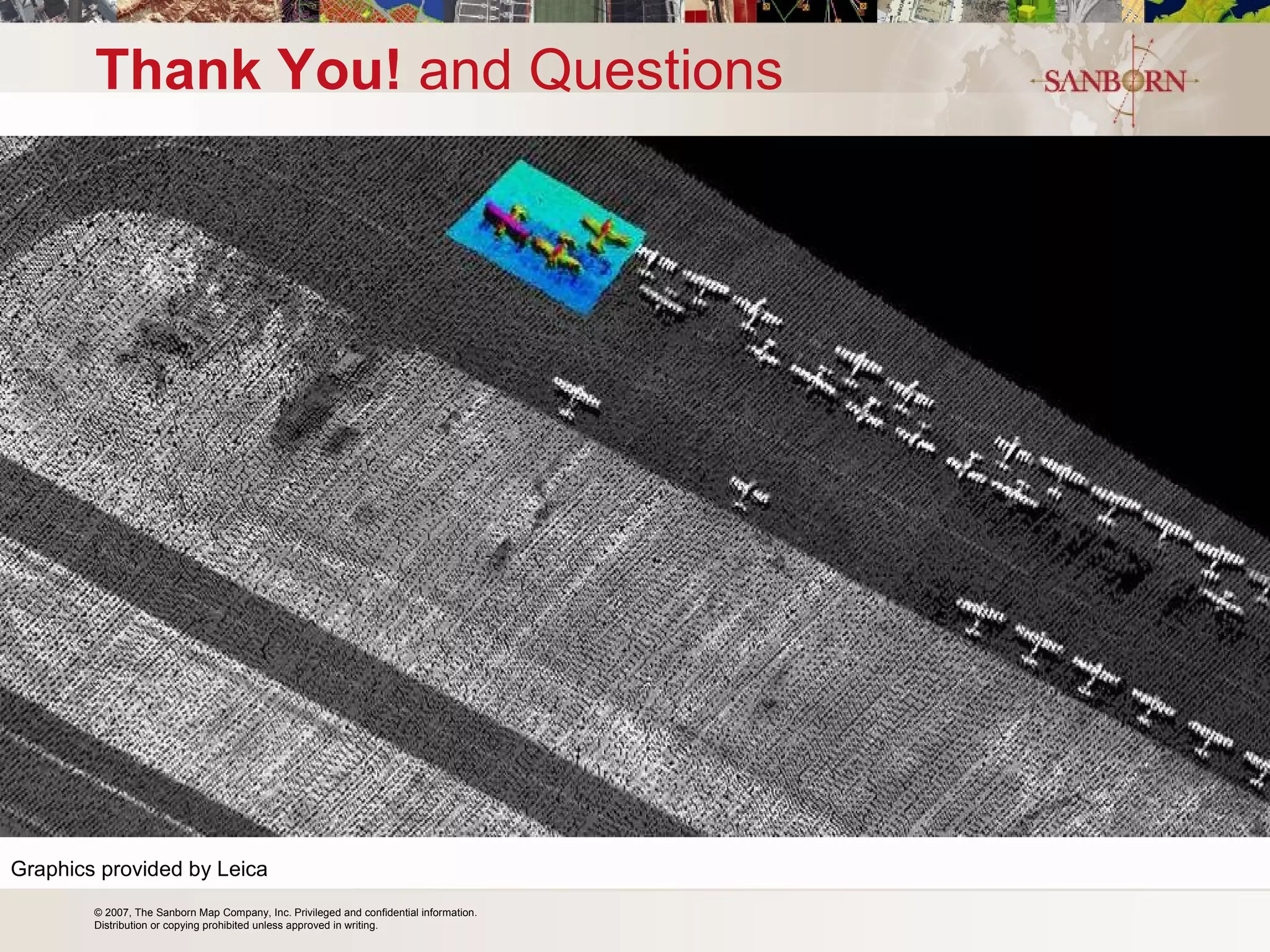
Thank You!  and Questions Graphics provided by Leica

"Why LiDAR?" Presentation

  • 1.
    LiDAR- Why DoWe need it? Benefits of Having High Resolution LiDAR Data September 16 th , 2009 GIS in The Rockies Presented by: Jamie Young General Manager – LiDAR services
  • 2.
    LiDAR Li ght D etection A nd R anging Aerial sensor Collects/scans data, either photons (reflected light) or laser pulses Aerial GPS (Global Positioning System) Based on GPS satellite triangulation, measures the location of the aircraft up to 0.1 second. IMU (Inertial Measurement Unit) Measures attitude (pitch/yaw/roll) of aircraft every .002 second. Ground GPS Measures the location of the aircraft up to 0.1 second relative to a known ground position
  • 3.
    LiDAR Collection Sensor for Your project Sensors Optech Leica Toposys Reigl Multi-pulse versus Single Pulse Single Pulse =150khz MPia – Multi-Pulse in air = 300khz
  • 4.
    Standard LIDAR – 1.4m point spacing 18.5 cm RMSEz, 1.0 m Horizontal General-use, Meets most needs for LiDAR-based DEM FEMA Compliant LIDAR – 1.4m point spacing 18.5 cm RMSEz, 1.0m Horizontal FEMA Map Modernization specified product Meets FEMA guidelines and specifications for LiDAR-based DEM High Density LIDAR – 0.7m point spacing 15 cm RMSEz, 0.5m Horizontal Special use, high accuracy and point concentrated data Meets most needs for LiDAR-based DEM in very dense vegetation and terrain constrained areas High Accuracy LiDAR – 0.7m or more Point spacing 9.24 cm RMSEz, 0.5 Horizontal Supplemental 1 foot accuracy specifications 50% overlap for very dense vegetation Requires very good calibration: Keep overlap Typical LiDAR Products Standard, FEMA, High Density
  • 5.
    Additional LiDAR productsData collection as required by client Breaklines products Contour products Low Density Collection 2-4 meter point sample density Very High Density Collections 20-40 points per meter 3-D Building extraction 3-D Wire frames 3-D Building polygons
  • 6.
    Additional LiDAR productsClients requiring Additional Classification Water Smooth water bodies Vegetation Low Medium High Buildings Points Foot prints
  • 7.
    Sanborn Developed Water Body Classification Lake on 7.5 quad map Lake before classification and elevation averaging Lake after classification and elevation averaging ARC surface model
  • 8.
    Roads 1.4 meterDensity Profile at 1.4 meter
  • 9.
    Road 0.7 MeterProfile at 0.7 meter
  • 10.
    Road 0.3 Meter Profile at 0.3 meter
  • 11.
    Best Practices Planningrelief Vegetation Application Collection Calibration Control Check Points Field verification Processing Filtering Manual editing Smart editing QA/QC
  • 12.
    Accuracy Issues Calibration – Process to help verify the Project Data Relative Accuracy of the data is critical – should be able to achieve under 10cm RMSEz and most cases under 5 cm RMSEz Verification of LiDAR Data is critical Manufacture need to listen to LiDAR vendors concerns: Hardware Error Intensity issues
  • 13.
  • 14.
    LiDAR Accuracy StandardsThings to Consider Accuracy is dependent on: Flying height Sensor parameters Rep Rate Scan Angle – 10 degree of scan angle? Scan frequency System accuracy Terrain Vegetation Data processing and more…!
  • 15.
    LiDAR Data AccuracyData meets RMSEz and accuracy requirements Data does not edge match Why? Large Collections Small Collections What can we do?
  • 16.
    LiDAR Post-processing Developmentof Production Work Flow to facilitate large Volumes of data IT infrastructure to handle large volumes of data QC processes through out the workflow Latest Filtering Processes and Software packages to ensure the best product. Manual Edit/QC on all Tiles – We look at everything Localized Filtered data based on characteristics of data Internal accuracy assessment on all projects Processes to deal with “Corn rowing” GeoCue Work Flow SC Stereo Pairs and Orthos to facilitate editing process and breakline process
  • 17.
    LiDAR Software andViewers Production Software ESRI ARCGIS ® 3D Analyst ™ QCoherent LP360 Microstation Terrasolid Terrascan Virtual Geomatics New Bore site Total GeoCue More…
  • 18.
    ROI I talkedwith several LiDAR Users Very difficult to get information….!!!! estimates that their initial ROI is $1 spent = $4 to $5 return? What they do know is that they get their money back Why? Much more detailed elevation model (NED) Many uses and applications Shelf Life Find Things they did not see before Karst formations in Alaska Sink Holes in Iowa Archeological sites in Kansas
  • 19.
    What Else What clients have to say… Less expensive? – more economical than traditional surveying or Photogrammetry Faster data? much more detailed Collection around the clock No AT, orthorectification or mosaicing required Reliable terrain data –penetrates canopy Non-intrusive – no land access required for paneling or surveying More accurate then auto-correlation Multiple uses
  • 20.
    What Else? Clearshortcomings in existing elevation data sets that make shareholders tasks impossible to complete LiDAR lifespan Most states -10 years FEMA -15 to 20 years Current elevation data does not meet business needs Consider different resolutions in different areas to get most money out of collection. Better, cheaper, faster? Remote assess to some regions a concern. Is it here?
  • 21.
    LiDAR Programs CountyUpdates Gwinnett County, Georgia –Every Year PIMA County, AZ – Every 2 years State Programs Iowa Full state in 3 years South Carolina Buy ups – Spec ups – additional products North Carolina 1999-2002 – 2 to 5 meter data 2009-2011 – 1.4 meter
  • 22.
    What else? Considerincluding many agencies to spread the cost Determine the best resolution for all How do you prioritize collection? Population or money usually does this Set up a contracting vehicle or use an existing one Lastly- QA/QC cost to make sure your data is good
  • 23.
    LiDAR BLOG Submityour LiDAR questions... http://lidarblog.wordpress.com
  • 24.
    Thank You! and Questions Graphics provided by Leica

Editor's Notes

  • #4 50khz = 50,000 points per second
  • #15 How is this controlled
  • #18 All LiDAR formats can be viewed in the same software