The Reinvention of ManagementWhy do great KM programs fail?Steve Denningwww.stevedenning.comhttp://blogs.forbes.com/stevedenningsteve@stevedenning.com1
1996-2000Knowledge managementBy all indicators, an apparent success“A world leader in KM”2
2000-2008Knowledge managementBy all indicators, an apparent successPut on a back burnerNot just the World Bank BP
 Ernst & Young
 IBM
 HPWithin a few years, it had been put on a back-burner3
In 2008, I began exploring:Why do managers act this way? (These are highly intelligent, educated people!)4
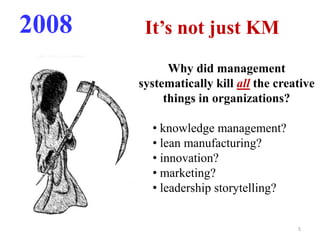
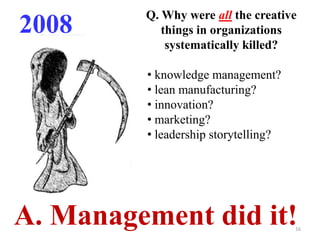
2008It’s not just KMWhy did management systematically kill all the creative things in organizations? knowledge management?
 lean manufacturing?
 innovation?
 marketing?
 leadership storytelling?5
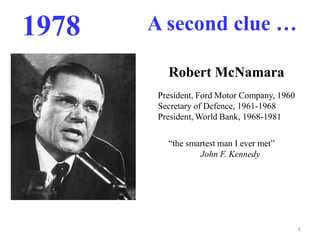
1978A second clue …Robert McNamaraPresident, Ford Motor Company, 1960Secretary of Defence, 1961-1968President, World Bank, 1968-1981“the smartest man I ever met”John F. Kennedy6
Most management textbooks…Most business schools …Traditional management rests on seven shaky principles7
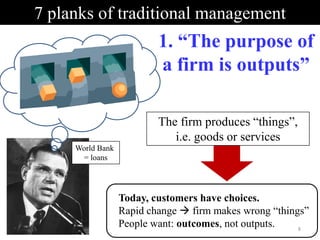
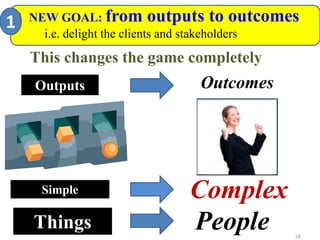
7 planks of traditional management1. “The purpose of a firm is outputs”The firm produces “things”, i.e. goods or servicesWorld Bank = loansToday, customers have choices.Rapid change  firm makes wrong “things”People want: outcomes, not outputs.8
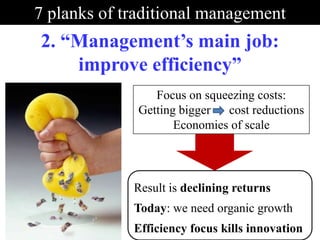
7 planks of traditional management2. “Management’s main job: improve efficiency”Focus on squeezing costs:Getting bigger      cost reductions Economies of scaleResult is declining returnsToday: we need organic growthEfficiency focus kills innovation9
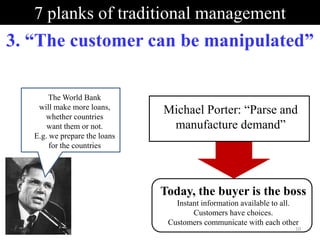
7 planks of traditional management3. “The customer can be manipulated”The World Bank will make more loans, whether countries want them or not.E.g. we prepare the loans for the countriesMichael Porter: “Parse and manufacture demand”Today, the buyer is the bossInstant information available to all.Customers have choices.Customers communicate with each other10
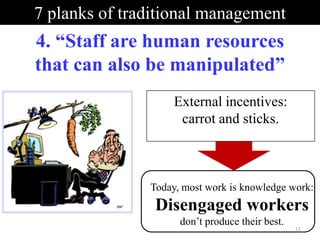
7 planks of traditional management4. “Staff are human resources that can also be manipulated”External incentives: carrot and sticks. Today, most work is knowledge work:Disengaged workers don’t produce their best. 11
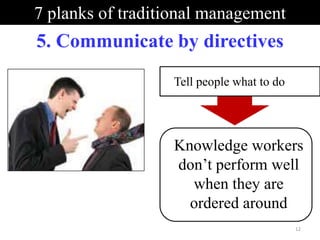
7 planks of traditional management5. Communicate by directivesTell people what to do Knowledge workers don’t perform well when they are ordered around12
7 planks of traditional management6. “Traditional management practices are self-evident”Management reflects timeless truths of the universe.Evidence of management dysfunction is inadmissible. Bad managers? Yes!Management itself is bad? Impossible!13
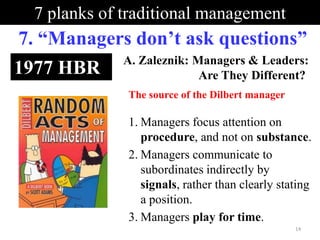
7 planks of traditional management7. “Managers don’t ask questions”A. Zaleznik: Managers & Leaders: Are They Different? 1977 HBR The source of the Dilbert manager Managers focus attention on procedure, and not on substance. Managers communicate to subordinates indirectly by signals, rather than clearly stating a position.Managers play for time.14
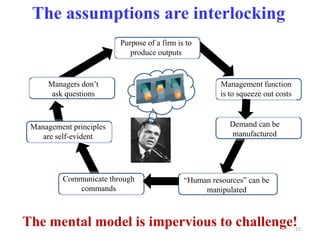
The assumptions are interlockingManagement principles are self-evidentManagement function is to squeeze out costsManagers don’task questionsPurpose of a firm is to produce outputsDemand can be manufacturedCommunicate through commands“Human resources” can be manipulatedThe mental model is impervious to challenge!15
2008Q. Why were allthe creative things in organizations systematically killed? knowledge management?
 lean manufacturing?
 innovation?
 marketing?
 leadership storytelling?A. Management did it!16
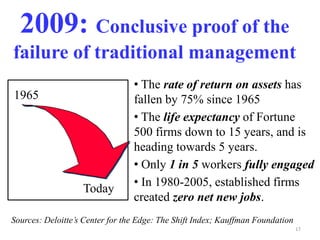
2009: Conclusive proof of the failure of traditional management The rate of return on assets has fallen by 75% since 1965
 The life expectancy of Fortune 500 firms down to 15 years, and is heading towards 5 years.
 Only 1 in 5 workers fully engaged
In 1980-2005, established firms created zero net new jobs.1965TodaySources: Deloitte’s Center for the Edge: The Shift Index; Kauffman Foundation17
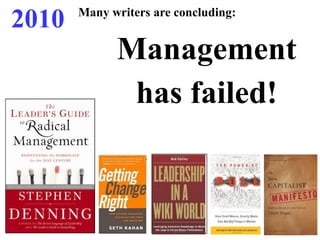
2010 Many writers are concluding:Management has failed! 18
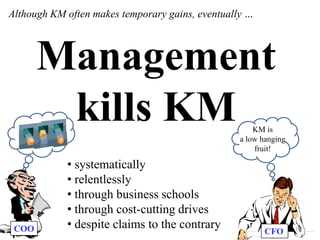
Although KM often makes temporary gains, eventually …Management kills KMKM isa low hangingfruit! systematically
 relentlessly
 through business schools
 through cost-cutting drives
 despite claims to the contraryCOOCFO19
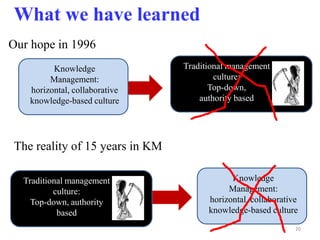
What we have learnedOur hope in 1996Traditional management culture: Top-down, authority basedTraditional managementculture: Top-down, authority basedKnowledge Management: horizontal, collaborative knowledge-based cultureKnowledge Management: horizontal, collaborative knowledge-based cultureThe reality of 15 years in KM20
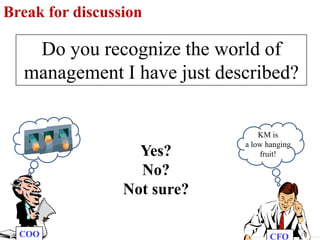
Break for discussion21Do you recognize the world of management I have just described?KM isa low hangingfruit!Yes?No?Not sure?COO21CFO
Implication for KM & organizational survival:We have to generate a culture of  continuous innovation22
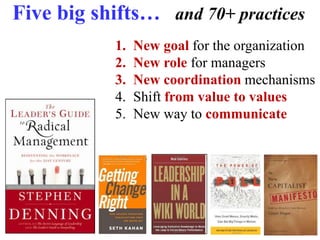
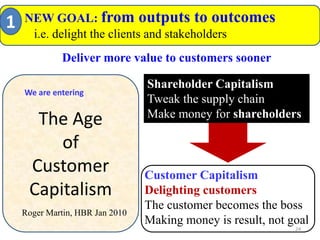
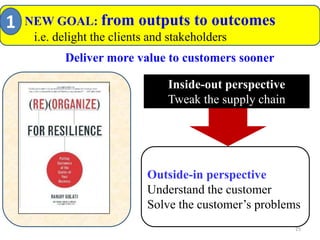
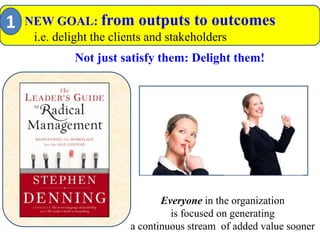
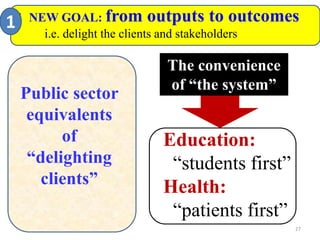
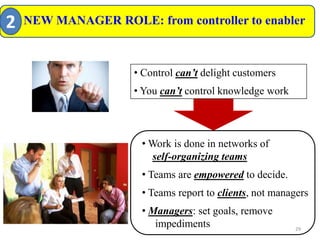
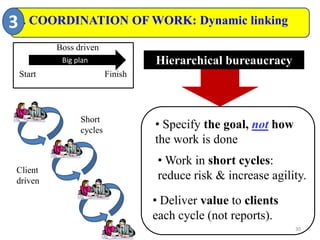
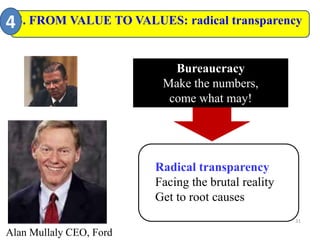
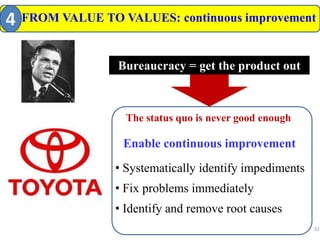
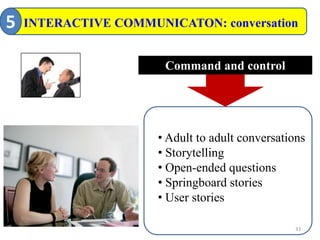
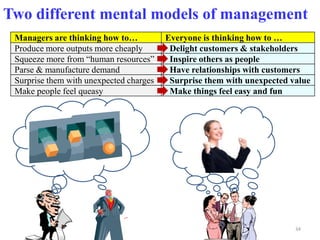
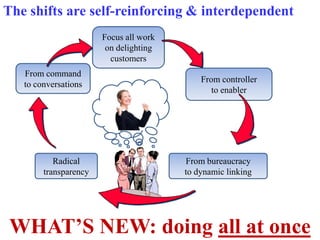
Five big shifts…and 70+ practicesNew goal for the organizationNew role for managersNew coordination mechanismsShift from value to valuesNew way to communicate23

Why KM Programs Fail

  • 1.
    The Reinvention ofManagementWhy do great KM programs fail?Steve Denningwww.stevedenning.comhttp://blogs.forbes.com/stevedenningsteve@stevedenning.com1
  • 2.
    1996-2000Knowledge managementBy allindicators, an apparent success“A world leader in KM”2
  • 3.
    2000-2008Knowledge managementBy allindicators, an apparent successPut on a back burnerNot just the World Bank BP
  • 4.
  • 5.
  • 6.
    HPWithin afew years, it had been put on a back-burner3
  • 7.
    In 2008, Ibegan exploring:Why do managers act this way? (These are highly intelligent, educated people!)4
  • 8.
    2008It’s not justKMWhy did management systematically kill all the creative things in organizations? knowledge management?
  • 9.
  • 10.
  • 11.
  • 12.
  • 13.
    1978A second clue…Robert McNamaraPresident, Ford Motor Company, 1960Secretary of Defence, 1961-1968President, World Bank, 1968-1981“the smartest man I ever met”John F. Kennedy6
  • 14.
    Most management textbooks…Mostbusiness schools …Traditional management rests on seven shaky principles7
  • 15.
    7 planks oftraditional management1. “The purpose of a firm is outputs”The firm produces “things”, i.e. goods or servicesWorld Bank = loansToday, customers have choices.Rapid change  firm makes wrong “things”People want: outcomes, not outputs.8
  • 16.
    7 planks oftraditional management2. “Management’s main job: improve efficiency”Focus on squeezing costs:Getting bigger cost reductions Economies of scaleResult is declining returnsToday: we need organic growthEfficiency focus kills innovation9
  • 17.
    7 planks oftraditional management3. “The customer can be manipulated”The World Bank will make more loans, whether countries want them or not.E.g. we prepare the loans for the countriesMichael Porter: “Parse and manufacture demand”Today, the buyer is the bossInstant information available to all.Customers have choices.Customers communicate with each other10
  • 18.
    7 planks oftraditional management4. “Staff are human resources that can also be manipulated”External incentives: carrot and sticks. Today, most work is knowledge work:Disengaged workers don’t produce their best. 11
  • 19.
    7 planks oftraditional management5. Communicate by directivesTell people what to do Knowledge workers don’t perform well when they are ordered around12
  • 20.
    7 planks oftraditional management6. “Traditional management practices are self-evident”Management reflects timeless truths of the universe.Evidence of management dysfunction is inadmissible. Bad managers? Yes!Management itself is bad? Impossible!13
  • 21.
    7 planks oftraditional management7. “Managers don’t ask questions”A. Zaleznik: Managers & Leaders: Are They Different? 1977 HBR The source of the Dilbert manager Managers focus attention on procedure, and not on substance. Managers communicate to subordinates indirectly by signals, rather than clearly stating a position.Managers play for time.14
  • 22.
    The assumptions areinterlockingManagement principles are self-evidentManagement function is to squeeze out costsManagers don’task questionsPurpose of a firm is to produce outputsDemand can be manufacturedCommunicate through commands“Human resources” can be manipulatedThe mental model is impervious to challenge!15
  • 23.
    2008Q. Why wereallthe creative things in organizations systematically killed? knowledge management?
  • 24.
  • 25.
  • 26.
  • 27.
    leadership storytelling?A.Management did it!16
  • 28.
    2009: Conclusive proofof the failure of traditional management The rate of return on assets has fallen by 75% since 1965
  • 29.
    The lifeexpectancy of Fortune 500 firms down to 15 years, and is heading towards 5 years.
  • 30.
    Only 1in 5 workers fully engaged
  • 31.
    In 1980-2005, establishedfirms created zero net new jobs.1965TodaySources: Deloitte’s Center for the Edge: The Shift Index; Kauffman Foundation17
  • 32.
    2010 Many writersare concluding:Management has failed! 18
  • 33.
    Although KM oftenmakes temporary gains, eventually …Management kills KMKM isa low hangingfruit! systematically
  • 34.
  • 35.
  • 36.
  • 37.
    despite claimsto the contraryCOOCFO19
  • 38.
    What we havelearnedOur hope in 1996Traditional management culture: Top-down, authority basedTraditional managementculture: Top-down, authority basedKnowledge Management: horizontal, collaborative knowledge-based cultureKnowledge Management: horizontal, collaborative knowledge-based cultureThe reality of 15 years in KM20
  • 39.
    Break for discussion21Doyou recognize the world of management I have just described?KM isa low hangingfruit!Yes?No?Not sure?COO21CFO
  • 40.
    Implication for KM& organizational survival:We have to generate a culture of continuous innovation22
  • 41.
    Five big shifts…and70+ practicesNew goal for the organizationNew role for managersNew coordination mechanismsShift from value to valuesNew way to communicate23