Saphenous Vein Harvesting
Tips, Tricks and Pitfalls
by
SA Mohamad Fadzly
Introduction
• Surgery for revascularization of the myocardium continues to be an
effective and lasting means of managing patients with multivessel
coronary artery disease
• Increasing popularity of PTCA and related interventional procedures:
o Atherectomy
o Intravascular Stents
• Not been a significant decrease in number of patients undergoing CABG
• CABG surgery continues to be one of the most commonly performed
surgical procedure
Conduit of Choice
The greater saphenous vein has been extensively used as a
conduit after internal mammary artery because :
• It can be procured conveniently
• Easy to handle
• An excellent inflow
Khonsari, Sintek (2007)
Internal Mammary Artery vs Saphenous Vein Graft
• Although the saphenous vein can remain patent for years,
the artherosclerosis is widely documented that using the
internal mammary artery as a conduit has gained much
prominence.
• IMA – conduit of choice
• Why?
 Appears to resist the development of atherosclerosis
 Has a higher late-patency rate than a comparable
saphenous vein graft
• Long-term follow up has definitely revealed significant
improvement in 10 years survival rates and a marked reduction in
the incidence of late cardiac events in patients who have
undergone left IMA bypass graft to the LAD coronary artery
• Internal thoracic arteries demonstrate better patency than
saphenous veins except when grafting moderately stenosed right
coronary arteries. When bypassing right coronary arteries with less
than 70% stenosis, saphenous veins may be a better choice.
Sabik, et all (2005)
Intra Operative Vessel Harvesting
• Anatomy of the greater saphenous vein
• Selection of vessel
• Positioning
• Prepping
• Draping
• Open (continuous) / Bridging Harvest Technique
• Preparation of the Vein
• Wound Closure
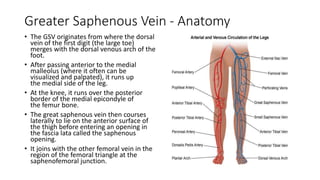
Greater Saphenous Vein - Anatomy
• The GSV originates from where the dorsal
vein of the first digit (the large toe)
merges with the dorsal venous arch of the
foot.
• After passing anterior to the medial
malleolus (where it often can be
visualized and palpated), it runs up
the medial side of the leg.
• At the knee, it runs over the posterior
border of the medial epicondyle of
the femur bone.
• The great saphenous vein then courses
laterally to lie on the anterior surface of
the thigh before entering an opening in
the fascia lata called the saphenous
opening.
• It joins with the other femoral vein in the
region of the femoral triangle at the
saphenofemoral junction.
The selection of SV is determined by :
• Age of patient
• Diabetes
• Peripheral vascular disease
• Varicosities
• Previous vein stripping
• Previous CABG
Preoperative Assessment
Assessment of risk factors :
Treadwell (2003)
• Diabetes mellitus
• Smoking
• Obesity
• Peripheral vascular disease
• Use of intra-aortic balloon pump
Diagnostic Tests
• Echocardiography ( evaluates heart structure and function )
• Ejection fraction / ventricular wall motion
• Cardiac catheterization report
• Labs report : (in particular but not limited to : WBC, HGB,
HCT)
Physical Assessment
History of :
• PVD
• Varicose veins
• Previous vein harvesting
• Previous vein stripping
• Deep vein thrombosis
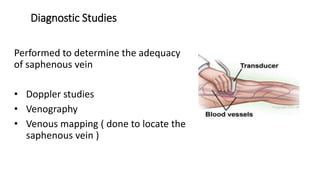
Diagnostic Studies
Performed to determine the adequacy
of saphenous vein
• Doppler studies
• Venography
• Venous mapping ( done to locate the
saphenous vein )
Be Wise in Making
Judgement
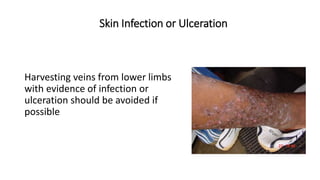
Harvesting veins from lower limbs
with evidence of infection or
ulceration should be avoided if
possible
Skin Infection or Ulceration
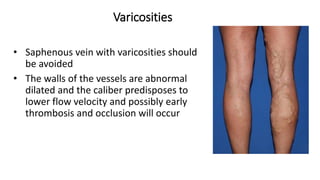
Varicosities
• Saphenous vein with varicosities should
be avoided
• The walls of the vessels are abnormal
dilated and the caliber predisposes to
lower flow velocity and possibly early
thrombosis and occlusion will occur
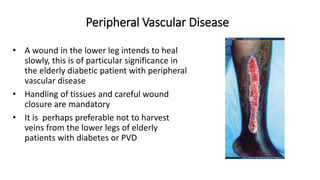
Peripheral Vascular Disease
• A wound in the lower leg intends to heal
slowly, this is of particular significance in
the elderly diabetic patient with peripheral
vascular disease
• Handling of tissues and careful wound
closure are mandatory
• It is perhaps preferable not to harvest
veins from the lower legs of elderly
patients with diabetes or PVD
Prepping
• A shower with antibacterial soap the night before and the
morning day of surgery
• Hair is clipped from the patient’s anterior chest, bilateral
groins and bilateral medial legs a night before surgery
• After induction and positioning, skin scrubbing will be done
with beta solution, Povidone Iodine, it is include the anterior
chest from chin to groin, bilateral groins and bilateral legs,
circumferentially
Selection Length of the Vessel
Length of the vessel needed :
• Echocardiography to evaluates heart structures and LV function
• CXR – to measure any heart enlargement
• Coronary angiogram – to determines exact location of the coronary
blockaged
•Determined by the Surgeon
•Anterior coronary bypasses generally requires about 10 – 15 cm of
conduit
•Posterior bypasses proximately about 20 cm
•Lateral bypasses proximately about 15 cm
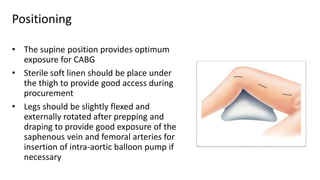
Positioning
• The supine position provides optimum
exposure for CABG
• Sterile soft linen should be place under
the thigh to provide good access during
procurement
• Legs should be slightly flexed and
externally rotated after prepping and
draping to provide good exposure of the
saphenous vein and femoral arteries for
insertion of intra-aortic balloon pump if
necessary
Draping
• The feet are wrapped with sterile towels or a stockinette
• The legs are flexed into a “frog-like” position
• A roll of sterile towels or sheets may be used to keep the legs
in the slightly flexed position
• The perineum is covered and a towel may be placed across
the umbilicus connected to the side drapes
• Cardiovascular drape is then placed over the patient
Saphenous Vein Landmarks
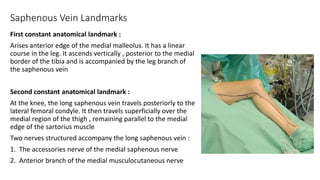
First constant anatomical landmark :
Arises anterior edge of the medial malleolus. It has a linear
course in the leg. It ascends vertically , posterior to the medial
border of the tibia and is accompanied by the leg branch of
the saphenous vein
Second constant anatomical landmark :
At the knee, the long saphenous vein travels posteriorly to the
lateral femoral condyle. It then travels superficially over the
medial region of the thigh , remaining parallel to the medial
edge of the sartorius muscle
Two nerves structured accompany the long saphenous vein :
1. The accessories nerve of the medial saphenous nerve
2. Anterior branch of the medial musculocutaneous nerve
Saphenous Vein Landmarks
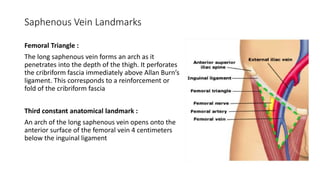
Femoral Triangle :
The long saphenous vein forms an arch as it
penetrates into the depth of the thigh. It perforates
the cribriform fascia immediately above Allan Burn’s
ligament. This corresponds to a reinforcement or
fold of the cribriform fascia
Third constant anatomical landmark :
An arch of the long saphenous vein opens onto the
anterior surface of the femoral vein 4 centimeters
below the inguinal ligament
Saphenous Vein Harvest Methods
Methods :
• Open - Complete continuous open technique
- Interrupted bridging skin incision
technique
• Endoscopic
Open method
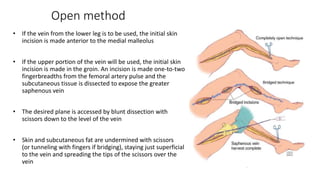
• If the vein from the lower leg is to be used, the initial skin
incision is made anterior to the medial malleolus
• If the upper portion of the vein will be used, the initial skin
incision is made in the groin. An incision is made one-to-two
fingerbreadths from the femoral artery pulse and the
subcutaneous tissue is dissected to expose the greater
saphenous vein
• The desired plane is accessed by blunt dissection with
scissors down to the level of the vein
• Skin and subcutaneous fat are undermined with scissors
(or tunneling with fingers if bridging), staying just superficial
to the vein and spreading the tips of the scissors over the
vein
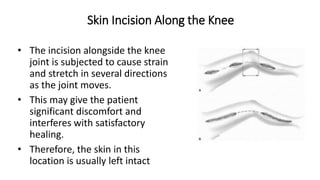
Skin Incision Along the Knee
• The incision alongside the knee
joint is subjected to cause strain
and stretch in several directions
as the joint moves.
• This may give the patient
significant discomfort and
interferes with satisfactory
healing.
• Therefore, the skin in this
location is usually left intact
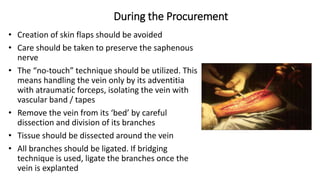
During the Procurement
• Creation of skin flaps should be avoided
• Care should be taken to preserve the saphenous
nerve
• The “no-touch” technique should be utilized. This
means handling the vein only by its adventitia
with atraumatic forceps, isolating the vein with
vascular band / tapes
• Remove the vein from its ‘bed’ by careful
dissection and division of its branches
• Tissue should be dissected around the vein
• All branches should be ligated. If bridging
technique is used, ligate the branches once the
vein is explanted
Try to Avoid
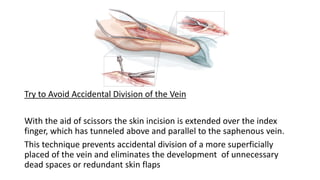
Try to Avoid Accidental Division of the Vein
With the aid of scissors the skin incision is extended over the index
finger, which has tunneled above and parallel to the saphenous vein.
This technique prevents accidental division of a more superficially
placed of the vein and eliminates the development of unnecessary
dead spaces or redundant skin flaps
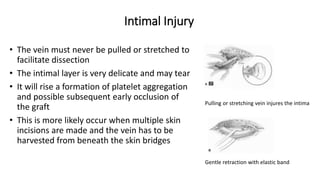
Intimal Injury
• The vein must never be pulled or stretched to
facilitate dissection
• The intimal layer is very delicate and may tear
• It will rise a formation of platelet aggregation
and possible subsequent early occlusion of
the graft
• This is more likely occur when multiple skin
incisions are made and the vein has to be
harvested from beneath the skin bridges
Pulling or stretching vein injures the intima
Gentle retraction with elastic band
Nerve Injury
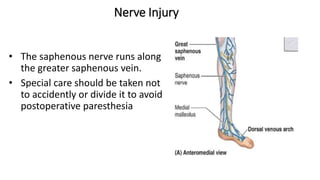
• The saphenous nerve runs along
the greater saphenous vein.
• Special care should be taken not
to accidently or divide it to avoid
postoperative paresthesia
PREPARING THE VEIN
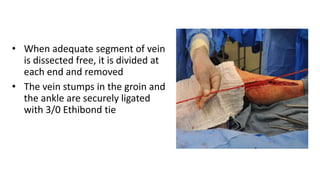
• When adequate segment of vein
is dissected free, it is divided at
each end and removed
• The vein stumps in the groin and
the ankle are securely ligated
with 3/0 Ethibond tie
Localized Varicosities
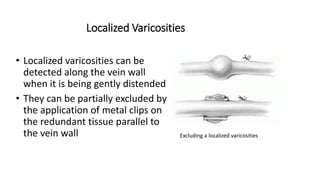
• Localized varicosities can be
detected along the vein wall
when it is being gently distended
• They can be partially excluded by
the application of metal clips on
the redundant tissue parallel to
the vein wall Excluding a localized varicosities
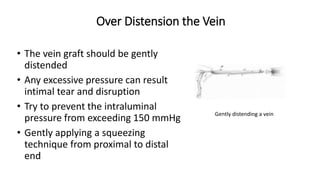
Over Distension the Vein
• The vein graft should be gently
distended
• Any excessive pressure can result
intimal tear and disruption
• Try to prevent the intraluminal
pressure from exceeding 150 mmHg
• Gently applying a squeezing
technique from proximal to distal
end
Gently distending a vein
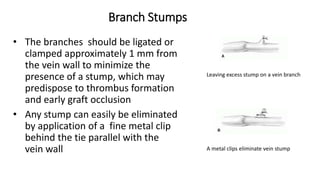
Branch Stumps
• The branches should be ligated or
clamped approximately 1 mm from
the vein wall to minimize the
presence of a stump, which may
predispose to thrombus formation
and early graft occlusion
• Any stump can easily be eliminated
by application of a fine metal clip
behind the tie parallel with the
vein wall
Leaving excess stump on a vein branch
A metal clips eliminate vein stump
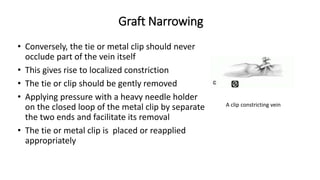
Graft Narrowing
• Conversely, the tie or metal clip should never
occlude part of the vein itself
• This gives rise to localized constriction
• The tie or clip should be gently removed
• Applying pressure with a heavy needle holder
on the closed loop of the metal clip by separate
the two ends and facilitate its removal
• The tie or metal clip is placed or reapplied
appropriately
A clip constricting vein
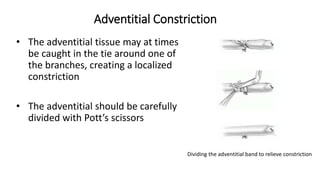
Adventitial Constriction
• The adventitial tissue may at times
be caught in the tie around one of
the branches, creating a localized
constriction
• The adventitial should be carefully
divided with Pott’s scissors
Dividing the adventitial band to relieve constriction
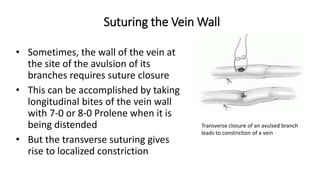
Suturing the Vein Wall
• Sometimes, the wall of the vein at
the site of the avulsion of its
branches requires suture closure
• This can be accomplished by taking
longitudinal bites of the vein wall
with 7-0 or 8-0 Prolene when it is
being distended
• But the transverse suturing gives
rise to localized constriction
Transverse closure of an avulsed branch
leads to constriction of a vein
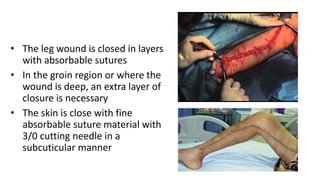
WOUND CLOSURE
• The leg wound is closed in layers
with absorbable sutures
• In the groin region or where the
wound is deep, an extra layer of
closure is necessary
• The skin is close with fine
absorbable suture material with
3/0 cutting needle in a
subcuticular manner
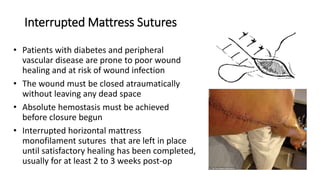
Interrupted Mattress Sutures
• Patients with diabetes and peripheral
vascular disease are prone to poor wound
healing and at risk of wound infection
• The wound must be closed atraumatically
without leaving any dead space
• Absolute hemostasis must be achieved
before closure begun
• Interrupted horizontal mattress
monofilament sutures that are left in place
until satisfactory healing has been completed,
usually for at least 2 to 3 weeks post-op
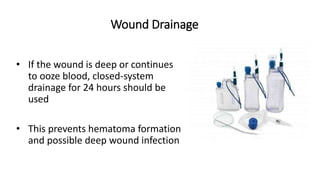
Wound Drainage
• If the wound is deep or continues
to ooze blood, closed-system
drainage for 24 hours should be
used
• This prevents hematoma formation
and possible deep wound infection
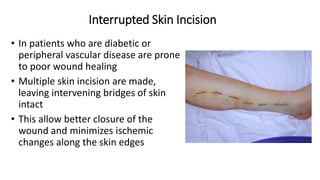
Interrupted Skin Incision
• In patients who are diabetic or
peripheral vascular disease are prone
to poor wound healing
• Multiple skin incision are made,
leaving intervening bridges of skin
intact
• This allow better closure of the
wound and minimizes ischemic
changes along the skin edges
Postoperative Assessment
(Evaluation of Postoperative Patient Outcomes)
• Assess lower extremities for nerve damage due to being
placed in the “frog-leg” position
• Post-operative bleeding – monitor dressing and wound for
excessive drainage and swelling
• Monitor for skin infection and ulceration
REFERENCES
• Khonsari, S., Sintek, C.F. (2007). Cardiac surgery safeguards and
pitfalls in operative technique (4th ed.) Los Angeles, USA: Walters
Kluwer Health/Lippincott Williams and Wilkins.
Sabik, J.F., Lytle, B.W., Blackstone, E.H., Houghtaling, P.L.,
Cosgrove, D.M. (2005). Comparison of Saphenous Vein and
Internal Thoracic Artery Graft Patency by Coronary System.
The Society of Thoracic Surgeons, 79:544 –51.
Treadwell, T. (2003). Diagnostic dilemma : Management of Saphenous
Vein Harvest wound complications following Coronary Artery
Bypass grafting. Diagnostic Dilemma, 15(3), 83 – 91.
Thank You

Saphenous Vein Harvesting

  • 1.
    Saphenous Vein Harvesting Tips,Tricks and Pitfalls by SA Mohamad Fadzly
  • 2.
    Introduction • Surgery forrevascularization of the myocardium continues to be an effective and lasting means of managing patients with multivessel coronary artery disease • Increasing popularity of PTCA and related interventional procedures: o Atherectomy o Intravascular Stents • Not been a significant decrease in number of patients undergoing CABG • CABG surgery continues to be one of the most commonly performed surgical procedure
  • 3.
    Conduit of Choice Thegreater saphenous vein has been extensively used as a conduit after internal mammary artery because : • It can be procured conveniently • Easy to handle • An excellent inflow Khonsari, Sintek (2007)
  • 4.
    Internal Mammary Arteryvs Saphenous Vein Graft • Although the saphenous vein can remain patent for years, the artherosclerosis is widely documented that using the internal mammary artery as a conduit has gained much prominence. • IMA – conduit of choice • Why?  Appears to resist the development of atherosclerosis  Has a higher late-patency rate than a comparable saphenous vein graft
  • 5.
    • Long-term followup has definitely revealed significant improvement in 10 years survival rates and a marked reduction in the incidence of late cardiac events in patients who have undergone left IMA bypass graft to the LAD coronary artery • Internal thoracic arteries demonstrate better patency than saphenous veins except when grafting moderately stenosed right coronary arteries. When bypassing right coronary arteries with less than 70% stenosis, saphenous veins may be a better choice. Sabik, et all (2005)
  • 6.
    Intra Operative VesselHarvesting • Anatomy of the greater saphenous vein • Selection of vessel • Positioning • Prepping • Draping • Open (continuous) / Bridging Harvest Technique • Preparation of the Vein • Wound Closure
  • 7.
    Greater Saphenous Vein- Anatomy • The GSV originates from where the dorsal vein of the first digit (the large toe) merges with the dorsal venous arch of the foot. • After passing anterior to the medial malleolus (where it often can be visualized and palpated), it runs up the medial side of the leg. • At the knee, it runs over the posterior border of the medial epicondyle of the femur bone. • The great saphenous vein then courses laterally to lie on the anterior surface of the thigh before entering an opening in the fascia lata called the saphenous opening. • It joins with the other femoral vein in the region of the femoral triangle at the saphenofemoral junction.
  • 8.
    The selection ofSV is determined by : • Age of patient • Diabetes • Peripheral vascular disease • Varicosities • Previous vein stripping • Previous CABG
  • 9.
    Preoperative Assessment Assessment ofrisk factors : Treadwell (2003) • Diabetes mellitus • Smoking • Obesity • Peripheral vascular disease • Use of intra-aortic balloon pump
  • 10.
    Diagnostic Tests • Echocardiography( evaluates heart structure and function ) • Ejection fraction / ventricular wall motion • Cardiac catheterization report • Labs report : (in particular but not limited to : WBC, HGB, HCT)
  • 11.
    Physical Assessment History of: • PVD • Varicose veins • Previous vein harvesting • Previous vein stripping • Deep vein thrombosis
  • 12.
    Diagnostic Studies Performed todetermine the adequacy of saphenous vein • Doppler studies • Venography • Venous mapping ( done to locate the saphenous vein )
  • 13.
    Be Wise inMaking Judgement
  • 14.
    Harvesting veins fromlower limbs with evidence of infection or ulceration should be avoided if possible Skin Infection or Ulceration
  • 15.
    Varicosities • Saphenous veinwith varicosities should be avoided • The walls of the vessels are abnormal dilated and the caliber predisposes to lower flow velocity and possibly early thrombosis and occlusion will occur
  • 16.
    Peripheral Vascular Disease •A wound in the lower leg intends to heal slowly, this is of particular significance in the elderly diabetic patient with peripheral vascular disease • Handling of tissues and careful wound closure are mandatory • It is perhaps preferable not to harvest veins from the lower legs of elderly patients with diabetes or PVD
  • 17.
    Prepping • A showerwith antibacterial soap the night before and the morning day of surgery • Hair is clipped from the patient’s anterior chest, bilateral groins and bilateral medial legs a night before surgery • After induction and positioning, skin scrubbing will be done with beta solution, Povidone Iodine, it is include the anterior chest from chin to groin, bilateral groins and bilateral legs, circumferentially
  • 18.
    Selection Length ofthe Vessel Length of the vessel needed : • Echocardiography to evaluates heart structures and LV function • CXR – to measure any heart enlargement • Coronary angiogram – to determines exact location of the coronary blockaged •Determined by the Surgeon •Anterior coronary bypasses generally requires about 10 – 15 cm of conduit •Posterior bypasses proximately about 20 cm •Lateral bypasses proximately about 15 cm
  • 19.
    Positioning • The supineposition provides optimum exposure for CABG • Sterile soft linen should be place under the thigh to provide good access during procurement • Legs should be slightly flexed and externally rotated after prepping and draping to provide good exposure of the saphenous vein and femoral arteries for insertion of intra-aortic balloon pump if necessary
  • 20.
    Draping • The feetare wrapped with sterile towels or a stockinette • The legs are flexed into a “frog-like” position • A roll of sterile towels or sheets may be used to keep the legs in the slightly flexed position • The perineum is covered and a towel may be placed across the umbilicus connected to the side drapes • Cardiovascular drape is then placed over the patient
  • 21.
    Saphenous Vein Landmarks Firstconstant anatomical landmark : Arises anterior edge of the medial malleolus. It has a linear course in the leg. It ascends vertically , posterior to the medial border of the tibia and is accompanied by the leg branch of the saphenous vein Second constant anatomical landmark : At the knee, the long saphenous vein travels posteriorly to the lateral femoral condyle. It then travels superficially over the medial region of the thigh , remaining parallel to the medial edge of the sartorius muscle Two nerves structured accompany the long saphenous vein : 1. The accessories nerve of the medial saphenous nerve 2. Anterior branch of the medial musculocutaneous nerve
  • 22.
    Saphenous Vein Landmarks FemoralTriangle : The long saphenous vein forms an arch as it penetrates into the depth of the thigh. It perforates the cribriform fascia immediately above Allan Burn’s ligament. This corresponds to a reinforcement or fold of the cribriform fascia Third constant anatomical landmark : An arch of the long saphenous vein opens onto the anterior surface of the femoral vein 4 centimeters below the inguinal ligament
  • 23.
    Saphenous Vein HarvestMethods Methods : • Open - Complete continuous open technique - Interrupted bridging skin incision technique • Endoscopic
  • 24.
    Open method • Ifthe vein from the lower leg is to be used, the initial skin incision is made anterior to the medial malleolus • If the upper portion of the vein will be used, the initial skin incision is made in the groin. An incision is made one-to-two fingerbreadths from the femoral artery pulse and the subcutaneous tissue is dissected to expose the greater saphenous vein • The desired plane is accessed by blunt dissection with scissors down to the level of the vein • Skin and subcutaneous fat are undermined with scissors (or tunneling with fingers if bridging), staying just superficial to the vein and spreading the tips of the scissors over the vein
  • 25.
    Skin Incision Alongthe Knee • The incision alongside the knee joint is subjected to cause strain and stretch in several directions as the joint moves. • This may give the patient significant discomfort and interferes with satisfactory healing. • Therefore, the skin in this location is usually left intact
  • 26.
    During the Procurement •Creation of skin flaps should be avoided • Care should be taken to preserve the saphenous nerve • The “no-touch” technique should be utilized. This means handling the vein only by its adventitia with atraumatic forceps, isolating the vein with vascular band / tapes • Remove the vein from its ‘bed’ by careful dissection and division of its branches • Tissue should be dissected around the vein • All branches should be ligated. If bridging technique is used, ligate the branches once the vein is explanted
  • 27.
  • 28.
    Try to AvoidAccidental Division of the Vein With the aid of scissors the skin incision is extended over the index finger, which has tunneled above and parallel to the saphenous vein. This technique prevents accidental division of a more superficially placed of the vein and eliminates the development of unnecessary dead spaces or redundant skin flaps
  • 29.
    Intimal Injury • Thevein must never be pulled or stretched to facilitate dissection • The intimal layer is very delicate and may tear • It will rise a formation of platelet aggregation and possible subsequent early occlusion of the graft • This is more likely occur when multiple skin incisions are made and the vein has to be harvested from beneath the skin bridges Pulling or stretching vein injures the intima Gentle retraction with elastic band
  • 30.
    Nerve Injury • Thesaphenous nerve runs along the greater saphenous vein. • Special care should be taken not to accidently or divide it to avoid postoperative paresthesia
  • 31.
  • 32.
    • When adequatesegment of vein is dissected free, it is divided at each end and removed • The vein stumps in the groin and the ankle are securely ligated with 3/0 Ethibond tie
  • 33.
    Localized Varicosities • Localizedvaricosities can be detected along the vein wall when it is being gently distended • They can be partially excluded by the application of metal clips on the redundant tissue parallel to the vein wall Excluding a localized varicosities
  • 34.
    Over Distension theVein • The vein graft should be gently distended • Any excessive pressure can result intimal tear and disruption • Try to prevent the intraluminal pressure from exceeding 150 mmHg • Gently applying a squeezing technique from proximal to distal end Gently distending a vein
  • 35.
    Branch Stumps • Thebranches should be ligated or clamped approximately 1 mm from the vein wall to minimize the presence of a stump, which may predispose to thrombus formation and early graft occlusion • Any stump can easily be eliminated by application of a fine metal clip behind the tie parallel with the vein wall Leaving excess stump on a vein branch A metal clips eliminate vein stump
  • 36.
    Graft Narrowing • Conversely,the tie or metal clip should never occlude part of the vein itself • This gives rise to localized constriction • The tie or clip should be gently removed • Applying pressure with a heavy needle holder on the closed loop of the metal clip by separate the two ends and facilitate its removal • The tie or metal clip is placed or reapplied appropriately A clip constricting vein
  • 37.
    Adventitial Constriction • Theadventitial tissue may at times be caught in the tie around one of the branches, creating a localized constriction • The adventitial should be carefully divided with Pott’s scissors Dividing the adventitial band to relieve constriction
  • 38.
    Suturing the VeinWall • Sometimes, the wall of the vein at the site of the avulsion of its branches requires suture closure • This can be accomplished by taking longitudinal bites of the vein wall with 7-0 or 8-0 Prolene when it is being distended • But the transverse suturing gives rise to localized constriction Transverse closure of an avulsed branch leads to constriction of a vein
  • 39.
  • 40.
    • The legwound is closed in layers with absorbable sutures • In the groin region or where the wound is deep, an extra layer of closure is necessary • The skin is close with fine absorbable suture material with 3/0 cutting needle in a subcuticular manner
  • 41.
    Interrupted Mattress Sutures •Patients with diabetes and peripheral vascular disease are prone to poor wound healing and at risk of wound infection • The wound must be closed atraumatically without leaving any dead space • Absolute hemostasis must be achieved before closure begun • Interrupted horizontal mattress monofilament sutures that are left in place until satisfactory healing has been completed, usually for at least 2 to 3 weeks post-op
  • 42.
    Wound Drainage • Ifthe wound is deep or continues to ooze blood, closed-system drainage for 24 hours should be used • This prevents hematoma formation and possible deep wound infection
  • 43.
    Interrupted Skin Incision •In patients who are diabetic or peripheral vascular disease are prone to poor wound healing • Multiple skin incision are made, leaving intervening bridges of skin intact • This allow better closure of the wound and minimizes ischemic changes along the skin edges
  • 44.
    Postoperative Assessment (Evaluation ofPostoperative Patient Outcomes) • Assess lower extremities for nerve damage due to being placed in the “frog-leg” position • Post-operative bleeding – monitor dressing and wound for excessive drainage and swelling • Monitor for skin infection and ulceration
  • 45.
    REFERENCES • Khonsari, S.,Sintek, C.F. (2007). Cardiac surgery safeguards and pitfalls in operative technique (4th ed.) Los Angeles, USA: Walters Kluwer Health/Lippincott Williams and Wilkins. Sabik, J.F., Lytle, B.W., Blackstone, E.H., Houghtaling, P.L., Cosgrove, D.M. (2005). Comparison of Saphenous Vein and Internal Thoracic Artery Graft Patency by Coronary System. The Society of Thoracic Surgeons, 79:544 –51. Treadwell, T. (2003). Diagnostic dilemma : Management of Saphenous Vein Harvest wound complications following Coronary Artery Bypass grafting. Diagnostic Dilemma, 15(3), 83 – 91.
  • 46.