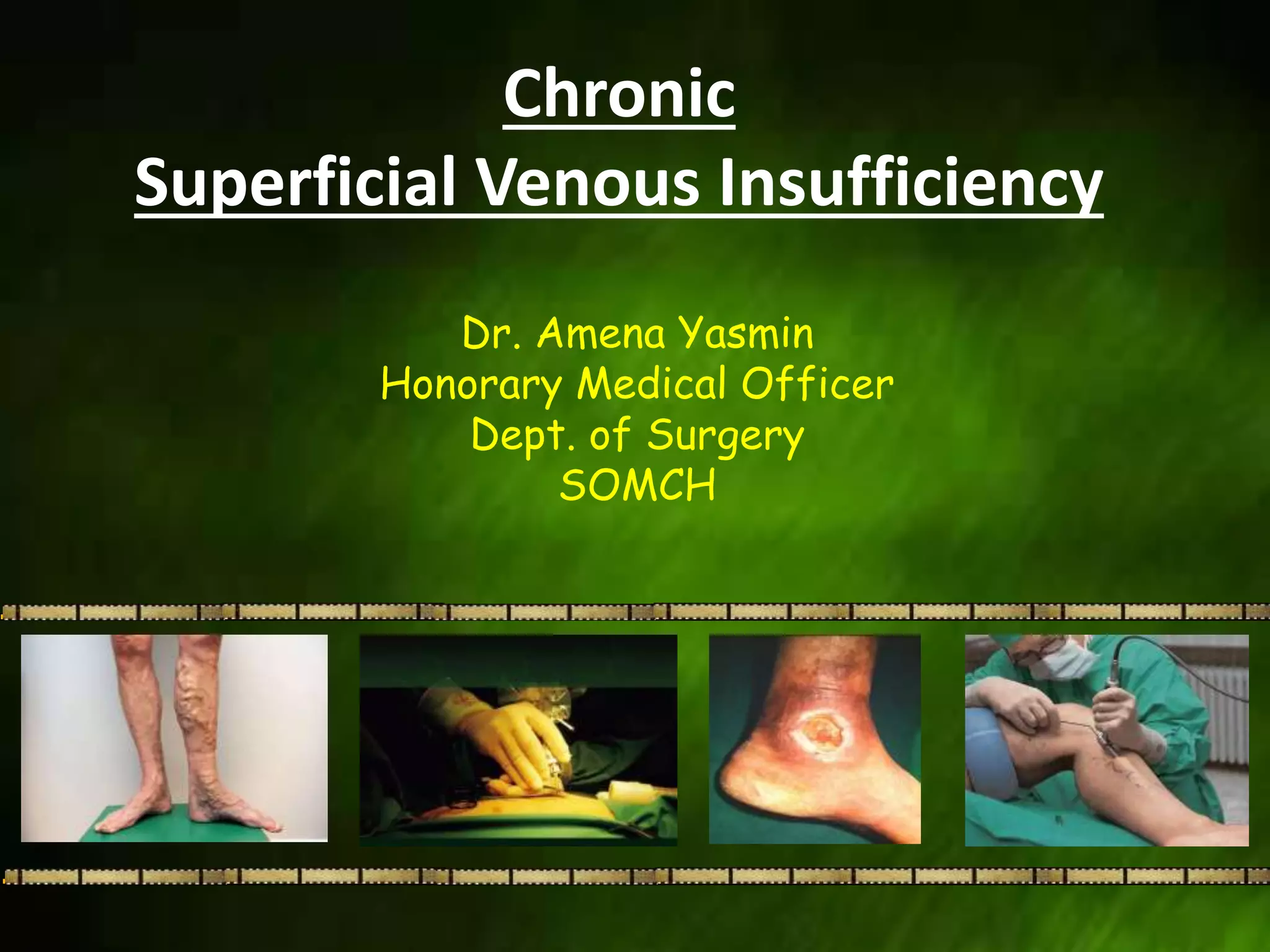
Chronic
Superficial Venous Insufficiency
Dr. Amena Yasmin
Honorary Medical Officer
Dept. of Surgery
SOMCH
CHRONIC SUPERFICIAL VENOUS INSUFFICIENCY (CSVI)
• occurs when the venous wall and/or valves in the
superficial leg veins are not working effectively,
making it difficult for blood to return to the
heart from the legs.
Clinical hallmarks:
Distal venous hypertension, which follows the
development of valvular incompetence, reflux,
and/or venous obstruction.
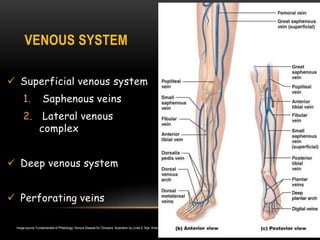
VENOUS SYSTEM
 Superficial venous system
1. Saphenous veins
2. Lateral venous
complex
 Deep venous system
 Perforating veins
Deep femoral v.
Femoral v.
Popliteal v.
Small saphenous v.
Great saphenous v.
Perforating v.
Perforating v.
Image source: Fundamentals of Phlebology: Venous Disease for Clinicians. Illustration by Linda S. Nye. American College of Phlebology 2004.
Deep femoral v.
Perforating v.
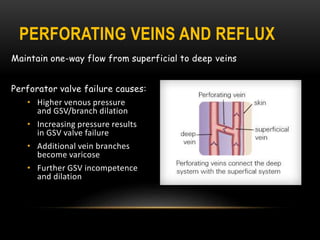
PERFORATING VEINS AND REFLUX
Maintain one-way flow from superficial to deep veins
Perforator valve failure causes:
• Higher venous pressure
and GSV/branch dilation
• Increasing pressure results
in GSV valve failure
• Additional vein branches
become varicose
• Further GSV incompetence
and dilation
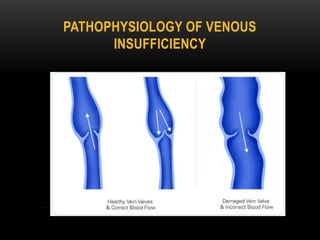
PATHOPHYSIOLOGY OF VENOUS
INSUFFICIENCY
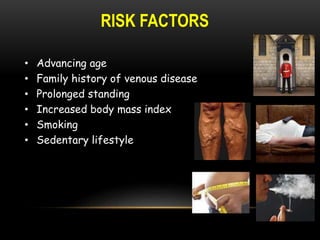
RISK FACTORS
• Advancing age
• Family history of venous disease
• Prolonged standing
• Increased body mass index
• Smoking
• Sedentary lifestyle
RISK FACTORS CONTD.
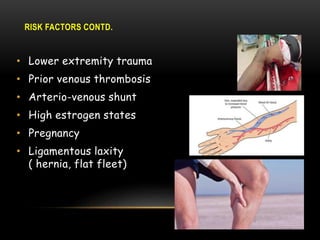
• Lower extremity trauma
• Prior venous thrombosis
• Arterio-venous shunt
• High estrogen states
• Pregnancy
• Ligamentous laxity
( hernia, flat fleet)
CEAP
classification
– an international consensus conference initiated the Clinical-
Etiology-Anatomy-Pathophysiology classification.
C: Clinical
E: Etiology
A: Anatomy
P: Pathophysiology
CEAP classification cont.
• C 0 – no evidence of venous disease.
• C 1 – telangiectasias/reticular veins.
• C 2 – varicose veins.
• C 3 – edema associated with vein disease.
• C 4a – pigmentation or eczema.
• C 4b – lipodermatosclerosis.
• C 5 – healed venous ulcer.
• C 6 – active venous ulcer.
CEAP classification cont.
• E c – congenital
• E p – primary venous disease.
• E s – secondary venous disorder.
• E n – not specified.
CEAP classification cont.
• A s – superficial veins.
• A d – deep veins.
• A p – perforating veins.
• A n – not specified.
• P r – venous reflux.
• P o – venous obstruction.
• P n – not specified.
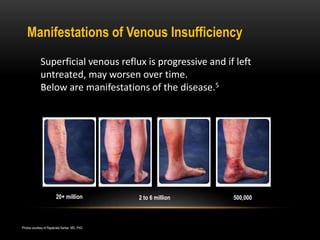
20+ million 2 to 6 million
Skin Ulcers
500,000
Manifestations of Venous Insufficiency
Superficial venous reflux is progressive and if left
untreated, may worsen over time.
Below are manifestations of the disease.5
Photos courtesy of Rajabrata Sarkar, MD, PhD.
Swollen Legs Skin ChangesVaricose Veins
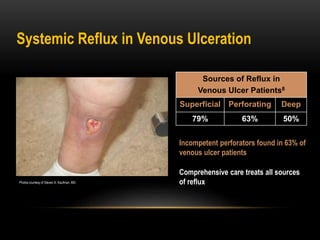
Systemic Reflux in Venous Ulceration
Incompetent perforators found in 63% of
venous ulcer patients
Comprehensive care treats all sources
of refluxPhotos courtesy of Steven A. Kaufman, MD.
Sources of Reflux in
Venous Ulcer Patients8
Superficial Perforating Deep
79% 63% 50%
SKIN CHANGES AT CSVI
Gravitational dermatitis
Hyperpigmentation
Lipodermatosclerosis
LIPODERMATOSCLEROSIS
There is a proliferation of the dermal capillaries
and fibrosis on subcutaneous tissue
It is a combination of:
• induration
• pigmentation
• inflammation
VENOUS ULCER
Clinical Findings:
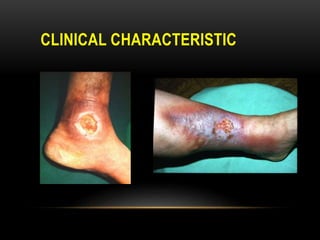
Inner aspect of the distal third of the leg
(commonly the pressure areas)
 Shape - rounded, elongated or very large like a cuff
(so-called gaiter ulcer)
 Base - flat, covered with fibrous slough
 Margins - sharp or rolled
CLINICAL CHARACTERISTIC
Diagnostic Evaluation
 Level 1 : history and clinical examination.
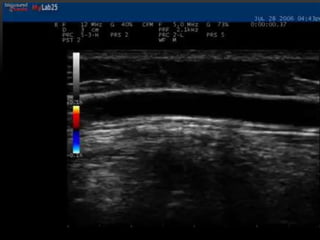
 Level 2 : non-invasive vascular laboratory testing
which now routinely include Duplex color scanning.
 Level 3 : invasive investigations or more complex
imaging studies including ascending and descending
venography, Varicography, venous pressure
measurements, magnetic resonance imaging.
Management of
Venous Stasis Ulcers
• Dressings
-Occlusive dressings
-Low adherent gauze dressings
• Surgical debridement
used to remove devitalized tissue.
• Enzymatic agents
used to break down necrotic tissue (Santyl).
MANAGEMENT contd.
• Growth factors
synthesized by many cell types such as platelets,
neutrophils, and epithelial cells (e.g. Regranex).
• Bioengineered tissue
used for a variety of non-healing ulcers
(e.g. Apligraf, Dermagraft).
• Skin grafting
an option for non-healing ulcers.
MANAGEMENT OF
CHRONIC SUPERFICIAL VENOUS
INSUFFICIENCY
A. Conservative treatment
B. Vein ablation treatments
C. Surgical procedure
1. Conservative Treatment
• Avoiding long periods of standing
• While sitting, legs should be above the thigh
• Avoiding crossing legs
• Ideal body weight
• Walking programme
• Compression therapy
• Micronised purified flavonoid fraction
(diosmin+ hesperidin)
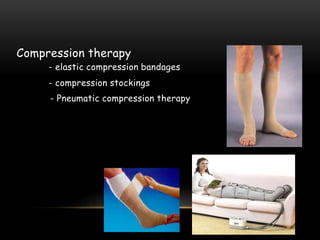
Compression therapy
- elastic compression bandages
- compression stockings
- Pneumatic compression therapy
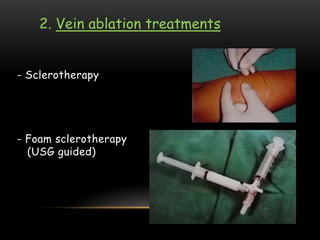
- Sclerotherapy
- Foam sclerotherapy
(USG guided)
2. Vein ablation treatments
Alternative techniques
 Radiofrequency ablation
 Endovenous laser ablation therapy.
Indications
Persistent signs/symptoms of venous disease after a
minimum of 3 months of medical therapy
Documented reflux (e.g. >0.5 seconds of reflux GSV).
Radiofrequency ablation
• Radiofrequency devices generate a high
frequency alternating current for which the
energy heats the adjacent vein walls to the
probe which alters the protein structure of
the vein effecting its closure.
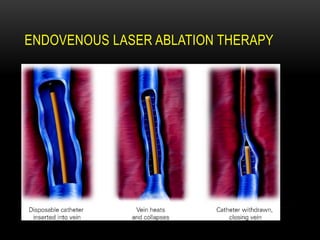
Endovenous laser ablation therapy
• Lasers emit a single, coherent wavelength of light.
Laser therapy of venous structures is based upon the
concept of photothermolysis. Vein wall injury is
mediated directly by absorption of photon energy by
the vein wall and indirectly by thermal convection from
heated blood.
ENDOVENOUS LASER ABLATION THERAPY
Endovenous RF ablation
3. SURGICAL OPTIONS
1. Sapheno-femoral/ sapheno-popliteal flush ligation
2. Venous stripping
3. Multiple phelebectomies
4. Ligation of the perforators
SAPHENO-FEMORALFLUSH LIGATION
VENOUS STRIPPING
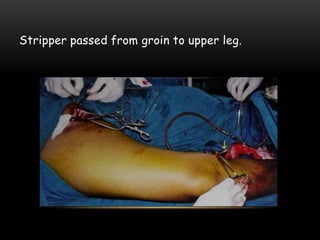
• SFJ is identified after giving a groin incision lateral
to pubic tubercle.
• LSV tributaries are ligated and divided
• A flush SFJ ligation is then performed
• LSV retrogradely stripped to the knee
• Tributaries of varicocities then avulsed through small
incisions
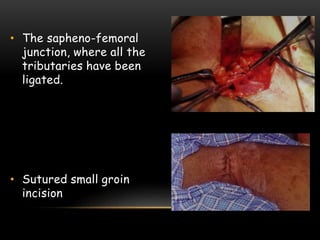
• The sapheno-femoral
junction, where all the
tributaries have been
ligated.
• Sutured small groin
incision
Stripper passed from groin to upper leg.
• Graduated compression stockings or bandages are worn day
& night for 7-10days; thereafter they are worn only during day
for one month
• Patient should sit with his feet elevated
• Patient should return to work and driving within 10days of
surgery
• Swimming and cycling are allowed after dressing have been
removed
Post-operative care
Venous Ulcer Patient Outcomes
• Treating the underlying cause of venous ulceration
results in improved clinical outcomes
• Treating both the superficial and perforator
hypertension results in:
• Faster ulcer healing time
• Lower ulcer recurrence rate
than with compression therapy alone9,10
Complication
• Eczema
• Ulcers
• Bleeding
• Thrombophlebitis
• DVT
Prevention
 Weight control
 Adequate physical exercise
 Avoidance of smoking
 Avoidance of sedentary activities
 Control of hypertension
 Modification of profession
REFERENCES
1. American Heart Association, SIR, Brand et al. “The Epidemiology of Varicose Veins: The
Framingham Study”
2. US Markets for Varicose Vein Treatment Devices 2006, Millennium Research Group 2005.
3. Coon WW, Willis PW, Keller JB: Venous thromboembolism and other venous disease in the
Tecumseh Community Health Study Circulation 1973; 48:839-846.
4. Barron HC, Ross BA. Varicose Veins: A guide to prevention and treatment. NY, NY: Facts on File, Inc.
[An Infobase Holdings Company]; 1995;vii.
5. White JV, Ryjewski C. Chronic venous insufficiency. Perspect Vasc Surg Endovasc Ther 2005;17:319-
27
6. Dietzek A, Two-Year Follow-Up Data From A Prospective, Multicenter Study Of The Efficacy Of The
ClosureFAST Catheter, 35th Annual Veith Symposium. November 19, 2008. New York.
7. Alameida JI. Lessons Learned After 2000 Endovenous Ablations. 34th Veith Symposium. Nov 14-18,
2007. New York
8. Hanrahn L. et al. Distribution of valvular incompetence in patients with venous stasis ulceration.
JVS 13,6, 805-812 June 1991
9. Jamie R Barwell, Colin E Davies, Comparison of surgery and compression with compression alone
in chronic venous ulceration (ESCHAR study): randomized controlled trial,THE LANCET, Vol 363,
June 04
10. Nelzen O. Fransson I. True long-term healing and recurrence of venous leg ulcers following SEPS
combined with superficial venous surgery: a prospective study. Eur J Vasc Endovasc Surg 34, 605-
612 (2007)
Thank you

Chronic Superficial Venous insufficiency

  • 1.
    Chronic Superficial Venous Insufficiency Dr.Amena Yasmin Honorary Medical Officer Dept. of Surgery SOMCH
  • 2.
    CHRONIC SUPERFICIAL VENOUSINSUFFICIENCY (CSVI) • occurs when the venous wall and/or valves in the superficial leg veins are not working effectively, making it difficult for blood to return to the heart from the legs.
  • 3.
    Clinical hallmarks: Distal venoushypertension, which follows the development of valvular incompetence, reflux, and/or venous obstruction.
  • 4.
    VENOUS SYSTEM  Superficialvenous system 1. Saphenous veins 2. Lateral venous complex  Deep venous system  Perforating veins Deep femoral v. Femoral v. Popliteal v. Small saphenous v. Great saphenous v. Perforating v. Perforating v. Image source: Fundamentals of Phlebology: Venous Disease for Clinicians. Illustration by Linda S. Nye. American College of Phlebology 2004. Deep femoral v. Perforating v.
  • 5.
    PERFORATING VEINS ANDREFLUX Maintain one-way flow from superficial to deep veins Perforator valve failure causes: • Higher venous pressure and GSV/branch dilation • Increasing pressure results in GSV valve failure • Additional vein branches become varicose • Further GSV incompetence and dilation
  • 6.
  • 7.
    RISK FACTORS • Advancingage • Family history of venous disease • Prolonged standing • Increased body mass index • Smoking • Sedentary lifestyle
  • 8.
    RISK FACTORS CONTD. •Lower extremity trauma • Prior venous thrombosis • Arterio-venous shunt • High estrogen states • Pregnancy • Ligamentous laxity ( hernia, flat fleet)
  • 9.
    CEAP classification – an internationalconsensus conference initiated the Clinical- Etiology-Anatomy-Pathophysiology classification. C: Clinical E: Etiology A: Anatomy P: Pathophysiology
  • 10.
    CEAP classification cont. •C 0 – no evidence of venous disease. • C 1 – telangiectasias/reticular veins. • C 2 – varicose veins. • C 3 – edema associated with vein disease. • C 4a – pigmentation or eczema. • C 4b – lipodermatosclerosis. • C 5 – healed venous ulcer. • C 6 – active venous ulcer.
  • 11.
    CEAP classification cont. •E c – congenital • E p – primary venous disease. • E s – secondary venous disorder. • E n – not specified.
  • 12.
    CEAP classification cont. •A s – superficial veins. • A d – deep veins. • A p – perforating veins. • A n – not specified. • P r – venous reflux. • P o – venous obstruction. • P n – not specified.
  • 13.
    20+ million 2to 6 million Skin Ulcers 500,000 Manifestations of Venous Insufficiency Superficial venous reflux is progressive and if left untreated, may worsen over time. Below are manifestations of the disease.5 Photos courtesy of Rajabrata Sarkar, MD, PhD. Swollen Legs Skin ChangesVaricose Veins
  • 14.
    Systemic Reflux inVenous Ulceration Incompetent perforators found in 63% of venous ulcer patients Comprehensive care treats all sources of refluxPhotos courtesy of Steven A. Kaufman, MD. Sources of Reflux in Venous Ulcer Patients8 Superficial Perforating Deep 79% 63% 50%
  • 15.
    SKIN CHANGES ATCSVI Gravitational dermatitis Hyperpigmentation Lipodermatosclerosis
  • 16.
    LIPODERMATOSCLEROSIS There is aproliferation of the dermal capillaries and fibrosis on subcutaneous tissue It is a combination of: • induration • pigmentation • inflammation
  • 17.
    VENOUS ULCER Clinical Findings: Inneraspect of the distal third of the leg (commonly the pressure areas)  Shape - rounded, elongated or very large like a cuff (so-called gaiter ulcer)  Base - flat, covered with fibrous slough  Margins - sharp or rolled
  • 18.
  • 19.
    Diagnostic Evaluation  Level1 : history and clinical examination.  Level 2 : non-invasive vascular laboratory testing which now routinely include Duplex color scanning.  Level 3 : invasive investigations or more complex imaging studies including ascending and descending venography, Varicography, venous pressure measurements, magnetic resonance imaging.
  • 22.
    Management of Venous StasisUlcers • Dressings -Occlusive dressings -Low adherent gauze dressings • Surgical debridement used to remove devitalized tissue. • Enzymatic agents used to break down necrotic tissue (Santyl).
  • 23.
    MANAGEMENT contd. • Growthfactors synthesized by many cell types such as platelets, neutrophils, and epithelial cells (e.g. Regranex). • Bioengineered tissue used for a variety of non-healing ulcers (e.g. Apligraf, Dermagraft). • Skin grafting an option for non-healing ulcers.
  • 24.
    MANAGEMENT OF CHRONIC SUPERFICIALVENOUS INSUFFICIENCY A. Conservative treatment B. Vein ablation treatments C. Surgical procedure
  • 25.
    1. Conservative Treatment •Avoiding long periods of standing • While sitting, legs should be above the thigh • Avoiding crossing legs • Ideal body weight • Walking programme • Compression therapy • Micronised purified flavonoid fraction (diosmin+ hesperidin)
  • 26.
    Compression therapy - elasticcompression bandages - compression stockings - Pneumatic compression therapy
  • 27.
    - Sclerotherapy - Foamsclerotherapy (USG guided) 2. Vein ablation treatments
  • 28.
    Alternative techniques  Radiofrequencyablation  Endovenous laser ablation therapy. Indications Persistent signs/symptoms of venous disease after a minimum of 3 months of medical therapy Documented reflux (e.g. >0.5 seconds of reflux GSV).
  • 29.
    Radiofrequency ablation • Radiofrequencydevices generate a high frequency alternating current for which the energy heats the adjacent vein walls to the probe which alters the protein structure of the vein effecting its closure.
  • 30.
    Endovenous laser ablationtherapy • Lasers emit a single, coherent wavelength of light. Laser therapy of venous structures is based upon the concept of photothermolysis. Vein wall injury is mediated directly by absorption of photon energy by the vein wall and indirectly by thermal convection from heated blood.
  • 31.
  • 32.
  • 33.
    3. SURGICAL OPTIONS 1.Sapheno-femoral/ sapheno-popliteal flush ligation 2. Venous stripping 3. Multiple phelebectomies 4. Ligation of the perforators
  • 34.
    SAPHENO-FEMORALFLUSH LIGATION VENOUS STRIPPING •SFJ is identified after giving a groin incision lateral to pubic tubercle. • LSV tributaries are ligated and divided • A flush SFJ ligation is then performed • LSV retrogradely stripped to the knee • Tributaries of varicocities then avulsed through small incisions
  • 35.
    • The sapheno-femoral junction,where all the tributaries have been ligated. • Sutured small groin incision
  • 36.
    Stripper passed fromgroin to upper leg.
  • 37.
    • Graduated compressionstockings or bandages are worn day & night for 7-10days; thereafter they are worn only during day for one month • Patient should sit with his feet elevated • Patient should return to work and driving within 10days of surgery • Swimming and cycling are allowed after dressing have been removed Post-operative care
  • 38.
    Venous Ulcer PatientOutcomes • Treating the underlying cause of venous ulceration results in improved clinical outcomes • Treating both the superficial and perforator hypertension results in: • Faster ulcer healing time • Lower ulcer recurrence rate than with compression therapy alone9,10
  • 39.
    Complication • Eczema • Ulcers •Bleeding • Thrombophlebitis • DVT
  • 40.
    Prevention  Weight control Adequate physical exercise  Avoidance of smoking  Avoidance of sedentary activities  Control of hypertension  Modification of profession
  • 41.
    REFERENCES 1. American HeartAssociation, SIR, Brand et al. “The Epidemiology of Varicose Veins: The Framingham Study” 2. US Markets for Varicose Vein Treatment Devices 2006, Millennium Research Group 2005. 3. Coon WW, Willis PW, Keller JB: Venous thromboembolism and other venous disease in the Tecumseh Community Health Study Circulation 1973; 48:839-846. 4. Barron HC, Ross BA. Varicose Veins: A guide to prevention and treatment. NY, NY: Facts on File, Inc. [An Infobase Holdings Company]; 1995;vii. 5. White JV, Ryjewski C. Chronic venous insufficiency. Perspect Vasc Surg Endovasc Ther 2005;17:319- 27 6. Dietzek A, Two-Year Follow-Up Data From A Prospective, Multicenter Study Of The Efficacy Of The ClosureFAST Catheter, 35th Annual Veith Symposium. November 19, 2008. New York. 7. Alameida JI. Lessons Learned After 2000 Endovenous Ablations. 34th Veith Symposium. Nov 14-18, 2007. New York 8. Hanrahn L. et al. Distribution of valvular incompetence in patients with venous stasis ulceration. JVS 13,6, 805-812 June 1991 9. Jamie R Barwell, Colin E Davies, Comparison of surgery and compression with compression alone in chronic venous ulceration (ESCHAR study): randomized controlled trial,THE LANCET, Vol 363, June 04 10. Nelzen O. Fransson I. True long-term healing and recurrence of venous leg ulcers following SEPS combined with superficial venous surgery: a prospective study. Eur J Vasc Endovasc Surg 34, 605- 612 (2007)
  • 42.