Chronic Venous Insufficiency
&
varices
Dr. Pezhman Kharazm
Assistant Professor of Vascular Surgery
Golestan University of Medical sciences
Today’s objectives
• To know anatomy of venous system
• To describe the physiology of venous system

• To know pathophysiology of CVI
• To diagnose Clinical Manifestations of CVI
• To name para clinic investigations in CVI
• To manage patients with CVI
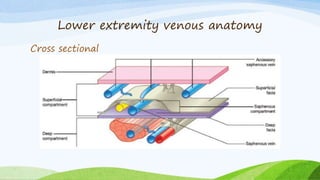
Lower extremity venous anatomy
Cross sectional
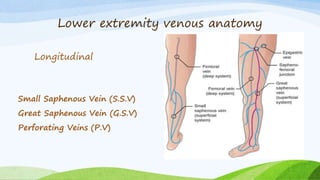
Lower extremity venous anatomy
Longitudinal
Small Saphenous Vein (S.S.V)
Great Saphenous Vein (G.S.V)
Perforating Veins (P.V)
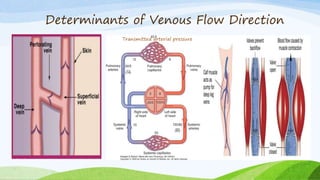
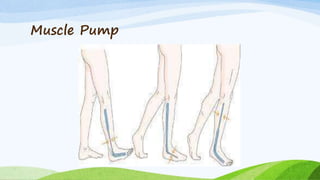
Determinants of Venous Flow Direction
Transmitted arterial pressure
Muscle Pump
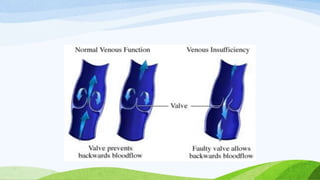
Venous Insufficiency
• Insufficiency contributes to:
Reflux
Reflux is the keyword of the CVI
and occurs secondary to:
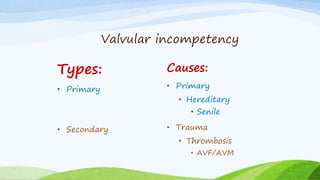
Valvular incompetency
Types:
• Primary
• Secondary
Causes:
• Primary
• Hereditary
• Senile
• Trauma
• Thrombosis
• AVF/AVM
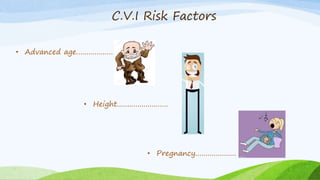
C.V.I Risk Factors
• Advanced age..................
• Height.........................
• Pregnancy....................
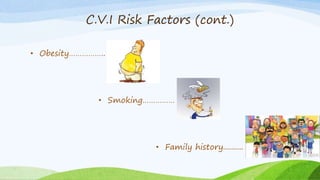
C.V.I Risk Factors (cont.)
• Obesity……………..
• Smoking……………
• Family history..........
C.V.I Risk Factors (cont.)
• Prolonged standing..........
• Female sex........
Pathophysiology:
Everything starts with venous
hypertension!
But How?
• Standing position + reflux = venous drainage problem
• Same inflow + less outflow = volume overload in
venous system = venous hypertension
Pathophysiology
• Venous hypertension at first results in venous dilation for
pooling more blood
• Clinical manifestation:
• Heaviness and warmness of the involved limb which
resolves with limb elevation and upward massage.
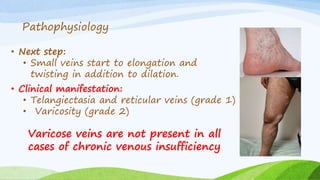
• Next step:
• Small veins start to elongation and
twisting in addition to dilation.
Pathophysiology
• Clinical manifestation:
• Telangiectasia and reticular veins (grade 1)
• Varicosity (grade 2)
Varicose veins are not present in all
cases of chronic venous insufficiency
• Next step:
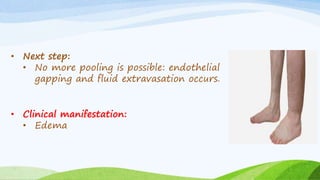
• No more pooling is possible: endothelial
gapping and fluid extravasation occurs.
• Clinical manifestation:
• Edema
• Next step:
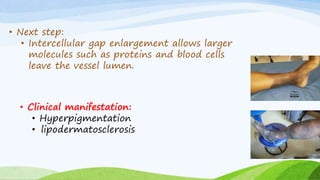
• Intercellular gap enlargement allows larger
molecules such as proteins and blood cells
leave the vessel lumen.
• Clinical manifestation:
• Hyperpigmentation
• lipodermatosclerosis
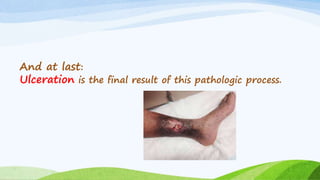
And at last:
Ulceration is the final result of this pathologic process.
Diagnostic Evaluation:
History& physical examination:
• Consider risk factors
• Past medical history (DVT)
• D&H (IV. Drug abuse)
• Ph/E
• Detailed examination of the target limb
Physical Examination
• Adjuncts:
Trendelenburg test
Perthes test
• Inspection:
Color
Scar (GSV harvest)
Edema
Hyperpigmentation
Ulcer
Telangectasia, reticular
& varicose veins
Lipodermatosclerosis
• Auscultation:
bruit
• Palpation:
Warmness
Pitting
Thrill
Distal pulses
Radiologic Studies:
Purposes of the study:
• Detection of the existing thrombosis (S&D systems)
• Localization of the reflux point
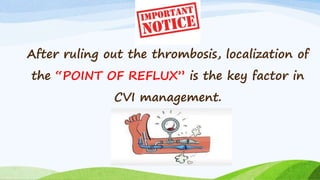
After ruling out the thrombosis, localization of
the “POINT OF REFLUX” is the key factor in
CVI management.
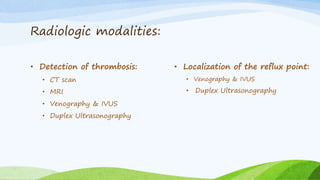
Radiologic modalities:
• Detection of thrombosis:
• CT scan
• MRI
• Venography & IVUS
• Duplex Ultrasonography
• Localization of the reflux point:
• Venography & IVUS
• Duplex Ultrasonography
Duplex ultrasonography (DUS) is the most
useful modality in diagnosis and
management of the “CVI”
Principles of treatment
• Wound care
• Compression therapy
• Medical treatment
• Endovascular interventions
• Surgical treatments
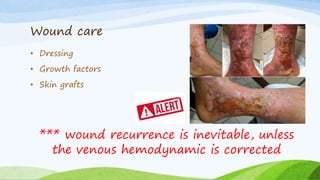
Wound care
• Dressing
• Growth factors
• Skin grafts
*** wound recurrence is inevitable, unless
the venous hemodynamic is corrected
Compression
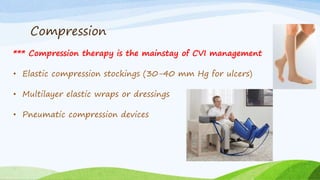
*** Compression therapy is the mainstay of CVI management
• Elastic compression stockings (30-40 mm Hg for ulcers)
• Multilayer elastic wraps or dressings
• Pneumatic compression devices
Medical treatments
• Increasing venous wall strength (flavonoids, chest nut oil)
• Increasing RBC flexibility (pentoxifylline)
• Decreasing blood coagulability (anti platelets and anticoagulants)
***Medications have a low grade of recommendation
and only prescribed in conjunction with effective
compression therapy
Interventions
• Purposes:
• Obstruction management
• Reflux elimination
*** Failure of treatment and recurrence are
the rule, unless these issues are taken into
account
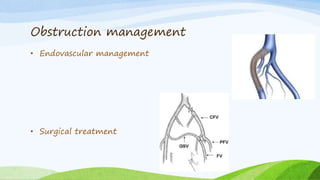
Obstruction management
• Endovascular management
• Surgical treatment
Reflux elimination
• Treatment is tailored based on point of reflux
• Superficial system reflux:
Ablative
• Deep system reflux:
Reconstructive
• Perforating vein reflux:
Ablative
Superficial system reflux
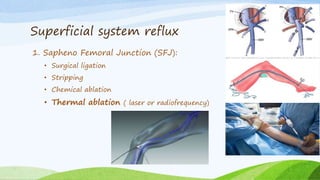
1. Sapheno Femoral Junction (SFJ):
• Surgical ligation
• Stripping
• Chemical ablation
• Thermal ablation ( laser or radiofrequency)
Superficial system reflux
2. Sapheno Popliteal Junction (SPJ)
• Ligation
• Stripping
• ablation
Superficial system reflux
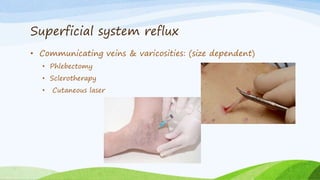
• Communicating veins & varicosities: (size dependent)
• Phlebectomy
• Sclerotherapy
• Cutaneous laser
Deep system reflux
• Valve reconstruction
• Valve transplantation
Perforating vein reflux
• Ligation
• Cut
• SEPS
Summary
• Lower extremity venous system includes deep, superficial and
perforating veins
• Cardiac pump, muscle contractions and venous valves are
determinants of upward flow in venous system
• Reflux is the key factor in chronic venous insufficiency
• Edema, varicosity, hyperpigmentation and ulcer are clinical
manifestations of CVI
• Compression therapy is the mainstay of management of CVI
patients
• Elimination of the highest point of reflux is the key factor in
successful treatment of CVI.
Thank You

Chronic Venous Insufficiency and Varicosity

  • 1.
    Chronic Venous Insufficiency & varices Dr.Pezhman Kharazm Assistant Professor of Vascular Surgery Golestan University of Medical sciences
  • 2.
    Today’s objectives • Toknow anatomy of venous system • To describe the physiology of venous system • To know pathophysiology of CVI • To diagnose Clinical Manifestations of CVI • To name para clinic investigations in CVI • To manage patients with CVI
  • 3.
    Lower extremity venousanatomy Cross sectional
  • 4.
    Lower extremity venousanatomy Longitudinal Small Saphenous Vein (S.S.V) Great Saphenous Vein (G.S.V) Perforating Veins (P.V)
  • 5.
    Determinants of VenousFlow Direction Transmitted arterial pressure
  • 6.
  • 8.
  • 9.
    Reflux is thekeyword of the CVI and occurs secondary to: Valvular incompetency
  • 10.
    Valvular incompetency Types: • Primary •Secondary Causes: • Primary • Hereditary • Senile • Trauma • Thrombosis • AVF/AVM
  • 11.
    C.V.I Risk Factors •Advanced age.................. • Height......................... • Pregnancy....................
  • 12.
    C.V.I Risk Factors(cont.) • Obesity…………….. • Smoking…………… • Family history..........
  • 13.
    C.V.I Risk Factors(cont.) • Prolonged standing.......... • Female sex........
  • 14.
    Pathophysiology: Everything starts withvenous hypertension! But How?
  • 15.
    • Standing position+ reflux = venous drainage problem • Same inflow + less outflow = volume overload in venous system = venous hypertension
  • 16.
    Pathophysiology • Venous hypertensionat first results in venous dilation for pooling more blood • Clinical manifestation: • Heaviness and warmness of the involved limb which resolves with limb elevation and upward massage.
  • 17.
    • Next step: •Small veins start to elongation and twisting in addition to dilation. Pathophysiology • Clinical manifestation: • Telangiectasia and reticular veins (grade 1) • Varicosity (grade 2) Varicose veins are not present in all cases of chronic venous insufficiency
  • 18.
    • Next step: •No more pooling is possible: endothelial gapping and fluid extravasation occurs. • Clinical manifestation: • Edema
  • 19.
    • Next step: •Intercellular gap enlargement allows larger molecules such as proteins and blood cells leave the vessel lumen. • Clinical manifestation: • Hyperpigmentation • lipodermatosclerosis
  • 20.
    And at last: Ulcerationis the final result of this pathologic process.
  • 21.
    Diagnostic Evaluation: History& physicalexamination: • Consider risk factors • Past medical history (DVT) • D&H (IV. Drug abuse) • Ph/E • Detailed examination of the target limb
  • 22.
    Physical Examination • Adjuncts: Trendelenburgtest Perthes test • Inspection: Color Scar (GSV harvest) Edema Hyperpigmentation Ulcer Telangectasia, reticular & varicose veins Lipodermatosclerosis • Auscultation: bruit • Palpation: Warmness Pitting Thrill Distal pulses
  • 23.
    Radiologic Studies: Purposes ofthe study: • Detection of the existing thrombosis (S&D systems) • Localization of the reflux point
  • 24.
    After ruling outthe thrombosis, localization of the “POINT OF REFLUX” is the key factor in CVI management.
  • 25.
    Radiologic modalities: • Detectionof thrombosis: • CT scan • MRI • Venography & IVUS • Duplex Ultrasonography • Localization of the reflux point: • Venography & IVUS • Duplex Ultrasonography
  • 26.
    Duplex ultrasonography (DUS)is the most useful modality in diagnosis and management of the “CVI”
  • 27.
    Principles of treatment •Wound care • Compression therapy • Medical treatment • Endovascular interventions • Surgical treatments
  • 28.
    Wound care • Dressing •Growth factors • Skin grafts *** wound recurrence is inevitable, unless the venous hemodynamic is corrected
  • 29.
    Compression *** Compression therapyis the mainstay of CVI management • Elastic compression stockings (30-40 mm Hg for ulcers) • Multilayer elastic wraps or dressings • Pneumatic compression devices
  • 30.
    Medical treatments • Increasingvenous wall strength (flavonoids, chest nut oil) • Increasing RBC flexibility (pentoxifylline) • Decreasing blood coagulability (anti platelets and anticoagulants) ***Medications have a low grade of recommendation and only prescribed in conjunction with effective compression therapy
  • 31.
    Interventions • Purposes: • Obstructionmanagement • Reflux elimination *** Failure of treatment and recurrence are the rule, unless these issues are taken into account
  • 32.
    Obstruction management • Endovascularmanagement • Surgical treatment
  • 33.
    Reflux elimination • Treatmentis tailored based on point of reflux • Superficial system reflux: Ablative • Deep system reflux: Reconstructive • Perforating vein reflux: Ablative
  • 34.
    Superficial system reflux 1.Sapheno Femoral Junction (SFJ): • Surgical ligation • Stripping • Chemical ablation • Thermal ablation ( laser or radiofrequency)
  • 35.
    Superficial system reflux 2.Sapheno Popliteal Junction (SPJ) • Ligation • Stripping • ablation
  • 36.
    Superficial system reflux •Communicating veins & varicosities: (size dependent) • Phlebectomy • Sclerotherapy • Cutaneous laser
  • 37.
    Deep system reflux •Valve reconstruction • Valve transplantation
  • 38.
    Perforating vein reflux •Ligation • Cut • SEPS
  • 39.
    Summary • Lower extremityvenous system includes deep, superficial and perforating veins • Cardiac pump, muscle contractions and venous valves are determinants of upward flow in venous system • Reflux is the key factor in chronic venous insufficiency • Edema, varicosity, hyperpigmentation and ulcer are clinical manifestations of CVI • Compression therapy is the mainstay of management of CVI patients • Elimination of the highest point of reflux is the key factor in successful treatment of CVI.
  • 40.