













PresentationTopic:
Who Invented laptop?
5TU
22February2013
Prepared by Group 5 members
from 5 Tu 2013:
Wendy Lim Yie Tiing (960110-13-6290)
Wong Ching Seng (960806-13-6395)
Halmen Hu Hong (960807-13-6119)
Shirley Dayang Paterick (961005-13-5936)
Purpose for
this invention
Purpose
This invention must give more convenient for
human and better than the last one.
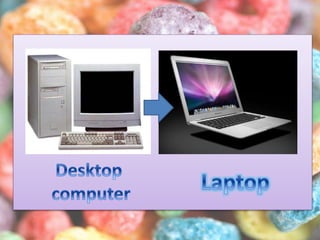
This invention had replace desktop computer.
This invention, laptop can replace desktop
computer because it is mobile. It can be carried
to anywhere and used anytime but its battery
must be fully charged.
Furthermore, laptop just takes up a little space of
your table. This is because all the components are
already resized into smaller parts and all the
components are set up in the mobile laptop.
Moreover, a laptop is very easy to set up. This is
because all the components are already combined
into one.
The first laptop was the GRiD Compass 1101, designed by
William Grant Bill Moggridge in 1979-1980, and released in
1982. Enclosed in a magnesium case, it introduced the now
familiar clamshell (翻盖) design, in which the flat (平板)
display folded shut against the keyboard. The computer could be
run from batteries, and was equipped with a 320×200 pixel
electroluminescent display and 384 kilobyte bubble memory. It
was not IBM-compatible, and its high price (US$ 8,000-10,000)
limited it to specialized applications. However, it was used heavily
by the U.S. military, and by NASA on the Space Shuttle during
1980s. The GRiD’s manufacturer subsequently earned significant
returns on its patent rights as its innovations became
commonplace. GRiD Systems Corp. was later bought by the
Tandy (now RadioShack ) Corporation.
The invention
was not catch on
immediately.
First
• William went on to study industrial design (1962-65) at Central St
Martins College of Art and Design where he eventually left his home
country to find work in the US shortly after finishing school. He found
work at the American Sterilizing Company (in Pennsylvania) where he
established a foot-hold in equipment design (hospital equipment),
which would lead him down a life-long path of technology design.
Then
• Eventually William returned to England and in 1969 returned to
college to study typography and communications, which would
tremendously benefit him later on in life. In the same year, he
started his first company (from the top floor of his home), called
Moggridge Associates, where his first successful marketable design
was a toaster for Hoover (UK Branch) and in 1973 designed a space
heater for the company that was featured on the cover of a
popular UK design magazine.
Start the
interest
• While designing industrial appliances for Hoover, William started to
become interested in computer design and actually created the
‘Mini Computer’ for UK-based Computer Technology LTD., however
it was never produced.
In 1979, William returned to the US and
opened up his second design company called ID Two
where he garnered an early client known as Grid
Systems Corporation (founded by John Ellenby). It
was for Grid that he designed, what is arguably (if
you take into account Xerox’s Dynabook project), the
first laptop computer known widely
as the GRiD Compass.
Let us know The
MAIN CHARACTER
for this TOPIC
Bill Moggridge
British industrial designer.
Father of the field of interaction design.
Inventor of the first laptop.
He designed the first laptop computer, the Grid
Compass, in 1979, was honoured for Lifetime
Achievement from the National Design
Awards, and given the Prince Philip Designers
Prize.
It inspired by some previous
invention. While designing
industrial appliances for Hoover,
William Grant Bill Morridge
started to become interested in
computer design and actually
created the ‘Mini Computer’ for
UK-based Computer Technology
LTD., however it was never
produced.
The inventor
was trying to
accomplish
the mini
computer for
convenient at
the time.
Significance
This invention changes our live and work…
 Productivity:
Using a laptop in places where a desktop PC
cannot be used, and at times that would
otherwise be wasted.
For example, an office worker managing their
e-mails during an hour-long commute by train,
or a student doing his/her homework at the
university coffee shop during
a break between lectures.
Immediacy:
Carrying a laptop means having instant [瞬间]
access [访问] to various information, personal
and work files. Immediacy [直接] allows
better collaboration[合作] between
coworkers or students, as a laptop can be
flipped open to present a problem or a
solution anytime, anywhere.
Size:
Laptops are smaller than
desktop PCs. This is
beneficial when space is at a
premium, for example in
small apartments and
student dorms. When not in
use, a laptop can be closed
and put away.
All-in-One:
designed to be portable,
laptops have everything
integrated in to the chassis.
For desktops (excluding all-
in-ones) this is divided into
the desktop, keyboard,
mouse, display, and
optional peripherals such
as speakers
What might life
be like if it had
never been
invented?
Our life will be like this…
It is hard for we to work outside because PC
cannot be bring anywhere.
The desktop computer will waste space of our
home before this invention.
The desktop computer hard to be set up
because components of desktop computer
are separate.
Nowadays, the invention had already
improve until the weight of the laptop became
light, components became more smaller, got
colourful screen, can online, quiet, low power
consumption and more thin compared to
before.
How might it
be improves in
the future?
It might be improve by continue resize the
components, LED screen, more lighter, more
function, more easier to be use, have large
space for more information and fast.
 http://www.zdnet.com/obituary-bill-
moggridge-inventor-of-the-first-laptop-
computer-7000003988/
 http://en.wikipedia.org/wiki/Laptop
 http://en.wikipedia.org/wiki/Bill_Moggridge
 http://en.wikipedia.org/wiki/GRiD_Compass
http://www.element14.com/community/com
munity/news/blog/2012/09/12/william-grant-
moggridge-inventor-of-the-grid-compass-the-
first-laptop-passes-away-at-69
 http://gizmodo.com/5941810/bill-moggridge-
inventor-of-the-first-laptop-has-died
Hope you enjoy it…
Who invented laptop

Who invented laptop

  • 1.
  • 3.
    Prepared by Group5 members from 5 Tu 2013: Wendy Lim Yie Tiing (960110-13-6290) Wong Ching Seng (960806-13-6395) Halmen Hu Hong (960807-13-6119) Shirley Dayang Paterick (961005-13-5936)
  • 4.
  • 5.
    Purpose This invention mustgive more convenient for human and better than the last one. This invention had replace desktop computer. This invention, laptop can replace desktop computer because it is mobile. It can be carried to anywhere and used anytime but its battery must be fully charged.
  • 6.
    Furthermore, laptop justtakes up a little space of your table. This is because all the components are already resized into smaller parts and all the components are set up in the mobile laptop. Moreover, a laptop is very easy to set up. This is because all the components are already combined into one.
  • 10.
    The first laptopwas the GRiD Compass 1101, designed by William Grant Bill Moggridge in 1979-1980, and released in 1982. Enclosed in a magnesium case, it introduced the now familiar clamshell (翻盖) design, in which the flat (平板) display folded shut against the keyboard. The computer could be run from batteries, and was equipped with a 320×200 pixel electroluminescent display and 384 kilobyte bubble memory. It was not IBM-compatible, and its high price (US$ 8,000-10,000) limited it to specialized applications. However, it was used heavily by the U.S. military, and by NASA on the Space Shuttle during 1980s. The GRiD’s manufacturer subsequently earned significant returns on its patent rights as its innovations became commonplace. GRiD Systems Corp. was later bought by the Tandy (now RadioShack ) Corporation.
  • 12.
    The invention was notcatch on immediately.
  • 13.
    First • William wenton to study industrial design (1962-65) at Central St Martins College of Art and Design where he eventually left his home country to find work in the US shortly after finishing school. He found work at the American Sterilizing Company (in Pennsylvania) where he established a foot-hold in equipment design (hospital equipment), which would lead him down a life-long path of technology design. Then • Eventually William returned to England and in 1969 returned to college to study typography and communications, which would tremendously benefit him later on in life. In the same year, he started his first company (from the top floor of his home), called Moggridge Associates, where his first successful marketable design was a toaster for Hoover (UK Branch) and in 1973 designed a space heater for the company that was featured on the cover of a popular UK design magazine. Start the interest • While designing industrial appliances for Hoover, William started to become interested in computer design and actually created the ‘Mini Computer’ for UK-based Computer Technology LTD., however it was never produced.
  • 14.
    In 1979, Williamreturned to the US and opened up his second design company called ID Two where he garnered an early client known as Grid Systems Corporation (founded by John Ellenby). It was for Grid that he designed, what is arguably (if you take into account Xerox’s Dynabook project), the first laptop computer known widely as the GRiD Compass.
  • 16.
    Let us knowThe MAIN CHARACTER for this TOPIC
  • 18.
    Bill Moggridge British industrialdesigner. Father of the field of interaction design. Inventor of the first laptop.
  • 19.
    He designed thefirst laptop computer, the Grid Compass, in 1979, was honoured for Lifetime Achievement from the National Design Awards, and given the Prince Philip Designers Prize.
  • 20.
    It inspired bysome previous invention. While designing industrial appliances for Hoover, William Grant Bill Morridge started to become interested in computer design and actually created the ‘Mini Computer’ for UK-based Computer Technology LTD., however it was never produced.
  • 21.
    The inventor was tryingto accomplish the mini computer for convenient at the time.
  • 22.
  • 23.
    This invention changesour live and work…  Productivity: Using a laptop in places where a desktop PC cannot be used, and at times that would otherwise be wasted.
  • 24.
    For example, anoffice worker managing their e-mails during an hour-long commute by train, or a student doing his/her homework at the university coffee shop during a break between lectures.
  • 25.
    Immediacy: Carrying a laptopmeans having instant [瞬间] access [访问] to various information, personal and work files. Immediacy [直接] allows better collaboration[合作] between coworkers or students, as a laptop can be flipped open to present a problem or a solution anytime, anywhere.
  • 26.
    Size: Laptops are smallerthan desktop PCs. This is beneficial when space is at a premium, for example in small apartments and student dorms. When not in use, a laptop can be closed and put away.
  • 27.
    All-in-One: designed to beportable, laptops have everything integrated in to the chassis. For desktops (excluding all- in-ones) this is divided into the desktop, keyboard, mouse, display, and optional peripherals such as speakers
  • 28.
    What might life belike if it had never been invented?
  • 29.
    Our life willbe like this… It is hard for we to work outside because PC cannot be bring anywhere. The desktop computer will waste space of our home before this invention. The desktop computer hard to be set up because components of desktop computer are separate.
  • 31.
    Nowadays, the inventionhad already improve until the weight of the laptop became light, components became more smaller, got colourful screen, can online, quiet, low power consumption and more thin compared to before.
  • 32.
    How might it beimproves in the future?
  • 33.
    It might beimprove by continue resize the components, LED screen, more lighter, more function, more easier to be use, have large space for more information and fast.
  • 35.
  • 36.
  • 37.