WHO/HIV/2012.27	


Annex	
  6.	
  Evidence	
  summaries	
  
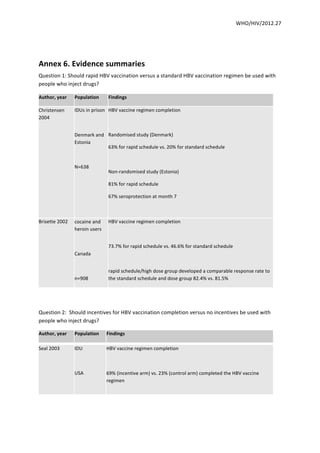
Question	
  1:	
  Should	
  rapid	
  HBV	
  vaccination	
  versus	
  a	
  standard	
  HBV	
  vaccination	
  regimen	
  be	
  used	
  with	
  
people	
  who	
  inject	
  drugs?	
  
Author,	
  year	
   Population	
   Findings	
  
Christensen	
  
2004	
  
IDUs	
  in	
  prison	


Denmark	
  and	
  
Estonia	


N=638	
  
HBV	
  vaccine	
  regimen	
  completion	


Randomised	
  study	
  (Denmark)	
  	
  
63%	
  for	
  rapid	
  schedule	
  vs.	
  20%	
  for	
  standard	
  schedule	


Non-­‐randomised	
  study	
  (Estonia)	
  
81%	
  for	
  rapid	
  schedule	
  
67%	
  seroprotection	
  at	
  month	
  7	


Brisette	
  2002	
   cocaine	
  and	
  
heroin	
  users	


Canada	


n=908	
  
HBV	
  vaccine	
  regimen	
  completion	


73.7%	
  for	
  rapid	
  schedule	
  vs.	
  46.6%	
  for	
  standard	
  schedule	


rapid	
  schedule/high	
  dose	
  group	
  developed	
  a	
  comparable	
  response	
  rate	
  to	
  
the	
  standard	
  schedule	
  and	
  dose	
  group	
  82.4%	
  vs.	
  81.5%	


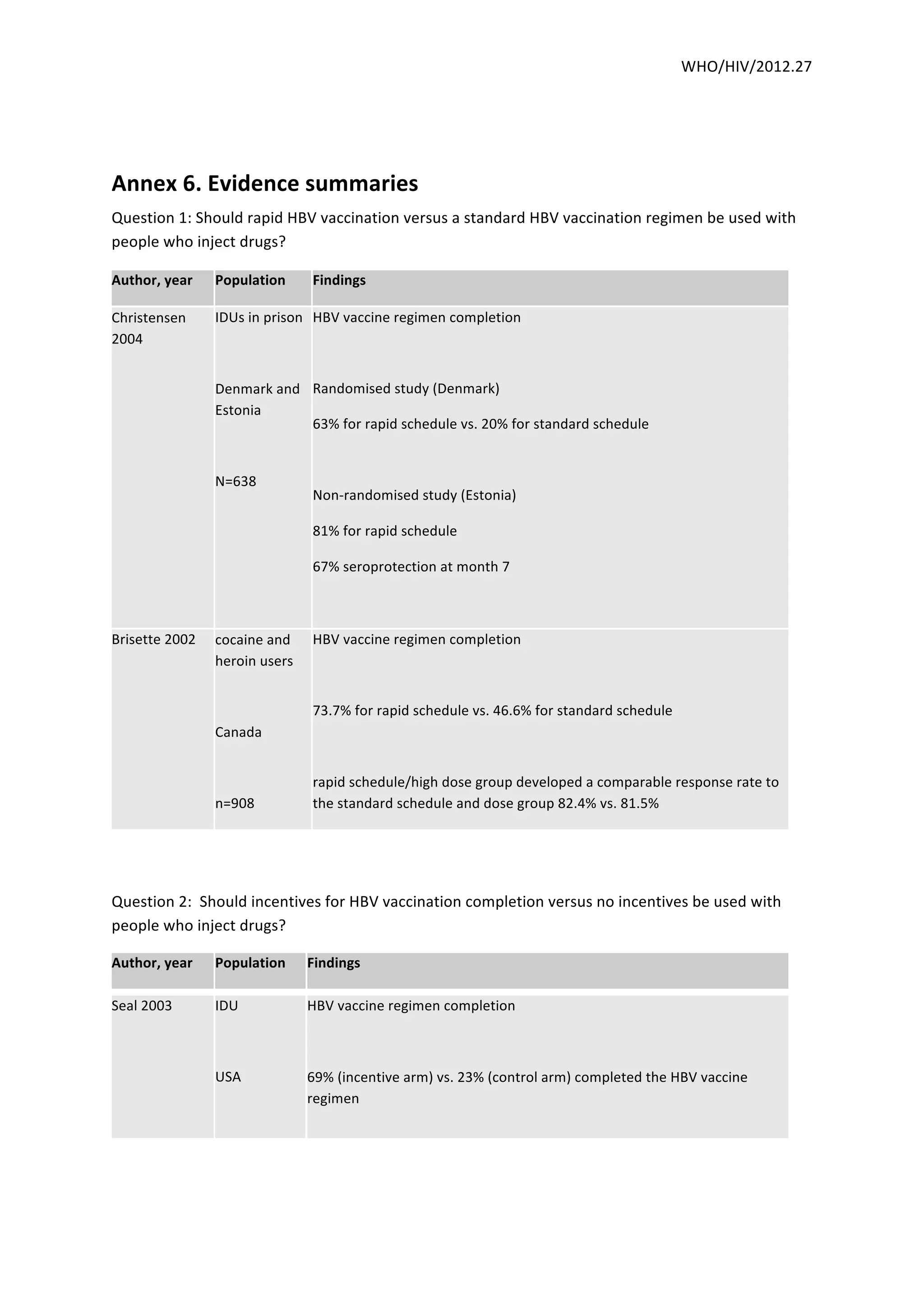
Question	
  2:	
  	
  Should	
  incentives	
  for	
  HBV	
  vaccination	
  completion	
  versus	
  no	
  incentives	
  be	
  used	
  with	
  
people	
  who	
  inject	
  drugs?	
  
Author,	
  year	
   Population	
   Findings	
  
Seal	
  2003	


IDU	


USA	


HBV	
  vaccine	
  regimen	
  completion	


69%	
  (incentive	
  arm)	
  vs.	
  23%	
  (control	
  arm)	
  completed	
  the	
  HBV	
  vaccine	
  
regimen	
  
  2	
  
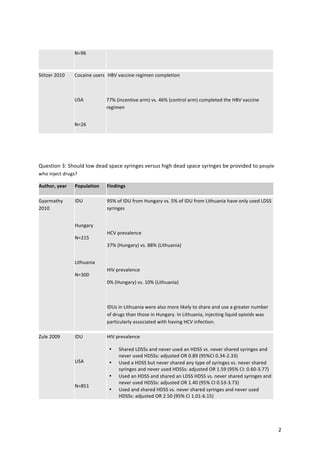
N=96	
  
Stitzer	
  2010	


Cocaine	
  users	


USA	


N=26	
  
	
  HBV	
  vaccine	
  regimen	
  completion	


77%	
  (incentive	
  arm)	
  vs.	
  46%	
  (control	
  arm)	
  completed	
  the	
  HBV	
  vaccine	
  
regimen	


Question	
  3:	
  Should	
  low	
  dead	
  space	
  syringes	
  versus	
  high	
  dead	
  space	
  syringes	
  be	
  provided	
  to	
  people	
  
who	
  inject	
  drugs?	
  
Author,	
  year	
   Population	
   Findings	
  
Gyarmathy	
  
2010	
  
IDU	


Hungary	
  
N=215	


Lithuania	
  
N=300	
  
95%	
  of	
  IDU	
  from	
  Hungary	
  vs.	
  5%	
  of	
  IDU	
  from	
  Lithuania	
  have	
  only	
  used	
  LDSS	
  
syringes	


HCV	
  prevalence	
  
37%	
  (Hungary)	
  vs.	
  88%	
  (Lithuania)	


HIV	
  prevalence	
  
0%	
  (Hungary)	
  vs.	
  10%	
  (Lithuania)	


IDUs	
  in	
  Lithuania	
  were	
  also	
  more	
  likely	
  to	
  share	
  and	
  use	
  a	
  greater	
  number	
  
of	
  drugs	
  than	
  those	
  in	
  Hungary.	
  In	
  Lithuania,	
  injecting	
  liquid	
  opioids	
  was	
  
particularly	
  associated	
  with	
  having	
  HCV	
  infection.	
  	
  
Zule	
  2009	
   IDU	


USA	


N=851	
  
HIV	
  prevalence	
  
• Shared	
  LDSSs	
  and	
  never	
  used	
  an	
  HDSS	
  vs.	
  never	
  shared	
  syringes	
  and	
  
never	
  used	
  HDSSs:	
  adjusted	
  OR	
  0.89	
  (95%CI	
  0.34-­‐2.33)	
  
• Used	
  a	
  HDSS	
  but	
  never	
  shared	
  any	
  type	
  of	
  syringes	
  vs.	
  never	
  shared	
  
syringes	
  and	
  never	
  used	
  HDSSs:	
  adjusted	
  OR	
  1.59	
  (95%	
  CI:	
  0.60-­‐3.77)	
  
• Used	
  an	
  HDSS	
  and	
  shared	
  an	
  LDSS	
  HDSS	
  vs.	
  never	
  shared	
  syringes	
  and	
  
never	
  used	
  HDSSs:	
  adjusted	
  OR	
  1.40	
  (95%	
  CI	
  0.53-­‐3.73)	
  
• Used	
  and	
  shared	
  HDSS	
  vs.	
  never	
  shared	
  syringes	
  and	
  never	
  used	
  
HDSSs:	
  adjusted	
  OR	
  2.50	
  (95%	
  CI	
  1.01-­‐6.15)	
  
  3	


HCV	
  prevalence	
  
• Shared	
  LDSSs	
  and	
  never	
  used	
  an	
  HDSS	
  vs.	
  never	
  shared	
  syringes	
  and	
  
never	
  used	
  HDSSs:	
  adjusted	
  OR	
  0.96	
  (95%	
  CI	
  0.53-­‐1.71)	
  
• Used	
  a	
  HDSS	
  but	
  never	
  shared	
  any	
  type	
  of	
  syringes	
  HDSS	
  vs.	
  never	
  
shared	
  syringes	
  and	
  never	
  used	
  HDSSs:	
  adjusted	
  OR	
  2.25	
  (95%	
  CI	
  1.30-­‐
3.90)	
  
• Used	
  an	
  HDSS	
  and	
  shared	
  an	
  LDSS	
  HDSS	
  vs.	
  never	
  shared	
  syringes	
  and	
  
never	
  used	
  HDSSs:	
  adjusted	
  OR	
  2.85	
  (95%	
  CI	
  1.43-­‐5.69)	
  
• Used	
  and	
  shared	
  HDSS	
  vs.	
  never	
  shared	
  syringes	
  and	
  never	
  used	
  
HDSSs:	
  adjusted	
  OR	
  2.21	
  (95%	
  CI	
  1.12-­‐4.35)	


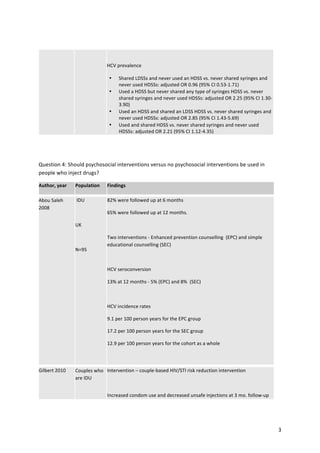
Question	
  4:	
  Should	
  psychosocial	
  interventions	
  versus	
  no	
  psychosocial	
  interventions	
  be	
  used	
  in	
  
people	
  who	
  inject	
  drugs?	
  
Author,	
  year	
   Population	
   Findings	
  
Abou	
  Saleh	
  
2008	
  
	
  IDU	


UK	


N=95	
  
82%	
  were	
  followed	
  up	
  at	
  6	
  months	
  
65%	
  were	
  followed	
  up	
  at	
  12	
  months.	


Two	
  interventions	
  -­‐	
  Enhanced	
  prevention	
  counselling	
  	
  (EPC)	
  and	
  simple	
  
educational	
  counselling	
  (SEC)	


HCV	
  seroconversion	
  
13%	
  at	
  12	
  months	
  -­‐	
  5%	
  (EPC)	
  and	
  8%	
  	
  (SEC)	


HCV	
  incidence	
  rates	
  	
  
9.1	
  per	
  100	
  person	
  years	
  for	
  the	
  EPC	
  group	
  
17.2	
  per	
  100	
  person	
  years	
  for	
  the	
  SEC	
  group	
  
12.9	
  per	
  100	
  person	
  years	
  for	
  the	
  cohort	
  as	
  a	
  whole	


Gilbert	
  2010	
   Couples	
  who	
  
are	
  IDU	


Intervention	
  –	
  couple-­‐based	
  HIV/STI	
  risk	
  reduction	
  intervention	


Increased	
  condom	
  use	
  and	
  decreased	
  unsafe	
  injections	
  at	
  3	
  mo.	
  follow-­‐up	
  
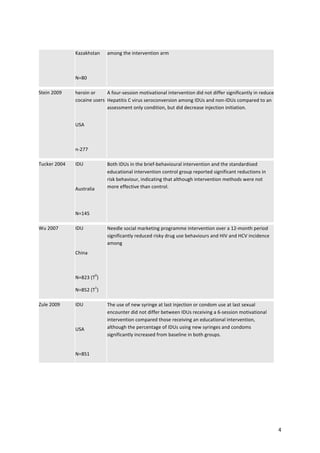
  4	
  
Kazakhstan	


N=80	
  
among	
  the	
  intervention	
  arm	
  
Stein	
  2009	


heroin	
  or	
  
cocaine	
  users	


USA	


n-­‐277	
  
A	
  four-­‐session	
  motivational	
  intervention	
  did	
  not	
  differ	
  significantly	
  in	
  reduce	
  
Hepatitis	
  C	
  virus	
  seroconversion	
  among	
  IDUs	
  and	
  non-­‐IDUs	
  compared	
  to	
  an	
  
assessment	
  only	
  condition,	
  but	
  did	
  decrease	
  injection	
  initiation.	


Tucker	
  2004	
   IDU	


Australia	


N=145	
  
Both	
  IDUs	
  in	
  the	
  brief-­‐behavioural	
  intervention	
  and	
  the	
  standardised	
  
educational	
  intervention	
  control	
  group	
  reported	
  significant	
  reductions	
  in	
  
risk	
  behaviour,	
  indicating	
  that	
  although	
  intervention	
  methods	
  were	
  not	
  
more	
  effective	
  than	
  control.	


Wu	
  2007	
   IDU	


China	


N=823	
  (T
0
)	
  
N=852	
  (T
1
)	
  
Needle	
  social	
  marketing	
  programme	
  intervention	
  over	
  a	
  12-­‐month	
  period	
  
significantly	
  reduced	
  risky	
  drug	
  use	
  behaviours	
  and	
  HIV	
  and	
  HCV	
  incidence	
  
among	
  
Zule	
  2009	
   IDU	


USA	


N=851	
  
The	
  use	
  of	
  new	
  syringe	
  at	
  last	
  injection	
  or	
  condom	
  use	
  at	
  last	
  sexual	
  
encounter	
  did	
  not	
  differ	
  between	
  IDUs	
  receiving	
  a	
  6-­‐session	
  motivational	
  
intervention	
  compared	
  those	
  receiving	
  an	
  educational	
  intervention,	
  
although	
  the	
  percentage	
  of	
  IDUs	
  using	
  new	
  syringes	
  and	
  condoms	
  
significantly	
  increased	
  from	
  baseline	
  in	
  both	
  groups.	


  5	
  
Question	
  5:	
  Should	
  peer	
  education	
  and	
  mentoring	
  versus	
  no	
  peer	
  education	
  and	
  mentoring	
  be	
  used	
  
in	
  people	
  who	
  inject	
  drugs?	
  
Author,	
  year	
   Population	
   Findings	
  
Garfein	
  2007	
   IDU	
  
USA	
  
N=	
  853	
  
29%	
  greater	
  decline	
  in	
  overall	
  injection	
  risk	
  among	
  intervention	
  
group	
  6	
  months	
  post-­‐intervention	
  relative	
  to	
  the	
  control	
  
[proportional	
  OR	
  0.71;	
  95%	
  CI:	
  0.52,	
  0.97],	
  and	
  a	
  76%	
  decrease	
  
compared	
  with	
  baseline.	
  
Decreases	
  were	
  also	
  observed	
  for	
  sexual	
  risk	
  behaviors,	
  but	
  they	
  did	
  
not	
  differ	
  by	
  trial	
  arm.	
  Overall	
  HCV	
  infection	
  incidence	
  (18.4/100	
  
person-­‐years)	
  did	
  not	
  differ	
  significantly	
  across	
  trial	
  arms	
  (RR	
  1.15;	
  
95%	
  CL	
  0.72,	
  1.82).	
  No	
  HIV	
  seroconversions	
  were	
  observed.	
  
Latka	
  2008	
   IDU	
  
USA	
  
N=418	
  
Compared	
  with	
  the	
  control	
  group,	
  intervention-­‐group	
  participants	
  
were	
  less	
  likely	
  to	
  report	
  distributive	
  risk	
  behaviors	
  at	
  3	
  months	
  
(OR=0.46;	
  95%	
  CI:	
  0.27,	
  0.79)	
  and	
  6	
  months	
  (OR=0.51;	
  95%	
  CI:0.31,	
  
0.83),	
  a	
  26%	
  relative	
  risk	
  reduction,	
  but	
  were	
  no	
  more	
  likely	
  to	
  cite	
  
their	
  HCV-­‐positive	
  status	
  as	
  a	
  reason	
  for	
  refraining	
  from	
  syringe	
  
lending.	
  Effects	
  were	
  strongest	
  among	
  intervention-­‐group	
  
participants	
  who	
  had	
  known	
  their	
  HCVpositive	
  status	
  for	
  at	
  least	
  6	
  
months.	
  Peer	
  mentoring	
  and	
  self-­‐efficacy	
  were	
  significantly	
  increased	
  
among	
  intervention-­‐group	
  participants,	
  and	
  intervention	
  effects	
  
were	
  mediated	
  through	
  improved	
  self-­‐efficacy.	


  6	
  
© World Health Organization 2012
All rights reserved. Publications of the World Health Organization are available on the WHO web site
(www.who.int) or can be purchased from WHO Press, World Health Organization, 20 Avenue Appia,
1211 Geneva 27, Switzerland (tel.: +41 22 791 3264; fax: +41 22 791 4857; e-mail:
bookorders@who.int).
Requests for permission to reproduce or translate WHO publications – whether for sale or for
noncommercial distribution – should be addressed to WHO Press through the WHO web site
(http://www.who.int/about/licensing/copyright_form/en/index.html).
The designations employed and the presentation of the material in this publication do not imply the
expression of any opinion whatsoever on the part of the World Health Organization concerning the legal
status of any country, territory, city or area or of its authorities, or concerning the delimitation of its
frontiers or boundaries. Dotted lines on maps represent approximate border lines for which there may
not yet be full agreement.
The mention of specific companies or of certain manufacturers’ products does not imply that they are
endorsed or recommended by the World Health Organization in preference to others of a similar nature
that are not mentioned. Errors and omissions excepted, the names of proprietary products are
distinguished by initial capital letters.
All reasonable precautions have been taken by the World Health Organization to verify the information
contained in this publication. However, the published material is being distributed without warranty of
any kind, either expressed or implied. The responsibility for the interpretation and use of the material
lies with the reader. In no event shall the World Health Organization be liable for damages arising from
its use.


Who hiv 2012.27_eng

  • 1.
      WHO/HIV/2012.27     Annex  6.  Evidence  summaries   Question  1:  Should  rapid  HBV  vaccination  versus  a  standard  HBV  vaccination  regimen  be  used  with   people  who  inject  drugs?   Author,  year   Population   Findings   Christensen   2004   IDUs  in  prison       Denmark  and   Estonia     N=638   HBV  vaccine  regimen  completion       Randomised  study  (Denmark)     63%  for  rapid  schedule  vs.  20%  for  standard  schedule     Non-­‐randomised  study  (Estonia)   81%  for  rapid  schedule   67%  seroprotection  at  month  7     Brisette  2002   cocaine  and   heroin  users     Canada     n=908   HBV  vaccine  regimen  completion     73.7%  for  rapid  schedule  vs.  46.6%  for  standard  schedule     rapid  schedule/high  dose  group  developed  a  comparable  response  rate  to   the  standard  schedule  and  dose  group  82.4%  vs.  81.5%       Question  2:    Should  incentives  for  HBV  vaccination  completion  versus  no  incentives  be  used  with   people  who  inject  drugs?   Author,  year   Population   Findings   Seal  2003     IDU     USA     HBV  vaccine  regimen  completion     69%  (incentive  arm)  vs.  23%  (control  arm)  completed  the  HBV  vaccine   regimen  
  • 2.
      2   N=96   Stitzer  2010     Cocaine  users     USA     N=26    HBV  vaccine  regimen  completion     77%  (incentive  arm)  vs.  46%  (control  arm)  completed  the  HBV  vaccine   regimen       Question  3:  Should  low  dead  space  syringes  versus  high  dead  space  syringes  be  provided  to  people   who  inject  drugs?   Author,  year   Population   Findings   Gyarmathy   2010   IDU     Hungary   N=215     Lithuania   N=300   95%  of  IDU  from  Hungary  vs.  5%  of  IDU  from  Lithuania  have  only  used  LDSS   syringes       HCV  prevalence   37%  (Hungary)  vs.  88%  (Lithuania)     HIV  prevalence   0%  (Hungary)  vs.  10%  (Lithuania)     IDUs  in  Lithuania  were  also  more  likely  to  share  and  use  a  greater  number   of  drugs  than  those  in  Hungary.  In  Lithuania,  injecting  liquid  opioids  was   particularly  associated  with  having  HCV  infection.     Zule  2009   IDU     USA     N=851   HIV  prevalence   • Shared  LDSSs  and  never  used  an  HDSS  vs.  never  shared  syringes  and   never  used  HDSSs:  adjusted  OR  0.89  (95%CI  0.34-­‐2.33)   • Used  a  HDSS  but  never  shared  any  type  of  syringes  vs.  never  shared   syringes  and  never  used  HDSSs:  adjusted  OR  1.59  (95%  CI:  0.60-­‐3.77)   • Used  an  HDSS  and  shared  an  LDSS  HDSS  vs.  never  shared  syringes  and   never  used  HDSSs:  adjusted  OR  1.40  (95%  CI  0.53-­‐3.73)   • Used  and  shared  HDSS  vs.  never  shared  syringes  and  never  used   HDSSs:  adjusted  OR  2.50  (95%  CI  1.01-­‐6.15)  
  • 3.
      3     HCV  prevalence   • Shared  LDSSs  and  never  used  an  HDSS  vs.  never  shared  syringes  and   never  used  HDSSs:  adjusted  OR  0.96  (95%  CI  0.53-­‐1.71)   • Used  a  HDSS  but  never  shared  any  type  of  syringes  HDSS  vs.  never   shared  syringes  and  never  used  HDSSs:  adjusted  OR  2.25  (95%  CI  1.30-­‐ 3.90)   • Used  an  HDSS  and  shared  an  LDSS  HDSS  vs.  never  shared  syringes  and   never  used  HDSSs:  adjusted  OR  2.85  (95%  CI  1.43-­‐5.69)   • Used  and  shared  HDSS  vs.  never  shared  syringes  and  never  used   HDSSs:  adjusted  OR  2.21  (95%  CI  1.12-­‐4.35)       Question  4:  Should  psychosocial  interventions  versus  no  psychosocial  interventions  be  used  in   people  who  inject  drugs?   Author,  year   Population   Findings   Abou  Saleh   2008    IDU     UK     N=95   82%  were  followed  up  at  6  months   65%  were  followed  up  at  12  months.       Two  interventions  -­‐  Enhanced  prevention  counselling    (EPC)  and  simple   educational  counselling  (SEC)     HCV  seroconversion   13%  at  12  months  -­‐  5%  (EPC)  and  8%    (SEC)     HCV  incidence  rates     9.1  per  100  person  years  for  the  EPC  group   17.2  per  100  person  years  for  the  SEC  group   12.9  per  100  person  years  for  the  cohort  as  a  whole     Gilbert  2010   Couples  who   are  IDU     Intervention  –  couple-­‐based  HIV/STI  risk  reduction  intervention     Increased  condom  use  and  decreased  unsafe  injections  at  3  mo.  follow-­‐up  
  • 4.
      4   Kazakhstan     N=80   among  the  intervention  arm   Stein  2009     heroin  or   cocaine  users     USA     n-­‐277   A  four-­‐session  motivational  intervention  did  not  differ  significantly  in  reduce   Hepatitis  C  virus  seroconversion  among  IDUs  and  non-­‐IDUs  compared  to  an   assessment  only  condition,  but  did  decrease  injection  initiation.       Tucker  2004   IDU       Australia     N=145   Both  IDUs  in  the  brief-­‐behavioural  intervention  and  the  standardised   educational  intervention  control  group  reported  significant  reductions  in   risk  behaviour,  indicating  that  although  intervention  methods  were  not   more  effective  than  control.       Wu  2007   IDU     China     N=823  (T 0 )   N=852  (T 1 )   Needle  social  marketing  programme  intervention  over  a  12-­‐month  period   significantly  reduced  risky  drug  use  behaviours  and  HIV  and  HCV  incidence   among   Zule  2009   IDU     USA     N=851   The  use  of  new  syringe  at  last  injection  or  condom  use  at  last  sexual   encounter  did  not  differ  between  IDUs  receiving  a  6-­‐session  motivational   intervention  compared  those  receiving  an  educational  intervention,   although  the  percentage  of  IDUs  using  new  syringes  and  condoms   significantly  increased  from  baseline  in  both  groups.          
  • 5.
      5   Question  5:  Should  peer  education  and  mentoring  versus  no  peer  education  and  mentoring  be  used   in  people  who  inject  drugs?   Author,  year   Population   Findings   Garfein  2007   IDU   USA   N=  853   29%  greater  decline  in  overall  injection  risk  among  intervention   group  6  months  post-­‐intervention  relative  to  the  control   [proportional  OR  0.71;  95%  CI:  0.52,  0.97],  and  a  76%  decrease   compared  with  baseline.   Decreases  were  also  observed  for  sexual  risk  behaviors,  but  they  did   not  differ  by  trial  arm.  Overall  HCV  infection  incidence  (18.4/100   person-­‐years)  did  not  differ  significantly  across  trial  arms  (RR  1.15;   95%  CL  0.72,  1.82).  No  HIV  seroconversions  were  observed.   Latka  2008   IDU   USA   N=418   Compared  with  the  control  group,  intervention-­‐group  participants   were  less  likely  to  report  distributive  risk  behaviors  at  3  months   (OR=0.46;  95%  CI:  0.27,  0.79)  and  6  months  (OR=0.51;  95%  CI:0.31,   0.83),  a  26%  relative  risk  reduction,  but  were  no  more  likely  to  cite   their  HCV-­‐positive  status  as  a  reason  for  refraining  from  syringe   lending.  Effects  were  strongest  among  intervention-­‐group   participants  who  had  known  their  HCVpositive  status  for  at  least  6   months.  Peer  mentoring  and  self-­‐efficacy  were  significantly  increased   among  intervention-­‐group  participants,  and  intervention  effects   were  mediated  through  improved  self-­‐efficacy.        
  • 6.
      6   ©World Health Organization 2012 All rights reserved. Publications of the World Health Organization are available on the WHO web site (www.who.int) or can be purchased from WHO Press, World Health Organization, 20 Avenue Appia, 1211 Geneva 27, Switzerland (tel.: +41 22 791 3264; fax: +41 22 791 4857; e-mail: bookorders@who.int). Requests for permission to reproduce or translate WHO publications – whether for sale or for noncommercial distribution – should be addressed to WHO Press through the WHO web site (http://www.who.int/about/licensing/copyright_form/en/index.html). The designations employed and the presentation of the material in this publication do not imply the expression of any opinion whatsoever on the part of the World Health Organization concerning the legal status of any country, territory, city or area or of its authorities, or concerning the delimitation of its frontiers or boundaries. Dotted lines on maps represent approximate border lines for which there may not yet be full agreement. The mention of specific companies or of certain manufacturers’ products does not imply that they are endorsed or recommended by the World Health Organization in preference to others of a similar nature that are not mentioned. Errors and omissions excepted, the names of proprietary products are distinguished by initial capital letters. All reasonable precautions have been taken by the World Health Organization to verify the information contained in this publication. However, the published material is being distributed without warranty of any kind, either expressed or implied. The responsibility for the interpretation and use of the material lies with the reader. In no event shall the World Health Organization be liable for damages arising from its use.