Download to read offline
![MSMGF MSM in Sub-Saharan Africa: Health, Access, & HIV | 5
1. BACKGROUND
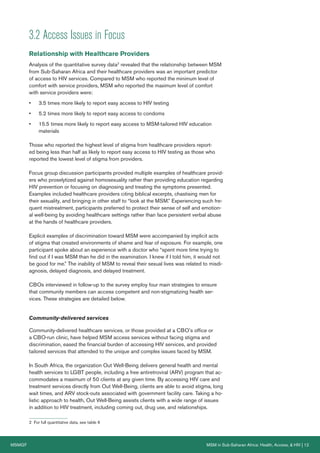
In Sub-Saharan Africa, available data show that men who have sex with men (MSM) face
high HIV prevalence and incidence. In most countries with reliable data, HIV prevalence
among MSM is either greater than or nearly equal to prevalence in the general popula-
tion. Examining the region as a whole, aggregate HIV prevalence among MSM is more
than three times that of the general population (see Figure 1).
FIGURE 1
Aggregate prevalence of HIV among MSM compared to the general
population in Sub-Saharan Africa [1-3]
A complex set of determinants drives the HIV pandemic in Sub-Saharan Africa. Among
MSM, stigma and discrimination play an important role, as does criminalization of sex
between men. Of the 48 countries in Sub-Saharan Africa, 30 criminalize sexual activity
between people of the same gender, with sanctions ranging from imprisonment to the
death penalty [4]. These laws can severely impact the ability of MSM to access ser-
vices, the ability of clinics to offer services tailored to the needs of MSM, and the ability
of MSM to participate openly in national planning processes that dictate funding and
programs [5-7].
0%
5%
10%
15%
20%
25%
30%
35%
Zambia Ghana Senegal Malawi Botswana South
Africa
Kenya Nigeria Namibia Tanzania Sudan
SUB-
SAHARAN
AFRICA
(Regional)
Population (15+) prevalence of HIV
Aggregate prevalence of HIV among MSM (%)](https://image.slidesharecdn.com/msminssapolicybrief-140821050457-phpapp01/85/MSM-in-sub-saharan-africa-5-320.jpg)
![MSMGF MSM in Sub-Saharan Africa: Health, Access, & HIV | 6
In addition to explicit criminalization, stigma and discrimination among healthcare
providers can significantly reduce access to services among MSM. According to a
recent study of MSM in Malawi, Namibia, and Botswana, few men had ever disclosed
same-sex practices to a health professional, and nearly 20% reported being afraid to
seek healthcare. The study indicated that fear of seeking health services was strongly
associated with experiences of discrimination [8].
Historically, community-based organizations (CBOs) led by lesbian, gay, bisexual, and
transgender (LGBT) people have spearheaded the response to HIV among MSM in
Sub-Saharan Africa. These organizations initiated and continue to provide nearly all
of the HIV services and information tailored to the needs of MSM in the region. They
also lead work to address the broader structural determinants of health, including
criminalization, stigma, and discrimination, by conducting advocacy for LGBT health
and human rights. Despite developing innovative and effective programs and con-
ducting powerful advocacy campaigns, many of these organizations have very little
funding or political support as they confront this massive public health crisis.
In recent years, a handful of mainstream professional AIDS service organizations
have begun to extend HIV programs to include MSM in the region. Some govern-
ments have also started addressing MSM in AIDS National Strategic Plans (NSPs),
though often in ways that do not allow for effective HIV programming among MSM
[9]. Multilateral agencies have recommended action to curb HIV among MSM in vari-
ous guidance documents [10, 11], and large global HIV donors like PEPFAR and the
Global Fund have made public commitments to fund HIV programming and research
among MSM [12, 13]. Despite this apparent progress, recent research suggests that
these developments have yet to translate into adequate funding and implementation
of MSM programs [14].
As acknowledgement of the HIV epidemics among MSM in Sub-Saharan Africa
builds, numerous new initiatives are being developed to scale-up programming for
key populations by increasing focus on targeted programs [15, 16]. However, there
remain important gaps in the knowledge necessary to ensure successful imple-
mentation of programs targeting MSM. Information on access to HIV programs and
services among MSM in Sub-Saharan Africa is limited, including information on the
barriers and facilitators that impact service access for MSM. There is also limited
understanding of how CBOs and community systems can work together with other
stakeholders and health systems to form effective and efficient solutions for the deliv-
ery of healthcare to MSM [17].
In this context of an uncontrolled epidemic among MSM in Sub-Saharan Africa and
new attempts to scale-up MSM-targeted programming, this policy brief aims to
address some of these gaps by examining current access to basic HIV prevention
and treatment services among MSM in Sub-Saharan Africa. These findings combine
the quantitative and qualitative data from the 2012 Global Men’s Health and Rights
(GMHR) study, and interviews with LGBT-led CBOs across six countries.
The brief concludes with recommendations for action to support the successful
scale-up of MSM-targeted HIV programs in the region.
Historically,
community-based
organizations
(CBOs) led by
lesbian, gay, bisexual,
and transgender
(LGBT) people have
spearheaded the
response to HIV
among MSM in Sub-
Saharan Africa.](https://image.slidesharecdn.com/msminssapolicybrief-140821050457-phpapp01/85/MSM-in-sub-saharan-africa-6-320.jpg)
![MSMGF MSM in Sub-Saharan Africa: Health, Access, & HIV | 7
2. METHODS
In 2012, the Global Forum on MSM and HIV (MSMGF) developed and implemented
a global multilingual online quantitative survey to identify and explore barriers and
facilitators HIV service access for MSM. Respondents were asked to rate the ease
with which they could access free or low cost condoms, condom-compatible lubri-
cants, HIV testing, HIV treatment, and MSM-targeted HIV education materials.
In addition to levels of access, the MSMGF Research Team
measured factors hypothesized to act as barriers or facili-
tators of service access using multiple-item scales. These
factors included: (i) comfort with health service provider;
(ii) past experiences of provider stigma; (iii) past experienc-
es of homophobic violence; (iv) community engagement;
(v) connection to gay community; and (vi) perceptions of
homophobia. We used multivariable mixed effects logistic
regression models to investigate the relationships between
each of the barrier and facilitator variables and easy access
to health services (adjusting for demographic variables and
for mutual confounding between the barriers and facilitator
variables). The sample for this sub-analysis was restricted to
respondents from Sub-Saharan Africa. The methods of this
survey are described in detail elsewhere [18].
Supplementing the global online survey, the MSMGF
worked with the African Men for Sexual Health and Rights
(AMSHeR) and LGBT-led organizations in South Africa,
Kenya, and Nigeria to conduct qualitative focus group dis-
cussions with local MSM in five cities: Nairobi, Lagos, Abuja,
Pretoria, and Johannesburg. The focus groups engaged in
open-ended conversations in 2012 on the factors that affect
access to HIV services, grounded in the lived experiences of
MSM in their respective cities. We have described the meth-
ods and findings of these discussions in a previous report
[19]. In this brief, we excerpt key findings.
After collecting and analyzing quantitative and qualitative
data and writing a preliminary report, the research team
conducted follow-up phone interviews in 2013 regarding
CBO work to address HIV among MSM in Ghana, Malawi,
Nigeria, South Africa, Uganda, and Zambia (see Table 1).
Representatives commented on the development and imple-
mentation of a wide range of locally relevant and successful
strategies to address the barriers and facilitators revealed by
the GMHR, including: (i) relationships between MSM and
their health service providers; (ii) homophobia and homopho-
bic violence; and (iii) engagement with the gay community.
We describe these interventions in this brief.
TABLE 1
Contributing community-based
organizations
Organization Location
African Men for Sexual Health
and Rights (AMSHeR)
Johannesburg,
South Africa
Alternatives Cameroun Douala,
Cameroon
Frank and Candy Kampala,
Uganda
Friends of Rainka Lusaka,
Zambia
Gay and Lesbian Coalition of
Kenya (GALCK)
Nairobi, Kenya
Gays & Lesbians of Zimbabwe
(GALZ)
Harare,
Zimbabwe
ISHTAR MSM Nairobi, Kenya
OUT LGBT Well-Being Pretoria,
South Africa
Out Right Namibia Windhoek,
Namibia
Rainbow Candle Light Bujumbura,
Burundi
The Center for Popular
Education and Human Rights,
Ghana (CEPEHRG)
Accra, Ghana
The Center for the
Development of People
(CEDEP)
Blantyre,
Malawi
The Initiative for Equal Rights
(TIER)
Lagos, Nigeria
The International Center on
Advocacy for the Right to
Health (ICARH)
Abuja, Nigeria](https://image.slidesharecdn.com/msminssapolicybrief-140821050457-phpapp01/85/MSM-in-sub-saharan-africa-7-320.jpg)
![MSMGF MSM in Sub-Saharan Africa: Health, Access, & HIV | 10
Additionally, when comparing younger and older MSM, we found that respondents
from Sub-Saharan Africa under the age of 30 had more than double the level of
access to lubricants (OR = 2.18, 95% CI: [1.23 – 3.86]) compared to respondents
over the age of 30. Similarly, respondents under the age of 30 had more than 2.5
times the level of access to HIV education materials (OR=2.60, 95% CI: [1.26 –
5.39]) compared to those over the age of 30. After adjusting for barriers and facili-
tators and for demographic variables, there was no difference in access to services
between MSM in these two age groups. This suggests that the differences between
younger and older MSM can be attributed to differences in the levels of barriers and
facilitators that these two groups face.
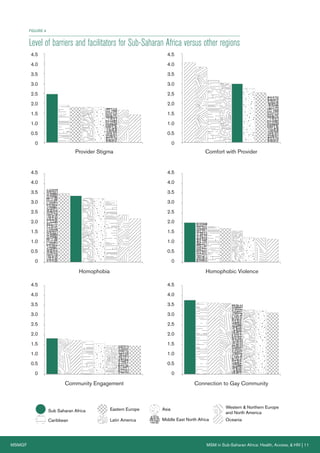
When comparing Sub-Saharan Africa to the other seven world regions represented
in the GMHR survey, respondents living in Sub-Saharan Africa reported the highest
level of stigma from healthcare providers and the fourth lowest level of comfort with
healthcare providers. Respondents from Sub-Saharan Africa also experienced the
highest level of homophobic violence and the third-highest level of perceived ho-
mophobia. Finally, respondents from Sub-Saharan Africa reported the highest levels
of engagement in gay community and connection to gay community.
It is important to note that in different regions barriers and facilitators might affect
access to services in different ways. For example, homophobic violence and past ex-
periences of stigma by providers were significantly associated with lower access to
HIV testing among MSM living in Sub-Saharan Africa, yet they were not a significant
predictor for access to services among the global sample of MSM in the GMHR
survey (see Table 3) [10].
TABLE 3
Predictors of access to services among MSM in Sub-Saharan Africa versus among
MSM globally
Predictors of Access
to Condoms
Predictors
of Access to
Lubricants
Predictors of Access
to HIV Testing
Predictors of
Access to HIV
Education
Predictors of
Access to HIV
Treatment*
Sub-SaharanAfrica
Barriers
• Homophobia • Homophobia
• Homophobic
violence
• Provider stigma
Facilitators
• Connection to gay
community
• Comfort with
provider
• Comfort with
provider
• Connection to gay
community
• Comfort with
provider
• Community
engagement
• Connection to
gay community
• Comfort with
provider
• Comfort with
provider
Global
Barriers
• Homophobia
• Provider stigma
• Homophobia • Homophobia • Homophobia • Homophobia
Facilitators
• Community
engagement
• Connection to gay
community
• Comfort with
provider
• Community
engagement
• Connection to
gay community
• Comfort with
provider
• Connection to gay
community
• Comfort with
provider
• Community
engagement
• Connection to
gay community
• Comfort with
provider
• Comfort with
provider](https://image.slidesharecdn.com/msminssapolicybrief-140821050457-phpapp01/85/MSM-in-sub-saharan-africa-10-320.jpg)
![MSMGF MSM in Sub-Saharan Africa: Health, Access, & HIV | 19
CBO interview participants identified capacity building needs to further these
pivotal roles, including skills to develop winning grant proposals, identifying
strong and appropriate project indicators, increasing management capacities,
improving report writing and research skills to expand the evidence base and
evidence-based planning, and monitoring and evaluating for impact. Community
systems strengthening approaches promise to help ensure higher-impact proj-
ects and programs that are accountable to community stakeholders [17].
Large donors should provide grant opportunities directly to MSM-led
CBOs working on the ground, and the grant opportunities should be
designed in such a way that MSM-led CBOs can access them without
having funds routed through a third party.
In addition to investing in program implementation costs and capac-
ity-building activities, donors should make adequate investments
in the capacity and sustainability of local MSM-led CBOs, including
salaries and overhead.
Donors must work with local MSM-led CBOs to shape support so that
it addresses real needs, targeted towards organizational sustainabil-
ity, with clear and measurable outcomes for the organizations receiv-
ing assistance.
2. Integrate Community Systems
In addition to strengthening community-based organizations to deliver services,
it is important to integrate community systems by supporting linkages between
MSM-led CBOs and different actors in local health systems. As this study
shows, MSM in Sub-Saharan Africa report the highest levels of stigma from
healthcare providers in the GMHR global sample, and the fourth lowest level of
comfort with healthcare providers. Violence and stigma significantly affect ac-
cess to HIV-related services including testing. MSM-led CBOs are well-suited to
build the capacity of mainstream health systems to ensure that they are friendly
and competent to meet MSM needs, leveraging enduring government funding of
health systems to work sustainably and effectively to improve the quality of MSM
services across wide geographic areas.
While vital progress has been made in recognizing the importance of engaging
communities and community systems, it must be noted that the appearance of
community involvement is far more common than the reality. At this point in the
global response, we must prioritize systems to assess meaningful community
engagement, with accountability to community members.
Governments should work with local MSM-led CBOs to build linkages
between community systems and health systems, including sensiti-
zation and competency trainings, designing medical school curricula,
and collaboratively developing and implementing shared initiatives.
Donors should prioritize proposals with adequate time and resourc-
es dedicated toward meaningful community engagement, includ-
ing failsafes and assessments that ensure appropriate community
engagement.
“It is very possible to
develop community
groups to gain the level
of expert services you
need. I have seen it so
many times – if you have
the right approach and a
longer term approach to
get your quality outputs,
you can do that with
community systems. The
added advantage is that
they are embedded in the
community, so they will
outlive any grant.”
—CBO Interview Participant](https://image.slidesharecdn.com/msminssapolicybrief-140821050457-phpapp01/85/MSM-in-sub-saharan-africa-19-320.jpg)
![MSMGF MSM in Sub-Saharan Africa: Health, Access, & HIV | 22
DATA TABLES
Table 4 shows the average score for each of the six barriers and facilitators referred to in this report. The averages
are measured for each of the five focus countries in this study brief, and for the five world regions included in the
GMHR survey, showing the global average across all respondents.
TABLE4
Levelsofbarriersandfacilitatorsindifferentcountriesandregions
RelationshipwithProviderHomophobiaEngagementwithCommunity
ProviderStigma
comfortwith
provider
Homophobia
Homophobic
Violence
Community
Engagement
Connection
toGayCommunity
Score95%CIScore95%CIScore95%CIScore95%CIScore95%CIScore95%CI
Countries
Kenya2.44[2.03;2.84]3.03[2.77;3.29]3.63[3.49;3.77]2.54[2.28;2.79]1.97[1.79;2.15]3.95[3.74;4.17]
Namibia3.63[3.25;4.02]2.56[2.28;2.84]2.59[2.47;2.71]1.66[1.48;1.83]1.64[1.46;1.83]3.79[3.58;3.99]
Nigeria3.1[2.78;3.42]3.04[2.85;3.23]3.7[3.59;3.81]1.97[1.77;2.17]1.84[1.69;1.99]3.79[3.63;3.95]
South
Africa
1.59[1.37;1.81]3.37[3.21;3.53]2.74[2.65;2.83]1.58[1.44;1.72]1.77[1.67;1.87]3.69[3.54;3.84]
Zimbabwe2.14[1.46;2.82]2.75[2.31;3.19]3.75[3.53;3.97]2.23[1.83;2.63]1.77[1.54;2]3.63[3.22;4.03]
Regions
Asia1.79[1.7;1.87]2.76[2.71;2.81]3.23[3.2;3.26]1.26[1.22;1.29]1.56[1.53;1.59]3.23[3.17;3.28]
Caribbean1.9[1.61;2.18]3.17[2.98;3.36]3.11[2.99;3.22]1.8[1.62;1.98]1.67[1.56;1.79]3.65[3.49;3.8]
Eastern
Europe
1.79[1.68;1.9]2.54[2.48;2.6]3.49[3.46;3.53]1.72[1.65;1.78]1.44[1.41;1.48]3.12[3.06;3.19]
Latin
America
1.79[1.67;1.91]3.02[2.95;3.08]3.25[3.21;3.29]1.59[1.53;1.65]1.46[1.42;1.5]3.28[3.21;3.35]
Middle
EastNorth
Africa
1.75[1.42;2.08]2.34[2.08;2.59]3.71[3.59;3.84]2.01[1.78;2.24]1.45[1.35;1.55]3.55[3.38;3.73]
Oceania1.42[1.28;1.56]4.06[3.97;4.16]2.21[2.14;2.28]1.18[1.13;1.22]1.72[1.66;1.79]3.62[3.52;3.72]
Sub
Saharan
Africa
2.46[2.31;2.61]2.98[2.89;3.07]3.37[3.31;3.43]2.01[1.91;2.1]1.82[1.76;1.89]3.76[3.68;3.84]
Western
Europe
1.65[1.57;1.72]3.83[3.78;3.88]2.41[2.38;2.44]1.23[1.2;1.25]1.8[1.76;1.83]3.6[3.55;3.65]
Global1.81[1.77;1.86]3.13[3.1;3.16]3.06[3.04;3.08]1.48[1.46;1.5]1.63[1.61;1.64]3.41[3.38;3.44]](https://image.slidesharecdn.com/msminssapolicybrief-140821050457-phpapp01/85/MSM-in-sub-saharan-africa-22-320.jpg)
![MSMGF MSM in Sub-Saharan Africa: Health, Access, & HIV | 23
TABLE5
ProportionofrespondentswhoreportedcompleteaccesstokeyHIVservices
CondomsLubricantsHIVTestingHIVTreatmentEducationMaterials
%95%CI%95%CI%95%CI%95%CI%95%CI
Countries
Kenya54.8[43.5;65.7]19.5[11.6;29.7]58.8[47.2;69.6]43.8[19.8;70.1]16.5[9.1;26.5]
Zimbabwe42.3[23.4;63.1]19.2[6.6;39.4]56[34.9;75.6]33.3[4.3;77.7]3.8[0.1;19.6]
Namibia34.7[23.9;46.9]13.5[6.7;23.5]28.8[18.8;40.6]20[0.5;71.6]17.8[9.8;28.5]
Nigeria40.9[31.8;50.4]33.9[25.3;43.3]40.4[31.1;50.2]10[2.1;26.5]27.9[19.8;37.2]
SouthAfrica69[60.7;76.5]19.1[13;26.6]65[56.4;72.9]42.1[20.3;66.5]10.9[6.3;17.4]
Regions
Asia28.5[26;31.1]17.4[15.3;19.7]24.9[22.4;27.6]39.2[29.7;49.4]5.9[4.6;7.5]
Caribbean40[30.6;50]19.2[12.2;28.1]42.6[32.8;52.8]73.3[44.9;92.2]11.9[6.3;19.8]
Eastern
Europe
25.2[22.2;28.5]17.6[14.9;20.5]28.1[24.9;31.5]40.5[29.3;52.6]9.2[7.2;11.6]
Latin
America
29.9[26.5;33.4]9.3[7.2;11.7]16[13.2;19]26.5[18.8;35.5]3.5[2.2;5.3]
MiddleEast
NorthAfrica
30.3[21.5;40.4]16.2[9.5;24.9]29.7[20.5;40.2]42.9[9.9;81.6]2.4[0.3;8.3]
Oceania55.1[48.6;61.4]50.6[44.2;57.1]67.4[61;73.3]63.6[45.1;79.6]40.4[34.1;47]
SubSaharan
Africa
47.4[43.3;51.6]19.4[16.2;22.8]47.6[43.4;51.9]26.5[18.1;36.4]14.4[11.5;17.6]
Western
Europe
46.5[43.6;49.4]32.5[29.7;35.3]57.1[54.2;60.1]49.7[43.7;55.6]31.6[28.8;34.5]
Global36.3[35;37.7]21.8[20.6;23]37.3[35.9;38.7]41.5[37.9;45.2]15.2[14.2;16.3]](https://image.slidesharecdn.com/msminssapolicybrief-140821050457-phpapp01/85/MSM-in-sub-saharan-africa-23-320.jpg)
![MSMGF MSM in Sub-Saharan Africa: Health, Access, & HIV | 24
TABLE6
RelationshipsbetweenbarriersandfacilitatorsandcompleteaccesstoservicesamongMSMinSub-SaharanAfrica
CondomsLubricantsHIVTestingHIVEducationHIVTreatment**
AOR*95%CIpAOR95%CIpAOR95%CIpAOR95%CIPAOR95%CIp
Homophobia0.47[0.12–1.87]0.2850.08[0.01–0.63]0.0170.08[0.01–0.5]0.0071.08[0.11–10.7]0.9470.04[0–3.04]0.142
Homophobic
Violence0.81[0.31–2.14]0.6763.24[0.86–12.16]0.0820.20[0.07–0.6]0.0041.54[0.37–6.35]0.5540.70[0.04–11.39]0.802
Provider
stigma0.59[0.32–1.08]0.0851.17[0.49–2.77]0.7220.42[0.21–0.82]0.0110.71[0.27–1.89]0.4950.68[0.09–5.06]0.703
Community
Engagement1.13[0.29–4.4]0.861.76[0.3–10.26]0.5320.50[0.11–2.34]0.3817.23[1.05–49.59]0.0441.74[0.04–79.75]0.776
Connection
toGay
Community6.94[2.21–21.81]0.0014.79[0.96–23.94]0.0568.59[2.56–28.74]<0.00110.36[1.5–71.79]0.0187.64[0.25–238.08]0.246
Comfortwith
Provider5.24[1.95–14.11]0.0013.48[0.9–13.48]0.0723.49[1.19–10.21]0.02215.48[3.18–75.39]0.001177.70[2.49–12697.48]0.017
*TheseAdjustedOddsRatios(AOR)comparethehighestpossiblelevelofeachpredictortothelowestpossiblelevel
**Duetothesmallsample-sizeofMSMlivingwithHIVinSub-SaharanAfrica,estimatesfortherelationshipbetweenbarriers/facilitatorsandaccesstoHIVtreatmentshowverywideconfi-
denceintervals.](https://image.slidesharecdn.com/msminssapolicybrief-140821050457-phpapp01/85/MSM-in-sub-saharan-africa-24-320.jpg)
![MSMGF MSM in Sub-Saharan Africa: Health, Access, & HIV | 25
REFERENCES
1. Beyrer, C., et al., Global epidemiology of HIV infection
in men who have sex with men. The Lancet, 2012.
2. World Health Organization. Global report: UNAIDS
report on the global AIDS epidemic 2010. Geneva:
WHO 2010 [Cited 12 June 2014]; Available from:
http://www.unaids.org/globalreport/Global_report.htm.
3. Poteat, T., et al., HIV risk among MSM in Senegal: a
qualitative rapid assessment of the impact of enforcing
laws that criminalize same sex practices. PLoS One,
2011. 6(12): p. e28760.
4. Itaborahy, L. and J. Zhu, State-sponsored homophobia:
a world survey of laws on criminalisation, protection,
and recognition of same-sex love. 2013, International
Lesbian, Gay, Bisexual, Trans and Intersex Association.
5. MSMGF. Specialist Submission to the Global
Commission on HIV and the Law. 2011 [Cited
16 November 2013]; Available from: http://
www.hivlawcommission.org/index.php/report-
submissions?task=document.viewdoc&id=76.
6. Makofane, K., et al., Homophobic legislation and its
impact on human security. African Security Review,
2014. 23(2): p. 186-195.
7. Amnesty International. Uganda: Anti-Homosexuality Act
prompts arrests, attacks, evictions, flight. 2014 [Cited
20 May 2014]; Available from: http://www.amnesty.org/
en/news/uganda-anti-homosexuality-act-prompts-arrests-
attacks-evictions-flight-2014-05-15.
8. Fay, H., et al., Stigma, health care access, and HIV
knowledge among men who have sex with men in
Malawi, Namibia, and Botswana. AIDS and Behavior,
2011. 15(6): p. 1088-1097.
9. Makofane, K., et al., Men who have sex with men
inadequately addressed in African AIDS National
Strategic Plans. Global public health, 2013. 8(2): p.
129-143.
10. UNAIDS. Getting to zero: 2011 - 2015 strategy.
2010 [Cited 3 March 2012]; Available from: http://
www.unodc.org/documents/eastasiaandpacific/
Publications/2011/JC2034_UNAIDS_Strategy_en.pdf.
11. World Health Organization. Prevention and Treatment of
HIV and Other Sexually Transmitted Infections Among
Men who Have Sex with Men and Transgender People:
Recommendations for a Public Health Approach. 2011
[Cited 15 May 2014]; Available from: http://www.who.
int/hiv/pub/guidelines/msm_guidelines2011/en/.
12. The Global Fund. The Global Fund strategy in relation to
sexual orientation and gender identities. 2009 [Cited 2
February 2012]; Available from: www.theglobalfund.org.
13. PEPFAR. Technical guidance on combination
HIV prevention. 2011 [Cited 13 January 2012];
Available from: http://www.pepfar.gov/documents/
organization/164010.pdf.
14. amfAr. Tackling HIV/AIDS Among Key Populations:
Essential to Achieving an AIDS-Free Generation.
2013 [Cited 14 May 2014]; Available from: http://www.
amfar.org/uploadedFiles/_amfarorg/Articles/On_The_
Hill/2013/Key%20Populations%20Issue%20Brief%20
-%20Final%20(2).pdf.
15. MSMGF. Community Update for MSM Advocates:
PEPFAR Blueprint - Creating an AIDS-Free Generation.
What does it mean for MSM? 2012 [Cited 17 November
2013]; Available from: http://www.msmgf.org/files/
msmgf/documents/Blueprint_CommunityUpdate.pdf.
16. Schwartländer, B., et al., Towards an improved
investment approach for an effective response to HIV/
AIDS. The Lancet, 2011. 377(9782): p. 2031-2041.
17. MSMGF. Community Systems Strengthening and Key
Populations. 2013 [Cited 1 December 2013]; Available
from: http://www.msmgf.org/files/msmgf//Publications/
CSS_and_Key_Populations_3oct2013.pdf.
18. Ayala, G., et al., Access to Basic HIV-Related Services
and PrEP Acceptability among Men Who Have sex with
Men Worldwide: Barriers, Facilitators, and Implications
for Combination Prevention. Journal of Sexually
Transmitted Diseases, 2013.
19. Arreola, S., et al. Access to HIV prevention and treatment
for men who have sex with men: Findings from the
2012 Global Men’s Health and Rights Study (GMHR).
2012 [Cited 4 April 2013]; Available from: http://www.
msmgf.org/files/msmgf/documents/GMHR_2012.pdf.](https://image.slidesharecdn.com/msminssapolicybrief-140821050457-phpapp01/85/MSM-in-sub-saharan-africa-25-320.jpg)

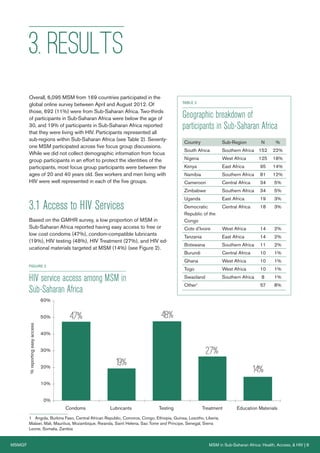
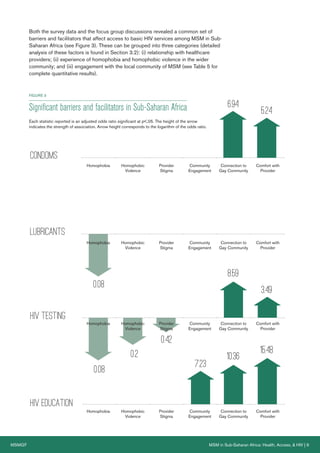
MSM in sub-Saharan Africa face low levels of access to HIV services. Only 47% reported easy access to condoms, 19% to lubricants, 48% to HIV testing, 27% to HIV treatment, and 14% to HIV educational materials targeted at MSM. Access is affected by three main factors: relationships with healthcare providers, experiences of homophobia and violence, and engagement with the local MSM community. Improving access will require addressing stigma from providers, discrimination, involvement of MSM community organizations, and creating a more supportive legal and social environment.


