The UC San Diego AntiViral Research Center sponsors weekly
presentations by infectious disease clinicians, physicians and
researchers. The goal of these presentations is to provide the most
current research, clinical practices and trends in HIV, HBV, HCV, TB
and other infectious diseases of global significance.
The slides from the AIDS Clinical Rounds presentation that you are
about to view are intended for the educational purposes of our
audience. They may not be used for other purposes without the
presenter’s express permission.
AIDS CLINICAL ROUNDS
Top Ten HIV Clinical Controversies 2014
1. Epidemiology
2. Prevention
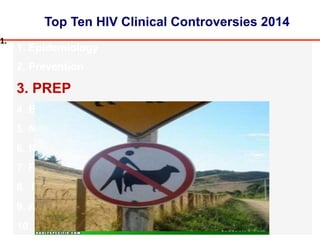
3. PREP
4. Barriers to Care
5. New Technologies
6. Nuc Sparing
7. Cure
8. Integrase Inhibitors
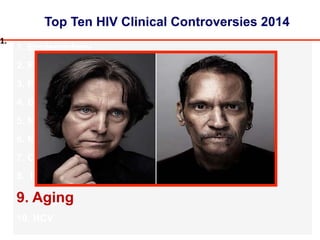
9. Aging
10. HCV
1.
Top Ten HIV Clinical Controversies 2014
1. Epidemiology
2. Prevention
3. PREP
4. Barriers to Care
5. New Technologies
6. Nuc Sparing
7. Primary Infection
8. Integrase Inhibitors
9. Aging
1.
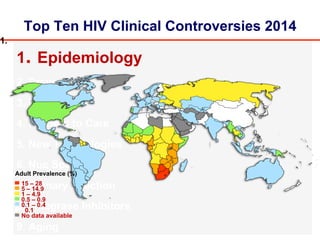
Adult Prevalence (%)
15 – 28
5 – 14.9
1 – 4.9
0.5 – 0.9
0.1 – 0.4
<0.1
No data available
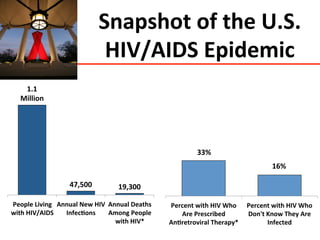
33%#
16%#
Percent#with#HIV#Who#
Are#Prescribed#
An8retroviral#Therapy*#
Percent#with#HIV#Who#
Don't#Know#They#Are#
Infected#
Snapshot#of#the#U.S.#
HIV/AIDS#Epidemic#
1.1#
Million#
47,500# 19,300#
People#Living#
with#HIV/AIDS#
Annual#New#HIV#
Infec8ons#
Annual#Deaths#
Among#People#
with#HIV*#
Source: UNAIDS / Lohse et al / Hoog et al / May et al / Hogg et al
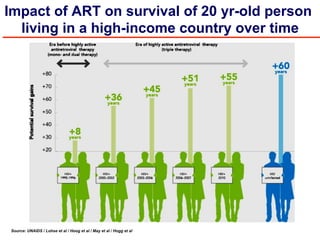
Impact of ART on survival of 20 yr-old person
living in a high-income country over time
Top Ten HIV Clinical Controversies 2014
1. Epidemiology
2. Prevention
3. PREP
4. Barriers to Care
5. New Technologies
6. Nuc Sparing
7. Primary Infection
8. Integrase Inhibitors
9. Aging
1.
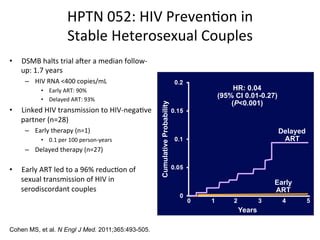
HPTN%052:%HIV%Preven0on%in%
Stable%Heterosexual%Couples%
•  DSMB%halts%trial%aAer%a%median%followF
up:%1.7%years%
–  HIV%RNA%<400%copies/mL%
•  Early%ART:%90%%
•  Delayed%ART:%93%%
•  Linked%HIV%transmission%to%HIVFnega0ve%
partner%(n=28)%
–  Early%therapy%(n=1)%
•  0.1%per%100%personFyears%
–  Delayed%therapy%(n=27)%
•  1.7%per%100%personFyears%
•  Early%ART%led%to%a%96%%reduc0on%of%
sexual%transmission%of%HIV%in%
serodiscordant%couples%
CumulativeProbability
0 1 2 3 4 5
Linked HIV Transmission
Early
ART
Delayed
ART
Cohen MS, et al. N Engl J Med. 2011;365:493-505.
Years
HR: 0.04
(95% CI 0.01-0.27)
(P<0.001)
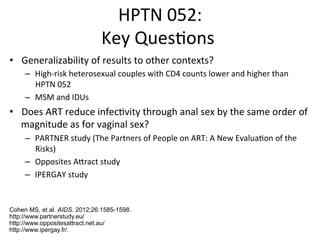
HPTN%052:%
Key%Ques0ons%%
•  Generalizability%of%results%to%other%contexts?%
–  HighFrisk%heterosexual%couples%with%CD4%counts%lower%and%higher%than%
HPTN%052%
–  MSM%and%IDUs%
•  Does%ART%reduce%infec0vity%through%anal%sex%by%the%same%order%of%
magnitude%as%for%vaginal%sex?%
–  PARTNER%study%(The%Partners%of%People%on%ART:%A%New%Evalua0on%of%the%
Risks)%
–  Opposites%Adract%study%
–  IPERGAY%study%
Cohen MS, et al. AIDS. 2012;26:1585-1598.
http://www.partnerstudy.eu/
http://www.oppositesattract.net.au/
http://www.ipergay.fr/.
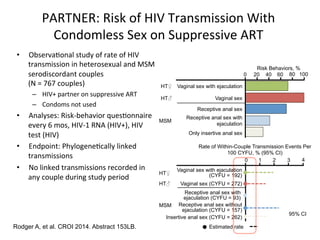
PARTNER:%Risk%of%HIV%Transmission%With%
Condomless%Sex%on%Suppressive%ART%%
•  Observa0onal%study%of%rate%of%HIV%
transmission%in%heterosexual%and%MSM%
serodiscordant%couples%%
(N%=%767%couples)%%
–  HIV+%partner%on%suppressive%ART%%
–  Condoms%not%used%
•  Analyses:%RiskFbehavior%ques0onnaire%
every%6%mos,%HIVF1%RNA%(HIV+),%HIV%
test%(HIV)%
•  Endpoint:%Phylogene0cally%linked%
transmissions%
•  No%linked%transmissions%recorded%in%
any%couple%during%study%period%
Rodger A, et al. CROI 2014. Abstract 153LB.
0 20 40 60 80 100
Risk Behaviors, %
Vaginal sex with ejaculation
Vaginal sex
Receptive anal sex
Receptive anal sex with
ejaculation
Only insertive anal sex
MSM
HT♀
HT♂
0 1 2 3 4
Rate of Within-Couple Transmission Events Per
100 CYFU, % (95% CI)
HT♀
Vaginal sex with ejaculation
(CYFU = 192)
HT♂ Vaginal sex (CYFU = 272)
Receptive anal sex with
ejaculation (CYFU = 93)
Receptive anal sex without
ejaculation (CYFU = 157)
Insertive anal sex (CYFU = 262)
MSM
Estimated rate
95% CI
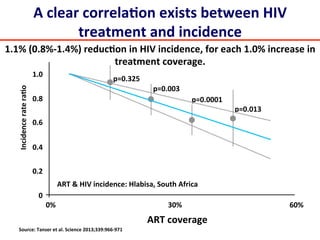
A#clear#correla8on#exists#between#HIV#
treatment#and#incidence#
Source:#Tanser#et#al.#Science#2013;339:966Y971#
1.1%#(0.8%Y1.4%)#reduc8on#in#HIV#incidence,#for#each#1.0%#increase#in#
treatment#coverage.##
ART#&#HIV#incidence:#Hlabisa,#South#Africa#
p=0.325#
p=0.003#
p=0.013#
p=0.0001#
Incidence#rate#ra8o#
1.0#
0.8#
0.6#
0.4#
0.2#
0#
ART#coverage#
0%# 30%# 60%#
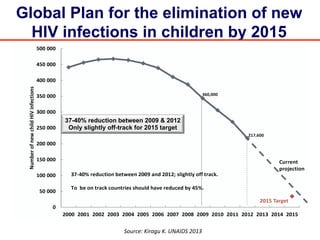
Source:(Kiragu(K.(UNAIDS(2013(
37-40% reduction between 2009 & 2012
Only slightly off-track for 2015 target
Global Plan for the elimination of new
HIV infections in children by 2015
Top Ten HIV Clinical Controversies 2014
1. Epidemiology
2. Prevention
3. PREP
4. Barriers to Care
5. New Technologies
6. Nuc Sparing
7. Primary Infection
8. Integrase Inhibitors
9. Aging
10. HCV
1.#
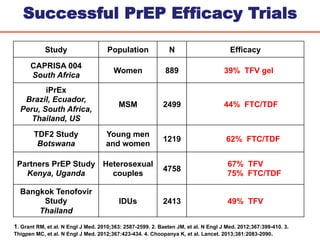
Study Population N Efficacy
CAPRISA 004
South Africa
Women 889 39% TFV gel
iPrEx
Brazil, Ecuador,
Peru, South Africa,
Thailand, US
MSM 2499 44% FTC/TDF
TDF2 Study
Botswana
Young men
and women
1219 62% FTC/TDF
Partners PrEP Study
Kenya, Uganda
Heterosexual
couples
4758
67% TFV
75% FTC/TDF
Bangkok Tenofovir
Study
Thailand
IDUs 2413 49% TFV
Successful PrEP Efficacy Trials
1. Grant RM, et al. N Engl J Med. 2010;363: 2587-2599. 2. Baeten JM, et al. N Engl J Med. 2012;367:399-410. 3.
Thigpen MC, et al. N Engl J Med. 2012;367:423-434. 4. Choopanya K, et al. Lancet. 2013;381:2083-2090.
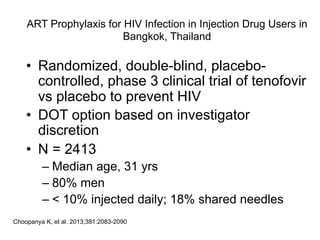
ART Prophylaxis for HIV Infection in Injection Drug Users in
Bangkok, Thailand
•  Randomized, double-blind, placebo-
controlled, phase 3 clinical trial of tenofovir
vs placebo to prevent HIV
•  DOT option based on investigator
discretion
•  N = 2413
– Median age, 31 yrs
– 80% men
– < 10% injected daily; 18% shared needles
Choopanya K, et al. 2013;381:2083-2090.
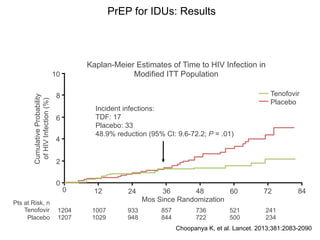
PrEP for IDUs: Results
Kaplan-Meier Estimates of Time to HIV Infection in
Modified ITT Population
Incident infections:
TDF: 17
Placebo: 33
48.9% reduction (95% CI: 9.6-72.2; P = .01)
Choopanya K, et al. Lancet. 2013;381:2083-2090.
CumulativeProbability
ofHIVInfection(%)
Mos Since Randomization
10
8
6
4
2
0
0 12 24 36 48 60 72 84
Pts at Risk, n
Tenofovir
Placebo
1204
1207
1007
1029
933
948
857
844
736
722
521
500
241
234
Tenofovir
Placebo
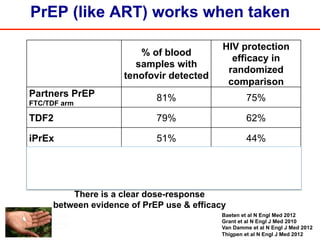
PrEP (like ART) works when taken
% of blood
samples with
tenofovir detected
HIV protection
efficacy in
randomized
comparison
Partners PrEP
FTC/TDF arm
81% 75%
TDF2 79% 62%
iPrEx 51% 44%
FEM-PrEP 26% 6%
VOICE 20% 0%
There is a clear dose-response
between evidence of PrEP use & efficacy
Baeten et al N Engl Med 2012
Grant et al N Engl J Med 2010
Van Damme et al N Engl J Med 2012
Thigpen et al N Engl J Med 2012
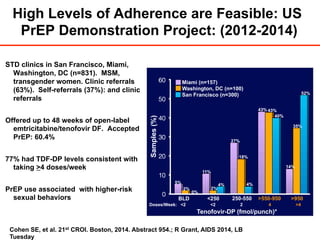
High Levels of Adherence are Feasible: US
PrEP Demonstration Project: (2012-2014)
STD clinics in San Francisco, Miami,
Washington, DC (n=831). MSM,
transgender women. Clinic referrals
(63%). Self-referrals (37%): and clinic
referrals
Offered up to 48 weeks of open-label
emtricitabine/tenofovir DF. Accepted
PrEP: 60.4%
77% had TDF-DP levels consistent with
taking >4 doses/week
PrEP use associated with higher-risk
sexual behaviors 0!
10!
20!
30!
40!
50!
60!
<250 250-550 >550-950BLD
Samples(%) 18%
43%
14%
5%
2%
Tenofovir-DP Levels (Week 4)
>950
Cohen SE, et al. 21st CROI. Boston, 2014. Abstract 954.; R Grant, AIDS 2014, LB
Tuesday
2%
11%
27%
4% 4%
52%
43%
40%
35%
Miami (n=157)
Washington, DC (n=100)
San Francisco (n=300)
Doses/Week: <2 <2 2 4 >4
Tenofovir-DP (fmol/punch)*
BLD: below limit of detection.
0%
*femtomole/punch: measure of flux density.
21
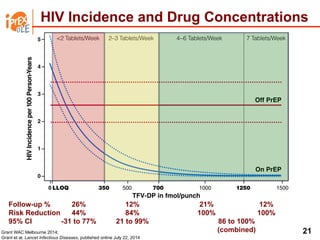
TFV-DP in DBS (fmol/punch) BLQ LLOQ to <350 ≥350 to <700 ≥700 to <1250 ≥1250
Estimated Dosing (Tablets/Week) None <2 2–3 4–6 7
Follow-up (% of Visits) 25% 26% 12% 21% 12%
HIV Infections 18 9 1 0 0
PersonYears 384 399 179 316 181
1000 15000 500350LLOQ 700 1250
HIVIncidenceper100Person-Years
TFV-DP in fmol/punch
Off PrEP
On PrEP
0
1
2
3
4
5 <2 Tablets/Week 2–3 Tablets/Week 4–6 Tablets/Week 7 Tablets/Week
HIV Incidence and Drug Concentrations
Follow-up % 26% 12% 21% 12%
Risk Reduction 44% 84% 100% 100%
95% CI -31 to 77% 21 to 99% 86 to 100%
(combined)Grant WAC Melbourne 2014;
Grant et al, Lancet Infectious Diseases, published online July 22, 2014
22
Top Ten HIV Clinical Controversies
2014
14. Barriers to Care
5. New Technologies
6. Nuc Sparing
7. Primary Infection
8. Integrase Inhibitors
9. Aging
10. HCV
1.
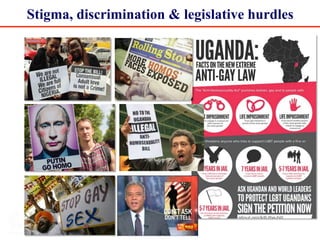
Stigma, discrimination & legislative hurdles
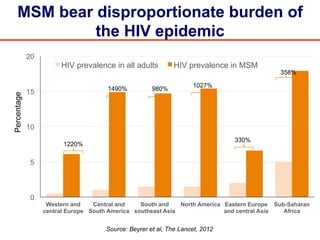
MSM bear disproportionate burden of
the HIV epidemic
Source: Beyrer et al, The Lancet, 2012 (
0
5
10
15
20
Western and
central Europe
Central and
South America
South and
southeast Asia
North America Eastern Europe
and central Asia
Sub-Saharan
Africa
Percentage
HIV prevalence in all adults HIV prevalence in MSM
1220%
1490% 980%
1027%
330%
358%
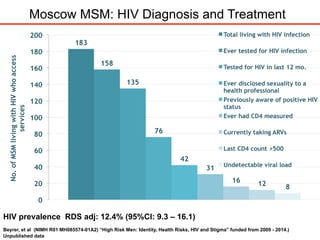
Moscow MSM: HIV Diagnosis and Treatment
HIV prevalence RDS adj: 12.4% (95%CI: 9.3 – 16.1)
Beyrer, et al (NIMH R01 MH085574-01A2) “High Risk Men: Identity, Health Risks, HIV and Stigma” funded from 2009 - 2014.)
Unpublished data
183
158
135
76
42
31
16 12 8
0
20
40
60
80
100
120
140
160
180
200
No.ofMSMlivingwithHIVwhoaccess
services
Total living with HIV infection
Ever tested for HIV infection
Tested for HIV in last 12 mo.
Ever disclosed sexuality to a
health professional
Previously aware of positive HIV
status
Ever had CD4 measured
Currently taking ARVs
Last CD4 count >500
Undetectable viral load
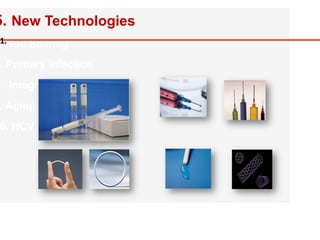
Top Ten HIV Clinical Controversies 20145. New Technologies
. Nuc Sparing
. Primary Infection
. Integrase Inhibitors
. Aging
0. HCV
1.#
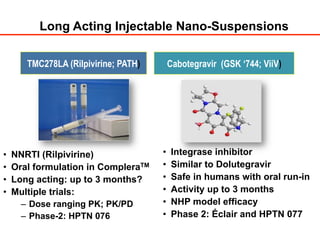
Long Acting Injectable Nano-Suspensions
•  NNRTI (Rilpivirine)
•  Oral formulation in CompleraTM
•  Long acting: up to 3 months?
•  Multiple trials:
–  Dose ranging PK; PK/PD
–  Phase-2: HPTN 076
•  Integrase inhibitor
•  Similar to Dolutegravir
•  Safe in humans with oral run-in
•  Activity up to 3 months
•  NHP model efficacy
•  Phase 2: Éclair and HPTN 077
Cabotegravir (GSK ‘744; ViiV)TMC278LA (Rilpivirine; PATH)
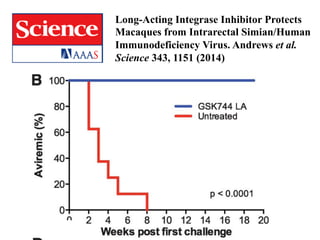
Long-Acting Integrase Inhibitor Protects
Macaques from Intrarectal Simian/Human
Immunodeficiency Virus. Andrews et al.
Science 343, 1151 (2014)
Top Ten HIV Clinical Controversies 2014
1. Epidemiology
2. Prevention
3. PREP
4. Barriers to Care
5. New Technologies
7. Primary Infection
8. Integrase Inhibitors
9. Aging
10. HCV
6. Nuc Sparing
1.#
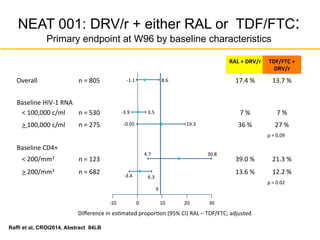
NEAT 001: DRV/r + either RAL or TDF/FTC:
Primary endpoint at W96 by baseline characteristics
n%=%805%%
n%=%530%%
n%=%275%%
n%=%123%
n%=%682%%
Overall%
<%100,000%c/ml%
>%100,000%c/ml%
<%200/mm3%
>%200/mm3%
Baseline%HIVF1%RNA%
Baseline%CD4+%
17.4%%%
7%%%
36%%%
39.0%%%
13.6%%%
13.7%%%
7%%%
27%%%
21.3%%%
12.2%%%
RAL#+#DRV/r# TDF/FTC#+#
DRV/r#
10%0%F10% 20% 30%
9%
Difference%in%es0mated%propor0on%(95%%CI)%RAL%–%TDF/FTC;%adjusted%
p%=%0.09%
p%=%0.02%
F1.1% 8.6%
F3.9% 3.5%
F0.05% 19.3%
4.7% 30.8%
F3.4% 6.3%
Raffi et al, CROI2014, Abstract 84LB
MODERN: MVC QD + DRV/r Not Noninferior
to TDF/FTC + DRV/r
•  Similar rates of VL suppression at Week
48 by screening assay type
Stellbrink H-J, et al. AIDS 2014. Abstract MOAB0101.
MVC + DRV/r (n = 396)
TDF/FTC + DRV/r (n = 401)
100
80
60
40
20
0
Wk
PtsWithHIV-1RNA<50copies/mL[1]
BL 4 8 12 16 20 24 36 48
77.3%
86.8%%
Adjusted treatment difference
(95% Cl): -9.5% (-14.8% to -4.2%)
Assay
Type
MVC + DRV/
r
(n = 396)
TDF/FTC +
DRV/r
(n = 401)
Phenotypic 74.4 87.0
Genotypic 80.7 86.5
Δ (95% CI)
6.9% (1.3% to
15%)
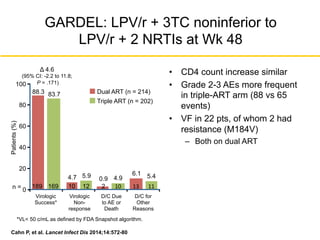
GARDEL: LPV/r + 3TC noninferior to
LPV/r + 2 NRTIs at Wk 48
•  CD4 count increase similar
•  Grade 2-3 AEs more frequent
in triple-ART arm (88 vs 65
events)
•  VF in 22 pts, of whom 2 had
resistance (M184V)
–  Both on dual ART
Patients(%)
88.3 83.7
Δ 4.6
(95% CI: -2.2 to 11.8;
P = .171)
Dual ART (n = 214)
Triple ART (n = 202)
189 169
0
20
40
60
80
100
4.7 5.9 0.9 4.9
n = 210 12
Virologic
Success*
Virologic
Non-
response
D/C Due
to AE or
Death
D/C for
Other
Reasons
6.1 5.4
10% %13% %11%
Cahn P, et al. Lancet Infect Dis 2014;14:572-80
*VL< 50 c/mL as defined by FDA Snapshot algorithm.
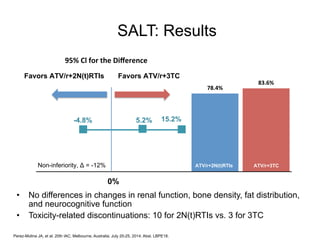
SALT: Results
•  No differences in changes in renal function, bone density, fat distribution,
and neurocognitive function
•  Toxicity-related discontinuations: 10 for 2N(t)RTIs vs. 3 for 3TC
78.4%#
83.6%#
95%#Cl#for#the#Difference#
Favors ATV/r+2N(t)RTIs
0%
Favors ATV/r+3TC
ATV/r+2N(t)RTIs ATV/r+3TC
-4.8% 5.2% 15.2%
Non-inferiority, Δ = -12%
Perez-Molina JA, et al. 20th IAC; Melbourne, Australia; July 20-25, 2014; Abst. LBPE18.
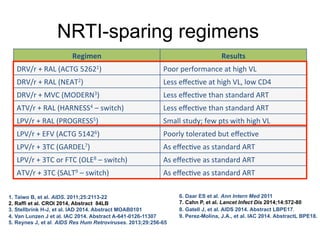
NRTI-sparing regimens
Regimen# Results#
DRV/r%+%RAL%(ACTG%52621)% Poor%performance%at%high%VL%
DRV/r%+%RAL%(NEAT2)% Less%effec0ve%at%high%VL,%low%CD4%
DRV/r%+%MVC%(MODERN3)% Less%effec0ve%than%standard%ART%
ATV/r%+%RAL%(HARNESS4%–%switch)% Less%effec0ve%than%standard%ART%
LPV/r%+%RAL%(PROGRESS5)% Small%study;%few%pts%with%high%VL%
LPV/r%+%EFV%(ACTG%51426)% Poorly%tolerated%but%effec0ve%
LPV/r%+%3TC%(GARDEL7)% As%effec0ve%as%standard%ART%
LPV/r%+%3TC%or%FTC%(OLE8%–%switch)% As%effec0ve%as%standard%ART%
ATV/r%+%3TC%(SALT9%–%switch)% As%effec0ve%as%standard%ART%
1. Taiwo B, et al. AIDS. 2011;25:2113-22
2. Raffi et al. CROI 2014, Abstract 84LB
3. Stellbrink H-J, et al. IAD 2014. Abstract MOAB0101
4. Van Lunzen J et al. IAC 2014. Abstract A-641-0126-11307
5. Reynes J, et al. AIDS Res Hum Retroviruses. 2013;29:256-65
6. Daar ES et al. Ann Intern Med 2011
7. Cahn P, et al. Lancet Infect Dis 2014;14:572-80
8. Gatell J, et al. AIDS 2014. Abstract LBPE17.
9. Perez-Molina, J.A., et al. IAC 2014. AbstractL BPE18.
Top Ten HIV Clinical Controversies 2014
1. Epidemiology
2. Prevention
3. PREP
4. Barriers to Care
5. New Technologies
6. Nuc Sparing
7. Cure
8. Integrase Inhibitors
9. Aging
10. HCV
1.#
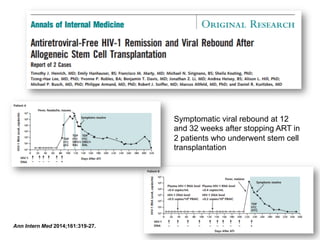
Ann Intern Med 2014;161:319-27.
Symptomatic viral rebound at 12
and 32 weeks after stopping ART in
2 patients who underwent stem cell
transplantation
Mississippi Baby Relapse
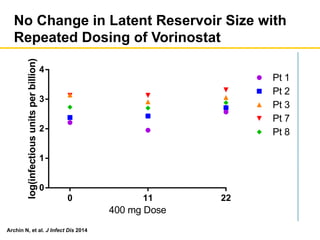
No Change in Latent Reservoir Size with
Repeated Dosing of Vorinostat
0 11 22
0
1
2
3
4
400 mg Dose
log(infectiousunitsperbillion)
Pt 1
Pt 2
Pt 3
Pt 7
Pt 8
No significant change in infected cell frequency"
Archin N, et al. J Infect Dis 2014
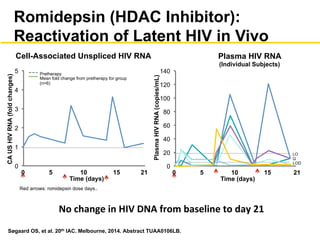
Romidepsin (HDAC Inhibitor):
Reactivation of Latent HIV in Vivo
Søgaard OS, et al. 20th IAC. Melbourne, 2014. Abstract TUAA0106LB.
Cell-Associated Unspliced HIV RNA
Red arrows: romidepsin dose days..
Plasma HIV RNA
(Individual Subjects)
0
1
2
3
4
5
CAUSHIVRNA(foldchanges)
0 5 10 15 21
Time (days)
Pretherapy
Mean fold change from pretherapy for group
(n=6)
0
20
40
60
80
100
120
140
PlasmaHIVRNA(copies/mL)
0 5 10 15 21
Time (days)
LO
Q
LOD
No#change#in#HIV#DNA#from#baseline#to#day#21#
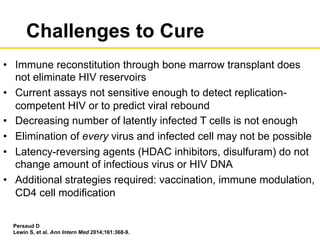
Challenges to Cure
•  Immune reconstitution through bone marrow transplant does
not eliminate HIV reservoirs
•  Current assays not sensitive enough to detect replication-
competent HIV or to predict viral rebound
•  Decreasing number of latently infected T cells is not enough
•  Elimination of every virus and infected cell may not be possible
•  Latency-reversing agents (HDAC inhibitors, disulfuram) do not
change amount of infectious virus or HIV DNA
•  Additional strategies required: vaccination, immune modulation,
CD4 cell modification
Persaud D
Lewin S, et al. Ann Intern Med 2014;161:368-9.
Top Ten HIV Clinical Controversies 2014
1. Epidemiology
2. Prevention
3. PREP
4. Barriers to Care
5. New Technologies
6. Nuc Sparing
7. Cure
9. Aging
10. 8. Integrase Inhibitors
HCV
1.#
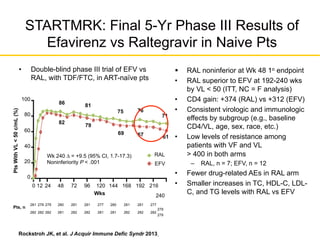
STARTMRK: Final 5-Yr Phase III Results of
Efavirenz vs Raltegravir in Naive Pts
•  Double-blind phase III trial of EFV vs
RAL, with TDF/FTC, in ART-naïve pts
!  RAL noninferior at Wk 48 1o endpoint
•  RAL superior to EFV at 192-240 wks
by VL < 50 (ITT, NC = F analysis)
•  CD4 gain: +374 (RAL) vs +312 (EFV)
•  Consistent virologic and immunologic
effects by subgroup (e.g., baseline
CD4/VL, age, sex, race, etc.)
•  Low levels of resistance among
patients with VF and VL
> 400 in both arms
–  RAL, n = 7; EFV, n = 12
•  Fewer drug-related AEs in RAL arm
•  Smaller increases in TC, HDL-C, LDL-
C, and TG levels with RAL vs EFV
61
71
240
279
279
RAL
EFV
PtsWithVL<50c/mL(%)
Wks
100
80
60
40
20
0
0 24 48 72 96 120 168
86
82
81
79
75
69
192
76
67
Wk 240 ∆ = +9.5 (95% CI, 1.7-17.3)
Noninferiority P < .001
21614412
281 279 280 281 281 277 281 281 277280278
282 282 281 282 282 281 282 282 282281282
Pts, n
Rockstroh JK, et al. J Acquir Immune Defic Syndr 2013
GS 102: EVG/COBI/TDF/FTC Noninferior to
EFV/TDF/FTC Through Wk 144
1. Sax PE, et al. Lancet. 2012;379:2439-2448.
2. Zolopa A, et al. J Acquir Immune Defic Syndr. 2013;63:96-100.
3. Wohl D, et al. J Acquir Immune Defic Syndr 2014;65:e118-20
Wk
48
Wk
144
EVG/COBI/TDF/FTC
(n = 348)
EFV/TDF/FTC
(n = 352)
80
75
0
20
40
60
80
100
Pa0ents%(%)%
88
84 8482
Wk
96
7 7 6 8 7
10
5
9 9 11 12
15
Wk
48
Wk
144
Wk
96
Wk
48
Wk
144
Wk
96
Virologic Success* Virologic Failure No Data!
95% CI for Difference
Wk 48[1]
Wk 96[2]
Wk 144[3]
-12% 12%0
Favors
EFV
Favors
EVG/COBI
-1.3% 11.1%
4.9%
3.6%
8.8%
2.7%
-1.6%
-2.9%
*
GS 103: EVG/COBI/TDF/FTC Noninferior to
ATV/r + TDF/FTC Through Wk 144
1. DeJesus E, et al. Lancet. 2012;379:2429-2438.
2. Rockstroh J, et al. J Acquir Immune Defic Syndr. 2013;62:483-486. 3.
Clumeck M, et al. J Acquir Immune Defic Syndr . 2014;65:e121-4.
EVG/COBI/TDF/FTC
(n = 353)
ATV/RTV + TDF/FTC
(n = 355)
78 75
90 87
Patients(%)
Wk
48
Wk
144
0
20
40
60
80
100
Wk
96
Wk
48
Wk
144
Wk
96
Wk
48
Wk
144
Wk
96
Virologic Success* Virologic Failure No Data!
83 82
5 5 57 7 78 8 1010
14
18
95% CI for Difference
-12% 12%0
Favors
ATV/RTV
Favors
EVG/COBI
-3.2% 9.4%
3.1%
2.7%
7.5%
1.1%
6.7%
-2.1%
-4.5%
Wk 48[1]
Wk 96[2]
Wk 144[3]
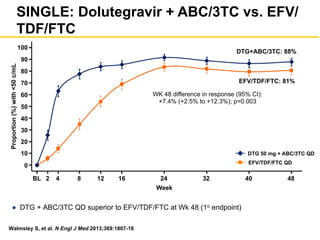
SINGLE: Dolutegravir + ABC/3TC vs. EFV/
TDF/FTC
Week
EFV/TDF/FTC QD
DTG 50 mg + ABC/3TC QD
BL 2 4 8 12 16 24 32 40 48
0
10
20
30
40
50
60
70
80
90
100
Proportion(%)with<50c/mL
DTG+ABC/3TC: 88%
EFV/TDF/FTC: 81%
WK 48 difference in response (95% CI):
+7.4% (+2.5% to +12.3%); p=0.003
●  DTG + ABC/3TC QD superior to EFV/TDF/FTC at Wk 48 (1o endpoint)
Walmsley S, et al. N Engl J Med 2013;369:1807-18
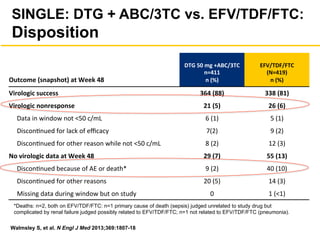
Outcome#(snapshot)#at#Week#48#
DTG#50#mg#+ABC/3TC#
n=411#
n#(%)#
EFV/TDF/FTC#
(N=419)#
n#(%)#
Virologic#success# 364#(88)# 338#(81)#
Virologic#nonresponse# 21#(5)# 26#(6)#
Data%in%window%not%<50%c/mL% 6%(1)% 5%(1)%
Discon0nued%for%lack%of%efficacy% 7(2)% 9%(2)%
Discon0nued%for%other%reason%while%not%<50%c/mL% 8%(2)% 12%(3)%
No#virologic#data#at#Week#48# 29#(7)# 55#(13)#
Discon0nued%because%of%AE%or%death*% 9%(2)% 40%(10)%
Discon0nued%for%other%reasons% 20%(5)% 14%(3)%
Missing%data%during%window%but%on%study% 0% 1%(<1)%
SINGLE: DTG + ABC/3TC vs. EFV/TDF/FTC:
Disposition
*Deaths: n=2, both on EFV/TDF/FTC: n=1 primary cause of death (sepsis) judged unrelated to study drug but
complicated by renal failure judged possibly related to EFV/TDF/FTC; n=1 not related to EFV/TDF/FTC (pneumonia).
Walmsley S, et al. N Engl J Med 2013;369:1807-18
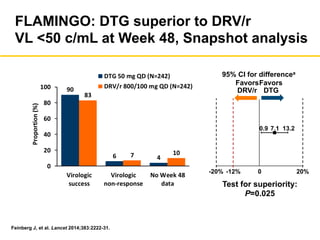
FLAMINGO: DTG superior to DRV/r
VL <50 c/mL at Week 48, Snapshot analysis
Feinberg J, et al. Lancet 2014;383:2222-31.
90
6 4
83
7 10
0
20
40
60
80
100
Virologic
success
Virologic
non5response
No8Week848
data
Proportion8(%)
DTG8508mg8QD8(N=242)
DRV/r8800/1008mg8QD8(N=242)
95% CI for differencea
Favors
DRV/r
Favors
DTG
-20% 0 20%
7.10.9 13.2
-12%
Test for superiority:
P=0.025
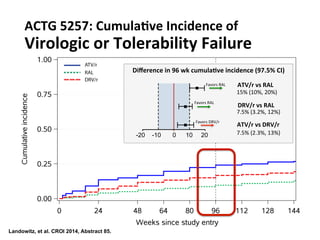
ACTG#5257:#Cumula8ve#Incidence#of##
Virologic#or#Tolerability#Failure#
Difference#in#96#wk#cumula8ve#incidence#(97.5%#CI)#
-20% 0%-10% 10% 20%
15%%(10%,%20%)%
7.5%%(3.2%,%12%)%
7.5%%(2.3%,%13%)%
ATV/r#vs#RAL#
DRV/r#vs#RAL#
ATV/r#vs#DRV/r#
Favors%RAL%
Favors%RAL%
Favors%DRV/r%
Landowitz, et al. CROI 2014, Abstract 85.
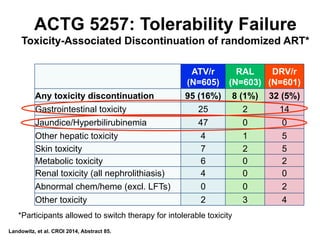
ACTG 5257: Tolerability Failure
Toxicity-Associated Discontinuation of randomized ART*
ATV/r
(N=605)
RAL
(N=603)
DRV/r
(N=601)
Any toxicity discontinuation 95 (16%) 8 (1%) 32 (5%)
Gastrointestinal toxicity 25 2 14
Jaundice/Hyperbilirubinemia 47 0 0
Other hepatic toxicity 4 1 5
Skin toxicity 7 2 5
Metabolic toxicity 6 0 2
Renal toxicity (all nephrolithiasis) 4 0 0
Abnormal chem/heme (excl. LFTs) 0 0 2
Other toxicity 2 3 4
*Participants allowed to switch therapy for intolerable toxicity
Landowitz, et al. CROI 2014, Abstract 85.
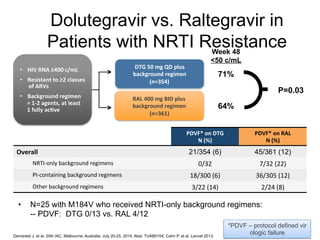
Dolutegravir vs. Raltegravir in
Patients with NRTI Resistance
•  N=25 with M184V who received NRTI-only background regimens:
-- PDVF: DTG 0/13 vs. RAL 4/12
Demarest J, et al. 20th IAC; Melbourne, Australia; July 20-25, 2014; Abst. TUAB0104; Cahn P, et al. Lancet 2013.
RAL#400#mg#BID#plus##
background#regimen##
(n=361)#
DTG#50#mg#QD#plus##
background#regimen##
(n=354)#
Week 48
<50 c/mL
•  HIV#RNA#≥400#c/mL##
•  Resistant#to#≥2#classes
#of#ARVs#
•  Background#regimen#
=#1Y2#agents,#at#least##
1#fully#ac8ve#
71%
64%
P=0.03
PDVF*#on#DTG#
N#(%)
PDVF*#on#RAL#
N#(%)
Overall 21/354 (6) 45/361 (12)
NRTIFonly%background%regimens 0/32 7/32%(22)
PIFcontaining%background%regimens% 18/300%(6) 36/305%(12)
Other%background%regimens 3/22%(14) 2/24%(8)
*PDVF – protocol defined vir
ologic failure
Top Ten HIV Clinical Controversies 2014
1. Epidemiology
2. Prevention
3. PREP
4. Barriers to Care
5. New Technologies
6. Nuc Sparing
7. Cure
8. Integrase Inhibitors
9. Aging
10. HCV
1.#
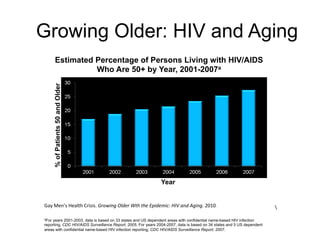
Growing Older: HIV and Aging
%ofPatients50andOlderEstimated Percentage of Persons Living with HIV/AIDS
Who Are 50+ by Year, 2001-2007a
Year
aFor years 2001-2003, data is based on 33 states and US dependent areas with confidential name-based HIV infection
reporting, CDC HIV/AIDS Surveillance Report, 2005. For years 2004-2007, data is based on 34 states and 5 US dependent
areas with confidential name-based HIV infection reporting, CDC HIV/AIDS Surveillance Report, 2007.
%Gay%Men’s%Health%Crisis.%Growing(Older(Wth(the(Epidemic:(HIV(and(Aging.%2010.(
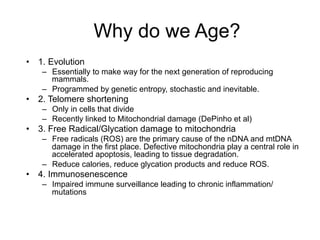
Why do we Age?
•  1. Evolution
–  Essentially to make way for the next generation of reproducing
mammals.
–  Programmed by genetic entropy, stochastic and inevitable.
•  2. Telomere shortening
–  Only in cells that divide
–  Recently linked to Mitochondrial damage (DePinho et al)
•  3. Free Radical/Glycation damage to mitochondria
–  Free radicals (ROS) are the primary cause of the nDNA and mtDNA
damage in the first place. Defective mitochondria play a central role in
accelerated apoptosis, leading to tissue degradation.
–  Reduce calories, reduce glycation products and reduce ROS.
•  4. Immunosenescence
–  Impaired immune surveillance leading to chronic inflammation/
mutations
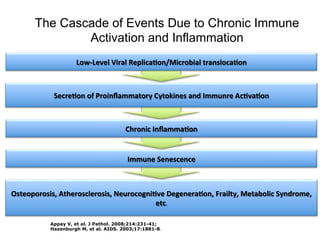
The Cascade of Events Due to Chronic Immune
Activation and Inflammation
Appay V, et al. J Pathol. 2008;214:231-41;
Hazenburgh M, et al. AIDS. 2003;17:1881-8.
Chronic#Inflamma8on#
Osteoporosis,#Atherosclerosis,#Neurocogni8ve#Degenera8on,#Frailty,#Metabolic#Syndrome,#
etc.#
LowYLevel#Viral#Replica8on/Microbial#transloca8on#
Secre8on#of#Proinflammatory#Cytokines#and#Immunre#Ac8va8on#
Immune#Senescence#
Top Ten HIV Clinical Controversies 2014
1. Epidemiology
2. Prevention
3. PREP
4. Barriers to Care
5. New Technologies
6. Nuc Sparing
7. Cure
8. Integrase Inhibitors
9. Aging
10. HCV
1.#
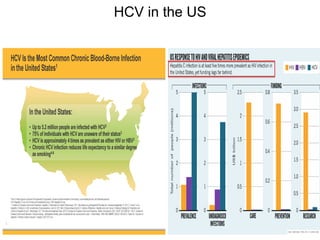
HCV in the US
Ledipisvir/Sofosbuvir#+#RBV#
LDV/SOF#
LDV/SOF#+#RBV#
LDV/SOF#
Week#0# Week#12# Week#24#
#LDV/SOF#
LDV/SOF#+#RBV#
Week#8#
IONY12#
IONY23#
IONY34#
Sulkowski M, et al. 20th IAC; Melbourne, Australia; July 20-25, 2014; Abst. LBPE15.
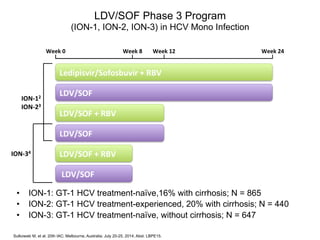
LDV/SOF Phase 3 Program
(ION-1, ION-2, ION-3) in HCV Mono Infection
•  ION-1: GT-1 HCV treatment-naïve,16% with cirrhosis; N = 865
•  ION-2: GT-1 HCV treatment-experienced, 20% with cirrhosis; N = 440
•  ION-3: GT-1 HCV treatment-naïve, without cirrhosis; N = 647
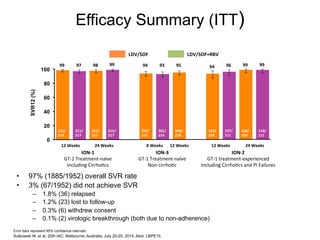
Efficacy Summary (ITT)
•  97% (1885/1952) overall SVR rate
•  3% (67/1952) did not achieve SVR
–  1.8% (36) relapsed
–  1.2% (23) lost to follow-up
–  0.3% (6) withdrew consent
–  0.1% (2) virologic breakthrough (both due to non-adherence)
0
20
40
60
80
100
IONY1#
GTF1%TreatmentFnaïve%%
Including%Cirrho0cs%
IONY3#
GTF1%TreatmentFnaïve%%
NonFcirrho0c%
IONY2##
GTF1%treatmentFexperienced%%
Including%Cirrho0cs%and%PI%Failures%
LDV/SOF# LDV/SOF+RBV#
12#Weeks# 24#Weeks# 12#Weeks# 24#Weeks##12#Weeks#
SVR12(%)
#8#Weeks#
107/#
111#
102/#
109#
108/#
109#
110/#
111#
211/#
217#
211/#
214#
212/#
217#
215/#
217#
202/#
215#
201/#
216#
206/#
216#
Error bars represent 95% confidence intervals.
Sulkowski M, et al. 20th IAC; Melbourne, Australia; July 20-25, 2014; Abst. LBPE15.
99% 97% 98% 99% 94% 93% 95% 94% 96% 99% 99%
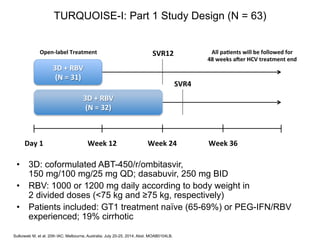
TURQUOISE-I: Part 1 Study Design (N = 63)
•  3D: coformulated ABT-450/r/ombitasvir,
150 mg/100 mg/25 mg QD; dasabuvir, 250 mg BID
•  RBV: 1000 or 1200 mg daily according to body weight in
2 divided doses (<75 kg and ≥75 kg, respectively)
•  Patients included: GT1 treatment naïve (65-69%) or PEG-IFN/RBV
experienced; 19% cirrhotic
Day#1# Week#12# Week#24#
OpenYlabel#Treatment# SVR12# All#pa8ents#will#be#followed#for##
48#weeks#aker#HCV#treatment#end#
3D#+#RBV#
(N#=#31)#
3D#+#RBV#
(N#=#32)#
SVR4#
Week#36#
Sulkowski M, et al. 20th IAC; Melbourne, Australia; July 20-25, 2014; Abst. MOAB0104LB.
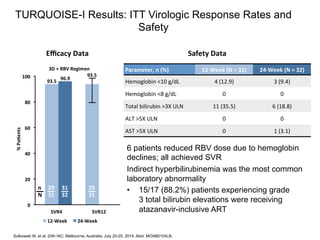
TURQUOISE-I Results: ITT Virologic Response Rates and
Safety
6 patients reduced RBV dose due to hemoglobin
declines; all achieved SVR
Indirect hyperbilirubinemia was the most common
laboratory abnormality
•  15/17 (88.2%) patients experiencing grade
3 total bilirubin elevations were receiving
atazanavir-inclusive ART
93.5% 96.9% 93.5%
29#
31#
31#
32#
29#
31#
Parameter,#n#(%)# 12YWeek#(N#=#31)# 24YWeek#(N#=#32)#
Hemoglobin%<10%g/dL% 4%(12.9)% 3%(9.4)%
Hemoglobin%<8%g/dL% 0% 0%
Total%bilirubin%>3X%ULN% 11%(35.5)% 6%(18.8)%
ALT%>5X%ULN% 0% 0%
AST%>5X%ULN% 0% 1%(3.1)%
n#
N#
Sulkowski M, et al. 20th IAC; Melbourne, Australia; July 20-25, 2014; Abst. MOAB0104LB.
Efficacy#Data# Safety#Data#
0#
20#
40#
60#
80#
100#
SVR4# SVR12#
%#Pa8ents#
3D#+#RBV#Regimen#
12YWeek# 24YWeek#
Barriers to HCV TreatmentinPrimaryCare.
.•  1. Stigma
•  “My practice will be full of drug addicts”
•  2. The perception that it’s too difficult:
Rapidly changing field, hard to keep up
•  3. How to know whether the patient has
cirrhosis
•  4. Difficulty in obtaining meds; too many PA’s
•  5. ‘It’s just not what we do here’..
•  6. Lack of resources for those who are still
unjecting drugs or drinking heavily.

Top Ten HIV Clinical Controversies 2014

  • 1.
    The UC SanDiego AntiViral Research Center sponsors weekly presentations by infectious disease clinicians, physicians and researchers. The goal of these presentations is to provide the most current research, clinical practices and trends in HIV, HBV, HCV, TB and other infectious diseases of global significance. The slides from the AIDS Clinical Rounds presentation that you are about to view are intended for the educational purposes of our audience. They may not be used for other purposes without the presenter’s express permission. AIDS CLINICAL ROUNDS
  • 2.
    Top Ten HIVClinical Controversies 2014 1. Epidemiology 2. Prevention 3. PREP 4. Barriers to Care 5. New Technologies 6. Nuc Sparing 7. Cure 8. Integrase Inhibitors 9. Aging 10. HCV 1.
  • 3.
    Top Ten HIVClinical Controversies 2014 1. Epidemiology 2. Prevention 3. PREP 4. Barriers to Care 5. New Technologies 6. Nuc Sparing 7. Primary Infection 8. Integrase Inhibitors 9. Aging 1. Adult Prevalence (%) 15 – 28 5 – 14.9 1 – 4.9 0.5 – 0.9 0.1 – 0.4 <0.1 No data available
  • 6.
  • 7.
    Source: UNAIDS /Lohse et al / Hoog et al / May et al / Hogg et al Impact of ART on survival of 20 yr-old person living in a high-income country over time
  • 9.
    Top Ten HIVClinical Controversies 2014 1. Epidemiology 2. Prevention 3. PREP 4. Barriers to Care 5. New Technologies 6. Nuc Sparing 7. Primary Infection 8. Integrase Inhibitors 9. Aging 1.
  • 11.
    HPTN%052:%HIV%Preven0on%in% Stable%Heterosexual%Couples% •  DSMB%halts%trial%aAer%a%median%followF up:%1.7%years% –  HIV%RNA%<400%copies/mL% • Early%ART:%90%% •  Delayed%ART:%93%% •  Linked%HIV%transmission%to%HIVFnega0ve% partner%(n=28)% –  Early%therapy%(n=1)% •  0.1%per%100%personFyears% –  Delayed%therapy%(n=27)% •  1.7%per%100%personFyears% •  Early%ART%led%to%a%96%%reduc0on%of% sexual%transmission%of%HIV%in% serodiscordant%couples% CumulativeProbability 0 1 2 3 4 5 Linked HIV Transmission Early ART Delayed ART Cohen MS, et al. N Engl J Med. 2011;365:493-505. Years HR: 0.04 (95% CI 0.01-0.27) (P<0.001)
  • 12.
    HPTN%052:% Key%Ques0ons%% •  Generalizability%of%results%to%other%contexts?% –  HighFrisk%heterosexual%couples%with%CD4%counts%lower%and%higher%than% HPTN%052% – MSM%and%IDUs% •  Does%ART%reduce%infec0vity%through%anal%sex%by%the%same%order%of% magnitude%as%for%vaginal%sex?% –  PARTNER%study%(The%Partners%of%People%on%ART:%A%New%Evalua0on%of%the% Risks)% –  Opposites%Adract%study% –  IPERGAY%study% Cohen MS, et al. AIDS. 2012;26:1585-1598. http://www.partnerstudy.eu/ http://www.oppositesattract.net.au/ http://www.ipergay.fr/.
  • 13.
    PARTNER:%Risk%of%HIV%Transmission%With% Condomless%Sex%on%Suppressive%ART%% •  Observa0onal%study%of%rate%of%HIV% transmission%in%heterosexual%and%MSM% serodiscordant%couples%% (N%=%767%couples)%% –  HIV+%partner%on%suppressive%ART%% – Condoms%not%used% •  Analyses:%RiskFbehavior%ques0onnaire% every%6%mos,%HIVF1%RNA%(HIV+),%HIV% test%(HIV)% •  Endpoint:%Phylogene0cally%linked% transmissions% •  No%linked%transmissions%recorded%in% any%couple%during%study%period% Rodger A, et al. CROI 2014. Abstract 153LB. 0 20 40 60 80 100 Risk Behaviors, % Vaginal sex with ejaculation Vaginal sex Receptive anal sex Receptive anal sex with ejaculation Only insertive anal sex MSM HT♀ HT♂ 0 1 2 3 4 Rate of Within-Couple Transmission Events Per 100 CYFU, % (95% CI) HT♀ Vaginal sex with ejaculation (CYFU = 192) HT♂ Vaginal sex (CYFU = 272) Receptive anal sex with ejaculation (CYFU = 93) Receptive anal sex without ejaculation (CYFU = 157) Insertive anal sex (CYFU = 262) MSM Estimated rate 95% CI
  • 14.
  • 15.
    Source:(Kiragu(K.(UNAIDS(2013( 37-40% reduction between2009 & 2012 Only slightly off-track for 2015 target Global Plan for the elimination of new HIV infections in children by 2015
  • 16.
    Top Ten HIVClinical Controversies 2014 1. Epidemiology 2. Prevention 3. PREP 4. Barriers to Care 5. New Technologies 6. Nuc Sparing 7. Primary Infection 8. Integrase Inhibitors 9. Aging 10. HCV 1.#
  • 17.
    Study Population NEfficacy CAPRISA 004 South Africa Women 889 39% TFV gel iPrEx Brazil, Ecuador, Peru, South Africa, Thailand, US MSM 2499 44% FTC/TDF TDF2 Study Botswana Young men and women 1219 62% FTC/TDF Partners PrEP Study Kenya, Uganda Heterosexual couples 4758 67% TFV 75% FTC/TDF Bangkok Tenofovir Study Thailand IDUs 2413 49% TFV Successful PrEP Efficacy Trials 1. Grant RM, et al. N Engl J Med. 2010;363: 2587-2599. 2. Baeten JM, et al. N Engl J Med. 2012;367:399-410. 3. Thigpen MC, et al. N Engl J Med. 2012;367:423-434. 4. Choopanya K, et al. Lancet. 2013;381:2083-2090.
  • 18.
    ART Prophylaxis forHIV Infection in Injection Drug Users in Bangkok, Thailand •  Randomized, double-blind, placebo- controlled, phase 3 clinical trial of tenofovir vs placebo to prevent HIV •  DOT option based on investigator discretion •  N = 2413 – Median age, 31 yrs – 80% men – < 10% injected daily; 18% shared needles Choopanya K, et al. 2013;381:2083-2090.
  • 19.
    PrEP for IDUs:Results Kaplan-Meier Estimates of Time to HIV Infection in Modified ITT Population Incident infections: TDF: 17 Placebo: 33 48.9% reduction (95% CI: 9.6-72.2; P = .01) Choopanya K, et al. Lancet. 2013;381:2083-2090. CumulativeProbability ofHIVInfection(%) Mos Since Randomization 10 8 6 4 2 0 0 12 24 36 48 60 72 84 Pts at Risk, n Tenofovir Placebo 1204 1207 1007 1029 933 948 857 844 736 722 521 500 241 234 Tenofovir Placebo
  • 20.
    PrEP (like ART)works when taken % of blood samples with tenofovir detected HIV protection efficacy in randomized comparison Partners PrEP FTC/TDF arm 81% 75% TDF2 79% 62% iPrEx 51% 44% FEM-PrEP 26% 6% VOICE 20% 0% There is a clear dose-response between evidence of PrEP use & efficacy Baeten et al N Engl Med 2012 Grant et al N Engl J Med 2010 Van Damme et al N Engl J Med 2012 Thigpen et al N Engl J Med 2012
  • 21.
    High Levels ofAdherence are Feasible: US PrEP Demonstration Project: (2012-2014) STD clinics in San Francisco, Miami, Washington, DC (n=831). MSM, transgender women. Clinic referrals (63%). Self-referrals (37%): and clinic referrals Offered up to 48 weeks of open-label emtricitabine/tenofovir DF. Accepted PrEP: 60.4% 77% had TDF-DP levels consistent with taking >4 doses/week PrEP use associated with higher-risk sexual behaviors 0! 10! 20! 30! 40! 50! 60! <250 250-550 >550-950BLD Samples(%) 18% 43% 14% 5% 2% Tenofovir-DP Levels (Week 4) >950 Cohen SE, et al. 21st CROI. Boston, 2014. Abstract 954.; R Grant, AIDS 2014, LB Tuesday 2% 11% 27% 4% 4% 52% 43% 40% 35% Miami (n=157) Washington, DC (n=100) San Francisco (n=300) Doses/Week: <2 <2 2 4 >4 Tenofovir-DP (fmol/punch)* BLD: below limit of detection. 0% *femtomole/punch: measure of flux density.
  • 22.
    21 TFV-DP in DBS(fmol/punch) BLQ LLOQ to <350 ≥350 to <700 ≥700 to <1250 ≥1250 Estimated Dosing (Tablets/Week) None <2 2–3 4–6 7 Follow-up (% of Visits) 25% 26% 12% 21% 12% HIV Infections 18 9 1 0 0 PersonYears 384 399 179 316 181 1000 15000 500350LLOQ 700 1250 HIVIncidenceper100Person-Years TFV-DP in fmol/punch Off PrEP On PrEP 0 1 2 3 4 5 <2 Tablets/Week 2–3 Tablets/Week 4–6 Tablets/Week 7 Tablets/Week HIV Incidence and Drug Concentrations Follow-up % 26% 12% 21% 12% Risk Reduction 44% 84% 100% 100% 95% CI -31 to 77% 21 to 99% 86 to 100% (combined)Grant WAC Melbourne 2014; Grant et al, Lancet Infectious Diseases, published online July 22, 2014
  • 23.
    22 Top Ten HIVClinical Controversies 2014 14. Barriers to Care 5. New Technologies 6. Nuc Sparing 7. Primary Infection 8. Integrase Inhibitors 9. Aging 10. HCV 1.
  • 25.
    Stigma, discrimination &legislative hurdles
  • 26.
    MSM bear disproportionateburden of the HIV epidemic Source: Beyrer et al, The Lancet, 2012 ( 0 5 10 15 20 Western and central Europe Central and South America South and southeast Asia North America Eastern Europe and central Asia Sub-Saharan Africa Percentage HIV prevalence in all adults HIV prevalence in MSM 1220% 1490% 980% 1027% 330% 358%
  • 27.
    Moscow MSM: HIVDiagnosis and Treatment HIV prevalence RDS adj: 12.4% (95%CI: 9.3 – 16.1) Beyrer, et al (NIMH R01 MH085574-01A2) “High Risk Men: Identity, Health Risks, HIV and Stigma” funded from 2009 - 2014.) Unpublished data 183 158 135 76 42 31 16 12 8 0 20 40 60 80 100 120 140 160 180 200 No.ofMSMlivingwithHIVwhoaccess services Total living with HIV infection Ever tested for HIV infection Tested for HIV in last 12 mo. Ever disclosed sexuality to a health professional Previously aware of positive HIV status Ever had CD4 measured Currently taking ARVs Last CD4 count >500 Undetectable viral load
  • 28.
    Top Ten HIVClinical Controversies 20145. New Technologies . Nuc Sparing . Primary Infection . Integrase Inhibitors . Aging 0. HCV 1.#
  • 30.
    Long Acting InjectableNano-Suspensions •  NNRTI (Rilpivirine) •  Oral formulation in CompleraTM •  Long acting: up to 3 months? •  Multiple trials: –  Dose ranging PK; PK/PD –  Phase-2: HPTN 076 •  Integrase inhibitor •  Similar to Dolutegravir •  Safe in humans with oral run-in •  Activity up to 3 months •  NHP model efficacy •  Phase 2: Éclair and HPTN 077 Cabotegravir (GSK ‘744; ViiV)TMC278LA (Rilpivirine; PATH)
  • 31.
    Long-Acting Integrase InhibitorProtects Macaques from Intrarectal Simian/Human Immunodeficiency Virus. Andrews et al. Science 343, 1151 (2014)
  • 33.
    Top Ten HIVClinical Controversies 2014 1. Epidemiology 2. Prevention 3. PREP 4. Barriers to Care 5. New Technologies 7. Primary Infection 8. Integrase Inhibitors 9. Aging 10. HCV 6. Nuc Sparing 1.#
  • 34.
    NEAT 001: DRV/r+ either RAL or TDF/FTC: Primary endpoint at W96 by baseline characteristics n%=%805%% n%=%530%% n%=%275%% n%=%123% n%=%682%% Overall% <%100,000%c/ml% >%100,000%c/ml% <%200/mm3% >%200/mm3% Baseline%HIVF1%RNA% Baseline%CD4+% 17.4%%% 7%%% 36%%% 39.0%%% 13.6%%% 13.7%%% 7%%% 27%%% 21.3%%% 12.2%%% RAL#+#DRV/r# TDF/FTC#+# DRV/r# 10%0%F10% 20% 30% 9% Difference%in%es0mated%propor0on%(95%%CI)%RAL%–%TDF/FTC;%adjusted% p%=%0.09% p%=%0.02% F1.1% 8.6% F3.9% 3.5% F0.05% 19.3% 4.7% 30.8% F3.4% 6.3% Raffi et al, CROI2014, Abstract 84LB
  • 35.
    MODERN: MVC QD+ DRV/r Not Noninferior to TDF/FTC + DRV/r •  Similar rates of VL suppression at Week 48 by screening assay type Stellbrink H-J, et al. AIDS 2014. Abstract MOAB0101. MVC + DRV/r (n = 396) TDF/FTC + DRV/r (n = 401) 100 80 60 40 20 0 Wk PtsWithHIV-1RNA<50copies/mL[1] BL 4 8 12 16 20 24 36 48 77.3% 86.8%% Adjusted treatment difference (95% Cl): -9.5% (-14.8% to -4.2%) Assay Type MVC + DRV/ r (n = 396) TDF/FTC + DRV/r (n = 401) Phenotypic 74.4 87.0 Genotypic 80.7 86.5 Δ (95% CI) 6.9% (1.3% to 15%)
  • 36.
    GARDEL: LPV/r +3TC noninferior to LPV/r + 2 NRTIs at Wk 48 •  CD4 count increase similar •  Grade 2-3 AEs more frequent in triple-ART arm (88 vs 65 events) •  VF in 22 pts, of whom 2 had resistance (M184V) –  Both on dual ART Patients(%) 88.3 83.7 Δ 4.6 (95% CI: -2.2 to 11.8; P = .171) Dual ART (n = 214) Triple ART (n = 202) 189 169 0 20 40 60 80 100 4.7 5.9 0.9 4.9 n = 210 12 Virologic Success* Virologic Non- response D/C Due to AE or Death D/C for Other Reasons 6.1 5.4 10% %13% %11% Cahn P, et al. Lancet Infect Dis 2014;14:572-80 *VL< 50 c/mL as defined by FDA Snapshot algorithm.
  • 37.
    SALT: Results •  Nodifferences in changes in renal function, bone density, fat distribution, and neurocognitive function •  Toxicity-related discontinuations: 10 for 2N(t)RTIs vs. 3 for 3TC 78.4%# 83.6%# 95%#Cl#for#the#Difference# Favors ATV/r+2N(t)RTIs 0% Favors ATV/r+3TC ATV/r+2N(t)RTIs ATV/r+3TC -4.8% 5.2% 15.2% Non-inferiority, Δ = -12% Perez-Molina JA, et al. 20th IAC; Melbourne, Australia; July 20-25, 2014; Abst. LBPE18.
  • 38.
    NRTI-sparing regimens Regimen# Results# DRV/r%+%RAL%(ACTG%52621)%Poor%performance%at%high%VL% DRV/r%+%RAL%(NEAT2)% Less%effec0ve%at%high%VL,%low%CD4% DRV/r%+%MVC%(MODERN3)% Less%effec0ve%than%standard%ART% ATV/r%+%RAL%(HARNESS4%–%switch)% Less%effec0ve%than%standard%ART% LPV/r%+%RAL%(PROGRESS5)% Small%study;%few%pts%with%high%VL% LPV/r%+%EFV%(ACTG%51426)% Poorly%tolerated%but%effec0ve% LPV/r%+%3TC%(GARDEL7)% As%effec0ve%as%standard%ART% LPV/r%+%3TC%or%FTC%(OLE8%–%switch)% As%effec0ve%as%standard%ART% ATV/r%+%3TC%(SALT9%–%switch)% As%effec0ve%as%standard%ART% 1. Taiwo B, et al. AIDS. 2011;25:2113-22 2. Raffi et al. CROI 2014, Abstract 84LB 3. Stellbrink H-J, et al. IAD 2014. Abstract MOAB0101 4. Van Lunzen J et al. IAC 2014. Abstract A-641-0126-11307 5. Reynes J, et al. AIDS Res Hum Retroviruses. 2013;29:256-65 6. Daar ES et al. Ann Intern Med 2011 7. Cahn P, et al. Lancet Infect Dis 2014;14:572-80 8. Gatell J, et al. AIDS 2014. Abstract LBPE17. 9. Perez-Molina, J.A., et al. IAC 2014. AbstractL BPE18.
  • 39.
    Top Ten HIVClinical Controversies 2014 1. Epidemiology 2. Prevention 3. PREP 4. Barriers to Care 5. New Technologies 6. Nuc Sparing 7. Cure 8. Integrase Inhibitors 9. Aging 10. HCV 1.#
  • 40.
    Ann Intern Med2014;161:319-27. Symptomatic viral rebound at 12 and 32 weeks after stopping ART in 2 patients who underwent stem cell transplantation
  • 41.
  • 42.
    No Change inLatent Reservoir Size with Repeated Dosing of Vorinostat 0 11 22 0 1 2 3 4 400 mg Dose log(infectiousunitsperbillion) Pt 1 Pt 2 Pt 3 Pt 7 Pt 8 No significant change in infected cell frequency" Archin N, et al. J Infect Dis 2014
  • 43.
    Romidepsin (HDAC Inhibitor): Reactivationof Latent HIV in Vivo Søgaard OS, et al. 20th IAC. Melbourne, 2014. Abstract TUAA0106LB. Cell-Associated Unspliced HIV RNA Red arrows: romidepsin dose days.. Plasma HIV RNA (Individual Subjects) 0 1 2 3 4 5 CAUSHIVRNA(foldchanges) 0 5 10 15 21 Time (days) Pretherapy Mean fold change from pretherapy for group (n=6) 0 20 40 60 80 100 120 140 PlasmaHIVRNA(copies/mL) 0 5 10 15 21 Time (days) LO Q LOD No#change#in#HIV#DNA#from#baseline#to#day#21#
  • 44.
    Challenges to Cure • Immune reconstitution through bone marrow transplant does not eliminate HIV reservoirs •  Current assays not sensitive enough to detect replication- competent HIV or to predict viral rebound •  Decreasing number of latently infected T cells is not enough •  Elimination of every virus and infected cell may not be possible •  Latency-reversing agents (HDAC inhibitors, disulfuram) do not change amount of infectious virus or HIV DNA •  Additional strategies required: vaccination, immune modulation, CD4 cell modification Persaud D Lewin S, et al. Ann Intern Med 2014;161:368-9.
  • 45.
    Top Ten HIVClinical Controversies 2014 1. Epidemiology 2. Prevention 3. PREP 4. Barriers to Care 5. New Technologies 6. Nuc Sparing 7. Cure 9. Aging 10. 8. Integrase Inhibitors HCV 1.#
  • 46.
    STARTMRK: Final 5-YrPhase III Results of Efavirenz vs Raltegravir in Naive Pts •  Double-blind phase III trial of EFV vs RAL, with TDF/FTC, in ART-naïve pts !  RAL noninferior at Wk 48 1o endpoint •  RAL superior to EFV at 192-240 wks by VL < 50 (ITT, NC = F analysis) •  CD4 gain: +374 (RAL) vs +312 (EFV) •  Consistent virologic and immunologic effects by subgroup (e.g., baseline CD4/VL, age, sex, race, etc.) •  Low levels of resistance among patients with VF and VL > 400 in both arms –  RAL, n = 7; EFV, n = 12 •  Fewer drug-related AEs in RAL arm •  Smaller increases in TC, HDL-C, LDL- C, and TG levels with RAL vs EFV 61 71 240 279 279 RAL EFV PtsWithVL<50c/mL(%) Wks 100 80 60 40 20 0 0 24 48 72 96 120 168 86 82 81 79 75 69 192 76 67 Wk 240 ∆ = +9.5 (95% CI, 1.7-17.3) Noninferiority P < .001 21614412 281 279 280 281 281 277 281 281 277280278 282 282 281 282 282 281 282 282 282281282 Pts, n Rockstroh JK, et al. J Acquir Immune Defic Syndr 2013
  • 47.
    GS 102: EVG/COBI/TDF/FTCNoninferior to EFV/TDF/FTC Through Wk 144 1. Sax PE, et al. Lancet. 2012;379:2439-2448. 2. Zolopa A, et al. J Acquir Immune Defic Syndr. 2013;63:96-100. 3. Wohl D, et al. J Acquir Immune Defic Syndr 2014;65:e118-20 Wk 48 Wk 144 EVG/COBI/TDF/FTC (n = 348) EFV/TDF/FTC (n = 352) 80 75 0 20 40 60 80 100 Pa0ents%(%)% 88 84 8482 Wk 96 7 7 6 8 7 10 5 9 9 11 12 15 Wk 48 Wk 144 Wk 96 Wk 48 Wk 144 Wk 96 Virologic Success* Virologic Failure No Data! 95% CI for Difference Wk 48[1] Wk 96[2] Wk 144[3] -12% 12%0 Favors EFV Favors EVG/COBI -1.3% 11.1% 4.9% 3.6% 8.8% 2.7% -1.6% -2.9% *
  • 48.
    GS 103: EVG/COBI/TDF/FTCNoninferior to ATV/r + TDF/FTC Through Wk 144 1. DeJesus E, et al. Lancet. 2012;379:2429-2438. 2. Rockstroh J, et al. J Acquir Immune Defic Syndr. 2013;62:483-486. 3. Clumeck M, et al. J Acquir Immune Defic Syndr . 2014;65:e121-4. EVG/COBI/TDF/FTC (n = 353) ATV/RTV + TDF/FTC (n = 355) 78 75 90 87 Patients(%) Wk 48 Wk 144 0 20 40 60 80 100 Wk 96 Wk 48 Wk 144 Wk 96 Wk 48 Wk 144 Wk 96 Virologic Success* Virologic Failure No Data! 83 82 5 5 57 7 78 8 1010 14 18 95% CI for Difference -12% 12%0 Favors ATV/RTV Favors EVG/COBI -3.2% 9.4% 3.1% 2.7% 7.5% 1.1% 6.7% -2.1% -4.5% Wk 48[1] Wk 96[2] Wk 144[3]
  • 49.
    SINGLE: Dolutegravir +ABC/3TC vs. EFV/ TDF/FTC Week EFV/TDF/FTC QD DTG 50 mg + ABC/3TC QD BL 2 4 8 12 16 24 32 40 48 0 10 20 30 40 50 60 70 80 90 100 Proportion(%)with<50c/mL DTG+ABC/3TC: 88% EFV/TDF/FTC: 81% WK 48 difference in response (95% CI): +7.4% (+2.5% to +12.3%); p=0.003 ●  DTG + ABC/3TC QD superior to EFV/TDF/FTC at Wk 48 (1o endpoint) Walmsley S, et al. N Engl J Med 2013;369:1807-18
  • 50.
    Outcome#(snapshot)#at#Week#48# DTG#50#mg#+ABC/3TC# n=411# n#(%)# EFV/TDF/FTC# (N=419)# n#(%)# Virologic#success# 364#(88)# 338#(81)# Virologic#nonresponse#21#(5)# 26#(6)# Data%in%window%not%<50%c/mL% 6%(1)% 5%(1)% Discon0nued%for%lack%of%efficacy% 7(2)% 9%(2)% Discon0nued%for%other%reason%while%not%<50%c/mL% 8%(2)% 12%(3)% No#virologic#data#at#Week#48# 29#(7)# 55#(13)# Discon0nued%because%of%AE%or%death*% 9%(2)% 40%(10)% Discon0nued%for%other%reasons% 20%(5)% 14%(3)% Missing%data%during%window%but%on%study% 0% 1%(<1)% SINGLE: DTG + ABC/3TC vs. EFV/TDF/FTC: Disposition *Deaths: n=2, both on EFV/TDF/FTC: n=1 primary cause of death (sepsis) judged unrelated to study drug but complicated by renal failure judged possibly related to EFV/TDF/FTC; n=1 not related to EFV/TDF/FTC (pneumonia). Walmsley S, et al. N Engl J Med 2013;369:1807-18
  • 51.
    FLAMINGO: DTG superiorto DRV/r VL <50 c/mL at Week 48, Snapshot analysis Feinberg J, et al. Lancet 2014;383:2222-31. 90 6 4 83 7 10 0 20 40 60 80 100 Virologic success Virologic non5response No8Week848 data Proportion8(%) DTG8508mg8QD8(N=242) DRV/r8800/1008mg8QD8(N=242) 95% CI for differencea Favors DRV/r Favors DTG -20% 0 20% 7.10.9 13.2 -12% Test for superiority: P=0.025
  • 52.
    ACTG#5257:#Cumula8ve#Incidence#of## Virologic#or#Tolerability#Failure# Difference#in#96#wk#cumula8ve#incidence#(97.5%#CI)# -20% 0%-10% 10%20% 15%%(10%,%20%)% 7.5%%(3.2%,%12%)% 7.5%%(2.3%,%13%)% ATV/r#vs#RAL# DRV/r#vs#RAL# ATV/r#vs#DRV/r# Favors%RAL% Favors%RAL% Favors%DRV/r% Landowitz, et al. CROI 2014, Abstract 85.
  • 53.
    ACTG 5257: TolerabilityFailure Toxicity-Associated Discontinuation of randomized ART* ATV/r (N=605) RAL (N=603) DRV/r (N=601) Any toxicity discontinuation 95 (16%) 8 (1%) 32 (5%) Gastrointestinal toxicity 25 2 14 Jaundice/Hyperbilirubinemia 47 0 0 Other hepatic toxicity 4 1 5 Skin toxicity 7 2 5 Metabolic toxicity 6 0 2 Renal toxicity (all nephrolithiasis) 4 0 0 Abnormal chem/heme (excl. LFTs) 0 0 2 Other toxicity 2 3 4 *Participants allowed to switch therapy for intolerable toxicity Landowitz, et al. CROI 2014, Abstract 85.
  • 54.
    Dolutegravir vs. Raltegravirin Patients with NRTI Resistance •  N=25 with M184V who received NRTI-only background regimens: -- PDVF: DTG 0/13 vs. RAL 4/12 Demarest J, et al. 20th IAC; Melbourne, Australia; July 20-25, 2014; Abst. TUAB0104; Cahn P, et al. Lancet 2013. RAL#400#mg#BID#plus## background#regimen## (n=361)# DTG#50#mg#QD#plus## background#regimen## (n=354)# Week 48 <50 c/mL •  HIV#RNA#≥400#c/mL## •  Resistant#to#≥2#classes #of#ARVs# •  Background#regimen# =#1Y2#agents,#at#least## 1#fully#ac8ve# 71% 64% P=0.03 PDVF*#on#DTG# N#(%) PDVF*#on#RAL# N#(%) Overall 21/354 (6) 45/361 (12) NRTIFonly%background%regimens 0/32 7/32%(22) PIFcontaining%background%regimens% 18/300%(6) 36/305%(12) Other%background%regimens 3/22%(14) 2/24%(8) *PDVF – protocol defined vir ologic failure
  • 55.
    Top Ten HIVClinical Controversies 2014 1. Epidemiology 2. Prevention 3. PREP 4. Barriers to Care 5. New Technologies 6. Nuc Sparing 7. Cure 8. Integrase Inhibitors 9. Aging 10. HCV 1.#
  • 56.
    Growing Older: HIVand Aging %ofPatients50andOlderEstimated Percentage of Persons Living with HIV/AIDS Who Are 50+ by Year, 2001-2007a Year aFor years 2001-2003, data is based on 33 states and US dependent areas with confidential name-based HIV infection reporting, CDC HIV/AIDS Surveillance Report, 2005. For years 2004-2007, data is based on 34 states and 5 US dependent areas with confidential name-based HIV infection reporting, CDC HIV/AIDS Surveillance Report, 2007. %Gay%Men’s%Health%Crisis.%Growing(Older(Wth(the(Epidemic:(HIV(and(Aging.%2010.(
  • 57.
    Why do weAge? •  1. Evolution –  Essentially to make way for the next generation of reproducing mammals. –  Programmed by genetic entropy, stochastic and inevitable. •  2. Telomere shortening –  Only in cells that divide –  Recently linked to Mitochondrial damage (DePinho et al) •  3. Free Radical/Glycation damage to mitochondria –  Free radicals (ROS) are the primary cause of the nDNA and mtDNA damage in the first place. Defective mitochondria play a central role in accelerated apoptosis, leading to tissue degradation. –  Reduce calories, reduce glycation products and reduce ROS. •  4. Immunosenescence –  Impaired immune surveillance leading to chronic inflammation/ mutations
  • 58.
    The Cascade ofEvents Due to Chronic Immune Activation and Inflammation Appay V, et al. J Pathol. 2008;214:231-41; Hazenburgh M, et al. AIDS. 2003;17:1881-8. Chronic#Inflamma8on# Osteoporosis,#Atherosclerosis,#Neurocogni8ve#Degenera8on,#Frailty,#Metabolic#Syndrome,# etc.# LowYLevel#Viral#Replica8on/Microbial#transloca8on# Secre8on#of#Proinflammatory#Cytokines#and#Immunre#Ac8va8on# Immune#Senescence#
  • 59.
    Top Ten HIVClinical Controversies 2014 1. Epidemiology 2. Prevention 3. PREP 4. Barriers to Care 5. New Technologies 6. Nuc Sparing 7. Cure 8. Integrase Inhibitors 9. Aging 10. HCV 1.#
  • 60.
  • 61.
    Ledipisvir/Sofosbuvir#+#RBV# LDV/SOF# LDV/SOF#+#RBV# LDV/SOF# Week#0# Week#12# Week#24# #LDV/SOF# LDV/SOF#+#RBV# Week#8# IONY12# IONY23# IONY34# SulkowskiM, et al. 20th IAC; Melbourne, Australia; July 20-25, 2014; Abst. LBPE15. LDV/SOF Phase 3 Program (ION-1, ION-2, ION-3) in HCV Mono Infection •  ION-1: GT-1 HCV treatment-naïve,16% with cirrhosis; N = 865 •  ION-2: GT-1 HCV treatment-experienced, 20% with cirrhosis; N = 440 •  ION-3: GT-1 HCV treatment-naïve, without cirrhosis; N = 647
  • 62.
    Efficacy Summary (ITT) • 97% (1885/1952) overall SVR rate •  3% (67/1952) did not achieve SVR –  1.8% (36) relapsed –  1.2% (23) lost to follow-up –  0.3% (6) withdrew consent –  0.1% (2) virologic breakthrough (both due to non-adherence) 0 20 40 60 80 100 IONY1# GTF1%TreatmentFnaïve%% Including%Cirrho0cs% IONY3# GTF1%TreatmentFnaïve%% NonFcirrho0c% IONY2## GTF1%treatmentFexperienced%% Including%Cirrho0cs%and%PI%Failures% LDV/SOF# LDV/SOF+RBV# 12#Weeks# 24#Weeks# 12#Weeks# 24#Weeks##12#Weeks# SVR12(%) #8#Weeks# 107/# 111# 102/# 109# 108/# 109# 110/# 111# 211/# 217# 211/# 214# 212/# 217# 215/# 217# 202/# 215# 201/# 216# 206/# 216# Error bars represent 95% confidence intervals. Sulkowski M, et al. 20th IAC; Melbourne, Australia; July 20-25, 2014; Abst. LBPE15. 99% 97% 98% 99% 94% 93% 95% 94% 96% 99% 99%
  • 63.
    TURQUOISE-I: Part 1Study Design (N = 63) •  3D: coformulated ABT-450/r/ombitasvir, 150 mg/100 mg/25 mg QD; dasabuvir, 250 mg BID •  RBV: 1000 or 1200 mg daily according to body weight in 2 divided doses (<75 kg and ≥75 kg, respectively) •  Patients included: GT1 treatment naïve (65-69%) or PEG-IFN/RBV experienced; 19% cirrhotic Day#1# Week#12# Week#24# OpenYlabel#Treatment# SVR12# All#pa8ents#will#be#followed#for## 48#weeks#aker#HCV#treatment#end# 3D#+#RBV# (N#=#31)# 3D#+#RBV# (N#=#32)# SVR4# Week#36# Sulkowski M, et al. 20th IAC; Melbourne, Australia; July 20-25, 2014; Abst. MOAB0104LB.
  • 64.
    TURQUOISE-I Results: ITTVirologic Response Rates and Safety 6 patients reduced RBV dose due to hemoglobin declines; all achieved SVR Indirect hyperbilirubinemia was the most common laboratory abnormality •  15/17 (88.2%) patients experiencing grade 3 total bilirubin elevations were receiving atazanavir-inclusive ART 93.5% 96.9% 93.5% 29# 31# 31# 32# 29# 31# Parameter,#n#(%)# 12YWeek#(N#=#31)# 24YWeek#(N#=#32)# Hemoglobin%<10%g/dL% 4%(12.9)% 3%(9.4)% Hemoglobin%<8%g/dL% 0% 0% Total%bilirubin%>3X%ULN% 11%(35.5)% 6%(18.8)% ALT%>5X%ULN% 0% 0% AST%>5X%ULN% 0% 1%(3.1)% n# N# Sulkowski M, et al. 20th IAC; Melbourne, Australia; July 20-25, 2014; Abst. MOAB0104LB. Efficacy#Data# Safety#Data# 0# 20# 40# 60# 80# 100# SVR4# SVR12# %#Pa8ents# 3D#+#RBV#Regimen# 12YWeek# 24YWeek#
  • 65.
    Barriers to HCVTreatmentinPrimaryCare. .•  1. Stigma •  “My practice will be full of drug addicts” •  2. The perception that it’s too difficult: Rapidly changing field, hard to keep up •  3. How to know whether the patient has cirrhosis •  4. Difficulty in obtaining meds; too many PA’s •  5. ‘It’s just not what we do here’.. •  6. Lack of resources for those who are still unjecting drugs or drinking heavily.