






Solving Your #1 Problem
         Tom Krekel
The ability to make good decisions
 regarding people represents one of
 the last reliable sources of
 competitive advantage, especially
 since so few organizations are good
 at it.
Peter Drucker
NY Times Best Selling book “Who: Solve Your
 #1 Problem, Geoff Smart and Randy Street.
Based on interviews with 20 billionaire and 30
  CEOs of multi-billion dollar companies
80 CEOs of large and entrepreneurial
  companies, Private equity investors,
Experience with 15,000 hires
University of Chicago did largest-ever
  statistical study
Who mistakes happen when managers:
Are unclear about what is needed in a job
Have a weak flow of candidates
Do not trust their ability to pick out the right
  candidate from a group of similar looking
  candidates
Lose candidates they really want to join their team
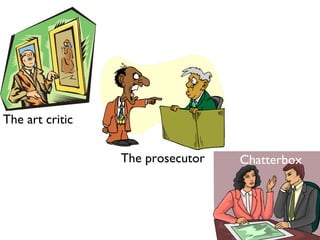
The art critic

                 The prosecutor   Chatterbox
The Fortune Teller


The Suitor


                                  The Trickster
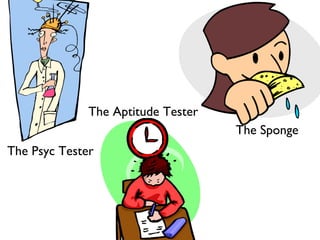
The Aptitude Tester
                                    The Sponge
The Psyc Tester
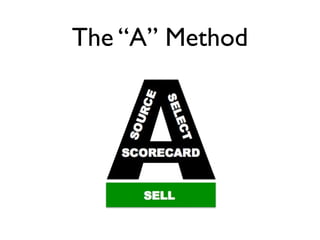
The “A” Method
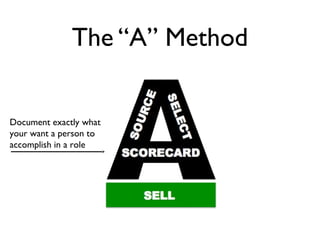
The “A” Method


Document exactly what
your want a person to
accomplish in a role
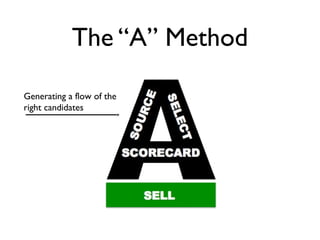
The “A” Method

Generating a flow of the
right candidates
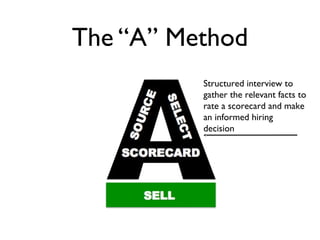
The “A” Method
          Structured interview to
          gather the relevant facts to
          rate a scorecard and make
          an informed hiring
          decision
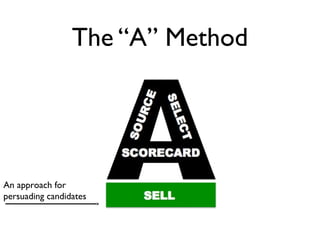
The “A” Method


An approach for
persuading candidates
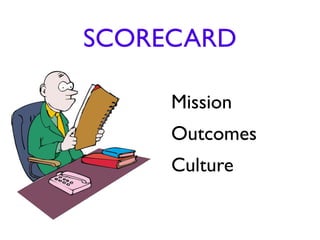
SCORECARD

     Mission
     Outcomes
     Culture
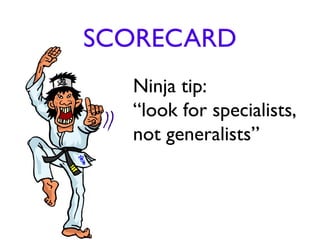
SCORECARD
  Ninja tip:
  “look for specialists,
  not generalists”
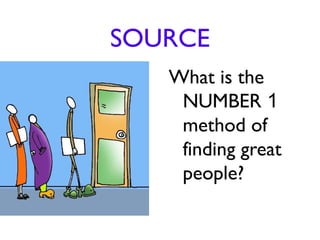
SOURCE
   What is the
    NUMBER 1
    method of
    finding great
    people?
Awww, really, that’s it?
Sourcing Challenge
Seeking referrals
•   “Who are the most talented people you know that I should
    consider hiring?”

•   I will commit to calling at least one of these contacts a week
    until I have called them all. (yes/no)

Recruiting Bounty
•   I will consider offering employees a referral bounty for
    recruiting of $___ and make a go/no decision by (date).

Deputize Friends
•   I will consider offering external Recruiting Deputies $___ for
    recruiting viable candidates by (date).
Sourcing Challenge
Seeking referrals
•   “Who are the most talented people you know that I should
    consider hiring?”

•   I will commit to calling at least one of these contacts a week
    until I have called them all. (yes/no)

Recruiting Bounty
•   I will consider offering employees a referral bounty for
    recruiting of $___ and make a go/no decision by (date).

Deputize Friends
•   I will consider offering external Recruiting Deputies $___ for
    recruiting viable candidates by (date).
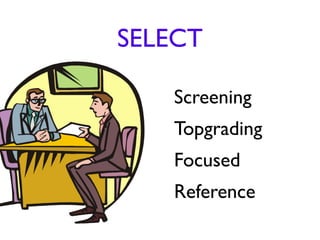
SELECT

   Screening
   Topgrading
   Focused
   Reference
T O R C truth serum

          • Threat
          • Of
          • Reference
          • Check
The Screening Interview
1. What are your career goals?
2. What are you really good at professionally?
  • Please give me some examples.
1. What are you not good at or not
   interested in?
  • Please give me some examples.
1. Who were your last 5 bosses, and how will
   they each rate your performance when we
   talk with them? (1-10)? Why?
What are you not good at or not
interested in? What’s a weakness?


             Don’t let them off.
             •Re-frame
             •Re-phrase
             •Re-ask
             •Just shut up at wait
The Topgrading Interview®

•   Education (5 minutes)
•   For each job in the past 15 years (20-30
    minutes per job)
    1. What were you hired to do?
    2. What accomplishments are you most proud
       of?
    3. What were some low points during that
       job?
The Topgrading Interview®
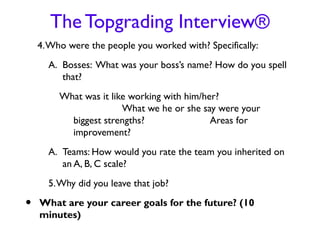
    4. Who were the people you worked with? Specifically:
      A. Bosses: What was your boss’s name? How do you spell
         that?
         What was it like working with him/her?
                        What we he or she say were your
           biggest strengths?                Areas for
           improvement?
      A. Teams: How would you rate the team you inherited on
         an A, B, C scale?
      5. Why did you leave that job?

•   What are your career goals for the future? (10
    minutes)
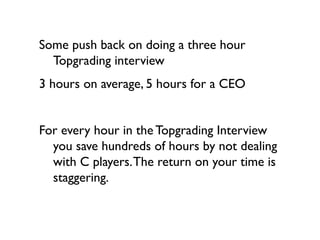
Some push back on doing a three hour
  Topgrading interview
3 hours on average, 5 hours for a CEO


For every hour in the Topgrading Interview
  you save hundreds of hours by not dealing
  with C players. The return on your time is
  staggering.
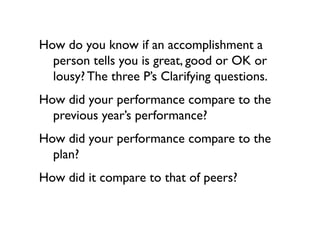
How do you know if an accomplishment a
  person tells you is great, good or OK or
  lousy? The three P’s Clarifying questions.
How did your performance compare to the
  previous year’s performance?
How did your performance compare to the
  plan?
How did it compare to that of peers?
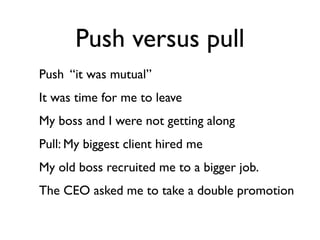
Push versus pull
Push “it was mutual”
It was time for me to leave
My boss and I were not getting along
Pull: My biggest client hired me
My old boss recruited me to a bigger job.
The CEO asked me to take a double promotion
SELL
       Fit
       Family
       Freedom
       Fortune
       Fun
Reference Interview
First question is a conversation starter
The next two questions are exactly the same as the
  screening interview.
The 3rd question is more powerful when you add: BACK
  THEN.
They liberate a reference to talk about weaknesses that
  existed in the past.
Surely, they might assume, the person has corrected those
   weaknesses.
At least they can tell themselves they aren’t being critical of
    the candidate in the present tense.
Questions:
Can Candidates really get their former bosses to talk?
YES Since 1990 when candidates arrange the
  interview 90% of the references are will to talk.


Definition of a high performer
Top 10%, B’s are next 25% and C’s are bottom 65%
People aren’t mutual funds.
Past performance really is an
 indicator of future success.
RED FLAGS: The candidate…..
does not mention past failures
exaggerates his or her answers
takes credit for the work of others
poorly of past bosses
Can’t explain past job moves
Seems more interested in
  compensation and benefits than the
  job itself
Tries too hard to look like an expert
Questions: Turned to someone around you here that
  you don’t know and share your best guess
“What is the cost of the average hiring mistake in
  terms of the employee’s base salary?”
“What percentage of new hires turn out to be high
  performers?” (25%)
Would you enthusiastically rehire everyone on your
 team?
An A player top 10% of talent available,
At the given comp level
In that specific company, with a certain organizational
   structure
In that particular industry
In that location
With specific accountabilities
With available resources
Reporting to a specific person
Jay Jordan, CEO of the Jordan
Company hired a guy who looked great on
  paper.


While terminating the fellow asked why..


“I hired your resume. But unfortunately what I
   go was you.”

Who for tom's i pad

  • 1.
    Solving Your #1Problem Tom Krekel
  • 3.
    The ability tomake good decisions regarding people represents one of the last reliable sources of competitive advantage, especially since so few organizations are good at it. Peter Drucker
  • 5.
    NY Times BestSelling book “Who: Solve Your #1 Problem, Geoff Smart and Randy Street. Based on interviews with 20 billionaire and 30 CEOs of multi-billion dollar companies 80 CEOs of large and entrepreneurial companies, Private equity investors, Experience with 15,000 hires University of Chicago did largest-ever statistical study
  • 6.
    Who mistakes happenwhen managers: Are unclear about what is needed in a job Have a weak flow of candidates Do not trust their ability to pick out the right candidate from a group of similar looking candidates Lose candidates they really want to join their team
  • 8.
    The art critic The prosecutor Chatterbox
  • 9.
    The Fortune Teller TheSuitor The Trickster
  • 10.
    The Aptitude Tester The Sponge The Psyc Tester
  • 11.
  • 12.
    The “A” Method Documentexactly what your want a person to accomplish in a role
  • 13.
    The “A” Method Generatinga flow of the right candidates
  • 14.
    The “A” Method Structured interview to gather the relevant facts to rate a scorecard and make an informed hiring decision
  • 15.
    The “A” Method Anapproach for persuading candidates
  • 16.
    SCORECARD Mission Outcomes Culture
  • 17.
    SCORECARD Ninjatip: “look for specialists, not generalists”
  • 18.
    SOURCE What is the NUMBER 1 method of finding great people?
  • 19.
  • 20.
    Sourcing Challenge Seeking referrals • “Who are the most talented people you know that I should consider hiring?” • I will commit to calling at least one of these contacts a week until I have called them all. (yes/no) Recruiting Bounty • I will consider offering employees a referral bounty for recruiting of $___ and make a go/no decision by (date). Deputize Friends • I will consider offering external Recruiting Deputies $___ for recruiting viable candidates by (date).
  • 21.
    Sourcing Challenge Seeking referrals • “Who are the most talented people you know that I should consider hiring?” • I will commit to calling at least one of these contacts a week until I have called them all. (yes/no) Recruiting Bounty • I will consider offering employees a referral bounty for recruiting of $___ and make a go/no decision by (date). Deputize Friends • I will consider offering external Recruiting Deputies $___ for recruiting viable candidates by (date).
  • 22.
    SELECT Screening Topgrading Focused Reference
  • 23.
    T O RC truth serum • Threat • Of • Reference • Check
  • 24.
    The Screening Interview 1.What are your career goals? 2. What are you really good at professionally? • Please give me some examples. 1. What are you not good at or not interested in? • Please give me some examples. 1. Who were your last 5 bosses, and how will they each rate your performance when we talk with them? (1-10)? Why?
  • 25.
    What are younot good at or not interested in? What’s a weakness? Don’t let them off. •Re-frame •Re-phrase •Re-ask •Just shut up at wait
  • 26.
    The Topgrading Interview® • Education (5 minutes) • For each job in the past 15 years (20-30 minutes per job) 1. What were you hired to do? 2. What accomplishments are you most proud of? 3. What were some low points during that job?
  • 27.
    The Topgrading Interview® 4. Who were the people you worked with? Specifically: A. Bosses: What was your boss’s name? How do you spell that? What was it like working with him/her? What we he or she say were your biggest strengths? Areas for improvement? A. Teams: How would you rate the team you inherited on an A, B, C scale? 5. Why did you leave that job? • What are your career goals for the future? (10 minutes)
  • 28.
    Some push backon doing a three hour Topgrading interview 3 hours on average, 5 hours for a CEO For every hour in the Topgrading Interview you save hundreds of hours by not dealing with C players. The return on your time is staggering.
  • 29.
    How do youknow if an accomplishment a person tells you is great, good or OK or lousy? The three P’s Clarifying questions. How did your performance compare to the previous year’s performance? How did your performance compare to the plan? How did it compare to that of peers?
  • 30.
    Push versus pull Push“it was mutual” It was time for me to leave My boss and I were not getting along Pull: My biggest client hired me My old boss recruited me to a bigger job. The CEO asked me to take a double promotion
  • 31.
    SELL Fit Family Freedom Fortune Fun
  • 32.
    Reference Interview First questionis a conversation starter The next two questions are exactly the same as the screening interview. The 3rd question is more powerful when you add: BACK THEN. They liberate a reference to talk about weaknesses that existed in the past. Surely, they might assume, the person has corrected those weaknesses. At least they can tell themselves they aren’t being critical of the candidate in the present tense.
  • 33.
    Questions: Can Candidates reallyget their former bosses to talk? YES Since 1990 when candidates arrange the interview 90% of the references are will to talk. Definition of a high performer Top 10%, B’s are next 25% and C’s are bottom 65%
  • 34.
    People aren’t mutualfunds. Past performance really is an indicator of future success.
  • 35.
    RED FLAGS: Thecandidate….. does not mention past failures exaggerates his or her answers takes credit for the work of others poorly of past bosses Can’t explain past job moves Seems more interested in compensation and benefits than the job itself Tries too hard to look like an expert
  • 36.
    Questions: Turned tosomeone around you here that you don’t know and share your best guess “What is the cost of the average hiring mistake in terms of the employee’s base salary?” “What percentage of new hires turn out to be high performers?” (25%) Would you enthusiastically rehire everyone on your team?
  • 37.
    An A playertop 10% of talent available, At the given comp level In that specific company, with a certain organizational structure In that particular industry In that location With specific accountabilities With available resources Reporting to a specific person
  • 38.
    Jay Jordan, CEOof the Jordan Company hired a guy who looked great on paper. While terminating the fellow asked why.. “I hired your resume. But unfortunately what I go was you.”

Editor's Notes

  • #3 You or the people you rely on make hiring mistakes. WSJ named this topic (HIRING) THE most important topic in business. Collins popularized the ideal that “Who” decisions are more important that “what” decisions. Want you to walk away with 20 or more take-aways. What do other successful business owners & entrepreneurs do? Who problems are preventable.
  • #5 Who not what
  • #9 Art Critic When it comes to judging art, going on gut instinct sometimes works just find. A good art critic can make an accurate appraisal of a painting within minutes. With executive hiring though, people who think they are naturally equipped to “read” people on the fly are setting themselves up to be fooled big time. The Prosecutor Many managers act like the prosecutors they see on TV. They aggressively question candidates, attempting to trip them up with trick questions and logic problems. Chatterbox This technique has a lot in common with the “la-di-da” interview. The conversation goes something like “How about them Broncos.” You grew up in California? Me too...
  • #10 The Suitor Rather than rigorously interviewing a candidate, some spend all of the energy selling the applicant on the opportunity. Suitors are more concerned with impressing candidates than assessing their capabilities. The spend all of their time talking and virtually no time listening. Fortune teller: Like to ask their candidates to look into the future regarding the job at hand by asking hypothetical questions “What would you do? How would you do it? Could you do it?” Fifty years of academic literature on interview methods make a strong case against using these types of questions. “If you were going to resolve a conflict with a co-worker, how would you do it?” Trickster: There are interviewers who use gimmicks to test for certain behaviors. They might throw a wad of paper on the floor, for example, to see if a candidate is willing to clean it up, or take him to a party to see how he interacts with other partygoers.
  • #11 Psyc tester: Would you rather be at a cocktail party or at work on a Friday night? is not useful though it is an actual question on popular psych tests. Aptitude: Should never become the sold determinant in a hiring decision. Use of screening but do not use in isolation. The Sponge A common approach among busy managers is to let everybody interview a candidate. The goal of this sponge-like behavior is to soak up information by spending as much time with people as possible. Unfortunately, managers rarely coordinate their efforts leaving everyone to ask the same, superficial questions.
  • #12 Geoff Smart’s book NY Times Best Seller “Who Solve Your #1 Problem” and the #1 ranked best seller on Amazon.
  • #22 You can’t outsource this activity. You can’t delegate this.
  • #26 I work too hard. I have too much urgency for results.
  • #27 Only use Topgrading interview as the heavy artillery for the last 2 people.
  • #28 Only use Topgrading interview as the heavy artillery for the last 2 people.