This presentation is a product of LeaderQuest Career Services, designed to help you develop your Interview Skills. The information in this presentation is a blend of best‐practice 
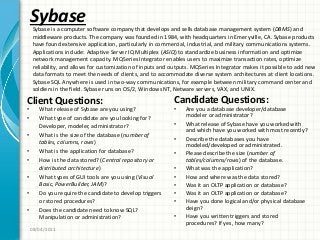
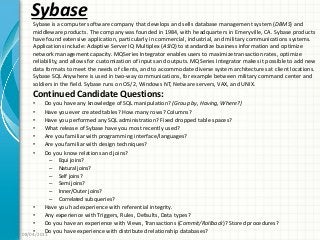
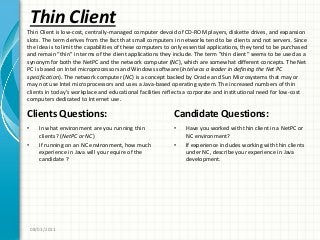
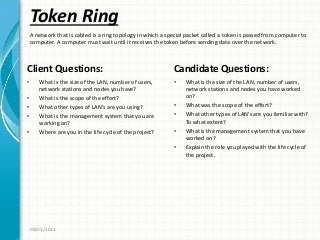
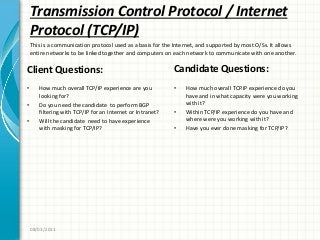
research and narratives gathered from career professionals and HR experts. Although LeaderQuest has made every reasonable attempt to achieve complete accuracy of the content 
in this product, they assume no responsibility for errors or omissions. Also, you should use this information as you see fit, and at your own risk. Your particular situation may not be 
exactly suited to the examples illustrated here; in fact, it's likely that they won't be identical, and you should adjust your use of the information and recommendations accordingly. 
Nothing in this presentation is intended to replace your own intelligence, nor other legal/professional advice, and is meant to inform and entertain the reader. Any trademarks, 
service marks, product names or features are assumed to be the property of their respective owners, and are used only for reference. There is no implied endorsement of any 
particular product or service within this presentation. 
1
2
3
4
Understand that everything happens for a reason. Even the worst thing like losing your job can bring opportunities for
growth.  Train your mind to look for the positive results you will find.  
Vision boards or vision books can be a great way to manifest positive experiences. Create a vibrant mental picture of 
what you want.
5
6
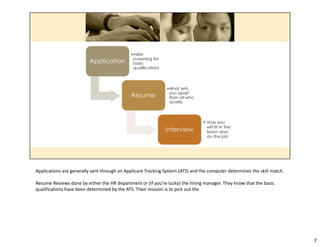
Applications are generally sent through an Applicant Tracking System (ATS) and the computer determines the skill match.
Resume Reviews done by either the HR department or (if you’re lucky) the hiring manager. They know that the basic 
qualifications have been determined by the ATS. Their mission is to pick out the 
7
8
9
10
11
12
13
14
15
16
17
18
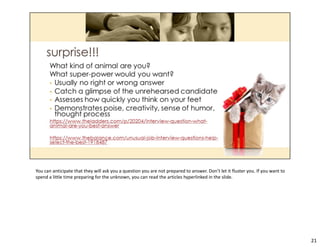
You can anticipate that they will ask you a question you are not prepared to answer. Don’t let it fluster you. If you want to 
spend a little time preparing for the unknown, you can read the articles hyperlinked in the slide.
19
20
21
22
23
The human brain is hard wired to remember stories and who told them. Not just the words, but the visuals that went 
through the listener’s head as well. A good marketer will use stories to sell products. 
Think about that last Disney commercial you saw.
24
25
26
27
28
29
30
31
32
33
34
35
36
37
38
39
40
41
42
43
44
45
46
47
48
49
50
51
52
53
54
55
56
57
58
59
60
61
62
63
64
65
66
67
68
69
70
71
Behavioral Questions Supplement
Behavioral questions are open ended questions that require more than a quick, generic response from the candidate.
These questions tell you more about the person's work style and personality, and validate the skills they have
represented.
The following is a comprehensive listing of behavioral questions that can be asked during an interview. This listing is
provided so that you can select several of the questions to ask during an interview PRIOR to the interview. You would
not want to ask more than 10 of these questions unless you felt the answers to the initial 10 were not adequate or
required further investigation.
Motivation and Purpose
It is much easier to teach workers new skills than to change their motivation or work habits. This is why it’s so
important to hire well-motivated people at the outset. Often, the tendency during interviewing is to focus more on
measuring skills and accomplishments, perhaps because it is more difficult to measure a candidate's motivation. One
way to get a candidate to reveal his or her degree of motivation is to ask open-ended questions.
- “Tell me about yourself.”
- “What do you want out of your next job?”
- “What skills or ideas do you bring to the position applying for?”
- “What would you like to accomplish in your next job that you were not able to accomplish in your last
position?”
- “What is your motivation to do this kind of work?”
- “We have a number of applicants interviewing for this position. Why should we take a closer look at you?”
- “How has your career motivations changed over the past few years?”
Diligence and Professionalism
The big difference between one candidate and another may not be evident until he or she is already on the job and
confronted with a major challenge or obstacle. Will the candidate retreat or shy back from a roadblock? Or will he or
she keep going regardless of how difficult the challenge may seem? And what will he or she be like to work with under
stressful circumstances?
- “Tell me about your most difficult work or personal experience.”
- “Give me an example of how you completed a project despite obstacles.”
- “Describe a time when you tackled a tough or unpopular assignment.”
- “Would your current / past boss describe you as the type of person who goes that extra mile?”
- “Tell me about a time when you didn't perform to expectations.”
- “What would your colleagues tell me about your attention to detail?”
- “How do you manage your workweek and make realistic deadlines?”
- “What personal skill or work habit have you struggled to improve?”
- “How do you manage stress in your daily work?”
- “Describe a professional skill that you have developed in your most recent job.”
Job Fit
With the many variations of job titles, the candidate's view of what the job may entail is often different from the
realities at the hiring company. Testing a candidate's fit will help both the recruiter and the candidate test key job
compatibility issues.
- “What were the most rewarding aspects of your previous job?”
- “What has frustrated you about your current or previous job?”
- “Describe your ideal job.”
- “What are the limitations of your current job?”
- “What concerns you most about performing this job?”
- “Considering your own resume, what do you think your weaknesses are regarding this job?”
- “Would you be able to travel or work extended hours necessary to perform the job?”
- “Do you prefer continuity or frequent change in your daily routine?”
- “What aspects of the job give you the most confidence?”
- “How would you enrich your current or most recent job?”
- “Why are you particularly well suited to this job?”
- “What is your most productive or ideal work setting?”
- “Tell me about two or three aspects of your last job that you would never want to repeat.”
Accomplishments
The objective here is to sort out what the candidate personally, or as part of a group, actually got done, as opposed to
what the job description was. Facts such as how many people reported to the candidate and how large a budget he or
she was responsible for are interesting, but they don't tell you how well he or she performed the job. Did
performance improve? Did sales go up? Did costs go down?
- “Tell me about a contribution that you have made to a team effort.”
- “Tell me about a special contribution you have made to an employer.”
- “Give me an example of a time you delivered more than was expected of you.”
- “What accomplishment is your greatest source of pride?”
- “What situations do your colleagues rely on you to handle?”
- “Tell me about a corporate goal that you were able to support through one or more of your actions.”
- “Tell me about a measurable outcome of one of your efforts.”
- “Which of your accomplishments was the most difficult to achieve?”
- “Tell me about a time when you saved money for an employer or an organization.”
- “Tell me about something you accomplished that required discipline.”
- “Tell me about a project you completed ahead of schedule.”
Cultural Fit
Hiring managers often see cultural fit as key factor in hiring decisions. While skills can be taught and learned,
personality or culture fit is generally something that either exists or does not. Asking some of the following questions
will help you understand what environment will be the best culture fit for the candidate:
- “Tell me about your relationships with your previous bosses.”
- “Describe your working relationships with your colleagues.”
- “Tell me about a work environment that is ineffective for you.”
- “What situations excite and motivate you?”
- “Tell me about a situation at work that frustrated you.”
- “Tell me about a problem you had with one of your work associates.”
- “What would your last boss want to change about your work habits?”
- “Are you most productive working alone or in a group?”
- “How would your last employer describe your work ethics?”
Career Passion
A skilled professional who brings a lot of passion to his or her work is quite likely to be a top performer who can drive
your business forward. The following questions can help you determine how passionate they are about their work:
- “Why do you want this job?”
- “Why do you want to work for this company?”
- “Why would you be especially good working in this business?”
- “What do you like about your current and past roles?”
- “Tell me where you think you'd like to be in five years.”
- “Tell me what you know about the industry.”
- “Describe your ideal career.”
-
Situational Questions
Situational or Behavioral questions will help you determine how a candidate will react in a certain situation or work
environment.
- “What is the most creative or innovative idea you have ever had?”
- “Give me an example of how you have overcome an obstacle in a creative way.”
- “Describe a time when an existing process just didn't work. What did you do to correct it?”
- “How would a former subordinate or associate describe your leadership style?”
- “Tell me about a time that you had to persuade others to adopt your idea.”
- “Have your past job appraisals adequately portrayed your leadership abilities?”
- “Tell me about one of your projects that failed.”
- “How have you demonstrated leadership by example?”
- “Describe situations in which you are most comfortable as the leader.”
- “In what situations are you an effective contributor if you are not the leader?”
- “Describe your comfort level working with people of higher rank and people of lower rank.”
- “Tell me about a time you had to alter your leadership style.”
Skills and Ability to Do the Job
You will always determine if the candidate has the basic skills to do the job early in the interviewing process. Even if
only a fairly routine skill set is necessary, there may be sizable differences between one candidate and another in their
abilities to perform particular aspects of the job.
- “What sets you apart from the crowd?”
- “What are the weaknesses in your skills relevant to these job requirements?”
- “Tell me about your strengths.”
- “How is your experience relevant to this job?”
- “What skills do you think are most critical to this job?”
- “Compared to others with a similar background in this field, how would you evaluate yourself?”
- “Have you ever been fired or asked to resign?”
- “What are your keys skills?”
- “What one weakness or habit would you like to work on first?”
- “What skills would you like to develop in this job?”
- “To what do you attribute your job success?”
Discriminatory Interview Questions
When is a question discriminatory? A guiding principle when determining what interview questions you can ask is
whether the question asked is job related. Ask yourself if the information you are trying to obtain really needed in
order to judge the candidate’s qualifications, level of skills and overall competence for the job in question.
Generally, questions relating to any of the following topics are discriminatory and should be avoided:
- candidate’s gender
- race
- age
- national origin
- religion
- birthplace
- disability
- marital/family status
- or other non-job-related question
Additionally, the way in which questions are phrased is equally important. Here are some examples of acceptable and
unacceptable interview questions:
SUBJECT/TOPIC UNACCEPTABLE ACCEPTABLE
Reliability/
Attendance
-Number of children?
-Who is going to baby-sit?
-What religion are you?
-Do you have pre-school age
children at home?
-Do you have a car?
-What hours and days can you work?
-Are there specific times that you
cannot work?
-Do you have responsibilities other
than work that will interfere with
specific job requirements such as
traveling?
Citizenship/National
Origin
-What is your national origin?
-Where are your parents from?
-What is your maiden name?
-Are you legally eligible for
employment in the United States?
-Have you ever worked under a
different name?
-Are you legally entitled to work in
this country?
Arrest and Conviction
(In ban-the-box
states this should
not be asked)
-Have you ever been arrested? -Have you ever been convicted of a
felony or misdemeanor? If so, when,
where and what was the disposition of
the case?
Disabilities -Do you have any job disabilities? -Can you perform the duties of the
job you are applying for?
SUBJECT/TOPIC UNACCEPTABLE ACCEPTABLE
Credit Record -Do you own your own home?
-Have your wages ever been
garnished?
-Have you ever declared bankruptcy?
-None – sometimes a client may ask
for a credit report and then we will
ask for the candidates consent.
Military Record -What type of discharge did you
receive?
-What type of education, training,
work experience did you receive
while in the military?
Language What is your native language?
Inquiry into use of how candidate
acquired ability to read, write or
speak a foreign language.
-Inquiry into languages candidate
speaks and writes fluently. (If the
job requires additional languages)
Organizations -List all clubs, societies and lodges to
which you belong .
-Inquiry into candidate’s membership
in organizations which the candidate
considers relevant to his or her ability
to perform the job.
-Are you a union member?
Race -Complexion of color or skin. -None
Worker’s
Compensation
-Have you ever filed for worker’s
compensation?
-Have you had any prior work injuries?
-None
Religion or Creed -Inquiry into candidate’s religious
denominations, religious affiliations,
church, parish, pastor or religious
holidays observed.
-None
Gender -Do you wish to be addressed as Mr.?
Mrs.? Miss? Or Ms.
-None
Addresses -What was your previous address?
-How long did you reside there?
-How long have you lived at your
current address?
-Do you own your home?
-None
Education -When did you graduate from high
school or college?
-Do you have a high school diploma or
equivalent?
-Do you have a university or college
degree?
Note: Discuss with your manager if you have any questions regarding what you can (and can’t) ask during the interview
process.
DO YOU SPEAK TECH?
10/6/2011
ADA
Client Questions:
• Describe the application and platform the
candidate will work on.
• What version of ADA are you currently working
with? (ADA or ADA95)
• What is the target microprocessor?
• Will the candidate be involved in enhancements
to existing systems or designing, coding, and
testing/debugging? Please describe the scope of
their duties.
• Should the candidate be familiar with any other
languages for this project? If so, which ones?
• Is “industry specific” experience necessary (i.e.
Tank, Aircraft)
Candidate Questions:
• How much experience do you have with ADA?
• What version(s) of ADA have you worked with?
• Please describe the applications and platforms
you have worked on in ADA.
• What was your role with these projects? Was
your primarily responsibility design and
development or enhancing existing
applications? What about testing/debugging?
• Have you utilized any tools or compilers such as
ObjectADA? If yes, elaborate.
• Are you familiar with any other languages? If
yes, which ones?
7/26/2011
ADA is a high-level programming language developed by the US Department of Defense. It was designed for
embedded applications and process control, but is also used for logistics applications. It is Pascal-based
language that is very comprehensive.
ADABAS
Client Questions:
• On what platform are you running ADABAS?
• What will the candidate ’s main responsibilities
include? (Tuning, modeling, or administration)
• How large is your database? (Memory, number
of tables, columns, rows)
• What is the application?
• Will the candidate need familiarity with
NATURAL? (a 4GL is commonly used with
ADABAS)
• Will the candidate be responsible for text
retrieval, and/or GIS processing?
• Will the candidate use SQL and distributed
database functions?
• Will the candidate need to utilize any specific
tools for report writing/generation?
Candidate Questions:
• How much experience do you have with
ADABAS?
• What platforms have you worked on?
• What phases of the life cycle have you been
involved in? (Implementation, tuning, modeling,
or administration)
• What was the size of the database that you
worked on?
• What were the applications of the database?
• Are you familiar with NATURAL?
• Have you performed text retrieval, and/or GIS
processing?
• Have you used SQL and distributed database
functions?
• Have you performed report writing/generation?
What tools were used?
7/26/2011
ADABAS is a Database Management System for IBM mainframes. It was introduced in 1969 and was one of the
first database management systems.
AS/400
Client Questions:
• Please describe your AS/400 System.
• Which series or model is it? Was it upgraded
from previous System/36 or System/38?
• Is the AS/400 connected with other systems? If
yes, please describe.
• What languages are used?
• Will the candidate work with control language?
Maintain it or design/write it?
• Will the candidate be performing, programming
or administration work?
• Will the project involve PC Support? If yes, what
will be used?
– Transfer files to/from PC.
– Write a screen saver program?
– Setup or use virtual printers?
Candidate Questions:
• How long have you programmed on the AS/400
System?
• Have you ever programmed in System/36 or
System/38 environments? If Sys/36, have you
ever converted from Sys/36 to Native?
• What languages did you program in on the
AS/400?
• Did you work with control language? Did you
maintain it? Design or write it?
• On the AS/400, which of the following have ou
worked on? Native environment; System/36;
version 3.1?
• Have you bee responsible for:
– RUMBA or Showcase Vista?
– Transfer files to/from PC’s?
– Write a screen saver?
– Client Access? If yes,
– Have you transferred files?
– Written screen saver programs?
– Provided facsimile support?
– Advanced function printing?
– Visual RPG? Code/400? SQL/400? S/38
utilities? Call Path? TCP/IP?
7/26/2011
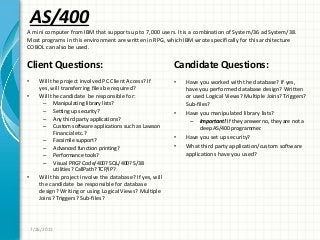
A mini computer from IBM that supports up to 7,000 users. It is a combination of System/36 ad System/38.
Most programs in this environment are written in RPG, which IBM wrote specifically for this architecture
COBOL can also be used.
AS/400
Client Questions:
• Will the project involved PC Client Access? If
yes, will transferring files be required?
• Will the candidate be responsible for:
– Manipulating library lists?
– Setting up security?
– Any third party applications?
– Custom software applications such as Lawson
Financial etc.?
– Facsimile support?
– Advanced function printing?
– Performance tools?
– Visual PRG? Code/400? SQL/400? S/38
utilities? CallPath? TCP/IP?
• Will this project involve the database? If yes, will
the candidate be responsible for database
design? Writing or using Logical Views? Multiple
Joins? Triggers? Sub-files?
Candidate Questions:
• Have you worked with the database? If yes,
have you performed database design? Written
or used Logical Views? Multiple Joins? Triggers?
Sub-files?
• Have you manipulated library lists?
– Important! If they answer no, they are not a
deep AS/400 programmer.
• Have you set up security?
• What third party application/custom software
applications have you used?
7/26/2011
A mini computer from IBM that supports up to 7,000 users. It is a combination of System/36 ad System/38.
Most programs in this environment are written in RPG, which IBM wrote specifically for this architecture
COBOL can also be used.
Active Directory
Client Questions:
• What version of windows do you currently
have installed?
• What specific Active Directory experience
do you need?
Candidate Questions:
• How long have you work with active
Directory?
• Have you used Active Directory in an
Enterprise environment?
• What is your NDS background?
7/25/2011
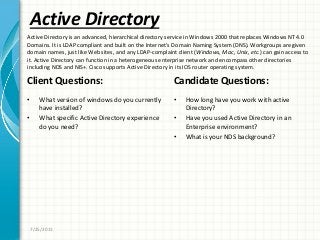
Active Directory is an advanced, hierarchical directory service in Windows 2000 that replaces Windows NT 4.0
Domains. It is LDAP compliant and built on the Internet’s Domain Naming System (DNS). Workgroups are given
domain names, just like Web sites, and any LDAP-complaint client (Windows, Mac, Unix, etc.) can gain access to
it. Active Directory can function in a heterogeneous enterprise network and encompass other directories
including NDS and NIS+. Cisco supports Active Directory in its IOS router operating system.
Active Server Page (ASP)
Client Questions:
• How are you using ASP?
• What level of experience with ASP will be
required?
• At what stage in the lifecycle of the project will
they be working? (design, development,
deployment)
• What Add-Ons have you used to create this?
(SQL, Exchange)
• Will the candidate be required to manage and
implement internet-based projects? Through
how much of the project life cycle?
• Does the candidate need experience with both
JavaScript and VBScript?
• What are some of the software or system
challenges you have identified?
Candidate Questions:
• What level of experience with ASP do you have?
• How have you used ASP?
• Where in the life cycle of the project have you
worked? (design, development, deployment)
• What Add-Ons have you used to create these?
(SQL, Exchange)
• Have you ever managed and implemented
Internet-based projects? Through how much of
the project life cycle?
• Have you worked with JavaScript and/or
VBScript while creating ASPs? Please describe.
7/26/2011
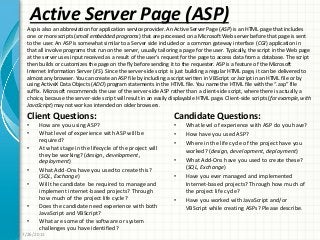
Asp is also an abbreviation for application service provider. An Active Server Page (ASP) is an HTML page that includes
one or more scripts (small embedded programs) that are processed on a Microsoft Web server before that page is sent
to the user. An ASP is somewhat similar to a Server side included or a common gateway interface (CGI) application in
that all involve programs that run on the server, usually tailoring a page for the user. Typically, the script in the Web page
at the server uses input received as a result of the user’s request for the page to access data from a database. The script
then builds or customizes the page on the fly before sending it to the requester. ASP is a feature of the Microsoft
Internet Information Server (IIS). Since the server-side script is just building a regular HTML page, it can be delivered to
almost any browser. You can create an ASP file by including a script written in VBScript or Jscript in an HTML file or by
using ActiveX Data Objects (ADO) program statements in the HTML file. You name the HTML file with the “.asp” file
suffix. Microsoft recommends the use of the server-side ASP rather than a client-side script, where there is actually a
choice, because the server-side script will result in an easily displayable HTML page. Client-side scripts (for example, with
JavaScript) may not work as intended on older browsers.
Analog Design
Client Questions:
• What type of Analog Designer do you need?
• What is the application of the circuit that the
candidate will be designing?
• If it is an Analog ASIC or I.C. (integrated circuit)
design, will the candidate need experience with
Pspice (not necessarily)…simulation tools? If yes,
which tools?
• If the answer to #3 is negative, are you using a
PCB design? If not, are you using a modular
system design?
• Is it an RF circuit? (Radio Frequency is the
technology that utilizes electromagnetic energy
to send information. )
• If it is an RF circuit, what frequency is the circuit
and what level of frequency should the
contractor have experience in?
• What design or CAD tools will the candidate be
using?
• What part of the functional flow will the
candidate be involved with?
(Design/simulation, development, layout,
verification/validation)
Candidate Questions:
• What analog design have you been responsible
for? Please describe.
• What were the applications of the circuits you
designed?
• Do you have experience with RF circuits? (Radio
Frequency is the technology that utilizes
electromagnetic energy to send information. )
• What were the frequencies of the circuits?
• What design/CAD tools have you used? In what
capacity?
• Have you designed Analog ASICs? If so, how
many?
• Have you been responsible for integrated circuit,
PCB, or modular system design? Please describe.
• Do you have experience with Pspice?
• What parts of the functional flow have you been
involved with? (Design/simulation,
development, layout, verification/validation)
7/29/2011
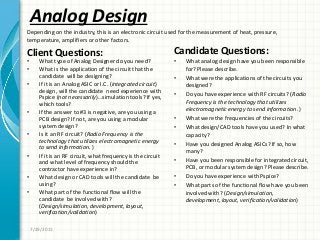
Depending on the industry, this is an electronic circuit used for the measurement of heat, pressure,
temperature, amplifiers or other factors.
Asynchronous Transfer Mode (ATM)
Client Questions:
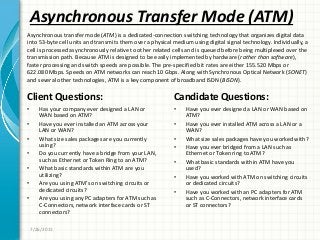
• Has your company ever designed a LAN or
WAN based on ATM?
• Have you ever installed an ATM across your
LAN or WAN?
• What size sales packages are you currently
using?
• Do you currently have a bridge from your LAN,
such as Ethernet or Token Ring to an ATM?
• What basic standards within ATM are you
utilizing?
• Are you using ATM’s on switching circuits or
dedicated circuits?
• Are you using any PC adapters for ATM such as
C-Connectors, network interface cards or ST
connectors?
Candidate Questions:
• Have you ever designed a LAN or WAN based on
ATM?
• Have you ever installed ATM across a LAN or a
WAN?
• What size sales packages have you worked with?
• Have you ever bridged from a LAN such as
Ethernet or Token ring to ATM?
• What basic standards within ATM have you
used?
• Have you worked with ATM on switching circuits
or dedicated circuits?
• Have you worked with an PC adapters for ATM
such as C-Connectors, network interface cards
or ST connectors?
7/26/2011
Asynchronous transfer mode (ATM) is a dedicated-connection switching technology that organizes digital data
into 53-byte cell units and transmits them over a physical medium using digital signal technology. Individually, a
cell is processed asynchronously relative to other related cells and is queued before being multiplexed over the
transmission path. Because ATM is designed to be easily implemented by hardware (rather than software),
faster processing and switch speeds are possible. The pre-specified bit rates are either 155.520 Mbps or
622.080 Mbps. Speeds on ATM networks can reach 10 Gbps. Along with Synchronous Optical Network (SONET)
and several other technologies, ATM is a key component of broadband ISDN (BISDN).
Asynchronous Transfer Mode (ATM)
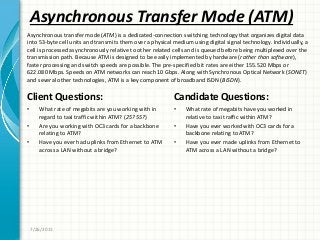
Client Questions:
• What rate of megabits are you working with in
regard to taxi traffic within ATM? (25? 55?)
• Are you working with OC3 cards for a backbone
relating to ATM?
• Have you ever had uplinks from Ethernet to ATM
across a LAN without a bridge?
Candidate Questions:
• What rate of megabits have you worked in
relative to taxi traffic within ATM?
• Have you ever worked with OC3 cards for a
backbone relating to ATM?
• Have you ever made uplinks from Ethernet to
ATM across a LAN without a bridge?
7/26/2011
Asynchronous transfer mode (ATM) is a dedicated-connection switching technology that organizes digital data
into 53-byte cell units and transmits them over a physical medium using digital signal technology. Individually, a
cell is processed asynchronously relative to other related cells and is queued before being multiplexed over the
transmission path. Because ATM is designed to be easily implemented by hardware (rather than software),
faster processing and switch speeds are possible. The pre-specified bit rates are either 155.520 Mbps or
622.080 Mbps. Speeds on ATM networks can reach 10 Gbps. Along with Synchronous Optical Network (SONET)
and several other technologies, ATM is a key component of broadband ISDN (BISDN).
Banyan Vines
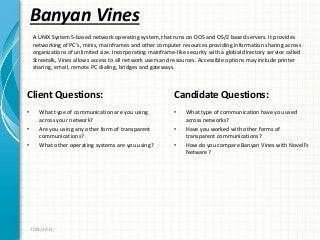
Client Questions:
• What type of communication are you using
across your network?
• Are you using any other form of transparent
communications?
• What other operating systems are you using?
Candidate Questions:
• What type of communication have you used
across networks?
• Have you worked with other forms of
transparent communications?
• How do you compare Banyan Vines with Novell’s
Netware?
7/29/2011
A UNIX System 5-based network operating system, that runs on DOS and OS/2 based servers. It provides
networking of PC’s, minis, mainframes and other computer resources providing information sharing across
organizations of unlimited size. Incorporating mainframe-like security with a global directory service called
Streetalk, Vines allows access to all network users and resources. Accessible options may include printer
sharing, email, remote PC dialing, bridges and gateways.
Basic Input / Output System (BIOS)
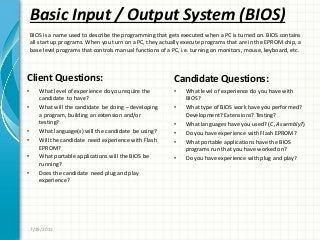
Client Questions:
• What level of experience do you require the
candidate to have?
• What will the candidate be doing – developing
a program, building an extension and/or
testing?
• What language(s) will the candidate be using?
• Will the candidate need experience with Flash
EPROM?
• What portable applications will the BIOS be
running?
• Does the candidate need plug and play
experience?
Candidate Questions:
• What level of experience do you have with
BIOS?
• What type of BIOS work have you performed?
Development? Extensions? Testing?
• What languages have you used? (C, Assembly?)
• Do you have experience with Flash EPROM?
• What portable applications have the BIOS
programs run that you have worked on?
• Do you have experience with plug and play?
7/29/2011
BIOS is a name used to describe the programming that gets executed when a PC is turned on. BIOS contains
all start up programs. When you turn on a PC, they actually execute programs that are in the EPROM chip, a
base level programs that controls manual functions of a PC, i.e. turning on monitors, mouse, keyboard, etc.
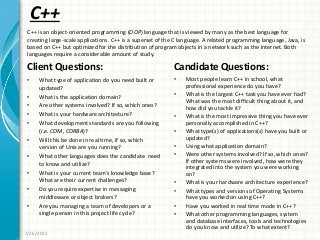
C++
Client Questions:
• What type of application do you need built or
updated?
• What is the application domain?
• Are other systems involved? If so, which ones?
• What is your hardware architecture?
• What development standards are you following
(i.e. COM, CORBA)?
• Will this be done in real time, if so, which
version of Unix are you running?
• What other languages does the candidate need
to know and utilize?
• What is your current team’s knowledge base?
What are their current challenges?
• Do you require expertise in messaging
middleware or object brokers?
• Are you managing a team of developers or a
single person in this project life cycle?
Candidate Questions:
• Most people learn C++ in school, what
professional experience do you have?
• What is the largest C++ task you have ever had?
What was the most difficult thing about it, and
how did you tackle it?
• What is the most impressive thing you have ever
personally accomplished in C++?
• What type(s) of applications(s) have you built or
updated?
• Using what application domain?
• Were other systems involved? If so, which ones?
If other systems were involved, how were they
integrated into the system you were working
on?
• What is your hardware architecture experience?
• What types and versions of Operating Systems
have you worked on using C++?
• Have you worked in real time mode in C++?
• What other programming languages, system
and database interfaces, tools and technologies
do you know and utilize? To what extent?
7/26/2011
C++ is an object-oriented programming (OOP) language that is viewed by many as the best language for
creating large-scale applications. C++ is a superset of the C language. A related programming language, Java, is
based on C++ but optimized for the distribution of program objects in a network such as the Internet. Both
languages require a considerable amount of study.
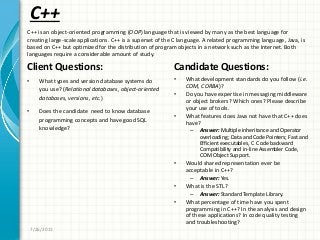
C++
Client Questions:
• What types and version database systems do
you use? (Relational databases, object-oriented
databases, versions, etc.)
• Does the candidate need to know database
programming concepts and have good SQL
knowledge?
Candidate Questions:
• What development standards do you follow (i.e.
COM, CORBA)?
• Do you have expertise in messaging middleware
or object brokers? Which ones? Please describe
your use of tools.
• What features does Java not have that C++ does
have?
– Answer: Multiple inheritance and Operator
overloading; Data and Code Pointers; Fast and
Efficient executables, C Code backward
Compatibility and in-line Assembler Code,
COM Object Support.
• Would shared representation ever be
acceptable in C++?
– Answer: Yes.
• What is the STL?
– Answer: Standard Template Library.
• What percentage of time have you spent
programming in C++? In the analysis and design
of these applications? In code quality testing
and troubleshooting?
7/26/2011
C++ is an object-oriented programming (OOP) language that is viewed by many as the best language for
creating large-scale applications. C++ is a superset of the C language. A related programming language, Java, is
based on C++ but optimized for the distribution of program objects in a network such as the Internet. Both
languages require a considerable amount of study.
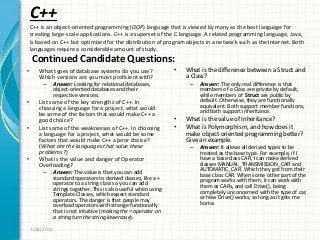
C++
• What types of database systems do you use?
Which versions are you most proficient with?
– Answer: Looking for relational databases,
object-oriented databases and their
respective versions.
• List some of the key strengths of C++. In
choosing a language for a project, what would
be some of the factors that would make C++ a
good choice?
• List some of the weaknesses of C++. In choosing
a language for a project, what would be some
factors that would make C++ a poor choice?
(What are the languages that solve these
problems?)
• What is the value and danger of Operator
Overloading?
– Answer: The value is that you can add
standard operators to derived classes, like a +
operator to a string class so you can add
strings together. This is also useful when using
Template Classes, which expect standard
operators. The danger is that people may
overload operators with strange functionally
that is not intuitive (making the = operator on
a string turn the string lowercase).
• What is the difference between a Struct and
a Class?
– Answer: The only real difference is that
members of a Class are private by default,
while members of Struct are public by
default. Otherwise, they are functionally
equivalent. Both support member functions,
and both support inheritance.
• What is the value of Inheritance?
• What is Polymorphism, and how does it
make object oriented programming better?
Give an example.
– Answer: It allows all derived types to be
treated as the base type. For example, if I
have a base class CAR, I can make derived
classes MANUAL_TRANSMISSION_CAR and
AUTOMATIC_CAR. Which they got from their
base class CAR. When some other part of the
program works with them, it can work with
them as CARs, and call Drive(), being
completely unconcerned with the type of car,
or how Drive() works, so long as it gets me
home.
7/26/2011
C++ is an object-oriented programming (OOP) language that is viewed by many as the best language for
creating large-scale applications. C++ is a superset of the C language. A related programming language, Java,
is based on C++ but optimized for the distribution of program objects in a network such as the Internet. Both
languages require a considerable amount of study.
Continued Candidate Questions:
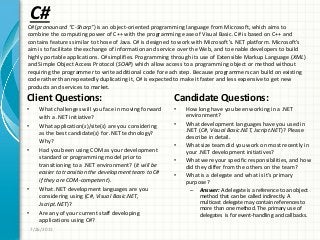
C#
Client Questions:
• What challenges will you face in moving forward
with a .NET initiative?
• What application(s)/site(s) are you considering
as the best candidate(s) for .NET technology?
Why?
• Had you been using COM as your development
standard or programming model prior to
transitioning to a .NET environment? (It will be
easier to transition the development team to C#
if they are COM-competent).
• What .NET development languages are you
considering using (C#, Visual Basic.NET,
Jscript.NET)?
• Are any of your current staff developing
applications using C#?
Candidate Questions:
• How long have you been working in a .NET
environment?
• What development languages have you used in
.NET (C#, Visual Basic.NET, Jscript.NET)? Please
describe in detail.
• What size team did you work on most recently in
your .NET development initiatives?
• What were your specific responsibilities, and how
did they differ from the others on the team?
• What is a delegate and what is it’s primary
purpose?
– Answer: A delegate is a reference to an object
method that can be called indirectly. A
multicast delegate may contain references to
more than one method. The primary use of
delegates is for event-handling and callbacks.
7/26/2011
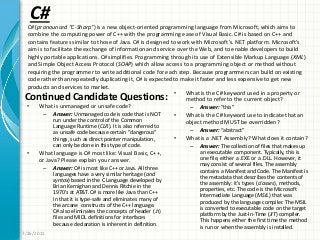
C# (pronounced “C-Sharp”) is an object-oriented programming language from Microsoft, which aims to
combine the computing power of C++ with the programming ease of Visual Basic. C# is based on C++ and
contains features similar to those of Java. C# is designed to work with Microsoft’s. NET platform. Microsoft’s
aim is to facilitate the exchange of information and service over the Web, and to enable developers to build
highly portable applications. C# simplifies. Programming through its use of Extensible Markup Language (XML)
and Simple Object Access Protocol (SOAP) which allow access to a programming object or method without
requiring the programmer to write additional code for each step. Because programmers can build on existing
code rather than repeatedly duplicating it, C# is expected to make it faster and less expensive to get new
products and services to market.
C#
Continued Candidate Questions:
• What is unmanaged or unsafe code?
– Answer: Unmanaged code is code that is NOT
run under the control of the Common
Language Runtime (CLR). It is also referred to
as unsafe code because certain “dangerous”
things, such as direct pointer manipulation,
can only be done in this type of code.
• What language is C# most like: Visual Basic, C++,
or Java? Please explain your answer.
– Answer: C# is most like C++ or Java. All three
languages have a very similar heritage (and
syntax) based in the C Language developed by
Brian Kernighan and Dennis Ritchie in the
1970’s at AT&T. C# is more like Java than C++
in that it is type-safe and eliminates many of
the arcane constructs of the C++ language.
C# also eliminates the concepts of header (.h)
files and MIDL definitions for interfaces
because declaration is inherent in definition.
• What is the C# keyword used in a property or
method to refer to the current object?
– Answer: “this”
• What is the C# keyword use to indicate that an
object method MUST be overridden?
– Answer: “abstract”
• What is a .NET Assembly? What does it contain?
– Answer: The collection of files that makes up
an executable component. Typically, this is
one file, either a .EXE or a .DLL. However, it
may consist of several files. The assembly
contains a Manifest and Code. The Manifest is
the metadata that describes the contents of
the assembly: it’s types (classes), methods,
properties, etc. The code is the Microsoft
Intermediate Language (MSIL) that was
produced by the language compiler. The MSIL
is converted to executable code on the target
platform by the Just-In-Time (JIT) compiler.
This happens either the first time the method
is run or when the assembly is installed.
7/26/2011
C# (pronounced “C-Sharp”) is a new object-oriented programming language from Microsoft, which aims to
combine the computing power of C++ with the programming ease of Visual Basic. C# is based on C++ and
contains features similar to those of Java. C# is designed to work with Microsoft’s. NET platform. Microsoft’s
aim is to facilitate the exchange of information and service over the Web, and to enable developers to build
highly portable applications. C# simplifies. Programming through its use of Extensible Markup Language (XML)
and Simple Object Access Protocol (SOAP) which allow access to a programming object or method without
requiring the programmer to write additional code for each step. Because programmers can build on existing
code rather than repeatedly duplicating it, C# is expected to make it faster and less expensive to get new
products and services to market.
Certifications
Here is a list of current Certifications by Microsoft:
• MCP: The Microsoft Certified Professional (MCP) credential is professionals who have the skills to successfully
implement a Microsoft product or technology as part of a business solution in an organization. You achieve this
certification by passing ONE test by Microsoft.
• MCSA: The Microsoft Certified Systems Administrator (MCSA) on Microsoft Windows 2000 certification is
designed for professionals who implement manage, and troubleshoot existing network and system
environments based on the Microsoft Windows 2000 and Windows .NET Server platforms. The newest
certification by Microsoft; this test requires passing 4 tests by Microsoft.
• MCSD: The Microsoft Certified Solution Developer (MSCD) credential is the premier certification for
professionals who design and develop leading-edge business solutions with Microsoft development tools,
technologies, platforms, and the Microsoft windows architecture. This is the developer certification by

Microsoft. This test requires passing 4 tests by Microsoft.
• MCSE: The Microsoft Certified Systems Engineer (MCSE) credential is the premier certification for professionals
who analyze the business requirements and design and implement the infrastructure for business solutions
based on the Microsoft Windows 2000 platform and Microsoft server software. This is the network certification
by Microsoft. This test requires passing 7 tests by Microsoft. You currently can be an MCSE under by the NT and
2000 Operating systems.
7/26/2011
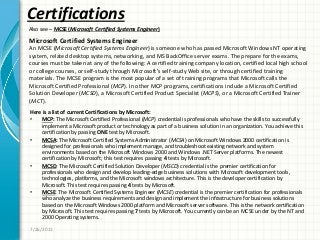
Also see – MCSE (Microsoft Certified Systems Engineer)
Microsoft Certified Systems Engineer
An MCSE (Microsoft Certified Systems Engineer) is someone who has passed Microsoft Windows NT operating
system, related desktop systems, networking, and MS BackOffice server exams. The prepare for the exams,
courses must be taken at any of the following: A certified training company location, certified local high school
or college courses, or self-study through Microsoft’s self-study Web site, or through certified training
materials. The MCSE program is the most popular of a set of training programs that Microsoft calls the
Microsoft Certified Professional (MCP). In other MCP programs, certifications include a Microsoft Certified
Solution Developer (MCSD), a Microsoft Certified Product Specialist (MCPS), or a Microsoft Certified Trainer
(MCT).
Certifications
Continued list of current Certifications by Microsoft:
• MCAD: The Microsoft Certified Application Developer (MCAD) for Microsoft .NET credential is for professionals
who use Microsoft technologies to develop and maintain department-level applications, components, Web, or
desktop clients, or back-end data services. This is a higher end developer certification by Microsoft. This test
requires 4 tests by Microsoft.
• MCDBA : The Microsoft Certified Database administrator (MCDBA) credential is the premier certification for
professionals who implement and administer Microsoft SQL Server databases. This is the dba certification by
Microsoft. This test requires passing 4 test by Microsoft.
• MCT: Microsoft Certified Trainers (MCTs) are qualified instructors who are certified by Microsoft to deliver
Microsoft Official Curriculum (MOC) and Microsoft Developer Network (MSDN) Training courses to IT
professionals and developers. This is the instructor certification by Microsoft. This test requires passing 1 test by
Microsoft as well as currently holding a valid certification from Microsoft.
• MOUS: Microsoft Office User Specialist (MOUS) certification is the premier Microsoft desktop certification, a
globally recognized standard for demonstrating desktop skills. This is the desktop certification by Microsoft. This
certification requires passing 1 test by Microsoft for the software in which you will be certified.
7/26/2011
Also see – MCSE (Microsoft Certified Systems Engineer)
Microsoft Certified Systems Engineer
An MCSE (Microsoft Certified Systems Engineer) is someone who has passed Microsoft Windows NT operating
system, related desktop systems, networking, and MS BackOffice server exams. The prepare for the exams,
courses must be taken at any of the following: A certified training company location, certified local high school
or college courses, or self-study through Microsoft’s self-study Web site, or through certified training
materials. The MCSE program is the most popular of a set of training programs that Microsoft calls the
Microsoft Certified Professional (MCP). In other MCP programs, certifications include a Microsoft Certified
Solution Developer (MCSD), a Microsoft Certified Product Specialist (MCPS), or a Microsoft Certified Trainer
(MCT).
Certifications
Also see – MCSE (Microsoft Certified Systems Engineer)
Client Questions:
• Do you need a Microsoft Certified System
Engineer?
• For what type of project?
• What level of certification do they need?
Candidate Questions:
• What level of certification do you have?
• What are the four different versions of Windows 2000?
– Answer: Professional, Server, Advanced Server, Data
Center
• What is the technology called in Windows 2000 that
replaces Windows NT 4.0 Domains?
– Answer: active Directory
• What does RPC stand for?
– Answer: Remote Procedure Call
• What is a Roaming User Profile?
– Answer: Roaming user profiles perform the same
function as local user profiles. The difference is that
whereas local user profiles are always accessed locally
on the machine a user is logged in on; roaming profiles
are accessed over the network from a central location.
This allows the same profile to be accessed from
anywhere on the network.7/27/2011
Microsoft Certified Systems Engineer
An MCSE (Microsoft Certified Systems Engineer) is someone who has passed Microsoft Windows NT
operating system, related desktop systems, networking, and MS BackOffice server exams. The prepare for
the exams, courses must be taken at any of the following: A certified training company location, certified
local high school or college courses, or self-study through Microsoft’s self-study Web site, or through
certified training materials. The MCSE program is the most popular of a set of training programs that
Microsoft calls the Microsoft Certified Professional (MCP). In other MCP programs, certifications include a
Microsoft Certified Solution Developer (MCSD), a Microsoft Certified Product Specialist (MCPS), or a
Microsoft Certified Trainer (MCT).
Citrix
Client Questions:
• What is your current version of Citrix?
• What edition of Presentation Server do you
have?
• How large is your Citrix deployment?
• What, if any, certifications are you looking for
with a candidate ?
• What applications are you deploying?
Candidate Questions:
• What version/versions of Citrix have you worked with?
Looking for: Current versions XP 4.0 (Meta Frame 1.8
is no longer supported)
• How big was your Citrix deployment? Looking for:
Multiple servers in a Farm.
• What were you using it for? Looking for: Citrix is used
to distribute applications to dumb terminals or any pc
through a Citrix client or web browser though the use of
NFuse.
• What was your role? Looking for: Dedicated focus on
Citrix. In Enterprise deployments there is always
dedicated resources. You want one of those preferably
the person who did architecture and built it.
• Years working with Citrix? – Citrix has a lot of quirks;
and each version and service pack has its own issues.
You want some time dedicated because most of the
issues are known problems and are easy to fix if it’s
not your first time seeing them.
• What are the problems you have dealt with? Looking
for: Universally printing is the answer. Even the newest
version with the latest fix has a compatibility issues with
some virus defense programs that see items in their
print cue as viruses and deletes them.
• Do you have any Certifications? Looking for: Citrix
Education offers the following certification programs:
Citrix Certified Administrator (CCA), Citrix Certified
Enterprise Administrator (CCEA), Citrix Certified
Instructor (CCI). Citrix Certified Integration Architect
(CCIA) and Citrix Certified Sales Professional (CCSP).7/27/2011
Citrix
• What are the 3 different editions of Presentation Server? Standard, Advanced, Enterprise.
• Difference between editions: Standard has no load balancing, Advanced has load balancing, Enterprise
has SNMP plug-in (HP OpenView), Installation Manager (package and install apps) and Resource
Manager (monitoring).
• What options are there for the datastore database? Looking for: Access and SQL.
– If answered correctly ask: In what situation would you use each? Looking for: Access is for small
deployments, SQL for large deployments.
• What methods of connection are supported for the database? Looking for: Access is indirect only, SQL is
indirect and direct.
– If answered correctly ask: What does that mean? Looking for: Indirect means Citrix servers don’t talk to
the db, they talk to a single server that talks to the db (single point of failure). Direct means each server
talks to the db independently.
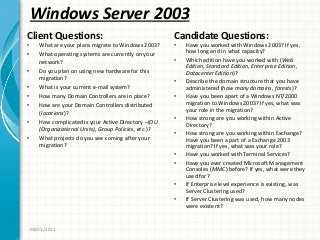
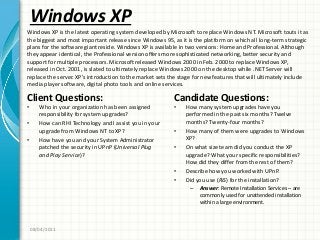
• What is IMA? Looking for: Independent Management Architecture. Windows service that controls Citrix
communications between servers. Main service in Citrix.
– If answered correctly ask: What did IMA replace? Replaced the ICA browser. Looking for: An engineer
with good experience will know this one. He/she has been around!
• What is the data collector? Looking for: Citrix server in charge of collecting live, dynamic data for the
farm.
• What info is in the Access/SQL datastore? Looking for: Mainly static info, like applications published,
users with permissions, etc. All dynamic info, like current user load, etc., is in the data collector.
• What is the local host cache? Looking for: Local copy of the Access/SQL db. Has the most pertinent
information.
• What is dsmaint? Looking for: Utility used to manage the database.
• How can you make changes to the db? Looking for: You can’t open the db, no matter it its SQL or Access.
Only way is to use Citrix management console.
7/27/2011
If you feel the candidate has done well with the questions so far, following are additional
technical questions:
Citrix
7/27/2011
If you feel the candidate has done well with the questions so far, following are additional
technical questions:
• What different ICA clients are there? Windows 32, ActiveX, MAC, Linux, DOS, Java.
• What is Citrix secure gateway? Looking for: A “proxy” like software that allows you to encrypt
connections to Citrix.
• What is altaddr? Looking for: Command you use to specify the alternate address of the Citrix server
If answered correctly ask: When do you use it? Looking for: When the servers are available over the
internet.
• What is the web interface? Looking for: The latest upgrade to NFuse, allowing you to connect to Citrix
applications over the internet.
• List some of the newest Citrix products: Looking for: Password Manager (single sign-on), Access
Gateway (VPN appliance).
• How do you control timeouts in Citrix? Looking for: Under the properties of the ICA listener in Citrix
Connection Configuration tool.
• What are Citrix policies? Looking for: Allow you to specify configuration options like for printers,
bandwidth management, etc.
• How can you filter them? Looking for: By server, user, group, client name, client IP.
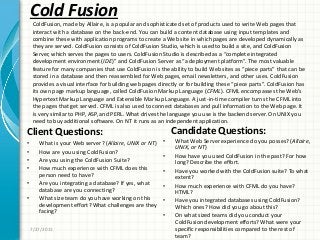
Cold Fusion
Client Questions:
• What is your Web server? (Allaire, UNIX or NT)
• How are you using ColdFusion?
• Are you using the ColdFusion Suite?
• How much experience with CFML does this
person need to have?
• Are you integrating a database? If yes, what
database are you connecting?
• What size team do you have working on this
development effort? What challenges are they
facing?
Candidate Questions:
• What Web Server experience do you posses? (Allaire,
UNIX, or NT)
• How have you used ColdFusion in the past? For how
long? Describe the effort.
• Have you worked with the ColdFusion suite? To what
extent?
• How much experience with CFML do you have?
HTML?
• Have you integrated databases using ColdFusion?
Which ones? How did you go about this?
• On what sized teams did you conduct your
ColdFusion development efforts? What were your
specific responsibilities compared to the rest of
team?
7/27/2011
ColdFusion, made by Allaire, is a popular and sophisticated set of products used to write Web pages that
interact with a database on the back-end. You can build a content database using input templates and
combine these with application programs to create a Web site in which pages are developed dynamically as
they are served. ColdFusion consists of ColdFusion Studio, which is used to build a site, and ColdFusion
Server, which serves the pages to users. ColdFusion Studio is described as a “complete integrated
development environment (IDE)” and ColdFusion Server as “a deployment platform”. The most valuable
feature for many companies that use ColdFusion is the ability to build Web sites as “piece parts” that can be
stored in a database and then reassembled for Web pages, email newsletters, and other uses. ColdFusion
provides a visual interface for building web pages directly or for building these “piece parts”. ColdFusion has
its own page markup language, called ColdFusion Markup Language (CFML). CFML encompasses the Web’s
Hypertext Markup Language and Extensible Markup Language. A just-in-time compiler turns the CFML into
the pages that get served. CFML is also used to connect databases and pull information to the Web page. It
is very similar to PHP, ASP, and PERL. What drives the language you use is the backend server. On UNIX you
need to buy additional software. On NT it runs as an independent application.
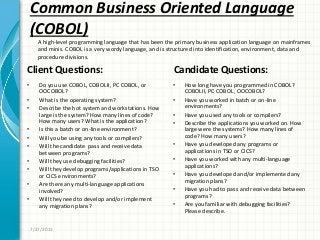
Common Business Oriented Language
(COBOL)
Client Questions:
• Do you use COBOL, COBOLII, PC COBOL, or
OOCOBOL?
• What is the operating system?
• Describe the hot system and workstations. How
large is the system? How many lines of code?
How many users? What is the application?
• Is this a batch or on-line environment?
• Will you be using any tools or compilers?
• Will the candidate pass and receive data
between programs?
• Will they use debugging facilities?
• Will they develop programs/applications in TSO
or CICS environments?
• Are there any multi-language applications
involved?
• Will they need to develop and/or implement
any migration plans?
Candidate Questions:
• How long have you programmed in COBOL?
COBOLII, PC COBOL, OOCOBOL?
• Have you worked in batch or on-line
environments?
• Have you used any tools or compilers?
• Describe the applications you worked on. How
large were the systems? How many lines of
code? How many users?
• Have you developed any programs or
applications in TSO or CICS?
• Have you worked with any multi-language
applications?
• Have you developed and/or implemented any
migration plans?
• Have you had to pass and receive data between
programs?
• Are you familiar with debugging facilities?
Please describe.
7/27/2011
A high-level programming language that has been the primary business application language on mainframes
and minis. COBOL is a very wordy language, and is structured into identification, environment, data and
procedure divisions.
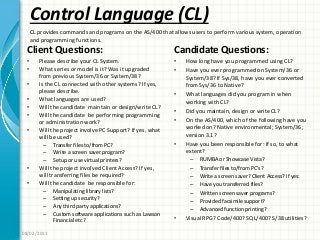
Control Language (CL)
Client Questions:
• Please describe your CL System.
• What series or model is it? Was it upgraded
from previous System/36 or System/38?
• Is the CL connected with other systems? If yes,
please describe.
• What languages are used?
• Will the candidate maintain or design/write CL?
• Will the candidate be performing programming
or administration work?
• Will the project involve PC Support? If yes, what
will be used?
– Transfer files to/from PC?
– Write a screen saver program?
– Setup or use virtual printers?
• Will the project involved Client Access? If yes,
will transferring files be required?
• Will the candidate be responsible for:
– Manipulating library lists?
– Setting up security?
– Any third party applications?
– Custom software applications such as Lawson
Financial etc?
Candidate Questions:
• How long have you programmed using CL?
• Have you ever programmed on System/36 or
System/38? If Sys/38, have you ever converted
from Sys/36 to Native?
• What languages did you program in when
working with CL?
• Did you maintain, design or write CL?
• On the AS/400, which of the following have you
worked on? Native environmental; System/36;
version 3.1?
• Have you been responsible for: If so, to what
extent?
– RUMBA or Showcase Vista?
– Transfer files to/from PC’s?
– Write a screen saver? Client Access? If yes:
– Have you transferred files?
– Written screen saver programs?
– Provided facsimile support?
– Advanced function printing?
• Visual RPG? Code/400? SQL/400? S/38 utilities?
08/02/2011
CL provides commands and programs on the AS/400 that allows users to perform various system, operation
and programming functions.
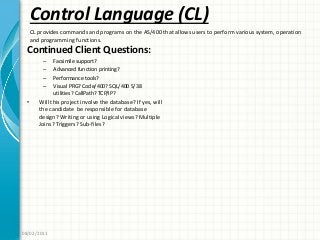
Control Language (CL)
Continued Client Questions:
– Facsimile support?
– Advanced function printing?
– Performance tools?
– Visual PRG? Code/400? SQL/400 S/38
utilities? CallPath? TCP/IP?
• Will this project involve the database? If yes, will
the candidate be responsible for database
design? Writing or using Logical views? Multiple
Joins? Triggers? Sub-files?
08/02/2011
CL provides commands and programs on the AS/400 that allows users to perform various system, operation
and programming functions.
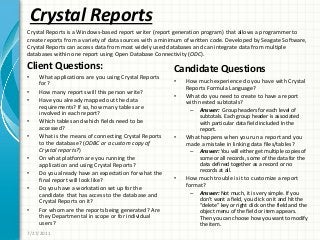
Crystal Reports
Client Questions:
• What applications are you using Crystal Reports
for?
• How many reports will this person write?
• Have you already mapped out the data
requirements? If so, how many tables are
involved in each report?
• Which tables and which fields need to be
accessed?
• What is the means of connecting Crystal Reports
to the database? (ODBC or a custom copy of
Crystal reports?)
• On what platform are you running the
application and using Crystal Reports?
• Do you already have an expectation for what the
final report will look like?
• Do you have a workstation set up for the
candidate that has access to the database and
Crystal Reports on it?
• For whom are the reports being generated? Are
they Departmental in scope or for individual
users?
Candidate Questions
• How much experience do you have with Crystal
Reports Formula Language?
• What do you need to create to have a report
with nested subtotals?
– Answer: Group headers for each level of
subtotals. Each group header is associated
with particular data field included In the
report.
• What happens when you run a report and you
made a mistake in linking data files/tables?
– Answer: You will either get multiple copies of
some or all records, some of the data for the
data defined together as a record or no
records at all.
• How much trouble is it to customize a report
format?
– Answer: Not much, it is very simple. If you
don’t want a field, you click on it and hit the
“delete” key or right click on the field and the
object menu of the field or item appears.
Then you can choose how you want to modify
the item.
7/27/2011
Crystal Reports is a Windows-based report writer (report generation program) that allows a programmer to
create reports from a variety of data sources with a minimum of written code. Developed by Seagate Software,
Crystal Reports can access data from most widely used databases and can integrate data from multiple
databases within one report using Open Database Connectivity (ODC).
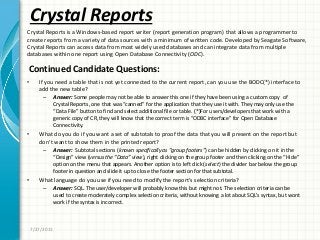
Crystal Reports
• If you need a table that is not yet connected to the current report, can you use the BODC(*) interface to
add the new table?
– Answer: Some people may not be able to answer this one if they have been using a custom copy of
Crystal Reports, one that was “canned” for the application that they use it with. They may only use the
“Data File” button to find and select additional file or table. (*)For users/developers that work with a
generic copy of CR, they will know that the correct term is “ODBC interface” for Open Database
Connectivity.
• What do you do if you want a set of subtotals to proof the data that you will present on the report but
don’t want to show them in the printed report?
– Answer: Subtotal sections (known specifically as “group footers”) can be hidden by clicking on it in the
“Design” view (versus the “Data” view), right clicking on the group footer and then clicking on the “Hide”
option on the menu that appears. Another option is to left click (select) the divider bar below the group
footer in question and slide it up to close the footer section for that subtotal.
• What language do you use if you need to modify the report’s selection criteria?
– Answer: SQL. The user/developer will probably know this but might not. The selection criteria can be
used to create moderately complex selection criteria, without knowing a lot about SQL’s syntax, but wont
work if the syntax is incorrect.
Continued Candidate Questions:
7/27/2011
Crystal Reports is a Windows-based report writer (report generation program) that allows a programmer to
create reports from a variety of data sources with a minimum of written code. Developed by Seagate Software,
Crystal Reports can access data from most widely used databases and can integrate data from multiple
databases within one report using Open Database Connectivity (ODC).
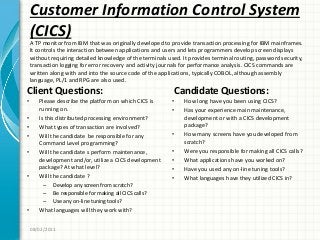
Customer Information Control System
(CICS)
Client Questions:
• Please describe the platform on which CICS is
running on.
• Is this distributed processing environment?
• What types of transaction are involved?
• Will the candidate be responsible for any
Command Level programming?
• Will the candidate s perform maintenance,
development and/or, utilize a CICS development
package? At what level?
• Will the candidate ?
– Develop any screen from scratch?
– Be responsible for making all CICS calls?
– Use any on-line tuning tools?
• What languages will they work with?
Candidate Questions:
• How long have you been using CICS?
• Has your experience main maintenance,
development or with a CICS development
package?
• How many screens have you developed from
scratch?
• Were you responsible for making all CICS calls?
• What applications have you worked on?
• Have you used any on-line tuning tools?
• What languages have they utilized CICS in?
08/02/2011
A TP monitor from IBM that was originally developed to provide transaction processing for IBM mainframes.
It controls the interaction between applications and users and lets programmers develop screen displays
without requiring detailed knowledge of the terminals used. It provides terminal routing, password security,
transaction logging for error recovery and activity journals for performance analysis. CICS commands are
written along with and into the source code of the applications, typically COBOL, although assembly
language, PL/1 and RPG are also used.
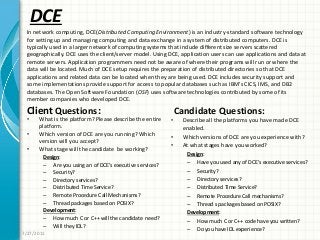
DCE
Client Questions:
• What is the platform? Please describe the entire
platform.
• Which version of DCE are you running? Which
version will you accept?
• What stage will the candidate be working?
Design:
– Are you using an of DCE’s executive services?
– Security?
– Directory services?
– Distributed Time Service?
– Remote Procedure Call Mechanisms?
– Thread packages based on POSIX?
Development:
– How much C or C++ will the candidate need?
– Will they IDL?
Candidate Questions:
• Describe all the platforms you have made DCE
enabled.
• Which versions of DCE are you experience with?
• At what stages have you worked?
Design:
– Have you used any of DCE’s executive services?
– Security?
– Directory services?
– Distributed Time Service?
– Remote Procedure Call mechanisms?
– Thread s packages based on POSIX?
Development:
– How much C or C++ code have you written?
– Do you have IDL experience?
7/27/2011
In network computing, DCE(Distributed Computing Environment) is an industry-standard software technology
for setting up and managing computing and data exchange in a system of distributed computers. DCE is
typically used in a larger network of computing systems that include different size servers scattered
geographically. DCE uses the client/server model. Using DCE, application users can use applications and data at
remote servers. Application programmers need not be aware of where their programs will run or where the
data will be located. Much of DCE setup requires the preparation of distributed directories so that DCE
applications and related data can be located when they are being used. DCE includes security support and
some implementations provide support for access to popular databases such as IBM’s CICS, IMS, and DB2
databases. The Open Software Foundation (OSF) uses software technologies contributed by some of its
member companies who developed DCE.
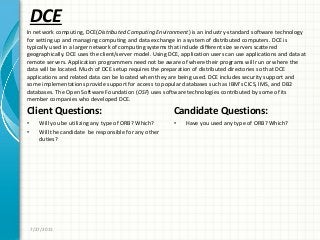
DCE
Client Questions:
• Will you be utilizing any type of ORB? Which?
• Will the candidate be responsible for any other
duties?
Candidate Questions:
• Have you used any type of ORB? Which?
7/27/2011
In network computing, DCE(Distributed Computing Environment) is an industry-standard software technology
for setting up and managing computing and data exchange in a system of distributed computers. DCE is
typically used in a larger network of computing systems that include different size servers scattered
geographically. DCE uses the client/server model. Using DCE, application users can use applications and data at
remote servers. Application programmers need not be aware of where their programs will run or where the
data will be located. Much of DCE setup requires the preparation of distributed directories so that DCE
applications and related data can be located when they are being used. DCE includes security support and
some implementations provide support for access to popular databases such as IBM’s CICS, IMS, and DB2
databases. The Open Software Foundation (OSF) uses software technologies contributed by some of its
member companies who developed DCE.
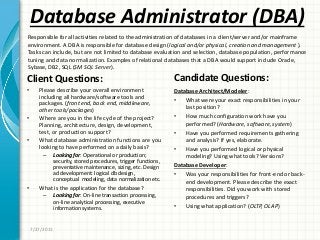
Database Administrator (DBA)
Client Questions:
• Please describe your overall environment
including all hardware/software tools and
packages. (front end, back end, middleware,
other tools/packages)
• Where are you in the life cycle of the project?
Planning, architecture, design, development,
test, or production support?
• What database administration functions are you
looking to have performed on a daily basis?
– Looking for: Operational or production;
security, stored procedures, trigger functions,
preventative maintenance, sizing, etc. Design
ad development: logical db design,
conceptual modeling, data normalization etc.
• What is the application for the database?
– Looking for: On-line transaction processing,
on-line analytical processing, executive
information systems.
Candidate Questions:
Database Architect/Modeler:
• What were your exact responsibilities in your
last position?
• How much configuration work have you
performed? (Hardware, software, system)
• Have you performed requirements gathering
and analysis? If yes, elaborate.
• Have you performed logical or physical
modeling? Using what tools? Versions?
Database Developer:
• Was your responsibilities for front-end or back-
end development. Please describe the exact
responsibilities. Did you work with stored
procedures and triggers?
• Using what application? (OLTP, OLAP)
7/27/2011
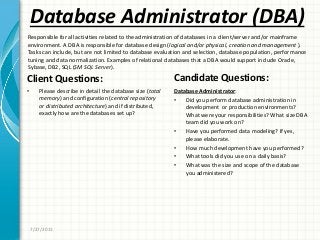
Responsible for all activities related to the administration of databases in a client/server and/or mainframe
environment. A DBA is responsible for database design (logical and/or physical, creation and management ).
Tasks can include, but are not limited to database evaluation and selection, database population, performance
tuning and data normalization. Examples of relational databases that a DBA would support include Oracle,
Sybase, DB2, SQL (SM SQL Server).
Database Administrator (DBA)
Client Questions:
• Please describe in detail the database size (total
memory) and configuration (central repository
or distributed architecture) and if distributed,
exactly how are the databases set up?
Candidate Questions:
Database Administrator:
• Did you perform database administration in
development or production environments?
What were your responsibilities? What size DBA
team did you work on?
• Have you performed data modeling? If yes,
please elaborate.
• How much development have you performed?
• What tools did you use on a daily basis?
• What was the size and scope of the database
you administered?
7/27/2011
Responsible for all activities related to the administration of databases in a client/server and/or mainframe
environment. A DBA is responsible for database design (logical and/or physical, creation and management ).
Tasks can include, but are not limited to database evaluation and selection, database population, performance
tuning and data normalization. Examples of relational databases that a DBA would support include Oracle,
Sybase, DB2, SQL (SM SQL Server).
Data Warehouse
Client Questions:
• What is the application for the warehouse
that you are working on? (OLAP, EIS, DSS)
• What is the entire architecture that you are
working in? Front-end hardware and
software, middleware hardware and software
and hack-end hardware and software and
versions?
• Where in the system development life cycle
are you working? Requirements Analysis,
Architecture/Design, Development,
Maintenance?
• How much data is in the warehouse? How
many gigabytes, tables, rows, columns?
• How is the back-end configured?
• What data modeling tools are you using?
Candidate Questions:
• What applications(s) for warehousing have you
worked on? OLAP, EIS, DSS?
• What was the entire architecture? Front-end
hardware and software, middleware hardware
and software and hack-end hardware and
software and versions?
• Where in the system development life cycle have
you worked? Requirements analysis,
Architecture/Design, Development, Maintenance?
• How much data was in the warehouse? How many
gigabytes, tables, rows, columns?
• How is the backend configured?
– Answer could include: Central repository or
distributed architecture.
7/28/2011
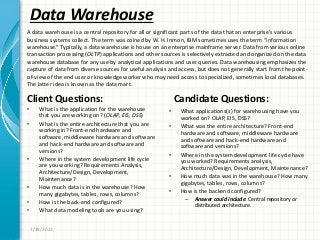
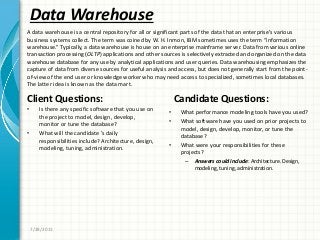
A data warehouse is a central repository for all or significant parts of the data that an enterprise’s various
business systems collect. The term was coined by W. H. Inmon, IBM sometimes uses the term “information
warehouse.” Typically, a data warehouse is house on an enterprise mainframe server. Data from various online
transaction processing (OLTP) applications and other sources is selectively extracted and organized on the data
warehouse database for any use by analytical applications and user queries. Data warehousing emphasizes the
capture of data from diverse sources for useful analysis and access, but does not generally start from the point-
of-view of the end user or knowledge worker who may need access to specialized, sometimes local databases.
The latter idea is known as the data mart.
Data Warehouse
Client Questions:
• Is there any specific software that you use on
the project to model, design, develop,
monitor or tune the database?
• What will the candidate ’s daily
responsibilities include? Architecture, design,
modeling, tuning, administration.
Candidate Questions:
• What performance modeling tools have you used?
• What software have you used on prior projects to
model, design, develop, monitor, or tune the
database?
• What were your responsibilities for these
projects?
– Answers could include: Architecture. Design,
modeling, tuning, administration.
7/28/2011
A data warehouse is a central repository for all or significant parts of the data that an enterprise’s various
business systems collect. The term was coined by W. H. Inmon, IBM sometimes uses the term “information
warehouse.” Typically, a data warehouse is house on an enterprise mainframe server. Data from various online
transaction processing (OLTP) applications and other sources is selectively extracted and organized on the data
warehouse database for any use by analytical applications and user queries. Data warehousing emphasizes the
capture of data from diverse sources for useful analysis and access, but does not generally start from the point-
of-view of the end user or knowledge worker who may need access to specialized, sometimes local databases.
The latter idea is known as the data mart.
DECnet
Client Questions:
• How much overall DECnet experience does the
candidate need to have?
• What version of DECnet are you using?
• Are you using any DOS machines? If so, does the
candidate need DECnet/DOS experience?
• Are you using TCP/IP? If so, does the candidate
need to have experience with DECnet/OSI?
Candidate Questions:
• How much overall experience with DECnet do
you have?
• What versions(s) of DECnet have you worked
with?
• Have you worked with DECnet/DOS?
• Have you worked with TCP/IP or DECnet/OSI?
7/26/2011
DECnet supports Ethernet-style LANs, baseband and broadband WANs over private and public lines. It
interconnects PDPs, VAXs, PC, Macs and workstations. In DECnet philosophy, a node must be an intelligent
machine and not simply a terminal as in other systems.
Delphi
Client Questions:
• What are your development platforms?
• Where in the life cycle of the project are you at
present?
• What is the application?
• How much experience will you expect the
candidate to have developing with Delphi?
• What versions of Delphi are you using for your
development efforts?
• Do you need the candidate to work with Pascal,
Object Pascal or Turbo Pascal?
• What types of databases does your company
work with?
• Do you need a candidate to make DLL or API
calls?
• What is your preference connecting to the back
end? Do you use the BDE engine or SQL links?
• Do you need the candidate to e familiar with
the OO concepts regarding encapsulation,
inheritance, and polymorphism?
• Will there be any development with VCL
components?
• What other third party controls do you want the
candidate to be familiar with?
Candidate Questions:
• What are the platforms you have developed
using Delphi?
• Which portions of the project life cycle were you
responsible for?
• How much experience have you had developing
Delphi?
• What versions of Delphi have you used?
• Have you worked with Pascal, Object Pascal or
Turbo Pascal?
• What types of databases have you worked with?
• Have you made DLL or API calls?
• What is your preference connecting to the back
end? Do you use the BDE engine or SQL links?
• Have you reused your objects?
• Are you familiar with the OO concepts regarding
encapsulation, inheritance, and polymorphism?
• Have you developed using VCL components?
• What other third party controls have you gained
expertise in?
7/28/2011
A GUI tool developed by Borland International based on Pascal. Delphi is fully compiled, making it faster than
VB and PB, which is interpreted. Delphi is also fully object-oriented, providing the opportunity for code
reusability.
Distributed Component Object Model
(DCOM)
Client Questions:
• What platform are you using? Windows 95/98,
NT 4, or windows 2000 (in Windows 2000 they
call COM/DCOM: COM+)?
• What type of security do you use? (There are a
lot of settings here about security and enabling
DCOM)
Candidate Questions:
• On which platform do you have DCOM
experience?
• What were your greater challenges with DCOM?
• Have you worked with COM+ for Windows
2000?
• Have you been involved in DCOM security
issues? To what extent? Describe them.
7/27/2011
DCOM (Distributed Component Object Model) is a set of Microsoft concepts and program interfaces in
which client program objects can request services from server program objects on other computers in a
network. DCOM is based on the Component Object Model, which provides a set of interfaces allowing
clients and servers to communicate within the same computer (that is running Windows 95 or a later
version). For example, pages can be created for a Web site that contain a script or program that can be
processed (before being sent to a requesting user) not on the Web site server but on another, more
specialized server in the network. Using COM interfaces, the Web server site program (now acting as a
client object) can forward a Remote Procedure Call (RPC) to the specialized server object, which provides
the necessary processing and returns the result to the web server site. It then passes the result on to the
Web page viewer. Before DCOM, which is a 32 bits wire protocol, was RPC (remote procedure call). This
term (RPC) and technology is still in use. DCOM can also work on a network within an enterprise or on
other networks besides the public Internet. It uses TCP/IP and Hypertext Transfer Protocol. DCOM comes as
part of NT 4.0 and is a free upgrade for windows 95. DCOM replaces OLE Remote Automation.
Distributed Component Object Model
(DCOM)
Client Questions:
• AS very important issue with DCOM is security.
(Usually it’s done using NT security to identify
who’s who, if they have access or not, and in
which Group/Role the user resides.) Who is
responsible for security in your department?
Are you looking to this candidate to provide
security expertise?
• Tell me about your firewall as it relates to
DCOM. Are you using RDS? XML?
Candidate Questions:
• Have you worked with Firewalls as they relate to
DCOM? To what extent?
• Have you used RDS? To what extent? Used XML?
Please describe.
7/27/2011
DCOM (Distributed Component Object Model) is a set of Microsoft concepts and program interfaces in
which client program objects can request services from server program objects on other computers in a
network. DCOM is based on the Component Object Model, which provides a set of interfaces allowing
clients and servers to communicate within the same computer (that is running Windows 95 or a later
version). For example, pages can be created for a Web site that contain a script or program that can be
processed (before being sent to a requesting user) not on the Web site server but on another, more
specialized server in the network. Using COM interfaces, the Web server site program (now acting as a
client object) can forward a Remote Procedure Call (RPC) to the specialized server object, which provides
the necessary processing and returns the result to the web server site. It then passes the result on to the
Web page viewer. Before DCOM, which is a 32 bits wire protocol, was RPC (remote procedure call). This
term (RPC) and technology is still in use. DCOM can also work on a network within an enterprise or on
other networks besides the public Internet. It uses TCP/IP and Hypertext Transfer Protocol. DCOM comes as
part of NT 4.0 and is a free upgrade for windows 95. DCOM replaces OLE Remote Automation.
Dynamic HTML (DHTML)
Client Questions:
• What types of DHTML do you use? For what
application? What do you need the site to do?
• Who is your target audience for the web page?
(Internet, Intranet or Extranet)
• What other software are you using in the design
of the page?
Candidate Questions:
• What types of DHTML are you using or have you
used?
• What tools have you used or are you using to
create/edit? (Dreamweaver, Homesite, etc.)
• In what do you feel you are most proficient?
(Design, coding, or both)
7/28/2011
Dynamic HTML is a collective term for a combination of new Hypertext Markup Language (HTML) tags and
options, that will let you create Web pages more animated and more responsive to user interaction than
previous versions of HTML. Much of the dynamic HTML is specified in HTML 4.0. Simple examples of dynamic
HTML pages would include (1) having the color of a text heading change when a user passes a mouse over it;
or (2) allowing a user to “drag and drop” an image to another place on a Web page. Dynamic HTML can allow
Web documents to look and act like desktop applications or multimedia productions. The features that
constitute dynamic HTML are included in Netscape Communications’ Navigator 4.0 (part of Netscape’s
Communicator suite) and above, by Microsoft’s browser, Internet Explorer 4.0 and above. While HTML 4.0 is
supported by both Netscape and Microsoft browsers, some additional capabilities are supported by only one
of the browsers, a Web site must create two versions of each site and serve the pages appropriate to each
user’s browser version.
The Concepts and Features in Dynamis HTML
• An object-oriented view of a Web page and its elements
• Cascading style sheets and the layering of content
• Programming that can address all or most page elements
• Dynamic fonts (moving words and things of similar nature)
Dynamic HTML (DHTML)
Client Questions:
• What tools are you using to create/edit?
(Dreamweaver, Homesite, etc.)
• What software are you using for the
development phase of the project?
• What size team is currently involved in the
effort? What challenges do they face?
• What expectations do you have of the candidate
? (Design, coding, mentoring?)
Candidate Questions:
• Have you developed Internet, Intranet, and/or
Extranet applications? Please describe your
experience.
• What software have you used in your Web page
design? How about in your development efforts?
• What size team have you worked on it these efforts?
What were your specific responsibilities compared to
the rest of the team?
• What challenges did you face and/or overcome in
these designs and/or implementation efforts?
7/28/2011
Dynamic HTML is a collective term for a combination of new Hypertext Markup Language (HTML) tags and
options, that will let you create Web pages more animated and more responsive to user interaction than
previous versions of HTML. Much of the dynamic HTML is specified in HTML 4.0. Simple examples of dynamic
HTML pages would include (1) having the color of a text heading change when a user passes a mouse over it;
or (2) allowing a user to “drag and drop” an image to another place on a Web page. Dynamic HTML can allow
Web documents to look and act like desktop applications or multimedia productions. The features that
constitute dynamic HTML are included in Netscape Communications’ Navigator 4.0 (part of Netscape’s
Communicator suite) and above, by Microsoft’s browser, Internet Explorer 4.0 and above. While HTML 4.0 is
supported by both Netscape and Microsoft browsers, some additional capabilities are supported by only one
of the browsers, a Web site must create two versions of each site and serve the pages appropriate to each
user’s browser version.
The Concepts and Features in Dynamis HTML
• An object-oriented view of a Web page and its elements
• Cascading style sheets and the layering of content
• Programming that can address all or most page elements
• Dynamic fonts (moving words and things of similar nature)
Embedded Systems Programming
Client Questions:
• How much experience do you want the
candidate to have?
• Which micro-controllers/microprocessors will
the candidate be working with?
• If Motorola – which series?
– Are there Microprocessors that are
compatible for this job?
– Will they be using CMOS? Low power?
– Will the candidate be working with RISC processors?
• If Intel, which series?
• What language(s) will the candidate be
programming in?
• What operating system will the candidate be
working with?
• Does the candidate need any network or
communications background? If so, what and
why?
• Will the candidate need device driver
experience? In what capacity?
• Will the candidate be using any suite of tools? If
yes, which ones?
• Will there be any work at the application level?
If yes, please detail.
Candidate Questions:
• How long have you worked with embedded
systems?
• What languages do you program in?
• Have you work with microprocessors or micro-
controllers?
• Which ones?
• What language(s) do you program in on the
microprocessor?
• Have you written about device drivers? If yes,
which ones? How many drivers have your
written?
• Do you have a network or data communications
background? If so, what protocols?
• What multitasking operating systems have you
worked with?
• Have you worked with any Suite of tools? (object
time, etc.)
• Have you performed any work at application
level? Have you worked with any other
operating systems?
7/28/2011
Embedded systems programming is the development of programs intended to be part of a larger operating
system or, in a somewhat different usage, to be incorporated on a microprocessor that can then be included
as part of a variety of hardware devices.
Enterprise JavaBeans
Client Questions:
• Do you need Web applications or Client
applications built? (Web or Client server)
• What application server are you using?
• Do you need to use JSP/Servlets?
• Are you using CORBA/RMI?
• Is the candidate going to be designing buttons
or similar features?
• Will the candidate need to program in any
other Java related packages?
Candidate Questions:
• Have you built Web Applications or Client
Applications? (Web or client server)
• What application server have you used?
• Have you used JSP/Servlets?
• Have you used CORBA/RMI?
• Have you designed buttons or similar features?
Using what?
• Have you programmed in any other Java related
packages? Which ones and to what extent?
7/28/2011
Enterprise JavaBeans (EJB) is an architecture for setting up program components, written in the Java
programming language, that run in the server parts of a computer network that uses the client/server model.
Enterprise JavaBeans is built on the JavaBeans technology for distributing program components (which are
call Bean, using the coffee metaphor) to client in a network. Enterprise JavaBeans offers enterprise’s the
advantage of being able to control change at the server level rather than having to update each individual
computer with a client whenever a new program component is changed or added. EJB components have the
advantage of being reusable in multiple applications. To deploy an EJB Bean or component, it must be part of
a specific application, which is called a container. Remember that EJB offers many different components.
Enterprise Resource Planning (ERP)
Client Questions:
• What ERP are you using or getting ready to
implement?
• Where are you in the life cycle of the project?
Are you looking for Architects and Project
Managers or staff augmentation at the
implementation level?
• On what platform are you implementing your
ERP? Is your ERP system designed to work with
different RDBMS’s (Relational Database
Management Systems) such as Oracle, Sybase,
or Informix?
• In which ERP modules will the candidate to
required to have experience?
• How many people do you have currently
assigned to this effort? What challenges are
they currently facing?
Candidate Questions:
• What ERPs have you worked with? What have
been your specific responsibilities on these
projects?
• On what sized teams have you participated?
What were your specific responsibilities?
• On what platforms and RDBMS did you use in
these ERP implementation efforts?
• What ERP modules did you have specific
responsibility for? What were your assigned
tasks?
7/28/2011
ERP (Enterprise Resource Planning) is an industry term for the broad set of activities supported by multi-
module application software that helps a manufacturer or other business manage the important parts of its
business. These include product planning, parts purchasing, maintaining inventories, interacting with
suppliers, providing customer service, and tracking orders. ERP can also include application modules for the
finance and human resources aspects of a business. Typically, an ERP system uses or is integrated with a
relational database system. The deployment of an ERP system can involve considerable business process
analysis, employee retraining, and new work procedures. SAP, PeopleSoft, Oracle, J.D. Edwards, and BAAN are
among ERP product providers offering ERP outsourcing.
Enterprise Resource Planning (ERP)
Client Questions:
Database and Network
• How will the data warehousing aspects be
addressed? Will your employees be handling
this, or is an outside expert going to lead this
portion on of the project?
• What is the maximum time it takes to upload
the remote data?
• Does the software support a parallel processing
option?
• How many security layers have been
incorporated into the software?
• What kind of networking protocols does the
software support?
Candidate Questions:
Database and Network
• Have you been involved in addressing data
warehousing requirements? Please explain.
• What kind of networking protocols have you
used?
7/28/2011
ERP (Enterprise Resource Planning) is an industry term for the broad set of activities supported by multi-
module application software that helps a manufacturer or other business manage the important parts of its
business. These include product planning, parts purchasing, maintaining inventories, interacting with
suppliers, providing customer service, and tracking orders. ERP can also include application modules for the
finance and human resources aspects of a business. Typically, an ERP system uses or is integrated with a
relational database system. The deployment of an ERP system can involve considerable business process
analysis, employee retraining, and new work procedures. SAP, PeopleSoft, Oracle, J.D. Edwards, and BAAN are
among ERP product providers offering ERP outsourcing.
Ethernet
Client Questions:
• Does your company currently use Ethernet?
• How large is the network that it is based on?
• Are you looking to interface with OSI layers?
• Have you ever had any limitation issues that
would make you consider the use of Token Ring
or FDDI?
Candidate Questions:
• In what capacity have you used Ethernet?
• How large were the networks that you worked
on?
• Have you interfaced with OSI layers?
• Have you had to use Token Ring or FDDI because
of Ethernet’s limits?
7/29/2011
Ethernet is the most widely-installed local area network (LAN) technology. Specified in a standard, IEEE
802.3, Ethernet was originally developed by Xerox and then developed further by Xerox, DEC, and Intel. An
Ethernet LAN typically uses coaxial cable or special grades of twisted pair wires. The most commonly
installed Ethernet systems are called 10BASE-T and provide transmission speeds up to 10 Mbps. Devices are
connected to the cable and compete for access using a Carrier Sense Multiple Access with Collision Detection
(CSMA/CD) protocol. Fast Ethernet or 100BASE-T provides transmission speeds up to megabits per second
and is typically used for LAN backbone systems, supporting workstations with 10BASE-T cards. Gigabit
Ethernet provides an even higher level of backbone support at 1000 megabits per second (1 gigabit or 1
billion bits per second).
Extensible Markup Language (XML)
Client Questions:
• What level of architecture and development
would this person be required to perform?
• What type of unit and systems testing do you
require on your applications?
• Do you need this person to resolve all
bugs/issues reported from UAT?
• In which other enterprise applications foes this
individual need to be strong? (Java, C++, ASP
and XML/XSL, VBScript, Weblogic, etc.)
• Do you need any prototype development
accomplished?
Candidate Questions:
• What level of architecture and development
have you performed?
• Did you perform unit and systems testing of
applications? If yes what type?
• Were you involved in any resolution of
bugs/issues during UAT?
• What other enterprise applications are you
experienced in?
• What experience with creating prototypes do
you have?
08/04/2011
XML (Extensible Markup Language) is a flexible way to create common information formats and share both
the format and data on the World Wide Web, intranets, and elsewhere. For example, computer makers might
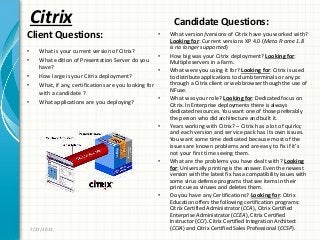
agree on a standard common way to describe the information about a computer product (processor speed ,
memory size, and so forth) and then describe the product information format with XML. Such a standard way
of describing data would enable a user to send an intelligent agent (a program) to each computer maker’s
Web site, gather data, and then make a valid comparison. Any individual or group of individuals or companies
that wants to share information in a consistent way can use XML. XML is “extensible” because, unlike HTML,
the markup symbols are unlimited and self-defining. XML is actually a simpler and easier-to-use subset of the
Standard Generalized Markup Language (SGML), the standard for how to create a document structure. It is
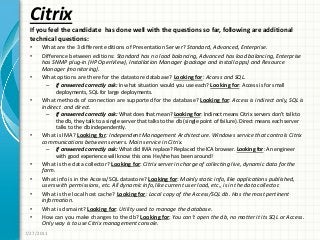
expected that HTML and XML will be used together in many Web applications. XML markup, for example, may
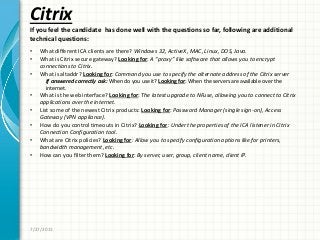
appear within an HTML page.
Firewall
Client Questions:
• Describe the Firewalls used in your organization.
• Do you use a standard application? If yes, which
one?
• Would the candidate need to use three-way
TCP/IP connection handshake?
• Will the candidate need to configure a firewall
that protects the network from SYN/DOS (Denial
Service) Flood attacks?
• Do you have ‘DMZ’ within your firewall/security
structure?
Candidate Questions:
• How long have you work with Firewall system
techniques?
• What applications have you used in your Firewall
development?
• Have you used a three-way TCP/IP connection
handshake? In what way?
• Have you dealt with SN Flood attack? In what
way?
– Answer: Generally, the client sends multiple
SYN packets to a server with spoofed IP
addresses.
7/29/2011
A system designed to prevent unauthorized access to or from a private network. Firewalls can be implemented
in both hardware and software, or a combination of both. Firewalls are frequently used to prevent
unauthorized Internet users from accessing private networks connected to the Internet, especially intranets. All
messages entering or leaving the intranet pass through the firewall, which examines each message and blocks
those that do not meet the specified security criteria.
Several types of firewall techniques:
 Packet filter – Looks at each packet entering or leaving the network and accepts or rejects it based on user-
defined rules.
 Application gateway – Applies security mechanisms to specific mechanisms to specific applications.
 Circuit-level gateway – Applies security mechanisms when a TCP or UDP connection is established.
 Proxy server – Intercepts all messages entering and leaving the network.
Firewall
Continued Candidate Questions:
7/29/2011
A system designed to prevent unauthorized access to or from a private network. Firewalls can be implemented
in both hardware and software, or a combination of both. Firewalls are frequently used to prevent
unauthorized Internet users from accessing private networks connected to the Internet, especially intranets. All
messages entering or leaving the intranet pass through the firewall, which examines each message and blocks
those that do not meet the specified security criteria.
Several types of firewall techniques:
 Packet filter – Looks at each packet entering or leaving the network and accepts or rejects it based on user-
defined rules.
 Application gateway – Applies security mechanisms to specific mechanisms to specific applications.
 Circuit-level gateway – Applies security mechanisms when a TCP or UDP connection is established.
 Proxy server – Intercepts all messages entering and leaving the network.
• Have you configured a firewall that will protect a network from SYN Flood attacks? If yes, please
elaborate. Answer – They should be using checkpoint configure SYN defender, etc.
• Describe a normal TCP/IP connection termination. Answer – Should be client – FIN, server – ACK of FIN.
Server – FIN, client – ACK of FIN.
• What should the last rule in the firewall be and how should it be configured? Answer – The last rule is
the clean-up rule and should reject/drop all traffic.
• What is a tunnel? Answer – A type of encryption that make the connection from one point to the other
point secure. A tunnel is called virtual because it cannot be accessed from the rest of the Internet based
connection.
• What is IPSec? Answer – A standards-based Protocol that provides privacy, integrity, and authenticity to data
that is transferred across a network.
• What are seven layers of the OSI model? Answer – Layer 1: Physical, Layer 2: Data Link, Layer 3: Network,
Layer 4: Transport, Layer 5: Session, Layer 6: Presentation, Layer 7: Application.
FoxPro
Client Questions:
• On what platform will the project be developed
(Windows, UNIX)
• Where in the life cycle are you? Database
design, development. Any database modeling? If
so, is it logical or physical?
• What version of FoxPro are you using?
• What is the application? Please describe the
size.
• What language(s) are necessary for the
candidate to know?
• Are they any more details or aspects of the ask
that I should be aware of in order to better
qualify a candidate for you?
Candidate Questions:
• What platform have you worked on? If
Windows, what version?
• Where in the life cycle have you worked?
(Database design, development)
• Have you performed any database modeling? If
so, is it logical or physical?
• What version of FoxPro have you used?
• Describe the application you worked on. What
size? Columns, tables, rows?
• Did you create Tables? Macros?
• What language(s) have you worked with?
7/29/2011
A dBase IV compatible DBMS (database management system) from Microsoft for PC’s. An enhanced version of
FoxBase, FoxPro includes windowing, SQL and QBC interfaces and ‘rushmore’ technology for fast queries on
large databases. The first Windows version was released in 1993, with a UNIX version following in 1994. In
1996, FoxPro was introduced on the PowerMac. Most recently, Visual FoxPro was developed, adding object
orientation and client/server support.
Frame Relay
Clients Questions:
• How large is the network you are using?
• How many users are on the network?
• How many nodes are on the network?
• What is the company’s experience with WAN’s?
• Does the candidate need knowledge of
communications products? If yes, which ones?
• Should the candidate have knowledge of the
Frame Relay packet format?
• What experience does the candidate need with
relationships between Frame Relay and ATM or
ISDN?
• Will they be responsible for working with
application directed products where they have to
consider voice, data, or video?
• What kind of performance ratings should the
candidate be receiving from outside vendors?
Which ones?
Candidate Questions:
• What is the largest network you have worked
on?
• How many users were on the network?
• How many nodes were on the network?
• What is your experience with WAN’s?
• Do you have knowledge of communications
products? If yes, which ones?
• Do you have knowledge of the Frame Relay
packet format?
• What experience do you have with relationships
between Frame Relay and ATM and ISDN?
• Have you worked with application directed
products where voice, data, or video interfaces
had to be considered?
• What kind of performance ratings have you
received from outside vendors? Which ones?
7/29/2011
Frame Relay is a high speed packed switching protocol used for wide area networks. It is often to connect local
area networks with major backbones, public wide area networks and in private network environments with
leased lines over T-1 lines. It requires a dedicated connection during the transmission period. It’s not ideally
suited for voice or video transmission, which requires a steady flow of transmissions. However, under certain
circumstances, it is used for voice and video transmission. Frame Relay packets at the data link layer of the
Open Systems Interconnection (OSI) model rather than at the Network layer. A frame can incorporate packets
from different protocols such as Ethernet and X.25. It is variable in size and can be as large as a thousand
bytes or more.
Help Desk
Client Questions:
• What Help Desk application are you currently
utilizing?
• What OS will need to be supported?
• What hardware and architecture do you need
supported?
• How many users will be supported?
• What level Help Desk staff are you looking to
bring aboard?
– LEVEL 1 = tracking and minor fixes, i.e. users
cant get Windows to open.
– LEVEL 2 = mid-level technical knowledge of
several products.
– LEVEL 3 = in-depth knowledge of many
products.
– LEVEL 4 = superior knowledge of multiple
products.
• Is this an internal or external Help Desk? (Does
the company support outside sales of software?)
Candidate Questions:
• What Help Desk application have you used the
most?
• What OS have you supported?
• What hardware and architecture have you
supported?
• Have you supported a Network environment?
Which one(s)?
• How many users have you spotted?
• What level Help Desk have you worked? 1, 2, 3
or 4?
• Was your Help Desk support for internal or
external users?
• What information gathering processes have you
used? (Email, phone, tracking systems etc.)
• Average number of issues supported on a daily
basis?
08/02/2011
The Help Desk is a source of technical support for hardware and software issues. Help Desk staff are charged
with tracking technical issues and either resolving them directly or escalating the problem to a more senior
level Help Desk staff member for resolution. There are many help desk application solutions. Clients may
knowledge of a specific application r a host of them. Use the following questions to determine which
solution(s) the client is using and which the candidate is/are familiar with?
Help Desk
Client Questions:
• What information gathering processes do you
use? (Email, phone, tracking systems etc.)
• What are the average number of issues
supported on a daily basis?
• Where is the highest volume? (What is being
called on the most?)
• What application(s), proprietary software,
and/or hardware are most critical from a
support perspective?
Candidate Questions:
• Highest volume of contact was for? (What was
being supported the most)
• What was your main focus of support?
(Application(s), proprietary software, hardware)
08/02/2011
The Help Desk is a source of technical support for hardware and software issues. Help Desk staff are charged
with tracking technical issues and either resolving them directly or escalating the problem to a more senior
level Help Desk staff member for resolution. There are many help desk application solutions. Clients may
knowledge of a specific application r a host of them. Use the following questions to determine which
solution(s) the client is using and which the candidate is/are familiar with?
Hubs
Client Questions:
• What is the size of your network? (How many
user stations?)
• What kind of Hubs are you using? What brands?
• What type of Hubs are you using? (Intel hub,
modular hub, passive hub, etc.)
Candidate Questions:
• Have you ever done remote support of routers,
such as troubleshooting and solving router
failures?
• Have you set up, installed and configured
routers? If yes, what type?
• What series CISCO routers have you worked
with?
• Have you every worked with router commands?
If yes, which ones?
• Have you ever tested routers? Using what?
• Have you ever worked with ENABLE? DLCI? CIR?
• Have you performed pinging and telenetting on
routers?
• Have you troubleshot circuitry and tested
circuits to spot router failure?
• Have you followed the life cycle of trouble
ticket?
8/02/2011
The hub is the point of the network where a collection of circuits are connected. It can also be called a
switching node. In describing network, topologies, a hub topology consists of a backbone (main circuit) to
which a number of outgoing lines can be attached (“dropped”), each providing one or more connection ports
for devices to attach to. For Internet users not connected to a local area network, this is the general topology
used by the access provider. Other common network topologies are the bus network and the ring network.
(Either of these could feed into a hub network using a bridge.) As a network product, a hub may include a
group of modern cards for dial-in users, a gateway card for connections to a local area network (for example,
an Ethernet or a Token Ring), and a connection to a line (the main line in this example).
Hypertext Markup Language (HTML)
Client Questions:
• What needs do you have for the development
of HTML?
• Do you need a designer or are you using a
design group?
• What version of HMTML are you utilizing
HTML 4.0, DHTML, and HTML 5 or XTML?
• What other Web Design skills are you looking
for?
• Is the Candidate required to code HTML by
hand or can an editor be used? (If so, please
specify which editor)
• Do you have needs for advanced HTML such
as DHTML or JavaScript?
• What is the scope/functionally of the project?
Candidate Questions:
• What is your experience with Web Page
development using HTML?
• Have you “hand coded” HTML? JavaScript?
• What you designed? To what extent?
• What is your experience “debugging” HTML code?
• What is your experience with WYSIWYG Editors?
• How familiar are you with HTML such as DHTML?
• Can you explain the difference between the <B>
and <STRONG> tags?
• Can you explain why <FONT> tag and others are
depreciated in HTML 4 and XHTML 1.0?
• Have you created test cases for Internet apps?
• How long have you been working with HTML?
• What versions of HTML have you worked with?08/02/2011
HTML (Hypertext Markup Language) is the set of markup symbols or codes inserted in a file intended for
display on a World Wide Web browser page. The markup tells the Web browser how to display a Wed page’s
words and images for the user. Each individual markup code is referred to as a tag (but many people also
refer to it as a tag). Some tags come in pairs that indicate when some display effect is to begin and when it
is to end. HTML is a formal Recommendation by the World Wide Web Consortium (W3C) and is generally
adhered to by the major browsers, Microsoft’s Internet Explorer and Netscape’s Navigator, which also
provide some additional non-standard codes. The current version of HTML is HTML 4.0. However, both
Internet Explorer and Netscape implement some features differently and provide non-standard extensions.
Web developers using the more advanced features of HTML 4 may have to design pages for both browsers
and send out the appropriate version to a user. Significant features in HTML 4 are sometimes described in
general as dynamic HTML. What is sometimes referred to as HTML 5 is an extensible form of HTML called
Extensible Hypertext Markup Language (XHTML).
Information Management System
(IMS)
Client Questions:
• What platform and version of MVS are you
running? Is this a multiprocessing environment?
• How large is your IMS database?
• What is the application?
• Is this an on-line environment?
• Will data be shared across multiple MVS
systems?
• Should the candidate have previous experience
with CICS or IMS DB?
Candidate Questions:
• How long have you been working with IMS?
• How much experience with MVS do you have?
• What platforms have you worked with? Have
you work in a multiprocessing or online-
environment?
• What was the size of the IMS databases that you
have worked on in the past?
• What were the database applications?
• Have you worked with data shared across
multiple MVS systems?
08/02/2011
IMS is an IBM hierarchical DBMS for mainframes under MVS
Integrated Data Management System
(IDMS)
Client Questions:
• What version of IDMS are you using?
• What platform and OS are you running?
• How large is your IDMS database? (memory,
tables, columns, rows)
• Will the candidate be reading diagrams? Which
type?
• What type of Case Tools will they use?
• Will they utilize the SQL option in IDMS?
Candidate Questions:
• How long have you been working with IDMS?
• What version are you currently using or what
was the most recent version on which you
worked?
• What was the size of the IDMS databases that
you worked on in the past?
• How much experience do you have reading
diagrams? Which ones?
• What types of case tools have you used?
• Have you ever utilized the SQL option in IDMS?
08/02/2011
IDMS is a relational database from Computer Associates that runs on minis and mainframes.
Internet Information Server (IIS)
Client Questions:
• What version of IIS are you running?
• Will the candidate install, configure and/or
administer the server?
• Are you looking for the candidate to build and
administer the Website, or create Web pages for
your site?
• How much in-house expertise do you have in
the following Microsoft tools? FrontPage (if
creating pages for Websites), ActiveX, or ASP
(for Web development)?
Candidate Questions:
• What version(s) of IIS have you supported?
• To what extent have you installed, configured
and/or administered the server?
• Have you built or administered Websites using
IIS? Please explain.
• Have you created Web Pages? Using what?
• Describe your level of expertise in ActiveX and
ASP. How long have you worked with the tools?
On what size teams? How did your
responsibilities differ from the rest of the
team’s?
08/02/2011
IIS (Internet Information Server) is a group of Internet servers (including a Web or Hypertext Transfer Protocol
server and a File Transfer Protocol server) with additional capabilities for Microsoft’s Windows NT and Windows
2000 Server operating systems. IIS is Microsoft’s entry to compete in the Internet server market that is also
addressed by Apache, Sun Microsystems, O’Reilly, and others. With IIS, Microsoft includes a set of programs for
building and administering Web sites, a search engine, and supporting for writing Web-based applications that
access databases. Microsoft points out that IIS is tightly integrated with the Windows NT and 2000 Servers in a
number of ways, resulting in fasted Web page serving.
Java
Client Questions:
• What is your development environment? (Client
site/Web)
• What are you building?
• What tools do you use (JBuilder, Forte’, etc.)
• Is this an application, or are you building a
Website?
• Will my candidate have to develop in Java
Applets or Servlets or both?
Candidate Questions:
• What were the development environments in
which you worked? (Client Site/Web)
• What have you built? (an application or a Website)
• What tools do you use? (Jbuilder, Forte’, etc.)
• Have you developed using Java Applets, Java
Servlets, or both? To what extent?
• On what sized team did you perform this work?
What were your specific responsibilities?
08/03/2011
A high-level programming language developed by Sun Microsystems. Java was originally called OAK, and was
designed for handheld devices and set-top boxes. Oak was unsuccessful, so in 1995 Sun changed the name is
Java and modified the language to take advantage of the burgeoning World Wide Web. Java is an object-
oriented language similar to C++, but simplified to eliminate language features that cause common
programming errors. Java source code files (files with a .java extension) are compiled into a format called
bytecode (files with a .class extension), which can then be executed by a Java interpreter. Compiled Java code
can run on most computers because Java interpreters and runtime environments, known as Java Virtual
Machines (VMs), exist for most operating systems, including UNIX, the Macintosh OS, and Windows.
Bytecode can also be converted directly into machine language instructions by a just-in-time compiler (JIT).
Java is general purpose programming language with a number of features that make the language well suited
for the use on the World Wide Web. Small Java applications are called Java applets and can be downloaded
from a Web server and run on your computer by a Java-compatible Web browser, such as Netscape Navigator
or Microsoft Internet Explorer. Java is a simple language with extensive libraries. It is important to
understand the types of applications the client needs built and the candidate has built as well as the tools
they are using and their development environment.
Java 2 EE
Client Questions:
• What is your development environment? (Client
Side? Server Side?)
• What are you building?
• What tools are you currently using?
• Will the candidate be required to link Enterprise
Information Systems (ERPs), packaged financial
applications, or CRM applications?
• Will the candidate be required to interface
existing applications and systems, bringing those
same capabilities to the web, to cell phones,
and to devices?
Candidate Questions:
• How long have you worked with J2EE?
• What have you built? (an application or a
Website?)
• Which of the following technologies have you
used in J2EE (EJB, JSP, Java Servlets, JNDI, JTA,
CORBA, XML)? Describe your accomplishments.
• On what sized team did you perform this work?
What were your specific responsibilities?
08/03/2011
JavaTM 2 Platform, Enterprise Edition (J2EETM) is a set of coordinated specifications and practices that
together enable solutions for developing, deploying, and managing multi-tier server-centric applications.
Building on the JavaTM 2 Platform, Standard Edition (J2SETM), J2EE adds the capabilities necessary to provide
complete, stable, secure, and fast Java platform to the enterprise level. It provides value by significantly
reducing the cost and complexity of developing and deploying multi-tier solutions, resulting in services that
can be rapidly deployed and easily enhanced. The primary technologies in J2EE are: Enterprise JavaBeans
(EJBs), JavaServer Pages (JSPs), Java Servlets, the Java Naming and Directory Interface (JNDI), the Java
Transaction API (JTA), CORBA, the JDBC data access API, and XML. EJB technology provides the scalable
architecture for executing business logic in a distributed computing environment. J2EE makes the life of an
enterprise developer easier by combining the EJB component architecture with other enterprise technologies
to solutions on the Java platform for seamless development and deployment of server side applications.
JavaScript
Client Questions:
• What browser are you using?
• What kind of JavaScripting is needed?
• Are candidate s required to have
“programming” knowledge of JavaScript or will
tool-enabled implementations be acceptable?
• Do you need to create test cases for JavaScript
applications?
• Are you using JS just for:
– Client side validation?
– Presentation?
– Modeling?
Candidate Questions:
• What browser have you worked with?
• What if your experience with web page
development using HTML?
• Do you have direct programming experience or
has your JavaScript work been enabled by
development tools or “cut n’ paste” samples?
• Can you give me some examples of the kind of
work you have done with JavaScript?
• Have you developed JavaScript for both
Netscape and Internet Explorer?
• Have you used JS for:
– Client side validation?
– Presentation?
– Modeling?08/03/2011
JavaScript is an interpreted programming or script language from Netscape. It is somewhat similar in capability
to Microsoft’s Visual Basic, Sun’s Tcl, the UNIX-derived Perl, and IBM’s REX. In general, script languages are
easier and faster to code in than the more structured and compiled languages such as C and C++. Script
languages generally take longer to process than compiled languages, but are very useful for shorter programs.
JavaScript is used in Web site development to do such things as:
• Automatically change a formatted date on a Web page
• Cause a link-to page to appear in a popup window
• Cause text or a graphic image to change during a mouse rollover
JavaScript uses some of the same ideas found in Java, the compiled object-oriented programming derived from
C++. JavaScript code can be embedded in HTML pages and interpreted by the Web browser (or client).
JavaScript can also be run at the server as in Microsoft’s Active Server Pages before the page is sent to the
requestor. Recent browsers from Netscape and Microsoft support JavaScript, though each has a slightly
different implementation.
Java Server Page
Client Questions:
• Do you have a need for a Webmaster that can
work in JSP or a Developer that can create in
JSP?
• What are your expectations and responsibilities
for the candidate ?
• Are you using templates? If not, what level of
creation is expected?
Candidate Questions:
• Are you a Webmaster than can work in JSP or a
Developer that can create in JSP?
• What is your experience with the product?
• Do you or have you used templates? If not, what
level of experience in creation do you have?
08/02/2011
Java Serve Page (JSP) is a technology for controlling the content or appearance of web pages through the use of
servlets, (small programs specified in the Web Page). It runs a Web server to modify the Web page for being
sent to the user who requested it. Sun Microsystems, the developer of Java, also refers to the JSP technology as
the Servlet application program interface (API). JSP is comparable to Microsoft’s Active Server Page (ASP)
technology. Whereas a Java Server Page calls a Java program that is executed by the Web server, an Active
Server Page contains a script that is interpreted by a script interpreter (such as VBScript or JScript) before the
page is sent to the user. An HTML page that contains a link to a Java servlet is sometimes given the file name
suffix of JSP.
Job Control Language (JCL)
Client Questions:
• What is the platform and operating system the
candidate will work on?
• How large is the application? How many lines of
code?
• Is there a database involved? Please describe.
• Will the candidate work with overrides?
• Will the candidate be writing new JCL or
modifying existing JCL?
Candidate Questions:
• How much experience do you have with JCL?
• What are some applications you have worked
on?
• What was your role? Programming, testing,
modifying?
• What platforms and Oss have you worked on?
• What databases have you worked on?
• Have you worked with overrides?
7/29/2011
JCL is a language for describing job (units of work) to the MVS, OS/390, and VSE operating systems, which run
on IBM’s S/390 large server (mainframe computers). These operating systems allocate their time and space
resources among the total number of jobs that have been started in the computer. Jobs in turn break down
into job steps. All the statements required to run a particular program constitute a job step. Jobs are
background (sometimes called batch) units of work that run without requiring user interaction (for example,
print jobs). In addition, the operating system manages interactive (foreground) user requests that initiate units
of work. In general, foreground work is given priority over background work.
Linux
Client Questions:
• What applications are you running on Linux?
• What other NOS are you running? (Depending
on the size of the company and its systems)
• What sized team do you have on this project,
and what challenges are they facing?
• What responsibilities will the candidate be
charged with?
Candidate Questions:
• Were you performing system administration or
application development tasks in Linux?
• Describe the application development life cycle if
this was your responsibility.
• What your responsibilities as a Linux Systems
Administrator?
• What other NOS have you supported with running
Linux?
– Answer: Depending on the size of the company
and its systems.
• Is there anything you van do in C++ that cannot do
in C?
– Answer: No. There is nothing you can do in C++
that you cannot do in C, after all you can write a
C++ complier in C.
• What is the different between C++ structure and
C++ class?
– Answer: The default access level assigned to
members of structure is public while the default
access level assigned to a class is private.
08/04/2011
Pronounced lee-nucks. A freely-distributable open source implementation of UNIX that runs on a number of
hardware platforms including Intel and Motorola microprocessors. Because it’s free, and because it runs on
many platforms, including PCs, Macintoshes and Amigas, Linux has become extremely popular over the last few
years. Linux has a reputation as a very efficient, high performing system. Linux’s kernel (the central part of the
operating system) was developed by Linus Torvalds at the University of Helsinki in Finland. To complete the
operating system, Torvalds and other team members made use of the system components developed by
members of the Free Software Foundation for the GNU project.
Local Area Network (LAN)
Client Questions:
• Are you looking for someone to administer your
LAN?
• Are you looking for someone to design a LAN?
• How big is your LAN?
• How many nodes are on this LAN?
• How many users are on this LAN?
• What platform does your LAN run on? I.e.
Novell, NT, Windows 2000.
Candidate Questions:
• Have you ever done LAN administration?
• Have you ever performed LAN design?
• How large were the networks you worked on?
• How many users, workstations, and nodes did
you support?
• What types of LAN’s have you worked with?
• Have you set up user ID’s?
• Have you done IP addressing? Subnetting? If so,
what is on the hardware side, software or both?
• Which side do you feel most proficient with?
• What is the difference between a Switch and a
HUB?
• Answer: A HUB does not allow
communication between more than 2
computers at the same time. A Switch
connects computers in a network,
allowing machines to send data at the
same time.
08/02/2011
A short distance communication network used to link together computers and peripheral devices (such as
printers) under some form of standard control.
Lotus Notes
Client Questions:
• Where are you in the life cycle? (Design,
Develop, Administration)
• Will conversion from another database to Lotus
Notes be required?
• Will connectivity from/to another database be
required?
• Will this application be web based, client based,
or both?
• Approximately how many users will be using this
application?
• If Administration:
– What is the size of your network?
– How many mailboxes?
– What version of Lotus Notes are you running?
– On what type of operating system is your
network running?
Candidate Questions:
• How are you working with Lotus Notes? (Design,
Develop, Administration)
• Have you ever converted from another database
to Lotus Notes?
• Have you ever developed applications with
Lotus Notes?
• What versions of Lotus Notes have you worked
with?
• Have you worked with VIP for Lotus Notes?
• How big were the applications you have worked
with? How many users?
• What types of applications have you developed?
– Answer: Web based, project management,
workflow, mail-in, etc.
08/04/2011
This is a groupware application developed by Lotus, which is not part of IBM. Lotus Notes was one of the first
applications to support a distributed database of documents that could be accessed by users across a LAN or
WAN. It is a sophisticated replication features enable users to work with local copies of documents ad have
their modifications propagated throughout an entire Note network. For many years, Notes was the only full-
featured groupware solution. With the sudden popularity of the World Wide Web, and Intranets in particular,
new groupware solutions are emerging. However, the replication model at the heart of Lotus Notes is still more
robust than any of the Web-based solutions.
Lotus Notes
Client Questions:
• If Developer:
– What version of Lotus Notes are you using?
– Are you working with VIP for Lotus Notes?
– Are you working with Lotus Notes API for
GUI?
Candidate Questions:
• Have you performed development on desktop
applications with Lotus Notes including:
Planning, Estimating, Design, Coding, and
Testing?
• How many mailboxes were on your network?
• Are you a CLP-Certified Lotus Professional?
08/04/2011
This is a groupware application developed by Lotus, which is not part of IBM. Lotus Notes was one of the first
applications to support a distributed database of documents that could be accessed by users across a LAN or
WAN. It is a sophisticated replication features enable users to work with local copies of documents ad have
their modifications propagated throughout an entire Note network. For many years, Notes was the only full-
featured groupware solution. With the sudden popularity of the World Wide Web, and Intranets in particular,
new groupware solutions are emerging. However, the replication model at the heart of Lotus Notes is still more
robust than any of the Web-based solutions.
Microsoft Access
Client Questions:
• What level of experience do you want the
candidate to have with Access?
• What is your current knowledge base within
your existing team?
• Other than Access, what does your platform
consist of? (tools, custom controls networks)
• Do you use multiple databases, tables, queries,
or reports? If yes, in what capacity?
• How many tables, queries, forms, macros,
modules and reports will the candidate create?
• Where in the life cycle would the candidate be
required to participate? (design, new
development, maintenance)
• What is the scope and complexity of this
effort? How many users? How many rows,
tables, columns?
• Does this position have interaction with other
groups or departments? (QA, HR, Analysts,
Users)
Candidate Questions:
• How long have you used Access? Which
version?
• What level of experience do you have with MS
Access? (Developing, implementing, testing)
• Have you used MS Access as an application or a
database? Please describe these efforts. If it
was primarily back end work, what kind of front
end did you use? (Access or VB)
• How many tables, queries, forms, macros,
modules, and reports did you create for your
project?
• At what stage have you worked with the
database, tables, queries, and reports?
(Creation, ongoing efforts, maintenance)
• What experience do you have creating –
Forms/Macros/Modules?
• What is the whole platform on which you have
worked?
• Have you worked with multiple databases? If
yes, in what capacity?
Microsoft Access is a powerful application for managing data. Information in Access can be shared among co-
workers over an Intranet, located, and retrieved quickly. This product can be integrated seamlessly with SQL
Server. A database program created by Microsoft for Windows. Using ODBC, it reads Microsoft SQL Server,
Sybase SQL Server and Oracle data.
7/25/2011
Microsoft Access
Client Questions:
• Will the candidate need to write stored
processes?
• Will the candidate need experience using
standard SQL or Access SQL? If yes, to what
level?
• Will the candidate need to know ODBC?
• Will they be generating reports and/or forms? If
yes, using what application?
• Is an understanding of security issues (user
adds/deletes/passwords) necessary?
• Does the candidate need to know Access Basic
or how to do scripting with VBA? If yes, to what
level?
• Will there be a need for linking and embedding?
If yes, using what product?
• Are you using this as an application or a
database? Is using as the database, what kind of
front end are you using? (Access, VB)
Candidate Questions:
• Where in the life cycle could you participate?
(design, new development, maintenance)
• Describe the scope and complexity of the efforts
in which you’ve been involved. How many
users? How many rows, tables, columns?
• What is your previous interaction with other
groups or departments? (QA, HR, Analysts,
Users)
• Have you ever written stored processes?
• What is your level of understanding SQL?
• What is your level of understanding ODBC?
• Have you ever generated reports and/or forms?
If yes, using what application?
• What level is your understanding and
application or security? (User
adds/deletes/passwords)
• Did you use SQL or VBA while developing the
Access database? Do you know Access Basic? If
yes, how were they used and to what level?
• Have you used linking and embedding? If yes,
using what product?
7/25/2011
Microsoft Access is a powerful application for managing data. Information in Access can be shared among co-
workers over an Intranet, located, and retrieved quickly. This product can be integrated seamlessly with SQL
Server. A database program created by Microsoft for Windows. Using ODBC, it reads Microsoft SQL Server,
Sybase SQL Server and Oracle data.
Microsoft Certified Systems Engineer
(MCSE)
An MCSE (Microsoft Certified Systems Engineer) is someone who has passed Microsoft Windows NT
operating system, related desktop systems, networking, and MS Back Office server exams. To prepare for the
exams, courses must be taken at any of the following: A certified training company location, certified local
high school or college courses, or self-study through Microsoft’s self-study Web site, or through certified
training materials. The MCSE program is the most popular of a set of training programs that Microsoft
Certified Professional (MCP). In other MCP programs, certifications include a Microsoft Certified Solution
Developer (MCSD), a Microsoft Certified Product Specialist (MCPS), or a Microsoft Certified Trainer (MCT).
Here is a list of current Certifications by Microsoft:
• MCP: The Microsoft Certified Professional (MCP) credential is professionals who have the skills to successfully
implement a Microsoft product or technology as part of a business solution in an organization. You achieve this
certification by passing ONE test by Microsoft.
• MCSA: The Microsoft Certified Systems Administrator (MCSA) on Microsoft Windows 2000 certification is
designed for professionals who implement manage, and troubleshoot existing network and system
environments based on the Microsoft Windows 2000 and Windows .NET Server platforms. The newest
certification by Microsoft; this test requires passing 4 tests by Microsoft.
• MCSD: The Microsoft Certified Solution Developer (MSCD) credential is the premier certification for
professionals who design and develop leading-edge business solutions with Microsoft development tools,
technologies, platforms, and the Microsoft windows architecture. This is the developer certification by
Microsoft. This test requires passing 4 tests by Microsoft.
• MCSE: The Microsoft Certified Systems Engineer (MCSE) credential is the premier certification for professionals
who analyze the business requirements and design and implement the infrastructure for business solutions
based on the Microsoft Windows 2000 platform and Microsoft server software. This is the network certification
by Microsoft. This test requires passing 7 tests by Microsoft. You currently can be an MCSE under by the NT and
2000 Operating systems.
08/05/2011
Microsoft Certified Systems Engineer
(MCSE)
An MCSE (Microsoft Certified Systems Engineer) is someone who has passed Microsoft Windows NT
operating system, related desktop systems, networking, and MS Back Office server exams. To prepare for the
exams, courses must be taken at any of the following: A certified training company location, certified local
high school or college courses, or self-study through Microsoft’s self-study Web site, or through certified
training materials. The MCSE program is the most popular of a set of training programs that Microsoft
Certified Professional (MCP). In other MCP programs, certifications include a Microsoft Certified Solution
Developer (MCSD), a Microsoft Certified Product Specialist (MCPS), or a Microsoft Certified Trainer (MCT).
Continued list of current Certifications by Microsoft:
• MCAD: The Microsoft Certified Application Developer (MCAD) for Microsoft .NET credential is for professionals
who use Microsoft technologies to develop and maintain department-level applications, components, Web, or
desktop clients, or back-end data services. This is a higher end developer certification by Microsoft. This test
requires 4 tests by Microsoft.
• MCDBA : The Microsoft Certified Database administrator (MCDBA) credential is the premier certification for
professionals who implement and administer Microsoft SQL Server databases. This is the dba certification by
Microsoft. This test requires passing 4 test by Microsoft.
• MCT: Microsoft Certified Trainers (MCTs) are qualified instructors who are certified by Microsoft to deliver
Microsoft Official Curriculum (MOC) and Microsoft Developer Network (MSDN) Training courses to IT
professionals and developers. This is the instructor certification by Microsoft. This test requires passing 1 test by
Microsoft as well as currently holding a valid certification from Microsoft.
• MOUS: Microsoft Office User Specialist (MOUS) certification is the premier Microsoft desktop certification, a
globally recognized standard for demonstrating desktop skills. This is the desktop certification by Microsoft. This
certification requires passing 1 test by Microsoft for the software in which you will be certified.
08/05/2011
Microsoft Certified Systems Engineer
(MCSE)
An MCSE (Microsoft Certified Systems Engineer) is someone who has passed Microsoft Windows NT
operating system, related desktop systems, networking, and MS Back Office server exams. To prepare
for the exams, courses must be taken at any of the following: A certified training company location,
certified local high school or college courses, or self-study through Microsoft’s self-study Web site, or
through certified training materials. The MCSE program is the most popular of a set of training
programs that Microsoft Certified Professional (MCP). In other MCP programs, certifications include a
Microsoft Certified Solution Developer (MCSD), a Microsoft Certified Product Specialist (MCPS), or a
Microsoft Certified Trainer (MCT).
08/05/2011
Client Questions:
• Do you have a need for a Microsoft Certified
System Engineer?
• What types of projects would you use an
MCSE for?
• Which version of MCSE would you require
(NT, 2000, 2003) for this candidate to have?
• Do you have any MCSE’s on your staff now? If
so, how many?
Candidate Questions:
• Which version is your MCSE (NT, 2000, 2003)?
• If their MCSE is in Windows NT or Windows 2000,
what are your plans to upgrade your certification?
• What level of certification do you have?
• What are the four different versions of Windows
2000?
Answer: Professional, Server, Advanced Server, Data
Center.
• What is the technology called in Windows 2000 that
replaces Windows NT 4.0 Domains?
Answer: Active Directory
• What does RPC stand for?
Answer: Remote Procedure Call.
• What is a Roaming User Profile?
Answer: Roaming user profiles perform the same
function as local user profiles. Difference is that
roaming profiles are accessed over the network from a
central location instead of on a locally accessed
.NET
Client Questions:
• What role will Microsoft’s new .NET technology
play in the future of your organization?
• What benefits will .NET bring to your company
or department?
• What challenges will you face in moving forward
with a .NET initiative?
• How will you train your current full-time
employees in .NET technology?
• What current or future application(s)/site(s)
would you consider to be the best candidate(s)
for .NET technology? Why?
Candidate Questions:
• Describe your recent experience developing
applications using .NET.
• How did you use Visual Studio.NET?
• On what sized team did you work? How many were
there on the team besides you? How did you
responsibilities differ from theirs?
• What .NET language(s) did you use?
– Answer: Visual Basic .NET, Visual C# .NET, Visual
C++ .NET, Jscript .NET
• Can you name three major components of the .NET
Framework?
– Answer: XML Web Services, Common Language
Runtime (CLR), Framework Class Libraries (FCL),
ASP.NET, ADO.NET, Windows Forms, Web Forms,
Visual Basic .NET, Visual C# .NET, Visual C++ .NET,
Common Language Specification (CLS).
08/05/2011
Microsoft .NET is an XML Web services platform that enables developers to create programs that transcend
device boundaries and fully harness the connectivity of the Internet. Microsoft’s Visual Studio .NET offers an
integrated development environment with support for languages such as Visual Basic .NET, Visual c# (“C
Sharp”) .NET, and Visual C++ .NET from Microsoft as well as others which will be made available by third
parties. One of the advantages of moving to the .NET platform is the ability to leverage (re-use) code assets
such as the Framework Class Libraries (FCL) thus reducing development life cycles. In addition, all languages are
interoperable. So classes coded in one language, let’s say Visual C# .NET, can be inherited and extended in
another language, say Visual Basic .NET. Microsoft-centric (Visual Basic, ASP, SQL Server) shops are among
those most likely to be going .NET. From an ROI perspective, companies looking to make the .NET leap can
shorten the learning curve and associate costs by using an experienced VB/ASP/COM consultant who
understands how to solve business problems using .NET technology and object oriented programming logic.
.NET
Continued Candidate Questions:
• What are the objects in ADO.NET that can be used for Data Binding?
– Answer: Dataset, DataReader, DataTable, DataView
• What are Server Controls?
– Answer: Controls used in ASP.NET Web forms that are actually
executed on the server.
• What are the Internet Standards upon which XML Web Services rely?
– Answer: Transmission Control Protocol/Internet Protocol (TCP/IP),
HyperText Transfer Protocol (HTTP), eXtensible Markup Language
(XML), Simple Object Access Protocol (SOAP), Web Service
Description Language (WSDL), and Universal Description, Discovery
&Integration (UDDI).
• What parts of the .NET framework have been submitted to the
European Computer Manufacturer’s Association (ECMA) for
standardization?
– Answer: The C# language specification, the Common Language
Infrastructure (CLI).
08/05/2011
Microsoft .NET is an XML Web services platform that enables developers to create programs that transcend
device boundaries and fully harness the connectivity of the Internet. Microsoft’s Visual Studio .NET offers an
integrated development environment with support for languages such as Visual Basic .NET, Visual c# (“C
Sharp”) .NET, and Visual C++ .NET from Microsoft as well as others which will be made available by third
parties. One of the advantages of moving to the .NET platform is the ability to leverage (re-use) code assets
such as the Framework Class Libraries (FCL) thus reducing development life cycles. In addition, all languages are
interoperable. So classes coded in one language, let’s say Visual C# .NET, can be inherited and extended in
another language, say Visual Basic .NET. Microsoft-centric (Visual Basic, ASP, SQL Server) shops are among
those most likely to be going .NET. From an ROI perspective, companies looking to make the .NET leap can
shorten the learning curve and associate costs by using an experienced VB/ASP/COM consultant who
understands how to solve business problems using .NET technology and object oriented programming logic.
Network Administration
Client Questions:
• What is your current network operating system?
• What is your current desktop operating system?
• If using Windows 2000 – What are your plans to
migrate to Windows 2003?
• Do you plan on using new hardware for this
migration?
• What is your current e-mail system?
• How many domain controllers are in place?
• How are your domain controllers distributed?
Candidate Questions:
• What types of networks have you managed?
• How large have there installations been
– How many servers?
– How many drops?
08/03/2011
A network administrator is a person who manages a local area communications network (LAN) or a wide area
communications network (WAN) within an organization. Responsibilities of the LAN administrator include
network security, installing new applications, distributing software upgrades, monitoring daily activity,
enforcing licensing agreements, developing a storage management program and providing for routine backups.
A WAN administrator is responsible for the configuration, implementation and monitoring of all networking
hardware such as modems, DSU/CSUs (Digital Service Unit/Channel Service Unit), routers and switches.
Network Security
Client Questions:
• What type of firewalls do you currently have in
place to protect valuable information from
being compromised by outsiders of your
organization?
• What do your budget look regarding network
security issues?
• What issues in the past have you faced with
regard to network security?
• With the reality of cyber threats and viruses,
what type of monitoring do you have in place to
notify you of problems or issues in order to
protect your network infrastructure?
Candidate Questions:
• What firewalls do you have experience with?
What were you specifically responsible for?
Please elaborate.
• What other tools have you used to increase the
security of the network?
• How did you work with VPNs? Describe how you
managed the network’s Authentication,
Encryption and Integrity issues.
• What is PKI? (Public Key Infrastructure)
– Answer: A PKI is a system of digital
certificates, certification authorities, and
other registration authorities that verify and
authenticate the validity of each party
involved in an electronic transaction through
the use of public key cryptography.
08/04/2011
An increasing number of companies are extending their extranets to capitalize on business-to-business
opportunities. White the advantages of using the Internet to connect to remote workers, branch offices,
suppliers, customers, and business partners are many; there is a built-in danger that sensitive data could fall
into the hands of hackers and corporate spies as it travels over this cost-effective but public network. With
security measures increasing, security capabilities are beginning to migrate into all network infrastructures.
Having security measures embedded directly into network elements will ensure a certain degree of inherent
protection in any network. Many organizations are installing VPNs (Virtual Private Networks) as a result. VPN
applications are supported by secure, network-to-network, host-to-host, or host-to-host tunnels – virtual
point-to-point connections. VPN’s offer three important security services: Authentication, to prove the
identity of tunnel endpoints. Encryption, to prevent eavesdropping or copying of sensitive information
transferred through the tunnel, and Integrity checks, to ensure that data are not changed in transit.
Network Security
Client Questions:
• Do you use Public Keys? If not, what types of
encryption or authentication do you use?
• Do you use RAS? What type of access do you
allow remote users?
• Are you using any type of wireless routers or
switches?
Candidate Questions:
• What is EFS?
– Answer: Encrypting file system
• Please describe the term 802.11?
– Answer: Also known as the IEEE 802.11 –
Institute of Electrical and Electronic Engineers
802.11 is defined as a wireless networking
component.
• What is RAS?
– Answer: Remote Access Server
08/04/2011
An increasing number of companies are extending their extranets to capitalize on business-to-business
opportunities. White the advantages of using the Internet to connect to remote workers, branch offices,
suppliers, customers, and business partners are many; there is a built-in danger that sensitive data could fall
into the hands of hackers and corporate spies as it travels over this cost-effective but public network. With
security measures increasing, security capabilities are beginning to migrate into all network infrastructures.
Having security measures embedded directly into network elements will ensure a certain degree of inherent
protection in any network. Many organizations are installing VPNs (Virtual Private Networks) as a result. VPN
applications are supported by secure, network-to-network, host-to-host, or host-to-host tunnels – virtual
point-to-point connections. VPN’s offer three important security services: Authentication, to prove the
identity of tunnel endpoints. Encryption, to prevent eavesdropping or copying of sensitive information
transferred through the tunnel, and Integrity checks, to ensure that data are not changed in transit.
Object Linking & Embedding (OLE)
Client Questions:
• How much OLE and/or COM experience is
required?
• Will the project require the building of OCX’s?
• Will this project involve an implementation of a
COM layer?
• What type of database/server will the client
application interact with?
Candidate Questions:
• How much OLE/COM experience do you have?
• Have you ever built OCX’s?
• Have you ever implemented a COM layer?
• What type of applications were involved?
• What type of database/server?
08/03/2011
Abbreviation of Object Linking and Embedding, pronounced as separate letters or as oh-leh. OLE is a compound
document standard developed by Microsoft. It enables creation of objects with one application that can then
be linked or embedded within a second application. Embedded objects retain their original format and links to
the application that created them. Support for OLE is built into the Windows and Macintosh operating systems.
A competing compound document standard developed jointly by IBM, Apple, and other computer firms is
called OpenDoc. There are no plans to release any other versions of OLE. As time mores forward, OLD expands
to accommodate new technology, never becoming obsolete as an architecture.
ORACLE
Client Questions:
• What are your needs? (Oracle database
designer, developer or administrator)
• How long has your company used Oracle?
• What version of Oracle are you currently
working with?
• On what platform are you currently running
Oracle on?
• Please describe that databases that would need
to be designed, developed and/or administered
and the architecture that it is part of:
– What is the size (memory, number of tables,
columns, rows)
– What are the applications?
– How and where is the data stored?
– What is the central repository or is it
distributed across different platforms? Please
describe that environment.
Candidate Questions:
• Are you a database designer, developer or
administrator?
• How long have you worked with Oracle?
• What versions of Oracle have you worked with
or are currently working with?
• On which platforms have you worked with
Oracle?
• Please describe the databases that you have
designed, developed, administered and the
architectures they were part of:
– What was the size (memory, number of tables,
columns, rows?)
– What was the application?
– How and where was the data stored?
– Was it a central repository or was it
distributed across different platforms? Please
describe the environment in detail.
08/03/2011
Best known for its sophisticated relational database management system which can be run on a variety of
computers from micro to mainframe. Oracle was first RDBMS (Relational Database Management System) to
incorporate SQL language. Database applications can be created on a PC and easily moved to other hardware
platforms.
ORACLE
Client Questions:
• Is it an OLTP (on-line transaction application
database) or OLAP (on-line analytical
processing) environment?
• What interaction will this person have with
developers? System Administrators?
• Will this person be responsible for any
production support?
• Will they need to perform logical and/or
physical database design? Describe.
– What tools/versions are used?
Candidate Questions:
• Was it an OLTP (on-line transaction application
database) or OLAP (on-line analytical
processing) environment?
• What interaction have you had with developers?
System Administrators?
• What is your experience on production support?
• Have you performed any logical and/or physical
database design? Describe.
– What tools/versions were used?
08/03/2011
Best known for its sophisticated relational database management system which can be run on a variety of
computers from micro to mainframe. Oracle was first RDBMS (Relational Database Management System) to
incorporate SQL language. Database applications can be created on a PC and easily moved to other hardware
platforms.
PeopleSoft
Client Questions:
• Describe in detail the technical environment in
which you are working. Please include network
architecture, HW/SW platforms including client
and server O/S and other software.
• Where are you in the life cycle (design,
development, implementation, conversion,
maintenance) of the project?
• Which PeopleSoft modules are you deploying?
• What responsibilities will the candidate have
with those modules?
• Design – What will the candidate have with
those modules?
– Business System Analysis?
– Gap Analysis?
– Do you follow any specific methodologies?
Candidate Questions:
• Describe in detail the technical environment in
which you are working. Please include network
architecture, HW/SW platforms including client
and server O/S and other software.
• What is your experience with the PeopleSoft
project life cycle (design, development,
implementation, conversion, maintenance)?
• What modules have you worked with?
• What were your responsibilities in those modules?
• Design – Have you been involved in architecting
PeopleSoft projects? In the actual design?
– Business System Analysis?
– Gap Analysis?
– Do you follow any specific methodologies?
7/26/2011
PeopleSoft is a leading provider of e-business application software and claims to be the only software company
to provide e-business solutions purely over the Internet for Fortune 1000 corporations. The company was
founded in 1987 by Dave Duffield and Ken Morris, whose goal was to build client/serer applications that
empower the user, are easily adaptable in a changing marketplace, and are supported by superior customer
service. PeopleSoft originally offered human resources and finance applications. Over the years, it has
developed tools and applications for general business processes such as materials management and e-business
in addition to applications for specific industries, such as the automotive, communications, and higher-
education fields.
PeopleSoft
Client Questions:
• Development – Describe the candidate’s daily
responsibilities.
– GUI customization used Peoplecode and
PeopleTools?
• Conversion – What system are you converting
from?
• Maintenance – What will this consist of?
– Database Administration?
– Network Administration?
Candidate Questions:
• Development – Describe responsibilities.
– GUI customization using Peoplecode and
PeopleTools?
• Conversion – What system have you converted
from?
• Any subsequent involvement in PeopleSoft
application maintenance?
– Database Administration?
– Network Administration?
08/05/2011
PeopleSoft is a leading provider of e-business application software and claims to be the only software company
to provide e-business solutions purely over the Internet for Fortune 1000 corporations. The company was
founded in 1987 by Dave Duffield and Ken Morris, whose goal was to build client/serer applications that
empower the user, are easily adaptable in a changing marketplace, and are supported by superior customer
service. PeopleSoft originally offered human resources and finance applications. Over the years, it has
developed tools and applications for general business processes such as materials management and e-business
in addition to applications for specific industries, such as the automotive, communications, and higher-
education fields.
Usage Questions for IT Decision Makers:
• Who is handling your data conversion? If your permanent staff is handling most of the conversion how is the day-
to-day workflow handled?
• What changes are you making to your current network infrastructure to support PeopleSoft?
• What changes are you making to your security policies?
• How is the connecting of existing databases and internal applications progressing?
• Will you be using the PeopleSoft Financial or your existing financial application?
• How much do you feel your internal staff is involved in the design of the application?
PeopleSoft
Continued Client Questions:
• When will testing begin?
• How have you prepared for end-user training
months after the implementation is complete?
08/05/2011
PeopleSoft is a leading provider of e-business application software and claims to be the only software company
to provide e-business solutions purely over the Internet for Fortune 1000 corporations. The company was
founded in 1987 by Dave Duffield and Ken Morris, whose goal was to build client/serer applications that
empower the user, are easily adaptable in a changing marketplace, and are supported by superior customer
service. PeopleSoft originally offered human resources and finance applications. Over the years, it has
developed tools and applications for general business processes such as materials management and e-business
in addition to applications for specific industries, such as the automotive, communications, and higher-
education fields.
Usage Questions for Human Resource Mgr / Payroll Manager:
• Are your payroll taxes reporting correctly?
• Are you able to get your quarterly payroll tax information? Is it corrent?
• Are you getting accurate Workers Compensation numbers?
• Are you able to determine what employee’s are eligible for benefits this month?
• If it’s union shop or retail type of client – Is your time entry information correct? (From punched timecards?)
Quality Assurance
Client Questions:
• What platform(s) will the candidate be testing?
• Will the candidate be doing Black Box or White
Box Testing?
• Will the candidate be using any automated test
tools? Which ones?
• Will they be writing test scripts, test suites
and/or test procedures?
• Will they be involved in regression testing,
integration testing, system testing and/or
functional testing?
• Will the candidate need to be able to read
code? If so, why? Which languages?
• Will they be required to perform any
programming? If so, in what languages?
• Will the candidate need any communication or
network protocol experience?
• What is the application?
• Will the candidate be required to perform
documentation?
Candidate Questions:
• What platforms have you done most of your
testing on?
• Have you tested any windows applications?
• Have you used automated test tools? If yes,
which ones?
• Have you written any test suites, test scripts
and/or test procedures?
• Have you ever done Black Box or White box
testing?
• Have you performed regression testing, system
testing and/or functional testing?
• Can you read code? If so, what languages?
• Can you program? If so, in what languages?
• Have you ever performed network testing? To
what level?
• Have you used shell scripts?
• Have you implemented any quality initiatives?
08/03/2011
Procedures taken to ensure that a company delivers products that conform to standards. This involves a
planned and systematic pattern of all actions necessary to provide adequate confidence that the product
optimally fulfills customer’s expectations.
Quality Assurance
Client Questions:
• What test metrics do you employ and how are
they utilized?
• What quality and testing methodologies do you
utilize?
• Will this person perform both static and
dynamic testing?
Candidate Questions:
• Have you ever done any documentation?
• What testing techniques do you employ to
ensure complete test coverage?
• Do you have any specialized training in testing
methodologies and techniques?
• Detail some major sections of the Test Plans,
Test Scripts, and Defect Reporting.
• Name and describe the method utilized in
prioritizing testing efforts and defect
management.
08/03/2011
Procedures taken to ensure that a company delivers products that conform to standards. This involves a
planned and systematic pattern of all actions necessary to provide adequate confidence that the product
optimally fulfills customer’s expectations.
Routers
Client Questions:
• What kind of Routers are you working with?
• What Router commands do you use?
• What are you doing with routers? Installing,
configuring or supporting?
• What kind of support? Remote support or hands
on?
• What Router commands are you working with?
(SHO-INT STAT, RE-Load etc)
• Are you testing circuits? If so, what are you
using?
• Do you have the need for pinging and
telenetting?
Candidate Questions:
• Have you ever performed remote support of
Routers such as troubleshooting and solving
router failures?
• Have you ever set up, installed and configured
routers? If so, what type?
• What series CISCO Routers have you worked
with?
• Have you every worked with Router commands?
If so, which ones?
• Have you ever used a T-BW to test Routers?
• Have you worked with: Enable, DLCI, CIR?
• Have you performed pinging and telenetting on
Routers?
• Have you ever troubleshot or tested circuitry to
spot Router failure?
• Have you ever opened up and driven a trouble
ticket? Administered a trouble ticket?
• Have you ever performed routing of protocols?08/03/2011
An interface between two networks. While routers are like bridges, they work differently. Routers provide more
functionally than bridges. For example, they can find the best route between any two networks, even if there
are several different networks in between. Routers provide network management capabilities such as load
balancing, portioning of the network use statistics, communication priority, and troubleshooting tools that
allow network managers to detect and correct problems even in a complex network. Given these capabilities,
routers often used in building wide are or enterprise wide networks.
SQL Server
Client Questions:
• What are your needs; database designer,
developer or administrator?
• How long has your company used SQL Server?
• What version are you current running?
• What platforms do you have SQL Server running
on?
• Please describe that databases that would need
to be designed, developed, administered to and
the architecture that it is part of:
– What is the size? (memory, number of tables,
columns, rows)
– What are the applications?
– How and where is data stored?
– What is the central repository or is it
distributed across different platforms? Please
describe the environment.
• Is it an OLTP (on-line transaction application
database) or OLAP (on-line analytical
processing) environment?
Candidate Questions:
• Are you a database designer, developer or
administrator?
• How long have you worked with SQL Server?
• What versions of SQL Server have you worked
with or are you currently working with?
• On what platforms have you worked with SQL
Server?
• Please describe the databases that you have
designed, developed, and administered and the
architectures they were apart of:
– What was the size (memory, number of tables,
columns, rows) of the database?
– What was the application?
– How and where was the data stored?
– Was it a central repository or was it
distributed across different platforms? Please
describe the environment in detail.
• Was it an OLTP (on-line transaction application
database) or OLAP (on-line analytical
processing) environment?
08/03/2011
Generically, any relational database management system (RDBMS) that can respond to queries from client
machines formatted in the SQL language. The term generally refers to either of the two database
management products from Sybase and Microsoft. Both companies offer client/server RDBMS products
called SQL Server
SQL Server
Client Questions:
• What interaction will this person have with
developers? System Administrators?
• Will this person be responsible for any
production support?
• Will they need to perform logical and/or
physical database design? Describe.
– What tools/versions are used?
Candidate Questions:
• What interaction have you had with developers?
System Administrators?
• What is your experience on production support?
• Have you performed any logical and/or physical
database design? Describe.
– What tools/versions were used?
08/03/2011
Generically, any relational database management system (RDBMS) that can respond to queries from client
machines formatted in the SQL language. The term generally refers to either of the two database
management products from Sybase and Microsoft. Both companies offer client/server RDBMS products
called SQL Server
Sybase
Client Questions:
• What release of Sybase are you using?
• What type of candidate are you looking for?
Developer, modeler, administrator?
• What is the size of the database (number of
tables, columns, rows)
• What is the application for database?
• How is the data stored? (Central repository or
distributed architecture)
• What types of GUI tools are you using (Visual
Basic, PowerBuilder, JAM)?
• Do you require the candidate to develop triggers
or stored procedures?
• Does the candidate need to know SQL?
Manipulation or administration?
Candidate Questions:
• Are you a database developer/database
modeler or administrator?
• What release of Sybase have you worked with
and which have you worked with most recently?
• Describe the databases you have
modeled/developed or administrated.
• Please describe the size (number of
tables/columns/rows) of the database.
• What was the application?
• How and where was the data stored?
• Was it an OLTP application or database?
• Have you done logical and/or physical database
deign?
• Have you written triggers and stored
procedures? If yes, how many?
08/04/2011
Sybase is a computer software company that develops and sells database management system (DBMS) and
middleware products. The company was founded in 1984, with headquarters in Emeryville, CA. Sybase products
have found extensive application, particularly in commercial, industrial, and military communications systems.
Applications include: Adaptive Server IQ Multiplex (ASIQ) to standardize business information and optimize
network management capacity. MQSeries Integrator enables users to maximize transaction rates, optimize
reliability, and allows for customization of inputs and outputs. MQSeries Integrator makes it possible to add new
data formats to meet the needs of clients, and to accommodate diverse system architectures at client locations.
Sybase SQL Anywhere is used in two-way communications, for example between military command center and
soldiers in the field. Sybase runs on OS/2, Windows NT, Netware servers, VAX, and UNIX.
Sybase
Continued Candidate Questions:
• Do you have any knowledge of SQL manipulation? (Group by, Having, Where?)
• Have you ever created tables? How many rows? Columns?
• Have you performed any SQL administration? Fixed dropped table spaces?
• What release of Sybase have you most recently used?
• Are you familiar with programming interface/languages?
• Are you familiar with design techniques?
• Do you know relations and joins?
– Equi joins?
– Natural joins?
– Self joins?
– Semi joins?
– Inner/Outer joins?
– Correlated sub queries?
• Have you had experience with referential integrity.
• Any experience with Triggers, Rules, Defaults, Data types?
• Do you have an experience with Views, Transactions (Commit/Rollback)? Stored procedures?
• Do you have experience with distributed relationship databases?08/04/2011
Sybase is a computer software company that develops and sells database management system (DBMS) and
middleware products. The company was founded in 1984, with headquarters in Emeryville, CA. Sybase products
have found extensive application, particularly in commercial, industrial, and military communications systems.
Applications include: Adaptive Server IQ Multiplex (ASIQ) to standardize business information and optimize
network management capacity. MQSeries Integrator enables users to maximize transaction rates, optimize
reliability, and allows for customization of inputs and outputs. MQSeries Integrator makes it possible to add new
data formats to meet the needs of clients, and to accommodate diverse system architectures at client locations.
Sybase SQL Anywhere is used in two-way communications, for example between military command center and
soldiers in the field. Sybase runs on OS/2, Windows NT, Netware servers, VAX, and UNIX.
Thin Client
Clients Questions:
• In what environment are you running thin
clients? (NetPC or NC)
• If running on an NC environment, how much
experience in Java will you require of the
candidate ?
Candidate Questions:
• Have you worked with thin client in a NetPC or
NC environment?
• If experience includes working with thin clients
under NC, describe your experience in Java
development.
08/03/2011
Thin Client is low-cost, centrally-managed computer devoid of CD-ROM players, diskette drives, and expansion
slots. The term derives from the fact that small computers in networks tend to be clients and not servers. Since
the idea is to limit the capabilities of these computers to only essential applications, they tend to be purchased
and remain “thin” in terms of the client applications they include. The term ”thin client” seems to be used as a
synonym for both the NetPC and the network computer (NC), which are somewhat different concepts. The Net
PC is based on Intel microprocessors and Windows software (Intel was a leader in defining the Net PC
specification). The network computer (NC) is a concept backed by Oracle and Sun Microsystems that may or
may not use Intel microprocessors and uses a Java-based operating system. The increased numbers of thin
clients in today’s workplace and educational facilities reflects a corporate and institutional need for low-cost
computers dedicated to Internet use.
Token Ring
Client Questions:
• What is the size of the LAN, number of users,
network stations and nodes you have?
• What is the scope of the effort?
• What other types of LAN’s are you using?
• What is the management system that you are
working on?
• Where are you in the life cycle of the project?
Candidate Questions:
• What is the size of the LAN, number of users,
network stations and nodes you have worked
on?
• What was the scope of the effort?
• What other types of LAN’s are you familiar with?
To what extent?
• What is the management system that you have
worked on?
• Explain the role you played with the life cycle of
the project.
08/03/2011
A network that is cabled is a ring topology in which a special packet called a token is passed from computer to
computer. A computer must wait until it receives the token before sending data over the network.
Transmission Control Protocol / Internet
Protocol (TCP/IP)
Client Questions:
• How much overall TCP/IP experience are you
looking for?
• Do you need the candidate to perform BGP
filtering with TCP/IP for an Internet or Intranet?
• Will the candidate need to have experience
with masking for TCP/IP?
Candidate Questions:
• How much overall TCP.IP experience do you
have and in what capacity were you working
with it?
• Within TCP/IP experience do you have and
where were you working with it?
• Have you ever done masking for TCP/IP?
08/03/2011
This is a communication protocol used as a basis for the Internet, and supported by most O/Ss. It allows
entire networks to be linked together and computers on each network to communicate with one another.
UNIX
Client Questions:
• What type of developer do you need?
Application Level:
 What is the application?
 Language? If C++ is there any methodology
involved?
System Level:
 Will they need sockets/streams experience?
 Inter-process communication (IPC)?
 Remote
Kernel Level:
 Will they need to tune the kernel/add flavors?
 Write device drivers? If yes, what kind?
 Write Application Program Interfaces (API)?
 Do they need to manage memory?
 What flavor of UNIX do you use? What flavors will
you accept?
Candidate Questions:
Application Level:
 What applications have you developed?
 What languages are you familiar with?
 If C++ is there any methodology involved?
System Level:
 Do you have sockets/streams experience?
 Interprocess communication (IPC)?
 Remote Procedure Calls (RPC)?
 What is your knowledge and experience with file
server issues?
Kernel Level:
 Have you ever tuned the kernel/added flavors?
 Written device drivers? If yes, what kind?
 Written Application Program Interfaces (API)?
 What experience do you have with memory
management?
 What versions of UNIX have you used?
08/04/2011
Pronouced yoo-niks. UNIX is a popular multi-user, multitasking operating system developed at Bell Labs in the
early 1970s. UNIX was designed to be a small, flexible system used exclusively by programmers. UNIX was one
of the first operating systems to be written in a high-level programming language, namely C. Writing it in C
allowed UNIX to be installed on virtually any computer for which a C compiler existed. UNIX operating systems
are used in widely-sold workstation products from Sun Microsystems, Silicon Graphics, IBM, and a number of
other companies. The Unix environment and the client/server program model were important elements in the
development of the Internet and the reshaping of computing as centered in networks rather than in individual
computers. Linux, is a UNIX derivative available in both “free software” and commercial versions. Linux
increasing in popularity as an alternative to proprietary operating systems.
UNIX
Client Questions:
• How much experience are you looking for?
• What flavors are used?
• Will they interface to the Web? If yes, will they
need CGI or Perl scripts?
• Is there middleware involved? What type?
• What scripting languages do you use?
• Does this position require certification?
• How many test boxes are you currently using?
• Will they interface a relational database?
Which one? Will they need SQL or Embedded
SQL?
– What version of UNIX do you use?
• Are you doing clustering?
• Will the candidate be apart of a team? What
size?
Candidate Questions:
• How many years of UNIX development
experience do you have?
• Have you worked with Web interfaces? If yes,
have you worked with CGI or Perl scripts?
• What is your level of middleware experience?
What type?
• Have you ever interfaced a relational database?
Which one? Do you have SQL or Embedded SQL
experience?
• What is your experience working as part of a
team? What size?
08/04/2011
Pronouced yoo-niks. UNIX is a popular multi-user, multitasking operating system developed at Bell Labs in the
early 1970s. UNIX was designed to be a small, flexible system used exclusively by programmers. UNIX was one
of the first operating systems to be written in a high-level programming language, namely C. Writing it in C
allowed UNIX to be installed on virtually any computer for which a C compiler existed. UNIX operating systems
are used in widely-sold workstation products from Sun Microsystems, Silicon Graphics, IBM, and a number of
other companies. The Unix environment and the client/server program model were important elements in the
development of the Internet and the reshaping of computing as centered in networks rather than in individual
computers. Linux, is a UNIX derivative available in both “free software” and commercial versions. Linux
increasing in popularity as an alternative to proprietary operating systems.
UNIX System Administration
Client Questions:
• What version of UNIX are you running?
• How large is the system?
– How many users?
– How many nodes?
• What shell scripting languages will they need (C,
Bourne Korn)?
• Will they need any utilities? (Perl AWK, SED)
• Will they have to perform patches?
• Will there be any porting?
– One version to another?
– One system to another?
• Will they have to install any hardware
peripherals (printers, faxes, modems, etc.)?
• Will they need any UNIX specific experience?
(HP OpenView, Solaris Jumpstart)
Candidate Questions:
• What version/s of UNIX do you have experience
with?
• How large is the system? Number of users? How
many nodes?
• Have you supported servers or workstations or
both? What kinds?
• Have you been involved in performing daily,
weekly, monthly, and annual backups of system
software?
• What shell scripting languages have you worked
with (C, Bourne, Korn)?
• Do you have any utilities? (Perl AWK, SED)
• Have you worked with VI Editor?
• Have you performed patches? Device
configurations?
08/04/2011
A person who manages a multi-user computer system and completes daily tasks such as: Set up, installation,
configuration, troubleshooting of UNIX peripherals, the operations system itself, loading patches with UNIX,
network system components and workstation support. They would resolve routine UNIX and network related
problems, adding and deleting users. Perform writing of shell scripts, provide support and backup strategy,
disaster recover, file transferring and file access methods.
UNIX System Administration
Client Questions:
• Will you require firewall experience?
• Will you require the candidate to administer
Web servers?
• Is this a 24x7 environment? If yes:
– How big is the team?
– Are they on-call?
– Do they wear beepers?
– Cover different shifts?
– What are billing expectations if they are called
in?
Candidate Questions:
• Have you ever ported applications
– One version to another?
– One system to another?
• Have you installed or supported any hardware
peripherals? (printers, faxes, modems, etc.)
• Do you have any UNIX specific experience? (HP,
OpenView, Solaris Jumpstart)
• Have you administered and Web Servers?
• Do you have any firewall experience?
• Have you ever worked in a 24x7 environment? If
yes:
– How big was the team?
– What type of call rotation were you in?
– Did you wear a beeper?
– Did you cover different shifts?
08/04/2011
A person who manages a multi-user computer system and completes daily tasks such as: Set up, installation,
configuration, troubleshooting of UNIX peripherals, the operations system itself, loading patches with UNIX,
network system components and workstation support. They would resolve routine UNIX and network related
problems, adding and deleting users. Perform writing of shell scripts, provide support and backup strategy,
disaster recover, file transferring and file access methods.
Visual Basic
Client Questions:
• What are the platforms on which you operate?
• Where in the project life cycle are you?
• What is the application?
• How much Visual Basic experience do you need
the candidate to have? With which versions?
• Do you require that the consultant be
experience in C or C++ in addition to Visual
Basic? If so, how much experience?
• How many screens does your application consist
of? Will it be a single document interface or an
MDI (multiple)?
• What third-party VBX’s (custom controls) do you
use? (Common 3rd party custom controls could
include: Sheridan data widget, Crystal Reports,
True Grid, Crystal Tools.)
Candidate Questions:
• How long have you been developing in Visual
Basic? What versions?
• Important! Always ask this of programmers, and ask
what the different is between versions.
• What if any experience do you have with C or
C++?
• Describe in detail the systems you developed in
Visual Basic:
– What was the application?
– What as your contribution to the project life
cycle?
• How many screens did you develop? Was it
single document interface or MDI?
• Have you ever written custom DLL, or API?
• Have you performed any Visual Basic scripting
on the web?
08/04/2011
Visual Basic (VB) is programming language and environment from Microsoft in which a programmer uses a
graphical user interface to choose and modify pre-selected sections of code written in the BASIC programming
language. Visual Basic was one of the first products to provide a graphical programming environment and a
paint metaphor for developing user interfaces. Instead of worrying about syntax details, the VB programmer
can add substantial amount of code simply by dragging and dropping controls, such as buttons and dialog
boxes, and then defining their appearance and behavior. Since Visual Basic is easy to learn and fast to write
code with, its sometimes used to prototype an application that will later be written in a more difficult but
efficient language. Visual Basic is also widely used to write working programs Microsoft says that there are at
least 3 million developers using Visual Basic. Competitors are PowerBuilder and Delphi.
Visual Basic
Client Questions:
• Will the candidate need to write custom DLLs, or
APIs?
• How much ODBC is needed?
• Any SQL experience required?
• Will the consultant have to write any triggers or
store procedures? If yes how many, and on what
database?
• What kinds of reporting tools are you using
within the application? (If using Crystal Reports,
be prepared to MPC a Crystal Reports person.)
• Is this application going to run on the Internet?
(If answer is affirmative, be prepared to MPC an
Active X candidate.)
• Will the consultant be working individually or on
a team? What sized team?
Candidate Questions:
• How much ODBC experience do you have?
• Please describe your SQL experience.
• Have you written triggers or stored procedures?
If so, how many and on what databases?
• Have you created pull down windows, dialog
boxes, push buttons, scroll bars or radio buttons?
• What databases do you work with? For how
long?
• Have you done any logical/physical database
design?
• How do you provide documentation within your
code? Give me an example.
• How and where do you incorporate error
handling into your code?
• What kinds of reporting tools have you used with
Visual Basic?
• Have you developed Visual Basic applications to
run on the Internet?
08/04/2011
Visual Basic (VB) is programming language and environment from Microsoft in which a programmer uses a
graphical user interface to choose and modify pre-selected sections of code written in the BASIC programming
language. Visual Basic was one of the first products to provide a graphical programming environment and a
paint metaphor for developing user interfaces. Instead of worrying about syntax details, the VB programmer
can add substantial amount of code simply by dragging and dropping controls, such as buttons and dialog
boxes, and then defining their appearance and behavior. Since Visual Basic is easy to learn and fast to write
code with, its sometimes used to prototype an application that will later be written in a more difficult but
efficient language. Visual Basic is also widely used to write working programs Microsoft says that there are at
least 3 million developers using Visual Basic. Competitors are PowerBuilder and Delphi.
Visual C++
Client Questions:
• Where in the life cycle of development is your
project? (Analysis, design, development,
enhancements, QA)
• What will the candidate be responsible for?
(Analysis, design development, debugging, QA,
Full life cycle)
• Is development at the server level dealing with
multithreading issues? Or, is it at the application
level?
• Which version of VC++ are you currently using in
your development?
• How many years of experience in Visual C++ do
you prefer the candidate to have?
Candidate Questions:
• How long have you been developing in VC++?
• What is the latest version you have used?
• What is your experience prior to VC++? How
many years?
• Describe applications you have developed.
• Do you have GDI programming experience?
(Graphic device) To what extent?
• Have you worked on D1 T C? To what extent?
• Have you been or have you ever designed or
developed from scratch?
08/03/2011
This is a C and C++ development system developed by Microsoft for C++ programmers. Visual C++ supports
object-oriented programming of 32-bit Windows applications with an integrated development environment
(IDE), a C/C++ complier, and a class library called the Microsoft Foundation Classes (MFC). The IDE includes an
AppWizard, ClassWizard, and testing features to make programming easier. Visual C++ was introduced in 1993,
Release 4.0 became available in 1996.
Visual FoxPro
Client Questions:
• What level of experience do you require?
• Will the candidate need to perform deign?
Development? Modification and enhancing
existing applications? Develop detailed sign
specifications? Testing? Coding? Debugging?
• Does the candidate need experience with SQL?
• ODBC knowledge?
• Will you need the candidate to develop Web-
enabled applications in Visual FoxPro?
Candidate Questions:
• What is your level of experience with Visual
FoxPro?
• Have you ever – Designed? Developed? Made
modification and/or enhancements to existing
applications? Developed detailed design
specification? Testing? Coding? Debugging?
• Do you have experience with SQL? To what
level?
• ODBC knowledge?
• Have you developed Web-enabled applications
in Visual FoxPro? Describe your efforts.
08/04/2011
Visual FoxPro is an object oriented programming environment from Microsoft that comes with pre-written
classes. Visual FoxPro is part of Microsoft’s Visual Studio suite of products. Visual FoxPro is relatively easy to
learn and fast for developing reusable code. A programmer can write code to access a FoxPro database or
connect to such databases as SQL Server and Oracle. Microsoft says that there are at least 500,000 developers
using FoxPro. Microsoft Visual FoxPro version 7.0 is an extremely powerful took for quickly building database
applications and components. It’s data-centric, object-oriented language offers developers a robust tool set for
building database applications for the desktop, as a client/server solution, or on the Web using components
and XML Web services.
Voice over IP (VOIP)
Client Questions:
• What plans does your organization have to
implement VoIP?
• How will you get that installation accomplished?
• Will you be installing softphones?
• What VoIP configuration will you be using?
Candidate Questions:
• With what VoIP phone configurations are you
most familiar?
• How many VoIP installations have you done?
• What Bluetooth installations have you done?
08/04/2011
Voice over Internet Protocol, VoIP, is a telephone service that uses the Internet as a global telephone network.
Many companies typically offer calling within the country for a fixed fee and a low per-minute charge for
international. Broadband Internet access (cable or DSL) is required, and regular house phones plug into an
analog telephone adapter provided by the company or purchased from a third party. IP Telephony is the two-
way transmission of voice over a packet-switched IP network, which is part of the TCP/IP protocol suite. The
terms “IP telephony” and “Voice over IP” (VoIP) are synonymous. However, the term VoIP is widely used for the
actually services offered, while IP telephony often refers to the technology behind it. In addition, IP telephony
is an umbrella term for all realtime applications over IP, including voice over instant messaging (IM) and
videoconferencing.
Windows 2000
Client Questions:
• When, if ever, is your organization planning on
migrating to Windows 2000? If the answer is
affirmative:
• As a Technical Support Account Executive:
“Who will handle this migration and how will
your user community receive training and
support on the new platform?”
• As a Consulting Services Account Executive:
“How will this migration impact your system
availability? What types of IT professionals will
you need to assist you in making certain that the
transition is seamless through your
organization?”
• How long has the Windows 2000 upgrade been
on your project list? What is keeping you from
starting?
• What kind of pressure are you getting from your
end users who say they need Windows 2000 to
do their day-to-day work?
Candidate Questions:
• How many windows 2000 migrations have you
conducted? How many people were on these
teams? Describe your responsibilities and how
they differed from the rest of the team.
• Did you provide user training once you
performed the Windows 2000 migration/s? How
was it developed?
• Have your migration responsibilities included
help desk functions?
08/04/2011
Microsoft released Windows 2000 in Feb. 2000 to replace Windows NT. Windows XP, released in OCT. 2001, is
slated to ultimately replace Windows 2000 on the desktop while .NET Server will replace the server. Windows
98, 98SE and Windows NT support will effectively be discontinued by the end of June 2002. Support for
Windows NT Server 4.0 will discontinue in 1/03. Plans across industries in 2001 were to migrate to Windows
2000 as a result of these lapses in support for the older operating systems.
Windows 2000
Continued Client Questions:
• What percentage of helpdesk calls/tickets are
Windows 2000 related due to end users trying
to open Office 2000 documents or installing
Windows 2000 on their own?
• At what point will you be able to justify a
Windows 2000 upgrade?
• What is your migration strategy? Do you plan to
migrate just workstations or member servers?
Do you plan to migrate to Active Directory? Do
you use Microsoft Exchange?
08/04/2011
Microsoft released Windows 2000 in Feb. 2000 to replace Windows NT. Windows XP, released in OCT. 2001, is
slated to ultimately replace Windows 2000 on the desktop while .NET Server will replace the server. Windows
98, 98SE and Windows NT support will effectively be discontinued by the end of June 2002. Support for
Windows NT Server 4.0 will discontinue in 1/03. Plans across industries in 2001 were to migrate to Windows
2000 as a result of these lapses in support for the older operating systems.
Windows Server 2003
Client Questions:
• What are your plans migrate to Windows 2003?
• What operating systems are currently on your
network?
• Do you plan on using new hardware for this
migration?
• What is your current e-mail system?
• How many Domain Controllers are in place?
• How are your Domain Controllers distributed
(locations)?
• How complicated is your Active Directory –(OU
(Organizational Units), Group Policies, etc.)?
• What projects do you see coming after your
migration?
Candidate Questions:
• Have you worked with Windows 2003? If yes,
how long and in what capacity?
• Which edition have you worked with (Web
Edition, Standard Edition, Enterprise Edition,
Datacenter Edition)?
• Describe the domain structure that you have
administered (how many domains, forests)?
• Have you been apart of a Windows NT/2000
migration to Windows 2003? If yes, what was
your role in the migration?
• How strong are you working within Active
Directory?
• How strong are you working within Exchange?
Have you been a part of a Exchange 2003
migration? If yes, what was your role?
• Have you worked with Terminal Services?
• Have you ever created Microsoft Management
Consoles (MMC) before? If yes, what were they
used for?
• If Enterprise level experience is existing, was
Server Clustering used?
• If Server Clustering was used, how many nodes
were existent?
08/03/2011
Windows XP
Client Questions:
• Who in your organization has been assigned
responsibility for system upgrades?
• How can RHI Technology and I assist you in your
upgrade from Windows NT to XP?
• How have you and your System Administrator
patched the security in UPnP (Universal Plug
and Play Service)?
Candidate Questions:
• How many system upgrades have you
performed in the past six months? Twelve
months? Twenty-four months?
• How many of them were upgrades to Windows
XP?
• On what size team did you conduct the XP
upgrade? What your specific responsibilities?
How did they differ from the rest of them?
• Describe how you worked with UPnP.
• Did you use (RIS) for the installation?
– Answer: Remote Installation Services – are
commonly used for unattended installation
within a large environment.
08/04/2011
Windows XP is the latest operating system developed by Microsoft to replace Windows NT. Microsoft touts it as
the biggest and most important release since Windows 95, as it is the platform on which all long-term strategic
plans for the software giant reside. Windows XP is available in two versions: Home and Professional. Although
they appear identical, the Professional version offers more sophisticated networking, better security and
support for multiple processors. Microsoft released Windows 2000 in Feb. 2000 to replace Windows XP,
released in Oct. 2001, is slated to ultimately replace Windows 2000 on the desktop while .NET Server will
replace the server. XP’s introduction to the market sets the stage for new features that will ultimately include
media player software, digital photo tools and online services.

Code Shifting for Interviews

  • 1.
    This presentation is a product of LeaderQuest Career Services, designed to help you develop your Interview Skills. The information in this presentation is a blend of best‐practice  research and narratives gathered from career professionals and HR experts. Although LeaderQuest has made every reasonable attempt to achieve complete accuracy of the content  in this product, they assume no responsibility for errors or omissions. Also, you should use this information as you see fit, and at your own risk. Your particular situation may not be  exactly suited to the examples illustrated here; in fact, it's likely that they won't be identical, and you should adjust your use of the information and recommendations accordingly.  Nothing in this presentation is intended to replace your own intelligence, nor other legal/professional advice, and is meant to inform and entertain the reader. Any trademarks,  service marks, product names or features are assumed to be the property of their respective owners, and are used only for reference. There is no implied endorsement of any  particular product or service within this presentation.  1
  • 2.
  • 3.
  • 4.
  • 5.
  • 6.
  • 7.
  • 8.
  • 9.
  • 10.
  • 11.
  • 12.
  • 13.
  • 14.
  • 15.
  • 16.
  • 17.
  • 18.
  • 19.
  • 20.
  • 21.
  • 22.
  • 23.
  • 24.
  • 25.
  • 26.
  • 27.
  • 28.
  • 29.
  • 30.
  • 31.
  • 32.
  • 33.
  • 34.
  • 35.
  • 36.
  • 37.
  • 38.
  • 39.
  • 40.
  • 41.
  • 42.
  • 43.
  • 44.
  • 45.
  • 46.
  • 47.
  • 48.
  • 49.
  • 50.
  • 51.
  • 52.
  • 53.
  • 54.
  • 55.
  • 56.
  • 57.
  • 58.
  • 59.
  • 60.
  • 61.
  • 62.
  • 63.
  • 64.
  • 65.
  • 66.
  • 67.
  • 68.
  • 69.
  • 70.
  • 71.
  • 72.
    Behavioral Questions Supplement Behavioralquestions are open ended questions that require more than a quick, generic response from the candidate. These questions tell you more about the person's work style and personality, and validate the skills they have represented. The following is a comprehensive listing of behavioral questions that can be asked during an interview. This listing is provided so that you can select several of the questions to ask during an interview PRIOR to the interview. You would not want to ask more than 10 of these questions unless you felt the answers to the initial 10 were not adequate or required further investigation. Motivation and Purpose It is much easier to teach workers new skills than to change their motivation or work habits. This is why it’s so important to hire well-motivated people at the outset. Often, the tendency during interviewing is to focus more on measuring skills and accomplishments, perhaps because it is more difficult to measure a candidate's motivation. One way to get a candidate to reveal his or her degree of motivation is to ask open-ended questions. - “Tell me about yourself.” - “What do you want out of your next job?” - “What skills or ideas do you bring to the position applying for?” - “What would you like to accomplish in your next job that you were not able to accomplish in your last position?” - “What is your motivation to do this kind of work?” - “We have a number of applicants interviewing for this position. Why should we take a closer look at you?” - “How has your career motivations changed over the past few years?” Diligence and Professionalism The big difference between one candidate and another may not be evident until he or she is already on the job and confronted with a major challenge or obstacle. Will the candidate retreat or shy back from a roadblock? Or will he or she keep going regardless of how difficult the challenge may seem? And what will he or she be like to work with under stressful circumstances? - “Tell me about your most difficult work or personal experience.” - “Give me an example of how you completed a project despite obstacles.” - “Describe a time when you tackled a tough or unpopular assignment.” - “Would your current / past boss describe you as the type of person who goes that extra mile?” - “Tell me about a time when you didn't perform to expectations.” - “What would your colleagues tell me about your attention to detail?” - “How do you manage your workweek and make realistic deadlines?” - “What personal skill or work habit have you struggled to improve?” - “How do you manage stress in your daily work?” - “Describe a professional skill that you have developed in your most recent job.” Job Fit With the many variations of job titles, the candidate's view of what the job may entail is often different from the realities at the hiring company. Testing a candidate's fit will help both the recruiter and the candidate test key job compatibility issues. - “What were the most rewarding aspects of your previous job?” - “What has frustrated you about your current or previous job?” - “Describe your ideal job.” - “What are the limitations of your current job?” - “What concerns you most about performing this job?” - “Considering your own resume, what do you think your weaknesses are regarding this job?”
  • 73.
    - “Would yoube able to travel or work extended hours necessary to perform the job?” - “Do you prefer continuity or frequent change in your daily routine?” - “What aspects of the job give you the most confidence?” - “How would you enrich your current or most recent job?” - “Why are you particularly well suited to this job?” - “What is your most productive or ideal work setting?” - “Tell me about two or three aspects of your last job that you would never want to repeat.” Accomplishments The objective here is to sort out what the candidate personally, or as part of a group, actually got done, as opposed to what the job description was. Facts such as how many people reported to the candidate and how large a budget he or she was responsible for are interesting, but they don't tell you how well he or she performed the job. Did performance improve? Did sales go up? Did costs go down? - “Tell me about a contribution that you have made to a team effort.” - “Tell me about a special contribution you have made to an employer.” - “Give me an example of a time you delivered more than was expected of you.” - “What accomplishment is your greatest source of pride?” - “What situations do your colleagues rely on you to handle?” - “Tell me about a corporate goal that you were able to support through one or more of your actions.” - “Tell me about a measurable outcome of one of your efforts.” - “Which of your accomplishments was the most difficult to achieve?” - “Tell me about a time when you saved money for an employer or an organization.” - “Tell me about something you accomplished that required discipline.” - “Tell me about a project you completed ahead of schedule.” Cultural Fit Hiring managers often see cultural fit as key factor in hiring decisions. While skills can be taught and learned, personality or culture fit is generally something that either exists or does not. Asking some of the following questions will help you understand what environment will be the best culture fit for the candidate: - “Tell me about your relationships with your previous bosses.” - “Describe your working relationships with your colleagues.” - “Tell me about a work environment that is ineffective for you.” - “What situations excite and motivate you?” - “Tell me about a situation at work that frustrated you.” - “Tell me about a problem you had with one of your work associates.” - “What would your last boss want to change about your work habits?” - “Are you most productive working alone or in a group?” - “How would your last employer describe your work ethics?” Career Passion A skilled professional who brings a lot of passion to his or her work is quite likely to be a top performer who can drive your business forward. The following questions can help you determine how passionate they are about their work: - “Why do you want this job?” - “Why do you want to work for this company?” - “Why would you be especially good working in this business?” - “What do you like about your current and past roles?” - “Tell me where you think you'd like to be in five years.” - “Tell me what you know about the industry.” - “Describe your ideal career.” - Situational Questions Situational or Behavioral questions will help you determine how a candidate will react in a certain situation or work environment.
  • 74.
    - “What isthe most creative or innovative idea you have ever had?” - “Give me an example of how you have overcome an obstacle in a creative way.” - “Describe a time when an existing process just didn't work. What did you do to correct it?” - “How would a former subordinate or associate describe your leadership style?” - “Tell me about a time that you had to persuade others to adopt your idea.” - “Have your past job appraisals adequately portrayed your leadership abilities?” - “Tell me about one of your projects that failed.” - “How have you demonstrated leadership by example?” - “Describe situations in which you are most comfortable as the leader.” - “In what situations are you an effective contributor if you are not the leader?” - “Describe your comfort level working with people of higher rank and people of lower rank.” - “Tell me about a time you had to alter your leadership style.” Skills and Ability to Do the Job You will always determine if the candidate has the basic skills to do the job early in the interviewing process. Even if only a fairly routine skill set is necessary, there may be sizable differences between one candidate and another in their abilities to perform particular aspects of the job. - “What sets you apart from the crowd?” - “What are the weaknesses in your skills relevant to these job requirements?” - “Tell me about your strengths.” - “How is your experience relevant to this job?” - “What skills do you think are most critical to this job?” - “Compared to others with a similar background in this field, how would you evaluate yourself?” - “Have you ever been fired or asked to resign?” - “What are your keys skills?” - “What one weakness or habit would you like to work on first?” - “What skills would you like to develop in this job?” - “To what do you attribute your job success?” Discriminatory Interview Questions When is a question discriminatory? A guiding principle when determining what interview questions you can ask is whether the question asked is job related. Ask yourself if the information you are trying to obtain really needed in order to judge the candidate’s qualifications, level of skills and overall competence for the job in question. Generally, questions relating to any of the following topics are discriminatory and should be avoided: - candidate’s gender - race - age - national origin - religion - birthplace - disability - marital/family status - or other non-job-related question Additionally, the way in which questions are phrased is equally important. Here are some examples of acceptable and unacceptable interview questions:
  • 75.
    SUBJECT/TOPIC UNACCEPTABLE ACCEPTABLE Reliability/ Attendance -Numberof children? -Who is going to baby-sit? -What religion are you? -Do you have pre-school age children at home? -Do you have a car? -What hours and days can you work? -Are there specific times that you cannot work? -Do you have responsibilities other than work that will interfere with specific job requirements such as traveling? Citizenship/National Origin -What is your national origin? -Where are your parents from? -What is your maiden name? -Are you legally eligible for employment in the United States? -Have you ever worked under a different name? -Are you legally entitled to work in this country? Arrest and Conviction (In ban-the-box states this should not be asked) -Have you ever been arrested? -Have you ever been convicted of a felony or misdemeanor? If so, when, where and what was the disposition of the case? Disabilities -Do you have any job disabilities? -Can you perform the duties of the job you are applying for? SUBJECT/TOPIC UNACCEPTABLE ACCEPTABLE Credit Record -Do you own your own home? -Have your wages ever been garnished? -Have you ever declared bankruptcy? -None – sometimes a client may ask for a credit report and then we will ask for the candidates consent. Military Record -What type of discharge did you receive? -What type of education, training, work experience did you receive while in the military? Language What is your native language? Inquiry into use of how candidate acquired ability to read, write or speak a foreign language. -Inquiry into languages candidate speaks and writes fluently. (If the job requires additional languages) Organizations -List all clubs, societies and lodges to which you belong . -Inquiry into candidate’s membership in organizations which the candidate considers relevant to his or her ability to perform the job. -Are you a union member? Race -Complexion of color or skin. -None Worker’s Compensation -Have you ever filed for worker’s compensation? -Have you had any prior work injuries? -None Religion or Creed -Inquiry into candidate’s religious denominations, religious affiliations, church, parish, pastor or religious holidays observed. -None Gender -Do you wish to be addressed as Mr.? Mrs.? Miss? Or Ms. -None Addresses -What was your previous address? -How long did you reside there? -How long have you lived at your current address? -Do you own your home? -None Education -When did you graduate from high school or college? -Do you have a high school diploma or equivalent? -Do you have a university or college degree? Note: Discuss with your manager if you have any questions regarding what you can (and can’t) ask during the interview process.
  • 76.
    DO YOU SPEAKTECH? 10/6/2011
  • 77.
    ADA Client Questions: • Describethe application and platform the candidate will work on. • What version of ADA are you currently working with? (ADA or ADA95) • What is the target microprocessor? • Will the candidate be involved in enhancements to existing systems or designing, coding, and testing/debugging? Please describe the scope of their duties. • Should the candidate be familiar with any other languages for this project? If so, which ones? • Is “industry specific” experience necessary (i.e. Tank, Aircraft) Candidate Questions: • How much experience do you have with ADA? • What version(s) of ADA have you worked with? • Please describe the applications and platforms you have worked on in ADA. • What was your role with these projects? Was your primarily responsibility design and development or enhancing existing applications? What about testing/debugging? • Have you utilized any tools or compilers such as ObjectADA? If yes, elaborate. • Are you familiar with any other languages? If yes, which ones? 7/26/2011 ADA is a high-level programming language developed by the US Department of Defense. It was designed for embedded applications and process control, but is also used for logistics applications. It is Pascal-based language that is very comprehensive.
  • 78.
    ADABAS Client Questions: • Onwhat platform are you running ADABAS? • What will the candidate ’s main responsibilities include? (Tuning, modeling, or administration) • How large is your database? (Memory, number of tables, columns, rows) • What is the application? • Will the candidate need familiarity with NATURAL? (a 4GL is commonly used with ADABAS) • Will the candidate be responsible for text retrieval, and/or GIS processing? • Will the candidate use SQL and distributed database functions? • Will the candidate need to utilize any specific tools for report writing/generation? Candidate Questions: • How much experience do you have with ADABAS? • What platforms have you worked on? • What phases of the life cycle have you been involved in? (Implementation, tuning, modeling, or administration) • What was the size of the database that you worked on? • What were the applications of the database? • Are you familiar with NATURAL? • Have you performed text retrieval, and/or GIS processing? • Have you used SQL and distributed database functions? • Have you performed report writing/generation? What tools were used? 7/26/2011 ADABAS is a Database Management System for IBM mainframes. It was introduced in 1969 and was one of the first database management systems.
  • 79.
    AS/400 Client Questions: • Pleasedescribe your AS/400 System. • Which series or model is it? Was it upgraded from previous System/36 or System/38? • Is the AS/400 connected with other systems? If yes, please describe. • What languages are used? • Will the candidate work with control language? Maintain it or design/write it? • Will the candidate be performing, programming or administration work? • Will the project involve PC Support? If yes, what will be used? – Transfer files to/from PC. – Write a screen saver program? – Setup or use virtual printers? Candidate Questions: • How long have you programmed on the AS/400 System? • Have you ever programmed in System/36 or System/38 environments? If Sys/36, have you ever converted from Sys/36 to Native? • What languages did you program in on the AS/400? • Did you work with control language? Did you maintain it? Design or write it? • On the AS/400, which of the following have ou worked on? Native environment; System/36; version 3.1? • Have you bee responsible for: – RUMBA or Showcase Vista? – Transfer files to/from PC’s? – Write a screen saver? – Client Access? If yes, – Have you transferred files? – Written screen saver programs? – Provided facsimile support? – Advanced function printing? – Visual RPG? Code/400? SQL/400? S/38 utilities? Call Path? TCP/IP? 7/26/2011 A mini computer from IBM that supports up to 7,000 users. It is a combination of System/36 ad System/38. Most programs in this environment are written in RPG, which IBM wrote specifically for this architecture COBOL can also be used.
  • 80.
    AS/400 Client Questions: • Willthe project involved PC Client Access? If yes, will transferring files be required? • Will the candidate be responsible for: – Manipulating library lists? – Setting up security? – Any third party applications? – Custom software applications such as Lawson Financial etc.? – Facsimile support? – Advanced function printing? – Performance tools? – Visual PRG? Code/400? SQL/400? S/38 utilities? CallPath? TCP/IP? • Will this project involve the database? If yes, will the candidate be responsible for database design? Writing or using Logical Views? Multiple Joins? Triggers? Sub-files? Candidate Questions: • Have you worked with the database? If yes, have you performed database design? Written or used Logical Views? Multiple Joins? Triggers? Sub-files? • Have you manipulated library lists? – Important! If they answer no, they are not a deep AS/400 programmer. • Have you set up security? • What third party application/custom software applications have you used? 7/26/2011 A mini computer from IBM that supports up to 7,000 users. It is a combination of System/36 ad System/38. Most programs in this environment are written in RPG, which IBM wrote specifically for this architecture COBOL can also be used.
  • 81.
    Active Directory Client Questions: •What version of windows do you currently have installed? • What specific Active Directory experience do you need? Candidate Questions: • How long have you work with active Directory? • Have you used Active Directory in an Enterprise environment? • What is your NDS background? 7/25/2011 Active Directory is an advanced, hierarchical directory service in Windows 2000 that replaces Windows NT 4.0 Domains. It is LDAP compliant and built on the Internet’s Domain Naming System (DNS). Workgroups are given domain names, just like Web sites, and any LDAP-complaint client (Windows, Mac, Unix, etc.) can gain access to it. Active Directory can function in a heterogeneous enterprise network and encompass other directories including NDS and NIS+. Cisco supports Active Directory in its IOS router operating system.
  • 82.
    Active Server Page(ASP) Client Questions: • How are you using ASP? • What level of experience with ASP will be required? • At what stage in the lifecycle of the project will they be working? (design, development, deployment) • What Add-Ons have you used to create this? (SQL, Exchange) • Will the candidate be required to manage and implement internet-based projects? Through how much of the project life cycle? • Does the candidate need experience with both JavaScript and VBScript? • What are some of the software or system challenges you have identified? Candidate Questions: • What level of experience with ASP do you have? • How have you used ASP? • Where in the life cycle of the project have you worked? (design, development, deployment) • What Add-Ons have you used to create these? (SQL, Exchange) • Have you ever managed and implemented Internet-based projects? Through how much of the project life cycle? • Have you worked with JavaScript and/or VBScript while creating ASPs? Please describe. 7/26/2011 Asp is also an abbreviation for application service provider. An Active Server Page (ASP) is an HTML page that includes one or more scripts (small embedded programs) that are processed on a Microsoft Web server before that page is sent to the user. An ASP is somewhat similar to a Server side included or a common gateway interface (CGI) application in that all involve programs that run on the server, usually tailoring a page for the user. Typically, the script in the Web page at the server uses input received as a result of the user’s request for the page to access data from a database. The script then builds or customizes the page on the fly before sending it to the requester. ASP is a feature of the Microsoft Internet Information Server (IIS). Since the server-side script is just building a regular HTML page, it can be delivered to almost any browser. You can create an ASP file by including a script written in VBScript or Jscript in an HTML file or by using ActiveX Data Objects (ADO) program statements in the HTML file. You name the HTML file with the “.asp” file suffix. Microsoft recommends the use of the server-side ASP rather than a client-side script, where there is actually a choice, because the server-side script will result in an easily displayable HTML page. Client-side scripts (for example, with JavaScript) may not work as intended on older browsers.
  • 83.
    Analog Design Client Questions: •What type of Analog Designer do you need? • What is the application of the circuit that the candidate will be designing? • If it is an Analog ASIC or I.C. (integrated circuit) design, will the candidate need experience with Pspice (not necessarily)…simulation tools? If yes, which tools? • If the answer to #3 is negative, are you using a PCB design? If not, are you using a modular system design? • Is it an RF circuit? (Radio Frequency is the technology that utilizes electromagnetic energy to send information. ) • If it is an RF circuit, what frequency is the circuit and what level of frequency should the contractor have experience in? • What design or CAD tools will the candidate be using? • What part of the functional flow will the candidate be involved with? (Design/simulation, development, layout, verification/validation) Candidate Questions: • What analog design have you been responsible for? Please describe. • What were the applications of the circuits you designed? • Do you have experience with RF circuits? (Radio Frequency is the technology that utilizes electromagnetic energy to send information. ) • What were the frequencies of the circuits? • What design/CAD tools have you used? In what capacity? • Have you designed Analog ASICs? If so, how many? • Have you been responsible for integrated circuit, PCB, or modular system design? Please describe. • Do you have experience with Pspice? • What parts of the functional flow have you been involved with? (Design/simulation, development, layout, verification/validation) 7/29/2011 Depending on the industry, this is an electronic circuit used for the measurement of heat, pressure, temperature, amplifiers or other factors.
  • 84.
    Asynchronous Transfer Mode(ATM) Client Questions: • Has your company ever designed a LAN or WAN based on ATM? • Have you ever installed an ATM across your LAN or WAN? • What size sales packages are you currently using? • Do you currently have a bridge from your LAN, such as Ethernet or Token Ring to an ATM? • What basic standards within ATM are you utilizing? • Are you using ATM’s on switching circuits or dedicated circuits? • Are you using any PC adapters for ATM such as C-Connectors, network interface cards or ST connectors? Candidate Questions: • Have you ever designed a LAN or WAN based on ATM? • Have you ever installed ATM across a LAN or a WAN? • What size sales packages have you worked with? • Have you ever bridged from a LAN such as Ethernet or Token ring to ATM? • What basic standards within ATM have you used? • Have you worked with ATM on switching circuits or dedicated circuits? • Have you worked with an PC adapters for ATM such as C-Connectors, network interface cards or ST connectors? 7/26/2011 Asynchronous transfer mode (ATM) is a dedicated-connection switching technology that organizes digital data into 53-byte cell units and transmits them over a physical medium using digital signal technology. Individually, a cell is processed asynchronously relative to other related cells and is queued before being multiplexed over the transmission path. Because ATM is designed to be easily implemented by hardware (rather than software), faster processing and switch speeds are possible. The pre-specified bit rates are either 155.520 Mbps or 622.080 Mbps. Speeds on ATM networks can reach 10 Gbps. Along with Synchronous Optical Network (SONET) and several other technologies, ATM is a key component of broadband ISDN (BISDN).
  • 85.
    Asynchronous Transfer Mode(ATM) Client Questions: • What rate of megabits are you working with in regard to taxi traffic within ATM? (25? 55?) • Are you working with OC3 cards for a backbone relating to ATM? • Have you ever had uplinks from Ethernet to ATM across a LAN without a bridge? Candidate Questions: • What rate of megabits have you worked in relative to taxi traffic within ATM? • Have you ever worked with OC3 cards for a backbone relating to ATM? • Have you ever made uplinks from Ethernet to ATM across a LAN without a bridge? 7/26/2011 Asynchronous transfer mode (ATM) is a dedicated-connection switching technology that organizes digital data into 53-byte cell units and transmits them over a physical medium using digital signal technology. Individually, a cell is processed asynchronously relative to other related cells and is queued before being multiplexed over the transmission path. Because ATM is designed to be easily implemented by hardware (rather than software), faster processing and switch speeds are possible. The pre-specified bit rates are either 155.520 Mbps or 622.080 Mbps. Speeds on ATM networks can reach 10 Gbps. Along with Synchronous Optical Network (SONET) and several other technologies, ATM is a key component of broadband ISDN (BISDN).
  • 86.
    Banyan Vines Client Questions: •What type of communication are you using across your network? • Are you using any other form of transparent communications? • What other operating systems are you using? Candidate Questions: • What type of communication have you used across networks? • Have you worked with other forms of transparent communications? • How do you compare Banyan Vines with Novell’s Netware? 7/29/2011 A UNIX System 5-based network operating system, that runs on DOS and OS/2 based servers. It provides networking of PC’s, minis, mainframes and other computer resources providing information sharing across organizations of unlimited size. Incorporating mainframe-like security with a global directory service called Streetalk, Vines allows access to all network users and resources. Accessible options may include printer sharing, email, remote PC dialing, bridges and gateways.
  • 87.
    Basic Input /Output System (BIOS) Client Questions: • What level of experience do you require the candidate to have? • What will the candidate be doing – developing a program, building an extension and/or testing? • What language(s) will the candidate be using? • Will the candidate need experience with Flash EPROM? • What portable applications will the BIOS be running? • Does the candidate need plug and play experience? Candidate Questions: • What level of experience do you have with BIOS? • What type of BIOS work have you performed? Development? Extensions? Testing? • What languages have you used? (C, Assembly?) • Do you have experience with Flash EPROM? • What portable applications have the BIOS programs run that you have worked on? • Do you have experience with plug and play? 7/29/2011 BIOS is a name used to describe the programming that gets executed when a PC is turned on. BIOS contains all start up programs. When you turn on a PC, they actually execute programs that are in the EPROM chip, a base level programs that controls manual functions of a PC, i.e. turning on monitors, mouse, keyboard, etc.
  • 88.
    C++ Client Questions: • Whattype of application do you need built or updated? • What is the application domain? • Are other systems involved? If so, which ones? • What is your hardware architecture? • What development standards are you following (i.e. COM, CORBA)? • Will this be done in real time, if so, which version of Unix are you running? • What other languages does the candidate need to know and utilize? • What is your current team’s knowledge base? What are their current challenges? • Do you require expertise in messaging middleware or object brokers? • Are you managing a team of developers or a single person in this project life cycle? Candidate Questions: • Most people learn C++ in school, what professional experience do you have? • What is the largest C++ task you have ever had? What was the most difficult thing about it, and how did you tackle it? • What is the most impressive thing you have ever personally accomplished in C++? • What type(s) of applications(s) have you built or updated? • Using what application domain? • Were other systems involved? If so, which ones? If other systems were involved, how were they integrated into the system you were working on? • What is your hardware architecture experience? • What types and versions of Operating Systems have you worked on using C++? • Have you worked in real time mode in C++? • What other programming languages, system and database interfaces, tools and technologies do you know and utilize? To what extent? 7/26/2011 C++ is an object-oriented programming (OOP) language that is viewed by many as the best language for creating large-scale applications. C++ is a superset of the C language. A related programming language, Java, is based on C++ but optimized for the distribution of program objects in a network such as the Internet. Both languages require a considerable amount of study.
  • 89.
    C++ Client Questions: • Whattypes and version database systems do you use? (Relational databases, object-oriented databases, versions, etc.) • Does the candidate need to know database programming concepts and have good SQL knowledge? Candidate Questions: • What development standards do you follow (i.e. COM, CORBA)? • Do you have expertise in messaging middleware or object brokers? Which ones? Please describe your use of tools. • What features does Java not have that C++ does have? – Answer: Multiple inheritance and Operator overloading; Data and Code Pointers; Fast and Efficient executables, C Code backward Compatibility and in-line Assembler Code, COM Object Support. • Would shared representation ever be acceptable in C++? – Answer: Yes. • What is the STL? – Answer: Standard Template Library. • What percentage of time have you spent programming in C++? In the analysis and design of these applications? In code quality testing and troubleshooting? 7/26/2011 C++ is an object-oriented programming (OOP) language that is viewed by many as the best language for creating large-scale applications. C++ is a superset of the C language. A related programming language, Java, is based on C++ but optimized for the distribution of program objects in a network such as the Internet. Both languages require a considerable amount of study.
  • 90.
    C++ • What typesof database systems do you use? Which versions are you most proficient with? – Answer: Looking for relational databases, object-oriented databases and their respective versions. • List some of the key strengths of C++. In choosing a language for a project, what would be some of the factors that would make C++ a good choice? • List some of the weaknesses of C++. In choosing a language for a project, what would be some factors that would make C++ a poor choice? (What are the languages that solve these problems?) • What is the value and danger of Operator Overloading? – Answer: The value is that you can add standard operators to derived classes, like a + operator to a string class so you can add strings together. This is also useful when using Template Classes, which expect standard operators. The danger is that people may overload operators with strange functionally that is not intuitive (making the = operator on a string turn the string lowercase). • What is the difference between a Struct and a Class? – Answer: The only real difference is that members of a Class are private by default, while members of Struct are public by default. Otherwise, they are functionally equivalent. Both support member functions, and both support inheritance. • What is the value of Inheritance? • What is Polymorphism, and how does it make object oriented programming better? Give an example. – Answer: It allows all derived types to be treated as the base type. For example, if I have a base class CAR, I can make derived classes MANUAL_TRANSMISSION_CAR and AUTOMATIC_CAR. Which they got from their base class CAR. When some other part of the program works with them, it can work with them as CARs, and call Drive(), being completely unconcerned with the type of car, or how Drive() works, so long as it gets me home. 7/26/2011 C++ is an object-oriented programming (OOP) language that is viewed by many as the best language for creating large-scale applications. C++ is a superset of the C language. A related programming language, Java, is based on C++ but optimized for the distribution of program objects in a network such as the Internet. Both languages require a considerable amount of study. Continued Candidate Questions:
  • 91.
    C# Client Questions: • Whatchallenges will you face in moving forward with a .NET initiative? • What application(s)/site(s) are you considering as the best candidate(s) for .NET technology? Why? • Had you been using COM as your development standard or programming model prior to transitioning to a .NET environment? (It will be easier to transition the development team to C# if they are COM-competent). • What .NET development languages are you considering using (C#, Visual Basic.NET, Jscript.NET)? • Are any of your current staff developing applications using C#? Candidate Questions: • How long have you been working in a .NET environment? • What development languages have you used in .NET (C#, Visual Basic.NET, Jscript.NET)? Please describe in detail. • What size team did you work on most recently in your .NET development initiatives? • What were your specific responsibilities, and how did they differ from the others on the team? • What is a delegate and what is it’s primary purpose? – Answer: A delegate is a reference to an object method that can be called indirectly. A multicast delegate may contain references to more than one method. The primary use of delegates is for event-handling and callbacks. 7/26/2011 C# (pronounced “C-Sharp”) is an object-oriented programming language from Microsoft, which aims to combine the computing power of C++ with the programming ease of Visual Basic. C# is based on C++ and contains features similar to those of Java. C# is designed to work with Microsoft’s. NET platform. Microsoft’s aim is to facilitate the exchange of information and service over the Web, and to enable developers to build highly portable applications. C# simplifies. Programming through its use of Extensible Markup Language (XML) and Simple Object Access Protocol (SOAP) which allow access to a programming object or method without requiring the programmer to write additional code for each step. Because programmers can build on existing code rather than repeatedly duplicating it, C# is expected to make it faster and less expensive to get new products and services to market.
  • 92.
    C# Continued Candidate Questions: •What is unmanaged or unsafe code? – Answer: Unmanaged code is code that is NOT run under the control of the Common Language Runtime (CLR). It is also referred to as unsafe code because certain “dangerous” things, such as direct pointer manipulation, can only be done in this type of code. • What language is C# most like: Visual Basic, C++, or Java? Please explain your answer. – Answer: C# is most like C++ or Java. All three languages have a very similar heritage (and syntax) based in the C Language developed by Brian Kernighan and Dennis Ritchie in the 1970’s at AT&T. C# is more like Java than C++ in that it is type-safe and eliminates many of the arcane constructs of the C++ language. C# also eliminates the concepts of header (.h) files and MIDL definitions for interfaces because declaration is inherent in definition. • What is the C# keyword used in a property or method to refer to the current object? – Answer: “this” • What is the C# keyword use to indicate that an object method MUST be overridden? – Answer: “abstract” • What is a .NET Assembly? What does it contain? – Answer: The collection of files that makes up an executable component. Typically, this is one file, either a .EXE or a .DLL. However, it may consist of several files. The assembly contains a Manifest and Code. The Manifest is the metadata that describes the contents of the assembly: it’s types (classes), methods, properties, etc. The code is the Microsoft Intermediate Language (MSIL) that was produced by the language compiler. The MSIL is converted to executable code on the target platform by the Just-In-Time (JIT) compiler. This happens either the first time the method is run or when the assembly is installed. 7/26/2011 C# (pronounced “C-Sharp”) is a new object-oriented programming language from Microsoft, which aims to combine the computing power of C++ with the programming ease of Visual Basic. C# is based on C++ and contains features similar to those of Java. C# is designed to work with Microsoft’s. NET platform. Microsoft’s aim is to facilitate the exchange of information and service over the Web, and to enable developers to build highly portable applications. C# simplifies. Programming through its use of Extensible Markup Language (XML) and Simple Object Access Protocol (SOAP) which allow access to a programming object or method without requiring the programmer to write additional code for each step. Because programmers can build on existing code rather than repeatedly duplicating it, C# is expected to make it faster and less expensive to get new products and services to market.
  • 93.
    Certifications Here is alist of current Certifications by Microsoft: • MCP: The Microsoft Certified Professional (MCP) credential is professionals who have the skills to successfully implement a Microsoft product or technology as part of a business solution in an organization. You achieve this certification by passing ONE test by Microsoft. • MCSA: The Microsoft Certified Systems Administrator (MCSA) on Microsoft Windows 2000 certification is designed for professionals who implement manage, and troubleshoot existing network and system environments based on the Microsoft Windows 2000 and Windows .NET Server platforms. The newest certification by Microsoft; this test requires passing 4 tests by Microsoft. • MCSD: The Microsoft Certified Solution Developer (MSCD) credential is the premier certification for professionals who design and develop leading-edge business solutions with Microsoft development tools, technologies, platforms, and the Microsoft windows architecture. This is the developer certification by Microsoft. This test requires passing 4 tests by Microsoft. • MCSE: The Microsoft Certified Systems Engineer (MCSE) credential is the premier certification for professionals who analyze the business requirements and design and implement the infrastructure for business solutions based on the Microsoft Windows 2000 platform and Microsoft server software. This is the network certification by Microsoft. This test requires passing 7 tests by Microsoft. You currently can be an MCSE under by the NT and 2000 Operating systems. 7/26/2011 Also see – MCSE (Microsoft Certified Systems Engineer) Microsoft Certified Systems Engineer An MCSE (Microsoft Certified Systems Engineer) is someone who has passed Microsoft Windows NT operating system, related desktop systems, networking, and MS BackOffice server exams. The prepare for the exams, courses must be taken at any of the following: A certified training company location, certified local high school or college courses, or self-study through Microsoft’s self-study Web site, or through certified training materials. The MCSE program is the most popular of a set of training programs that Microsoft calls the Microsoft Certified Professional (MCP). In other MCP programs, certifications include a Microsoft Certified Solution Developer (MCSD), a Microsoft Certified Product Specialist (MCPS), or a Microsoft Certified Trainer (MCT).
  • 94.
    Certifications Continued list ofcurrent Certifications by Microsoft: • MCAD: The Microsoft Certified Application Developer (MCAD) for Microsoft .NET credential is for professionals who use Microsoft technologies to develop and maintain department-level applications, components, Web, or desktop clients, or back-end data services. This is a higher end developer certification by Microsoft. This test requires 4 tests by Microsoft. • MCDBA : The Microsoft Certified Database administrator (MCDBA) credential is the premier certification for professionals who implement and administer Microsoft SQL Server databases. This is the dba certification by Microsoft. This test requires passing 4 test by Microsoft. • MCT: Microsoft Certified Trainers (MCTs) are qualified instructors who are certified by Microsoft to deliver Microsoft Official Curriculum (MOC) and Microsoft Developer Network (MSDN) Training courses to IT professionals and developers. This is the instructor certification by Microsoft. This test requires passing 1 test by Microsoft as well as currently holding a valid certification from Microsoft. • MOUS: Microsoft Office User Specialist (MOUS) certification is the premier Microsoft desktop certification, a globally recognized standard for demonstrating desktop skills. This is the desktop certification by Microsoft. This certification requires passing 1 test by Microsoft for the software in which you will be certified. 7/26/2011 Also see – MCSE (Microsoft Certified Systems Engineer) Microsoft Certified Systems Engineer An MCSE (Microsoft Certified Systems Engineer) is someone who has passed Microsoft Windows NT operating system, related desktop systems, networking, and MS BackOffice server exams. The prepare for the exams, courses must be taken at any of the following: A certified training company location, certified local high school or college courses, or self-study through Microsoft’s self-study Web site, or through certified training materials. The MCSE program is the most popular of a set of training programs that Microsoft calls the Microsoft Certified Professional (MCP). In other MCP programs, certifications include a Microsoft Certified Solution Developer (MCSD), a Microsoft Certified Product Specialist (MCPS), or a Microsoft Certified Trainer (MCT).
  • 95.
    Certifications Also see –MCSE (Microsoft Certified Systems Engineer) Client Questions: • Do you need a Microsoft Certified System Engineer? • For what type of project? • What level of certification do they need? Candidate Questions: • What level of certification do you have? • What are the four different versions of Windows 2000? – Answer: Professional, Server, Advanced Server, Data Center • What is the technology called in Windows 2000 that replaces Windows NT 4.0 Domains? – Answer: active Directory • What does RPC stand for? – Answer: Remote Procedure Call • What is a Roaming User Profile? – Answer: Roaming user profiles perform the same function as local user profiles. The difference is that whereas local user profiles are always accessed locally on the machine a user is logged in on; roaming profiles are accessed over the network from a central location. This allows the same profile to be accessed from anywhere on the network.7/27/2011 Microsoft Certified Systems Engineer An MCSE (Microsoft Certified Systems Engineer) is someone who has passed Microsoft Windows NT operating system, related desktop systems, networking, and MS BackOffice server exams. The prepare for the exams, courses must be taken at any of the following: A certified training company location, certified local high school or college courses, or self-study through Microsoft’s self-study Web site, or through certified training materials. The MCSE program is the most popular of a set of training programs that Microsoft calls the Microsoft Certified Professional (MCP). In other MCP programs, certifications include a Microsoft Certified Solution Developer (MCSD), a Microsoft Certified Product Specialist (MCPS), or a Microsoft Certified Trainer (MCT).
  • 96.
    Citrix Client Questions: • Whatis your current version of Citrix? • What edition of Presentation Server do you have? • How large is your Citrix deployment? • What, if any, certifications are you looking for with a candidate ? • What applications are you deploying? Candidate Questions: • What version/versions of Citrix have you worked with? Looking for: Current versions XP 4.0 (Meta Frame 1.8 is no longer supported) • How big was your Citrix deployment? Looking for: Multiple servers in a Farm. • What were you using it for? Looking for: Citrix is used to distribute applications to dumb terminals or any pc through a Citrix client or web browser though the use of NFuse. • What was your role? Looking for: Dedicated focus on Citrix. In Enterprise deployments there is always dedicated resources. You want one of those preferably the person who did architecture and built it. • Years working with Citrix? – Citrix has a lot of quirks; and each version and service pack has its own issues. You want some time dedicated because most of the issues are known problems and are easy to fix if it’s not your first time seeing them. • What are the problems you have dealt with? Looking for: Universally printing is the answer. Even the newest version with the latest fix has a compatibility issues with some virus defense programs that see items in their print cue as viruses and deletes them. • Do you have any Certifications? Looking for: Citrix Education offers the following certification programs: Citrix Certified Administrator (CCA), Citrix Certified Enterprise Administrator (CCEA), Citrix Certified Instructor (CCI). Citrix Certified Integration Architect (CCIA) and Citrix Certified Sales Professional (CCSP).7/27/2011
  • 97.
    Citrix • What arethe 3 different editions of Presentation Server? Standard, Advanced, Enterprise. • Difference between editions: Standard has no load balancing, Advanced has load balancing, Enterprise has SNMP plug-in (HP OpenView), Installation Manager (package and install apps) and Resource Manager (monitoring). • What options are there for the datastore database? Looking for: Access and SQL. – If answered correctly ask: In what situation would you use each? Looking for: Access is for small deployments, SQL for large deployments. • What methods of connection are supported for the database? Looking for: Access is indirect only, SQL is indirect and direct. – If answered correctly ask: What does that mean? Looking for: Indirect means Citrix servers don’t talk to the db, they talk to a single server that talks to the db (single point of failure). Direct means each server talks to the db independently. • What is IMA? Looking for: Independent Management Architecture. Windows service that controls Citrix communications between servers. Main service in Citrix. – If answered correctly ask: What did IMA replace? Replaced the ICA browser. Looking for: An engineer with good experience will know this one. He/she has been around! • What is the data collector? Looking for: Citrix server in charge of collecting live, dynamic data for the farm. • What info is in the Access/SQL datastore? Looking for: Mainly static info, like applications published, users with permissions, etc. All dynamic info, like current user load, etc., is in the data collector. • What is the local host cache? Looking for: Local copy of the Access/SQL db. Has the most pertinent information. • What is dsmaint? Looking for: Utility used to manage the database. • How can you make changes to the db? Looking for: You can’t open the db, no matter it its SQL or Access. Only way is to use Citrix management console. 7/27/2011 If you feel the candidate has done well with the questions so far, following are additional technical questions:
  • 98.
    Citrix 7/27/2011 If you feelthe candidate has done well with the questions so far, following are additional technical questions: • What different ICA clients are there? Windows 32, ActiveX, MAC, Linux, DOS, Java. • What is Citrix secure gateway? Looking for: A “proxy” like software that allows you to encrypt connections to Citrix. • What is altaddr? Looking for: Command you use to specify the alternate address of the Citrix server If answered correctly ask: When do you use it? Looking for: When the servers are available over the internet. • What is the web interface? Looking for: The latest upgrade to NFuse, allowing you to connect to Citrix applications over the internet. • List some of the newest Citrix products: Looking for: Password Manager (single sign-on), Access Gateway (VPN appliance). • How do you control timeouts in Citrix? Looking for: Under the properties of the ICA listener in Citrix Connection Configuration tool. • What are Citrix policies? Looking for: Allow you to specify configuration options like for printers, bandwidth management, etc. • How can you filter them? Looking for: By server, user, group, client name, client IP.
  • 99.
    Cold Fusion Client Questions: •What is your Web server? (Allaire, UNIX or NT) • How are you using ColdFusion? • Are you using the ColdFusion Suite? • How much experience with CFML does this person need to have? • Are you integrating a database? If yes, what database are you connecting? • What size team do you have working on this development effort? What challenges are they facing? Candidate Questions: • What Web Server experience do you posses? (Allaire, UNIX, or NT) • How have you used ColdFusion in the past? For how long? Describe the effort. • Have you worked with the ColdFusion suite? To what extent? • How much experience with CFML do you have? HTML? • Have you integrated databases using ColdFusion? Which ones? How did you go about this? • On what sized teams did you conduct your ColdFusion development efforts? What were your specific responsibilities compared to the rest of team? 7/27/2011 ColdFusion, made by Allaire, is a popular and sophisticated set of products used to write Web pages that interact with a database on the back-end. You can build a content database using input templates and combine these with application programs to create a Web site in which pages are developed dynamically as they are served. ColdFusion consists of ColdFusion Studio, which is used to build a site, and ColdFusion Server, which serves the pages to users. ColdFusion Studio is described as a “complete integrated development environment (IDE)” and ColdFusion Server as “a deployment platform”. The most valuable feature for many companies that use ColdFusion is the ability to build Web sites as “piece parts” that can be stored in a database and then reassembled for Web pages, email newsletters, and other uses. ColdFusion provides a visual interface for building web pages directly or for building these “piece parts”. ColdFusion has its own page markup language, called ColdFusion Markup Language (CFML). CFML encompasses the Web’s Hypertext Markup Language and Extensible Markup Language. A just-in-time compiler turns the CFML into the pages that get served. CFML is also used to connect databases and pull information to the Web page. It is very similar to PHP, ASP, and PERL. What drives the language you use is the backend server. On UNIX you need to buy additional software. On NT it runs as an independent application.
  • 100.
    Common Business OrientedLanguage (COBOL) Client Questions: • Do you use COBOL, COBOLII, PC COBOL, or OOCOBOL? • What is the operating system? • Describe the hot system and workstations. How large is the system? How many lines of code? How many users? What is the application? • Is this a batch or on-line environment? • Will you be using any tools or compilers? • Will the candidate pass and receive data between programs? • Will they use debugging facilities? • Will they develop programs/applications in TSO or CICS environments? • Are there any multi-language applications involved? • Will they need to develop and/or implement any migration plans? Candidate Questions: • How long have you programmed in COBOL? COBOLII, PC COBOL, OOCOBOL? • Have you worked in batch or on-line environments? • Have you used any tools or compilers? • Describe the applications you worked on. How large were the systems? How many lines of code? How many users? • Have you developed any programs or applications in TSO or CICS? • Have you worked with any multi-language applications? • Have you developed and/or implemented any migration plans? • Have you had to pass and receive data between programs? • Are you familiar with debugging facilities? Please describe. 7/27/2011 A high-level programming language that has been the primary business application language on mainframes and minis. COBOL is a very wordy language, and is structured into identification, environment, data and procedure divisions.
  • 101.
    Control Language (CL) ClientQuestions: • Please describe your CL System. • What series or model is it? Was it upgraded from previous System/36 or System/38? • Is the CL connected with other systems? If yes, please describe. • What languages are used? • Will the candidate maintain or design/write CL? • Will the candidate be performing programming or administration work? • Will the project involve PC Support? If yes, what will be used? – Transfer files to/from PC? – Write a screen saver program? – Setup or use virtual printers? • Will the project involved Client Access? If yes, will transferring files be required? • Will the candidate be responsible for: – Manipulating library lists? – Setting up security? – Any third party applications? – Custom software applications such as Lawson Financial etc? Candidate Questions: • How long have you programmed using CL? • Have you ever programmed on System/36 or System/38? If Sys/38, have you ever converted from Sys/36 to Native? • What languages did you program in when working with CL? • Did you maintain, design or write CL? • On the AS/400, which of the following have you worked on? Native environmental; System/36; version 3.1? • Have you been responsible for: If so, to what extent? – RUMBA or Showcase Vista? – Transfer files to/from PC’s? – Write a screen saver? Client Access? If yes: – Have you transferred files? – Written screen saver programs? – Provided facsimile support? – Advanced function printing? • Visual RPG? Code/400? SQL/400? S/38 utilities? 08/02/2011 CL provides commands and programs on the AS/400 that allows users to perform various system, operation and programming functions.
  • 102.
    Control Language (CL) ContinuedClient Questions: – Facsimile support? – Advanced function printing? – Performance tools? – Visual PRG? Code/400? SQL/400 S/38 utilities? CallPath? TCP/IP? • Will this project involve the database? If yes, will the candidate be responsible for database design? Writing or using Logical views? Multiple Joins? Triggers? Sub-files? 08/02/2011 CL provides commands and programs on the AS/400 that allows users to perform various system, operation and programming functions.
  • 103.
    Crystal Reports Client Questions: •What applications are you using Crystal Reports for? • How many reports will this person write? • Have you already mapped out the data requirements? If so, how many tables are involved in each report? • Which tables and which fields need to be accessed? • What is the means of connecting Crystal Reports to the database? (ODBC or a custom copy of Crystal reports?) • On what platform are you running the application and using Crystal Reports? • Do you already have an expectation for what the final report will look like? • Do you have a workstation set up for the candidate that has access to the database and Crystal Reports on it? • For whom are the reports being generated? Are they Departmental in scope or for individual users? Candidate Questions • How much experience do you have with Crystal Reports Formula Language? • What do you need to create to have a report with nested subtotals? – Answer: Group headers for each level of subtotals. Each group header is associated with particular data field included In the report. • What happens when you run a report and you made a mistake in linking data files/tables? – Answer: You will either get multiple copies of some or all records, some of the data for the data defined together as a record or no records at all. • How much trouble is it to customize a report format? – Answer: Not much, it is very simple. If you don’t want a field, you click on it and hit the “delete” key or right click on the field and the object menu of the field or item appears. Then you can choose how you want to modify the item. 7/27/2011 Crystal Reports is a Windows-based report writer (report generation program) that allows a programmer to create reports from a variety of data sources with a minimum of written code. Developed by Seagate Software, Crystal Reports can access data from most widely used databases and can integrate data from multiple databases within one report using Open Database Connectivity (ODC).
  • 104.
    Crystal Reports • Ifyou need a table that is not yet connected to the current report, can you use the BODC(*) interface to add the new table? – Answer: Some people may not be able to answer this one if they have been using a custom copy of Crystal Reports, one that was “canned” for the application that they use it with. They may only use the “Data File” button to find and select additional file or table. (*)For users/developers that work with a generic copy of CR, they will know that the correct term is “ODBC interface” for Open Database Connectivity. • What do you do if you want a set of subtotals to proof the data that you will present on the report but don’t want to show them in the printed report? – Answer: Subtotal sections (known specifically as “group footers”) can be hidden by clicking on it in the “Design” view (versus the “Data” view), right clicking on the group footer and then clicking on the “Hide” option on the menu that appears. Another option is to left click (select) the divider bar below the group footer in question and slide it up to close the footer section for that subtotal. • What language do you use if you need to modify the report’s selection criteria? – Answer: SQL. The user/developer will probably know this but might not. The selection criteria can be used to create moderately complex selection criteria, without knowing a lot about SQL’s syntax, but wont work if the syntax is incorrect. Continued Candidate Questions: 7/27/2011 Crystal Reports is a Windows-based report writer (report generation program) that allows a programmer to create reports from a variety of data sources with a minimum of written code. Developed by Seagate Software, Crystal Reports can access data from most widely used databases and can integrate data from multiple databases within one report using Open Database Connectivity (ODC).
  • 105.
    Customer Information ControlSystem (CICS) Client Questions: • Please describe the platform on which CICS is running on. • Is this distributed processing environment? • What types of transaction are involved? • Will the candidate be responsible for any Command Level programming? • Will the candidate s perform maintenance, development and/or, utilize a CICS development package? At what level? • Will the candidate ? – Develop any screen from scratch? – Be responsible for making all CICS calls? – Use any on-line tuning tools? • What languages will they work with? Candidate Questions: • How long have you been using CICS? • Has your experience main maintenance, development or with a CICS development package? • How many screens have you developed from scratch? • Were you responsible for making all CICS calls? • What applications have you worked on? • Have you used any on-line tuning tools? • What languages have they utilized CICS in? 08/02/2011 A TP monitor from IBM that was originally developed to provide transaction processing for IBM mainframes. It controls the interaction between applications and users and lets programmers develop screen displays without requiring detailed knowledge of the terminals used. It provides terminal routing, password security, transaction logging for error recovery and activity journals for performance analysis. CICS commands are written along with and into the source code of the applications, typically COBOL, although assembly language, PL/1 and RPG are also used.
  • 106.
    DCE Client Questions: • Whatis the platform? Please describe the entire platform. • Which version of DCE are you running? Which version will you accept? • What stage will the candidate be working? Design: – Are you using an of DCE’s executive services? – Security? – Directory services? – Distributed Time Service? – Remote Procedure Call Mechanisms? – Thread packages based on POSIX? Development: – How much C or C++ will the candidate need? – Will they IDL? Candidate Questions: • Describe all the platforms you have made DCE enabled. • Which versions of DCE are you experience with? • At what stages have you worked? Design: – Have you used any of DCE’s executive services? – Security? – Directory services? – Distributed Time Service? – Remote Procedure Call mechanisms? – Thread s packages based on POSIX? Development: – How much C or C++ code have you written? – Do you have IDL experience? 7/27/2011 In network computing, DCE(Distributed Computing Environment) is an industry-standard software technology for setting up and managing computing and data exchange in a system of distributed computers. DCE is typically used in a larger network of computing systems that include different size servers scattered geographically. DCE uses the client/server model. Using DCE, application users can use applications and data at remote servers. Application programmers need not be aware of where their programs will run or where the data will be located. Much of DCE setup requires the preparation of distributed directories so that DCE applications and related data can be located when they are being used. DCE includes security support and some implementations provide support for access to popular databases such as IBM’s CICS, IMS, and DB2 databases. The Open Software Foundation (OSF) uses software technologies contributed by some of its member companies who developed DCE.
  • 107.
    DCE Client Questions: • Willyou be utilizing any type of ORB? Which? • Will the candidate be responsible for any other duties? Candidate Questions: • Have you used any type of ORB? Which? 7/27/2011 In network computing, DCE(Distributed Computing Environment) is an industry-standard software technology for setting up and managing computing and data exchange in a system of distributed computers. DCE is typically used in a larger network of computing systems that include different size servers scattered geographically. DCE uses the client/server model. Using DCE, application users can use applications and data at remote servers. Application programmers need not be aware of where their programs will run or where the data will be located. Much of DCE setup requires the preparation of distributed directories so that DCE applications and related data can be located when they are being used. DCE includes security support and some implementations provide support for access to popular databases such as IBM’s CICS, IMS, and DB2 databases. The Open Software Foundation (OSF) uses software technologies contributed by some of its member companies who developed DCE.
  • 108.
    Database Administrator (DBA) ClientQuestions: • Please describe your overall environment including all hardware/software tools and packages. (front end, back end, middleware, other tools/packages) • Where are you in the life cycle of the project? Planning, architecture, design, development, test, or production support? • What database administration functions are you looking to have performed on a daily basis? – Looking for: Operational or production; security, stored procedures, trigger functions, preventative maintenance, sizing, etc. Design ad development: logical db design, conceptual modeling, data normalization etc. • What is the application for the database? – Looking for: On-line transaction processing, on-line analytical processing, executive information systems. Candidate Questions: Database Architect/Modeler: • What were your exact responsibilities in your last position? • How much configuration work have you performed? (Hardware, software, system) • Have you performed requirements gathering and analysis? If yes, elaborate. • Have you performed logical or physical modeling? Using what tools? Versions? Database Developer: • Was your responsibilities for front-end or back- end development. Please describe the exact responsibilities. Did you work with stored procedures and triggers? • Using what application? (OLTP, OLAP) 7/27/2011 Responsible for all activities related to the administration of databases in a client/server and/or mainframe environment. A DBA is responsible for database design (logical and/or physical, creation and management ). Tasks can include, but are not limited to database evaluation and selection, database population, performance tuning and data normalization. Examples of relational databases that a DBA would support include Oracle, Sybase, DB2, SQL (SM SQL Server).
  • 109.
    Database Administrator (DBA) ClientQuestions: • Please describe in detail the database size (total memory) and configuration (central repository or distributed architecture) and if distributed, exactly how are the databases set up? Candidate Questions: Database Administrator: • Did you perform database administration in development or production environments? What were your responsibilities? What size DBA team did you work on? • Have you performed data modeling? If yes, please elaborate. • How much development have you performed? • What tools did you use on a daily basis? • What was the size and scope of the database you administered? 7/27/2011 Responsible for all activities related to the administration of databases in a client/server and/or mainframe environment. A DBA is responsible for database design (logical and/or physical, creation and management ). Tasks can include, but are not limited to database evaluation and selection, database population, performance tuning and data normalization. Examples of relational databases that a DBA would support include Oracle, Sybase, DB2, SQL (SM SQL Server).
  • 110.
    Data Warehouse Client Questions: •What is the application for the warehouse that you are working on? (OLAP, EIS, DSS) • What is the entire architecture that you are working in? Front-end hardware and software, middleware hardware and software and hack-end hardware and software and versions? • Where in the system development life cycle are you working? Requirements Analysis, Architecture/Design, Development, Maintenance? • How much data is in the warehouse? How many gigabytes, tables, rows, columns? • How is the back-end configured? • What data modeling tools are you using? Candidate Questions: • What applications(s) for warehousing have you worked on? OLAP, EIS, DSS? • What was the entire architecture? Front-end hardware and software, middleware hardware and software and hack-end hardware and software and versions? • Where in the system development life cycle have you worked? Requirements analysis, Architecture/Design, Development, Maintenance? • How much data was in the warehouse? How many gigabytes, tables, rows, columns? • How is the backend configured? – Answer could include: Central repository or distributed architecture. 7/28/2011 A data warehouse is a central repository for all or significant parts of the data that an enterprise’s various business systems collect. The term was coined by W. H. Inmon, IBM sometimes uses the term “information warehouse.” Typically, a data warehouse is house on an enterprise mainframe server. Data from various online transaction processing (OLTP) applications and other sources is selectively extracted and organized on the data warehouse database for any use by analytical applications and user queries. Data warehousing emphasizes the capture of data from diverse sources for useful analysis and access, but does not generally start from the point- of-view of the end user or knowledge worker who may need access to specialized, sometimes local databases. The latter idea is known as the data mart.
  • 111.
    Data Warehouse Client Questions: •Is there any specific software that you use on the project to model, design, develop, monitor or tune the database? • What will the candidate ’s daily responsibilities include? Architecture, design, modeling, tuning, administration. Candidate Questions: • What performance modeling tools have you used? • What software have you used on prior projects to model, design, develop, monitor, or tune the database? • What were your responsibilities for these projects? – Answers could include: Architecture. Design, modeling, tuning, administration. 7/28/2011 A data warehouse is a central repository for all or significant parts of the data that an enterprise’s various business systems collect. The term was coined by W. H. Inmon, IBM sometimes uses the term “information warehouse.” Typically, a data warehouse is house on an enterprise mainframe server. Data from various online transaction processing (OLTP) applications and other sources is selectively extracted and organized on the data warehouse database for any use by analytical applications and user queries. Data warehousing emphasizes the capture of data from diverse sources for useful analysis and access, but does not generally start from the point- of-view of the end user or knowledge worker who may need access to specialized, sometimes local databases. The latter idea is known as the data mart.
  • 112.
    DECnet Client Questions: • Howmuch overall DECnet experience does the candidate need to have? • What version of DECnet are you using? • Are you using any DOS machines? If so, does the candidate need DECnet/DOS experience? • Are you using TCP/IP? If so, does the candidate need to have experience with DECnet/OSI? Candidate Questions: • How much overall experience with DECnet do you have? • What versions(s) of DECnet have you worked with? • Have you worked with DECnet/DOS? • Have you worked with TCP/IP or DECnet/OSI? 7/26/2011 DECnet supports Ethernet-style LANs, baseband and broadband WANs over private and public lines. It interconnects PDPs, VAXs, PC, Macs and workstations. In DECnet philosophy, a node must be an intelligent machine and not simply a terminal as in other systems.
  • 113.
    Delphi Client Questions: • Whatare your development platforms? • Where in the life cycle of the project are you at present? • What is the application? • How much experience will you expect the candidate to have developing with Delphi? • What versions of Delphi are you using for your development efforts? • Do you need the candidate to work with Pascal, Object Pascal or Turbo Pascal? • What types of databases does your company work with? • Do you need a candidate to make DLL or API calls? • What is your preference connecting to the back end? Do you use the BDE engine or SQL links? • Do you need the candidate to e familiar with the OO concepts regarding encapsulation, inheritance, and polymorphism? • Will there be any development with VCL components? • What other third party controls do you want the candidate to be familiar with? Candidate Questions: • What are the platforms you have developed using Delphi? • Which portions of the project life cycle were you responsible for? • How much experience have you had developing Delphi? • What versions of Delphi have you used? • Have you worked with Pascal, Object Pascal or Turbo Pascal? • What types of databases have you worked with? • Have you made DLL or API calls? • What is your preference connecting to the back end? Do you use the BDE engine or SQL links? • Have you reused your objects? • Are you familiar with the OO concepts regarding encapsulation, inheritance, and polymorphism? • Have you developed using VCL components? • What other third party controls have you gained expertise in? 7/28/2011 A GUI tool developed by Borland International based on Pascal. Delphi is fully compiled, making it faster than VB and PB, which is interpreted. Delphi is also fully object-oriented, providing the opportunity for code reusability.
  • 114.
    Distributed Component ObjectModel (DCOM) Client Questions: • What platform are you using? Windows 95/98, NT 4, or windows 2000 (in Windows 2000 they call COM/DCOM: COM+)? • What type of security do you use? (There are a lot of settings here about security and enabling DCOM) Candidate Questions: • On which platform do you have DCOM experience? • What were your greater challenges with DCOM? • Have you worked with COM+ for Windows 2000? • Have you been involved in DCOM security issues? To what extent? Describe them. 7/27/2011 DCOM (Distributed Component Object Model) is a set of Microsoft concepts and program interfaces in which client program objects can request services from server program objects on other computers in a network. DCOM is based on the Component Object Model, which provides a set of interfaces allowing clients and servers to communicate within the same computer (that is running Windows 95 or a later version). For example, pages can be created for a Web site that contain a script or program that can be processed (before being sent to a requesting user) not on the Web site server but on another, more specialized server in the network. Using COM interfaces, the Web server site program (now acting as a client object) can forward a Remote Procedure Call (RPC) to the specialized server object, which provides the necessary processing and returns the result to the web server site. It then passes the result on to the Web page viewer. Before DCOM, which is a 32 bits wire protocol, was RPC (remote procedure call). This term (RPC) and technology is still in use. DCOM can also work on a network within an enterprise or on other networks besides the public Internet. It uses TCP/IP and Hypertext Transfer Protocol. DCOM comes as part of NT 4.0 and is a free upgrade for windows 95. DCOM replaces OLE Remote Automation.
  • 115.
    Distributed Component ObjectModel (DCOM) Client Questions: • AS very important issue with DCOM is security. (Usually it’s done using NT security to identify who’s who, if they have access or not, and in which Group/Role the user resides.) Who is responsible for security in your department? Are you looking to this candidate to provide security expertise? • Tell me about your firewall as it relates to DCOM. Are you using RDS? XML? Candidate Questions: • Have you worked with Firewalls as they relate to DCOM? To what extent? • Have you used RDS? To what extent? Used XML? Please describe. 7/27/2011 DCOM (Distributed Component Object Model) is a set of Microsoft concepts and program interfaces in which client program objects can request services from server program objects on other computers in a network. DCOM is based on the Component Object Model, which provides a set of interfaces allowing clients and servers to communicate within the same computer (that is running Windows 95 or a later version). For example, pages can be created for a Web site that contain a script or program that can be processed (before being sent to a requesting user) not on the Web site server but on another, more specialized server in the network. Using COM interfaces, the Web server site program (now acting as a client object) can forward a Remote Procedure Call (RPC) to the specialized server object, which provides the necessary processing and returns the result to the web server site. It then passes the result on to the Web page viewer. Before DCOM, which is a 32 bits wire protocol, was RPC (remote procedure call). This term (RPC) and technology is still in use. DCOM can also work on a network within an enterprise or on other networks besides the public Internet. It uses TCP/IP and Hypertext Transfer Protocol. DCOM comes as part of NT 4.0 and is a free upgrade for windows 95. DCOM replaces OLE Remote Automation.
  • 116.
    Dynamic HTML (DHTML) ClientQuestions: • What types of DHTML do you use? For what application? What do you need the site to do? • Who is your target audience for the web page? (Internet, Intranet or Extranet) • What other software are you using in the design of the page? Candidate Questions: • What types of DHTML are you using or have you used? • What tools have you used or are you using to create/edit? (Dreamweaver, Homesite, etc.) • In what do you feel you are most proficient? (Design, coding, or both) 7/28/2011 Dynamic HTML is a collective term for a combination of new Hypertext Markup Language (HTML) tags and options, that will let you create Web pages more animated and more responsive to user interaction than previous versions of HTML. Much of the dynamic HTML is specified in HTML 4.0. Simple examples of dynamic HTML pages would include (1) having the color of a text heading change when a user passes a mouse over it; or (2) allowing a user to “drag and drop” an image to another place on a Web page. Dynamic HTML can allow Web documents to look and act like desktop applications or multimedia productions. The features that constitute dynamic HTML are included in Netscape Communications’ Navigator 4.0 (part of Netscape’s Communicator suite) and above, by Microsoft’s browser, Internet Explorer 4.0 and above. While HTML 4.0 is supported by both Netscape and Microsoft browsers, some additional capabilities are supported by only one of the browsers, a Web site must create two versions of each site and serve the pages appropriate to each user’s browser version. The Concepts and Features in Dynamis HTML • An object-oriented view of a Web page and its elements • Cascading style sheets and the layering of content • Programming that can address all or most page elements • Dynamic fonts (moving words and things of similar nature)
  • 117.
    Dynamic HTML (DHTML) ClientQuestions: • What tools are you using to create/edit? (Dreamweaver, Homesite, etc.) • What software are you using for the development phase of the project? • What size team is currently involved in the effort? What challenges do they face? • What expectations do you have of the candidate ? (Design, coding, mentoring?) Candidate Questions: • Have you developed Internet, Intranet, and/or Extranet applications? Please describe your experience. • What software have you used in your Web page design? How about in your development efforts? • What size team have you worked on it these efforts? What were your specific responsibilities compared to the rest of the team? • What challenges did you face and/or overcome in these designs and/or implementation efforts? 7/28/2011 Dynamic HTML is a collective term for a combination of new Hypertext Markup Language (HTML) tags and options, that will let you create Web pages more animated and more responsive to user interaction than previous versions of HTML. Much of the dynamic HTML is specified in HTML 4.0. Simple examples of dynamic HTML pages would include (1) having the color of a text heading change when a user passes a mouse over it; or (2) allowing a user to “drag and drop” an image to another place on a Web page. Dynamic HTML can allow Web documents to look and act like desktop applications or multimedia productions. The features that constitute dynamic HTML are included in Netscape Communications’ Navigator 4.0 (part of Netscape’s Communicator suite) and above, by Microsoft’s browser, Internet Explorer 4.0 and above. While HTML 4.0 is supported by both Netscape and Microsoft browsers, some additional capabilities are supported by only one of the browsers, a Web site must create two versions of each site and serve the pages appropriate to each user’s browser version. The Concepts and Features in Dynamis HTML • An object-oriented view of a Web page and its elements • Cascading style sheets and the layering of content • Programming that can address all or most page elements • Dynamic fonts (moving words and things of similar nature)
  • 118.
    Embedded Systems Programming ClientQuestions: • How much experience do you want the candidate to have? • Which micro-controllers/microprocessors will the candidate be working with? • If Motorola – which series? – Are there Microprocessors that are compatible for this job? – Will they be using CMOS? Low power? – Will the candidate be working with RISC processors? • If Intel, which series? • What language(s) will the candidate be programming in? • What operating system will the candidate be working with? • Does the candidate need any network or communications background? If so, what and why? • Will the candidate need device driver experience? In what capacity? • Will the candidate be using any suite of tools? If yes, which ones? • Will there be any work at the application level? If yes, please detail. Candidate Questions: • How long have you worked with embedded systems? • What languages do you program in? • Have you work with microprocessors or micro- controllers? • Which ones? • What language(s) do you program in on the microprocessor? • Have you written about device drivers? If yes, which ones? How many drivers have your written? • Do you have a network or data communications background? If so, what protocols? • What multitasking operating systems have you worked with? • Have you worked with any Suite of tools? (object time, etc.) • Have you performed any work at application level? Have you worked with any other operating systems? 7/28/2011 Embedded systems programming is the development of programs intended to be part of a larger operating system or, in a somewhat different usage, to be incorporated on a microprocessor that can then be included as part of a variety of hardware devices.
  • 119.
    Enterprise JavaBeans Client Questions: •Do you need Web applications or Client applications built? (Web or Client server) • What application server are you using? • Do you need to use JSP/Servlets? • Are you using CORBA/RMI? • Is the candidate going to be designing buttons or similar features? • Will the candidate need to program in any other Java related packages? Candidate Questions: • Have you built Web Applications or Client Applications? (Web or client server) • What application server have you used? • Have you used JSP/Servlets? • Have you used CORBA/RMI? • Have you designed buttons or similar features? Using what? • Have you programmed in any other Java related packages? Which ones and to what extent? 7/28/2011 Enterprise JavaBeans (EJB) is an architecture for setting up program components, written in the Java programming language, that run in the server parts of a computer network that uses the client/server model. Enterprise JavaBeans is built on the JavaBeans technology for distributing program components (which are call Bean, using the coffee metaphor) to client in a network. Enterprise JavaBeans offers enterprise’s the advantage of being able to control change at the server level rather than having to update each individual computer with a client whenever a new program component is changed or added. EJB components have the advantage of being reusable in multiple applications. To deploy an EJB Bean or component, it must be part of a specific application, which is called a container. Remember that EJB offers many different components.
  • 120.
    Enterprise Resource Planning(ERP) Client Questions: • What ERP are you using or getting ready to implement? • Where are you in the life cycle of the project? Are you looking for Architects and Project Managers or staff augmentation at the implementation level? • On what platform are you implementing your ERP? Is your ERP system designed to work with different RDBMS’s (Relational Database Management Systems) such as Oracle, Sybase, or Informix? • In which ERP modules will the candidate to required to have experience? • How many people do you have currently assigned to this effort? What challenges are they currently facing? Candidate Questions: • What ERPs have you worked with? What have been your specific responsibilities on these projects? • On what sized teams have you participated? What were your specific responsibilities? • On what platforms and RDBMS did you use in these ERP implementation efforts? • What ERP modules did you have specific responsibility for? What were your assigned tasks? 7/28/2011 ERP (Enterprise Resource Planning) is an industry term for the broad set of activities supported by multi- module application software that helps a manufacturer or other business manage the important parts of its business. These include product planning, parts purchasing, maintaining inventories, interacting with suppliers, providing customer service, and tracking orders. ERP can also include application modules for the finance and human resources aspects of a business. Typically, an ERP system uses or is integrated with a relational database system. The deployment of an ERP system can involve considerable business process analysis, employee retraining, and new work procedures. SAP, PeopleSoft, Oracle, J.D. Edwards, and BAAN are among ERP product providers offering ERP outsourcing.
  • 121.
    Enterprise Resource Planning(ERP) Client Questions: Database and Network • How will the data warehousing aspects be addressed? Will your employees be handling this, or is an outside expert going to lead this portion on of the project? • What is the maximum time it takes to upload the remote data? • Does the software support a parallel processing option? • How many security layers have been incorporated into the software? • What kind of networking protocols does the software support? Candidate Questions: Database and Network • Have you been involved in addressing data warehousing requirements? Please explain. • What kind of networking protocols have you used? 7/28/2011 ERP (Enterprise Resource Planning) is an industry term for the broad set of activities supported by multi- module application software that helps a manufacturer or other business manage the important parts of its business. These include product planning, parts purchasing, maintaining inventories, interacting with suppliers, providing customer service, and tracking orders. ERP can also include application modules for the finance and human resources aspects of a business. Typically, an ERP system uses or is integrated with a relational database system. The deployment of an ERP system can involve considerable business process analysis, employee retraining, and new work procedures. SAP, PeopleSoft, Oracle, J.D. Edwards, and BAAN are among ERP product providers offering ERP outsourcing.
  • 122.
    Ethernet Client Questions: • Doesyour company currently use Ethernet? • How large is the network that it is based on? • Are you looking to interface with OSI layers? • Have you ever had any limitation issues that would make you consider the use of Token Ring or FDDI? Candidate Questions: • In what capacity have you used Ethernet? • How large were the networks that you worked on? • Have you interfaced with OSI layers? • Have you had to use Token Ring or FDDI because of Ethernet’s limits? 7/29/2011 Ethernet is the most widely-installed local area network (LAN) technology. Specified in a standard, IEEE 802.3, Ethernet was originally developed by Xerox and then developed further by Xerox, DEC, and Intel. An Ethernet LAN typically uses coaxial cable or special grades of twisted pair wires. The most commonly installed Ethernet systems are called 10BASE-T and provide transmission speeds up to 10 Mbps. Devices are connected to the cable and compete for access using a Carrier Sense Multiple Access with Collision Detection (CSMA/CD) protocol. Fast Ethernet or 100BASE-T provides transmission speeds up to megabits per second and is typically used for LAN backbone systems, supporting workstations with 10BASE-T cards. Gigabit Ethernet provides an even higher level of backbone support at 1000 megabits per second (1 gigabit or 1 billion bits per second).
  • 123.
    Extensible Markup Language(XML) Client Questions: • What level of architecture and development would this person be required to perform? • What type of unit and systems testing do you require on your applications? • Do you need this person to resolve all bugs/issues reported from UAT? • In which other enterprise applications foes this individual need to be strong? (Java, C++, ASP and XML/XSL, VBScript, Weblogic, etc.) • Do you need any prototype development accomplished? Candidate Questions: • What level of architecture and development have you performed? • Did you perform unit and systems testing of applications? If yes what type? • Were you involved in any resolution of bugs/issues during UAT? • What other enterprise applications are you experienced in? • What experience with creating prototypes do you have? 08/04/2011 XML (Extensible Markup Language) is a flexible way to create common information formats and share both the format and data on the World Wide Web, intranets, and elsewhere. For example, computer makers might agree on a standard common way to describe the information about a computer product (processor speed , memory size, and so forth) and then describe the product information format with XML. Such a standard way of describing data would enable a user to send an intelligent agent (a program) to each computer maker’s Web site, gather data, and then make a valid comparison. Any individual or group of individuals or companies that wants to share information in a consistent way can use XML. XML is “extensible” because, unlike HTML, the markup symbols are unlimited and self-defining. XML is actually a simpler and easier-to-use subset of the Standard Generalized Markup Language (SGML), the standard for how to create a document structure. It is expected that HTML and XML will be used together in many Web applications. XML markup, for example, may appear within an HTML page.
  • 124.
    Firewall Client Questions: • Describethe Firewalls used in your organization. • Do you use a standard application? If yes, which one? • Would the candidate need to use three-way TCP/IP connection handshake? • Will the candidate need to configure a firewall that protects the network from SYN/DOS (Denial Service) Flood attacks? • Do you have ‘DMZ’ within your firewall/security structure? Candidate Questions: • How long have you work with Firewall system techniques? • What applications have you used in your Firewall development? • Have you used a three-way TCP/IP connection handshake? In what way? • Have you dealt with SN Flood attack? In what way? – Answer: Generally, the client sends multiple SYN packets to a server with spoofed IP addresses. 7/29/2011 A system designed to prevent unauthorized access to or from a private network. Firewalls can be implemented in both hardware and software, or a combination of both. Firewalls are frequently used to prevent unauthorized Internet users from accessing private networks connected to the Internet, especially intranets. All messages entering or leaving the intranet pass through the firewall, which examines each message and blocks those that do not meet the specified security criteria. Several types of firewall techniques:  Packet filter – Looks at each packet entering or leaving the network and accepts or rejects it based on user- defined rules.  Application gateway – Applies security mechanisms to specific mechanisms to specific applications.  Circuit-level gateway – Applies security mechanisms when a TCP or UDP connection is established.  Proxy server – Intercepts all messages entering and leaving the network.
  • 125.
    Firewall Continued Candidate Questions: 7/29/2011 Asystem designed to prevent unauthorized access to or from a private network. Firewalls can be implemented in both hardware and software, or a combination of both. Firewalls are frequently used to prevent unauthorized Internet users from accessing private networks connected to the Internet, especially intranets. All messages entering or leaving the intranet pass through the firewall, which examines each message and blocks those that do not meet the specified security criteria. Several types of firewall techniques:  Packet filter – Looks at each packet entering or leaving the network and accepts or rejects it based on user- defined rules.  Application gateway – Applies security mechanisms to specific mechanisms to specific applications.  Circuit-level gateway – Applies security mechanisms when a TCP or UDP connection is established.  Proxy server – Intercepts all messages entering and leaving the network. • Have you configured a firewall that will protect a network from SYN Flood attacks? If yes, please elaborate. Answer – They should be using checkpoint configure SYN defender, etc. • Describe a normal TCP/IP connection termination. Answer – Should be client – FIN, server – ACK of FIN. Server – FIN, client – ACK of FIN. • What should the last rule in the firewall be and how should it be configured? Answer – The last rule is the clean-up rule and should reject/drop all traffic. • What is a tunnel? Answer – A type of encryption that make the connection from one point to the other point secure. A tunnel is called virtual because it cannot be accessed from the rest of the Internet based connection. • What is IPSec? Answer – A standards-based Protocol that provides privacy, integrity, and authenticity to data that is transferred across a network. • What are seven layers of the OSI model? Answer – Layer 1: Physical, Layer 2: Data Link, Layer 3: Network, Layer 4: Transport, Layer 5: Session, Layer 6: Presentation, Layer 7: Application.
  • 126.
    FoxPro Client Questions: • Onwhat platform will the project be developed (Windows, UNIX) • Where in the life cycle are you? Database design, development. Any database modeling? If so, is it logical or physical? • What version of FoxPro are you using? • What is the application? Please describe the size. • What language(s) are necessary for the candidate to know? • Are they any more details or aspects of the ask that I should be aware of in order to better qualify a candidate for you? Candidate Questions: • What platform have you worked on? If Windows, what version? • Where in the life cycle have you worked? (Database design, development) • Have you performed any database modeling? If so, is it logical or physical? • What version of FoxPro have you used? • Describe the application you worked on. What size? Columns, tables, rows? • Did you create Tables? Macros? • What language(s) have you worked with? 7/29/2011 A dBase IV compatible DBMS (database management system) from Microsoft for PC’s. An enhanced version of FoxBase, FoxPro includes windowing, SQL and QBC interfaces and ‘rushmore’ technology for fast queries on large databases. The first Windows version was released in 1993, with a UNIX version following in 1994. In 1996, FoxPro was introduced on the PowerMac. Most recently, Visual FoxPro was developed, adding object orientation and client/server support.
  • 127.
    Frame Relay Clients Questions: •How large is the network you are using? • How many users are on the network? • How many nodes are on the network? • What is the company’s experience with WAN’s? • Does the candidate need knowledge of communications products? If yes, which ones? • Should the candidate have knowledge of the Frame Relay packet format? • What experience does the candidate need with relationships between Frame Relay and ATM or ISDN? • Will they be responsible for working with application directed products where they have to consider voice, data, or video? • What kind of performance ratings should the candidate be receiving from outside vendors? Which ones? Candidate Questions: • What is the largest network you have worked on? • How many users were on the network? • How many nodes were on the network? • What is your experience with WAN’s? • Do you have knowledge of communications products? If yes, which ones? • Do you have knowledge of the Frame Relay packet format? • What experience do you have with relationships between Frame Relay and ATM and ISDN? • Have you worked with application directed products where voice, data, or video interfaces had to be considered? • What kind of performance ratings have you received from outside vendors? Which ones? 7/29/2011 Frame Relay is a high speed packed switching protocol used for wide area networks. It is often to connect local area networks with major backbones, public wide area networks and in private network environments with leased lines over T-1 lines. It requires a dedicated connection during the transmission period. It’s not ideally suited for voice or video transmission, which requires a steady flow of transmissions. However, under certain circumstances, it is used for voice and video transmission. Frame Relay packets at the data link layer of the Open Systems Interconnection (OSI) model rather than at the Network layer. A frame can incorporate packets from different protocols such as Ethernet and X.25. It is variable in size and can be as large as a thousand bytes or more.
  • 128.
    Help Desk Client Questions: •What Help Desk application are you currently utilizing? • What OS will need to be supported? • What hardware and architecture do you need supported? • How many users will be supported? • What level Help Desk staff are you looking to bring aboard? – LEVEL 1 = tracking and minor fixes, i.e. users cant get Windows to open. – LEVEL 2 = mid-level technical knowledge of several products. – LEVEL 3 = in-depth knowledge of many products. – LEVEL 4 = superior knowledge of multiple products. • Is this an internal or external Help Desk? (Does the company support outside sales of software?) Candidate Questions: • What Help Desk application have you used the most? • What OS have you supported? • What hardware and architecture have you supported? • Have you supported a Network environment? Which one(s)? • How many users have you spotted? • What level Help Desk have you worked? 1, 2, 3 or 4? • Was your Help Desk support for internal or external users? • What information gathering processes have you used? (Email, phone, tracking systems etc.) • Average number of issues supported on a daily basis? 08/02/2011 The Help Desk is a source of technical support for hardware and software issues. Help Desk staff are charged with tracking technical issues and either resolving them directly or escalating the problem to a more senior level Help Desk staff member for resolution. There are many help desk application solutions. Clients may knowledge of a specific application r a host of them. Use the following questions to determine which solution(s) the client is using and which the candidate is/are familiar with?
  • 129.
    Help Desk Client Questions: •What information gathering processes do you use? (Email, phone, tracking systems etc.) • What are the average number of issues supported on a daily basis? • Where is the highest volume? (What is being called on the most?) • What application(s), proprietary software, and/or hardware are most critical from a support perspective? Candidate Questions: • Highest volume of contact was for? (What was being supported the most) • What was your main focus of support? (Application(s), proprietary software, hardware) 08/02/2011 The Help Desk is a source of technical support for hardware and software issues. Help Desk staff are charged with tracking technical issues and either resolving them directly or escalating the problem to a more senior level Help Desk staff member for resolution. There are many help desk application solutions. Clients may knowledge of a specific application r a host of them. Use the following questions to determine which solution(s) the client is using and which the candidate is/are familiar with?
  • 130.
    Hubs Client Questions: • Whatis the size of your network? (How many user stations?) • What kind of Hubs are you using? What brands? • What type of Hubs are you using? (Intel hub, modular hub, passive hub, etc.) Candidate Questions: • Have you ever done remote support of routers, such as troubleshooting and solving router failures? • Have you set up, installed and configured routers? If yes, what type? • What series CISCO routers have you worked with? • Have you every worked with router commands? If yes, which ones? • Have you ever tested routers? Using what? • Have you ever worked with ENABLE? DLCI? CIR? • Have you performed pinging and telenetting on routers? • Have you troubleshot circuitry and tested circuits to spot router failure? • Have you followed the life cycle of trouble ticket? 8/02/2011 The hub is the point of the network where a collection of circuits are connected. It can also be called a switching node. In describing network, topologies, a hub topology consists of a backbone (main circuit) to which a number of outgoing lines can be attached (“dropped”), each providing one or more connection ports for devices to attach to. For Internet users not connected to a local area network, this is the general topology used by the access provider. Other common network topologies are the bus network and the ring network. (Either of these could feed into a hub network using a bridge.) As a network product, a hub may include a group of modern cards for dial-in users, a gateway card for connections to a local area network (for example, an Ethernet or a Token Ring), and a connection to a line (the main line in this example).
  • 131.
    Hypertext Markup Language(HTML) Client Questions: • What needs do you have for the development of HTML? • Do you need a designer or are you using a design group? • What version of HMTML are you utilizing HTML 4.0, DHTML, and HTML 5 or XTML? • What other Web Design skills are you looking for? • Is the Candidate required to code HTML by hand or can an editor be used? (If so, please specify which editor) • Do you have needs for advanced HTML such as DHTML or JavaScript? • What is the scope/functionally of the project? Candidate Questions: • What is your experience with Web Page development using HTML? • Have you “hand coded” HTML? JavaScript? • What you designed? To what extent? • What is your experience “debugging” HTML code? • What is your experience with WYSIWYG Editors? • How familiar are you with HTML such as DHTML? • Can you explain the difference between the <B> and <STRONG> tags? • Can you explain why <FONT> tag and others are depreciated in HTML 4 and XHTML 1.0? • Have you created test cases for Internet apps? • How long have you been working with HTML? • What versions of HTML have you worked with?08/02/2011 HTML (Hypertext Markup Language) is the set of markup symbols or codes inserted in a file intended for display on a World Wide Web browser page. The markup tells the Web browser how to display a Wed page’s words and images for the user. Each individual markup code is referred to as a tag (but many people also refer to it as a tag). Some tags come in pairs that indicate when some display effect is to begin and when it is to end. HTML is a formal Recommendation by the World Wide Web Consortium (W3C) and is generally adhered to by the major browsers, Microsoft’s Internet Explorer and Netscape’s Navigator, which also provide some additional non-standard codes. The current version of HTML is HTML 4.0. However, both Internet Explorer and Netscape implement some features differently and provide non-standard extensions. Web developers using the more advanced features of HTML 4 may have to design pages for both browsers and send out the appropriate version to a user. Significant features in HTML 4 are sometimes described in general as dynamic HTML. What is sometimes referred to as HTML 5 is an extensible form of HTML called Extensible Hypertext Markup Language (XHTML).
  • 132.
    Information Management System (IMS) ClientQuestions: • What platform and version of MVS are you running? Is this a multiprocessing environment? • How large is your IMS database? • What is the application? • Is this an on-line environment? • Will data be shared across multiple MVS systems? • Should the candidate have previous experience with CICS or IMS DB? Candidate Questions: • How long have you been working with IMS? • How much experience with MVS do you have? • What platforms have you worked with? Have you work in a multiprocessing or online- environment? • What was the size of the IMS databases that you have worked on in the past? • What were the database applications? • Have you worked with data shared across multiple MVS systems? 08/02/2011 IMS is an IBM hierarchical DBMS for mainframes under MVS
  • 133.
    Integrated Data ManagementSystem (IDMS) Client Questions: • What version of IDMS are you using? • What platform and OS are you running? • How large is your IDMS database? (memory, tables, columns, rows) • Will the candidate be reading diagrams? Which type? • What type of Case Tools will they use? • Will they utilize the SQL option in IDMS? Candidate Questions: • How long have you been working with IDMS? • What version are you currently using or what was the most recent version on which you worked? • What was the size of the IDMS databases that you worked on in the past? • How much experience do you have reading diagrams? Which ones? • What types of case tools have you used? • Have you ever utilized the SQL option in IDMS? 08/02/2011 IDMS is a relational database from Computer Associates that runs on minis and mainframes.
  • 134.
    Internet Information Server(IIS) Client Questions: • What version of IIS are you running? • Will the candidate install, configure and/or administer the server? • Are you looking for the candidate to build and administer the Website, or create Web pages for your site? • How much in-house expertise do you have in the following Microsoft tools? FrontPage (if creating pages for Websites), ActiveX, or ASP (for Web development)? Candidate Questions: • What version(s) of IIS have you supported? • To what extent have you installed, configured and/or administered the server? • Have you built or administered Websites using IIS? Please explain. • Have you created Web Pages? Using what? • Describe your level of expertise in ActiveX and ASP. How long have you worked with the tools? On what size teams? How did your responsibilities differ from the rest of the team’s? 08/02/2011 IIS (Internet Information Server) is a group of Internet servers (including a Web or Hypertext Transfer Protocol server and a File Transfer Protocol server) with additional capabilities for Microsoft’s Windows NT and Windows 2000 Server operating systems. IIS is Microsoft’s entry to compete in the Internet server market that is also addressed by Apache, Sun Microsystems, O’Reilly, and others. With IIS, Microsoft includes a set of programs for building and administering Web sites, a search engine, and supporting for writing Web-based applications that access databases. Microsoft points out that IIS is tightly integrated with the Windows NT and 2000 Servers in a number of ways, resulting in fasted Web page serving.
  • 135.
    Java Client Questions: • Whatis your development environment? (Client site/Web) • What are you building? • What tools do you use (JBuilder, Forte’, etc.) • Is this an application, or are you building a Website? • Will my candidate have to develop in Java Applets or Servlets or both? Candidate Questions: • What were the development environments in which you worked? (Client Site/Web) • What have you built? (an application or a Website) • What tools do you use? (Jbuilder, Forte’, etc.) • Have you developed using Java Applets, Java Servlets, or both? To what extent? • On what sized team did you perform this work? What were your specific responsibilities? 08/03/2011 A high-level programming language developed by Sun Microsystems. Java was originally called OAK, and was designed for handheld devices and set-top boxes. Oak was unsuccessful, so in 1995 Sun changed the name is Java and modified the language to take advantage of the burgeoning World Wide Web. Java is an object- oriented language similar to C++, but simplified to eliminate language features that cause common programming errors. Java source code files (files with a .java extension) are compiled into a format called bytecode (files with a .class extension), which can then be executed by a Java interpreter. Compiled Java code can run on most computers because Java interpreters and runtime environments, known as Java Virtual Machines (VMs), exist for most operating systems, including UNIX, the Macintosh OS, and Windows. Bytecode can also be converted directly into machine language instructions by a just-in-time compiler (JIT). Java is general purpose programming language with a number of features that make the language well suited for the use on the World Wide Web. Small Java applications are called Java applets and can be downloaded from a Web server and run on your computer by a Java-compatible Web browser, such as Netscape Navigator or Microsoft Internet Explorer. Java is a simple language with extensive libraries. It is important to understand the types of applications the client needs built and the candidate has built as well as the tools they are using and their development environment.
  • 136.
    Java 2 EE ClientQuestions: • What is your development environment? (Client Side? Server Side?) • What are you building? • What tools are you currently using? • Will the candidate be required to link Enterprise Information Systems (ERPs), packaged financial applications, or CRM applications? • Will the candidate be required to interface existing applications and systems, bringing those same capabilities to the web, to cell phones, and to devices? Candidate Questions: • How long have you worked with J2EE? • What have you built? (an application or a Website?) • Which of the following technologies have you used in J2EE (EJB, JSP, Java Servlets, JNDI, JTA, CORBA, XML)? Describe your accomplishments. • On what sized team did you perform this work? What were your specific responsibilities? 08/03/2011 JavaTM 2 Platform, Enterprise Edition (J2EETM) is a set of coordinated specifications and practices that together enable solutions for developing, deploying, and managing multi-tier server-centric applications. Building on the JavaTM 2 Platform, Standard Edition (J2SETM), J2EE adds the capabilities necessary to provide complete, stable, secure, and fast Java platform to the enterprise level. It provides value by significantly reducing the cost and complexity of developing and deploying multi-tier solutions, resulting in services that can be rapidly deployed and easily enhanced. The primary technologies in J2EE are: Enterprise JavaBeans (EJBs), JavaServer Pages (JSPs), Java Servlets, the Java Naming and Directory Interface (JNDI), the Java Transaction API (JTA), CORBA, the JDBC data access API, and XML. EJB technology provides the scalable architecture for executing business logic in a distributed computing environment. J2EE makes the life of an enterprise developer easier by combining the EJB component architecture with other enterprise technologies to solutions on the Java platform for seamless development and deployment of server side applications.
  • 137.
    JavaScript Client Questions: • Whatbrowser are you using? • What kind of JavaScripting is needed? • Are candidate s required to have “programming” knowledge of JavaScript or will tool-enabled implementations be acceptable? • Do you need to create test cases for JavaScript applications? • Are you using JS just for: – Client side validation? – Presentation? – Modeling? Candidate Questions: • What browser have you worked with? • What if your experience with web page development using HTML? • Do you have direct programming experience or has your JavaScript work been enabled by development tools or “cut n’ paste” samples? • Can you give me some examples of the kind of work you have done with JavaScript? • Have you developed JavaScript for both Netscape and Internet Explorer? • Have you used JS for: – Client side validation? – Presentation? – Modeling?08/03/2011 JavaScript is an interpreted programming or script language from Netscape. It is somewhat similar in capability to Microsoft’s Visual Basic, Sun’s Tcl, the UNIX-derived Perl, and IBM’s REX. In general, script languages are easier and faster to code in than the more structured and compiled languages such as C and C++. Script languages generally take longer to process than compiled languages, but are very useful for shorter programs. JavaScript is used in Web site development to do such things as: • Automatically change a formatted date on a Web page • Cause a link-to page to appear in a popup window • Cause text or a graphic image to change during a mouse rollover JavaScript uses some of the same ideas found in Java, the compiled object-oriented programming derived from C++. JavaScript code can be embedded in HTML pages and interpreted by the Web browser (or client). JavaScript can also be run at the server as in Microsoft’s Active Server Pages before the page is sent to the requestor. Recent browsers from Netscape and Microsoft support JavaScript, though each has a slightly different implementation.
  • 138.
    Java Server Page ClientQuestions: • Do you have a need for a Webmaster that can work in JSP or a Developer that can create in JSP? • What are your expectations and responsibilities for the candidate ? • Are you using templates? If not, what level of creation is expected? Candidate Questions: • Are you a Webmaster than can work in JSP or a Developer that can create in JSP? • What is your experience with the product? • Do you or have you used templates? If not, what level of experience in creation do you have? 08/02/2011 Java Serve Page (JSP) is a technology for controlling the content or appearance of web pages through the use of servlets, (small programs specified in the Web Page). It runs a Web server to modify the Web page for being sent to the user who requested it. Sun Microsystems, the developer of Java, also refers to the JSP technology as the Servlet application program interface (API). JSP is comparable to Microsoft’s Active Server Page (ASP) technology. Whereas a Java Server Page calls a Java program that is executed by the Web server, an Active Server Page contains a script that is interpreted by a script interpreter (such as VBScript or JScript) before the page is sent to the user. An HTML page that contains a link to a Java servlet is sometimes given the file name suffix of JSP.
  • 139.
    Job Control Language(JCL) Client Questions: • What is the platform and operating system the candidate will work on? • How large is the application? How many lines of code? • Is there a database involved? Please describe. • Will the candidate work with overrides? • Will the candidate be writing new JCL or modifying existing JCL? Candidate Questions: • How much experience do you have with JCL? • What are some applications you have worked on? • What was your role? Programming, testing, modifying? • What platforms and Oss have you worked on? • What databases have you worked on? • Have you worked with overrides? 7/29/2011 JCL is a language for describing job (units of work) to the MVS, OS/390, and VSE operating systems, which run on IBM’s S/390 large server (mainframe computers). These operating systems allocate their time and space resources among the total number of jobs that have been started in the computer. Jobs in turn break down into job steps. All the statements required to run a particular program constitute a job step. Jobs are background (sometimes called batch) units of work that run without requiring user interaction (for example, print jobs). In addition, the operating system manages interactive (foreground) user requests that initiate units of work. In general, foreground work is given priority over background work.
  • 140.
    Linux Client Questions: • Whatapplications are you running on Linux? • What other NOS are you running? (Depending on the size of the company and its systems) • What sized team do you have on this project, and what challenges are they facing? • What responsibilities will the candidate be charged with? Candidate Questions: • Were you performing system administration or application development tasks in Linux? • Describe the application development life cycle if this was your responsibility. • What your responsibilities as a Linux Systems Administrator? • What other NOS have you supported with running Linux? – Answer: Depending on the size of the company and its systems. • Is there anything you van do in C++ that cannot do in C? – Answer: No. There is nothing you can do in C++ that you cannot do in C, after all you can write a C++ complier in C. • What is the different between C++ structure and C++ class? – Answer: The default access level assigned to members of structure is public while the default access level assigned to a class is private. 08/04/2011 Pronounced lee-nucks. A freely-distributable open source implementation of UNIX that runs on a number of hardware platforms including Intel and Motorola microprocessors. Because it’s free, and because it runs on many platforms, including PCs, Macintoshes and Amigas, Linux has become extremely popular over the last few years. Linux has a reputation as a very efficient, high performing system. Linux’s kernel (the central part of the operating system) was developed by Linus Torvalds at the University of Helsinki in Finland. To complete the operating system, Torvalds and other team members made use of the system components developed by members of the Free Software Foundation for the GNU project.
  • 141.
    Local Area Network(LAN) Client Questions: • Are you looking for someone to administer your LAN? • Are you looking for someone to design a LAN? • How big is your LAN? • How many nodes are on this LAN? • How many users are on this LAN? • What platform does your LAN run on? I.e. Novell, NT, Windows 2000. Candidate Questions: • Have you ever done LAN administration? • Have you ever performed LAN design? • How large were the networks you worked on? • How many users, workstations, and nodes did you support? • What types of LAN’s have you worked with? • Have you set up user ID’s? • Have you done IP addressing? Subnetting? If so, what is on the hardware side, software or both? • Which side do you feel most proficient with? • What is the difference between a Switch and a HUB? • Answer: A HUB does not allow communication between more than 2 computers at the same time. A Switch connects computers in a network, allowing machines to send data at the same time. 08/02/2011 A short distance communication network used to link together computers and peripheral devices (such as printers) under some form of standard control.
  • 142.
    Lotus Notes Client Questions: •Where are you in the life cycle? (Design, Develop, Administration) • Will conversion from another database to Lotus Notes be required? • Will connectivity from/to another database be required? • Will this application be web based, client based, or both? • Approximately how many users will be using this application? • If Administration: – What is the size of your network? – How many mailboxes? – What version of Lotus Notes are you running? – On what type of operating system is your network running? Candidate Questions: • How are you working with Lotus Notes? (Design, Develop, Administration) • Have you ever converted from another database to Lotus Notes? • Have you ever developed applications with Lotus Notes? • What versions of Lotus Notes have you worked with? • Have you worked with VIP for Lotus Notes? • How big were the applications you have worked with? How many users? • What types of applications have you developed? – Answer: Web based, project management, workflow, mail-in, etc. 08/04/2011 This is a groupware application developed by Lotus, which is not part of IBM. Lotus Notes was one of the first applications to support a distributed database of documents that could be accessed by users across a LAN or WAN. It is a sophisticated replication features enable users to work with local copies of documents ad have their modifications propagated throughout an entire Note network. For many years, Notes was the only full- featured groupware solution. With the sudden popularity of the World Wide Web, and Intranets in particular, new groupware solutions are emerging. However, the replication model at the heart of Lotus Notes is still more robust than any of the Web-based solutions.
  • 143.
    Lotus Notes Client Questions: •If Developer: – What version of Lotus Notes are you using? – Are you working with VIP for Lotus Notes? – Are you working with Lotus Notes API for GUI? Candidate Questions: • Have you performed development on desktop applications with Lotus Notes including: Planning, Estimating, Design, Coding, and Testing? • How many mailboxes were on your network? • Are you a CLP-Certified Lotus Professional? 08/04/2011 This is a groupware application developed by Lotus, which is not part of IBM. Lotus Notes was one of the first applications to support a distributed database of documents that could be accessed by users across a LAN or WAN. It is a sophisticated replication features enable users to work with local copies of documents ad have their modifications propagated throughout an entire Note network. For many years, Notes was the only full- featured groupware solution. With the sudden popularity of the World Wide Web, and Intranets in particular, new groupware solutions are emerging. However, the replication model at the heart of Lotus Notes is still more robust than any of the Web-based solutions.
  • 144.
    Microsoft Access Client Questions: •What level of experience do you want the candidate to have with Access? • What is your current knowledge base within your existing team? • Other than Access, what does your platform consist of? (tools, custom controls networks) • Do you use multiple databases, tables, queries, or reports? If yes, in what capacity? • How many tables, queries, forms, macros, modules and reports will the candidate create? • Where in the life cycle would the candidate be required to participate? (design, new development, maintenance) • What is the scope and complexity of this effort? How many users? How many rows, tables, columns? • Does this position have interaction with other groups or departments? (QA, HR, Analysts, Users) Candidate Questions: • How long have you used Access? Which version? • What level of experience do you have with MS Access? (Developing, implementing, testing) • Have you used MS Access as an application or a database? Please describe these efforts. If it was primarily back end work, what kind of front end did you use? (Access or VB) • How many tables, queries, forms, macros, modules, and reports did you create for your project? • At what stage have you worked with the database, tables, queries, and reports? (Creation, ongoing efforts, maintenance) • What experience do you have creating – Forms/Macros/Modules? • What is the whole platform on which you have worked? • Have you worked with multiple databases? If yes, in what capacity? Microsoft Access is a powerful application for managing data. Information in Access can be shared among co- workers over an Intranet, located, and retrieved quickly. This product can be integrated seamlessly with SQL Server. A database program created by Microsoft for Windows. Using ODBC, it reads Microsoft SQL Server, Sybase SQL Server and Oracle data. 7/25/2011
  • 145.
    Microsoft Access Client Questions: •Will the candidate need to write stored processes? • Will the candidate need experience using standard SQL or Access SQL? If yes, to what level? • Will the candidate need to know ODBC? • Will they be generating reports and/or forms? If yes, using what application? • Is an understanding of security issues (user adds/deletes/passwords) necessary? • Does the candidate need to know Access Basic or how to do scripting with VBA? If yes, to what level? • Will there be a need for linking and embedding? If yes, using what product? • Are you using this as an application or a database? Is using as the database, what kind of front end are you using? (Access, VB) Candidate Questions: • Where in the life cycle could you participate? (design, new development, maintenance) • Describe the scope and complexity of the efforts in which you’ve been involved. How many users? How many rows, tables, columns? • What is your previous interaction with other groups or departments? (QA, HR, Analysts, Users) • Have you ever written stored processes? • What is your level of understanding SQL? • What is your level of understanding ODBC? • Have you ever generated reports and/or forms? If yes, using what application? • What level is your understanding and application or security? (User adds/deletes/passwords) • Did you use SQL or VBA while developing the Access database? Do you know Access Basic? If yes, how were they used and to what level? • Have you used linking and embedding? If yes, using what product? 7/25/2011 Microsoft Access is a powerful application for managing data. Information in Access can be shared among co- workers over an Intranet, located, and retrieved quickly. This product can be integrated seamlessly with SQL Server. A database program created by Microsoft for Windows. Using ODBC, it reads Microsoft SQL Server, Sybase SQL Server and Oracle data.
  • 146.
    Microsoft Certified SystemsEngineer (MCSE) An MCSE (Microsoft Certified Systems Engineer) is someone who has passed Microsoft Windows NT operating system, related desktop systems, networking, and MS Back Office server exams. To prepare for the exams, courses must be taken at any of the following: A certified training company location, certified local high school or college courses, or self-study through Microsoft’s self-study Web site, or through certified training materials. The MCSE program is the most popular of a set of training programs that Microsoft Certified Professional (MCP). In other MCP programs, certifications include a Microsoft Certified Solution Developer (MCSD), a Microsoft Certified Product Specialist (MCPS), or a Microsoft Certified Trainer (MCT). Here is a list of current Certifications by Microsoft: • MCP: The Microsoft Certified Professional (MCP) credential is professionals who have the skills to successfully implement a Microsoft product or technology as part of a business solution in an organization. You achieve this certification by passing ONE test by Microsoft. • MCSA: The Microsoft Certified Systems Administrator (MCSA) on Microsoft Windows 2000 certification is designed for professionals who implement manage, and troubleshoot existing network and system environments based on the Microsoft Windows 2000 and Windows .NET Server platforms. The newest certification by Microsoft; this test requires passing 4 tests by Microsoft. • MCSD: The Microsoft Certified Solution Developer (MSCD) credential is the premier certification for professionals who design and develop leading-edge business solutions with Microsoft development tools, technologies, platforms, and the Microsoft windows architecture. This is the developer certification by Microsoft. This test requires passing 4 tests by Microsoft. • MCSE: The Microsoft Certified Systems Engineer (MCSE) credential is the premier certification for professionals who analyze the business requirements and design and implement the infrastructure for business solutions based on the Microsoft Windows 2000 platform and Microsoft server software. This is the network certification by Microsoft. This test requires passing 7 tests by Microsoft. You currently can be an MCSE under by the NT and 2000 Operating systems. 08/05/2011
  • 147.
    Microsoft Certified SystemsEngineer (MCSE) An MCSE (Microsoft Certified Systems Engineer) is someone who has passed Microsoft Windows NT operating system, related desktop systems, networking, and MS Back Office server exams. To prepare for the exams, courses must be taken at any of the following: A certified training company location, certified local high school or college courses, or self-study through Microsoft’s self-study Web site, or through certified training materials. The MCSE program is the most popular of a set of training programs that Microsoft Certified Professional (MCP). In other MCP programs, certifications include a Microsoft Certified Solution Developer (MCSD), a Microsoft Certified Product Specialist (MCPS), or a Microsoft Certified Trainer (MCT). Continued list of current Certifications by Microsoft: • MCAD: The Microsoft Certified Application Developer (MCAD) for Microsoft .NET credential is for professionals who use Microsoft technologies to develop and maintain department-level applications, components, Web, or desktop clients, or back-end data services. This is a higher end developer certification by Microsoft. This test requires 4 tests by Microsoft. • MCDBA : The Microsoft Certified Database administrator (MCDBA) credential is the premier certification for professionals who implement and administer Microsoft SQL Server databases. This is the dba certification by Microsoft. This test requires passing 4 test by Microsoft. • MCT: Microsoft Certified Trainers (MCTs) are qualified instructors who are certified by Microsoft to deliver Microsoft Official Curriculum (MOC) and Microsoft Developer Network (MSDN) Training courses to IT professionals and developers. This is the instructor certification by Microsoft. This test requires passing 1 test by Microsoft as well as currently holding a valid certification from Microsoft. • MOUS: Microsoft Office User Specialist (MOUS) certification is the premier Microsoft desktop certification, a globally recognized standard for demonstrating desktop skills. This is the desktop certification by Microsoft. This certification requires passing 1 test by Microsoft for the software in which you will be certified. 08/05/2011
  • 148.
    Microsoft Certified SystemsEngineer (MCSE) An MCSE (Microsoft Certified Systems Engineer) is someone who has passed Microsoft Windows NT operating system, related desktop systems, networking, and MS Back Office server exams. To prepare for the exams, courses must be taken at any of the following: A certified training company location, certified local high school or college courses, or self-study through Microsoft’s self-study Web site, or through certified training materials. The MCSE program is the most popular of a set of training programs that Microsoft Certified Professional (MCP). In other MCP programs, certifications include a Microsoft Certified Solution Developer (MCSD), a Microsoft Certified Product Specialist (MCPS), or a Microsoft Certified Trainer (MCT). 08/05/2011 Client Questions: • Do you have a need for a Microsoft Certified System Engineer? • What types of projects would you use an MCSE for? • Which version of MCSE would you require (NT, 2000, 2003) for this candidate to have? • Do you have any MCSE’s on your staff now? If so, how many? Candidate Questions: • Which version is your MCSE (NT, 2000, 2003)? • If their MCSE is in Windows NT or Windows 2000, what are your plans to upgrade your certification? • What level of certification do you have? • What are the four different versions of Windows 2000? Answer: Professional, Server, Advanced Server, Data Center. • What is the technology called in Windows 2000 that replaces Windows NT 4.0 Domains? Answer: Active Directory • What does RPC stand for? Answer: Remote Procedure Call. • What is a Roaming User Profile? Answer: Roaming user profiles perform the same function as local user profiles. Difference is that roaming profiles are accessed over the network from a central location instead of on a locally accessed
  • 149.
    .NET Client Questions: • Whatrole will Microsoft’s new .NET technology play in the future of your organization? • What benefits will .NET bring to your company or department? • What challenges will you face in moving forward with a .NET initiative? • How will you train your current full-time employees in .NET technology? • What current or future application(s)/site(s) would you consider to be the best candidate(s) for .NET technology? Why? Candidate Questions: • Describe your recent experience developing applications using .NET. • How did you use Visual Studio.NET? • On what sized team did you work? How many were there on the team besides you? How did you responsibilities differ from theirs? • What .NET language(s) did you use? – Answer: Visual Basic .NET, Visual C# .NET, Visual C++ .NET, Jscript .NET • Can you name three major components of the .NET Framework? – Answer: XML Web Services, Common Language Runtime (CLR), Framework Class Libraries (FCL), ASP.NET, ADO.NET, Windows Forms, Web Forms, Visual Basic .NET, Visual C# .NET, Visual C++ .NET, Common Language Specification (CLS). 08/05/2011 Microsoft .NET is an XML Web services platform that enables developers to create programs that transcend device boundaries and fully harness the connectivity of the Internet. Microsoft’s Visual Studio .NET offers an integrated development environment with support for languages such as Visual Basic .NET, Visual c# (“C Sharp”) .NET, and Visual C++ .NET from Microsoft as well as others which will be made available by third parties. One of the advantages of moving to the .NET platform is the ability to leverage (re-use) code assets such as the Framework Class Libraries (FCL) thus reducing development life cycles. In addition, all languages are interoperable. So classes coded in one language, let’s say Visual C# .NET, can be inherited and extended in another language, say Visual Basic .NET. Microsoft-centric (Visual Basic, ASP, SQL Server) shops are among those most likely to be going .NET. From an ROI perspective, companies looking to make the .NET leap can shorten the learning curve and associate costs by using an experienced VB/ASP/COM consultant who understands how to solve business problems using .NET technology and object oriented programming logic.
  • 150.
    .NET Continued Candidate Questions: •What are the objects in ADO.NET that can be used for Data Binding? – Answer: Dataset, DataReader, DataTable, DataView • What are Server Controls? – Answer: Controls used in ASP.NET Web forms that are actually executed on the server. • What are the Internet Standards upon which XML Web Services rely? – Answer: Transmission Control Protocol/Internet Protocol (TCP/IP), HyperText Transfer Protocol (HTTP), eXtensible Markup Language (XML), Simple Object Access Protocol (SOAP), Web Service Description Language (WSDL), and Universal Description, Discovery &Integration (UDDI). • What parts of the .NET framework have been submitted to the European Computer Manufacturer’s Association (ECMA) for standardization? – Answer: The C# language specification, the Common Language Infrastructure (CLI). 08/05/2011 Microsoft .NET is an XML Web services platform that enables developers to create programs that transcend device boundaries and fully harness the connectivity of the Internet. Microsoft’s Visual Studio .NET offers an integrated development environment with support for languages such as Visual Basic .NET, Visual c# (“C Sharp”) .NET, and Visual C++ .NET from Microsoft as well as others which will be made available by third parties. One of the advantages of moving to the .NET platform is the ability to leverage (re-use) code assets such as the Framework Class Libraries (FCL) thus reducing development life cycles. In addition, all languages are interoperable. So classes coded in one language, let’s say Visual C# .NET, can be inherited and extended in another language, say Visual Basic .NET. Microsoft-centric (Visual Basic, ASP, SQL Server) shops are among those most likely to be going .NET. From an ROI perspective, companies looking to make the .NET leap can shorten the learning curve and associate costs by using an experienced VB/ASP/COM consultant who understands how to solve business problems using .NET technology and object oriented programming logic.
  • 151.
    Network Administration Client Questions: •What is your current network operating system? • What is your current desktop operating system? • If using Windows 2000 – What are your plans to migrate to Windows 2003? • Do you plan on using new hardware for this migration? • What is your current e-mail system? • How many domain controllers are in place? • How are your domain controllers distributed? Candidate Questions: • What types of networks have you managed? • How large have there installations been – How many servers? – How many drops? 08/03/2011 A network administrator is a person who manages a local area communications network (LAN) or a wide area communications network (WAN) within an organization. Responsibilities of the LAN administrator include network security, installing new applications, distributing software upgrades, monitoring daily activity, enforcing licensing agreements, developing a storage management program and providing for routine backups. A WAN administrator is responsible for the configuration, implementation and monitoring of all networking hardware such as modems, DSU/CSUs (Digital Service Unit/Channel Service Unit), routers and switches.
  • 152.
    Network Security Client Questions: •What type of firewalls do you currently have in place to protect valuable information from being compromised by outsiders of your organization? • What do your budget look regarding network security issues? • What issues in the past have you faced with regard to network security? • With the reality of cyber threats and viruses, what type of monitoring do you have in place to notify you of problems or issues in order to protect your network infrastructure? Candidate Questions: • What firewalls do you have experience with? What were you specifically responsible for? Please elaborate. • What other tools have you used to increase the security of the network? • How did you work with VPNs? Describe how you managed the network’s Authentication, Encryption and Integrity issues. • What is PKI? (Public Key Infrastructure) – Answer: A PKI is a system of digital certificates, certification authorities, and other registration authorities that verify and authenticate the validity of each party involved in an electronic transaction through the use of public key cryptography. 08/04/2011 An increasing number of companies are extending their extranets to capitalize on business-to-business opportunities. White the advantages of using the Internet to connect to remote workers, branch offices, suppliers, customers, and business partners are many; there is a built-in danger that sensitive data could fall into the hands of hackers and corporate spies as it travels over this cost-effective but public network. With security measures increasing, security capabilities are beginning to migrate into all network infrastructures. Having security measures embedded directly into network elements will ensure a certain degree of inherent protection in any network. Many organizations are installing VPNs (Virtual Private Networks) as a result. VPN applications are supported by secure, network-to-network, host-to-host, or host-to-host tunnels – virtual point-to-point connections. VPN’s offer three important security services: Authentication, to prove the identity of tunnel endpoints. Encryption, to prevent eavesdropping or copying of sensitive information transferred through the tunnel, and Integrity checks, to ensure that data are not changed in transit.
  • 153.
    Network Security Client Questions: •Do you use Public Keys? If not, what types of encryption or authentication do you use? • Do you use RAS? What type of access do you allow remote users? • Are you using any type of wireless routers or switches? Candidate Questions: • What is EFS? – Answer: Encrypting file system • Please describe the term 802.11? – Answer: Also known as the IEEE 802.11 – Institute of Electrical and Electronic Engineers 802.11 is defined as a wireless networking component. • What is RAS? – Answer: Remote Access Server 08/04/2011 An increasing number of companies are extending their extranets to capitalize on business-to-business opportunities. White the advantages of using the Internet to connect to remote workers, branch offices, suppliers, customers, and business partners are many; there is a built-in danger that sensitive data could fall into the hands of hackers and corporate spies as it travels over this cost-effective but public network. With security measures increasing, security capabilities are beginning to migrate into all network infrastructures. Having security measures embedded directly into network elements will ensure a certain degree of inherent protection in any network. Many organizations are installing VPNs (Virtual Private Networks) as a result. VPN applications are supported by secure, network-to-network, host-to-host, or host-to-host tunnels – virtual point-to-point connections. VPN’s offer three important security services: Authentication, to prove the identity of tunnel endpoints. Encryption, to prevent eavesdropping or copying of sensitive information transferred through the tunnel, and Integrity checks, to ensure that data are not changed in transit.
  • 154.
    Object Linking &Embedding (OLE) Client Questions: • How much OLE and/or COM experience is required? • Will the project require the building of OCX’s? • Will this project involve an implementation of a COM layer? • What type of database/server will the client application interact with? Candidate Questions: • How much OLE/COM experience do you have? • Have you ever built OCX’s? • Have you ever implemented a COM layer? • What type of applications were involved? • What type of database/server? 08/03/2011 Abbreviation of Object Linking and Embedding, pronounced as separate letters or as oh-leh. OLE is a compound document standard developed by Microsoft. It enables creation of objects with one application that can then be linked or embedded within a second application. Embedded objects retain their original format and links to the application that created them. Support for OLE is built into the Windows and Macintosh operating systems. A competing compound document standard developed jointly by IBM, Apple, and other computer firms is called OpenDoc. There are no plans to release any other versions of OLE. As time mores forward, OLD expands to accommodate new technology, never becoming obsolete as an architecture.
  • 155.
    ORACLE Client Questions: • Whatare your needs? (Oracle database designer, developer or administrator) • How long has your company used Oracle? • What version of Oracle are you currently working with? • On what platform are you currently running Oracle on? • Please describe that databases that would need to be designed, developed and/or administered and the architecture that it is part of: – What is the size (memory, number of tables, columns, rows) – What are the applications? – How and where is the data stored? – What is the central repository or is it distributed across different platforms? Please describe that environment. Candidate Questions: • Are you a database designer, developer or administrator? • How long have you worked with Oracle? • What versions of Oracle have you worked with or are currently working with? • On which platforms have you worked with Oracle? • Please describe the databases that you have designed, developed, administered and the architectures they were part of: – What was the size (memory, number of tables, columns, rows?) – What was the application? – How and where was the data stored? – Was it a central repository or was it distributed across different platforms? Please describe the environment in detail. 08/03/2011 Best known for its sophisticated relational database management system which can be run on a variety of computers from micro to mainframe. Oracle was first RDBMS (Relational Database Management System) to incorporate SQL language. Database applications can be created on a PC and easily moved to other hardware platforms.
  • 156.
    ORACLE Client Questions: • Isit an OLTP (on-line transaction application database) or OLAP (on-line analytical processing) environment? • What interaction will this person have with developers? System Administrators? • Will this person be responsible for any production support? • Will they need to perform logical and/or physical database design? Describe. – What tools/versions are used? Candidate Questions: • Was it an OLTP (on-line transaction application database) or OLAP (on-line analytical processing) environment? • What interaction have you had with developers? System Administrators? • What is your experience on production support? • Have you performed any logical and/or physical database design? Describe. – What tools/versions were used? 08/03/2011 Best known for its sophisticated relational database management system which can be run on a variety of computers from micro to mainframe. Oracle was first RDBMS (Relational Database Management System) to incorporate SQL language. Database applications can be created on a PC and easily moved to other hardware platforms.
  • 157.
    PeopleSoft Client Questions: • Describein detail the technical environment in which you are working. Please include network architecture, HW/SW platforms including client and server O/S and other software. • Where are you in the life cycle (design, development, implementation, conversion, maintenance) of the project? • Which PeopleSoft modules are you deploying? • What responsibilities will the candidate have with those modules? • Design – What will the candidate have with those modules? – Business System Analysis? – Gap Analysis? – Do you follow any specific methodologies? Candidate Questions: • Describe in detail the technical environment in which you are working. Please include network architecture, HW/SW platforms including client and server O/S and other software. • What is your experience with the PeopleSoft project life cycle (design, development, implementation, conversion, maintenance)? • What modules have you worked with? • What were your responsibilities in those modules? • Design – Have you been involved in architecting PeopleSoft projects? In the actual design? – Business System Analysis? – Gap Analysis? – Do you follow any specific methodologies? 7/26/2011 PeopleSoft is a leading provider of e-business application software and claims to be the only software company to provide e-business solutions purely over the Internet for Fortune 1000 corporations. The company was founded in 1987 by Dave Duffield and Ken Morris, whose goal was to build client/serer applications that empower the user, are easily adaptable in a changing marketplace, and are supported by superior customer service. PeopleSoft originally offered human resources and finance applications. Over the years, it has developed tools and applications for general business processes such as materials management and e-business in addition to applications for specific industries, such as the automotive, communications, and higher- education fields.
  • 158.
    PeopleSoft Client Questions: • Development– Describe the candidate’s daily responsibilities. – GUI customization used Peoplecode and PeopleTools? • Conversion – What system are you converting from? • Maintenance – What will this consist of? – Database Administration? – Network Administration? Candidate Questions: • Development – Describe responsibilities. – GUI customization using Peoplecode and PeopleTools? • Conversion – What system have you converted from? • Any subsequent involvement in PeopleSoft application maintenance? – Database Administration? – Network Administration? 08/05/2011 PeopleSoft is a leading provider of e-business application software and claims to be the only software company to provide e-business solutions purely over the Internet for Fortune 1000 corporations. The company was founded in 1987 by Dave Duffield and Ken Morris, whose goal was to build client/serer applications that empower the user, are easily adaptable in a changing marketplace, and are supported by superior customer service. PeopleSoft originally offered human resources and finance applications. Over the years, it has developed tools and applications for general business processes such as materials management and e-business in addition to applications for specific industries, such as the automotive, communications, and higher- education fields. Usage Questions for IT Decision Makers: • Who is handling your data conversion? If your permanent staff is handling most of the conversion how is the day- to-day workflow handled? • What changes are you making to your current network infrastructure to support PeopleSoft? • What changes are you making to your security policies? • How is the connecting of existing databases and internal applications progressing? • Will you be using the PeopleSoft Financial or your existing financial application? • How much do you feel your internal staff is involved in the design of the application?
  • 159.
    PeopleSoft Continued Client Questions: •When will testing begin? • How have you prepared for end-user training months after the implementation is complete? 08/05/2011 PeopleSoft is a leading provider of e-business application software and claims to be the only software company to provide e-business solutions purely over the Internet for Fortune 1000 corporations. The company was founded in 1987 by Dave Duffield and Ken Morris, whose goal was to build client/serer applications that empower the user, are easily adaptable in a changing marketplace, and are supported by superior customer service. PeopleSoft originally offered human resources and finance applications. Over the years, it has developed tools and applications for general business processes such as materials management and e-business in addition to applications for specific industries, such as the automotive, communications, and higher- education fields. Usage Questions for Human Resource Mgr / Payroll Manager: • Are your payroll taxes reporting correctly? • Are you able to get your quarterly payroll tax information? Is it corrent? • Are you getting accurate Workers Compensation numbers? • Are you able to determine what employee’s are eligible for benefits this month? • If it’s union shop or retail type of client – Is your time entry information correct? (From punched timecards?)
  • 160.
    Quality Assurance Client Questions: •What platform(s) will the candidate be testing? • Will the candidate be doing Black Box or White Box Testing? • Will the candidate be using any automated test tools? Which ones? • Will they be writing test scripts, test suites and/or test procedures? • Will they be involved in regression testing, integration testing, system testing and/or functional testing? • Will the candidate need to be able to read code? If so, why? Which languages? • Will they be required to perform any programming? If so, in what languages? • Will the candidate need any communication or network protocol experience? • What is the application? • Will the candidate be required to perform documentation? Candidate Questions: • What platforms have you done most of your testing on? • Have you tested any windows applications? • Have you used automated test tools? If yes, which ones? • Have you written any test suites, test scripts and/or test procedures? • Have you ever done Black Box or White box testing? • Have you performed regression testing, system testing and/or functional testing? • Can you read code? If so, what languages? • Can you program? If so, in what languages? • Have you ever performed network testing? To what level? • Have you used shell scripts? • Have you implemented any quality initiatives? 08/03/2011 Procedures taken to ensure that a company delivers products that conform to standards. This involves a planned and systematic pattern of all actions necessary to provide adequate confidence that the product optimally fulfills customer’s expectations.
  • 161.
    Quality Assurance Client Questions: •What test metrics do you employ and how are they utilized? • What quality and testing methodologies do you utilize? • Will this person perform both static and dynamic testing? Candidate Questions: • Have you ever done any documentation? • What testing techniques do you employ to ensure complete test coverage? • Do you have any specialized training in testing methodologies and techniques? • Detail some major sections of the Test Plans, Test Scripts, and Defect Reporting. • Name and describe the method utilized in prioritizing testing efforts and defect management. 08/03/2011 Procedures taken to ensure that a company delivers products that conform to standards. This involves a planned and systematic pattern of all actions necessary to provide adequate confidence that the product optimally fulfills customer’s expectations.
  • 162.
    Routers Client Questions: • Whatkind of Routers are you working with? • What Router commands do you use? • What are you doing with routers? Installing, configuring or supporting? • What kind of support? Remote support or hands on? • What Router commands are you working with? (SHO-INT STAT, RE-Load etc) • Are you testing circuits? If so, what are you using? • Do you have the need for pinging and telenetting? Candidate Questions: • Have you ever performed remote support of Routers such as troubleshooting and solving router failures? • Have you ever set up, installed and configured routers? If so, what type? • What series CISCO Routers have you worked with? • Have you every worked with Router commands? If so, which ones? • Have you ever used a T-BW to test Routers? • Have you worked with: Enable, DLCI, CIR? • Have you performed pinging and telenetting on Routers? • Have you ever troubleshot or tested circuitry to spot Router failure? • Have you ever opened up and driven a trouble ticket? Administered a trouble ticket? • Have you ever performed routing of protocols?08/03/2011 An interface between two networks. While routers are like bridges, they work differently. Routers provide more functionally than bridges. For example, they can find the best route between any two networks, even if there are several different networks in between. Routers provide network management capabilities such as load balancing, portioning of the network use statistics, communication priority, and troubleshooting tools that allow network managers to detect and correct problems even in a complex network. Given these capabilities, routers often used in building wide are or enterprise wide networks.
  • 163.
    SQL Server Client Questions: •What are your needs; database designer, developer or administrator? • How long has your company used SQL Server? • What version are you current running? • What platforms do you have SQL Server running on? • Please describe that databases that would need to be designed, developed, administered to and the architecture that it is part of: – What is the size? (memory, number of tables, columns, rows) – What are the applications? – How and where is data stored? – What is the central repository or is it distributed across different platforms? Please describe the environment. • Is it an OLTP (on-line transaction application database) or OLAP (on-line analytical processing) environment? Candidate Questions: • Are you a database designer, developer or administrator? • How long have you worked with SQL Server? • What versions of SQL Server have you worked with or are you currently working with? • On what platforms have you worked with SQL Server? • Please describe the databases that you have designed, developed, and administered and the architectures they were apart of: – What was the size (memory, number of tables, columns, rows) of the database? – What was the application? – How and where was the data stored? – Was it a central repository or was it distributed across different platforms? Please describe the environment in detail. • Was it an OLTP (on-line transaction application database) or OLAP (on-line analytical processing) environment? 08/03/2011 Generically, any relational database management system (RDBMS) that can respond to queries from client machines formatted in the SQL language. The term generally refers to either of the two database management products from Sybase and Microsoft. Both companies offer client/server RDBMS products called SQL Server
  • 164.
    SQL Server Client Questions: •What interaction will this person have with developers? System Administrators? • Will this person be responsible for any production support? • Will they need to perform logical and/or physical database design? Describe. – What tools/versions are used? Candidate Questions: • What interaction have you had with developers? System Administrators? • What is your experience on production support? • Have you performed any logical and/or physical database design? Describe. – What tools/versions were used? 08/03/2011 Generically, any relational database management system (RDBMS) that can respond to queries from client machines formatted in the SQL language. The term generally refers to either of the two database management products from Sybase and Microsoft. Both companies offer client/server RDBMS products called SQL Server
  • 165.
    Sybase Client Questions: • Whatrelease of Sybase are you using? • What type of candidate are you looking for? Developer, modeler, administrator? • What is the size of the database (number of tables, columns, rows) • What is the application for database? • How is the data stored? (Central repository or distributed architecture) • What types of GUI tools are you using (Visual Basic, PowerBuilder, JAM)? • Do you require the candidate to develop triggers or stored procedures? • Does the candidate need to know SQL? Manipulation or administration? Candidate Questions: • Are you a database developer/database modeler or administrator? • What release of Sybase have you worked with and which have you worked with most recently? • Describe the databases you have modeled/developed or administrated. • Please describe the size (number of tables/columns/rows) of the database. • What was the application? • How and where was the data stored? • Was it an OLTP application or database? • Was it an OLTP application or database? • Have you done logical and/or physical database deign? • Have you written triggers and stored procedures? If yes, how many? 08/04/2011 Sybase is a computer software company that develops and sells database management system (DBMS) and middleware products. The company was founded in 1984, with headquarters in Emeryville, CA. Sybase products have found extensive application, particularly in commercial, industrial, and military communications systems. Applications include: Adaptive Server IQ Multiplex (ASIQ) to standardize business information and optimize network management capacity. MQSeries Integrator enables users to maximize transaction rates, optimize reliability, and allows for customization of inputs and outputs. MQSeries Integrator makes it possible to add new data formats to meet the needs of clients, and to accommodate diverse system architectures at client locations. Sybase SQL Anywhere is used in two-way communications, for example between military command center and soldiers in the field. Sybase runs on OS/2, Windows NT, Netware servers, VAX, and UNIX.
  • 166.
    Sybase Continued Candidate Questions: •Do you have any knowledge of SQL manipulation? (Group by, Having, Where?) • Have you ever created tables? How many rows? Columns? • Have you performed any SQL administration? Fixed dropped table spaces? • What release of Sybase have you most recently used? • Are you familiar with programming interface/languages? • Are you familiar with design techniques? • Do you know relations and joins? – Equi joins? – Natural joins? – Self joins? – Semi joins? – Inner/Outer joins? – Correlated sub queries? • Have you had experience with referential integrity. • Any experience with Triggers, Rules, Defaults, Data types? • Do you have an experience with Views, Transactions (Commit/Rollback)? Stored procedures? • Do you have experience with distributed relationship databases?08/04/2011 Sybase is a computer software company that develops and sells database management system (DBMS) and middleware products. The company was founded in 1984, with headquarters in Emeryville, CA. Sybase products have found extensive application, particularly in commercial, industrial, and military communications systems. Applications include: Adaptive Server IQ Multiplex (ASIQ) to standardize business information and optimize network management capacity. MQSeries Integrator enables users to maximize transaction rates, optimize reliability, and allows for customization of inputs and outputs. MQSeries Integrator makes it possible to add new data formats to meet the needs of clients, and to accommodate diverse system architectures at client locations. Sybase SQL Anywhere is used in two-way communications, for example between military command center and soldiers in the field. Sybase runs on OS/2, Windows NT, Netware servers, VAX, and UNIX.
  • 167.
    Thin Client Clients Questions: •In what environment are you running thin clients? (NetPC or NC) • If running on an NC environment, how much experience in Java will you require of the candidate ? Candidate Questions: • Have you worked with thin client in a NetPC or NC environment? • If experience includes working with thin clients under NC, describe your experience in Java development. 08/03/2011 Thin Client is low-cost, centrally-managed computer devoid of CD-ROM players, diskette drives, and expansion slots. The term derives from the fact that small computers in networks tend to be clients and not servers. Since the idea is to limit the capabilities of these computers to only essential applications, they tend to be purchased and remain “thin” in terms of the client applications they include. The term ”thin client” seems to be used as a synonym for both the NetPC and the network computer (NC), which are somewhat different concepts. The Net PC is based on Intel microprocessors and Windows software (Intel was a leader in defining the Net PC specification). The network computer (NC) is a concept backed by Oracle and Sun Microsystems that may or may not use Intel microprocessors and uses a Java-based operating system. The increased numbers of thin clients in today’s workplace and educational facilities reflects a corporate and institutional need for low-cost computers dedicated to Internet use.
  • 168.
    Token Ring Client Questions: •What is the size of the LAN, number of users, network stations and nodes you have? • What is the scope of the effort? • What other types of LAN’s are you using? • What is the management system that you are working on? • Where are you in the life cycle of the project? Candidate Questions: • What is the size of the LAN, number of users, network stations and nodes you have worked on? • What was the scope of the effort? • What other types of LAN’s are you familiar with? To what extent? • What is the management system that you have worked on? • Explain the role you played with the life cycle of the project. 08/03/2011 A network that is cabled is a ring topology in which a special packet called a token is passed from computer to computer. A computer must wait until it receives the token before sending data over the network.
  • 169.
    Transmission Control Protocol/ Internet Protocol (TCP/IP) Client Questions: • How much overall TCP/IP experience are you looking for? • Do you need the candidate to perform BGP filtering with TCP/IP for an Internet or Intranet? • Will the candidate need to have experience with masking for TCP/IP? Candidate Questions: • How much overall TCP.IP experience do you have and in what capacity were you working with it? • Within TCP/IP experience do you have and where were you working with it? • Have you ever done masking for TCP/IP? 08/03/2011 This is a communication protocol used as a basis for the Internet, and supported by most O/Ss. It allows entire networks to be linked together and computers on each network to communicate with one another.
  • 170.
    UNIX Client Questions: • Whattype of developer do you need? Application Level:  What is the application?  Language? If C++ is there any methodology involved? System Level:  Will they need sockets/streams experience?  Inter-process communication (IPC)?  Remote Kernel Level:  Will they need to tune the kernel/add flavors?  Write device drivers? If yes, what kind?  Write Application Program Interfaces (API)?  Do they need to manage memory?  What flavor of UNIX do you use? What flavors will you accept? Candidate Questions: Application Level:  What applications have you developed?  What languages are you familiar with?  If C++ is there any methodology involved? System Level:  Do you have sockets/streams experience?  Interprocess communication (IPC)?  Remote Procedure Calls (RPC)?  What is your knowledge and experience with file server issues? Kernel Level:  Have you ever tuned the kernel/added flavors?  Written device drivers? If yes, what kind?  Written Application Program Interfaces (API)?  What experience do you have with memory management?  What versions of UNIX have you used? 08/04/2011 Pronouced yoo-niks. UNIX is a popular multi-user, multitasking operating system developed at Bell Labs in the early 1970s. UNIX was designed to be a small, flexible system used exclusively by programmers. UNIX was one of the first operating systems to be written in a high-level programming language, namely C. Writing it in C allowed UNIX to be installed on virtually any computer for which a C compiler existed. UNIX operating systems are used in widely-sold workstation products from Sun Microsystems, Silicon Graphics, IBM, and a number of other companies. The Unix environment and the client/server program model were important elements in the development of the Internet and the reshaping of computing as centered in networks rather than in individual computers. Linux, is a UNIX derivative available in both “free software” and commercial versions. Linux increasing in popularity as an alternative to proprietary operating systems.
  • 171.
    UNIX Client Questions: • Howmuch experience are you looking for? • What flavors are used? • Will they interface to the Web? If yes, will they need CGI or Perl scripts? • Is there middleware involved? What type? • What scripting languages do you use? • Does this position require certification? • How many test boxes are you currently using? • Will they interface a relational database? Which one? Will they need SQL or Embedded SQL? – What version of UNIX do you use? • Are you doing clustering? • Will the candidate be apart of a team? What size? Candidate Questions: • How many years of UNIX development experience do you have? • Have you worked with Web interfaces? If yes, have you worked with CGI or Perl scripts? • What is your level of middleware experience? What type? • Have you ever interfaced a relational database? Which one? Do you have SQL or Embedded SQL experience? • What is your experience working as part of a team? What size? 08/04/2011 Pronouced yoo-niks. UNIX is a popular multi-user, multitasking operating system developed at Bell Labs in the early 1970s. UNIX was designed to be a small, flexible system used exclusively by programmers. UNIX was one of the first operating systems to be written in a high-level programming language, namely C. Writing it in C allowed UNIX to be installed on virtually any computer for which a C compiler existed. UNIX operating systems are used in widely-sold workstation products from Sun Microsystems, Silicon Graphics, IBM, and a number of other companies. The Unix environment and the client/server program model were important elements in the development of the Internet and the reshaping of computing as centered in networks rather than in individual computers. Linux, is a UNIX derivative available in both “free software” and commercial versions. Linux increasing in popularity as an alternative to proprietary operating systems.
  • 172.
    UNIX System Administration ClientQuestions: • What version of UNIX are you running? • How large is the system? – How many users? – How many nodes? • What shell scripting languages will they need (C, Bourne Korn)? • Will they need any utilities? (Perl AWK, SED) • Will they have to perform patches? • Will there be any porting? – One version to another? – One system to another? • Will they have to install any hardware peripherals (printers, faxes, modems, etc.)? • Will they need any UNIX specific experience? (HP OpenView, Solaris Jumpstart) Candidate Questions: • What version/s of UNIX do you have experience with? • How large is the system? Number of users? How many nodes? • Have you supported servers or workstations or both? What kinds? • Have you been involved in performing daily, weekly, monthly, and annual backups of system software? • What shell scripting languages have you worked with (C, Bourne, Korn)? • Do you have any utilities? (Perl AWK, SED) • Have you worked with VI Editor? • Have you performed patches? Device configurations? 08/04/2011 A person who manages a multi-user computer system and completes daily tasks such as: Set up, installation, configuration, troubleshooting of UNIX peripherals, the operations system itself, loading patches with UNIX, network system components and workstation support. They would resolve routine UNIX and network related problems, adding and deleting users. Perform writing of shell scripts, provide support and backup strategy, disaster recover, file transferring and file access methods.
  • 173.
    UNIX System Administration ClientQuestions: • Will you require firewall experience? • Will you require the candidate to administer Web servers? • Is this a 24x7 environment? If yes: – How big is the team? – Are they on-call? – Do they wear beepers? – Cover different shifts? – What are billing expectations if they are called in? Candidate Questions: • Have you ever ported applications – One version to another? – One system to another? • Have you installed or supported any hardware peripherals? (printers, faxes, modems, etc.) • Do you have any UNIX specific experience? (HP, OpenView, Solaris Jumpstart) • Have you administered and Web Servers? • Do you have any firewall experience? • Have you ever worked in a 24x7 environment? If yes: – How big was the team? – What type of call rotation were you in? – Did you wear a beeper? – Did you cover different shifts? 08/04/2011 A person who manages a multi-user computer system and completes daily tasks such as: Set up, installation, configuration, troubleshooting of UNIX peripherals, the operations system itself, loading patches with UNIX, network system components and workstation support. They would resolve routine UNIX and network related problems, adding and deleting users. Perform writing of shell scripts, provide support and backup strategy, disaster recover, file transferring and file access methods.
  • 174.
    Visual Basic Client Questions: •What are the platforms on which you operate? • Where in the project life cycle are you? • What is the application? • How much Visual Basic experience do you need the candidate to have? With which versions? • Do you require that the consultant be experience in C or C++ in addition to Visual Basic? If so, how much experience? • How many screens does your application consist of? Will it be a single document interface or an MDI (multiple)? • What third-party VBX’s (custom controls) do you use? (Common 3rd party custom controls could include: Sheridan data widget, Crystal Reports, True Grid, Crystal Tools.) Candidate Questions: • How long have you been developing in Visual Basic? What versions? • Important! Always ask this of programmers, and ask what the different is between versions. • What if any experience do you have with C or C++? • Describe in detail the systems you developed in Visual Basic: – What was the application? – What as your contribution to the project life cycle? • How many screens did you develop? Was it single document interface or MDI? • Have you ever written custom DLL, or API? • Have you performed any Visual Basic scripting on the web? 08/04/2011 Visual Basic (VB) is programming language and environment from Microsoft in which a programmer uses a graphical user interface to choose and modify pre-selected sections of code written in the BASIC programming language. Visual Basic was one of the first products to provide a graphical programming environment and a paint metaphor for developing user interfaces. Instead of worrying about syntax details, the VB programmer can add substantial amount of code simply by dragging and dropping controls, such as buttons and dialog boxes, and then defining their appearance and behavior. Since Visual Basic is easy to learn and fast to write code with, its sometimes used to prototype an application that will later be written in a more difficult but efficient language. Visual Basic is also widely used to write working programs Microsoft says that there are at least 3 million developers using Visual Basic. Competitors are PowerBuilder and Delphi.
  • 175.
    Visual Basic Client Questions: •Will the candidate need to write custom DLLs, or APIs? • How much ODBC is needed? • Any SQL experience required? • Will the consultant have to write any triggers or store procedures? If yes how many, and on what database? • What kinds of reporting tools are you using within the application? (If using Crystal Reports, be prepared to MPC a Crystal Reports person.) • Is this application going to run on the Internet? (If answer is affirmative, be prepared to MPC an Active X candidate.) • Will the consultant be working individually or on a team? What sized team? Candidate Questions: • How much ODBC experience do you have? • Please describe your SQL experience. • Have you written triggers or stored procedures? If so, how many and on what databases? • Have you created pull down windows, dialog boxes, push buttons, scroll bars or radio buttons? • What databases do you work with? For how long? • Have you done any logical/physical database design? • How do you provide documentation within your code? Give me an example. • How and where do you incorporate error handling into your code? • What kinds of reporting tools have you used with Visual Basic? • Have you developed Visual Basic applications to run on the Internet? 08/04/2011 Visual Basic (VB) is programming language and environment from Microsoft in which a programmer uses a graphical user interface to choose and modify pre-selected sections of code written in the BASIC programming language. Visual Basic was one of the first products to provide a graphical programming environment and a paint metaphor for developing user interfaces. Instead of worrying about syntax details, the VB programmer can add substantial amount of code simply by dragging and dropping controls, such as buttons and dialog boxes, and then defining their appearance and behavior. Since Visual Basic is easy to learn and fast to write code with, its sometimes used to prototype an application that will later be written in a more difficult but efficient language. Visual Basic is also widely used to write working programs Microsoft says that there are at least 3 million developers using Visual Basic. Competitors are PowerBuilder and Delphi.
  • 176.
    Visual C++ Client Questions: •Where in the life cycle of development is your project? (Analysis, design, development, enhancements, QA) • What will the candidate be responsible for? (Analysis, design development, debugging, QA, Full life cycle) • Is development at the server level dealing with multithreading issues? Or, is it at the application level? • Which version of VC++ are you currently using in your development? • How many years of experience in Visual C++ do you prefer the candidate to have? Candidate Questions: • How long have you been developing in VC++? • What is the latest version you have used? • What is your experience prior to VC++? How many years? • Describe applications you have developed. • Do you have GDI programming experience? (Graphic device) To what extent? • Have you worked on D1 T C? To what extent? • Have you been or have you ever designed or developed from scratch? 08/03/2011 This is a C and C++ development system developed by Microsoft for C++ programmers. Visual C++ supports object-oriented programming of 32-bit Windows applications with an integrated development environment (IDE), a C/C++ complier, and a class library called the Microsoft Foundation Classes (MFC). The IDE includes an AppWizard, ClassWizard, and testing features to make programming easier. Visual C++ was introduced in 1993, Release 4.0 became available in 1996.
  • 177.
    Visual FoxPro Client Questions: •What level of experience do you require? • Will the candidate need to perform deign? Development? Modification and enhancing existing applications? Develop detailed sign specifications? Testing? Coding? Debugging? • Does the candidate need experience with SQL? • ODBC knowledge? • Will you need the candidate to develop Web- enabled applications in Visual FoxPro? Candidate Questions: • What is your level of experience with Visual FoxPro? • Have you ever – Designed? Developed? Made modification and/or enhancements to existing applications? Developed detailed design specification? Testing? Coding? Debugging? • Do you have experience with SQL? To what level? • ODBC knowledge? • Have you developed Web-enabled applications in Visual FoxPro? Describe your efforts. 08/04/2011 Visual FoxPro is an object oriented programming environment from Microsoft that comes with pre-written classes. Visual FoxPro is part of Microsoft’s Visual Studio suite of products. Visual FoxPro is relatively easy to learn and fast for developing reusable code. A programmer can write code to access a FoxPro database or connect to such databases as SQL Server and Oracle. Microsoft says that there are at least 500,000 developers using FoxPro. Microsoft Visual FoxPro version 7.0 is an extremely powerful took for quickly building database applications and components. It’s data-centric, object-oriented language offers developers a robust tool set for building database applications for the desktop, as a client/server solution, or on the Web using components and XML Web services.
  • 178.
    Voice over IP(VOIP) Client Questions: • What plans does your organization have to implement VoIP? • How will you get that installation accomplished? • Will you be installing softphones? • What VoIP configuration will you be using? Candidate Questions: • With what VoIP phone configurations are you most familiar? • How many VoIP installations have you done? • What Bluetooth installations have you done? 08/04/2011 Voice over Internet Protocol, VoIP, is a telephone service that uses the Internet as a global telephone network. Many companies typically offer calling within the country for a fixed fee and a low per-minute charge for international. Broadband Internet access (cable or DSL) is required, and regular house phones plug into an analog telephone adapter provided by the company or purchased from a third party. IP Telephony is the two- way transmission of voice over a packet-switched IP network, which is part of the TCP/IP protocol suite. The terms “IP telephony” and “Voice over IP” (VoIP) are synonymous. However, the term VoIP is widely used for the actually services offered, while IP telephony often refers to the technology behind it. In addition, IP telephony is an umbrella term for all realtime applications over IP, including voice over instant messaging (IM) and videoconferencing.
  • 179.
    Windows 2000 Client Questions: •When, if ever, is your organization planning on migrating to Windows 2000? If the answer is affirmative: • As a Technical Support Account Executive: “Who will handle this migration and how will your user community receive training and support on the new platform?” • As a Consulting Services Account Executive: “How will this migration impact your system availability? What types of IT professionals will you need to assist you in making certain that the transition is seamless through your organization?” • How long has the Windows 2000 upgrade been on your project list? What is keeping you from starting? • What kind of pressure are you getting from your end users who say they need Windows 2000 to do their day-to-day work? Candidate Questions: • How many windows 2000 migrations have you conducted? How many people were on these teams? Describe your responsibilities and how they differed from the rest of the team. • Did you provide user training once you performed the Windows 2000 migration/s? How was it developed? • Have your migration responsibilities included help desk functions? 08/04/2011 Microsoft released Windows 2000 in Feb. 2000 to replace Windows NT. Windows XP, released in OCT. 2001, is slated to ultimately replace Windows 2000 on the desktop while .NET Server will replace the server. Windows 98, 98SE and Windows NT support will effectively be discontinued by the end of June 2002. Support for Windows NT Server 4.0 will discontinue in 1/03. Plans across industries in 2001 were to migrate to Windows 2000 as a result of these lapses in support for the older operating systems.
  • 180.
    Windows 2000 Continued ClientQuestions: • What percentage of helpdesk calls/tickets are Windows 2000 related due to end users trying to open Office 2000 documents or installing Windows 2000 on their own? • At what point will you be able to justify a Windows 2000 upgrade? • What is your migration strategy? Do you plan to migrate just workstations or member servers? Do you plan to migrate to Active Directory? Do you use Microsoft Exchange? 08/04/2011 Microsoft released Windows 2000 in Feb. 2000 to replace Windows NT. Windows XP, released in OCT. 2001, is slated to ultimately replace Windows 2000 on the desktop while .NET Server will replace the server. Windows 98, 98SE and Windows NT support will effectively be discontinued by the end of June 2002. Support for Windows NT Server 4.0 will discontinue in 1/03. Plans across industries in 2001 were to migrate to Windows 2000 as a result of these lapses in support for the older operating systems.
  • 181.
    Windows Server 2003 ClientQuestions: • What are your plans migrate to Windows 2003? • What operating systems are currently on your network? • Do you plan on using new hardware for this migration? • What is your current e-mail system? • How many Domain Controllers are in place? • How are your Domain Controllers distributed (locations)? • How complicated is your Active Directory –(OU (Organizational Units), Group Policies, etc.)? • What projects do you see coming after your migration? Candidate Questions: • Have you worked with Windows 2003? If yes, how long and in what capacity? • Which edition have you worked with (Web Edition, Standard Edition, Enterprise Edition, Datacenter Edition)? • Describe the domain structure that you have administered (how many domains, forests)? • Have you been apart of a Windows NT/2000 migration to Windows 2003? If yes, what was your role in the migration? • How strong are you working within Active Directory? • How strong are you working within Exchange? Have you been a part of a Exchange 2003 migration? If yes, what was your role? • Have you worked with Terminal Services? • Have you ever created Microsoft Management Consoles (MMC) before? If yes, what were they used for? • If Enterprise level experience is existing, was Server Clustering used? • If Server Clustering was used, how many nodes were existent? 08/03/2011
  • 182.
    Windows XP Client Questions: •Who in your organization has been assigned responsibility for system upgrades? • How can RHI Technology and I assist you in your upgrade from Windows NT to XP? • How have you and your System Administrator patched the security in UPnP (Universal Plug and Play Service)? Candidate Questions: • How many system upgrades have you performed in the past six months? Twelve months? Twenty-four months? • How many of them were upgrades to Windows XP? • On what size team did you conduct the XP upgrade? What your specific responsibilities? How did they differ from the rest of them? • Describe how you worked with UPnP. • Did you use (RIS) for the installation? – Answer: Remote Installation Services – are commonly used for unattended installation within a large environment. 08/04/2011 Windows XP is the latest operating system developed by Microsoft to replace Windows NT. Microsoft touts it as the biggest and most important release since Windows 95, as it is the platform on which all long-term strategic plans for the software giant reside. Windows XP is available in two versions: Home and Professional. Although they appear identical, the Professional version offers more sophisticated networking, better security and support for multiple processors. Microsoft released Windows 2000 in Feb. 2000 to replace Windows XP, released in Oct. 2001, is slated to ultimately replace Windows 2000 on the desktop while .NET Server will replace the server. XP’s introduction to the market sets the stage for new features that will ultimately include media player software, digital photo tools and online services.