Scaling to 100+ employees
OF COMPANIES SUCK AT
HIRING
Define the Role
Sourcing
Performance
Management
& Retention
Offer Management Interviewing
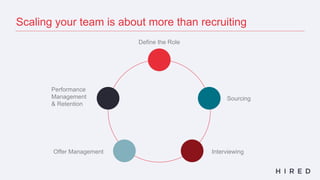
Scaling your team is about more than recruiting
Define what you need…
so you know when you find it
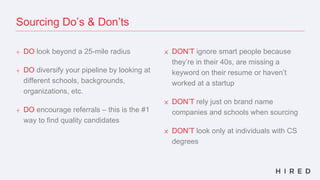
Sourcing Do’s & Don’ts
+ DO look beyond a 25-mile radius
+ DO diversify your pipeline by looking at
different schools, backgrounds,
organizations, etc.
+ DO encourage referrals – this is the #1
way to find quality candidates
× DON’T ignore smart people because
they’re in their 40s, are missing a
keyword on their resume or haven’t
worked at a startup
× DON’T rely just on brand name
companies and schools when sourcing
× DON’T look only at individuals with CS
degrees
Sourcing Do’s & Don’ts
Interviewing
A structured approach to
solving your #1 problem
Topgrading
Source: Ere.net
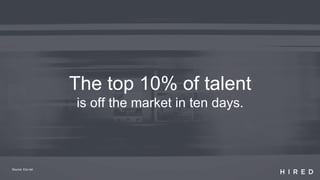
The top 10% of talent
is off the market in ten days.
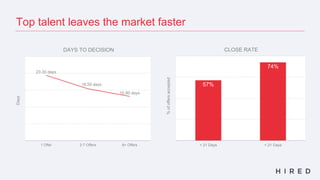
23.30 days
18.50 days
15.80 days
1 Offer 2-7 Offers 8+ Offers
Days
57%
74%
> 21 Days < 21 Days
%ofoffersaccepted
DAYS TO DECISION CLOSE RATE
Top talent leaves the market faster
o The companies that make decisions faster win
more often
o If your time-to-hire averages more than 16 days,
you are likely too slow for half the best talent
o Never reschedule on a candidate or let your
schedule dictate the speed of the process
o When a candidate ends a process before your
organization has made a decision, that means
your hiring process has wasted resources
o Streamlining your interview process has to come
from the top
o As your company grows, not everyone on the
team can meet every candidate; hire good people
and trust them to hire more good people
o Get used to talking money upfront otherwise
you risk going through an entire interview process
just to find out that you’re not aligned on
compensation
The best hiring processes are the fastest
o The phrase “Culture Fit” can open the
door for misinterpretation and biases
o Focus instead on finding people who are
a “Culture Add”
o You want people who are going to bring
something new to the table; your
company shouldn’t look the same at 300
people as it did at 30
o Culture is about a set of shared
values, so the first step towards creating
interview questions is to write down your
company values
o Good: Tell me about a time when you
learned a new skill. Tell me about the
last time you took a risk and what you
learned from it.
o Bad: What do you like to do on the
weekend?
Culture interviews
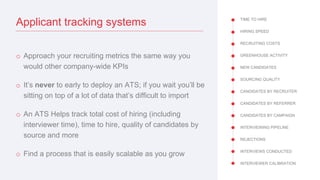
TIME TO HIRE
HIRING SPEED
RECRUITING COSTS
GREENHOUSE ACTIVITY
NEW CANDIDATES
SOURCING QUALITY
CANDIDATES BY RECRUITER
CANDIDATES BY REFERRER
CANDIDATES BY CAMPAIGN
INTERVIEWING PIPELINE
REJECTIONS
INTERVIEWS CONDUCTED
INTERVIEWER CALIBRATION
Applicant tracking systems
o Approach your recruiting metrics the same way you
would other company-wide KPIs
o It’s never to early to deploy an ATS; if you wait you’ll be
sitting on top of a lot of data that’s difficult to import
o An ATS Helps track total cost of hiring (including
interviewer time), time to hire, quality of candidates by
source and more
o Find a process that is easily scalable as you grow
Performance management
& retention
Hiring is only half the battle
o One of the keys to management and retention is having the right HR
resources
o You can recruit 100 amazing people in a year, but if you don’t have systems
in place for retention, career growth, etc. you’re going to eventually lose
many of them
o If you have 40-50 people it’s likely time for Director of HR who can serve as
a partner to the hiring team
o Don’t fall into the trap of using a PEO for too long
Things HR can do
o Compensation Philosophy (i.e. 90th percentile)
o Promotion policies (frequency, criteria)
o Cultural Committee
o Training for Jr. Managers & Employees
o Headcount & Hiring Plans
o Salary Banding for Open Roles
o Benefits & Perks, Vacation Policies
o Communicate Policies, Compliance
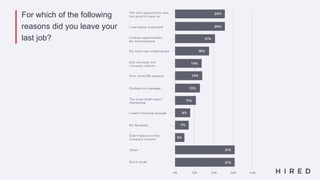
For which of the following
reasons did you leave your
last job?
Questions?
mehul@hired.com

Scaling to 100+ Employees

  • 1.
    Scaling to 100+employees
  • 2.
  • 3.
    Define the Role Sourcing Performance Management &Retention Offer Management Interviewing Scaling your team is about more than recruiting
  • 4.
    Define what youneed… so you know when you find it
  • 5.
  • 6.
    + DO lookbeyond a 25-mile radius + DO diversify your pipeline by looking at different schools, backgrounds, organizations, etc. + DO encourage referrals – this is the #1 way to find quality candidates × DON’T ignore smart people because they’re in their 40s, are missing a keyword on their resume or haven’t worked at a startup × DON’T rely just on brand name companies and schools when sourcing × DON’T look only at individuals with CS degrees Sourcing Do’s & Don’ts
  • 7.
  • 8.
    A structured approachto solving your #1 problem Topgrading
  • 9.
    Source: Ere.net The top10% of talent is off the market in ten days.
  • 10.
    23.30 days 18.50 days 15.80days 1 Offer 2-7 Offers 8+ Offers Days 57% 74% > 21 Days < 21 Days %ofoffersaccepted DAYS TO DECISION CLOSE RATE Top talent leaves the market faster
  • 11.
    o The companiesthat make decisions faster win more often o If your time-to-hire averages more than 16 days, you are likely too slow for half the best talent o Never reschedule on a candidate or let your schedule dictate the speed of the process o When a candidate ends a process before your organization has made a decision, that means your hiring process has wasted resources o Streamlining your interview process has to come from the top o As your company grows, not everyone on the team can meet every candidate; hire good people and trust them to hire more good people o Get used to talking money upfront otherwise you risk going through an entire interview process just to find out that you’re not aligned on compensation The best hiring processes are the fastest
  • 12.
    o The phrase“Culture Fit” can open the door for misinterpretation and biases o Focus instead on finding people who are a “Culture Add” o You want people who are going to bring something new to the table; your company shouldn’t look the same at 300 people as it did at 30 o Culture is about a set of shared values, so the first step towards creating interview questions is to write down your company values o Good: Tell me about a time when you learned a new skill. Tell me about the last time you took a risk and what you learned from it. o Bad: What do you like to do on the weekend? Culture interviews
  • 13.
    TIME TO HIRE HIRINGSPEED RECRUITING COSTS GREENHOUSE ACTIVITY NEW CANDIDATES SOURCING QUALITY CANDIDATES BY RECRUITER CANDIDATES BY REFERRER CANDIDATES BY CAMPAIGN INTERVIEWING PIPELINE REJECTIONS INTERVIEWS CONDUCTED INTERVIEWER CALIBRATION Applicant tracking systems o Approach your recruiting metrics the same way you would other company-wide KPIs o It’s never to early to deploy an ATS; if you wait you’ll be sitting on top of a lot of data that’s difficult to import o An ATS Helps track total cost of hiring (including interviewer time), time to hire, quality of candidates by source and more o Find a process that is easily scalable as you grow
  • 14.
  • 15.
    Hiring is onlyhalf the battle o One of the keys to management and retention is having the right HR resources o You can recruit 100 amazing people in a year, but if you don’t have systems in place for retention, career growth, etc. you’re going to eventually lose many of them o If you have 40-50 people it’s likely time for Director of HR who can serve as a partner to the hiring team o Don’t fall into the trap of using a PEO for too long
  • 16.
    Things HR cando o Compensation Philosophy (i.e. 90th percentile) o Promotion policies (frequency, criteria) o Cultural Committee o Training for Jr. Managers & Employees o Headcount & Hiring Plans o Salary Banding for Open Roles o Benefits & Perks, Vacation Policies o Communicate Policies, Compliance
  • 17.
    For which ofthe following reasons did you leave your last job?
  • 18.

Editor's Notes

  • #2 You can give a very brief overview of Hired here, but in line with the organizers’ request – no sales pitch.
  • #3 Now that I’ve given you a quick overview of Hired, I’d like to talk about how you can compete for talent in today’s market. The insights in this deck are pulled from our platform and the experience we’ve had helping thousands of individuals get matched with awesome job opportunities. And one of the lessons we’ve learned is that most companies really suck at hiring.
  • #4 It’s important to note that scaling your team isn’t just about recruiting. There are multiple stages that you need to think about.
  • #5 One of the first things you need to think about is the job description. If you dive right into the interview process with only a vague idea of what you’re looking for you’re ultimately going to waste your time and the candidates’ time.
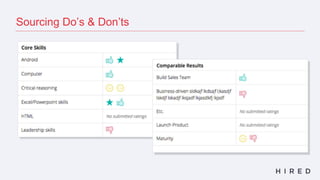
  • #6 We create scorecards like this for every role at Hired. The hiring manager creates a focus area and a set of questions that map to that focus area so that the candidate isn’t getting the same questions over and over. Using a scoring rubric like this helps to a) make the interview process more structured b) eliminate bias from the process and c) ensure that you mapping questions AND feedback to the job requirements.
  • #7 Here are just a few of the most important do’s and don’t’s when it comes to finding people. Talk about Hired’s referral program – what we do at orientation, how we share hot open jobs with employees, our referral incentive program. Mention that 40% of our employees are referrals. Talk about how building a diverse pipeline can help build diversity in your workforce. If everyone in your company comes from the same few schools, employers, etc. you are doing yourself a disservice. Your best ideas are going to come from the most unexpected places.
  • #9 These books form the foundation of hiring… All our interview reports are based on data gathered during these structured interviews. Everybody in the company has a copy of the book
  • #10 SPEED matters. Great people have options.
  • #11 Looking at this slide you can see why speed in hiring process is so important— top talent is coming off the market at a much faster rate than their peers. Looking at the graph on the left you can see that if it takes you 15-20 days to make a decision you’re going to miss the majority of the most in-demand engineers (indicated here by the number of offers they received). Looking at the graph on the right, you can see that offers that are made within 21 days from initial contact close at a much higher rate than those that don’t.
  • #12 If you prioritize interviews then your team will. Scheduling is one of the biggest things that can bog down the process. As a founder or CEO one of your most important jobs is to get your team rallied around the idea that recruiting is one of the most important things you do.
  • #13 You can use this slide to talk about diversity and how the interviewing process is a good way to build diversity into your company. Emphasize that you can start small – diversity of thought, of background, etc. can be equally powerful.
  • #14 Talk about some of the options here – Greenhouse, Lever, etc. You can talk about our experience using Greenhouse and what the process was like to choose them. Emphasize that even at 3-5 employees, it’s never too early to get an ATS so you can start tracking who you interview and keep track of people who might be a fit for other roles down the line. Implementing an ATS can slow donw your hiring processes, so if you wait until you have a larger team, you’re doing yourself a disservice. The worst thing you can do is keep everything in Google docs.
  • #16 HR has gotten a bad wrap – many people think of it just as a cost center or a paper pusher, but the reality is that a good HR person/team can help you put processes in place to keep your employees happy. Recruiting is really just one side of the coin – you need to balance both hiring and retention. If you get to 40 people, you need a full time HR person. Otherwise you start accruing “human debt” which is just dangerous as technical debt.
  • #18 This is data from a recent survey of full-time employed adults that we commissioned with Harris Interactive. What’s interesting here is that many of these things – including the first five reasons – can be proactively addressed with a good HR program.